International Journal of Engineering
J o u r n a l H o m e p a g e : w w w . i j e . i r
A Two Stage Heuristic Solution Approach for Resource Assignment during a Cell
Formation Problem
M. Bashiri*, M. Bagheri
Department of Industrial engineering, University of Shahed, Tehran, Iran.
P A P E R I N F O
Paper history: Received 24 October 2012
Received in revised form 03 April 2013 Accepted 18 April 2013
Keywords:
Cellular Manufacturing System Clustering
Cell Formation Operator Assignment Linearization
A B S T R A C T
Design of Cellular Manufacturing System (CMS) involves four major decisions: Cell formation (CF), Group layout (GL), Group scheduling (Gs) and Resource assignment (RA). These problems should be regarded, concurrently, in order to obtain an optimal solution in a CM environment. However; solving complexity by simultaneous consideration of these problems will be increased. In order to over come this difficulty, in this paper a two stage heuristic procedure is proposed for CF and RA decision problems. The solution approach contains a heuristic multivariate clustering technique as the first stage to find the best machine-cluster center distances. Next in the second stage a new mathematical model based on extracted distances and also worker related issues including salary, hiring, firing and cross-training is proposed. In order to verify and validate the performance of proposed approach a mathematical model considering the inter-intra cell part trips and also operator related issues are developed and some numerical examples are solved using Lingo Software. Moreover, the necessity of simultaneous consideration of CF and RA is investigated. The analysis of results verifies the solution approach in both optimality and computational time aspects.
doi:10.5829/idosi.ije.2013.26.09c.02
1. INTRODUCTION 1
Cellular manufacturing system (CMS) is an innovative manufacturing strategy and an application of the group technology (GT) concept which can be used in order to increase both flexibility and efficiency of manufacturing systems in today’s competitive environment. Some advantages of CMS implementation are quality and efficiency improvement, material handling cost reduction, work in process inventory reduction, setup cost reduction and etc. A CMS design problem includes four main steps.
(1) Cell formation (CF): grouping machines and parts into manufacturing cells in order to achieve some objectives such as inter-cell part trips reduction. (2) Group layout (GL): determining the optimal layout
of machines and cells within cells and shop floor, respectively.
(3) Group scheduling (GS): determining the sequence of parts within manufacturing cells to minimize some objectives such as tardiness and makespan.
*Corresponding Author Email:[email protected] (M. Bashiri)
(4) Resource assignment (RA): assigning the workers and other manufacturing recourses to machines and cells resulting in production efficiency improvement.
In order to reach a practical solution in a cellular envirenmnet these decisions should be regarded concurrently. Accordingly, many studies have been conducted to design a CMS in recent years. These studies can be classified into following categories:
problem by attention to minimization of cell load variation. Jabal-Ameli and Arkat [3] have proposed a pure integer mathematical model to solve the cell formation problem considering machine reliability and alternative process routing. Their research shows that the reliability consideration has significant impacts on the overall system efficiency. Furthermore, the integration of the cell formation problem with production planning and system reconfiguration is investigated by Kioon et al. [4]. Tavakkoli-Moghaddam et al. [5] have developed a model for facility layout problem in CMS with stochastic demands. The main goal of objective function is to minimize inter-cell and intra-cell part trips. Moreover, a comprehensive mathematical model have been proposed by Tavakkoli-Moghaddam et al. [6]. The fuzziness and uncertainty concepts have been study in their research, where its objectives are minimization of total machines and parts costs, maximization of preference level of the decision making (DM) and balancing the intracellular workload. Tavakkoli-Moghaddam et al. [7] proposed a new mathematical model to solve the inter-intra cell layout problem in the presence of stochastic demands. In their research it is assumed that the predefined cell formation structure is as an input of the inter-intra cell layout problem.
However, considering many production elements in a mathematical programming model results in increasing the complexity of the problem. In the other words, obtaining optimal solution using mathematical programming techniques is almost intractable due to the combinatorial complexity of the CMS problem.
1. 2. Artificial Intelligence (AI)-based Techniques
The main strategy of these methods is searching the solution space in such a way that an optimal or near to optimal solution can be found in a reasonable computational time. These methods can be implemented in many large scale cellular manufacturing problem solving algorithms. The main algorithms used in this area are: Genetic Algorithm (GA), Artificial Neural Network (ANN), Simulated Annealing (SA), Tabu Search (TS) and recently Imperialist Competitive Algorithm (ICA).
For example Wu et al. [8] have proposed a water flow- like algorithm to solve the cell formation problem. Their meta-heuristic solution approach has been verified in both solution effectiveness and efficiency aspects in comparison with other solution methods proposed in literature. A multi objective particle swarm optimization algorithm has been applied by Tavakkoli-Moghaddam et al. [9] to solve a multi objective cellular manufacturing system where its objectives are optimal labor allocation and maximization of cell utilization.
Also a multi-objective mathematical model has been developed by Zhao and Wu [10]. The objectives of their proposed model are minimization of cell load variation,
total inter-intra cell part trips and total number of exceptional elements. Because of the complexity of given problem, they also have implemented a genetic algorithm to solve the problem. Chen and Srivastava [11] have introduced a quadratic programming model for CMS. Their model’s objective was sum of machine similarities within cells maximization. They also implemented a simulated annealing algorithm to solve the model. Also, Kia et al. [12] have proposed a simulated annealing approach to solve the cell formation and inter-intra cell layout problems, simultaneously. Arkat et al. [13] proposed two mathematical models to design a CMS. The first proposed model was based on the integration of CF and group layout problems. The second model was extension of the first model by incorporating the group scheduling problem in order to improve the total system efficiency. Krishnan et al. [14] have investigated the inter-intra cell layout problem in a CM environment. Their research includes three basic steps; at first a mathematical model has been proposed for grouping the machines into cells in order to minimize the inter-cell part total movements. The second step addresses two heuristic procedures to grouping the parts into cells based on machine grouping solution. At last a genetic algorithm has been implemented to determine the best inter-intra cell layout. Also Jolai et al. [15] proposed an electromagnetism- like meta-heuristic to solve the cell formation problem integrated with the inter-intra cell layout. Tavakkoli-Moghaddam et al. [16] have developed a dynamic cell formation problem. Three basic meta-heuristics including genetic algorithm, simulated annealing based method and Tabu search were implemented to solve the model and then introduced approaches have been compared to each other. Despite of ability to find the solutions with little computational effort, these approaches can’t reach the optimal solutions in most cases.
numerical examples with respect to proposed clustering approach. However their work can’t be implemented in a framework integrated with other decisions of CMS. Rogers and KulKarni [20] developed a mathematical model to solve the cell formation problem using a bi-variate clustering approach. Despite the ability of their proposed method in obtaining good solutions, the operation sequence is not considered in their research as an essential production parameter.
1. 4. Resource Assignment in Cellular Manufacturing System In every industrial plant, operators as main production resources play an essential role in increasing the total manufacturing efficiency. Hence, incorporating the operator related issues in cellular manufacturing system design is today’s necesity of managers decisions. There are also some studies in literuture which consider the operator assignment problem in a CM environment. Satoglu and Suresh [21] proposed a goal programming technique to solve a hybrid CMS. Their proposed paper included three steps. First, the parts with erratic demands should be selected as special parts. These parts should be processed in a functional layout of the shop floor because of their erratic demands which can affect the overall system efficiency. At the second step, they proposed a mathematical model to solve the cell formation problem and at last according to this machine-cell framework, operator assignment problem was solved using a goal programming technique. Mahdavi et al. [22] solved the cell formation problem integrating with production planning and worker assignment in a dynamic environment. Also, minimization of holding and backorder costs, inter-cell
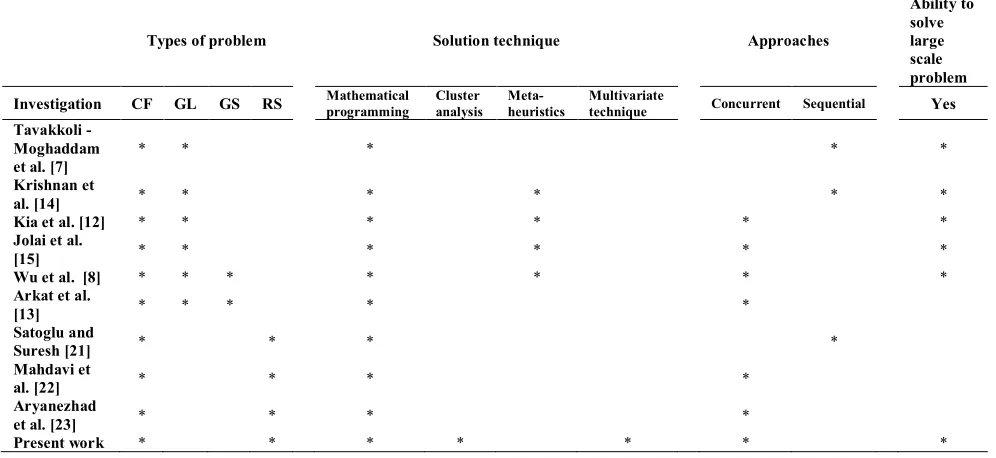
material handling cost, machine and reconfiguration costs and hiring, firing and salary costs have been considered in their proposed mathematical model. Furthermore, Aryanezhad et al. [23] developed a new model to deal with solving the cell formation and operator assignment problems concurrently. Part routing flexibility, machine flexibility and also promotion of workers from one skill level to another have been considered. However because of complexity of the given problem, solving their model in a reasonable computational time is almost intractable. Table 1 summarizes previous recent studies which have dealt with two or three aspects of CMS problems and their sequential or simultaneous approaches and also solution method. The last column of this table shows the capabilities of proposed methods to solve the large scale problems which is an essential parameter for studies to be used in industiral plants.
According to Table 1, it can be realized that a few studies have investigated the human-machine interactions in a cellular envirenment. However; there is not any study which can consider both optimality and capability in solving large scale problems, simultaneously. Actually operator assignment and cell formation problems should be regarded concurrently in order to obtain an optimal cellular manufacturing design. Moreover; according to the recent studies solving cell formation and operator assignment problems simultaneously, specially for large scale problems, in a reasoanble computational time is almost intractable and proposing new heuristics and meta-heuristics to overcome this difficulty will be valuable. This paper tries to fill the gap.
TABLE 1. The summary of literature review
Types of problem Solution technique Approaches
Ability to solve large scale problem
Investigation CF GL GS RS Mathematical programming Cluster analysis Meta-heuristics Multivariate technique Concurrent Sequential Yes
Tavakkoli -Moghaddam
et al. [7] * * * * *
Krishnan et
al. [14] * * * * * *
Kia et al. [12] * * * * * *
Jolai et al.
[15] * * * * * *
Wu et al. [8] * * * * * * *
Arkat et al.
[13] * * * * *
Satoglu and
Suresh [21] * * * *
Mahdavi et
al. [22] * * * *
Aryanezhad
et al. [23] * * * *
The main contribution of presented paper is proposing a new two stage heuristic solution technique to solve the cell formation and worker assignment problems, simultaneously. At the first stage a heuristic multivariate clustering technique is applied to solve the cell formation problem. Optimal solution is considered as a candidate solution for the second stage. Actually distances between machines and cluster centers are counted to be incorporated as candidate cell formation solution in the next stage. A new mathematical model considering the worker related issues including salary, training cost, hiring and firing costs is proposed for the second stage. Also, by considering distances between machines and clusters which are obtained by clustering technique, the cell formation and worker assignment problems are solved, concurrently.
The presented heurisitic approach has an essential advantage. The mathematical model obtained by implementing this approach is a simple linear model which can be solved by Branch and Bound (B&B) method in a reasonable computational time specially for large size problems despite of previous studies. However, in order to validate the performance of the given approach, a non-linear mathematical model considering the inter-intra cell part trips and operator related issues is developed and some numerical examples are solved and compared.
2. PROPOSED APPROACH
The proposed solution approach consists of two main steps. As a first stage a multivariate clustering algorithm is proposed based on machine-part incidence matrix and also the operation sequence for each part type. The main objective of this step is grouping the machines into cells in an efficient way and determining the machine-cell distances. Total inter-cell part trips should be minimized through implementing this approach. Next, a new mathematical model is proposed considering the operator related issues such as salary, cross-training, hiring and firing costs. The distances determined in the previous step are used to find the optimal solution according to the interrelation between cell formation and worker assignment problems.
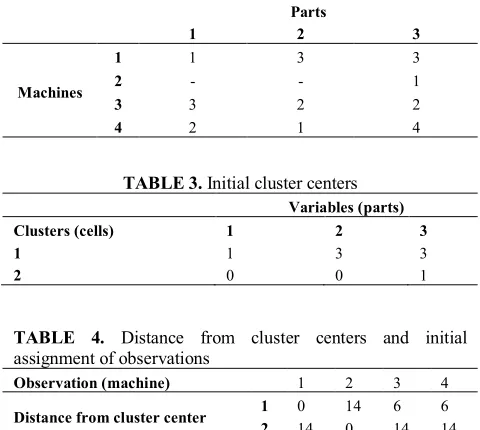
2. 1. A Multivariate Clustering Technique Applied to Machine Grouping Problem The first step in designing a cellular manufacturing system is cell formation problem in which parts and machines should be grouped into production cells in order to satisfy some objectives such as exceptional elements minimization. In this study we present a multivariate technique to solve the machine grouping problem. The proposed solution method can be described by an example. A part-machine incidence matrix is shown in Table 2. In this
table, aij is the operation number of part j which should be processed on machine i.
For example, in order to process part number 3, operations 1-4 should be performed on machines 2, 3, 1 and 4, respectively. Suppose that there exist 2 cells with machine capacity of 2 and the machines should be assigned to these cells. For instance, for part 1 it is desirable that machines 1 and 4 be located in the same group. However, considering part 2, machines 3 and 4 should be grouped into a same cell which is not consistent with the previous grouping related to part 1. So, a consistent clustering approach can be used for this purpose. The basic aim of cluster analysis is to assign n objects (machines) to K mutually exclusive groups (cells) considering all the variables (parts) while minimizing some measures of distance or dissimilarity. In order to describe the proposed algorithm, the demonstrated example in Table 1 is solved as follows:
First, machines 1 and 2 are selected, randomly, as initial centers of clusters (cells). Squared Euclidean distance is a common used measure. Generally, square Euclidean distance of points a and b in an n-dimension space is calculated as Equation (1):
2 ,
1
( )
n
a b i i
i
dis a b
=
=
å
- (1)Table 4 illustrates cluster centers and also the squared Euclidean distances between all machine-cell pairs and the assignments are shown in Table 3. For example, the minimum distance value between machine 3 and two cluster centers is 6 which is relevant to the first cluster, so machine 3 should be assigned to the first cluster.
TABLE 2. The machine-part incidence matrix considering operation sequence
Parts
1 2 3
Machines
1 1 3 3
2 - - 1
3 3 2 2
4 2 1 4
TABLE 3. Initial cluster centers
Variables (parts)
Clusters (cells) 1 2 3
1 1 3 3
2 0 0 1
TABLE 4. Distance from cluster centers and initial assignment of observations
Observation (machine) 1 2 3 4
Distance from cluster center 1 0 14 6 6
2 14 0 14 14
Next, the new cluster centers should be recomputed, given in Table 5. To calculate the new value as a center of the cluster, the mean of machines existing in corresponding cluster for each variable is calculated as Equation (2). This algorithm is a non hierarchical clustering algorithm. The details of this kind of algorithm is described by Sharma [24].
1, ,
m ji j j c c i
a cen ter
m
= Î
=
å
(2)where centerc,i is the center of cluster c for variable i. ji
a
is the process sequence of part i which machine j is assigned to cluster c for variable i and finally m is total number of machines in cluster c. Also, this table reports diffrent cluster centers in different algorithm steps. Since there are two changes which is greater than convergence criterion (0.05), the algorithm should be repeated again by computing the machine-cluster centers distances. After a repeat of algorithm and because of reaching the stopping condition, the optimal machine-part clustering solution which is demonstrated in Table 6 is obtained. Hence, the entire algorithm can be described as follows:1. Number of cells k
2. Select k machines randomly and assign each of them to a cell, respectively.
3. Determine the centers of each cluster using Equation (2).
4. Determine the squared Euclidean distances of each machine from each cell using Equation (1).
5. Find the minimum distance for each machine and assign it to the corresponding cell.
6. Compute the center of each cluster and determine the change in center values.
7. If the change in the center of a cluster with respect to at least one variable (part) is greater than the convergence criterion, go to 4, otherwise go to 8. 8. Determine the squared Euclidean distance of each
machine from each cell. 9. End
TABLE 5. Cluster centers (change in cluster centers)
Variables (parts)
1 2 3
Clusters (cells) 1 2, (1) 2, (1) 3, (0)
2 0, (0) 0, (0) 1, (0)
TABLE 6. The optimal machine grouping solution
Cluster
1 2
Machines
1 1 -
2 - 1
3 1 -
4 1 -
2. 2. Considering the Operator Related Issues in CMS Design There are two main strategies to incorporate the operator related issues such as salary, training, hiring and firing costs in a CMS design problem. The first strategy is solving the problem sequentially. In this approach it is assumed that the cell formation problem is solved as a first stage and then its solution provides a framework to solve the operator assignment problem. As discussed before, cell formation and resource assigment are interrelated and should not be treated as independent problems.
The second strategy tries to optimize mentioned stages simultaneously and seems that it is a suitable approach. However the main deficiency of this strategy is its solving complexity. The main contribution of presented paper is reducing this complexity through introducing a new two stage heuristic method. The proposed mathematical model which is based on the second strategy considers the operator and cell formation related issues, simultaneously.
Since it considers the cell formation solution obtained by multivariate technique as candidate solution, the complexity of solving is considerably less than existing mathematical models. The crucial assumptions of the proposed model are as follows:
1- An operator can be assigned to only one cell in each period.
2- An operator can be assigned to more than one machine based on his/her skill.
3- An operator can be trained to learn new skills to work with other machines. Training cost for each operator is different based on his/her abilities. 4- Training is performed before a production period
and is assumed that it takes zero time.
2. 2. 1. Notation Indices and their relative upper bounds
I Number of machines
J Number of parts
C Number of machine cells
OPj Number of operations required by part j
K Number of available operators
i Index for machines (i =1,..,I )
j Index for parts (j =1,..,J)
c Index for machine cells (c =1,..,C)
d Index for operations required in each part
(d =1,..,OPj)
Input parameters
ki
a Training cost for operator k to achieve machine i skill
j
D Demand of part j
ic
dis Distance between machine i and the center of cluster c
jd
W Processing time of operation d of part j
ki
Sa Salary for operator k to work with machine i (per hour)
k
H Hiring cost of operator k
k
F Firing cost of operator k
, c c
u l The upper and lower machine capacity for cell c
,
i i
u l The maximum and minimum number of operators required by machine i
, k k
u l The maximum and minimum number of machines which can be assigned to operator k
minh Minimum number of operators should be hired
p
l Importance factor of objective function p
1; If operation of part is processed by machine 0; Otherwise
jdi
d j i
P = íì î
1; If operator is unable to work with machine 0; ì = í î ki k i Z Otherwise Decision variables
1; If machine is assigned to cell 0; ic i c X Otherwise ì = í î
1; If operator hired 0;
k
k should be h
Otherwise ì
= í î
1; If operator is assigned to machine
0; ki k i r Otherwise ì = í î
1; If operator is assigned to cell
0; kc k c S Otherwise ì = í î
2. 2. 2. Mathematical Models
2.2.2.1. The Model Based on the Proposed Solution Method: Model 1
The 0-1 nonlinear programming model for the CMS design is presented as follow:
( )
1
1 1 1
1
1 1 1 1
2 1 1
m in 1
(
(1 )
)
j
C I K
k ki ic kc ki ki c i k
K
k k k k
k O P
J I K
jdi j jd ki ki j d i k
I C
ic ic i c
O B
h r X S Z a
h H h F
P D W r Sa
dis X l l = = = = = = = = = = = + + -+ +
å å å
å
å å å å
å å
(3-1) (3-2) (3-3) (3-4) Subjected to: 1 1 1 1 ; ; ; C ic c I ic c i I ic c i X iX u c
X l c
= = = = " £ " ³ "
å
å
å
(4) (5) (6) 1 min k K k h h = ³å
(7) , ; ki kr
£h
"k i
(8), ;
kc k
S £
h
"k c
(9)1
;
kc k
C
c
S h
k
= = "
å
(10) 1 ; = £ "å
K ki ik
r u i (11)
1
;
=
³ "
å
K ki ik
r l i (12)
1
;
=
£ "
å
I ki k ki
r u h k (13)
1
;
=
³ "
å
I ki ki
r l k (14)
1
, =
£
å
C "ki ic kc c
r X S k i (15)
{ }
, , Î 0,1
r S X (16)
2.2.2.2. A Classical Model Based on the Inter-Intra Cell Part Trips: Model 2 In order to evaluate the proposed method’s efficiency, a mathematical model based on the inter-intra cell part trips and also operator related issues is formulated as follows. It will be compared to the previous model for better analysis.
1 1 1 1
1
1 1 1 1 1
2 ( 1)
1 1 1 1 1 1
1 1 1
min 2
(
( (1 ) )
)
( max( 1,0)
ma
j
i
i
C I K
k ki ic kc ki ki c i k
K
k k k k
k OP J I K
jdi j jd ki ki j d i k
OP
J I I C C
j jdi j d i ic i c j d i i c c c
OP
J C
j j d c
OB
h r X S Z a
h H h F
P D W r Sa
D P P X X
D l l = = = = = = = = -¢ ¢ ¢ + ¢ ¢ = = = = = = -= = = = + + -+ + + -+
ååå
å
åååå
å å åååå
å å å
( 1)1 1
x(I jdi ic I j d i ic 1, 0))
i i
P X P + X
= = +
-å
å
(3-1) (3-2) (3-3) (3-5) (3-6) Subjected to:Constraints (4) – (16).
The differences between these two models are related to terms of (3-5) and (3-6) which minimize the intra and inter cell part trips, respectively.
2. 2. 3. Linearization
2.2.3.1. Linear model for the proposed Model 1
The first mathematical model proposed in this paper is a non-linear model because of terms (3-1) and constraint (16). In order to achieve a linear model by minimum number of required constraints, the following technique has been employed [25]:
Consider the 0-1 term Z =X1´X2´ ´... Xn where Xi(
1,..,
i= n) is a binary variable. It is obvious that Z can be 1 if and only if all the variables are 1 and otherwise it must be 0. Considering this mathematical point, the nonlinear term in objective function or constraint can be replaced by the new variable Z considering following auxiliary constraints: 1 1,.., ( 1) i n i i
Z X i n
Z X n
=
£ " =
³
å
--So, for linearization of the proposed model 1, new binary variables XSikc, Qikcare defined instead of the nonlinear terms as stated below:
, , ; ikc ic kc
XS =X S "i k c
, , . ikc k ki ikc
Q =h r XS "i k c
By considering these equations, the following auxiliary constraints should be added to the proposed model 1:
, ,
, ,
1 , ,
, ,
, ,
, ,
2 , ,
ikc ic
ikc kc
ikc ic kc
ikc k
ikc ikc
ikc ki
ikc k ikc ki
XS X i k c
XS S i k c
XS X S i k c
Q h i k c
Q XS i k c
Q r i k c
Q h XS r i k c
£ "
£ "
³ + - " £ "
£ " £ "
³ + + - "
(17) (18) (19) (20) (21) (22) (23)
Thus, the final version of the linear 0-1 programming model can be presented as follows:
1
1 1 1
1
1 1 1 1
2 1 1
m in 1
(
( (1 ) )
)
j
C I K
ikc ki k i c i k
K
k k k k
k OP
J I K
jdi j jd ki ki j d i k
I C
ic ic i c
O B
Q Z a
h H h F
P D W r S a
dis X l l = = = = = = = = = = = + + -+ +
å å å
å
å å å å
å å
(3-5) (3-2) (3-3) (3-4) Subjected to:Unaltered set constraints (4) – (14), new auxiliary constraints (17) – (23) and also:
Set constraint (15) is replaced by the following one:
1
,
ki ikc
C
c
r XS k i
=
£
å
" (24)Set constraint (16) is replaced by:
{ }
, , , , Î 0,1
r S X XS Q (25)
2.2.3.2. Linear Model for the Proposed Model 2
In model 2 all mentioned changes of model 1 should be done, moreover some other changes should be implemented to have a linear model. It is clear that added constraints in this model make it more time consuming in the solution stage. The max function in terms (3-5) and (3-6), can be linearized by replacing an additional variable and two auxiliary constraints. So, let define new binary variables Mii cc¢ ¢and Njdc which are replaced by following equations:
( 1)
1 1
max( 1, 0) , , ,
max( 1, 0) , ,
ii cc ic i c
I I
jdc jdi ic j d i ic
i i
M X X i i c c
N P X P X j d c
¢ ¢ ¢ ¢
+
= =
¢ ¢
= + - "
=
å
+å
- "Again six following auxiliary constraints should be added to proposed model to have a linear form:
1 , , ,
ii cc ic i c
M ¢ ¢³X +X ¢ ¢- "i i c c¢ ¢ (26)
0 , , ,
ii cc
( 1)
1 1
1 , ,
+
= =
³
å
I +å
I - "jdc jdi ic j d i ic
i i
N P X P X j d c (28)
0 , ,
jdc
N ³ "j d c (29)
Thus, the final version of the linear 0-1 programming model of non-linear model 2 can be presented as follows:
1
1 1 1
1
1 1 1 1
1
2 ( 1)
1 1 1 1 1
1
1 1 1
min 2
(
( (1 ) )
)
(
) j
i
i
C I K
k ki ic kc ki ki
c i k
K
k k k k
k OP
J I K
jdi j jd ki ki
j d i k
OP
J I I C C
j jdi j d i ii cc
j d i i c c c
OP
J C
j jdc
j d c
OB
h r X S Z a
h H h F
P D W r Sa
D P P M
D N l
l
= = =
=
= = = =
-¢ ¢ ¢
+
¢ ¢
= = = = = =
-= = =
=
+ +
-+
+
ååå
å
åååå
å å åååå
å å å
(3-1)
(3-2)
(3-3)
(3-7)
(3-8)
Subjected to:
Unaltered set constraints (5)– (14), (24), auxiliary constraints (17) – (23), (26-29) and also:
Set constraint (16) is replaced by:
{ }
, , , , , , 0,1r S X XS Q M NÎ (30)
It is clear that model 2 has more constraints and variables comparing to model 1. In the next section some numerical examples are solved to evaluate the performance of the proposed models.
3. NECESSITY OF SIMULATANEOUS CONSIDERATION DIFFERENT DECISIONS IN CMS
The objective function of the proposed mathematical model consists of two basic costs. The first one is related to the machine-cell distances cost (term 3-4). The second one is related to operator related issues and includes training cost (term 3-5), hiring and firing cost (term 3-2) and salary cost (term 3-3). In order to analyze the operator-machine interactions more precisely, these two basic costs are named as f1 and f2, respectively. Based on this definition let consider three separate models as follows:
Model 3:
Minimize f1=Summation of term (3-4) Subjected to: constraints 4 to 6, 25
Model 4:
Minimize f2 = Summation of terms (3-5), (3-2), (3-3) Subjected to: constraints 7 to 14, 17 to 23, 24 to 25
Model 5:
Minimize OB1= Summation of f1 and f2 Subjected to: 4 to 14, 17 to 25
By this decomposition, models 3 and 4 can be treated as separate optimization models which try to optimize the cell formation and operator related costs, respectively. By implementing model 5 which is formulated in this paper, these two decisions can be optimized simultaneously.
In order to verify performance of the proposed model, let define the following notations:
* 1
f The optimal objective value of model 3
* 2
f The optimal objective value of model 4 *
3
f The optimal objective value of model 5
* 13
f The objective value of model 5 which is obtained by replacement of optimal variables of model 3 into model 5.
Aryanezhad et al. [20] suggested a criterion as Equation (31) to calculate the gap of differences between the optimal objective value of model 3 and its objective value obtained by solving model 5:
* * 1 13 * 13
100
-=f f ´
In
f (31)
Also they have shown that * * * 3 £ 1 + 2
f f f . Hence two different conditions can be occurr. If * * *
3 = 1 + 2
f f f
solving models 3 and 4 consecutively, can be a good strategy because of model 5 solving complexity. Actually in this situation In=0 and it means that there is no difference between models 3 and 5 in obtaining an optimal solution for cell formation problem. However, it has been shown that in most cases * * *
3 < 1 + 2
f f f or we can say In>0. In this situation solving model 5 in order to find an optimal solution which satisfies both models 3 and 4 can be selected as a decision strategy. In this study we analyze the operator-machine interactions by this strategy.
4. NUMERICAL ILLUSTRATION
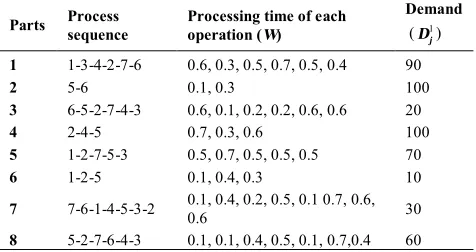
method, the first step is to find the optimal assignment of machines in cells using the clustering multivariate technique described previously. This step is necessary to find the ultimate machine-cluster distances. Table 12 reports the results. Here it is assumed that the transmission of parts between cells is independent of their batch sizes. The extracted distances provide a framework to solve the cell formation and operator assignment problems simultaneously. Mentioned distances were entered to model 1 to achieve this goal.
TABLE 7. The input information of part-machine matrix for the numerical example (instance 3)
Parts Process sequence Processing time of each operation (W) Demand ( 1
j
D)
1 1-3-4-2-7-6 0.6, 0.3, 0.5, 0.7, 0.5, 0.4 90
2 5-6 0.1, 0.3 100
3 6-5-2-7-4-3 0.6, 0.1, 0.2, 0.2, 0.6, 0.6 20
4 2-4-5 0.7, 0.3, 0.6 100
5 1-2-7-5-3 0.5, 0.7, 0.5, 0.5, 0.5 70
6 1-2-5 0.1, 0.4, 0.3 10
7 7-6-1-4-5-3-2 0.1, 0.4, 0.2, 0.5, 0.1 0.7, 0.6, 0.6 30
8 5-2-7-6-4-3 0.1, 0.1, 0.4, 0.5, 0.1, 0.7,0.4 60
TABLE 8. Operators skills in working with different machines (1-Z) for the numerical example (instance 3)
Machine
Operators
1 2 3 4 5 6 7
1 1 0 0 0 0 1 0
2 0 1 0 1 1 0 0
3 1 1 0 0 0 0 0
4 0 0 0 0 0 0 0
5 1 0 0 0 0 0 0
6 0 1 0 0 0 0 1
7 1 1 0 0 0 0 0
8 0 0 0 0 0 1 0
9 1 1 0 0 0 0 0
10 0 1 0 0 0 0 0
TABLE 9. Operators training cost to learn working with different machines (a) for the numerical example (instance 3)
Machine
Operators
1 2 3 4 5 6 7
1 0 7 9 5 6 0 6
2 8 0 9 0 0 4 5
3 0 0 9 4 6 4 6
4 7 6 8 3 6 3 4
5 0 7 8 5 6 4 6
6 6 0 9 4 6 3 0
7 0 0 7 5 6 4 5
8 6 5 9 5 6 0 4
9 0 0 9 4 6 4 6
10 6 0 7 3 6 3 4
TABLE 10. Salary of operators in working with different machines (Sa) for the numerical example (instance 3)
Machine
Operators
1 2 3 4 5 6 7
1 9 5 8 1 7 10 7
2 10 9 4 5 2 6 5
3 2 2 7 4 2 2 4
4 10 5 2 8 5 2 9
5 7 10 8 8 10 3 6
6 1 8 1 2 4 9 6
7 3 10 3 5 6 3 10
8 6 7 1 5 3 9 3
9 10 1 1 7 8 3 8
10 10 9 9 8 3 10 8
TABLE 11. Hiring (H) and firing (F) costs, maximum and minimum number of machines to be assigned for each operator in the numerical example (instance 3)
Hiring cost Firing cost Uk Lk
Operators
1 100 80 3 1
2 100 80 3 1
3 80 60 3 1
4 40 20 3 1
5 30 10 3 1
6 40 20 3 1
7 50 20 3 1
8 50 20 3 1
9 50 20 3 1
10 50 25 3 1
TABLE 12. Distance from cluster centers and machines in an optimal assignment
Distance from cluster centers
Observation
(machine) 1 2 3
Should be
assigned to cluster 1 12.25 51.88 40.25 1
2 33.25 32.22 4.25 3
3 82.25 14.22 53.25 2
4 37.25 10.88 40.25 2
5 39.25 52.55 4.25 3
6 12.25 49.55 48.25 1
7 35.25 14.22 60.25 2
TABLE 13. Optimal operator assignment and machine grouping solution: proposed approach (l1=0.9 ,l2=0.1)
Machines
Operators
1 2 3 4 5 6 7
1 *
2 * *
3 * *
4 * *
5
6 * *
7 *
8 * *
9 * *
10
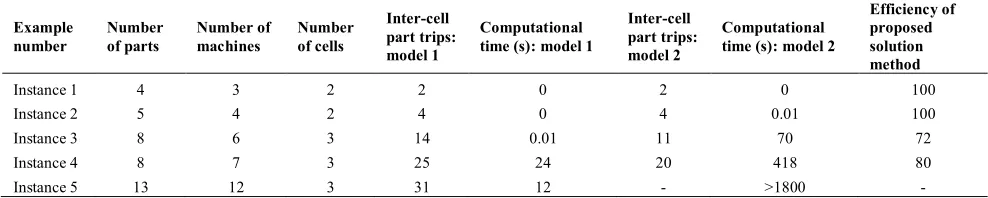
TABLE 14. Comparison between the proposed method and mathematical model 2
Example number
Number of parts
Number of machines
Number of cells
Inter-cell part trips: model 1
Computational time (s): model 1
Inter-cell part trips: model 2
Computational time (s): model 2
Efficiency of proposed solution method
Instance 1 4 3 2 2 0 2 0 100
Instance 2 5 4 2 4 0 4 0.01 100
Instance 3 8 6 3 14 0.01 11 70 72
Instance 4 8 7 3 25 24 20 418 80
Instance 5 13 12 3 31 12 - >1800 -
TABLE 15. Different solutions by different importance factors by simultaneous consideration (instance3)
1 2
( , )l l f1 f2 Total cost
(0.9,0.1) 981.9 210 904.71 (0.8,0.2) 1000.200 101.33 820.42 (0.7,0.3) 1000.500 100.33 730.44 (0.6,0.4) 1000.500 100.33 640.43 (0.5,0.5) 1000.500 100.33 550.41 (0.4,0.6) 1000.500 100.33 460.40 (0.3,0.7) 1065 72.33 370.13 (0.2,0.8) 1065 72.33 270.86 (0.1,0.9) 1065 72.33 171.60*
TABLE 16. Objective values of models 3, 5 and gap criterion (In)
Example number *
1
f *
13
f In criterion (%)
Instance 1 2 2 0
Instance 2 32 113 71 Instance 3 8.5 32 73 Instance 4 72 210 65
The aggregated objective function is sensitive to its initial objectives coefficients and the solutions are dependent to the defined coefficients. We considered 0.9 and 0.1 as importance factors of l l1, 2, respectively. Table 13 reports the operator and machines assignment problems solution by mentioned coefficient values.
It can be realized from Table 13 that operators 5 and 10 will not be employed because of their low firing costs. Although the operator 6 can work with machine 7, the operator 2 is trained to work with it because of operator’s 2 low salary in comparison to operator 6. It is clear that the proposed solution approach can be considered as an effective method to deal with cell formation problem considering operator related issues, simultaneously. The computational time of solving model 1 using Lingo 8 software is 24 seconds. Number of inter cell part trips using this method is 25. Furthermore, considering model 2 shows that its
computational time is 418 seconds. But the number of inter-cell part trips is 20, because the second model minimizes the inter-intra cell part trips as a linear mathematical model despite of proposed solution method which solve the problem by a heuristic approach. For more analysis some other numerical examples were generated to evaluate the performance of the proposed method compared to model 2. Table 14 reports the results. In this table the problem parameters such as number of machines, number of parts, number of operators, processing times and also related costs are generated randomly in hypothetical bounds. According to this table the proposed two stage solution method can obtain the optimum or near to optimum solutions in less computational time in comparison to the aggregated model 2. However, increasing the problem size can affect the optimality of models. In other words if optimization of a large scale problem is desirable the second model can’t be effective. However, the efficiency of the proposed method in finding the optimal solution can be calculated using Equation (31):
(1 S opt) 100%
efficincy
opt
-= - ´ (31)
where S is the solution obtained based on the two stage heuristic approach (Model 1) and opt is the optimum solution found by second mathematical model (model 2).
Table 15 reports various values of importance factors and corresponding objective values obtained for instance 3. According to this table minimum total cost is obtained by considering the importance of coefficient of 0.9 for the second initial objective function. Moreover; operator-machine interactions can be investigated by the data presented in Table 16. In this table, the optimal objective values of *
1
f , * 3
shoud be solved concurrently. However, by applying the multivariate techniqe proposed in this paper the complexity of this model is decreased strictly.
5. CONCLUSION
Simultaneous solving of cell formation and worker assignment problems is an essential issue in order to find an optimal solution for a CMS.
Hence, considering these problems concurrently, results in complexity of problem in such a way that solving the integrated problems in a reasonable computational time especially for large scale problems is almost intracable. In this paper, a new two stage heuristic solution approach is developed. In stege 1 a heuristic multivariate clustering technique is proposed to solve the cell formation problem which minimizes the total inter-cell part trips. The first stage provides a candidate solution for the second stage where a new mathematical model is proposed considering the worker related issues and cell formation problem. The performance of the proposed procedure was verified by solving numerical instances in both computational time and optimality aspects comparing to the alternative aggregated mathematical model. Moreover; necessity of simultaneous consideration of CF and RA is investigated in details. However, there are many other real world production factors such as machine reliability and routing flexibility which can be considered in an extended model. Also, proposing new clustering algortithms under provided framework to increase the total system efficiency is valuable. Integration of two other CMS related decisions including GS and GL with respect to the proposed solution approach can be interesting issues as a future research.
6. REFERENCES
1. Purcheck, G. F., "A mathematical classification as a basis for the design of group-technology production cells", Production
Engineer, Vol. 54, No. 1, (1975), 35-48.
2. Onwubolu, G. and Mutingi, M., "A genetic algorithm approach to cellular manufacturing systems", Computers & Industrial
Engineering, Vol. 39, No. 1, (2001), 125-144.
3. Ameli, M. S. J. and Arkat, J., "Cell formation with alternative process routings and machine reliability consideration", The
International Journal of Advanced Manufacturing
Technology, Vol. 35, No. 7-8, (2008), 761-768.
4. kioon, S. A., Bulgak, A. A. and Bektas, T., "Integrated cellular manufacturing systems design with production planning and dynamic system reconfiguration", European Journal of
Operational Research, Vol. 192, No. 2, (2009), 414-428.
5. Tavakoli-Moghadam, R., Javadi, B., Jolai, F. and Mirgorbani, S., "An efficient algorithm to inter and intra-cell layout problems in cellular manufacturing systems with stochastic demands",
International Journal of Engineering-Materials and Energy
Research Center-, Vol. 19, No. 1, (2006), 67-75.
6. Tavakkoli-Moghaddam, R., Minaeian, S. and Rabbani, S., "A new multi-objective model for dynamic cell formation problem with fuzzy parameters", International Journal of Engineering—Transactions A: Basic, Vol. 21, No. 2, (2008), 159-172.
7. Tavakkoli-Moghaddam, R., Javadian, N., Javadi, B. and Safaei, N., "Design of a facility layout problem in cellular manufacturing systems with stochastic demands", Applied
Mathematics and Computation, Vol. 184, No. 2, (2007),
721-728.
8. Wu, T.-H., Chung, S.-H. and Chang, C.-C., "A water flow-like algorithm for manufacturing cell formation problems",
European Journal of Operational Research, Vol. 205, No. 2,
(2010), 346-360.
9. Tavakkoli-Moghaddam, R., Makui, A., Khazaei, M. and Ghodratnama, A., "Solving a new bi-objective model for a cell formation problem considering labor allocation by multi-objective particle swarm optimization", International Journal
of Engineering-Transactions A: Basics, Vol. 24, No. 3, (2011),
249-257.
10. Zhao, C. and Wu, Z., "A genetic algorithm for manufacturing cell formation with multiple routes and multiple objectives",
International Journal of Production Research, Vol. 38, No. 2,
(2000), 385-395.
11. Chen, W.-H. and Srivastava, B., "Simulated annealing procedures for forming machine cells in group technology",
European Journal of Operational Research, Vol. 75, No. 1, (1994), 100-111.
12. Kia, R., Baboli, A., Javadian, N., Tavakkoli-Moghaddam, R., Kazemi, M., and Khorrami, J., "Solving a group layout design model of a dynamic cellular manufacturing system with alternative process routings, lot splitting and flexible reconfiguration by simulated annealing", Computers &
Operations Research, Vol. 39, No. 11, (2012), 2642-2658.
13. Arkat, J., Farahani, M. H. and Hosseini, L., "Integrating cell formation with cellular layout and operations scheduling", The
International Journal of Advanced Manufacturing
Technology, Vol. 61, No. 5-8, (2012), 637-647.
14. Krishnan, K. K., Mirzaei, S., Venkatasamy, V. and Pillai, V. M., "A comprehensive approach to facility layout design and cell formation", The International Journal of Advanced
Manufacturing Technology, Vol. 59, No. 5-8, (2012), 737-753.
15. Jolai, F., Tavakkoli-Moghaddam, R., Golmohammadi, A. and Javadi, B., "An electromagnetism-like algorithm for cell formation and layout problem", Expert Systems with
Applications, Vol. 39, No. 2, (2012), 2172-2182.
16. Tavakkoli-Moghaddam, R., Aryanezhad, M.-B., Safaei, N. and Azaron, A., "Solving a dynamic cell formation problem using metaheuristics", Applied Mathematics and Computation, Vol. 170, No. 2, (2005), 761-780.
17. McAuley, J., "Machine grouping for efficient production",
Production Engineer, Vol. 51, No. 2, (1972), 53-57.
18. King, J. R., "Machine-component grouping in production flow analysis: An approach using a rank order clustering algorithm",
International Journal of Production Research, Vol. 18, No. 2,
(1980), 213-232.
19. Wei, N.-C. and Mejabi, O. O., "A clustering approach for minimizing intercell trips in cell formation", Journal of
Intelligent Manufacturing, Vol. 19, No. 1, (2008), 13-20.
20. Rogers, D. F. and Kulkarni, S. S., "Optimal bivariate clustering and a genetic algorithm with an application in cellular manufacturing", European Journal of Operational Research, Vol. 160, No. 2, (2005), 423-444.
resource constrained environments", Computers & Industrial
Engineering, Vol. 56, No. 2, (2009), 560-575.
22. Mahdavi, I., Aalaei, A., Paydar, M. M. and Solimanpur, M., "Designing a mathematical model for dynamic cellular manufacturing systems considering production planning and worker assignment", Computers & Mathematics with
Applications, Vol. 60, No. 4, (2010), 1014-1025.
23. Aryanezhad, M., Deljoo, V. and Mirzapour Al-e-hashem, S., "Dynamic cell formation and the worker assignment problem: A new model", The International Journal of Advanced
Manufacturing Technology, Vol. 41, No. 3-4, (2009), 329-342.
24. Sharma, S., "Applied multivariate techniques", John Wiley & Sons, Inc., (1995).
25. Chen, D.-S., Batson, R. G. and Dang, Y., "Applied integer programming: Modeling and solution", Wiley. com, (2011).
A Two Stage Heuristic Solution Approach for Resource Assignment during a Cell
Formation Problem
M. Bashiri, M. Bagheri
Department of Industrial engineering, University of Shahed, Tehran, Iran.
P A P E R I N F O
Paper history: Received 24 October 2012
Received in revised form 03 April 2013 Accepted 18 April 2013
Keywords:
Cellular Manufacturing System Clustering
Cell Formation Operator Assignment Linearization
هﺪﯿﮑﭼ
ﻞﻣﺎﺷﯽﻟﻮﻠﺳﺪﯿﻟﻮﺗﻢﺘﺴﯿﺳﯽﺣاﺮﻃ
4
ﯽﻣﻊﺑﺎﻨﻣﺺﯿﺼﺨﺗونﺎﻣﺪﯿﭼﯽﺣاﺮﻃ،تﺎﯿﻠﻤﻋيﺪﻨﺒﻧﺎﻣز،لﻮﻠﺳيﺪﻨﺑﺮﮑﯿﭘﯽﻠﮐﻪﻟﺎﺴﻣ
ﻪﮐﺪﺷﺎﺑ ﺪﻧﺮﯿﮔراﺮﻗﻪﺟﻮﺗدرﻮﻣنﺎﻣﺰﻤﻫرﻮﻄﺑﯽﺘﺴﯾﺎﺑﻪﻨﯿﻬﺑباﻮﺟﮏﯾﻪﺑﯽﺑﺎﯿﺘﺳدرﻮﻈﻨﻣﻪﺑ .
ﻞﺋﺎﺴﻣﻦﯾانﺎﻣﺰﻤﻫيﺮﯿﮔﺮﻈﻧردﺎﻣا
ﭘ دادﺪﻫاﻮﺧﺶﯾاﺰﻓاارﻪﻟﺎﺴﻣﯽﮔﺪﯿﭽﯿ .
ﻞﺣياﺮﺑياﻪﻠﺣﺮﻣوديرﺎﮑﺘﺑاﻢﺘﯾرﻮﮕﻟاﮏﯾﻪﻟﺎﻘﻣﻦﯾارد،ﻞﮑﺸﻣﻦﯾاﺮﺑﻪﺒﻠﻏرﻮﻈﻨﻣﻪﺑ
ﺖﺳاهﺪﺷﻪﺋاراﻊﺑﺎﻨﻣﺺﯿﺼﺨﺗويﺪﻨﺑﺮﮑﯿﭘﻞﺋﺎﺴﻣنﺎﻣزﻢﻫ
. هﺮﯿﻐﺘﻣﺪﻨﭼيﺪﻨﺑﻪﺷﻮﺧيرﺎﮑﺘﺑاﻢﺘﯾرﻮﮕﻟا ﮏﯾﺖﺴﺨﻧﻪﻠﺣﺮﻣرد
ﻮﺧﺮﻫزاﻦﯿﺷﺎﻣﺮﻫﻪﻠﺻﺎﻓﻦﺘﻓﺎﯾياﺮﺑ ﻪﺷ
) لﻮﻠﺳ ( ﺖﺳاهﺪﺷﻪﺋارا .
ﺺﯿﺼﺨﺗﻪﻟﺎﺴﻣﻞﺣياﺮﺑﯽﺿﺎﯾرﯽﻟﺪﻣمودﻪﻠﺣﺮﻣرد
هﺪﯾدﺮﮔﻪﺋاراﻞﺒﻗﻪﻠﺣﺮﻣزاهﺪﻣآﺖﺳﺪﺑيﺎﻫﻪﻠﺻﺎﻓيﺮﯿﮔﺮﻈﻧردﺎﺑلﻮﻠﺳيﺪﻨﺑﺮﮑﯿﭘﻦﯿﻨﭽﻤﻫولﻮﻠﺳوﻦﯿﺷﺎﻣﻪﺑرﺎﮐيوﺮﯿﻧ ﺖﺳا . ﻪﺟﻮﺗدرﻮﻣناﺮﮔرﺎﮐشزﻮﻣآودﺰﻤﺘﺳد،جاﺮﺧا،ماﺪﺨﺘﺳاﺪﻨﻧﺎﻣﯽﻠﺋﺎﺴﻣلﺪﻣﻦﯾارد
ﺖﺳاﻪﺘﻓﺮﮔراﺮﻗ
. رﻮﻈﻨﻣﻪﺑﻦﯿﻨﭽﻤﻫ
ﺖﺳاهﺪﺷﻪﺋارايﺪﻨﺑﺮﮑﯿﭘوﺮﮔرﺎﮐﺺﯿﺼﺨﺗﻞﺋﺎﺴﻣيﺮﯿﮔﺮﻈﻧردﺎﺑﻪﭼرﺎﭙﮑﯾﯽﺿﺎﯾرلﺪﻣﮏﯾهﺪﺷﻪﺋاراﻞﺣﺪﺘﻣﺪﯿﯾﺎﺗ
. فﺪﻫ
ﯽﻣﺮﮔرﺎﮐيﺎﻫﻪﻨﯾﺰﻫﻦﯿﻨﭽﻤﻫوتﺎﻌﻄﻗﯽﻟﻮﻠﺳنوردوﯽﻟﻮﻠﺳﻦﯿﺑتﺎﮐﺮﺣدﺪﻌﺗﻦﺘﺧﺎﺳﻪﻨﯿﻤﮐلﺪﻣﻦﯾا
ﻪﺋاراﺪﺘﻣردﻪﮐﺪﺷﺎﺑ
ﺰﯿﻧهﺪﺷ
ﺖﺳاهﺪﺷﻪﺘﻓﺮﮔﺮﻈﻧردياﻪﻠﺣﺮﻣودرﻮﻄﺑ
.
ﯽﻟﻮﻠﺳﺪﯿﻟﻮﺗﻪﻟﺎﺴﻣنﺎﻣﺰﻤﻫيﺮﯿﮔﺮﻈﻧردتروﺮﺿﻪﻟﺎﻘﻣﻦﯾاردﻦﯿﻨﭽﻤﻫ
ﺖﺳاﻪﺘﻓﺮﮔراﺮﻗﻞﯿﻠﺤﺗوﯽﺳرﺮﺑدرﻮﻣﺮﮔرﺎﮐﺺﯿﺼﺨﺗو
.
ﺪﺘﻣ،يدﺪﻋيﺎﻫلﺎﺜﻣﻞﺣزاﻞﺻﺎﺣيﺎﻫباﻮﺟﻞﯿﻠﺤﺗوﻪﯾﺮﺠﺗ
ﺎﺗﻞﺣنﺎﻣزظﺎﺤﻟزاﻢﻫوﯽﮕﻨﯿﻬﺑﺮﻈﻧزاﻢﻫارهﺪﺷﻪﺋارا ﯽﻣﺪﯿﯾ
ﺪﻨﮐ .