*Corresponding author:Wilson Sylvester Fredrick ISSN: 0976-3031
Research Article
STUDIES ON THE PHYTOCHEMISTRY AND VALIDATION FOR ANTICANCER
PROPERTIES OF ECLIPTA PROSTRATE. Linn
Wilson Sylvester Fredrick
1., Arul Delphin Sudha
1and Justin Prabakaran
21
Department of Marine Biotechnology, AMET deemed to be University, Kanathur, Chennai-Tamil Nadu, India
2Department of Biotechnology, St. Joseph Autonomous College, Tiruchirapalli- 620 002, Tamil Nadu, India
DOI: http://dx.doi.org/10.24327/ijrsr.2018.0909.2757
ARTICLE INFO ABSTRACT
Eclipta prostrate was sequentially extracted with hexane, chloroform and ethyl acetate three solvents separate the compounds on the basis of their polarity. The extracts were analyzed to delineate their chemical structure and properties using High performance Thin Layer Chromotography (HPTLC), Gas chromatography-Mass spectrometry (GC-MS) and Liquid Chromotography Mass Spectrometry (LC-MS) techniques. The separation of the various compounds in the crude extracts and phytochemical studies by elucidating their structures. HPTLC has revealed the presence of about 16 compounds in the hexane extract. Through GC-MS about 28 compounds have been characterized in the chloroform extract and about 32 compounds have been characterized in the Ethyl Acetate extract. Structural elucidation has been done on 11 compounds present in the Ethyl acetate extract with the help of LC-MS. The identified compounds were validated the anticancer property of the plant was tested with EAC tumor cell line using MTT assay for the inhibition of cell proliferation. Testing with all the three extracts indicate that the anticancer property is present in all the three extracts.
INTRODUCTION
Eclipta is thought to be native to Asia, but is widely naturalized around the world1,2. Eclipta germination is greater in warm, moist soils and as a result, it typically occurs in poorly drained fields, irrigated areas, or during periods of heavy rainfall3. The plant has several phytoconstituents and used in traditional medicinal research. E. prostrate is used in both sidha medicine as well as tribal practitioners as it has various medicinal properties. E. prostrata is used as a purgative, externally for skin diseases4. It is used for animal feed5. The ethnomedicinal herb is used for treatment of antiosteoporosis6, anti inflammatory7 antihyper lipemia 8, 9 gastrointestinal disorders, respiratory tract disorders, fever, hair loss and graying of hair 10 liver disorders 11, skin disorders 12, spleen enlargement 13. E. prostrate shows excellent antibacterial properties 14. Rahman15 observed that the methanol extract of the whole plant of E.prostrata and one of its isolated compounds reveals potent antidiabetic activity.
There are various instruments involved in quantifiyin and qualitating the sample extract. High performance Thin Layer Chromotography (HPTLC) has used for evaluation of such botanical materials of therapeutic value. HPTLC quantify the
phytoconstituents, expected to be present in a medicinal plant E. prostrata proved to be effective in reducing CSH of dental plaque bacteria which would in turn affect their ability to adhere to tooth enamel16. НPTLC is used to ensure the quality as well safety of the herbal drugs present in a plant 17. The phytochemical analysis of the E.prostrate has been analyzed through Gas chromatography-Mass spectrometry (GC-MS) and its medicinal properties are also studied18. The ethyl acetate extract of E. prostrata possesses a potential antioxidant capacity, which is used to prevent oxidative stress-induced neurodegeneration in Parkinson’s disease19. Liquid Chromotography Mass Spectrometry (LC-MS) can be used as the qualitative and quantitative methods could also be reliable tools for quality control analyses 20 MTT assay in particularly its simplicity and effectiveness, to assess the anti-inflammatory and anti-cancer activities at preliminary levels 21. Therefore, this present study has taken for the detailed structural details of the biological compounds of the plant E.prostrate by HPTLC, GC-MS and LC-MS and validation of the anticancer property of the extracts prepared with solvents of different polarity.
International Journal of
Recent Scientific
Research
International Journal of Recent Scientific Research
Vol. 9, Issue, 9(D), pp. 28902-28909, September, 2018
Copyright © Wilson Sylvester Fredrick et al, 2018, this is an open-access article distributed under the terms of the Creative Commons Attribution License, which permits unrestricted use, distribution and reproduction in any medium, provided the original work is properly cited.
DOI: 10.24327/IJRSR
CODEN: IJRSFP (USA)
Article History: Received 13th June, 2018
Received in revised form 11th July, 2018
Accepted 8th August, 2018
Published online 28th September, 2018
Key Words:
MATERIALS AND METHODS
Plant collection
E.prostrate was collected from the herbal garden of AMET deemed to be University, Kanathur, Chennai, Tamil Nadu, India. The collected leaves were brought to the department laboratory, washed, shade dried and ground to a fine powder of 100g.
Extraction
The extraction was done by Soxhlet apparatus with 25gm of powder. The Soxhlet apparatus was filled with 50 ml of hexane and the extraction was carried out at 400 c for about 6 hrs. After 5 hours extract was collected and condensed to a solvent free extract. The plant residue after the extraction with hexane was again extracted with chloroform, a moderately polar solvent as explained for hexane extraction. After 6 hours of extraction the extract was collected and condensed to a solvent free extract. The same was repeated with a high polar solvent namely ethyl acetate.
HPTLC
Standardization of qubercitin in E. prostrata by HPTLC
Preparation of standard solution: About 1 mg of qubercitin standard was taken in a eppendorf tube (1mL). 1 ml of methanol was added to it and mixed by vortexing mixture to dissolve the sample completely.
Preparation of sample solution
About 101.9mg of the extract was dissolved in 5ml of hexane, 103.2 mg of extract was dissolved in 10ml of chloroform and
103.2mg of extract was dissolved in 5ml of ethyl acetate of E. prostrata was taken in three separate 1mL of eppendorf
tubes.
Chromotographic conditions
HPTLC analysis was performed using isocratic technique. Mobile phase was optimized with toluene and methanol in a ratio of 9:1 v/v. The temperature was maintained at 25°C and mobile phase was developed in a twin trough glass chamber. The standard stock solution was applied consequently in the range of 2-10 μL with 2 μL gradual increments. Hexane, chloroform and ethyl acetate extract of E. prostrata was applied at the concentration 101.9mg/mL, 103.2 mg and 103.2mg mg/ml respectively. The tracks on HPTLC plate were used for standardization, including standard and sample solution, respectively in a band form.
Applied 2μl of standard &10μl of test solutions was spotted on a precoated silica gel 60 F254 HPTLC plate (E.Merck) of uniform thickness 0.2mm using Linomat5 sample applicator. Developed the plate in the solvent system to a distance of 8cm. Scanned the plate densitometrically at 254nm using TLC Scanner 3. Observed the plate under UV light at 254nm using Camag Reprostar3.
After development, plates were air dried. The dry plate was treated with sulfuric acid-anisaldehyde spraying reagent. The plate was kept at 110°C for 5 min in hot air oven and evaluation was carried out in 366 and 540 nm. Colored bands were observed at 540 nm. The spot capacity can be increased by developing the plate with two different solvents, using
two-dimensional chromatography. The procedure begins with development of sample loaded a plate with solvent first. After removing it, the plate is rotated 90° and developed other solvent.
LC-MS
LC-MS is a powerful technique that has very high sensitivity and selectivity and so is useful in many applications. Its application is oriented towards the separation, general detection and potential identification of chemicals of particular masses in the presence of other chemicals (i.e., in complex mixtures), e.g., natural products from natural-product extracts, and pure substances from mixtures of chemical intermediates. Preparative LC-MS systems can be used for rapid mass-directed purification of specific substances from such mixtures. The results showed a good linear correlation, precision, accuracy, and repeatability that could be used for contents determination
GC-MS
The methanol extract of E. prostrata was performed using a Perkin–Elmer GC Clarus 500 system comprising an AOC-20i autosampler and a GC-MS equipped with a Elite-5MS (5% diphenyl/95% dimethyl poly siloxane) fused a capillary column (30 × 0.25 μm ID × 0.25 μm df). For GC-MS detection, an electron ionization system was operated in the electron impact mode with ionization energy of 70 eV. Helium gas (99.999%) was used as a carrier gas at a constant flow rate of 1 ml/min, and an injection volume of 2 μl was employed (a split ratio of 10:1). The injector temperature was maintained at 250°C, the ion-source temperature was 200 °C, the oven temperature was programmed from 110°C (isothermal for 2 min), with an increase of 10 °C/min to 200°C, then 5 °C/min to 280°C, ending with a 9 min isothermal at 280 °C. Mass spectra were taken at 70 eV; a scan interval of 0.5s and fragments from 45 to 450 Da. The solvent delay was 0 to 2 min, and the total GC-MS running time was 36 min. The relative percentage amount of each component was calculated by comparing its average peak area to the total areas. The mass detector used in this analysis was Turbo-Mass Gold-Perkin-Elmer, and the software adapted to handle mass spectra and chromatograms was a Turbo-Mass ver-5.2.
Anticancer activity
Microplate Reader (Biotek plate reader, USA). The results obtained were calculated and presented as a percentage of control values.
RESULTS AND DISCUSION
HPTLC
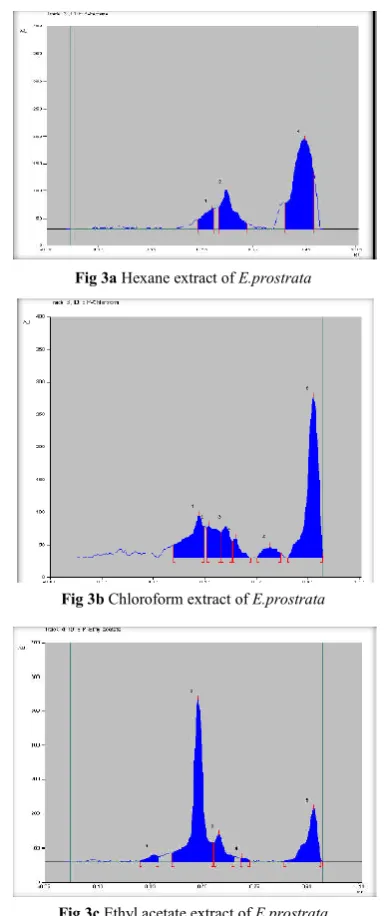
HPTLC has been carried out for all the extracts such as hexane, chloroform and ethyl acetate and results on given in Fig no 1. A 3D graphic display of the HPTLC data is presented in Fig 2. The peak heights are given in table-1. This spectrum of HPTLC for the variability extracts such as hexane, chloroform and ethyl acetate are compared with that of Quercetin (standard) in Fig no (3,3a.3b & 3c). The details of the standard and other extracts given in table: 1. The resolution front of the standard is 0.53 to 0.61. The maximum peak height was 334.9, in the HPTLC and further indicates that 3 distinct compounds present in large quantities. The chloroform extract contains 7 compounds and the peak detail is given in Fig: 3b. The spectrum of ethyl acetate extract shows 5 distinct compounds, whereas the chloroform and ethyl acetate shows one compound with considerably higher concentration.
Fig 1 HPTLC profile of E.prostrata photo documentation under UV at 254nm
Fig 2 The 3D properties of the extract obtained by HPTLC for the hexane,
chloroform and ethyl acetate extracts at 254nm.
Fig 3 Standard sample of quercitin
Fig 3a Hexane extract of E.prostrata
Fig 3b Chloroform extract of E.prostrata
Fig 3c Ethyl acetate extract of E.prostrata
Fig 3 List of compounds analyzed by HPTLC spectrum of variable extracts
Table 1 Analytical results of extract (Hexane, chloroform, ethyl acetate) with a standard of Quercetin
Peak Start Start Max Max Height End End Area Area
Rf height Rf Height % Rf Height %
1 0.52 5.1 0.57 334.9 100.00 0.61 0.4 7269.3 100.00
Sample-1
Hexane
1 0.51 17.9 0.57 37.4 12.73 0.57 36.3 1204.4 9.90
2 0.59 40.7 0.62 72.4 24.61 0.70 11.4 2845.4 23.39
3 0.80 0.1 0.84 41.3 14.3 0.85 39.3 936.9 7.70
4 0.85 39.3 0.92 143.0 48.63 0.96 74.5 7178.6 59.01
Sample-2 Chloroform
1 0.40 18.3 0.50 64.2 14.85 0.52 47.9 2921.6 22.68
2 0.53 46.0 0.54 48.4 11.19 0.59 38.4 1628.2 12.64
3 0.59 38.6 0.61 48.0 11.09 0.63 25.0 1105.8 8.58
4 0.63 25.1 0.65 29.4 6.80 0.70 0.1 638.9 4.96
5 0.73 0.3 0.78 16.5 3.82 0.82 8.1 684.5 5.31
6 0.85 0.1 0.89 13.4 3.09 0.89 12.5 245.1 1.90
7 0.89 12.6 0.95 212.6 49.16 0.97 43.9 5658.3 43.92
Sample-3 Ethyl acetate
2 0.41 26.3 0.51 471.5 64.77 0.57 55.4 14155.0 65.65
3 0.57 55.8 0.59 79.2 10.87 0.65 16.2 2270.8 10.53
4 0.67 12.6 0.68 13.1 1.80 0.71 5.9 255.4 1.18
5 0.87 5.2 0.95 143.6 19.73 0.98 4.9 4230.1 19.62
LC-MS
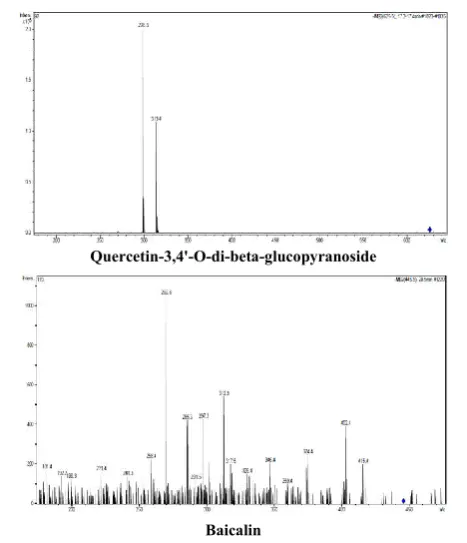
The following structural compounds have been identified in the LC-MS analysis is given in Fig 4. The identified compounds are Isorhamnetin-3- Galactoiside-6” Rhamnoside, Procyanidin, Vitexin, 3-Caffeoylquinic acid, Delphinidin-3-O-beta-glucopyranoside, Kaempferol-3-Glucuronide, 1,5-diCaffeoylquinic acid, Eriodictyol-7-O-glucoside, 3,7-Dihydroxy-3',4'-dimethoxyflavone, Quercetin-3,4'-O-di-beta-glucopyranoside , Baicalin.
Isorhamnetin-3- Galactoiside-6” Rhamnoside
Procyanidin
Vitexin
3-Caffeoylquinic acid
Delphinidin-3-0 - beta- glucopyranoside
Kaempferol-3-Glucoronide
1-5-dicaffeoylquinic acid
Eriodictyol-7-0- glucoside
Quercetin-3,4'-O-di-beta-glucopyranoside
Baicalin
Fig 4 Spectrum details of compounds obtained by LC-MS extracted with Ethyl
acetate
GC-MS
GC-MS studies indicate that about 27 compounds are present in the extract. The molecular formula and the molecular weight of each compound are given in table 3. The spectrum of GC-MS of the chloroform extract of E. prostrate is presented in Fig:5. The predominant compounds were found to be 3,7,11,15-Tetramethyl-2- (table 2), some of the compounds present in large quantities are 2-Hexanol, (R)-, 3,7,11,15-Tetramethyl-2-, n-Hexadecanoic acid, 9,12,15-Octadecatrienoic acid, (Z,Z,Z)- and Stearic acid (table 2).
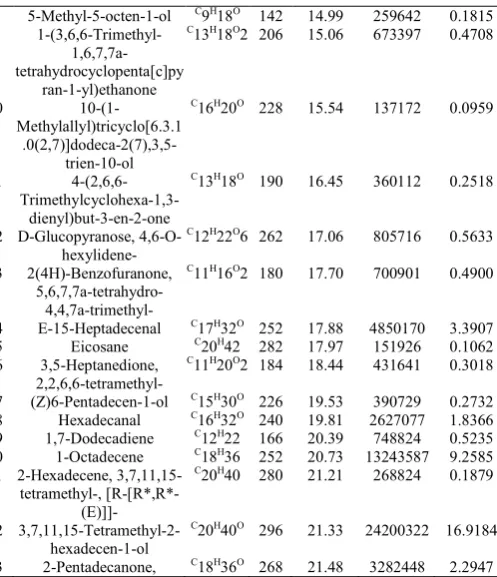
GC-MS studies indicate that about 32 compounds are present in the ethyl acetate extract. The molecular formula and the molecular weight of each compound are given in table 2. The spectrum of GC-MS of Ethyl acetate extract of E. prostrate is presented in Fig: 6. The predominant is found to be n-Hexadecanoic acid (table 3), some of the compounds present in large quantities are n-Hexadecanoic acid, 3,7,11,15-Tetramethyl-2-hexadecen-1-, 1-Octadecene, n-Propyl acetate.
Fig 5 GC-MS chromatogram analysis of chloroform of E.prostrata
Table 2 Compounds identified in the chloroform extract of E. prostrate in the
S.No Name of the compound Formula MW Retention
Time Peak area
1. 3-Penten-2-ol C5H10O 86 2.74 0.96
2. 2-Hexanol, (R)- C6H14O 102 4.50 4.95
3. Octan-2-one, 3,6-dimethyl- C10H20O 156 5.12 0.15
4. Bicyclo[2.1.1]hex-ene,
2-ethenyl-
C8H10 106 5.58 0.7666
5. Decane, 3,6-dimethyl- C12H26 170 17.46 0.2468
6. Phenol,
2,4-bis(1,1-dimethylethyl)-
C14H22O 206 18.93 0.1386
7. 2(4H)-Benzofuranone,
5,6,7,7a-tetrahydro-4,4,7a-trimethyl-
C11H16O2 180 19.61 0.1005
8. Dodecanoic acid C12H24O2 200 19.95 0.3213
9. Undecane, 3,6-dimethyl- C13H28 184 21.62 0.0899
10. (Z)6-Pentadecen-1-ol C15H30O 226 21.72 0.1531
11. cis-9-Hexadecenal C16H30O 238 21.79 0.1526
12. 1-Nonadecanol C19H40O 284 22.05 2.073
13. 1-Dodecanol, 3,7,11-trimethyl- C15H32O 228 22.95 0.2903
14. Tetradecanoic acid C14H28O2 228 23.10 0.5010
15. 2-Hexadecene,
3,7,11,15-tetramethyl-, [R-
C20H40 280
23.66 1.816
[R*,R*-(E)]]-
16.
3,7,11,15-Tetramethyl-2-hexadecen-1-ol
C20H40O 296 23.81 48.944
17 2-Pentadecanone,
6,10,14-trimethyl-
C18H36O 268 23.95 0.0374
18
3,7,11,15-Tetramethyl-2-hexadecen-1-ol
C20H40O 296 24.46 16.577
19 Pentadecanal C15H30O 226 25.38 0.1812
20 n-Hexadecanoic acid C16H32O2 256 26.36 7.483
21 Phenanthrene, 7-ethenyl- C19H28 256 27.74 0.2355
1,2,3,4,4a,4b,5,6,7,8,10,10a-dodecahydro-4a,7-
dimethyl-1-methylene-, [4aS-(4aà,4aá,7á,10aá)]-
22 1,2-Octadecanediol C18H38O2 286 29.13 0.4290
23 Phytol C20H40O 296 29.32 0.9546
24 9,17-Octadecadienal, (Z)- C18H32O 264 30.48 0.4719
25 9,12,15-Octadecatrienoic acid,
(Z,Z,Z)-
C18H30O2 278 30.68 4.232
26 Stearic acid C18H36O2 284 31.10 5.176
27 Palmitoyl chloride C16H31ClO 274 34.07 2.557
GC-MS analysis (Sample injected: 1.4µL)
Fig 6 GC-MS chromatogram analysis of Ethyl acetate of E.prostrata
Table 3 Compounds identified in the ethyl acetate extract of E. prostrate in the GC-MS analysis (Sample injected: 1.4µL)
S.No Name of the compounds Formula MW Retention
Time Peak Area
% Peak area
1 n-Propyl acetate C5H10O2 102 2.87 26509642 18.5328
2 Cyclopropane, (2- C8H14 110 7.41 103127 0.0721
methylenebutyl)-
3 Glycerin C3H8O3 92 8.81 1224024 0.8557
4 1-Butanol, 2-methyl-, C7H14O2 130 10.72 83672 0.0585
acetate
5 Cyclohexanone, 2-acetyl- C8H12O2 140 12.41 107174 0.0749
6 1H-Pyrrole-2,5-dione, 3- C7H7NO2 137 12.78 888476 0.6211
ethenyl-4-methyl-
8 5-Methyl-5-octen-1-ol C9H18O 142 14.99 259642 0.1815
9 1-(3,6,6-Trimethyl- C13H18O2 206 15.06 673397 0.4708
1,6,7,7a- tetrahydrocyclopenta[c]py
ran-1-yl)ethanone
10 10-(1- C16H20O 228 15.54 137172 0.0959
Methylallyl)tricyclo[6.3.1 .0(2,7)]dodeca-2(7),3,5-
trien-10-ol
11 4-(2,6,6- C13H18O 190 16.45 360112 0.2518
Trimethylcyclohexa-1,3- dienyl)but-3-en-2-one
12 D-Glucopyranose, 4,6-O- C12H22O6 262 17.06 805716 0.5633
hexylidene-
13 2(4H)-Benzofuranone, C11H16O2 180 17.70 700901 0.4900
5,6,7,7a-tetrahydro- 4,4,7a-trimethyl-
14 E-15-Heptadecenal C17H32O 252 17.88 4850170 3.3907
15 Eicosane C20H42 282 17.97 151926 0.1062
16 3,5-Heptanedione, C11H20O2 184 18.44 431641 0.3018
2,2,6,6-tetramethyl-
17 (Z)6-Pentadecen-1-ol C15H30O 226 19.53 390729 0.2732
18 Hexadecanal C16H32O 240 19.81 2627077 1.8366
19 1,7-Dodecadiene C12H22 166 20.39 748824 0.5235
20 1-Octadecene C18H36 252 20.73 13243587 9.2585
21 2-Hexadecene, 3,7,11,15- C20H40 280 21.21 268824 0.1879
tetramethyl-, [R-[R*,R*- (E)]]-
22 3,7,11,15-Tetramethyl-2- C20H40O 296 21.33 24200322 16.9184
hexadecen-1-ol
23 2-Pentadecanone, C18H36O 268 21.48 3282448 2.2947
Anticancer activity
The lowest polarity solvent used is the Hexane. The concentrations used are from 1μg/ml to 1000μg/ml phytochemical of E. prostrata. The anticancer activity of the active principle was tested with the growth of EAC (Ehrlich’s ascites carcinoma (EAC-) tumor cell lines employing MTT assay. The MTT assay is a colorimetric assay for assessing cell viability. NADH-dependent cellular oxidoreductase the Hexane extract (30μg/ml and 65% inhibition). The IC50 concentration of the chloroform extract is 3972.2 μg/ml dose which is in no way better than the IC50 concentration of the Hexane extract (402.6). This inhibitory effect could be attributed to only a consortium of phytochemicals present in the plant that could be extracted with chloroform. These compounds are moderately polar in nature and this anticancer property of this extract could be attributed to a consortium of active principles listed in table-2.
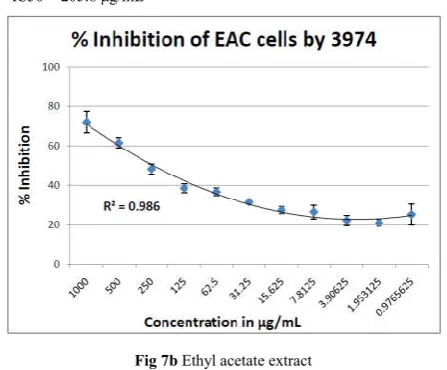
The Hexane a low polar solvent and then chloroform a moderate polar solvent the residue was used to extract with Ethyl acetate a high polar solvent. Thus, this extract will contain only high polar chemical present in the plant sample. The Ethyl acetate extract of E.prostrate was studied with the help of EAC tumor cell line using MTT assay. The results are shown in Fig no: 7 An observable inhibition of the of the tumor cell proliferation was recorded in ~15μg/ml chloroform extract and a maximum of >75% inhibition was recorded in 1000μg/ml dose. These results are more or less similar to that of the chloroform extract. The correlation coefficient between the dose of Ethyl acetate extract and the %inhibition was found to be R2=0.986 which indicates that the relationship between the dose and the inhibition is almost perfectly positive. A comparison of the commencement of the inhibition and the maximum inhibition ~15μg/ml and >75% inhibition was recorded in 1000μg/ml dose is higher than that of the Hexane extract (30μg/ml and 65% inhibition) but similar to that of the
chloroform extract. The IC50 concentration of the chloroform extract is ~206 μg/ml dose which is much lower than that of the Hexane (403 μg/ml and that of the Chloroform (397 μg/ml) which indicates that the active principles present in the Ethyl acetate extract, which are of high polar nature are more effective as anticancer activity. This inhibitory effect could be attributed to only a consortium of phytochemicals present in the plant that could be extracted with Ethyl acetate. These compounds are highly polar in nature and this anticancer property of this extract could be attributed to a consortium compound given in table 3.
Fig 7 MTT assay plate
3972 = IC50 = 402.6 μg/mL
Fig 7 Hexane extract
3973=IC50=397.2μg/mL
3974 = IC50 = 205.8 μg/mL
Fig 7b Ethyl acetate extract
Fig 7 Construction effect of E. prosrate (Hexane, Chloroform and Ethyl
acetate) on the proliferation of EAC tumour cells analyzed with MTT assay
CONCLUSION
E.prostrate was extracted with hexane, chloroform and ethyl acetate. The chloroform and ethyl acetate extracts were shown 87 compounds through GC-MS and LC-MS. Among these 87 compounds, four compounds possess anticancer properties. Through GC-MS, about 28 compounds have been characterized in the chloroform extract and about 32 from the ethyl acetate extract. The anticancer activity was tested with EAC tumor cell line using MTT assay for the inhibition of cell proliferation. The IC50 information (402, 397 and 205μl/ml respectively in hexane, chloroform and ethyl acetate respectively) indicates the high polar compounds extracted with ethyl acetate has higher anticancer activity than the compounds extracted with the other two solvents. Hence, the ethnomedicinal herb E.prostrate which has promising value on high medicinal values can be further taken for anticancer and pharmacological research.
Conflict of interest:
There is no conflict of interest.
Acknowledgement
The authors are thankful to the AMET Deemed to be University for their constant support and financial assistance.
References
1. Holm, L. G., J. V. Poncho, J. P. Herberger, and D. L. Plunknett. 1979. A Geographical Atlas of World Weeds. New York: John Wiley and Sons.
2. USDA National Resources Conservation Service. 2014. “The Plants Database.” Greensboro, NC: National Plant Data Team. http://plants.usda.gov.
3. Prostko, E. P. 2012. “Eclipta Identification and Control in Peanut.” Circular 869. Athens, GA: University of Georgia Coop. Extn.
4. Neal MC, 1965. In: Gardens of Hawaii. Bernice Pauahi Bishop Museum Special Publication No. 50. Honolulu, Hawaii, USA: Bishop Museum.
5. Moody K; Elliot PC, 1984. The use of rice-field weeds for animal feed. In: Report of the Crop-livestock Systems Research, Monitoring Tour, Philippines and Thailand. Los Ba±os, Laguna, Philippines: International Rice Research Institute, 52-64.
6. LeeM.K, N. R. Ha, H. Yang, S. H. Sung, and Y. C. Kim, “Stimulatory constituents of Eclipta prostrata on mouse osteoblast differentiation,” Phytotherapy Research, vol. 23, no. 1, pp. 129-131, 2009.
7. Tewtrakul, S. Subhadhirasakul, P. Tansakul, S. Cheenpracha, and C. Karalai, Antiinflammatory constituents from E.prostrata using RAW264.7 macrophage cells, Phytotherapy Research, vol. 25, no. 9, pp. 1313-1316, 2011.
8. Kim D I, S.-H. Lee, J.-H. Choi, H. S. Lillehoj, M.-H. Yu, and G.-S. Lee, “The butanol fraction of Eclipta prostrata (Linn) effectively reduces serum lipid levels and improves antioxidant activities in CD rats,” Nutrition Research, vol. 28, no. 8, pp. 550-554, 2008. 9. Kumari C S, S. Govindasamy, and E. Sukumar, “Lipid
lowering activity of Eclipta prostrata in experimental hyperlipidemia,” Journal of Ethnopharmacology, vol. 105, no. 3, pp. 332–335, 2006.
10. Roy R K, M. Thakur, and V. K. Dixit, “Hair growth promoting activity of Eclipta alba in male albino rats,” Archives of Dermatological Research, vol. 300, no. 7, pp. 357–364, 2008
11. Wagner H, B. Geyer, Y. Kiso, H. Hikino, and G. S. Rao, “Coumestans as the main active principles of the liver drugs Eclipta alba and Wedelia calendulacea,” Planta Medica, vol. 5, pp. 370-374, 1986.
12. Chan C F, W.-Y. Huang, H.-Y. Guo, and B. R. Wang, “Potent antioxidative and UVB protective effect of water extract of Eclipta prostrata L,” The Scientific World Journal, vol. 2014,
13. Rownak Jahan, Abdullah Al-Nahain, Snehali Majumder, and Mohammed Rahmatullah., Ethnopharmacological Significance of Eclipta alba (L.) Hassk. (Asteraceae)., International Scholarly Research Notices Volume 2014,
Article ID 385969, 22 pages
http://dx.doi.org/10.1155/2014/385969.
14. Khan AV and Khan AA, Ehnomedicianl uses of E.prostrata. Linn., Indian Journal of traditional Knowledge. Vol 7(2), April, 2008,pp- 316- 320. 15. Nithya R. John, Viraj C. Gala, Ashok M. Bhagwat And
Chhaya S. Sawant., HPTLC analysis of eclipta prostrata and psidium guajava extracts and their effect on cell-surface hydrophobicity of a consortium of dental plaque isolates. Int J Pharm Pharm Sci, Vol 5, Suppl 3, 935-940.
16. Rahman M.S, M. Z. Rahman, B. Begum, R. Chowdhury, Sk. Nazrul Islam & Mohammad A. Rashid. Antidiabetic principle from E.prostrata. Lat. Am. J. Pharm. 30 (8): 1656-60 (2011)
17. Bhattacharjee A, Chakraborty A, Dutta D, Mukhopadhyay G (2017) Standardization of Eclipta Alba by HPTLC, HPLC and AAS. Pharm Anal Acta 8: 541. doi:10.4172/2153-2435.1000541.
18. Wyson WJ, Deventhiran M, Saravanan P, Anand D and Rajarajan S : Phytochemical Analysis of Leaf Extract of Eclipta Prostrata (L.) by GC- MS Method. Int J Pharm Sci Res 2016; 7(1): 272-78.doi: 10.13040/IJPSR.0975-8232.7(1).272-78.
Eclipta prostrata against 6-hydroxydopamine-induced neurotoxicity in SH-SY5Y cells. Science Asia 42 (2016): 259-265. doi: 10.2306/scienceasia1513-1874.2016.42.259.
20. Lifeng Han, Erwei Liu, Agyemang Kojo, Jing Zhao, Wei Li, Yi Zhang, Tao Wang, and Xiumei Gao1, Qualitative and Quantitative Analysis of Eclipta prostrata L. by LC/MS. The Scientific World Journal. Volume 2015, Article ID 980890, 15 pages http://dx.doi.org/10.1155/2015/980890.
21. Ashutosh Bahuguna, Imran Khan, Vivek K. Bajpai and Sun Chul Kang. MTT assay to evaluate the cytotoxic potential of a drug. Bangladesh J Pharmacol. 2017; 12:115-118. DOI: 10.3329/bjp.v12i2.30892
How to cite this article:
Wilson Sylvester Fredrick et al.2018, Studies on the Phytochemistry and Validation for Anticancer Properties of Eclipta Prostrate. Linn. Int J Recent Sci Res. 9(9), pp.28902-28909. DOI: http://dx.doi.org/10.24327/ijrsr.2018.0909.2757