ty: Insights from an Analysis of Newspaper
Headlines in the Context of the Greek Crisis
T
HIERRYH
ERMANFaculty of Literature and Humanities
Institute of Language Sciences and Communication & EFLE Universities of Neuchâtel and Lausanne.
Pierre-a-Mazel 7, CH2000, Neuchâtel, Switzerland.
D
IMITRISS
ERAFISFaculty of Communication Sciences
Institute of Argumentation, Linguistics and Semiotics Università della Svizzera Italiana (USI)
Via G. Buffi 13, CH6900, Lugano, Switzerland
Abstract: The present paper exam-ines how discursive representations and emotive constructions underpin an argumentative dynamic that emerges from apparently non-argumentative statements, like those found in newspaper headlines. Our data comes from Greek broadsheet newspapers in the polarized context of the Greek crisis. First, we outline an analytic synergy that scrutinizes representational meaning and the semiotization of emotions in head-lines. We then move towards the reconstruction of the inferential passage, contained in the headlines, that unites the implicit standpoint with its supporting argument.
Keywords: argumentativity, argued emotions, argumentum model of topics (AMT), Greece, Greek crisis, newspapers, print media discourse
1. Introduction
Traditionally, argumentation is seen as either a product, a process, or a procedure (Tindale 1999) in which a claim (Toulmin 2003 [1958]) is supported by at least two components: a given premise (datum) and an often implicit linkage premise between the datum and the claim. In this sense, argumentation could be defined a minima as “a verbal act containing a set of propositions (premises) supporting another proposition (conclusion)” (Lewiński and Mo-hammed 2016, p. 1). In many French argumentation theories, however, argumentation may be defined as broadly as “exerting an influence on one’s opinion, attitude, even behavior” (Grize 1990, p. 41, translated by Amossy 2005, p. 87) through verbal means. The focus here is on the goal rather than on a mere description of a textual and/or logical process1 (see the introductory pages of Os-wald, Herman, and Jacquin 2018 for an overview of the different perspectives).
Two main influences might explain such a difference. First, the seminal work of Chaïm Perelman and Lucie Olbrechts-Tyteca (1969 [1958]) whose emphasis on the rhetorical goal to gain “the adherence of minds” had a deep impact on the research on argu-mentation, especially after the horror of the World War II and the Nazi propaganda. Even if the authors’ work is loaded with reflec-tions on argumentation schemes, the main idea that argumentation aims to gain and exert an influence on audience’s minds seems to have had more of an impact on the readers than the typology of structural schemes. The explicit reference to a “new rhetoric” emphasizes the attempt to revise the Aristotelian rhetoric, and, indeed, many scholars have suggested that Perelman’s
tation” is essentially a synonym for “rhetoric” (Amossy and Koren 2009, §7). The second main influence may come from linguistics during the so-called structuralist wave, which constrains later argumentation theories, in a way, to observing natural language rather than argumentative reconstructions. The natural logic of Jean-Blaise Grize and his group (1990, 1996) has greatly influ-enced French discourse analysis during the 1970’s and 1980’s along with Anscombre and Ducrot’s (1983) L’Argumentation dans la langue. Grize’s works, in particular, are fueled by the idea that
language creates a schematization of the world that can influence an audience’s representations of the world.
Describing different phenomena under the same aegis of “ar-gumentation” may be highly problematic. However, what is more important, in our view, is that analysts must be equipped to deal with texts that suggest standpoints without stating the explicit argumentative relationships between different textual elements (see Herman 2018). More specifically, we claim that argumenta-tion theories should take into account the layer of implicit argu-mentation, which Amossy (2005) calls the “argumentative dimen-sion of discourse” or, preferably, “argumentativity” (rather than merely “argumentation”) (see Amossy 2009a). As the author highlights, texts may develop an argumentative potential, that is “argumentativity,” and suggest a standpoint without actually ex-plicitly uttering an argument in favor of a conclusion (see Amossy 2009b). Moreover, we argue that this layer of argumentativity may be amplified by the discursive (or broadly semiotic) construction of certain emotions (e.g. fear, anger, detestation) that could be addressed in order to be legitimately felt by the audience in specif-ic contexts (see Plantin 2011, Mspecif-icheli 2014). An apparently de-scriptive text, through that prism, may “argue” justifying the emo-tions the audience should feel in this context. As becomes evident, this view is clearly on the fringe of what has been traditionally conceived as “argumentation.”
news-paper headlines. We will first explain how argumentativity may be envisioned, setting the threshold between non-argumentation, argumentativity, and argumentation (section 2). Then we will tackle the case of emotions, which are argued through discursive representations, as a prototypical case of argumentativity, and we will explain, following Micheli’s (2014) view, how this hidden argumentative layer in discourse may protrude in the discursive representation (section 2.2). After presenting our analytical framework (section 3), we will focus on our case study: Greek newspaper headlines during the Greek crisis (section 4). Given the methodological orientation of the present paper, two examples will illustrate our proposal.
We indeed place our examination within the context of the Greek crisis. Greece has proven to be a special case among the countries of the European Union (EU) that faced significant finan-cial problems when crisis emerged in 2008 (see Vassilopoulou et al. 2014 and references therein). The austerity measures imple-mented by several Greek governments in accordance with the proposals of the so-called “Troika” of the International Monetary Fund (IMF) and the EU institutions caused massive indignation (see e.g. Goutsos and Polymeneas 2014, Serafis et al. 2018) and new divisions in the Greek political and party system (see Dinas and Rori 2013, pp. 271-276; Vasilopoulou and Halikiopoulou 2013, pp. 528-529). This profound socio-political unrest was crucially shaped by media constructions (see Lampropoulou 2014; Mitsikopoulou and Lykou 2015; Lykou and Mitsikopoulou 2017; Serafis and Herman 2018). Within the aforementioned context, we will first scrutinize discursive representations and emotive con-structions realized in headlines of the Greek newspapers Kathi-merini (conservative) and Ta Nea (center-left). Then we will track the opaque argumentative dynamic that lies at the core of the headlines by reconstructing the inferential passage that binds the main standpoint with the supporting argument.
2. Theoretical and methodological orientations
texts, and (b) emotions can make these moves more salient in crucial ways. This issue appears to be quite challenging in current debates. For example, in the “argumentation mining” field, the necessity to identify argumentation along with emotions is under-lined (see Stede and Schneider 2019). More specifically, as Wiebe et al. put it:
“[i]s the rhetoric from a particular opposition group intensifying? What is the range of opinions being expressed in the world press [e.g.] about the best course of action in Iraq? A system that could automatically identify opinions and emotions from text should be an enormous help to someone trying to answer these kinds of questions” (2005:1).
We aim at intensifying the respective debates, and indeed, we argue that newspaper headlines might be considered as argumenta-tive utterances under certain conditions and in certain contexts.2 In what follows we will try to set clear limits on the concepts we are going to discuss: (a) what is argumentativity, and how does it differ from argumentation? (b) is there any text without argumen-tativity?
Our theoretical perspective is informed by Ruth Amossy’s (2012 [2000]) framework entitled as “argumentation in discourse.” This framework is clearly inspired by Grize’s natural logic and Perelman’s view on rhetoric. Following Perelman and
Tyteca (1969 [1958]), Amossy highlights the importance of rea-sonableness, co-construction, and social setting developed by the Belgian philosopher against the core concepts of truth, rationality, and validity traditionally associated with argumentation. As she says:
As a result, argumentation does not simply rest upon solid, immu-table logical procedures the validity of which must be tested by the analyst. What is reasonable and plausible is always co-constructed by men and women engaging in verbal exchanges, and it is the dynamic of this co-construction realized in natural language and in a communicative framework, that has to be ana-lyzed” (Amossy 2009a, p. 317).
In this line, and also following Grize (1990), Amossy considers that argumentation may be seen, more specifically, as the use of specific discursive means (and discourses) in order “to act upon an
addressee by modifying (or strengthening) his representations of the surrounding world” (Amossy 2009a, pp. 313-314; see also Grize 1990, pp. 40-41).
argumentative approach.3 In brief, according to SFL, language is a source/system of meaning making within a socio-cultural context, since, at the same time, it has the intrinsic ability to represent the word in its ideational function/meaning, enact social relationships in its interpersonal function/meaning, and interweave ideational and interpersonal meaning(s) creating contextualized discourses in its textual function (Halliday 1973, 1978). Consequently, in the present case, the term discourse refers to the linguistic modes (social and cultural) that the world is organized and represented in various texts (see Fairclough 2003).
Secondly, Amossy proposes the aforementioned cross-fertilization among argumentation and discourse analysis since, as we have already mentioned, she adopts a more dynamic concep-tion of argumentaconcep-tion. According to this conception, argumenta-tion is not only a property of texts that have an explicit “argumen-tative goal or objective” (Amossy 2009b, p. 254), that is, texts that explicitly aim to persuade and achieve consensus, like, for exam-ple, a political speech in the parliament. On the contrary, an argu-mentative potential and dynamic may be retrieved even in texts that simply “orient ways of looking at things and interpreting the world without putting forward any thesis” (Amossy 2009b, p. 254), that is, in apparently non-argumentative genres of texts, such as, for instance, literature and/or news media (see Amossy 2005). Such a broad conception of argumentation is based on the premise that a discourse “always answers some explicit or hidden question, or at least suggests a way of looking at the surrounding world” being “pervaded by a general argumentativity” (Amossy 2009a, p.
254, our emphasis). More specifically, “[t]he theory of ‘[a]rgumentation in discourse’ is based on the assumption that argumentativity pervades and partly regulates all verbal exchang-es” (Amossy 2009a, p. 313). In other words, argumentative poten-tial and obscure argumentative patterns may be tracked (in various
degrees) even in apparently non-argumentative texts and structures (Amossy 2002, 2005) since “argumentativity is one of discourse’s constitutive dimensions, which means that even discourses that do not participate in any formal debate or disclose a manifest persua-sive purpose have an underlying argumentative dimension” (Amossy 2009a, p. 315, original emphasis; see also Amossy 2005). As we will show in our analysis (see section 4), even if, at first glance, much remains implicit in newspaper headlines, they nevertheless may construe dense, contextualized representations of the social action that takes place in specific moments in the Greek crisis. We grant the premise (and we will illustrate in our analysis) that, in these discursive representations, a standpoint may be sus-tained even if left implicit (see Zampa 2017, p. 131). A SF-based analysis will provide us with a scrutiny of the discursive represen-tations construed in the headlines under examination.
2.1. Argumentativity and argumentation
By using the term “argumentativity,” our purpose is not necessari-ly to widen the notion of argumentation to all discourses, which is a danger already noted by Micheli and referred to as “generalized argumentativism” (2009, p. 20). Even though we will not consider each utterance as a form of argumentation (we will put forth two criteria that we use to avoid the trap of the “generalized argumen-tativism”), we argue that linguistic wrappings, as descriptive as they may appear, may trigger inferences in an argumentative way. Many reasons can support this position.
First, there is no statement without a portrayal of the speaker, as Amossy acknowledges (2012); therefore, the image I may give of myself when I speak can influence how the audience will perceive what I say. Secondly, as Plantin (2011) and Micheli (2014) showed, emotions can be situated beyond simple emotional nouns or adjectives. For instance, the clause “Children are starving to death in Syldavia” is a descriptive statement that may however legitimize, through the expressed fatal outcome, pity or anger towards such a reality.4 We will return to this issue later.
What these two claims clearly show is that texts do not only describe reality but may also influence ways of considering the world. The text itself (as part of its context) serves as an argument to justify an interpretation in an abductive approach of discourses (Eco 1992). The signs, here language, but we could broaden the palette to prosody, gestures, etc., may give arguments that support interpretations in a particular way. According to Jean-Blaise Grize, the way we use and arrange words in context can be described by the metaphor of “illumination”—“éclairages” in French5: “The discourse entities must be illuminated, which means that some of their facets must be highlighted and others hidden and every illu-mination colours what it illuminates, because it makes use of cultural preconstructs that are never neutral.” (Grize 2004, p. 42, translated by van Eemeren et al. 2014, p. 488). The notion of “illumination” is a relevant metaphor that highlights how lexical and syntactic choices constitute signs to be interpreted in an infer-ential way, precisely because of how they are “illuminated.”While Grize considers that it is difficult to decide whether a text is argu-mentative or not,6 Amossy radicalizes her theoretical point of view by considering, as we mentioned before, that argumentativity is inherent of any discourse. While we assume that any statement can be critically, hermeneutically, or interpretatively analyzed, we believe it would be difficult to consider that each statement, be-cause it may influence our beliefs, is necessarily a threat or a trap that aims at adhering unaware minds. It would be quite exhausting to think that every utterance exerts an influence of which we should be aware. Therefore, we propose two criteria that, in our view, may indicate that a text is fueled by argumentativity: (a) argumentativity may be triggered by textual salience and/or (b)
conditions, specifically in the explicit presence of an opinion that the speaker is committed to (see Herman 2018).
5 According to Amossy, the official translation of “éclairages” is “points of view” in English (personal communication).
argumentativity can reasonably be taken into account because of the contextual knowledge.
The first criterion echoes a discussion revolving around how linguistic/semiotic choices may be underlined in texts strengthen-ing in this sense the construed meanstrengthen-ing. For instance, the notion of “foregrounding” (see Leech 2008, Leech and Short 2007), which according to the dictionary of stylistics “is […] the ‘throwing into relief’ of the linguistic sign against the backgrounds of the norms of ordinary language” (Wales 2014, p. 166). On the same discus-sion, Bonhomme (2005) proposes the idea of different degrees of “salience” provoked by figures of speech in a text. Finally, in the systemic functional perspective, Halliday uses the concept of “prominence as a general name for the phenomenon of linguistic highlighting, whereby some feature of the language of a text stands out in some way” (Halliday 1971, p. 340), while fore-grounding is a kind of motivated prominence that “contributes to the writer’s total meaning” (Halliday 1971, p. 339).7 In all the aforementioned traditions in linguistics, textual salience (or fore-grounding or prominence) is supposed to mark the constructed meaning; in this sense, it may give rise to (or better, or sharpen) an implicit argumentative potential, that is argumentativity.
The second criterion is a contextual one. It is the knowledge of the context that strengthens the representation of the text and allows the addressee to assume, with more or less plausibility, that an apparently descriptive text may have an argumentative poten-tial, or better, may be intertwined with argumentativity. For exam-ple, the knowledge regarding the different positioning of the ex-amined newspapers, their political tendencies, and the very polar-ized and tense events in Greece are good reasons to believe that Greek newspapers’ headlines are more inclined to reveal their standpoints than a traditional news report from a news wire agen-cy. Because of the context, we could be suspicious about the
able conscious or unconscious bias and intent or will to exert an influence on the audience.8
Next, we would like to emphasize a special aspect that enforces argumentativity in texts and discourses, and this one relates to specific interpretations tracked by emotions constructed in dis-course. We will show how different point of views (i.e. “illumina-tions” in Grize’s terms) might justify some emotions; we will show how they argue for and through an emotion. Our idea is that apparently descriptive journalistic headlines offer justifications for and through emotions particularly in the highly polarized context during the Greek crisis.
2.2. Emotions and argumentativity
More specifically, we seek to show how the argumentative dynamic borne out in discursive representations is enforced in newspaper headlines. To that end, we appeal to the studies exploiting the category of “argued emotion” (Plantin 1999, 2004, 2011; Micheli 2010, 2014). We are seeking to show how argumentativity is materialized through emotive constructions in configurations of print media discourse, specifically in newspapers headlines.
According to these studies, and echoing rhetorical pathos, “emotions themselves are accessible to argumentation,” and more specifically, they may become “the very object of argumentation” since speakers “argue in favor of or against an emotion” and support what they feel and why they should legitimately feel like this (Plantin 2004 as quoted in Micheli 2010, p. 5, p. 13). More specifically, emotions may become the very vehicle of achieving
consensus on the reasonable (Perelman 1979, Amossy 2009a) and thus they may be an intrinsic part of argumentation as this is realized in various genres of discourse (see Cigada 2016, p. 390; see also Plantin 1998). According to recent research on an argumentative perception that could embrace an analysis of
emotions in discourse, the particular function of these emotive constructions is to enhance the premises on which a claim may be developed (see Schär 2018, p. 147). Following this research, we will show in our analysis that emotive constructions stem from and complement the discursive construction of reality, aiming to motivate the audience to make the choice proposed (implicitly or explicitly) by each newspaper. Moreover, as we will see in the analysis section, the presence of emotions may advance the “degrees of argumentativity” (Amossy 2005, p. 88), sharpening, for example, the discursive representation.
Summing up, following the conceptual lines of Amossy’s (2010 [2000]) perception on argumentativity, we first pay special attention to a linguistic-based discourse analysis of newspaper headlines in order to unveil implicit aspects of the construed representational meaning. Then, we show how meaning is complemented by appealing to an analysis that focuses on how emotions are semiotized in discursive structures (i.e. in newspapers headlines). Based on these findings, we will move towards the reconstruction of the inferential passage that unites the main standpoint with the argument that supports it, unveiling, in this sense, the opaque argumentative dynamic that lies at the core of the headlines.
3.Analytical perspectives—a synergy
For the aims of our analysis, we will present an approach employ-ing analytical tools by two pillars (see Serafis 2017, Ch. 3; Serafis and Herman 2018, pp. 187-189 for a preliminary elaboration). Namely: (a) Systemic Functional (SF) lexicogrammatical analysis (Halliday and Matthiessen 2004) and (b) rhetorical analysis of emotions semiotization in discourse (Micheli 2014). As we have already heralded, based on the results coming from this analytical combination, we will proceed to the reconstruction of inferential configurations emerging in the headlines by drawing on the Ar-gumentum Model of Topics (henceforth AMT) (see Rigotti and Greco Morasso 2010; Rocci 2017; Rigotti and Greco 2019).
More specifically, firstly, we exploit tools from a SF analysis of
Halli-day and Matthiessen 2004, Ch. 5). Transitivity involves configura-tions of representational meaning by interrelating three main ele-ments: the processes (realized by verbal groups), the participants
(realized by nominal groups), and the circumstances (realized by various types of adverbial groups and prepositional phrases) (Hal-liday and Matthiessen 2004, pp. 176–177, p. 260).
In addition to transitivity analysis, and following Micheli (2014), we conduct an analysis of emotions semiotization in dis-course in order to show the emotions revealed in different repre-sentations in transitivity configurations. We highlight the im-portance of emotions constructed by discursive representations because, as we will witness, emotive constructions complement the discursive construction of reality, aiming to guide the audience towards the implicit claim made by the newspaper. In this sense, “argued” emotions underpin newspapers’ attempts to express a standpoint and provide stimuli for actions (Plantin 2004; Micheli 2010).
people involved (naming strategies, participant roles of agent or patient); to the expressed spatial and temporal distance (e.g. the closer in time an event, the more justified the emotion it triggers); to the potential consequences and to the probability of them hap-pening; to the causes and responsibilities emphasized; to the capacity to command or control the situation; to the allusion to
resembling situations; or to the compatibility or not with the val-ues shared among a reference group.
For example, the headline “three children have been found starved to death in our city” in an European newspaper may be seen as constructing an argued emotion through many criteria including: (1) victims are children who are socially considered “innocent” and need to be protected—the prominence is highlight-ed by the fact that they are the grammatical subject of this passive phrase; (2) the consequences are terrible (death); (3) the temporal and spatial distance are quite near, raising the degree of emotion we are supposed to experience; (4) this situation is not compatible with social values, in this case, children must be protected; (5) we were unable to control and avoid this terrible situation; (6) the causes and responsibilities are unknown although we should won-der about the parents’ responsibilities which are socially supposed to protect the children as well as the responsibilities of social institutions. For these reasons, this forged example offers many reasons that underpin an emotion that is, by the way, hard to label (possibilities include anger, shame, indignation, etc). The “argu-mentativity” of this headline, which appears to be descriptive, can be seen through the reconstruction of unexpressed arguments that justify an expected emotion in such situations.
usually realized as prepositions—that spring from the locus and give rise to specific arguments (e.g. if the cause is present, so is the effect). On the other hand, the material-contextual component
includes the shared socio-cultural premises that the participants (must) take into consideration. Namely, (a) the endoxon that refers to the shared opinion(s), accepted by the public in a specific socio-cultural setting, and (b) the datum, which is a premise of factual nature. The intersection of these two components (procedural-inferential and material-contextual) form a quasi-Y structure that better highlights the way towards the sustained stand-point/conclusion (see Rigotti and Greco 2019: 208-216). Next, we briefly present our data and the criteria of their selection before moving towards our analysis.
4. Data analysis
In total, our data comprise 50 headlines coming from the following Greek broadsheet newspapers: Kathimerini, Ta Nea, Elftherotypia,
newspaper’s standpoint. After presenting our data and illustrating the criteria of selection, we offer representative examples of analy-sis compliant to the analytical synergy we outlined before (see section 3).
(1) Η στυγνή βία προκαλεί σοκ ‘The brutal violence causes shock’ (Kathimerini, May 6, 2010)
In a headline in Kathimerini on May 6, 2010, the nominal group Η
interpretation in the specific context. Still, the absence of the specific social agent (who exercises “the violence”) or the one that experiences the “shock” construes extensive social diffusion of the violence and shock in the demonstration. This allows Kathimerini
to implicitly represent the demonstrations (like the one on May 5, 2010) as the very place where “the violence” exists and the pro-testers (in general as the embodiment of the protest) as the agents of this “violence.” Kathimerini incriminates social disobedience to austerity programs in this manner.
Complementing our analysis in transitivity with the analysis of emotions semiotization in this headline, we may witness shock
coded as “said,” realized, respectively, by the nominal types βία
“violence” and σοκ “shock.” The adjective στυγνή “brutal” and the (further) negative quality that it carries (in the nominal group Η
στυγνή βία “The brutal violence”) further loads the specific emo-tion (i.e. shock). Since no specific social actor is represented as experiencing the emotion of shock in the transitivity structure, shock may be experienced by everyone in the specific context. Moreover, the “said” emotion, portrayed as having a general affect to the audience, can be coded as “argued” and one that further provokes the emotion of fear, in Micheli’s terms, that should be
legitimately felt by the audience of the newspaper. According to the representational meaning, construed in the transitivity, shock is extensively disseminated in the society (audience) and thus (a) there is no easy way (for anyone) to control the situation (see the respective criterion of the [lack of] ability to control the situation) and, moreover, (b) according to the extra-textual knowledge, the “violence” stems from the anti-bailout protests (see the criterion of the people involved) and the consequences which are very close to time (see criterion of temporal and spatial distance) are very strong, i.e. the death of the three bank-employees (see the criterion of the possible consequences). Indeed, the (im)possibility of the audience to take control of the situation (see the respective criteri-on) is highly used here: the lack of control justifies and legitimizes the emotion of fear which is “argued” as a consequence of the
shock.
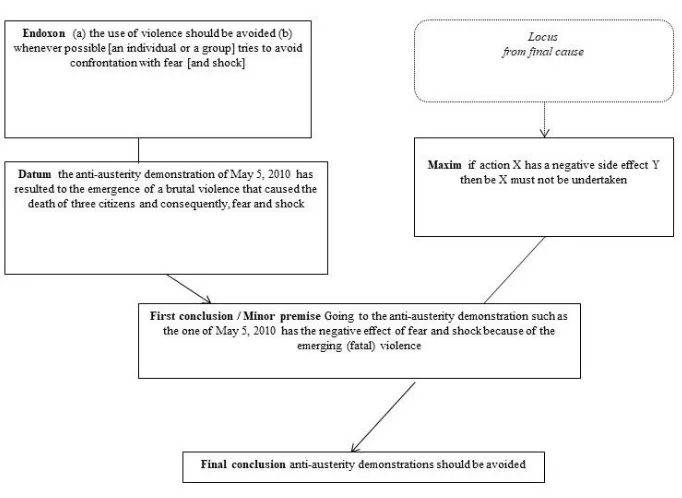
reconstruction of the implicit standpoint honed in the discursive and emotive construction. This could be: “The anti-austerity pro-tests should be avoided.” The argument that supports the afore-mentioned standpoint results from the discursive and emotive construction that, as we tried to unveil in our previous analysis, appears in the headline: “The anti-austerity protest encapsulates fatal violence and causes fear.” In order to exemplify how this very standpoint and argument are interconnected, we employ the AMT quasi-Y structure. More specifically, on the axis of the procedural-inferential components the locus from final cause
Figure 1: The AMT representation in the case of Kathimerini on May 6, 2010
(2) Ψήφος εκτάκτου ανάγκης “Emergency vote” (Ta Nea, June 29, 2011)
In the nominal group of the headline of Ta Nea on June 29, 2011,
Ψήφος εκτάκτου ανάγκης “Emergency vote,” by the nominal type
by the nominal group εκτάκτου ανάγκης “emergency”; the specific conceptualization is realized in Greek by the nominal group in the genitive case which states the necessity of the ‘vote’ (see εκτάκτου ανάγκης [genitive case underlined]). Through the above represen-tation, the “vote” in the Greek parliament is imposed by an “emer-gency” occurring due to the financial turbulence in Greece. Con-textual knowledge offers us this more adequate interpretation: There were widespread statements addressed by governmental officials, according to which none of the MPs of the ruling social-ist party (PASOK) were disposed to vote for such large-scale austerity measures—included in the bailout program—baldly at the antipode of their pre-electoral manifesto which was promising an expansion of fiscal policies. PASOK MPs were attributing implementation of these measures to the fact that a financial col-lapse would follow a possible failure of the bailout agreement with Greece’s creditors (MoU). In this sense, the parliamentary majori-ty is conceptualized as acting (“vote”) against its will in order to overcome the tremendous financial difficulties and avoid a finan-cial collapse. The meaning construction could be exemplified as: PMs’ ruling majority votes (against its will) due to the (e.g. finan-cial) emergency.
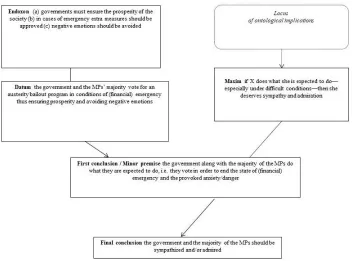
are labelled as “argued”—in favor of the Greek government and the MPs that support it. Moreover, it is worth noting here that sympathy and admiration should be felt since, in an extremely short and polarized period (see temporal criterion), the government makes difficult decisions in order to avoid (financial etc.) dangers (see consequences criterion) caused precisely because of the actual socio-political and financial situation, that is, by the state of emer-gency. In this sense, the nominal choice “emergency” in this con-figuration argues the specific emotions.
Figure 2: The AMT representation in the case of the headline of Ta Nea on June 29, 2011
5. Conclusion
argument(s) that may support a claim. Our analysis was located in an extremely polarized socio-political context, specifically, the Greek crisis. Despite the short data analysis, we have shown that the analyzed newspaper headlines may possess an opaque argu-mentative core in the discursive and emotive representations that emerge from these very linguistic wrappings. Since the paper was a methodologically-oriented one, we do not claim to provide ex-tended analytical findings through our analysis during the relevant period. However, we hope that the analytical integration we out-lined here will be applied to different datasets in future research.
(AMT, see Rigotti and Greco 2019) through the quasi-Y structure permitted us to unveil then the inferential configuration argument-to-standpoint that otherwise would remain obscure in the present-ed data. Although a more extensive analysis of a wider corpus would address these issues more precisely, our intention in this methodologically-oriented paper was primarily to provide a syner-gy in order to track implicit argumentation in instances of appar-ently non-argumentative discourses. In this sense, we wish to sketch new research avenues for contemporary debates on argu-mentation studies.
Acknowledgements: We would like to thank Raphaël Micheli for his input on a previous version of this paper. We especially owe thanks to the two anonymous reviewers for their constructive comments.
References
Amossy, Ruth. 2002. Introduction to the study of doxa. Poetics Today
23(3): 369-394.
Amossy, Ruth. 2005. The argumentative dimension of discourse. In
Practices of Argumentation, eds. Frans H. van Eemeren and Peter Houtlosser, 87-98. Amsterdam: John Benjamins.
Amossy, Ruth. 2009a. The new rhetoric’s inheritance. Argumentation and discourse analysis. Argumentation 23(3): 313-324.
Amossy, Ruth. 2009b. Argumentation in discourse. A socio-discursive approach to arguments. Informal Logic 29(3): 252-267.
Amossy, Ruth. 2012. L’argumentation dans le discours. Paris: A. Colin. Amossy, Ruth, and Roselyne Koren. 2009. Rhétorique et argumentation:
Approches croisées. Argumentation et Analyse du Discours 2: https://doi.org/10.4000/aad.561. URL accessed 26 February 2019
https://journals.openedition.org/aad/561.
Anscombre, Jean-Claude, and Oswald Ducrot. 1983. L’argumentation
dans la langue. Bruxelles: P. Mardaga.
Bell, Allan. 1991. The language of news media. Oxford: Blackwell. Bonhomme, Marc. 2005. Pragmatique des figures du discours.
Paris/Geneve: H. Champion.
van Dijk, Teun A. 1988. News as discourse. Hillsdale, NJ: Lawrence Erlbaum.
van Dijk, Teun A. 1991. The interdisciplinary study of news as dis-course. In Handbook of qualitative methods in mass communication research, eds. Klaus Bruhn-Jensen and Nicholas Jankowski, 108-120. London: Routledge.
Dinas, Elias, and Lamprini Rori. 2013. The 2012 Greek parliamentary elections: Fear and loathing in the polls. West European Politics
36(1): 270-282.
Eco, Umberto. 1992. Les limites de l’interprétation. Paris: B. Grasset. van Eemeren, Frans. H., Garssen, Bart, Krabbe, Erik C. W., Snoek
Henkemans, Fransisca A., Verheij, Bart, and Jean Wagemans. 2014.
Handbook of argumentation theory. Dordrecht: Springer.
Fairclough, Norman. 2003. Analysing discourse: Textual analysis for social research. London: Routledge.
Goutsos, Dionysis and Polymeneas, George. 2014. Identity as space: Localism in the Greek protests of Syntagma square. Journal of Language and Politics 13(1): 675-701.
Grize, Jean-Blaise. 1990. Logique et langage. Paris: Ophrys.
Grize, Jean-Blaise. 1996. Logique naturelle et communications. Paris: Presses universitaires de France.
Grize, J.-B. (2004). Le point de vue de la logique naturelle. Démontrer, prouver, argumenter [The point of view of natural logic. Demonstrat-ing, provDemonstrat-ing, arguing]. In L’argumentation aujourd’hui. Positions
théoriques en confrontation, eds. M. Doury and S. Moirand, 35-44. Paris: Presses Sorbonne Nouvelle.
Halliday, Michael A.K. 1971. Linguistic function and literary style: An inquiry into the language of William Golding’s the inheritors. In Lit-erary Style: A symposium, ed. Seymour Chatman. New York: Oxford University Press.
Halliday, Michael A.K. 1973. Explorations in the functions of language. London: Edward Arnold.
Halliday, Michael A.K. 1978. Language as social semiotic: The social interpretation of language and meaning. London: Edward Arnold. Halliday, Michael A.K., and Christian M.I.M Matthiessen. 2004. An
Introduction to functional grammar (3rd revised edition). London: Edward Arnold.
Herman, Thierry. 2018. Éclairages, dimension rhétorique et argumentation à l’épreuve des tweets de Donald Trump.
Argumentation et Analyse du Discours 20.
https://doi.org/10.4000/aad.2504. URL accessed 26 February 2019 :
Lampropoulou, Sofia. 2014. Greece will decide the future of Europe: The recontextualisation of the Greek national elections in a British broadsheet newspaper. Discourse & Society 25(4): 467-482.
Leech, Geoffrey. 2008. Language in literature: Style and foregrounding.
London: Routledge.
Leech, Geoffrey, and Michael Short. 2007. Style in fiction: A linguistic introduction to English fictional prose. London and New York:
Longman.
van Leeuwen, Theo. 2008. Discourse and practice: New tools for criti-cal discourse analysis. New York: Oxford University Press.
Lewiński, Marcin, and Dima Mohammed. 2016. Argumentation theory. In International encyclopedia of communication theory and philoso-phy, eds. Klaus Bruhn Jensen, Robert Craig, Jefferson Pooley and Er-ic Rothenbuhler, 1-15. New York: John Wiley & Sons.
Lykou, Christina, and Bessie Mitsikopoulou. 2017. The chronicle of an ongoing crisis: Diachronic media representations of Greece and Eu-rope in the Greek press. In: Greece in crisis: Combining critical dis-course and corpus linguistics perspectives, eds. Dionysis Goutsos and Ourania Hatzidaki, 113-150. Amsterdam: John Benjamins. Micheli, Raphaël. 2009. La construction de l’objet dans quelques
approches discursives et interactionnelles de l’argumentation: Une approche métathéorique. In Argumentation: théorie, langue, discours: Actes de la section Argumentation du XXX. Congrès des romanistes allemands, Vienne, septembre 2007 (Rhethos), eds. Vahram Atayan and Daniela Pirazzini, 19-30. Frankfurt am Main: Peter Lang.
Micheli, Raphaël. 2010. Emotions as objects of argumentative constructions. Argumentation 24(1): 1-17.
Micheli, Raphaël. 2014. Les émotions dans les discours. Modèle d’analyse, perspectives empiriques. Bruxelles: De Boeck (“Champs linguistiques”).
Mitsikopoulou, Bessie, and Christina Lykou. 2015. The discursive construction of the recent European economic crisis in two political magazines. On the Horizon 23(3): 190–201.
Oswald, Steve, Herman, Thierry, and Jérôme Jacquin, eds. 2018. Argu-mentation and language-linguistic, cognitive and discursive explora-tions. Cham: Springer International Publishing.
Perelman, Chaïm, and Lucie Olbrechts-Tyteca. 1969 [1958]. The new rhetoric: A treatise on argumentation. Notre Dame: Notre Dame University Press.
Plantin, Christian. 1998. Les saisons des émotions. In: Forms of argu-mentative discourse, ed Marina Bondi, 3-50. Bologna: CLUEB. Plantin, Christian. 1999. Arguing emotions. In Proceedings of the fourth
international conference of the international society for the study of argumentation, eds. Frans H. van Eemeren, Rob Grootendorst and J. Antony Blair, 631-638. Amsterdam: SicSat.
Plantin, Christian. 2004. On the inseparability of reason and emotion in argumentation. In Emotion in dialogic interaction, ed. Edda Weigand, 269-281. London: Benjamins.
Plantin, Christian. 2011. Les bonnes raisons des émotions: Principes et méthode pour l'étude du discours émotionné. Berne: P. Lang.
Psychogios, Dimitris. 2004. Τα έντυπα Μέσα επικοινωνίας: Από τον πηλό
στο δίκτυο [Print media: From the clay to the network]. Athens: Kastaniotis.
Rigotti, Eddo, and Sara Greco Morasso. 2010. Comparing the argumen-tum model of topics to other contemporary approaches to argument schemes: The procedural and the material components. Argumenta-tion 24(4): 489-512.
Rigotti, Eddo, and Sara Greco. 2019. Inference in argumentation. A topics-based approach to argument schemes. Cham: Springer. Robin, Christian. 2009. L’angle journalistique. Paris: CFPJ.
Rocci, Andrea. 2017. Modality in argumentation: A semantic investiga-tion of the role of modalities in the structure of arguments with an application to Italian modal expressions. Dordrecht: Springer.
Schär. Rebecca, G. 2018. An argumentative analysis of the emergence of issues in adult-children discussions. PhD dissertation, Università del-la Svizzera italiana.
Serafis, Dimitris. 2017. The construction of the Greek crisis in the public sphere: Discourses and emotions (pathos) under critical perceptions. PhD dissertation, University of Neuchâtel and Panteion University. Serafis, Dimitris, and Thierry Herman. 2018. Media discourse and
pathos: Sketching a critical and integrationist approach – Greek and French headlines before the Greek referendum of 2015. Social Semi-otics 28(2): 184-200.
Serafis, Dimitris, E. Dimitris Kitis, and Argiris Archakis. 2018. Graffiti slogans and the construction of collective identity: Evidence from the anti-austerity protests in Greece. Text & Talk 38(6): 775–797.
Tindale, Christopher. W. 1999. Acts of arguing: A rhetorical model of argument. Albany NY: State University of New York Press.
Toulmin, Stephen E. 2003. The uses of argument (Updated edition). Cambridge: Cambridge University Press.
Vasilopoulou, Sofia, and Daphne Halikiopoulou. 2013. In the shadow of Grexit: The Greek election of 17 June 2012. South European Society and Politics 18(4): 523-542.
Vasilopoulou, Sofia, Daphne Halikiopoulou, and Theofanis Exadaktylos. 2014. Greece in crisis: austerity, populism and the politics of blame.
Journal of Common Market Studies 52(2): 388–402.
Wales, Katie. 2014. A dictionary of stylistics. London and New York:
Longman.
Wiebe, Janyce, Wilson, Theresa and Claire Cardie. 2005. Annotating expressions of opinions and emotions in language. Language Re-sources and Evaluation 39(2): 165–210.