VOLUME NO.5(2015),ISSUE NO.07(JULY) ISSN 2231-5756
A Monthly Double-Blind Peer Reviewed (Refereed/Juried) Open Access International e-Journal - Included in the International Serial Directories
Indexed & Listed at:
Ulrich's Periodicals Directory ©, ProQuest, U.S.A., EBSCO Publishing, U.S.A., Cabell’s Directories of Publishing Opportunities, U.S.A., Open J-Gage, India [link of the same is duly available at Inflibnet of University Grants Commission (U.G.C.)],
VOLUME NO.5(2015),ISSUE NO.07(JULY) ISSN 2231-5756
INTERNATIONAL JOURNAL OF RESEARCH IN COMMERCE, IT & MANAGEMENT
CONTENTS
Sr.
No.
TITLE & NAME OF THE AUTHOR (S)
Page
No.
1.
A STUDY ON CUSTOMER’S APPREHENSION TOWARDS MOBILE BANKING TECHNOLOGY
PADMAAVATHY.PA. & DR. B. ADALARASU
1
2.
TURNOVER ANALYSIS: A CASE STUDY OF AUTOMOBILE INDUSTRY IN INDIA
DR. M. VENKATA RAO & DR. K. KANAKA RAJU
5
3.
UNDERSTANDING ORGANISATIONAL CULTURE THROUGH OCTAPACE PROFILE: AN EMPIRICAL STUDY OF
THE UNIVERSITY
DR. PRAVEEN CHOUGALE & SOMNATH D. PAWAR
13
4.
A COMPARATIVE STUDY OF SOCIAL ACCOUNTING, AUDITING AND DISCLOSURE PRACTICES APPLIED BY
INDIAN CORPORATE SECTOR
SHARDHA G. THAKUR & DR. MAHESHCHANDRA P. JOSHI
18
5.
CRITICAL FACTORS FOR THE SUCCESS OF EXPERIENTIAL BRANDING IN FLIPKART.COM
K.J. JAIMS & BELAGAVI BAKKAPPA
23
6.
DETERMINANTS OF JORDANIAN BANKING SYSTEM ACTIVITIES
GHAZI A. ALRGAIBAT & TORKI M. AL-FAWWAZ
29
7.
ASSESSING THE MEDIATING ROLE OF SOCIAL IDENTITY ON THE RELATIONSHIP BETWEEN SOCIAL
NETWORKING SITE USAGE AND BRIDGING SOCIAL CAPITAL
SANGEETHA K L & DR. D. MAVOOTHU
36
8.
IMPACT OF THE REFORM OF LIBERALIZATION ON EMPLOYEES' PRODUCTIVITY OF ETHIOPIAN LEATHER
INDUSTRY
DR. BREHANU BORJI
41
9.
INTEGRATED MARKETING COMMUNICATION IN POLITICAL CAMPAIGNING: A SUCCESS STORY OF BJP IN
2014 LOK SABHA ELECTION
MOHD DANISH CHISHTI, DR. RESHMA NASREEN, NAZIA HASAN KHAN, PRIYANKA INDORIA & MIR SHAHID
SATAR
49
10.
DIMENSIONS OF OPERATIONAL EFFICIENCY OF INDIAN PAINT INDUSTRY: AN EMPIRICAL STUDY
S. KAMALADEVI & DR. A. VIJAYAKUMAR
53
11.
ATTITUDE OF CUSTOMERS TOWARDS INTERNET BANKING: A CASE OF NAMAKKAL TOWN, TAMIL NADU
M.MATHIYARASAN & DR.G.VADIVALAGAN
59
12.
ADVERTISING ON SOCIAL MEDIA: THE INDIAN SCENARIO
PRAMA VISHNOI & NAMITA PADHY
63
13.
THE PROMOTIONAL STRATEGY IN COMPETITIVE SMARTPHONE MARKET: A CASE STUDY OF INDIAN AND
CHINESE MOBILE HANDSETS COMPANIES
SHWETA
66
14.
YOUNG SHOPPERS’ PERCEPTIONS ON LEADING ONLINE RETAILERS - WITH SPECIFIC REFERENCE TO
E-SERVICE QUALITY AND E-RECOVERY DIMENSIONS
DR. ANDAL AMMISETTI
70
15.
AWARENESS ABOUT AVAILABILITY OF EDUCATIONAL LOANS FOR HIGHER EDUCATIONAL PROGRAMMES
AMONG THE PU STUDENTS OF BANGALORE CITY
ASHA RANI.K
73
16.
FACTORS THAT MAKE THE DIFFERENTIATION IN THE SERVICE SECTOR
AASHISH.C.I
80
17.
ADAPTABILITY OF QUALITY MANAGEMENT IN HUMAN RESOURCES OF PUBLIC TRANSPORT SYSTEM
SARIN RAJU & SINI V.PILLAI
83
18.
EFFECTIVENESS OF TRAINING FOR HUMAN RESOURCE DEVELOPMENT: A CASE STUDY OF A PUBLIC
SECTOR BANK IN ODISHA
LOPAMUDRA PATTNAIK & NAMEIRAKPAM CHETANA
88
19.
EMPLOYER BRANDING: EMPLOYER OF CHOICE
ANURADHA DHANKAR
94
20.
HUMAN RIGHTS OF AN ACCUSED PERSON UNDER CRIMINAL JUSTICE SYSTEM IN INDIA
SANSAR SINGH
96
VOLUME NO.5(2015),ISSUE NO.07(JULY) ISSN 2231-5756
INTERNATIONAL JOURNAL OF RESEARCH IN COMMERCE, IT & MANAGEMENT
CHIEF PATRON
PROF. K. K. AGGARWAL
Chairman, Malaviya National Institute of Technology, Jaipur
(An institute of National Importance & fully funded by Ministry of Human Resource Development, Government of India)
Chancellor, K. R. Mangalam University, Gurgaon
Chancellor, Lingaya’s University, Faridabad
Founder Vice-Chancellor (1998-2008), Guru Gobind Singh Indraprastha University, Delhi
Ex. Pro Vice-Chancellor, Guru Jambheshwar University, Hisar
FOUNDER PATRON
LATE SH. RAM BHAJAN AGGARWAL
Former State Minister for Home & Tourism, Government of Haryana
Former Vice-President, Dadri Education Society, Charkhi Dadri
Former President, Chinar Syntex Ltd. (Textile Mills), Bhiwani
FORMER CO-ORDINATOR
DR. S. GARG
Faculty, Shree Ram Institute of Business & Management, Urjani
ADVISORS
PROF. M. S. SENAM RAJU
Director A. C. D., School of Management Studies, I.G.N.O.U., New Delhi
PROF. M. N. SHARMA
Chairman, M.B.A., Haryana College of Technology & Management, Kaithal
PROF. S. L. MAHANDRU
Principal (Retd.), Maharaja Agrasen College, Jagadhri
EDITOR
PROF. R. K. SHARMA
Professor, Bharti Vidyapeeth University Institute of Management & Research, New Delhi
CO-EDITOR
DR. BHAVET
Faculty, Shree Ram Institute of Engineering & Technology, Urjani
EDITORIAL ADVISORY BOARD
DR. RAJESH MODI
Faculty, Yanbu Industrial College, Kingdom of Saudi Arabia
PROF. SANJIV MITTAL
University School of Management Studies, Guru Gobind Singh I. P. University, Delhi
PROF. ANIL K. SAINI
Chairperson (CRC), Guru Gobind Singh I. P. University, Delhi
DR. SAMBHAVNA
VOLUME NO.5(2015),ISSUE NO.07(JULY) ISSN 2231-5756
INTERNATIONAL JOURNAL OF RESEARCH IN COMMERCE, IT & MANAGEMENT
DR. MOHENDER KUMAR GUPTA
Associate Professor, P. J. L. N. Government College, Faridabad
DR. SHIVAKUMAR DEENE
Asst. Professor, Dept. of Commerce, School of Business Studies, Central University of Karnataka, Gulbarga
ASSOCIATE EDITORS
PROF. NAWAB ALI KHAN
Department of Commerce, Aligarh Muslim University, Aligarh, U.P.
PROF. ABHAY BANSAL
Head, Department of Information Technology, Amity School of Engineering & Technology, Amity
University, Noida
PROF. A. SURYANARAYANA
Department of Business Management, Osmania University, Hyderabad
PROF. V. SELVAM
SSL, VIT University, Vellore
DR. PARDEEP AHLAWAT
Associate Professor, Institute of Management Studies & Research, Maharshi Dayanand University, Rohtak
DR. S. TABASSUM SULTANA
Associate Professor, Department of Business Management, Matrusri Institute of P.G. Studies, Hyderabad
SURJEET SINGH
Asst. Professor, Department of Computer Science, G. M. N. (P.G.) College, Ambala Cantt.
FORMER TECHNICAL ADVISOR
AMITA
Faculty, Government M. S., Mohali
FINANCIAL ADVISORS
DICKIN GOYAL
Advocate & Tax Adviser, Panchkula
NEENA
Investment Consultant, Chambaghat, Solan, Himachal Pradesh
LEGAL ADVISORS
JITENDER S. CHAHAL
Advocate, Punjab & Haryana High Court, Chandigarh U.T.
CHANDER BHUSHAN SHARMA
Advocate & Consultant, District Courts, Yamunanagar at Jagadhri
SUPERINTENDENT
VOLUME NO.5(2015),ISSUE NO.07(JULY) ISSN 2231-5756
INTERNATIONAL JOURNAL OF RESEARCH IN COMMERCE, IT & MANAGEMENT
CALL FOR MANUSCRIPTS
We invite unpublished novel, original, empirical and high quality research work pertaining to recent developments & practices in the areas of Computer Science & Applications; Commerce; Business; Finance; Marketing; Human Resource Management; General Management; Banking; Economics; Tourism Administration & Management; Education; Law; Library & Information Science; Defence & Strategic Studies; Electronic Science; Corporate Governance; Industrial Relations; and emerging paradigms in allied subjects like Accounting; Accounting Information Systems; Accounting Theory & Practice; Auditing; Behavioral Accounting; Behavioral Economics; Corporate Finance; Cost Accounting; Econometrics; Economic Development; Economic History; Financial Institutions & Markets; Financial Services; Fiscal Policy; Government & Non Profit Accounting; Industrial Organization; International Economics & Trade; International Finance; Macro Economics; Micro Economics; Rural Economics; Co-operation; Demography: Development Planning; Development Studies; Applied Economics; Development Economics; Business Economics; Monetary Policy; Public Policy Economics; Real Estate; Regional Economics; Political Science; Continuing Education; Labour Welfare; Philosophy; Psychology; Sociology; Tax Accounting; Advertising & Promotion Management; Management Information Systems (MIS); Business Law; Public Responsibility & Ethics; Communication; Direct Marketing; E-Commerce; Global Business; Health Care Administration; Labour Relations & Human Resource Management; Marketing Research; Marketing Theory & Applications; Non-Profit Organizations; Office Administration/Management; Operations Research/Statistics; Organizational Behavior & Theory; Organizational Development; Production/Operations; International Relations; Human Rights & Duties; Public Administration; Population Studies; Purchasing/Materials Management; Retailing; Sales/Selling; Services; Small Business Entrepreneurship; Strategic Management Policy; Technology/Innovation; Tourism & Hospitality; Transportation Distribution; Algorithms; Artificial Intelligence; Compilers & Translation; Computer Aided Design (CAD); Computer Aided Manufacturing; Computer Graphics; Computer Organization & Architecture; Database Structures & Systems; Discrete Structures; Internet; Management Information Systems; Modeling & Simulation; Neural Systems/Neural Networks; Numerical Analysis/Scientific Computing; Object Oriented Programming; Operating Systems; Programming Languages; Robotics; Symbolic & Formal Logic; Web Design and emerging paradigms in allied subjects.
Anybody can submit the soft copy of unpublished novel; original; empirical and high quality research work/manuscriptanytime in M.S. Word format
after preparing the same as per our GUIDELINES FOR SUBMISSION; at our email address i.e. [email protected] or online by clicking the link online submission as given on our website (FOR ONLINE SUBMISSION, CLICK HERE).
GUIDELINES FOR SUBMISSION OF MANUSCRIPT
1. COVERING LETTER FOR SUBMISSION:
DATED: _____________
THE EDITOR
IJRCM
Subject: SUBMISSION OF MANUSCRIPT IN THE AREA OF .
(e.g. Finance/Mkt./HRM/General Mgt./Engineering/Economics/Computer/IT/ Education/Psychology/Law/Math/other, please specify)
DEAR SIR/MADAM
Please find my submission of manuscript entitled ‘___________________________________________’ for possible publication in one of your journals.
I hereby affirm that the contents of this manuscript are original. Furthermore, it has neither been published elsewhere in any language fully or partly, nor is it under review for publication elsewhere.
I affirm that all the co-authors of this manuscript have seen the submitted version of the manuscript and have agreed to their inclusion of names as co-authors.
Also, if my/our manuscript is accepted, I agree to comply with the formalities as given on the website of the journal. The Journal has discretion to publish our contribution in any of its journals.
NAME OF CORRESPONDING AUTHOR :
Designation :
Institution/College/University with full address & Pin Code : Residential address with Pin Code : Mobile Number (s) with country ISD code : Is WhatsApp or Viber active on your above noted Mobile Number (Yes/No) : Landline Number (s) with country ISD code :
E-mail Address :
Alternate E-mail Address :
VOLUME NO.5(2015),ISSUE NO.07(JULY) ISSN 2231-5756
INTERNATIONAL JOURNAL OF RESEARCH IN COMMERCE, IT & MANAGEMENT
NOTES:
a) The whole manuscript has to be in ONE MS WORD FILE only, which will start from the covering letter, inside the manuscript.
pdf. version is liable to be rejected without any consideration.
b) The sender is required to mention the following in the SUBJECT COLUMNof the mail:
New Manuscript for Review in the area of (e.g. Finance/Marketing/HRM/General Mgt./Engineering/Economics/Computer/IT/ Education/Psychology/Law/Math/other, please specify)
c) There is no need to give any text in the body of mail, except the cases where the author wishes to give any specific message
w.r.t. to the manuscript.
d) The total size of the file containing the manuscript is expected to be below 1000 KB.
e) Abstract alone will not be considered for review and the author is required to submit the complete manuscript in the first instance.
f) The journal gives acknowledgement w.r.t. the receipt of every email within twenty four hours and in case of non-receipt of acknowledgment from the journal, w.r.t. the submission of manuscript, within two days of submission, the corresponding author is required to demand for the same by sending a separate mail to the journal.
g) The author (s) name or details should not appear anywhere on the body of the manuscript, except the covering letter and the cover page of the manuscript, in the manner as mentioned in the guidelines.
2. MANUSCRIPT TITLE: The title of the paper should be bold typed, centeredand fully capitalised.
3. AUTHOR NAME (S) & AFFILIATIONS: Author (s) name, designation, affiliation (s), address, mobile/landline number (s), and
email/alternate email address should be given underneath the title.
4. ACKNOWLEDGMENTS: Acknowledgements can be given to reviewers, guides, funding institutions, etc., if any.
5. ABSTRACT: Abstract should be in fully italicized text, ranging between 150 to 300 words. The abstract must be informative and explain the background, aims, methods, results & conclusion in a SINGLE PARA. Abbreviations must be mentioned in full.
6. KEYWORDS: Abstract must be followed by a list of keywords, subject to the maximum of five. These should be arranged in alphabetic order separated by commas and full stop at the end. All words of the keywords, including the first one should be in small letters, except special words e.g. name of the Countries, abbreviations.
7. JEL CODE: Provide the appropriate Journal of Economic Literature Classification System code (s). JEL codes are available at www.aeaweb.org/econlit/jelCodes.php, however, mentioning JEL Code is not mandatory.
8. MANUSCRIPT: Manuscript must be in BRITISH ENGLISH prepared on a standard A4 size PORTRAIT SETTING PAPER. It should be free from any errors i.e. grammatical, spelling or punctuation. It must be thoroughly edited at your end.
9. HEADINGS: All the headings must be bold-faced, aligned left and fully capitalised. Leave a blank line before each heading. 10. SUB-HEADINGS: All the sub-headings must be bold-faced, aligned left and fully capitalised.
11. MAIN TEXT:
THE MAIN TEXT SHOULD FOLLOW THE FOLLOWING SEQUENCE:
INTRODUCTION
REVIEW OF LITERATURE
NEED/IMPORTANCE OF THE STUDY
STATEMENT OF THE PROBLEM
OBJECTIVES
HYPOTHESIS (ES)
RESEARCH METHODOLOGY
RESULTS & DISCUSSION
FINDINGS
RECOMMENDATIONS/SUGGESTIONS
CONCLUSIONS
LIMITATIONS
SCOPE FOR FURTHER RESEARCH
REFERENCES
APPENDIX/ANNEXURE
VOLUME NO.5(2015),ISSUE NO.07(JULY) ISSN 2231-5756
INTERNATIONAL JOURNAL OF RESEARCH IN COMMERCE, IT & MANAGEMENT
12. FIGURES & TABLES: These should be simple, crystal CLEAR, centered, separately numbered & self explained, and titles must be above the table/figure. Sources of data should be mentioned below the table/figure. It should be ensured that the tables/figures are referred to from the main text.
13. EQUATIONS/FORMULAE: These should be consecutively numbered in parenthesis, horizontally centered with equation/formulae number placed at the right. The equation editor provided with standard versions of Microsoft Word should be utilised. If any other equation editor is utilised, author must confirm that these equations may be viewed and edited in versions of Microsoft Office that does not have the editor.
14. ACRONYMS: These should not be used in the abstract. The use of acronyms is elsewhere is acceptable. Acronyms should be defined on its first use in each section: Reserve Bank of India (RBI). Acronyms should be redefined on first use in subsequent sections. 15. REFERENCES: The list of all references should be alphabetically arranged. The author (s) should mention only the actually utilised
references in the preparation of manuscript and they are supposed to follow Harvard Style of Referencing. Also check to make sure that everything that you are including in the reference section is duly cited in the paper. The author (s) are supposed to follow the references as per the following:
•
All works cited in the text (including sources for tables and figures) should be listed alphabetically.•
Use (ed.) for one editor, and (ed.s) for multiple editors.•
When listing two or more works by one author, use --- (20xx), such as after Kohl (1997), use --- (2001), etc, in chronologically ascending order.•
Indicate (opening and closing) page numbers for articles in journals and for chapters in books.•
The title of books and journals should be in italics. Double quotation marks are used for titles of journal articles, book chapters, dissertations, reports, working papers, unpublished material, etc.•
For titles in a language other than English, provide an English translation in parenthesis.•
Headers, footers, endnotes and footnotes should not be used in the document. However, you can mention short notes to elucidate some specific point, which may be placed in number orders after the references.PLEASE USE THE FOLLOWING FOR STYLE AND PUNCTUATION IN REFERENCES:
BOOKS
•
Bowersox, Donald J., Closs, David J., (1996), "Logistical Management." Tata McGraw, Hill, New Delhi.•
Hunker, H.L. and A.J. Wright (1963), "Factors of Industrial Location in Ohio" Ohio State University, Nigeria.CONTRIBUTIONS TO BOOKS
•
Sharma T., Kwatra, G. (2008) Effectiveness of Social Advertising: A Study of Selected Campaigns, Corporate Social Responsibility, Edited by David Crowther & Nicholas Capaldi, Ashgate Research Companion to Corporate Social Responsibility, Chapter 15, pp 287-303.JOURNAL AND OTHER ARTICLES
•
Schemenner, R.W., Huber, J.C. and Cook, R.L. (1987), "Geographic Differences and the Location of New Manufacturing Facilities," Journal of Urban Economics, Vol. 21, No. 1, pp. 83-104.CONFERENCE PAPERS
•
Garg, Sambhav (2011): "Business Ethics" Paper presented at the Annual International Conference for the All India Management Association, New Delhi, India, 19–23UNPUBLISHED DISSERTATIONS
•
Kumar S. (2011): "Customer Value: A Comparative Study of Rural and Urban Customers," Thesis, Kurukshetra University, Kurukshetra.ONLINE RESOURCES
•
Always indicate the date that the source was accessed, as online resources are frequently updated or removed.WEBSITES
VOLUME NO.5(2015),ISSUE NO.07(JULY) ISSN 2231-5756
INTERNATIONAL JOURNAL OF RESEARCH IN COMMERCE, IT & MANAGEMENT
EFFECTIVENESS OF TRAINING FOR HUMAN RESOURCE DEVELOPMENT: A CASE STUDY OF A PUBLIC
SECTOR BANK IN ODISHA
LOPAMUDRA PATTNAIK
JUNIOR RESEARCH FELLOW
DEPARTMENT OF BUSINESS ADMINISTRATION
SAMBALPUR UNIVERSITY
JYOTI VIHAR
NAMEIRAKPAM CHETANA
JUNIOR RESEARCH FELLOW
DEPARTMENT OF BUSINESS ADMINISTRATION
SAMBALPUR UNIVERSITY
JYOTI VIHAR
ABSTRACT
The role of banking sector is very essential to face global challenges as one of the most essential service sectors. Today, in India the service sector is contributing half of the Gross Domestic Production and the banking industry is a major contributor to it. The significant role of banking industry is indispensable to speed up the economic development. At the same time, global economic condition demands highly skilled workforce in banking sector to face competition from the private players. Indian nationalised banks need efforts to improve skills of manpower across the discipline in an inclusive manner. The workforce requires skill development programmes like effective training to encounter the emerging needs of global challenges. This paper aims to identify the different training needs for different levels of employees in public sector bank. Data analysis was conducted using Chi-Square test to study the significance of the statements in assessing effectiveness of training for human resource development. Mean and standard deviation were used to compare the level of satisfaction with regard to effectiveness of training among executive and non-executive employees. Results show that employees are not provided with human skill training to develop human relation competencies. It also reveals that employee participation in determining the training need is very low in public sector banks.Executive employees go with a clear understanding of the knowledge and skills they expected to acquire from training sponsored by the bank. Most of the employees feel discontented regarding the selection of external training programmes because enough information about their quality and suitability is not collected.
KEYWORDS
bank, human resource, training.
INTORDUCTION
raining is a set of activities which aims to facilitate learning of new knowledge, attitude, and skills among employees in the organisation to improve their work performance and contribute to the organisational achievements. Training is a planned effort to improvise the skills of human resource that will lead to the fulfilment of personal and organisational goals. According to Lynton and Pareek (2000) training is indispensable and becomes strategic if it takes into account long term organisational goals and objectives. Having goals such as development of new and better products, expanding to a global market, and developing a workforce with core competence are strategic. Organization takes decision for training intervention based on overriding business objectives. It may be as a result of new product or services lunched into the market, changes in business strategy or a result of increase in competition.
As the scope of training activities are increasing due to thick competition in business, so this is often being described as human resource development (HRD) process. Training programme for human resources development is very crucial decision in an organisation. Training is regarded as a means to achieve effective human resources development objectives of the concerned organisation. The effectiveness of HRD program depends on the degree of interest and participation of employees’ and hence, reflects in the intended business outcome.
Organization takes decision for training intervention based on overriding business objectives. It may be as a result of new product or services lunched into the market, changes in business strategy or a result of increase in competition.
CONCEPT OF TRAINING IN HUMAN RESOURCE DEVELOPMENT
Training is a process of learning which is provided to employees to improve their performance in the job. It includes the usage and knowledge of tools, techniques, and crafts, or a system or method for performing the job in the organisation. Human resource development can be defined as a systematic learning experience, conducted in a specific time period, to improve the job performance and growth. HRD is a process of developing skills, competencies, knowledge and attitude of people in an organisation. HRD is an integral part of human resource management. Human resource management is more concerned with training for human resource development. The organisation has to understand the dynamics of human resource and attempt to cope with the changing situation with appropriate training programmes to develop the human resource.
In this knowledge era it is very important for the human resource managers to focus on bringing organisational and individual employee goals closer together. To achieve this, managers are required to make visionary decisions. It is the responsibility of the human resources professionals to optimise employee skills to create a more valuable, skilled workforce. The skill development and training for employees will lead towards desired human resource development.
FACTORS INFLUENCING EFFECTIVENESS OF TRAINING PROGRAMMES FOR HUMAN RESOURCE DEVELOPMENT
Factors influencing effectiveness of training programmes for human resource development can be divided in two different heads, namely, individual factors and organisational factors. The factors are depicted in the diagram below.
VOLUME NO.5(2015),ISSUE NO.07(JULY) ISSN 2231-5756
INTERNATIONAL JOURNAL OF RESEARCH IN COMMERCE, IT & MANAGEMENT
LITERATURE REVIEW
Rothwell & Sredl (1992) described training needs assessment as the initial movement toward developing human resources development program, the subsequent learning instruction are basically dependent on proper identification or assessment of the training needs. If the need assessment is inaccurate, the learners are most likely to drop out, no matter how motivated they may be.
Frank and Margerison (1978) in their work‘Training Methods and Organisation Development’ have established thattraining concerned with skill development have resulted in improving the organizational effectiveness and overall performance of the workforce.
Wang (2002) explained training interventions in human resources development as an investment activity for the organization. It is necessary for employees to fully participate in the program for the investment to be meaningful productive and fruitful.
In the study ‘Human Resource Development and Organizational Values’, Hassan (2007) has examined the relationship between HRD practices and organizational values. He has established that HRD practices like training and development were positively related to organizational values of collaboration, creativity, quality, delegation and human treatment.
Harwitz (1999) has conducted an extensive study entitled‘The emergence of strategic training and development: the current state of play’ to evaluate how HRD need arises from different business strategies and how it depends on the purpose as well as structure of the strategies. He concludes that a strategic approach to training and development necessitates increased level of theoretical rigour, more rigorous evaluation of effectiveness and resolution of responsibility for training.
According to Siebat, (2000) the delivery style of the facilitators’ plays a vital role in retaining the learners to the completion of the training program.
Collisio (2000) in his study found the qualities of good instructor and facilitator for effective training programmes. The work revealed that he or she must be flexible and adaptable, responsive, accessible, having in-depth knowledge of the subject matter, courageous and open. Facilitators or instructors that are not equipped with these attributes are not likely to motivate and retain training participants to completion in both traditional and technology based training programmes.
Bose (2004) has conducted an empirical study titled ‘E-government: infrastructure and technologies for education and training’ to point out that national governments around the world have started committing substantial resources to creating the environment and infrastructure for doing business electronically with their citizens, businesses, and other government entities. However, to stay in tune with this internet economy, the skills and knowledge of their citizens and employees need to be continually updated and refreshed. E-learning provides the vehicle for this continuous education and training. The purpose of this research is to identify the infrastructure and e-learning technologies that are currently available for creating a comprehensive online education and training environment that supports development of government workforce.
According to Kirpatrick (1998), there are four levels of evaluating training programmes. These are the (1) reaction; (2) learning; (3) behavioural change; and (4) impact to organisation. The reaction level measures the participants’ feedback right after the conduct of the training. Feedback are taken related to attainment of objectives, processes, methodologies, time, reading materials, resource persons/facilitators and other logistics of the training. On the other hand, participants’ learning level determines what specific skills, knowledge or even what they learned is commonly asked at the end of the training period.
Purohit (1992)analysed that the process of human resource development would begin by imparting training for effective performance of a specific task and development of an individual perform that task. Having undergone a specific training program, an individual may be assessed in respect of an acquisition of desired skills to perform the identified task.
According to Hytönen (2002) the scope of HRD extends to a variety of activities from different forms of organized training to various development projects, special tasks and arrangements related to the management of an organisation as well as to everyday work. Nevertheless, even though HRD implies a broad range of developmental activities, formal training has had and still has the most visible role in the actualization of HRD.
In his work ‘Management Development: Integrating Individual and Organizational Needs’, Anderson (1993)hasexamined the contribution of training to both individuals and organisations in the process of management development. He suggested the concepts such as coaching, counselling, mentoring and action learning are the most important approaches to management development in their own right and in helping individuals in organisations to assimilate and apply learning that derived from more formal management development methods including management training.
John E. Mathieu (2006) in his study ‘Individual and situational influences on the development of self-efficacy: Implications for training effectiveness’ has proposed a model that included individual and situational antecedents of self-efficacy development during training. Initial performance and self-efficacy levels, achievement motivation and choice were examined as individual variables. Constraints, operationalized at both the individual and aggregate levels of analysis were examined as situational influences. The study concluded that there are positive linear relationships with training reactions and subsequent performance and an interactive relationship with performance when training reactions were considered as moderator.
OBJECTIVES OF THE STUDY
1. To investigate the effectiveness of training for human resource development in a public sector bank of Odisha.
2. The study focused to compare the level of satisfaction of executive and non-executive class employees in a public sector bank of Odisha.
HYPOTHESIS
H0 – There is no significant relation between the level of employees and training programmes designed for them.
RESEARCH METHODOLOGY
The objectives of the study were set and research methodology was determined. Questionnaire containing ten different statements were distributed to employees of three different branches of a public sector bank.
The sampling unit of the present study consists employees of three different branches of a public sector bank in Odisha. Random sampling method was used to collect the data. Sample size of the study is 60.
24 out of the 60 respondents belonged to the executive class and 36 belonged to the non-executive class.
Factors influencing effectiveness of training programmes for
Individual Factors
1. Self-motivation 2. Learning ability
3. Perceived individual benefits 4. Employee participation
Organisational Factors
1. Designing and implementing appropriate training programmes
2. Learning culture
VOLUME NO.5(2015),ISSUE NO.07(JULY) ISSN 2231-5756
INTERNATIONAL JOURNAL OF RESEARCH IN COMMERCE, IT & MANAGEMENT
Primary data was collected from three different branches of a public sector bank. A structured questionnaire consisting of close ended questionnaire was used for the purpose of the study.
Data analysis was conducted using Chi-Square test to study the significance of the statements in assessing effectiveness of training for human resource development. Mean and standard deviation were used to compare the level of satisfaction with regard to effectiveness of training among executive and non-executive employees.
DATA ANALYSIS
1. Training programmes help in individual development as well as organisational goals at my organisation.
TABLE NO. 1.1
Class Not at all agree Somewhat agree Can’t say Agree Strongly agree Total Executive 1 4 2 9 8 24 Non-executive 3 7 3 12 11 36 Total 4 11 5 21 19 60 χ2 (Calculated) = 0.539, df = 4, χ2 (Tabulated) at 5% level of significance = 9.488
Table No. 1.1 presents the role of training in individual development as well as organisational achievements in the organisation. The χ2 Calculated value 0.539 with a degree of freedom (df) = 4 is less than the χ2Tabulated 9.488 at 5% level of significance. It reveals that the role of training has an influence in individual development as well as organisational achievements in the organisation.
2. Induction training is given adequate importance.
TABLE NO. 1.2
Class Not at all agree Somewhat agree Can’t say Agree Strongly agree Total Executive 3 2 1 7 11 24 Non-executive 1 4 2 13 16 36 Total 4 6 3 20 27 60 χ2 (Calculated) = 2.419, df = 4, χ2 (Tabulated) at 5% level of significance = 9.488
Table No. 1.2 infers that induction training is given adequate importance in the organisation. The χ2 (Calculated) value 2.419 with a degree of freedom (df) = 4 is less than χ2Tabulated value 9.488 at 5% level of significance. It infers that employees are satisfied with the induction training given in the organisation. 3. Induction training is periodically evaluated and implemented.
TABLE NO. 1.3
Class Not at all agree Somewhat agree Can’t say Agree Strongly agree Total Executive 4 2 2 8 8 24 Non-executive 3 4 3 15 11 36 Total 7 6 5 23 19 60 χ2 (Calculated) = 1.261, df = 4, χ2 (Tabulated) at 5% level of significance = 9.488
Table No. 1.3 represents regarding the periodical evaluation of induction training. The χ2 Calculated value is 1.261 with a degree of freedom (df) = 4 is less than χ2 Tabulated value 9.488 at 5% level of significance. The χ2 reveals that it is evaluated periodically.
4. Employees are helped to acquire technical knowledge and skill through training.
TABLE NO. 1.4
Class Not at all agree Somewhat agree Can’t say Agree Strongly agree Total Executive 3 2 1 10 8 24 Non-executive 2 4 2 12 16 36 Total 5 6 3 22 24 60 χ2 (Calculated) = 1.713, df = 4, χ2 (Tabulated) at 5% level of significance = 9.488.
Table No. 1.4 represents regarding the role of training in creating technical knowledge and skill among employees. The χ2 Calculated value 1.713 with a degree of freedom (df) = 4 is less than χ2 Tabulated value 9.488 at 5% level of significance. The χ2 test of independence shows that there is a significant relationship
between the varaibles.
5. There is an adequate emphasis on developing managerial capabilities of management staff through training in human skills.
TABLE NO. 1.5
Class Not at all agree Somewhat agree Can’t say Agree Strongly agree Total Executive 4 5 3 6 6 24 Non-executive 10 9 5 7 5 36 Total 14 14 8 13 11 60 χ2 (Calculated) = 2.213, df = 4, χ2 (Tabulated) at 5% level of significance = 9.488
Table No. 1.5 shows regarding the role of training in developing managerial capabilities of management staff in human skills. The χ2 Calculated value 2.213 with a degree of freedom (df) = 4 is less than χ2 Tabulated value 9.488 at 5% level of significance. The χ2 test of independence shows that there is a significant
relationship between the varaibles.
6. Human relation competencies are adequately developing in this organisation through human skill training.
TABLE NO. 1.6
Class Not at all agree Somewhat agree Can’t say Agree Strongly agree Total Executive 5 7 4 4 4 24 Non-executive 12 11 3 7 3 36 Total 17 18 7 11 7 60 χ2 (Calculated) = 2.573, df = 4, χ2 (Tabulated) at 5% level of significance = 9.488
Table No. 1.6 infers regarding the significance of human skills in developing human relation competencies. The χ2 Calculated value 2.573 with a degree of
VOLUME NO.5(2015),ISSUE NO.07(JULY) ISSN 2231-5756
INTERNATIONAL JOURNAL OF RESEARCH IN COMMERCE, IT & MANAGEMENT
7. Employees in my organisation participate in determining the training need.
TABLE NO. 1.7
Class Not at all agree Somewhat agree Can’t say Agree Strongly agree Total Executive 7 5 3 5 4 24 Non-executive 15 10 4 4 3 36 Total 22 15 7 9 7 60 χ2 (Calculated) = 2.471, df = 4, χ2 (Tabulated) at 5% level of significance = 9.488
Table No. 1.7 represents regarding the participation of employees in determining the training needs. The χ2 Calculated value 2.471 with a degree of freedom (df)
= 4 is less than χ2 Tabulated value 9.488 at 5% level of significance. It infers that employees in the organisation participate in determining the training needs. 8. Employees sponsored for training go with a clear understanding of the knowledge and skills they expected to acquire from training.
TABLE NO. 1.8
Class Not at all agree Somewhat agree Can’t say Agree Strongly agree Total Executive 3 5 4 8 6 24 Non-executive 9 10 7 5 5 36 Total 12 15 11 13 11 60 χ2 (Calculated) = 3.942, df = 4, χ2 (Tabulated) at 5% level of significance = 9.488.
Table No. 1.8 infers regarding the a clear understanding of the knowledge and skills they expected to acquire from training. The χ2 Calculated value 3.942 with a degree of freedom (df) = 4 is less than χ2 Tabulated value 9.488 at 5% level of significance. It shows that employees sponsored for training go with a clear
understanding of the knowledge and skills they expected to acquire from training. 9. The quality of in organisation’s training programmes in this organisation is excellent.
Class Not at all agree Somewhat agree Can’t say Agree Strongly agree Total Executive 2 3 3 10 6 24 Non-executive 4 4 2 18 8 36 Total 6 7 5 28 14 60 χ2 (Calculated) = 3.111, df = 4, χ2 (Tabulated) at 5% level of significance = 9.488
Table No. 1.9 presents the quality of in organisation’s training programmes in this organisation. The χ2 Calculated value 3.111 with a degree of freedom (df) = 4 is less than the χ2Tabulated 9.488 at 5% level of significance. It reveals that the quality of in organisation’s programmes in the organisation is satisfactory. 10. External training programmes are carefully chosen after collecting enough information about their quality and suitability.
Class Not at all agree Somewhat agree Can’t say Agree Strongly agree Total Executive 8 7 2 4 3 24 Non-executive 11 10 7 5 3 36 Total 19 17 9 9 6 60 χ2 (Calculated) = , df =1.667 4, χ2 (Tabulated) at 5% level of significance = 9.488.
Table No. 1.10 represents regarding the selection of external training programmes according to their quality and suitability . The χ2 Calculated value 1.667 with
a degree of freedom (df) = 4 is less than χ2 Tabulated value 9.488 at 5% level of significance. The χ2 test of independence shows that external training programmes are carefully chosen after collecting enough information about their quality and suitability.
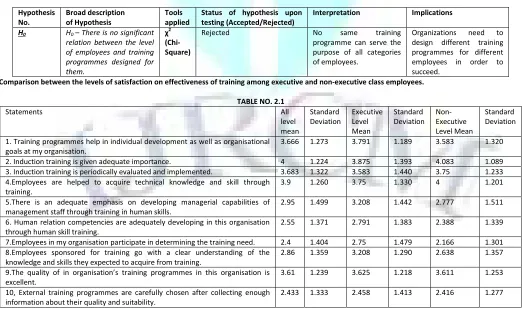
Hypothesis No. Broad description of Hypothesis Tools applied
Status of hypothesis upon testing (Accepted/Rejected)
Interpretation Implications
H0 H0 –There is no significant
relation between the level of employees and training programmes designed for them.
χ2
(Chi-Square)
Rejected No same training programme can serve the purpose of all categories of employees.
Organizations need to design different training programmes for different employees in order to succeed.
Comparison between the levels of satisfaction on effectiveness of training among executive and non-executive class employees.
TABLE NO. 2.1
Statements All
level mean Standard Deviation Executive Level Mean Standard Deviation Non-Executive Level Mean Standard Deviation 1. Training programmes help in individual development as well as organisational
goals at my organisation.
3.666 1.273 3.791 1.189 3.583 1.320 2. Induction training is given adequate importance. 4 1.224 3.875 1.393 4.083 1.089 3. Induction training is periodically evaluated and implemented. 3.683 1.322 3.583 1.440 3.75 1.233 4.Employees are helped to acquire technical knowledge and skill through
training.
3.9 1.260 3.75 1.330 4 1.201 5.There is an adequate emphasis on developing managerial capabilities of
management staff through training in human skills.
2.95 1.499 3.208 1.442 2.777 1.511 6.Human relation competencies are adequately developing in this organisation
through human skill training.
2.55 1.371 2.791 1.383 2.388 1.339 7.Employees in my organisation participate in determining the training need. 2.4 1.404 2.75 1.479 2.166 1.301 8.Employees sponsored for training go with a clear understanding of the
knowledge and skills they expected to acquire from training.
2.86 1.359 3.208 1.290 2.638 1.357 9.The quality of in organisation’s training programmes in this organisation is
excellent.
3.61 1.239 3.625 1.218 3.611 1.253 10, External training programmes are carefully chosen after collecting enough
information about their quality and suitability.
VOLUME NO.5(2015),ISSUE NO.07(JULY) ISSN 2231-5756
INTERNATIONAL JOURNAL OF RESEARCH IN COMMERCE, IT & MANAGEMENT
FINDINGS
Training has been associated with developing performance of bank employees. So, the banking sector can prepare an encouraging environment for advanced training programmes. It will lead to expansion of knowledge, enhancement of positive attitude and improvisation of job skills among the employees. To enhance the effectiveness of training in public sector banks the further findings may focus some light:
• Majority of the bank employees agree that training has a positive effect on human resource development.
• The executive class employees of public sector banks are less satisfied than the non-executive class employees with regard to induction training provided in the bank.
• Induction training is properly evaluated and implemented in banks.
• Non-executive employees are facilitated with training in a better manner than the executive employees to acquire technical knowledge and skill through training.
• There is an adequate emphasis on developing managerial capabilities of executive class employees through training in human skills.
• Employees are not provided with human skill training to develop human relation competencies.
• Employee participation in determining the training need is very low in public sector banks.
• Executive employees go with a clear understanding of the knowledge and skills they expected to acquire from training sponsored by the bank.
• Most of the employees feel discontented regarding the selection of external training programmes because enough information about their quality and suitability is not collected.
SUGGESTIONS
Based on the findings of the study the following conclusion and suggestions were drawn:
o Executive class employees should be facilitated with better induction training and technical skills.
o There should be more focus on developing human relation competencies through human skill training programmes.
o More involvement of employees should be invited for training need assessment.
o Non-executive employees sponsored for training should be provided with clarity in information to understand the knowledge and skills they are expected to acquire from training.
o Initiatives should be taken to select the external training programmes carefully after collecting enough information about their quality and suitability in the organisation.
CONCLUSION
It can be concluded that the actual barrier to the effectiveness of training comes from the human resource development functions. A well designed training programme will create better opportunities for learning. Training programme provides comfortable climate that helps to increase the satisfaction of the employees. Training programmes need to be designed differently as per the needs of different employees based on the length of their experience as well as on the basis of their grades by giving equal emphasis on both executives and non-executives.
LIMITATIONS
The present study has been conducted based on the response received from 60 executives and non-executives working in a public sector bank in Odisha. The findings of the study may not have universal applicability for organisations not included in the study.
SCOPE FOR FURTHER RESEARCH
The findings of this study may not have universal applicability since the study is confined to a definite period and to a public sector bank in Odisha. Hence to arrive at any general conclusion, the hypotheses formulated in this research need further testing by way of additional research in the field of training and organization development in different periods and in different banks of the same industry as well as of other industries. An inter industry study in the field will also be useful.
REFERENCES
1. Anderson Gordon, C., “Management Development: Integrating Individual and Organizational Needs”, Industrial and Commercial Training,1993, 25(4). 2. Bose Ranjit, “E-government: Infrastructure and Technologies for Education and Training”, Electronic Government an International Journal, 2004, 1(4) (pp.
349-361)
3. Collison, G. B. (2000), “Facilitating on-line learning”. WI, Atwood: Madison.
4. Frank Erik, and Margerison Charles,“Training Methods and Organization Development”, Journal of European Industrial Training, 1978, 2(4) (pp. 2-32). 5. Harwitz Frank, M., “The Emergence of Strategic Training and development: The Current state of Play”, Journal of European Industrial Training,1999,23(4/5)
(pp. 180-190).
6. Hassan, A., “Human Resource Development and Organizational Values”, Journal of European Industrial Training, 2007, 31(6) (pp.435-448).
7. Hytönen, T. (2002), “Exploring the practice of Human Resource Development as a Field of Professional Expertise”, Ph.D. Thesis, University of Jyväskylä, Finland, (p. 29)
8. Kirkapatrick, D.L. (1998), “Evaluating Training Programs: The Four Levels”, San Francisco: Berrette-Koehler. 9. Lynton, R.P. and Pareek, U. (2000), The Human Resource Development Handbook, London, UK: Kogan Page Ltd.
10. Mathieu J.E., “Individual and Situational Influences on the Development of Self-efficacy: Implications for Training Effectiveness”, Personnel Psychology, 2006,46(1) (pp. 125-147).
11. Purohit, G.N. (1992) “A Comparative Study of Integrated Human Resource Development Systems of Public and Private Sector Organisations”,(Doctoral Thesis), Faculty of Commerce & Management studies Jai Narain University, Jodhpur.
12. Rothwell, W. and Sredl (1992), The ASTD refrence guide to professional human resources development role and competence (2 Ed.). Amherst, M.A: HRD Press.
13. Seibert, A. (2000), “Teaching adult student the way they learn: The instructor's role in retaining adult learners and increasing the chances of success” Paper presented at the National conference on the adult learners, Atlanta, GA.
VOLUME NO.5(2015),ISSUE NO.07(JULY) ISSN 2231-5756
INTERNATIONAL JOURNAL OF RESEARCH IN COMMERCE, IT & MANAGEMENT
ANNEXURE
QUESTIONNAIRE
About Yourself
This section asks for some details on you, which will help to classify your answer. 1. Designation: Executive Non-Executive
2. Age group [Put a tick (√) mark according to your age ]
(i) 20>30 Years (ii) 30>40 Years (iii) More than 40 Years 3. Educational Qualification [Put a tick (√) mark according to your educational qualification ]
(i) Graduate (ii) Post Graduate (iii) Technical or professional graduate [Specify Degree (s) ________]
4. There are 10 statements in the following table. Please mark satisfied or dissatisfied with the same on a five point scale of, 1 = Strongly Dissatisfied; 2 = Dissatisfied; 3 = Can’t Say; 4 = Satisfied; 5 = Strongly Satisfied; (Single Coding Only).
Statements Scale
1. Training programmes help in individual development as well as organisational goals at my organisation. 1---2---3---4---5
2. Induction training is given adequate importance. 1---2---3---4---5
3. Induction training is periodically evaluated and implemented. 1---2---3---4---5
4. Employees are helped to acquire technical knowledge and skill through training. 1---2---3---4---5
5. There is an adequate emphasis on developing managerial capabilities of management staff through training in human skills. 1---2---3---4---5
6. Human relation competencies are adequately developing in this organisation through human skill training. 1---2---3---4---5
7. Employees in my organisation participate in determining the training need. 1---2---3---4---5
8. Employees sponsored for training go with a clear understanding of the knowledge and skills they expected to acquire from training. 1---2---3---4---5
9. The quality of in organisation’s training programmes in this organisation is excellent. 1---2---3---4---5
VOLUME NO.5(2015),ISSUE NO.07(JULY) ISSN 2231-5756
INTERNATIONAL JOURNAL OF RESEARCH IN COMMERCE, IT & MANAGEMENT
REQUEST FOR FEEDBACK
Dear Readers
At the very outset, International Journal of Research in Commerce, IT & Management (IJRCM)
acknowledges & appreciates your efforts in showing interest in our present issue under your kind perusal.
I would like to request you tosupply your critical comments and suggestions about the material published
in this issue as well as on the journal as a whole, on our [email protected] for further
improvements in the interest of research.
If youhave any queries please feel free to contact us on our E-mail
.
I am sure that your feedback and deliberations would make future issues better – a result of our joint
effort.
Looking forward an appropriate consideration.
With sincere regards
Thanking you profoundly
Academically yours
Sd/-
Co-ordinator
DISCLAIMER
VOLUME NO.5(2015),ISSUE NO.07(JULY) ISSN 2231-5756