RESEARCH NOTE
MICROENCAPSULATION OF ORANGE OIL BY COMPLEX
COACERVATION AND ITS RELEASE BEHAVIOR
F. Vahabzadeh
Department of Chemical Engineering, Amirkabir University of Technology Tehran, Iran, [email protected]
M. Zivdar and A. Najafi
Department of Chemical Engineering, Sistan and Baluchestan University Zahedan, 98164, Iran, [email protected] [email protected]
(Received: July 15, 2003 – Accepted in Revised Form: October 14, 2004)
Abstract Microencapsulation of liquid orange oil as a common flavoring agent in food industries by complex coacervation in a gelatin – gum Arabic polymeric wall system was studied. At a fixed ratio of 10% w/v as concentration of the materials used in this study, trend of changes of microencapsulation process variables using different wall polymeric contents along with varying levels of the core to wall ratio were investigated. Distribution pattern of the coacervate particle size showed that more than 70% of the particle with the average diameter of 9.68 mm were reasonably encapsulated in those treatments having core to wall ratio at the level of 1:1 and 1:2 while gelatin to gum arabic content of the wall system were set to be 1:1 and 2:1 ratio, respectively. The yield of the process as ratio of the amount of coacervate microcapsules produced to the amount of materials initially present in the emulsion was highest (69%) for the treatment described. Moreover, the release and swelling data have been analyzed in terms of the generalized equation Mt/M∞=ktn applicable for swellable controlled release systems. The results obtained were discussed on the basis of the release rate constant k, and diffusional exponent n.
Key Words Complex Coacervation, Microencapsulation, Orange Oil, Release Behavior, Gelatin - Gum Arabic
ﻩﺪﻴﻜﭼ
ﻱﺩﺮﺑﺭﺎﻛ ﺎﺑ ﻲﻠﺻﺍ ﻱﺎﻫ ﻩﺪﻨﻫﺩ ﻢﻌﻃ ﻪﻠﻤﺟ ﺯﺍ ﻝﺎﻘﺗﺮﭘ ﺲﻧﺎﺳﺍ ﻱﺯﺎﺳ ﻝﻮﺴﭙﻛﻭﺮﻜﻴﻣ ﺮﺿﺎﺣ ﻖﻴﻘﺤﺗ ﺭﺩ
ﺯﺍ ﻩﺩﺎﻔﺘﺳﺍ ﺎﺑ ﻲﻳﺍﺬﻏ ﻊﻳﺎﻨﺻ ﺭﺩ ﻊﻴﺳﻭ ًﺎﺘﺒﺴﻧ
ﺗ
ﺑ ﻭ ﻩﺪﻴﭽﻴﭘ ﻱﺯﺎﺳ ﻩﺩﻮﺗ ﻚﻴﻨﻜ
ﻪ
ﻱﺍ ﻩﺭﺍﻮﻳﺩ ﻢﺘﺴﻴﺳ ﻱﺮﻴﮔﺭﺎﻛ
ﻦﻴﺗﻻﮊ –
ﻲﺑﺮﻋﻎﻤﺻ
ﺖﻓﺮﮔﺭﺍﺮﻗﻲﺳﺭﺮﺑﺩﺭﻮﻣ
.
ﺒﺴﻧﻚﻳﺭﺩ
ﺖﺑﺎﺛﺖ w/v % ١٠ ﺑ ﻪ
ﻱﺍﻮﺘﺤﻣﺭﺩﻭﺩﺍﻮﻣﺖﻈﻠﻏﻥﺍﻮﻨﻋ
ﻱﺍﻩﺭﺍﻮﻳﺩﻱﺮﻤﻴﻠﭘ
)
ﻦﻴﺗﻻﮊ –
ﻲﺑﺮﻋﻎﻤﺻ
(
ﻩﺩﺎﻣﺖﺒﺴﻧﺯﺍﻒﻠﺘﺨﻣﻲﺣﻮﻄﺳﺎﺑﻲﻫﺍﺮﻤﻫﺭﺩﻭﻒﻠﺘﺨﻣﻱﺎﻫﺖﺒﺴﻧﺭﺩ
ﻱﺍﻪﺘﺴﻫ
)
ﻝﺎﻘﺗﺮﭘ ﺲﻧﺎﺳﺍ
(
ﺖﻓﺮﮔﺭﺍﺮﻗﻪﻌﻟﺎﻄﻣ ﺩﺭﻮﻣﻭﻲﺣﺍﺮﻃﻱﺪﻨﭼ ﻱﺎﻫﺭﺎﻤﻴﺗ،ﻱﺍﻩﺭﺍﻮﻳﺩﻪﺑ
.
ﻪﻋﻮﻤﺠﻣ ﻦﻳﺍﺭﺩ
ﺕﺍﺮﻴﻴﻐﺗﺪﻧﻭﺭ ﺎﻫﺭﺎﻤﻴﺗ
ﺪﻳﺩﺮﮔ ﻲﺳﺭﺮﺑ ﻲﺗﺎﻴﻠﻤﻋﻲﻠﺻﺍ ﻱﺎﻫﺮﻴﻐﺘﻣ
.
ﻮﮕﻟﺍﺯﺍ ﻞﺻﺎﺣ ﺞﻳﺎﺘﻧ
ﯼ
ﻩﺯﺍﺪﻧﺍ ﻊﻳﺯﻮﺗ ﻭﺶﺨﭘ
ﺯﺍﺶﻴﺑﺭﻮﻀﺣﺮﮕﻧﺎﺸﻧﻩﺪﺷﻱﺯﺎﺳﻩﺩﻮﺗﺕﺍﺭﺫ
%
٧٠
ﺮﻄﻗﻦﻴﮕﻧﺎﻴﻣﺎﺑﺕﺍﺭﺫﺯﺍ
mm ٦٨ / ٩ ﺩﻮﺑ .
ﺖﺒﺴﻧﺎﺑﺕﺍﺭﺫﻦﻳﺍ
ﻱﺍﻩﺭﺍﻮﻳﺩﻪﺑﻱﺍ ﻪﺘﺴﻫﺩﺍﻮﻣ
١:٢
ﻭ
١:١
ﺪﺷ ﻪﻴﻬﺗ
.
ﻦﻴﺗﻻﮊ ﻱﺍﻮﺘﺤﻣﺖﺒﺴﻧ ﻪﻛﻲﻟﺎﺣﺭﺩ
ﻪﺑ ﻤﺻ
ﻢﺘﺴﻴﺳﺭﺩﻲﺑﺮﻋﻎ
ﺐﻴﺗﺮﺗﻪﺑﻱﺍﻩﺭﺍﻮﻳﺩ
٢:١
ﻭ
١:١
ﻮﺑ ﺩ
.
ﻱﺍﺮﺑ
ﻩﺭﺎﺷﺍﺩﺭﻮﻣﺭﺎﻤﻴﺗ
،
ﻱﺯﺎﺳﻩﺩﻮﺗﺕﺍﺭﺫ ﺭﺍﺪﻘﻣﺕﺭﻮﺻﻪﺑﺪﻴﻟﻮﺗﻲﻳﺁﺭﺎﻛ
ﺩﻮﺑﺪﺣﻦﻳﺮﺘﺸﻴﺑﻥﻮﻴﺴﻟﻮﻣﺍﺭﺩﺩﻮﺟﻮﻣﻪﻴﻟﻭﺍﺩﺍﻮﻣ ﺭﺍﺪﻘﻣﻪﺑ ﻱﺪﻴﻟﻮﺗﻩﺪﺷ
%)
٦٩
.(
ﻪﻄﺑﺍﺭ Mt/M∞=ktn ﯼﺍﺮﺑ
ﻪﻌﻟﺎﻄﻣ
ﺩﺍﺯﺁﻭﻡﺭﻮﺗﺪﻧﻭﺭ
ﻩﺩﻮﺗﺕﺍﺭﺫﻱﺯﺎﺳ
ﺖﻓﺮﮔﺭﺍﺮﻗﻩﺩﺎﻔﺘﺳﺍﺩﺭﻮﻣﻩﺪﺷﻱﺯﺎﺳ
.
ﺕﺪﺷﺖﺑﺎﺛﻪﺑﻪﺟﻮﺗﺎﺑﻞﺻﺎﺣﺞﻳﺎﺘﻧ
ﺩﺍﺯﺁ ﻱﺯﺎﺳ k ﺎﻤﻧﻭ ﯼ ﻱﺫﻮﻔﻧ n
ﺗﻭﺚﺤﺑﺩﺭﻮﻣ
ﺴﻔ
ﺖﻓﺮﮔﺭﺍﺮﻗﺮﻴ
.
1. INTRODUCTION
Most liquid food flavorings are volatile substances and their unstable chemical nature under influence of
various methods used for microencapsulation, complex coacervation is one of the oldest methods known and has been used for a wide range of applications [2-5]. The term coacervation first was introduced into colloidal chemistry by Bungenberg de Jong and Kruyt in 1930’s to give a description for flocculation or separation of liquids from solution where at least one of the liquids contained a colloidal solute [6,7]. One of the accepted technique in complex coacervation, is based on using gelatin – gum arabic as the wall system in which the main step is deposition of the liquid colloidal wall material as a continuous phase coating about the material to be encapsulated as a dispersed phase [7,8]. Obviously many operational variables would be effective on the performance of the wall system and its efficiency.
There are some studies especially in the area of pharmaceuticals concerning the release kinetics of the encapsulant from an encapsulating system [9,10]. An attractive approach was developed using a generalized equation which is based on the Fick’s law of diffusion for a swellable polymeric system:
n
t kt
M M
= ∞
Where ( ∞
M
M
t) is the fractional release at time t; k, a constant characteristic of the polymer –encapsulant system; and n, an exponent which is characteristic of the mechanism of the encapsulant release; in that Mt has been calculated using percent release at the specified time and M∞is the amount of the core material released at long times, which may or may not be equal to the total core materials (orange oil) incorporated in the coacervate particles [9,10].
Although there are substantial research on food flavorings and the relevant encapsulation processes to our knowledge, but little work has been done about the mechanism and the mathematical modeling of the release event of the food subjects. On the other hand regarding to the pharmaceutical industry available reports on the modeling subject relative to the mechanism of the drug action are overwhelming [3,9,10,11,12].
In the present work, coacervation as a common and well known encapsulation procedure was used to prepare spherical particles of liquid food flavoring (orange oil) encapsulated in gum arabic and gelatin as the wall system. By using the generalized equation, i.e., mentioned above, the
release behavior of the food flavoring encapsulant was also, studied.
2. EXPERIMENTAL SECTION
Materials
Gum arabic (GA) and gelatin (GE)powder, Merck; orange oil as the food-flavoring agent (Düllberg Konzentra, Germany – purchased from the local market.); glutaraldehyde (25%) and sodium hydroxide (analytical grade).
Preparation of Microcapsules
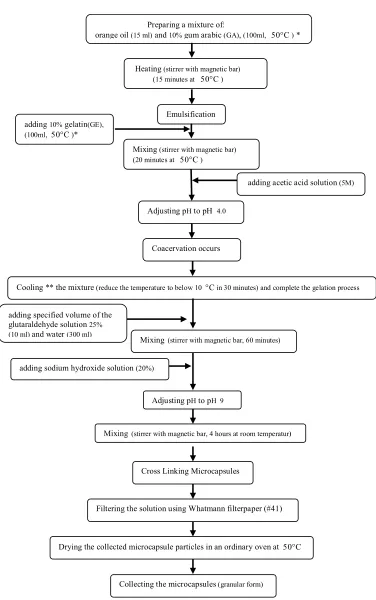
Microencapsulationmethod used in the present study was essentially based on the procedure described by Luzzi and Gerranghty[6] and, as modified by Madan et al.[7]. The scheme for preparing the coacervates is shown in Figure 1.
A series of sieves were used for the separation of microcapsules in various size ranges. Particles passing through one sieve and retained on the next finer sieve were given the arithmetic mean size of the two screen openings. In order to obtain the particles having average diameter of 9.68, 1.93, 0.325 and 0.075 mm, sieves with the appropriate characteristics of the screen openings were used (16.0, 3.35, 0.500 and 0.149 mm).
In the present study the ratio of core to wall materials was set at three levels. Moreover, the ratio for gelatin to gum arabic as the chemical constituents of the wall system was selected to be at three different levels. Nine different treatments therefore, were prepared according to the specifications given in the Table 1.
Yield of the complex coacervation procedure in the present study was determined by dividing weight of the coacervate prepared, by the initial weight of the materials used (combined weight of core and wall materials).
Determination of the Release Rate and
Swelling Ratio
After placing a specified amountPreparing a mixture of:
orange oil (15 ml)and 10%gum arabic (GA), (100ml, 50 C° )*
Emulsification
adding specified volume of the glutaraldehyde solution 25% (10 ml) and water (300 ml)
adding acetic acid solution (5M)
Adjusting pHto pH 4.0
Coacervation occurs
Cooling ** the mixture (reduce the temperature to below 10 °Cin 30 minutes) and complete the gelation process
Mixing(stirrer with magnetic bar, 60 minutes) adding 10% gelatin(GE),
(100ml, 50 C° )*
Heating (stirrer with magnetic bar) (15 minutes at 50 C° )
Mixing (stirrer with magnetic bar) (20 minutes at 50 C° )
adding sodium hydroxide solution (20%)
Adjusting pHto pH 9
Mixing(stirrer with magnetic bar, 4 hours at room temperatur)
Cross Linking Microcapsules
Filtering the solution using Whatmann filterpaper (#41)
Drying the collected microcapsule particles in an ordinary oven at 50 C°
Collecting the microcapsules (granular form)
Figure 1. Scheme for microencapsulation of the liquid food flavoring (orange oil) using complex coacervation technique as is described in the present study.
٭The separate aqueous solutions of GA and GE (coating materials) were left to equilibrate at room temperature for 15 hours.
were dried in an ordinary oven at 50 C° (W3). Percent of the release and also swelling ratio were determined as follows:
100 W
W W (%) release
1 3
1− ×
=
swelling ratio= 1
3 2
W W
W −
As mentioned earlier a generalized equation which has been developed on the basis of Fick’s law of diffusion and used successfully elsewhere [9,10] was considered in the present study to analyze the release behavior of the orange oil encapsulant.
3. RESULTS AND DISCUSSION
Distribution Pattern of the Coacervate Particle
size
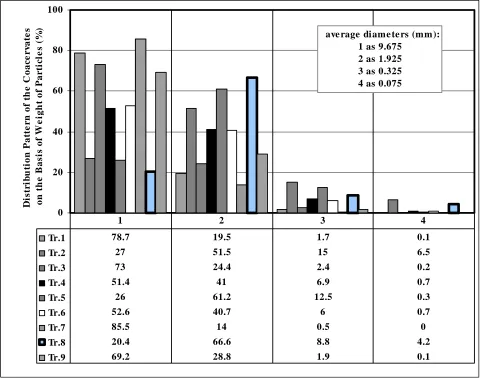
The sizes of the dried coacervate particles had a distribution pattern, which is shown in Figure 2. At a fixed ratio of 10% w/v as the concentration of the materials used in the present study, different polymer contents (gelatin and gum arabic as the principal wall constituents) along with three levels of the core to wall ratio were used to prepare the coacervate particles (see Table 1) (results of the preliminary works showed that the emulsification step could not be performedproperly at the concentration lower than 10%). The distribution pattern for the particle diameter did not change significantly when the ratio of the polymeric wall was changed from 1(GE): 1(GA) to 2(GE): 1(GA) and more than 70% of the particles had average diameter of 9.68 mm (Figure 2, trs. 1, 3, 7 and 9). When the level of gum arabic as one of the two wall constituents was increased 1(GE): 2(GA), the particles diameter changed in a way that even increasing core to wall ratio from 1:2 to 2:1 showed to have little effect, and more than 60% of the particles had average diameter of 1.93 mm (Figure 2, trs. 5 and 8). The complex coacervation technique used in the present study did not show to give particles within the desired and reasonable range of diameter of 0.33 mm and 0.075 mm (see Figure 2).
By mixing the pure starch with gelatin, sphere aggregates resembling popcorn balls, with a novel characteristic was produced [13]. The performance of these spheres as the flavor carrier has been evaluated very special. Our expectation from the present work and mixing gum arabic and gelatin was to produce spheres having, capacity, to coat and retain orange oil as discussed above. Moreover, the light microscope was used to see the integrity of the prepared spheres. No further testing was done in the present study. Techniques such as X-ray photoelectron microscopy have been used for the morphological characterization of the wall matrix in the drug delivery systems [14]. Results of these kinds of studies provide informative explanation for the extent of the core material distribution, TABLE 1. Specifications of the Nine Treatments Prepared in the Present Study Using Complex Coacervation Technique, According to A Ratio of the Encapsulant to the Encapsulating Coat and Also Ratio of the Principal Polymeric Constituents of
the Wall System [Gelatin (GE) to Gum Arabic (GA)] – A Number of 1 to 9 Is Given to Each of These Treatments.
ratio of gelatin to gum arabic as the wall constituent GE:GA
1:1 1:2 2:1 ratio of core(C) to wall (W) material
C:W treatment
1:1 1 2 3
2:1 4 5 6
relevant to the release mechanism.
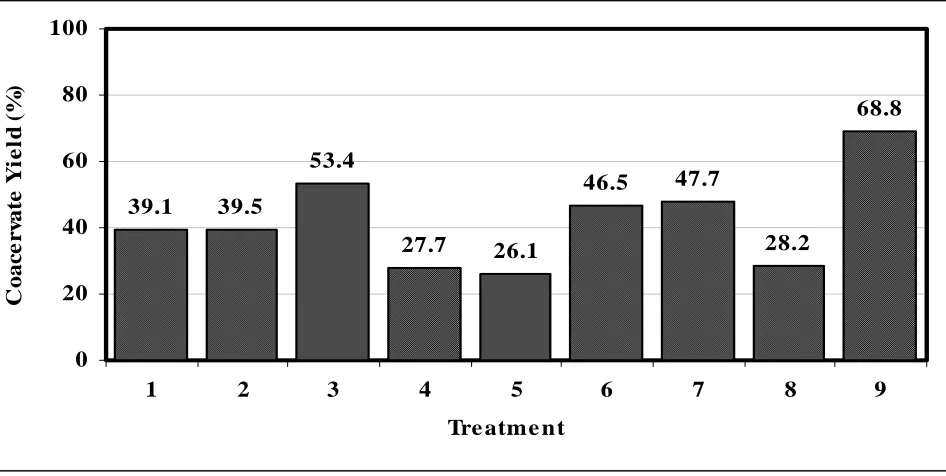
The ratio of the amount of coacervate microcapsules produced to the amount of materials present initially in the emulsion, has been defined as the yield of the process (see experimental section) and in terms of percentage, the yield is the highest (68.8 %) for treatment 9 where the ratio of the encapsulant to the encapsulating materials was 1:2 while the ratio of gelatin to gum arabic as the polymeric wall, was set at the level of 2:1 (Figure 3, also see Table 1). In fact, whenthe encapsulation is properly performed and the reasonable percentage of coacervate particle stay within the desired size then one may say this pattern of size distribution
relates to the higher yield of the process. It seems that the optimum conditions for maximum complex coacervate yield are those of treatment 9 (see Figures 2 and 3). Usually proper performance of the encapsulation is accomplished by preventing the presence and use of chemical and/or physical agents that interfere with the process and therefore strength of the protective wall [6]. Also in preparing coacervates by complex coacervation, pH of the media has an important role and in order to obtain a maximum number of ionic bonds between oppositely charged molecules present in the systems, pH adjustment is necessary: gelatin is a positively charged molecule at pH below its isoelectric 0
20 40 60 80 100
ave rage diame te rs (mm): 1 as 9.675
2 as 1.925 3 as 0.325 4 as 0.075
D
is
tr
ib
u
ti
on
P
a
tt
e
r
n
of
t
h
e
C
oac
e
r
v
a
te
s
on
t
h
e
B
a
s
is
of
W
e
ig
h
t
of
P
a
r
ti
c
le
s
(
%
)
Tr.1 78.7 19.5 1.7 0.1
Tr.2 27 51.5 15 6.5
Tr.3 73 24.4 2.4 0.2
Tr.4 51.4 41 6.9 0.7
Tr.5 26 61.2 12.5 0.3
Tr.6 52.6 40.7 6 0.7
Tr.7 85.5 14 0.5 0
Tr.8 20.4 66.6 8.8 4.2
Tr.9 69.2 28.8 1.9 0.1
1 2 3 4
point while gum arabic particles carry negative charges [8,11]. In fact complex coacervation could not occur above this pH [6,7]. The improper pH adjustment and therefore interference in the coacervation process leads to the material leakage and structural discontinuity of wall (unstabilized coacervates) [5,7]. In the present study pH was adjusted properly and the role of gelatin in completing the wall system could be evaluated fairly well when the ratio of the encapsulant was reduced to half of that of the encapsulating wall materials, (see Figures 2 and 3 also see Table 1, tr. 9). Increasing the hydrophilicity of the wall polymer by rising the level of gum arabic, seems to compensate the increased level of the encapsulant having hydrophobic characteristics (see Figure 2 and Table 1, trs. 5,8) and more than 60% of the dried coacervate particles remain within the average diameter of 1.93 mm however, the yield of the process in treatments 5 and 8 were about 40% lower than that of treatment 9 (see Figure 3). By using glutaraldehyde as the hardening agent in the coacervation process, the particles are stabilized and degree of chemical cross-linking in the capsule shell increases [8]. In the present study use of glutaraldehyde had positive effect on the
coacervate yield and higher percentage of the particles remained within the desired range of diameter [12]. The level of added glutaraldehyde was optimized however, since this reagent when added at the higher concentration (i.e., a definite volume of the 25% glutaraldehyde solution:≥20 ml) did not show to have a considerable effect on the process [12].
Release Behavior of the Orange Oil
Encapsulant from the Swellable Polymeric
System
using the generalized equation, whichhas been developed on the basis of Fick’s law of diffusion for a swellable polymeric system [9,10], the fractional release of orange oil encapsulant was calculated. As it is said before M∞ is the amount of
encapsulant released at a long times, which may or may not be equal to the total encapsulant incorporated in an encapsulating system [10]. The constants n and k, both are best determined by means of a Log-Log plot of
∞
M
M
tversus time
(Log Mt M∞
= nLog t +Log k) [10]. The slope of this plot is the dimensionless exponent, n and the
39.1 39.5
53.4
27.7 26.1
46.5 47.7
28.2
68.8
0 20 40 60 80 100
1 2 3 4 5 6 7 8 9
Tre atme nt
C
o
a
c
er
v
a
te
Y
ield
(
%
)
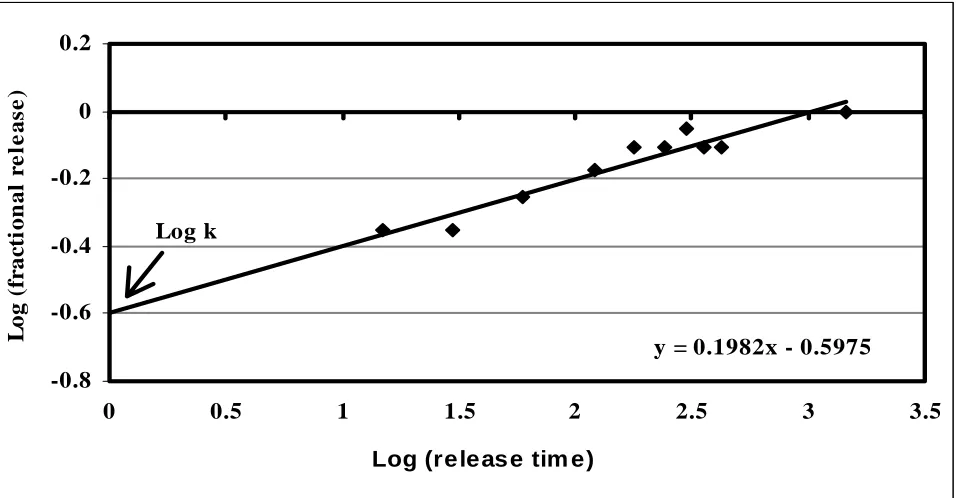
intercept on the Y-axis gives the release rate constant, k. The calculated values for k and n in the present study are given in Table 2. The release rate constant k, depends on the characteristics of the polymeric wall – core system while n, as the exponent, describes more about the type of release mechanism for the encapsulant[10]. In the present study these values are grouped into three levels (see Table 2). The k constant decreases with increasing degree of cross-linking of the polymeric
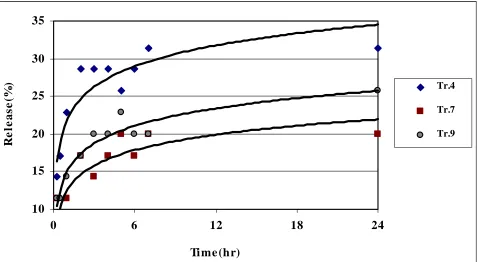
structure [9,10]. As it is seen in Table 2 the release rate constant k, is low for treatments 4, 7 and 9. Wall system having gelatin at the higher ratio may exhibit higher level of the cross-linking (Tables 1 and 2, tr. 9). While the incorporation of more orange oil in preparing the microcapsules (Tables 1 and 2, tr. 4), would increase hydrophobicity characteristics of the core and this may have a decreasing effect on the rate of release. Therefore in the present study, the degree of cross-linking of the polymeric wall system and hydrophobicity characteristics of the encapsulant may almost have equal contribution to the release rate of the microcapsules. Figure 4 shows the plots of percentage of release as a function of time; the data for treatments 4, 7 and 9 are shown. Release remained constant after about 7 hours equilibration period while as an example for representing Log. - Log. Plot, the data of treatment 9 was used (Figure 5). The latter three treatments (tr. 4, 7 and 9) had n value in the range of 0.17 – 0.23. In the experimental setup given by Shukla etal., starch– urea– formaldehyde combination has been used as the encapsulating material[9] and based on the
10 15 20 25 30 35
0 6 12 18 24
Time (hr)
Re
le
a
s
e
(%
) Tr.4
Tr.7
Tr.9
Figure 4. Time course of release of the prepared coacervates –the results obtained for only three treatments are shown in this figure (see the text for the detailed procedure).
TABLE 2. Release Rate Constant, k and Diffusional Exponent, n, of Coacervates Prepared According to the Specifications Given for the Nine Different Treatments (See Table 1 and Also the Text for Details).
treatment k(min
-1) n
1,2,5,8
3,6
4,7,9
0.4
0.5
0.23 – 0.32
0.12 – 0.14
0.08 – 0.1
mathematical solutions of the equation introduced before, three cases have been described: Fickian encapsulant diffusion gives release kinetics with n = 0.5 while for a special case n = 1 generally known as a zero–order kinetics and it is characterized by constant rate of release for the encapsulant [9,10]. Another type of transport mechanism, has been called non-Fickian or deviating from the regular form (anomalous), with 0.5 < n < 1 [10]. In some studies the computed values of n was reported to be as low as 0.3 and 0.45 for Fickian and zero-order mechanism [9]. It is assumed that further reduction in n values could be expected (n = 0.25) when one deals with the bulk release from polydisperse system of irregular shapes, indicating presence of Fickian or anomalous transport mechanism [9]. It is said that studying release of the single particle then could confirm the type of mechanism more precisely [9]. In the present study addition of glutaraldehyde to the medium of the microencapsulation had effect on the k constant and the exponent, n: the exponent n was increased while the release rate constant k had decreased [12,15]. Although the existing possible relationship showed to have a
trend, which was optimum, when glutaraldehyde added at a level not less than 20 ml of the 25% solution. As the level of glutaraldehyde decreased below this concentration, the exponent, n increased 4% while the release rate constant, k was decreased by 7 % [12]. Glutaraldehyde added at the higher level showed to have neither a positive effect on the yield nor and on the desired particle size. An increase in exponent, n up to 32% decrease in the k constant at about 27 % was observed under the latter situation [12]. Stabilization of the coacervates by glutaraldehyde addition to the microencapsulation medium, is an index in describing the characteristics of the polymeric system (i.g., decrease in the release rate constant, k) although the glutaraldehyde addition to the medium showed to have an effect on the transport mechanism of the encapsulant (i.g., increase of the exponent, n).
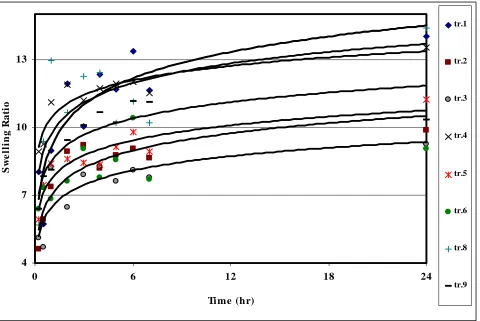
The swelling ratio was also determined in the present study. Relationship between the hydration ability (swelling ratio) of the specified hydrogel and its degree of cross-linking has been studied in details [5,16]. In the present study, the coacervates with higher cross-linking in the wall system (see
y = 0.1982x - 0.5975 -0.8
-0.6 -0.4 -0.2 0 0.2
0 0.5 1 1.5 2 2.5 3 3.5
Log (release tim e)
L
o
g (
fr
ac
ti
on
al
r
e
le
as
e
)
Log k
Table 1, trs. 3, 6 and 9) had lower swelling ratio (Figure 6). An increase in hydration ability is evident for treatments having higher amount of hydrophilic groups in the polymeric wall system (higher content of gum arabic as compared to that of gelatin) (see Figure 6, trs. 2, 5 and 8). The swelling ratio for treatments 1 and 4 having the ratio of gelatin to gum arabic in the wall system as 1:1 and the ratio of core to wall as 1:1 (tr.1) and 2:1 (tr.4), is also high (see Figure 6). The coacervate yield for these treatments is rather low (see Figure 3, trs. 1 and 4). By considering the desired and reasonable particle size and the release behavior, one may conclude that treatment 9 is the treatment of choice (see related Figures 2-5).
4. CONCLUSION
Complex coacervation technique was used to
prepare gelatin–gum arabic complex coacervate microcapsules in the form of coarse granular particles. Particles size distribution was studied with a series of sieves. Swelling ratio and yield of phase separation both were obtained and for studying release behavior of the microcapsules, a generalized equation based on Fick’s law of diffusion was used.
5. REFERENCES
1. Young, S., Sarda, X. and Rosenberg, M., “Microencapsulating Properties of Whey Proteins – 1. Microencapsulation of Anhydrous Milk Fat”, J.Dairy Sci., Vol. 76, No. 10,
(1993), 2868-2877.
2. Bhandari, B., Dumoulin, E., Richard, H., Noleau, I. and Lebert, A., “Flavor Encapsulation by Spray Drying: Application to Citral and Linalyl Acetate”, J. Food Sci.,
Vol. 57, No. 1, (1992), 217-221.
3. Lee, P., “Novel Approach to Zero-Order Drug Delivery via Immobilized Nonuniform Drug Distribution in Glassy
4 7 10 13
0 6 12 18 24
Ti me (hr)
S
w
e
llin
g
R
a
ti
o
tr.1
tr.2
tr.3
tr.4
tr.5
tr.6
tr.8
tr.9
Hydrogels”, J. Pharm. Sci., Vol. 73, No. 10, (1984),
1344-1347.
4. Young, S., Sarda, X. and Rosenberg, M., “Microencapsulating Properties of Whey Proteins - 2. Combination of Whey Proteins with Carbohyrates”, J. Dairy Sci., Vol. 76, No. 10, (1993), 2878-2885.
5. Sheu, T. and Rosenberg, M., “Microencapsulation by Spray Drying Ethyl Caprylate in Whey Protein and Carbohydrate Wall Systems”, J. Food Sci., Vol. 60, No. 1, (1995),
98-103.
6. Luzzi, L. and Gerraughty, R., “Effects of Selected Variables on the Microencapsulation of Solids”, J. Pharm. Sci., Vol. 56, No. 5, (1967), 634-638.
7. Madan, P., Luzzi, L. and Price, J., “Factors Influencing Microencapsulation of a Waxy Solid by Complex Coacervation”, J. Pharm. Sci., Vol. 61, No. 10, (1972), 1586-1588.
8. Takenaka, H., Kawashima, Y. and Lin, S., “Micromeritic Properties of Sulfamethoxazole Microcapsules Prepared by Gelatin – Acacia Coacervation”, J. Pharm. Sci., Vol.
69, No. 5, (1980), 513-516.
9. Shukla, P., Rajagopalan, N. and Sivaram, S., “Starch Urea – Formaldehyde Matrix Encapsulation IV. Influence of Solubility and Physical State of Encapsulant on Rate and Mechanism of Release”, J. Applied Polymer Sci., Vol. 48,
No. 7, (1993), 1209-1222.
10.Narasimhan, B., Mallapragada, S. and Peppas, N., “Release kinetics. Data interpretation”, in Encyclopedia of Controlled Drug Delivery, Vol. 2., Mathiowitz, E., (Ed.), John Wiley and Sons, Inc., N. Y., (1999), 921-935. 11.Tsung, M. and Burgess, D., “Preparation and Stabilization
of Heparin / Gelatin Complex Coacervate Microcapsules”,
J. Pharm. Sci., Vol. 86, No. 5, (1997), 603-607.
12.Najafi, A., “Controlled Release of Food Ingredients”, M.Sc. Thesis, Sistan and Baluchestan University, Zahedan, Iran, (2003).
13.Zhao, J., Whistler, R. L., “Spherical Aggregates of Starch Granules as Flavor Carriers”, Food Technology, Vol. 48,
No. 7, (1994), 104-105.
14.Wang, Ch., Sengothi, K., Wong, H. M., Lee, T., “Controlled Release of Human Immunoglobulin G.2. Morphological Characterization”, J. Pharm. Sci., Vol. 88,
No. 2, (1999), 221-228.
15.Jiang, H. and Zhu, K., “Polyanion/Gelatin Complexes as pH-Sensitive Gels for Controlled Protein Release”, J. Applied Polymer Sci., Vol. 80, (2001), 1416-1425.