RESEARCH NOTE
M/M/m/K QUEUE WITH ADDITIONAL SERVERS AND
DISCOURAGEMENT
M. Jain and G.C. Sharma
School of Mathematical Sciences, Institute of Basic Science
Khandari, Agra, 282002, India, [email protected] - [email protected]
(Received: July 2, 2000 – Accepted in Revised Form: October 25, 2001)
Abstract Waiting in long queue is undesirable due to which in some practical situations customers become impatient and leave the system. In such cases providing additional servers can reduce long queue. This investigation deals with multi-server queueing system with additional servers and discouragement. The customers arrive in poisson fashion and are served exponentially by a pool of permanent and additional servers on the basis of FCFS queue discipline. The explicit formula to determine the number of customers in the queue has been obtained. Numerical illustration has been provided to validate the analytical results established. Graphs are drawn for expected number of customers in the system and probability of all additional servers being busy in order to visualize the effect of various parameters.
Key Words Multi-Server Queue, Finite Capacity, Additional Servers, Queue Size, Discouragement, Cost Analysis
ﻩﺪﻴﻜﭼ
ﻩﺪﻴﻜﭼ
ﻩﺪﻴﻜﭼ
ﻩﺪﻴﻜﭼ
ﺮﺻ
ﻲﻣ ﺚﻋﺎﺑ ﻲﻌﻗﺍﻭ ﻞﻳﺎﺴﻣ ﺭﺩ ﹰﺎﻀﻌﺑ ﻭ ﻩﺩﻮﺑ ﺪﻨﻳﺎﺷﻮﺧﺎﻧ ﻲﻧﻻﻮﻃ ﻱﺎﻬﻔﺻ ﺭﺩ ﺖﻗﻭ ﻑ ﻱﺎﻬﻳﺮﺘﺸﻣ ﻪﻛ ﺩﻮﺷ
ﺪﻨﻨﻛ ﻙﺮﺗ ﺍﺭ ﻢﺘﺴﻴﺳ ﺭﻮﺒﺻ ﺮﻴﻏ .
ﻲﻣ ﻩﺪﻨﻫﺩ ﺲﻳﻭﺮﺳ ﻥﺩﺮﻛ ﻪﻓﺎﺿﺍ ﻂﺳﻮﺗ ﻪﺑ ﺩﺭﺍﻮﻣ ﻪﻧﻮﮕﻨﻳﺍ ﺭﺩ ﺍﺭ ﻒﺻ ﻝﻮﻃ ﻥﺍﻮﺗ
ﺩﺍﺩ ﺶﻫﺎﻛ .
ﻩﺪﻨﻫﺩ ﺲﻳﻭﺮﺳ ﺶﻳﺍﺰﻓﺍ ﻥﺎﻜﻣﺍ ﻪﻛ ﻩﺪﻨﻫﺩ ﺲﻳﻭﺮﺳ ﺪﻨﭼ ﻒﺻ ﻱﺎﻬﻤﺘﺴﻴﺳ ﺎﺑ ﻖﻴﻘﺤﺗ ﻦﻳﺍ ﺭﺎﻛﻭﺮﺳ ﺪﻧﺭﺍﺩ
ﻲﻣ ﺭﺍﺮﻗ ﻲﺳﺭﺮﺑ ﺩﺭﻮﻣ ﻢﻫ ﺍﺭ ﻢﺘﺴﻴﺳ ﻥﺎﮔﺪﻨﻨﻛ ﻙﺮﺗ ﻦﻤﺿ ﺭﺩ ﻭ ﺩﺭﺍﺩ ﺪﻫﺩ
. ﺩﺭﺍﻭ ﻥﻮﺳﺍﻮﭘ ﻊﻳﺯﻮﺗ ﺱﺎﺳﺍ ﺮﺑ ﺎﻬﻳﺮﺘﺸﻣ
ﻲﻣ
ﻲﻣ ﺖﻣﺪﺧ ﻲﻳﺎﻤﻧ ﻊﻳﺯﻮﺗ ﺱﺎﺳﺍ ﺮﺑ ﻭ ﺪﻧﻮﺷ ﻲﻤﻳﺍﺩ ﻥﺎﮔﺪﻨﻨﻛ ﺖﻣﺪﺧ ﺯﺍ ﻪﻋﻮﻤﺠﻣ ﻚﻳ ﻪﻛ ﻒﻴﺻﻮﺗ ﻦﻳﺍ ﺎﺑ ،ﺪﻧﺮﻴﮔ
ﺮﺑ ﻒﺻ ﻢﻈﻧ ﻭ ﺖﺴﻫ ﺰﻴﻧ ﻩﺪﻨﻫﺩ ﺲﻳﻭﺮﺳ ﺶﻳﺍﺰﻓﺍ ﻥﺎﻜﻣﺍ ﻭ ﻢﻳﺭﺍﺩ ﺱﺎﺳﺍ
(FCFS) ﻱﺩﺍﺮﻓﺍ ﺎﺑ ﻡﺪﻘﺗ ﻖﺣ ﻲﻨﻌﻳ ؛ﺖﺳﺍ
ﻩﺪﺷ ﺩﺭﺍﻭ ﻒﺻ ﻪﺑ ﺮﺗﺩﻭﺯ ﻪﻛ ﺖﺳﺍ ﺪﻧﺍ
. ﻩﺪﺷ ﻪﺒﺳﺎﺤﻣ ﻒﺻ ﺭﺩ ﻱﺮﺘﺸﻣ ﺩﺍﺪﻌﺗ ﻦﻴﻴﻌﺗ ﻱﺍﺮﺑ ﻲﻨﺷﻭﺭ ﻭ ﺢﺿﺍﻭ ﻝﻮﻣﺮﻓ
ﺖﺳﺍ .
ﺖﺳﺍ ﻩﺪﺷ ﻩﺩﺎﻔﺘﺳﺍ ﻱﺩﺪﻋ ﻱﺎﻬﻟﺎﺜﻣ ﺯﺍ ﻩﺪﻣﺁ ﺖﺳﺪﺑ ﻲﻠﻴﻠﺤﺗ ﺞﻳﺎﺘﻧ ﻲﻳﺍﻭﺭ ﻱﺍﺮﺑ .
ﻲﺿﺎﻳﺭ ﺪﻴﻣﺍ ﻩﺪﻫﺎﺸﻣ ﻱﺍﺮﺑ
ﻦﻴﻨﭽﻤﻫ ﻭ ﻢﺘﺴﻴﺳ ﺭﺩ ﻱﺮﺘﺸﻣ ﺩﺍﺪﻌﺗ ﺎﺗ ﺖﺳﺍ ﻩﺪﺷ ﻩﺩﺎﻔﺘﺳﺍ ﻲﻳﺎﻫﺭﺍﺩﻮﻤﻧ ﺯﺍ ﻲﻓﺎﺿﺍ ﻥﺎﮔﺪﻨﻫﺩ ﺲﻳﻭﺮﺳ ﻝﺎﻐﺘﺷﺍ ﻝﺎﻤﺘﺣﺍ
ﺩﻮﺷ ﻩﺪﻳﺩ ﻪﻨﻴﻋ ﻪﺑ ﺎﻫﺮﺘﻣﺍﺭﺎﭘ ﺭﺎﺘﻓﺭ ﻩﻮﺤﻧ .
1. INTRODUCTION
For an organization, the service costs recommend a minimal level of service, whereas undesirable long waiting times recommend a high level of service. From the cost viewpoint these two considerations create conflicting pressure on the decision maker. Therefore it is necessary to evolve some way of compromise so that queuing model may give the best balance between the average delay and the cost of providing this service. Providing additional servers for a long queue can do this. Murari [1] studied a limited waiting space queuing
system with additional special channel for a long queue. Makaddis and Zaki [2] developed the M/M/1/∞ queuing system with additional servers for a long queue. Varshney et al. [3] extended this work to M/M/m/K queuing system with additional servers. Jain [4] suggested the provision of additional repairmen apart from permanent repair facility for M/M/R machine repairmen problem with spares. Jain and Ghimire [5] studied M/M/m/K queue with nopassing and additional servers.
system, which causes the loss to the system and also inconveniences to the customers. Jain et al. [6] introduced concept of nopassing for multiserver queueing model with two types of customers and discouragement.
Some efforts have been made to study queuing models with discouragement via diffusion approximation. Varshney et al. [7] analyzed the diffusion approximation for G/G/m queuing system with discouragement. Garg et al. [8] developed the G/Gy/m queuing system with discouragement via diffusion approximation. Jain [9] and Varshney et al. [10] investigated queuing model with discouragement via diffusion approximation and provided some useful results for the measures of effectiveness. Jain and Singh [11] studied a finite capacity priority queuing model with discouragement. Jain [12] investigated Markovian queuing model with discouragement and having the facility of additional servers to share the load in case of a long queue. The customers were assumed to be originated from infinite source and there is provision of infinite waiting space. But in realistic situations, the assumption of infinite capacity is unrealistic so that the study of finite capacity model is more desirable. Recently, Jain et al. [13] discussed M/M/C/K/N machine repair problem with balking, reneging, spares and additional repairman.
In this study, we investigate the finite capacity M/M/m/K queue with additional servers and discouragement. The paper is organized as follows. Mathematical model and analysis are given in section 2. The expected number of customers in long run and the probability that a particular server being busy have been derived in section 3. Section 4 provides particular cases wherein comparative study for model with and without additional servers has also been documented. For illustration purpose, some numerical results have been reported in section 5. In last section 6, we conclude our investigation by discussing the various applications of the model.
2. MATHEMATICAL MODEL AND ANALYSIS
The customers arrive according to Poisson process
with mean rate λ and are served exponentially with mean rate µ by a pool of s including r = s-m additional servers on the basis of FCFS queue discipline. The number of servers required for service depends upon the number of customers present in the system in the following ways:
• When the number of customers is less than or equal to N, m (
≥
1) permanent servers will be available in the system.• When the number of customers is greater than N and less than or equal to 2N, an additional server will be provided in the system. In general, when the number of customers is greater than jN and less than or equal to
) 1 ( ,..., 3 , 2 , 1 , ) 1
(j+ N j= s−m− , system will provide j additional servers. The jth (j = 1, 2, 3,..., s-m-1) additional server will be turned off as soon as the number of customers in the system drops to jN.
• There will be all r additional servers available when there are more than rN customers in the system.
The customers are assumed to be discouraged by a long queue so that the arrival rate depends on the number of customers per server present in the system.
The state-dependent arrival and service rates for the model are given by
< ≤ − λ
+
+ < ≤ λ
+ +
< ≤ λ
+
< λ
= λ
β β β
K n N ) m s ( ; 1
n s
N ) 1 j ( n jN ; 1
n j m
N n m ; 1
n m
m n ;
n (1)
where β is a positive constant called "pressure coefficient" which indicates the degree to which the arrival rate is effected by the number of customers per server in the system. Thus, the customers balk with probability
1-β
+ + 1 n
j m
< ≤ − µ + < ≤ µ + < ≤ µ < µ = µ K n N ) m s ( ; s N ) 1 j ( n jN ; ) j m ( N n m ; m m n ; n n ;j=1,2,3,…..s-m-1 (2) Let Pn be the steady state probability of being n
customers in the system. Using Equations 1 and 2 and birth death process [14], we get
≤ ≤ − + − ρ + ≤ ≤ + − ρ ≤ ≤ ρ ≤ < ρ =
∏
∏
− − = − − β − β − − = − β − β − − β − − β − K n N ) m s ( ; s ) r m ( 1 )! 1 m ( m ! n p N ) 1 j ( n jN ; ) r m ( 1 )! 1 m ( m ! n p N n m ; m ) ! m ( 1 ! n p m n 0 ; ! n p P 1 m s 0 r N ) m s n )( 1 ( ) 1 ( N 1 m n 0 s 0 r ) jN n )( 1 ( N 1 1 m n 0 ) 1 )( m n ( 1 n 0 n 0 n (3)where ρ is traffic intensity and is given by relation ) m s ( − µ λ = ρ
By using normalizing condition P 1
K 0 n n =
∑
= we get 1 K 1 N ) m s (n nN(1 ) n 1 m s 0 r ) 1 ( N ) 1 )( m s ( N 1 1 m s 0 r ) 1 ( N 1 m s 1 j N ) 1 j ( 1 jN n n 1 1 m N 1 m
n n(1 ) n 1 1 m M 1 n n 0 s 1 ! n ) r m ( s )! 1 m ( m ) r m ( 1 ! n )! 1 m ( m m ! n ) ! m ( m ! n 1 P − + −
= −β
− − = β − β − − β − − = β − − − = + + = β − − +
= −β
β − − = ρ + − + + ρ − + ρ + ρ + =
∑
∏
∏
∑ ∑
∑
∑
(4)3. PERFORMANCE MEASURES
Expected number of customers in the long run with (s - m) additional servers is given by
+ + + + + + − = − + − = − − = − + − − − = − − − − = + + = − − + = − − − =
∑
∏
∏
∑ ∑
∑
∑
) 1 ( 1 ) ( 1 0 ) 1 ( 1 ) 1 )( ( 1 0 ) )( 1 ( 1 1 ) 1 ( 1 1 ) 1 ( 1 1 1 ) 1 ( 1 0 1 ! ) ( ! ) ( 1 ! ) ( ! 1 ! ) ! ( )! ( ) ( β β β β β β β β β ρ ρ ρ ρ nN K N m s n n m s r N m s N m j r jN n N m s j N j jN n n m n N m n n m m n n s n r m s m m r m n j m m m m n m m m n P Q E (5)The probability that the number of customers greater than or equal to (jN+1) and less than (j+1)N in long run is
Prob. [(jN+1) ≤Q<(j+1)N]
∏
∑ ∑
= β − − − = + + = β − + ρ + = j 0 r ) 1 ( N 1 m s 1 j N ) 1 j ( 1 jN n n 1 m 0 ) r m ( 1 ! n ) j m ( ! m m P (6)where j = 0, 1, 2, ..., (s-m-1).
The probability that the number of customers greater than ( s - m)N in the system is
Prob. [(s-m)N
≤
Q≤
K]∑
∏
− = − + β −β− = β − − β − − β − ρ + = K 1 N ) m s (
n nN(1 )
n 1 m s 0 r ) 1 ( N 1 ) 1 )( m s ( N 1 m 0 s 1 ) ! n ( ) r m ( s ! m m P (7)
4. SPECIAL CASES
Case – I
When β=0, Pn given by the Equation 3Case – II
For j = 0 and m = s, we get results for a model with discouragement which tally with standard results (cf. [14]).5. NUMERICAL ILLUSTRATION
To quantitatively characterize the performance of
the system, we tabulate the probability of jth additional servers being busy and expected number of customers E(Q) in the system. Table 1 demonstrates the probability of jth (j=1,2,3) additional servers being busy. In table 2, we display E(Q) and the probability of all additional servers being busy by fixing the other parameters as follows: m = 2, K = 50, N = 2, β = 0.5 and µ = 1. It is observed that E(Q) decreases as pressure coefficient (β) and number of servers (s) increases which tally with 0
1 2 3 4 5 6 7 8
1 1.5 2 2.5 3 3.5 4 4.5
λλλλ
E ( Q
s=3
s=4
s=5
Figure 1. Average number of customers in the system for β = 0.5, µ = 1, m = 2, N = 2 and K = 50.
0.0
0.1
0.2
0.3
0.4
0.5
0.6
0.7
0.8
0.9
1.0
1 1.5 2 2.5 3 3.5 4 4.5
λλλλ
Prob
s=3
s=4
s=5
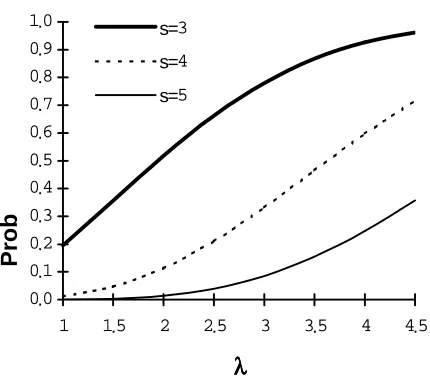
Figure 2. Prob. [rN <= Q <= K] for β = 0.5, µ = 1, m = 2, N = 2 and K = 50.
0 1 2 3 4 5 6 7 8 9
0.1 0.2 0.3 0.4 0.5 0.6 0.7 0.8 0.9
ββββ
E(Q)
r=1 r=2 r=3
Figure 3. Expected number of customers for λ = 3, µ = 1, m = 2, N = 2 and K = 50.
0.0
0.1
0.2
0.3
0.4
0.5
0.6
0.7
0.8
0.9
1.0
0.1 0.2 0.3 0.4 0.5 0.6 0.7 0.8 0.9
ββββ
Prob
r=1
r=2
r=3
physical situation. In figure 1, the effect of arrival rate on the expected number of customers for fixed
β = 0.5, µ = 1, m = 2, N = 2, K = 50 by varying additional servers r = 1, 2, 3 is depicted. We observe that expected number of customers in the system decreases by providing more additional servers. Figure 2 demonstrates the probability of all additional servers being busy for r = 1, 2, 3. It is easily seen that probability decreases with the increase in r. Figures 3 and 4 display E(Q) and Prob. [(rN <= Q < K] vs. βfor r = 1, 2, 3. Figures 3 reveals that as β and r increase, E(Q) decreases. From Figure 4, we observe that probability of all
additional servers being busy decreases as β and r increase.
6. DISCUSSION
This model enables us to reduce the waiting times of the customers in the system with the reasonable service cost by providing additional servers in case of a long queue. Admittedly, explicit formula obtained is extremely useful to estimate the number of customers in the queue at any instant directly. The effect of providing additional servers on waiting time plays a significant role to reduce the balking behavior of the customers. In all, this model is of immense importance and has many potential applications in computer, production, telecommunication systems to reduce the waiting time in case of heavy traffic. Some other areas of applications are air/railway reservation, collection counters at various places, particularly on the last day, and priority health centers in rural areas, etc.
7. ACKNOWLEDGEMENT
This research is supported by University Grants Commission, New Delhi vide project number F.8-2/98(SR-I) and F.8-5/98(SR-I). The authors wish to thank anonymous referees for their valuable comments and suggestions.
8. REFERENCES
1. Murari, K. E., "An Additional Special Channel, Limited Space Queuing Problem with Service in Batches of Variable Size", Oper. Res., Vol. 16, No. 1, (1968), 83 - 90.
2. Makkaddis, G. S. and Zaki, S. S., "The Problem of Queuing System M/M/1 with Additional Servers for a Longer Queue", Indian J. Pure, Appl. Maths, Vol. 14, No. 37, (1983), 345 - 354.
3. Varshney, K., Jain, M. and Sharma, G. C., "The M/M/m/K Queuing System with Additional Servers for a Large Queue", Proc. of the seminar 65th Birthday celebration of Prof. S.C. Dasgupta, (1988), 277-282.
4. Jain, M., "M/M/R Machine Repair Problem with Spares and Additional Servers”, Indian Journal of Pure and
TABLE 1. Probability of jth additional servers being busy for λλλλ = 3, µµµµ = 1, m = 2, N = 2 and K = 50.
Prob. [(jN+1)<=Q<(j+1) N] r ββββ
j=1 j=2 j=3
0.1 0.514 0.5 0.512 2
0.9 0.509
0.1 0.484 0.199 0.5 0.489 0.201 3
0.9 0.493 0.203
0.1 0.381 0.241 0.092
0.5 0.416 0.226 0.066
4
0.9 0.443 0.207 0.047
TABLE 2. The expected number of customers in the system and the Probability of all additional servers being busy for λλλλ = 3, µµµµ = 1, m = 2, N = 2 and K = 50.
E (Q) Prob. [rN <= Q <K] ββββ
s = 3 s = 5 s = 3 s = 5
0.1 7.76 3.17 0.88 0.13
0.2 5.36 3.06 0.84 0.12
0.3 4.42 2.96 0.81 0.10
0.4 3.90 2.89 0.79 0.09
0.5 3.57 2.82 0.78 0.08
0.6 3.33 2.75 0.76 0.07
0.7 3.15 2.70 0.75 0.06
0.8 3.01 2.65 0.74 0.06
Applied Mathematics, Vol.29, No. 1, (May 1998), 517-524.
5. Jain, M. and Ghimire, R. P., "M/M/m/K Queue with Nopassing and Additional Servers", Journal of M. A. C. T., Vol. 32, (1999), 13-21.
6. Jain, M., Sharma, B. and Sharma, G. C., "On Nopassing Multiserver Queuing Model with Two Types of Customers and Discouragement", Jour. Math. Phy. Sci., Vol.23, No. 4 (1989), 319 - 329.
7. Varshney, K., Jain, M. and Sharma, G. C., "Diffusion Approximation for G/G/m Queuing System with Discouragement", Jour. Ind. Stat. Asso., Vol. 25 (1987), 91- 96.
8. Garg, K. M., Jain, M. and Sharma, G. C., "G/Gy/m Queuing System with Discouragement Via Diffusion Approximation", Microelectron. Reliab., Vol. 33, No. 7 (1993), 1057 - 1059.
9. Jain, M., "Diffusion Approximation for G/G/1 Double Ended Queue with Balking", International J. Mgmt. and System, Vol. 31 (1994), 175-180.
10. Varshney, K., Jain, M. and Sharma, G. C., "On G/G/m Queue with Balking and Reneging Via Diffusion
Approximation", Proc. Ind. Maths. Soc., 55th Annual Conference, Abstract No. J-166(1989), 52.
11. Jain, M. and Singh, C., "A Finite Capacity Priority Queue with Discouragement", International Journal of Engineering, Vol. 11, No. 4 (1998), 191-195.
12. Jain, M., "M/M/m Queue with Discouragement and Additional Servers", Gujrat Statistical Review, Vol. 25, No. 1 - 2 (1998), 31-42.
13. Jain, M., Singh, M. and Bhaghel, K. P. S., "M/M/C/K/N Machine Repair Problem with Balking, Reneging, Spares and Additional Repairman", Journal of GSR, Vol. 25-26, (2000), 49-60.
14. Hiller, F. S. and Lieberman, G. J., "Operations Research",
Golden Day Inc., U.S.A.; Indian Print, CBS, Delhi (1992). 15. Abou-El-Ata, M. O. and Shawky, A. I., "The
Single-Server Markovian Overflow Queue with Balking, Reneging and an Additional Server for Longer Queues",
Microelectron. Reliab., Vol. 32, (1992), 1389-1394. 16. Shawky, A. I., "The Single-Server Machine Interference