A Monthly Double-Blind Peer Reviewed (Refereed/Juried) Open Access International e-Journal - Included in the International Serial Directories Indexed & Listed at:
VOLUME NO.3(2013),ISSUE NO.09(SEPTEMBER) ISSN 2231-5756
INTERNATIONAL JOURNAL OF RESEARCH IN COMMERCE, IT & MANAGEMENT
CONTENTS
CONTENTS
CONTENTS
CONTENTS
Sr.No.
TITLE & NAME OF THE AUTHOR (S)
Page No. 1. ADEQUACY OF KNOWLEDGE AND ATTITUDE TOWARDS INFORMATION TECHNOLOGY OF STUDENT LIBRARY USERS AT SELECTED COLLEGES AND
UNIVERSITIES IN CALABARZON, PHILIPPINES
DR. MA. LINDIE D. MASALINTO, DR. MA. CONSUELO M. OBILLO, RUFO S CALIXTRO JR., JOSEFA G. CARRILLO & MA. XENIA Z. BITERA
1
2. MOBILITY IN HETEROGENEOUS WIRELESS NETWORK USING HMAC
C. SUGANTHI & DR. C. MANOHARAN
4
3. A STUDY ON CONSUMERS PERCEPTION TOWARDS THE PURCHASE DECISION OF TWO WHEELER MOTORCYCLES IN NELLORE DISTRICT, ANDHRA PRADESH
D.V.RAMANA & DR. PARA SUBBAIAH
9
4. OPTIMIZING THE DE-DUPLICATION FOLIAGE IMAGE ACCESS IN STORAGE SYSTEMS
CHITTALA RAMA SATYA & B.VIJAYA KUMAR
15
5. A STUDY ON THE IMPACT OF E TAILERS ON UNORGANISED AND ORGANISED RETAILERS WITH REFERENCE TO ELECTRONIC GOODS
KALAVATHY K.S & DR. BINA PANDEY
18
6. A MODERN CLASSIFICATION OF PRICING STRATEGIES OF RETAILERS
SREELATA, N. V. NARASIMHAM & DR. M. K. GUPTA
24
7. LEADERSHIP CONCEPT: AN OPINION SURVEY IN A PRIVATE SECTOR AND GOVERNMENT SECTOR
DR. E. LOKANADHA REDDY & DR. G HARANATH
30
8. MARKETING MIX: A REVIEW ON THE ‘P’S OF MARKETING
M.VASUDEVAN, DR. V. M. SENTHILKUMAR & K.SASIKUMAR
37
9. SECURING A BIOMETRIC TRAIT: A CASE STUDY ON FINGER PRINTS
MADHU CHAUHAN & DR. R. P. SAXENA
40
10. INFORMATION AND COMMUNICATION TECHNOLOGY AND THE PERFORMANCE OF SMALL AND MEDIUM ENTERPRISES IN NASARAWA STATE, NIGERIA
UMARU DANLADI MOHAMMED & CHINELO GRACE OBELEAGU-NZELIBE
43
11. RELIABILITY TEST PLANS BASED ON LOG-LOGISTIC DISTRIBUTION
R.R.L.KANTAM, B.SRIRAM & A. SUHASINI
49
12. MIGRATION AND SUSTAINABLE DEVELOPMENT
DR. H.R.UMA, MADHU G.R. & MAHAMMAD HABEEB
58
13. THE ANTECEDENTS OF BRAND LOYALTY: AN EMPIRICAL STUDY ON AIRTEL CELLULAR SERVICES
DR. P. SUJATHA
61
14. STATUS OF BI SOLUTIONS AT SELECTED BRANCHES OF BANKS IN RAJASTHAN
DR. AZIMUDDIN KHAN
66
15. A STUDY ON USAGE OF GEOSPATIAL TECHNOLOGIES IN POWER UTILITY
VARUN PRAKASH
71
16. AN IMPROVED INVISIBLE WATERMARKING TECHNIQUE FOR IMAGE AUTHENTICATION
DASU VAMAN RAVI PRASAD
76
17. ORGANIZATIONAL STRUCTURE, RESPONSIBILITY, MOTIVATION LEVEL AND JOB SATISFACTION OF SELF-FINANCING ENGINEERING COLLEGES BY USING MATHEMATICAL MODELING
RAVI DATT, DR. SUNIL DUTT, DR. SITA RAM & SANTOSH KUMARI
82
18. DESIGN AND IMPLEMENTATION OF A REAL-TIME VEHICLE TRACKING SYSTEM
MAITANMI OLUSOLA STEPHEN, OGUNLERE SAMSON OJO, DR. ADEKUNLE YINKA, GREGORY ONWODI & MALASOWE BRIDGET
86
19. PERFORMANCE EVALUATION OF MANET ROUTING PROTOCOLS WITH SCALABILITY FOR E-MAIL THROUGHPUT TRAFFIC USING OPNET MODELER
MANDEEP SINGH & BALWINDER SINGH
93
20. DETAILED INVESTIGATION OF RESIDENTIAL SATISFACTION IN APARTMENT’S MANAGEMENT SERVICE
P. BALATHANDAYUTHAM & DR. R. SRITHARAN
98
21. A STUDY ON THE PSYCHOLOGICAL IMPACT OF REDUNDANCY ON SURVIVORS
S.SOWJANYA
100
22. A STUDY ON SECURITY THREAT AWARENESS AMONG STUDENTS USING SOCIAL NETWORKING SITES, BY APPLYING DATA MINING TECHNIQUES
A.PAPPU RAJAN
103
23. ELECTRONIC REMITTANCE SYSTEM IN INDIA: CHANGING PARADIGMS OF PAYMENT MECHANISMS IN INDIA
SAMIR
107
24. E-SATISFACTION AND E-LOYALTY OF CONSUMERS SHOPPING ONLINE
R. SATHISH KUMAR
111
25. STUDENTS PERCEPTION TOWARDS e-BANKING: SPECIAL REFERENCE TO KOLLAM DISTRICT IN KERALA
NIJAZ NIZAR
114
26. TECHNOLOGICAL DRIFT TOWARDS SMART DEVICES: AN OVERVIEW
MUKESH H.V & HALASWAMY D. NAIK
118
27. MOTIVATION AS AN EFFECTIVE TOOL FOR ORGANIZATIONAL DEVELOPMENT IN NIGERIA
DR. ABDULSALAM JIBRIL & YUSUF SAJO
121
28. AN UNDERSTANDING OF DUNNING’S OWNERSHIP-LOCATION-INTERNALISATION (OLI) ECLECTIC THEORY OF MULTINATIONAL COMPANIES
JABES GABBIS ODHIAMBO KOTIENO
124
29. AUTHORING TOOL: KEY FOR E-LEARNING SYSTEM DEVELOPMENT
JAVED WASIM
128
30. ANTECEDENTS AND CONSEQUENCES OF WORK-EXHAUSTION (IT SECTOR)
UMAIR NAJAM & FAISAL ABBAS
131
CHIEF PATRON
CHIEF PATRON
CHIEF PATRON
CHIEF PATRON
PROF. K. K. AGGARWAL
Chairman, Malaviya National Institute of Technology, Jaipur
(An institute of National Importance & fully funded by Ministry of Human Resource Development, Government of India)
Chancellor, K. R. Mangalam University, Gurgaon
Chancellor, Lingaya’s University, Faridabad
Founder Vice-Chancellor (1998-2008), Guru Gobind Singh Indraprastha University, Delhi
Ex. Pro Vice-Chancellor, Guru Jambheshwar University, Hisar
FOUNDER
FOUNDER
FOUNDER
FOUNDER PATRON
PATRON
PATRON
PATRON
LATE SH. RAM BHAJAN AGGARWAL
Former State Minister for Home & Tourism, Government of Haryana
Former Vice-President, Dadri Education Society, Charkhi Dadri
Former President, Chinar Syntex Ltd. (Textile Mills), Bhiwani
CO
CO
CO
CO----ORDINATOR
ORDINATOR
ORDINATOR
ORDINATOR
AMITA
Faculty, Government M. S., Mohali
ADVISORS
ADVISORS
ADVISORS
ADVISORS
DR. PRIYA RANJAN TRIVEDI
Chancellor, The Global Open University, Nagaland
PROF. M. S. SENAM RAJU
Director A. C. D., School of Management Studies, I.G.N.O.U., New Delhi
PROF. M. N. SHARMA
Chairman, M.B.A., Haryana College of Technology & Management, Kaithal
PROF. S. L. MAHANDRU
Principal (Retd.), Maharaja Agrasen College, Jagadhri
EDITOR
EDITOR
EDITOR
EDITOR
PROF. R. K. SHARMA
Professor, Bharti Vidyapeeth University Institute of Management & Research, New Delhi
CO
CO
CO
CO----EDITOR
EDITOR
EDITOR
EDITOR
DR. BHAVET
Faculty, Shree Ram Institute of Business & Management, Urjani
EDITORIAL ADVISORY BOARD
EDITORIAL ADVISORY BOARD
EDITORIAL ADVISORY BOARD
EDITORIAL ADVISORY BOARD
DR. RAJESH MODI
Faculty, Yanbu Industrial College, Kingdom of Saudi Arabia
PROF. SANJIV MITTAL
University School of Management Studies, Guru Gobind Singh I. P. University, Delhi
PROF. ANIL K. SAINI
VOLUME NO.3(2013),ISSUE NO.09(SEPTEMBER) ISSN 2231-5756
INTERNATIONAL JOURNAL OF RESEARCH IN COMMERCE, IT & MANAGEMENT
DR. SAMBHAVNA
Faculty, I.I.T.M., Delhi
DR. MOHENDER KUMAR GUPTA
Associate Professor, P. J. L. N. Government College, Faridabad
DR. SHIVAKUMAR DEENE
Asst. Professor, Dept. of Commerce, School of Business Studies, Central University of Karnataka, Gulbarga
ASSOCIATE EDITORS
ASSOCIATE EDITORS
ASSOCIATE EDITORS
ASSOCIATE EDITORS
PROF. NAWAB ALI KHAN
Department of Commerce, Aligarh Muslim University, Aligarh, U.P.
PROF. ABHAY BANSAL
Head, Department of Information Technology, Amity School of Engineering & Technology, Amity
University, Noida
PROF. A. SURYANARAYANA
Department of Business Management, Osmania University, Hyderabad
DR. SAMBHAV GARG
Faculty, Shree Ram Institute of Business & Management, Urjani
PROF. V. SELVAM
SSL, VIT University, Vellore
DR. PARDEEP AHLAWAT
Associate Professor, Institute of Management Studies & Research, Maharshi Dayanand University, Rohtak
DR. S. TABASSUM SULTANA
Associate Professor, Department of Business Management, Matrusri Institute of P.G. Studies, Hyderabad
SURJEET SINGH
Asst. Professor, Department of Computer Science, G. M. N. (P.G.) College, Ambala Cantt.
TECHNICAL ADVISOR
TECHNICAL ADVISOR
TECHNICAL ADVISOR
TECHNICAL ADVISOR
AMITA
Faculty, Government M. S., Mohali
FINANCIAL ADVISORS
FINANCIAL ADVISORS
FINANCIAL ADVISORS
FINANCIAL ADVISORS
DICKIN GOYAL
Advocate & Tax Adviser, Panchkula
NEENA
Investment Consultant, Chambaghat, Solan, Himachal Pradesh
LEGAL ADVISORS
LEGAL ADVISORS
LEGAL ADVISORS
LEGAL ADVISORS
JITENDER S. CHAHAL
Advocate, Punjab & Haryana High Court, Chandigarh U.T.
CHANDER BHUSHAN SHARMA
Advocate & Consultant, District Courts, Yamunanagar at Jagadhri
CALL FOR
CALL FOR
CALL FOR
CALL FOR MANUSCRIPTS
MANUSCRIPTS
MANUSCRIPTS
MANUSCRIPTS
We invite unpublished novel, original, empirical and high quality research work pertaining to recent developments & practices in the areas of Computer Science & Applications; Commerce; Business; Finance; Marketing; Human Resource Management; General Management; Banking; Economics; Tourism Administration & Management; Education; Law; Library & Information Science; Defence & Strategic Studies; Electronic Science; Corporate Governance; Industrial Relations; and emerging paradigms in allied subjects like Accounting; Accounting Information Systems; Accounting Theory & Practice; Auditing; Behavioral Accounting; Behavioral Economics; Corporate Finance; Cost Accounting; Econometrics; Economic Development; Economic History; Financial Institutions & Markets; Financial Services; Fiscal Policy; Government & Non Profit Accounting; Industrial Organization; International Economics & Trade; International Finance; Macro Economics; Micro Economics; Rural Economics; Co-operation; Demography: Development Planning; Development Studies; Applied Economics; Development Economics; Business Economics; Monetary Policy; Public Policy Economics; Real Estate; Regional Economics; Political Science; Continuing Education; Labour Welfare; Philosophy; Psychology; Sociology; Tax Accounting; Advertising & Promotion Management; Management Information Systems (MIS); Business Law; Public Responsibility & Ethics; Communication; Direct Marketing; E-Commerce; Global Business; Health Care Administration; Labour Relations & Human Resource Management; Marketing Research; Marketing Theory & Applications; Non-Profit Organizations; Office Administration/Management; Operations Research/Statistics; Organizational Behavior & Theory; Organizational Development; Production/Operations; International Relations; Human Rights & Duties; Public Administration; Population Studies; Purchasing/Materials Management; Retailing; Sales/Selling; Services; Small Business Entrepreneurship; Strategic Management Policy; Technology/Innovation; Tourism & Hospitality; Transportation Distribution; Algorithms; Artificial Intelligence; Compilers & Translation; Computer Aided Design (CAD); Computer Aided Manufacturing; Computer Graphics; Computer Organization & Architecture; Database Structures & Systems; Discrete Structures; Internet; Management Information Systems; Modeling & Simulation; Neural Systems/Neural Networks; Numerical Analysis/Scientific Computing; Object Oriented Programming; Operating Systems; Programming Languages; Robotics; Symbolic & Formal Logic; Web Design and emerging paradigms in allied subjects.
Anybody can submit the soft copy of unpublished novel; original; empirical and high quality research work/manuscriptanytime in M.S. Word format
after preparing the same as per our GUIDELINES FOR SUBMISSION; at our email address i.e. [email protected] or online by clicking the link online submission as given on our website (FOR ONLINE SUBMISSION, CLICK HERE).
GUIDELINES FOR SUBMISSION OF MANUSCRIPT
GUIDELINES FOR SUBMISSION OF MANUSCRIPT
GUIDELINES FOR SUBMISSION OF MANUSCRIPT
GUIDELINES FOR SUBMISSION OF MANUSCRIPT
1. COVERING LETTER FOR SUBMISSION:
DATED: _____________
THE EDITOR
IJRCM
Subject: SUBMISSION OF MANUSCRIPT IN THE AREA OF.
(e.g. Finance/Marketing/HRM/General Management/Economics/Psychology/Law/Computer/IT/Engineering/Mathematics/other, please specify)
DEAR SIR/MADAM
Please find my submission of manuscript entitled ‘___________________________________________’ for possible publication in your journals.
I hereby affirm that the contents of this manuscript are original. Furthermore, it has neither been published elsewhere in any language fully or partly, nor is it under review for publication elsewhere.
I affirm that all the author (s) have seen and agreed to the submitted version of the manuscript and their inclusion of name (s) as co-author (s).
Also, if my/our manuscript is accepted, I/We agree to comply with the formalities as given on the website of the journal & you are free to publish our contribution in any of your journals.
NAME OF CORRESPONDING AUTHOR: Designation:
Affiliation with full address, contact numbers & Pin Code: Residential address with Pin Code:
Mobile Number (s): Landline Number (s): E-mail Address: Alternate E-mail Address:
NOTES:
a) The whole manuscript is required to be in ONE MS WORD FILE only (pdf. version is liable to be rejected without any consideration), which will start from the covering letter, inside the manuscript.
b) The sender is required to mentionthe following in the SUBJECT COLUMN of the mail:
New Manuscript for Review in the area of (Finance/Marketing/HRM/General Management/Economics/Psychology/Law/Computer/IT/ Engineering/Mathematics/other, please specify)
c) There is no need to give any text in the body of mail, except the cases where the author wishes to give any specific message w.r.t. to the manuscript. d) The total size of the file containing the manuscript is required to be below 500 KB.
e) Abstract alone will not be considered for review, and the author is required to submit the complete manuscript in the first instance.
f) The journal gives acknowledgement w.r.t. the receipt of every email and in case of non-receipt of acknowledgment from the journal, w.r.t. the submission of manuscript, within two days of submission, the corresponding author is required to demand for the same by sending separate mail to the journal.
2. MANUSCRIPT TITLE: The title of the paper should be in a 12 point Calibri Font. It should be bold typed, centered and fully capitalised.
3. AUTHOR NAME (S) & AFFILIATIONS: The author (s) full name, designation, affiliation (s), address, mobile/landline numbers, and email/alternate email address should be in italic & 11-point Calibri Font. It must be centered underneath the title.
VOLUME NO.3(2013),ISSUE NO.09(SEPTEMBER) ISSN 2231-5756
INTERNATIONAL JOURNAL OF RESEARCH IN COMMERCE, IT & MANAGEMENT
5. KEYWORDS: Abstract must be followed by a list of keywords, subject to the maximum of five. These should be arranged in alphabetic order separated bycommas and full stops at the end.
6. MANUSCRIPT: Manuscript must be in BRITISH ENGLISH prepared on a standard A4 size PORTRAIT SETTING PAPER. It must be prepared on a single space and single column with 1” margin set for top, bottom, left and right. It should be typed in 8 point Calibri Font with page numbers at the bottom and centre of every page. It should be free from grammatical, spelling and punctuation errors and must be thoroughly edited.
7. HEADINGS: All the headings should be in a 10 point Calibri Font. These must be bold-faced, aligned left and fully capitalised. Leave a blank line before each heading.
8. SUB-HEADINGS: All the sub-headings should be in a 8 point Calibri Font. These must be bold-faced, aligned left and fully capitalised.
9. MAIN TEXT: The main text should follow the following sequence:
INTRODUCTION
REVIEW OF LITERATURE
NEED/IMPORTANCE OF THE STUDY
STATEMENT OF THE PROBLEM
OBJECTIVES
HYPOTHESES
RESEARCH METHODOLOGY
RESULTS & DISCUSSION
FINDINGS
RECOMMENDATIONS/SUGGESTIONS
CONCLUSIONS
SCOPE FOR FURTHER RESEARCH
ACKNOWLEDGMENTS
REFERENCES
APPENDIX/ANNEXURE
It should be in a 8 point Calibri Font, single spaced and justified. The manuscript should preferably not exceed 5000 WORDS.
10. FIGURES &TABLES: These should be simple, crystal clear, centered, separately numbered & self explained, and titles must be above the table/figure. Sources of data should be mentioned below the table/figure. It should be ensured that the tables/figures are referred to from the main text.
11. EQUATIONS:These should be consecutively numbered in parentheses, horizontally centered with equation number placed at the right.
12. REFERENCES: The list of all references should be alphabetically arranged. The author (s) should mention only the actually utilised references in the preparation of manuscript and they are supposed to follow Harvard Style of Referencing. The author (s) are supposed to follow the references as per the following:
•
All works cited in the text (including sources for tables and figures) should be listed alphabetically.•
Use (ed.) for one editor, and (ed.s) for multiple editors.•
When listing two or more works by one author, use --- (20xx), such as after Kohl (1997), use --- (2001), etc, in chronologically ascending order.•
Indicate (opening and closing) page numbers for articles in journals and for chapters in books.•
The title of books and journals should be in italics. Double quotation marks are used for titles of journal articles, book chapters, dissertations, reports, working papers, unpublished material, etc.•
For titles in a language other than English, provide an English translation in parentheses.•
The location of endnotes within the text should be indicated by superscript numbers.PLEASE USE THE FOLLOWING FOR STYLE AND PUNCTUATION IN REFERENCES: BOOKS
•
Bowersox, Donald J., Closs, David J., (1996), "Logistical Management." Tata McGraw, Hill, New Delhi.•
Hunker, H.L. and A.J. Wright (1963), "Factors of Industrial Location in Ohio" Ohio State University, Nigeria. CONTRIBUTIONS TO BOOKS•
Sharma T., Kwatra, G. (2008) Effectiveness of Social Advertising: A Study of Selected Campaigns, Corporate Social Responsibility, Edited by David Crowther & Nicholas Capaldi, Ashgate Research Companion to Corporate Social Responsibility, Chapter 15, pp 287-303.JOURNAL AND OTHER ARTICLES
•
Schemenner, R.W., Huber, J.C. and Cook, R.L. (1987), "Geographic Differences and the Location of New Manufacturing Facilities," Journal of Urban Economics, Vol. 21, No. 1, pp. 83-104.CONFERENCE PAPERS
•
Garg, Sambhav (2011): "Business Ethics" Paper presented at the Annual International Conference for the All India Management Association, New Delhi, India, 19–22 June.UNPUBLISHED DISSERTATIONS AND THESES
•
Kumar S. (2011): "Customer Value: A Comparative Study of Rural and Urban Customers," Thesis, Kurukshetra University, Kurukshetra. ONLINE RESOURCES•
Always indicate the date that the source was accessed, as online resources are frequently updated or removed. WEBSITESA STUDY ON USAGE OF GEOSPATIAL TECHNOLOGIES IN POWER UTILITY
VARUN PRAKASH
RESEARCH SCHOLAR, ICFAI UNIVERSITY, RANCHI
MANAGER
BSES RAJDHANI POWER LTD.
NEW DELHI
ABSTRACT
Electricity Act 2002 was land mark in history of Indian Power sector, which paved the way for unbundling of power sector into Discoms and also led to participation of private players in all three phases i.e.; generation, transmission and distribution of this sector. The power utilities since then has travelled long journey from a just hardcore ‘sarkari’ govt organisation to now being slowly transformed to service industry. The power utilities since being service provide to consumers/citizens has adopted various innovative technologies which has enabled them to provide better and faster service; one such technology is GeoSpatial Technology. Still not all power utilities has adopted these technologies but still paper investigates the usage pattern , their problems related to usage and know how of Geospatial Technologies in one such power utility through discussions and unstructured interviews of the focussed group executives. The study can be of great help and learning for other utilities to define their strategy in rectification of problems of user departments and make use of this technology in full fledges scale. The study will also help the utilities who are just in nascent stage of implementation of GIS, as they can link the same with users right from the start of the project.
KEYWORDS
power utility, GeoSpatial, users.
INTRODUCTION
ikipedia defines GIS as geographic information system (GIS) is a system designed to capture, store, manipulate, analyze, manage, and present all types of geographical data. The acronym GIS is sometimes used for geographical information science or geospatial information studies to refer to the academic discipline or career of working with geographic information systems and is a large domain within the broader academic discipline of Geoinformatics. In the simplest terms, GIS is the merging of cartography, statistical analysis, and computer science technology.
This geographically referenced database in recent times has been of great aiding tool in improving of electrical utility performance, better planning and improving efficiency of various departments by adoption of this technology.
Geospatial technologies in last couple of years have seen exemplary application in utilities especially power sector. The importance of these was also felt by government of India and which was seen as the initiative of the Government of India and of the States, as the Accelerated Power Development & Reform Programme (APDRP) was launched in 2001, for the strengthening of Sub Transmission and Distribution network and reduction in AT&C losses.
The main objective of the programme was to bring Aggregate Technical & Commercial (AT&C) losses below 15% in five years in urban and in high-density areas. The scheme comprises of two parts-Part-A & Part-B.
Part-A of the Restructured-APDRP Scheme relating to base line data for Consumer Indexing, Geographical Information System (GIS) Mapping, Metering of Distribution Transformers (DTR’s) and Feeders, and Automatic Data Logging for all Distribution Transformers and Feeders. It would also include adoption of IT applications for Meter Reading, Billing and Collection, Energy Accounting/Auditing., management Information System (MIS), redressal of consumer service centers and IT base consumer centers etc. [5]
The study basically tries to investigate in details the usage pattern of GeoSpatial technologies among the user departments in power utility. The study aims at motivation of user in using this new emerging technology and find out how geospatial technologies helps the user in decision making. The paper also tries to find the various problems which limits the usage of GIS to user departments and which can be taken up to maximise the usage and thus help the utility in improving efficiency.
LITERATURE REVIEW
Clarke, K. C., 1986 defines GIS is a information system that integrates, stores, edits, analyzes, shares, and displays geographic information for informing decision making. GIS applications are tools that allow users to create interactive queries (user-created searches), analyze spatial information, edit data in maps, and present the results of all these operations.
Dr.Rajani Mishra, Praveen Shukla,(2011),investigatesuse of e-resources by research scholars of Institute of Technology , Banaras Hindu University deals with the use of e-resources by the research scholars and to determine the extent to which research scholars of Institute of Technology, Banaras Hindu University (India) are aware and make use of e resources, to highlight the problems faced by them in accessing e-resources, their views on usefulness of e-resources compared to that of print resources and the place from where they prefer to access information.
Pramod Pathak & Govind Swaroop Pathak, ‘Behavioural issues in accidents : A study of Coal Mines ‘ The present research endeavour is designed to get insights into the various causes of accidents in coal mines, as perceived by executives working in a coal mining organization.
Tarak Shah(2006) discusses on use of IT and geo spatial technologies taking Gujarat electricity board as case study , and also discusses various reforms which has led to decrease in losses and increase in revenue for the state government
Nandan Nilekani, ‘IT Task Force Report for Power Sector’, stressed on usage of by various SEBs to provide unified view of spatial (geographical) and a spatial (asset attributes) information for enhancing operations management .
OBJECTIVES
The objective of study is as follows:
• To find frequency of use of GIS by user Depts.
• To Study user requirements from GIS and how they take GIS inputs in their decision making.
• Problems faced by utility users for GIS Usage.
VOLUME NO.3(2013),ISSUE NO.09(SEPTEMBER) ISSN 2231-5756
INTERNATIONAL JOURNAL OF RESEARCH IN COMMERCE, IT & MANAGEMENT
METHODOLOGY
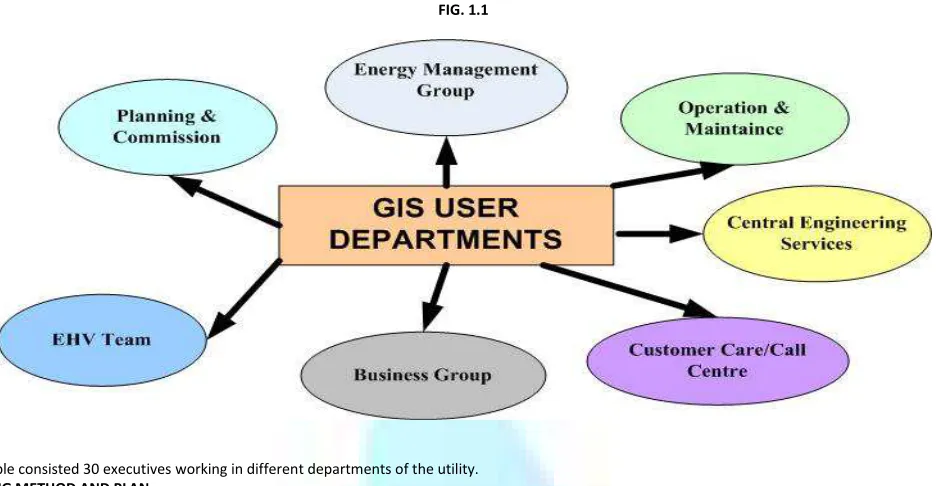
The user departments of GIS in utility are shown in fig below.
FIG. 1.1
SAMPLE
The sample consisted 30 executives working in different departments of the utility.
SAMPLING METHOD AND PLAN
The method of sampling adopted for this study was ‘Purposive Sampling’, owing to the specific nature of research problem under investigation. The subjects constitute executives who were participants in 4 days program of Application of GeoSpatial Technologies for utilities at one of the certified training Centres of Ministry of Power in National Capital Region. Among these, the executives who voluntarily agreed to participate comprise our sample.
PROCEDURE
The data was collected by ‘a dual-moderator focus group interview’ (Malhotra, 2001). A focus group is an interview conducted by a trained moderator(s) in a non structured and natural manner with a small group of respondents. The moderator leads the discussion. During the discussion the participants were asked question and their views and experience on usage of the technology were taken. Some of the taken in the discussion and findings later. The main purpose of focus groups is to gain insights by listening to a group of people from the appropriate target market talk about issues of interest to the researcher.
The value of the technique lies in the unexpected findings often obtained from a free flowing group discussion (for details, one may refer to Malhotra, 2001, Morgan, 1997).
Focus groups are the most important qualitative research procedure. They are so popular that many marketing research practitioners consider this technique synonymous with qualitative research (Garee & Schori, 1997).A focus group generally includes 8 to 12 member (Dachler, 1997; Fern, 1982). A focus group should be synonymous in terms of demographic and socioeconomic characteristics. Commonality among group members avoids interactions and conflicts among group members on side issues (Nelson &Fruitcake, 1988).
DATA ANALYSIS & INTERPRETATION
The data was collected during the interview were analyzed and presented in form of tables and figures illustrated below.
KNOWLEDGE ABOUT GIS
Through focus group interviews user departments were asked about they were aware about what is GIS, its capabilities and activities etc.
TABLE 1: KNOWLEDGE OF GIS
SL PARTICULARS PARTICIPANTS(30) PERCENTAGE
1 Basic Awareness of GIS 27 90 2 Knowledge of custom Applications 15 50 3 In Depth Knowledge of GIS Applications in their area of interest. 6 20
FIGURE 1.1 KNOWLEDGE OF GIS
GIS KNOW HOW
90
50
20
0 20 40 60 80 100
Basic Awarness of GIS Knowledge of custom
Applications
In Depth Knowledge of GIS Applications in their
area of interest.
The graph clearly depicts that most of the user departments (90%) are aware about GIS, also 50 % of the user have knowledge of Custom Applications of GIS and applications. But very less of the users (20%) are not aware powerful capability of GIS technology. So, there is needed to make use the user departments more aware about GIS technologies usefulness for their day to day work and their area of interest.
FREQUENCY OF USE OF GIS
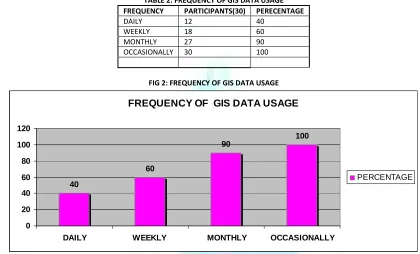
This is basically to study how frequently the user uses GIS data in any form, the pattern of usage was studied. Most of the users use GIS data either monthly or occasionally. Daily usage of GIS data by the user is still very limited.
TABLE 2: FREQUENCY OF GIS DATA USAGE FREQUENCY PARTICIPANTS(30) PERECENTAGE
DAILY 12 40 WEEKLY 18 60 MONTHLY 27 90 OCCASIONALLY 30 100
FIG 2: FREQUENCY OF GIS DATA USAGE
WHAT USER WANT MOST FROM GIS
The study tries to find out for what all different purpose User Departments needs GIS data. The study revealed that electrical network information is one of the biggest information which users demand from GIS. With Delhi Geo-Spatial Data Infrastructure Act, 2011 coming into place , demand of GIS Maps mostly in pdf format and also increased by users as they need to attach with the schemes they prepare.
Use of GIS Reports is less; the main factor accounting to this is that user wants reports with dynamic attributes, some of problems discussed in next section mainly accounts for this.
TABLE-3: USAGE OF GIS DATA FOR DIFFERENT INFORMATION
SL NO What User want most from GIS DESCRIPTION PARTICIPANTS(30) % 1 Spatial View of Assets Location of DT/SSTN, Feeder etc 30 100 2 GIS Based Utility Reports Reports Published by GIS 18 60 3 Need For Maps Pdf/Print Out 24 80 4 Electrical Network Information SLDs, DT/Feeder etc Info 27 90 5 Location of Utility Buildings Nearest Complaint Centre, Cash Office 26 86.7
FIG. 3: USAGE OF GIS DATA FOR DIFFERENT INFORMATION
METHODS OF ACCESS OF GIS INFORMATION
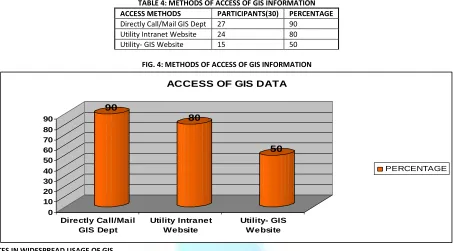
In the Last section we discussed about different types of user information which user needs from GIS. Here the study tries to find out different ways through which user access GIS data for their requirements. The study revealed contacting GIS Dept either by mail or call is most prevalent way to get the required information which user needs. Access of Utility Intranet website is other major means of accessing information. The study clearly depicts usage of GIS website is not very popular among users.
FREQUENCY OF GIS DATA USAGE
40
60
90
100
0 20 40 60 80 100 120
DAILY WEEKLY MONTHLY OCCASIONALLY
PERCENTAGE
100
60
80
90
86.66666667
0 20 40 60 80 100 120
Spatial Vie w of Assets
GIS Based Utility Reports
Nee d For M aps
Electrical Netw ork Inform ation
Location of Utility Buildings
VOLUME NO.3(2013),ISSUE NO.09(SEPTEMBER) ISSN 2231-5756
INTERNATIONAL JOURNAL OF RESEARCH IN COMMERCE, IT & MANAGEMENT
TABLE 4: METHODS OF ACCESS OF GIS INFORMATIONACCESS METHODS PARTICIPANTS(30) PERCENTAGE
Directly Call/Mail GIS Dept 27 90 Utility Intranet Website 24 80 Utility- GIS Website 15 50
FIG. 4: METHODS OF ACCESS OF GIS INFORMATION
HINDRANCES IN WIDESPREAD USAGE OF GIS
The study analysed various problem encountered by the users which limits the usage of GIS in the organisation. The retrieval speed of GIS web and is not very interactive nature is one of major limitation which limits the usage of GIS. Other important factor is user specific information which user cannot get mainly due to various factors like non integration with other modules like SCADA, SAP, and OMS etc. The study also stressed on improvement of IT Infrastructure like user PC configuration i.e.; hardware and LAN Connectivity.
TABLE 5: HINDRANCES IN WIDESPREAD USAGE OF GIS
Causes PARTICIPANTS(30) PERCENTAGE
Slow LAN Connectivity 18 60 Low Configuration User PC 15 50 Slow Speed of GIS Website 21 70 GIS website not very User Interactive 12 40 Specific User Requirement not Available 18 60 Use of IT as work culture in Utility 12 40
FIG 5:HINDRANCES IN WIDESPREAD USAGE OF GIS
RESULTS & FINDINGS
The major findings of the study are as follows:
Most of the user knows about GIS, but still awareness among about advanced application of this technology and how they can use for their day-day work. The utility management should focus on increasing frequency of usage of GIS as still most of the user uses it either occasionally /monthly or weekly. Very less user uses it daily.
GIS data bank has enough information which user want which can be revealed, as 90% user want network related information from GIS and 80 % needs maps for various purposes. GIS Database has great demand among the users.
90 80 50 0 10 20 30 40 50 60 70 80 90 Directly Call/Mail GIS Dept Utility Intranet Website Utility- GIS Website ACCESS OF GIS DATA
The finding revealed access of GIS information in the organisation is still primitive as 90% user contact GIS dept for their requirements. The need is make the user more used to utility GIS website and does GIS analysis independently.
Utility needs to address some IT infrastructure related issues in order to increase user level and their dependency on GIS.
CONCLUSION & FUTURE SCOPE
The study revealed that users in various departments in the power utility are keen in using GeoSpatial technologies especially among young peers. The GIS Database has been appreciated and the participants found it very useful in taking key decisions. The management of the utility should focus on addressing the issues which has been found in the study. The study can also help other utilities of different states that are in stage of implementation of GIS and take the key learning from the finding in the research study.
Since the study which was conducted on focussed group though discussion and unstructured natural way of interview, the research in the level can be carried out based on Quantitative Analysis of research, and paves the way for next advanced research ‘ Road Ahead - Successful Implementation of Geospatial technologies in utility’
GLOSSARY
GIS- Geographical Information System
SCADA- Supervisory Control & Data Acquisition System OMS – Outage Management System
DT- Distribution Transformer SLD- Single Line Diagram SSTN- Sub Station LAN- Local Area Network EHV – Extra High Voltage IT- Information Technology
REFERENCES
1. Clarke, K. C., 1986. Advances in geographic information systems, computers, environment and urban systems, Vol. 10, pp. 175–184.
2. Dr.Rajani Mishra, Praveen Shukla,’ Use of E-resources by research scholars of Inititute of Technology,Banaras Hindu University, India’, Researchers World, 3. Garee, Michael, L., & Schori, Thomas, R. (1997). ‘Focus Groups illuminate Quantitative Research’. Marketing News. Vol. 31 (12), p. 25.
4. Malhotra, Naresh. (2001). Marketing Research: An Applied Orientation, 3rd Edition, 1st Indian Reprint. Delhi, India: Addison Wesley Longman (Singapore). 5. Ministry of Power Reports, Government of India.
6. Nanadan Nilekani ‘IT Task force report for Power Sector’.
7. Nelson, J.E., & Frontczak, N. (1988) How Acquaintanceship and Analyst can influence Focus Group Results. Journal of Advertising, Vol 17 (1), p. 41 – 48. 8. Pramod Pathak & Govind Swaroop Pathak. ‘Behavioural issues in accidents : A study of Coal Mines’. Management Insight.
9. Tarak Shah,(2006)’ Gujarat Electricity Board – A Benchmark in the progress of SEB reforms.
WEBSITE
10. http://www.powermin.nic.in/distribution/apdrp/projects/pdf/Order_for_Restructured__APDRP_During_11th_Plan.pdf.
VOLUME NO.3(2013),ISSUE NO.09(SEPTEMBER) ISSN 2231-5756
INTERNATIONAL JOURNAL OF RESEARCH IN COMMERCE, IT & MANAGEMENT
REQUEST FOR FEEDBACK
Dear Readers
At the very outset, International Journal of Research in Commerce, IT and Management (IJRCM)
acknowledges & appreciates your efforts in showing interest in our present issue under your kind perusal.
I would like to request you to supply your critical comments and suggestions about the material published
in this issue as well as on the journal as a whole, on our E-mail i.e.
for further
improvements in the interest of research.
If you have any queries please feel free to contact us on our E-mail
.
I am sure that your feedback and deliberations would make future issues better – a result of our joint
effort.
Looking forward an appropriate consideration.
With sincere regards
Thanking you profoundly
Academically yours
Sd/-