A Monthly Double-Blind Peer Reviewed (Refereed/Juried) Open Access International e-Journal - Included in the International Serial Directories Indexed & Listed at:
VOLUME NO.3(2013),ISSUE NO.10(OCTOBER) ISSN2231-5756
INTERNATIONAL JOURNAL OF RESEARCH IN COMMERCE, IT & MANAGEMENT
CONTENTS
CONTENTS
CONTENTS
CONTENTS
Sr.
No.
TITLE & NAME OF THE AUTHOR (S)
Page No.
1. MACHINE USAGE BASED ON PRODUCT MIX IN MANUFACTURING CLASSIFICATIONS DR. SURESH TULSHIRAM SALUNKE & SHWETA SURESH TULSHIRAM SALUNKE
1
2. A STUDY ON THE CHALLENGES FACED BY TIRUPUR GARMENT EXPORTERS DR. S. SARANANAN & S. MOHANRAJ
5
3. HEALTHCARE AND MEDICAL TOURISM: RETROSPECT AND PROSPECT R. VEERAPPAN, J. SASIGANTH, FR. ANGELO JOSEPH & A. JOE ROBINSON
8
4. TRADE BETWEEN INDIA AND ASEAN COUNTRIES FOR AGRICULTURAL AND MINERAL PRODUCTS: EXPLORING COMPATIBILITY THROUGH REVEALED COMPARATIVE ADVANTAGE
DR. B. P. SARATH CHANDRAN
11
5. RELEVANCE OF ISLAMIC BANKING TO INDIAN ECONOMY S. NAYAMATH BASHA & DR. BADIUDDIN AHMED
17
6. AXIOMATIZATION OF THE PREFERENCE CORE IN MULTICRITERIA COOPERATIVE GAMES A. SUGUMARAN & P. VISHNU PRAKASH
21
7. CORPORATE GOVERNANCE & INFORMATION SECURITY: AN ANALYTICAL STUDY DR. BADIUDDIN AHMED, SYED HAMID MOHIUDDIN QUADRI & IRFANUDDIN
25
8. RUPEE FALLING: DOLLAR IS ON HORSE RIDE M. RAMU, M. S. K. VARMA & S.SUDHEER
28
9. AN ANALYSIS OF INDIAN AUTOMOBILE INDUSTRY: SLOWDOWN AS AN OPPORTUNITY FOR NEW DEVELOPMENT DR. ANKUR KUMAR RASTOGI & NITIN GOPAL GUPTA
36
10. A PROPOSED THEORY OF NEURAL NETWORKS IN KNOWLEDGE MANAGEMENT FOR AN EXPERT SYSTEM V. SUMALATHA
41
11. THE INFORMATION MANAGEMENT PRACTICES OF BHIRDAR UNIVERSITY DR. MATEBE TAFERE
45
12. VEBLENIAN SOCIO-PSYCHOLOGICAL MODEL: AN ETHNOGRAPHIC STUDY DR. K. ABRAHAM & DR. M. RAJASEKHAR
51
13. INNOVATIVE TEACHING AND LEARNING TO ENHANCE CRITICAL THINKING AND REFLECTIVE PRACTICE, FOR QUALITY AND RELEVANCE OF HEALTH EDUCATION
DR. BIRHANU MOGES ALEMU
56
14. A STATISTICAL ANALYSIS OF PHYSICALLY DISABLED POPULATION: DEVELOPMENT IN REHABILITATION SCHEMES DR. CHINNA ASHAPPA
68
15. USE OF E-JOURNALS IN THE DISCIPLINES OF LIFE SCIENCE IN K.U.K: AN ANALYTICAL STUDY ANIL KUMAR
72
16. ISLAMIC MICROFINANCE-FINANCING THE POOREST OF THE POOR DILAWAR AHMAD BHAT
79
17. USE OF CLOUD COMPUTING IN MANUFACTURING COMPANIES SHEETAL MAHENDHER & SUBASHREE
83
18. CLIMATE CHANGE AND VECTOR BORNE DISEASES: THE ROLE OF GIS & REMOTE SENSING DIVYA GEORGE & DR. R. RAJKUMAR
88
19. FEASIBILITY STUDY FOR IMPLEMENTATION OF AN ACTIVITY- BASED COSTING SYSTEM (ABCS) IN ALLOY STEEL INDUSTRIES (ASI) MAJID NILI AHMADABADI & ALI SOLEIMANI
96
20. AN IMPACT OF SERVICE QUALITY ON LOYAL CUSTOMER AND ITS SATISFACTION: A STUDY OF PRIVATE BANKS IN KANPUR CITY (INDIA) RAVINDRA KUMAR KUSHWAHA, GURPREET SINGH, NEERAJ JOSHI & NEHA PUSHPAK
101
21. A STUDY ON EMPLOYEE PERFORMANCE APPRAISAL IN CEMENT INDUSTRY IN TAMILNADU DR. M. RAGURAMAN, R. VEERAPPAN, S. ALBERT, M. SUGANYA & S. HEMAVATHY
107
22. DETERMINANTS OF MOBILE BANKING TECHNOLOGY ADOPTION OF COMMERCIAL BANKS IN ETHIOPIA ZEMENU AYNADIS, TESFAYE ABATE & ABEBE TILAHUN
110
23. EVALUATION OF LIC’S EFFICIENCY IN GENERATING CAPITAL FUNDS UNDER ULIP’S SCHEMES MANJUSHREE S
117
24. EVALUATION OF COST MANAGEMENT TOOLS: A STUDY ON MULTINATIONAL PHARMACEUTICAL COMPANIES OF BANGLADESH TAHMINA AHMED
120
25. AN EVALUATION OF NEW ZEALAND’S EXPORT COMPETITIVENESS USING SHIFT-SHARE ANALYSIS DR. SATYA GONUGUNTLA
126
26. INCREASING INTERNATIONAL COLLABORATIONS IN SCIENCE AND TECHNOLOGY AROUND THE WORLD, AND ITS PATTERNS IN INDIA WITH SPECIAL REFERENCE TO INDO-GERMAN COLLABORATION
MUNEEB HUSSAIN GATTOO & MUJEEB HUSSAIN GATTOO
131
27. A STUDY ON THE ETHICAL INVESTMENT DECISION MAKING IN INDIAN RELIGIOUS ORGANISATIONS BINCY BABURAJ KALUVILLA
135
28. GREEN MARKETING MIX: A STRATEGY FOR SUSTAINABLE DEVELOPMENT L. NANDA GOPAL
138
29. CONSIDERING RELATIONSHIP BETWEEN CASH WITH CAPITAL COST AND FINANCIAL FLEXIBILITY AHMAD GHASEMI & DR. ROYA DARABI
140
30. UNDERSTANDING THE GREEKS AND THEIR USE TO MEASURE RISK SANJANA JUNEJA
146
CHIEF PATRON
CHIEF PATRON
CHIEF PATRON
CHIEF PATRON
PROF. K. K. AGGARWAL
Chairman, Malaviya National Institute of Technology, Jaipur
(An institute of National Importance & fully funded by Ministry of Human Resource Development, Government of India)
Chancellor, K. R. Mangalam University, Gurgaon
Chancellor, Lingaya’s University, Faridabad
Founder Vice-Chancellor (1998-2008), Guru Gobind Singh Indraprastha University, Delhi
Ex. Pro Vice-Chancellor, Guru Jambheshwar University, Hisar
FOUNDER
FOUNDER
FOUNDER
FOUNDER PATRON
PATRON
PATRON
PATRON
LATE SH. RAM BHAJAN AGGARWAL
Former State Minister for Home & Tourism, Government of Haryana
Former Vice-President, Dadri Education Society, Charkhi Dadri
Former President, Chinar Syntex Ltd. (Textile Mills), Bhiwani
CO
CO
CO
CO----ORDINATOR
ORDINATOR
ORDINATOR
ORDINATOR
AMITA
Faculty, Government M. S., Mohali
ADVISORS
ADVISORS
ADVISORS
ADVISORS
DR. PRIYA RANJAN TRIVEDI
Chancellor, The Global Open University, Nagaland
PROF. M. S. SENAM RAJU
Director A. C. D., School of Management Studies, I.G.N.O.U., New Delhi
PROF. M. N. SHARMA
Chairman, M.B.A., Haryana College of Technology & Management, Kaithal
PROF. S. L. MAHANDRU
Principal (Retd.), Maharaja Agrasen College, Jagadhri
EDITOR
EDITOR
EDITOR
EDITOR
PROF. R. K. SHARMA
Professor, Bharti Vidyapeeth University Institute of Management & Research, New Delhi
CO
CO
CO
CO----EDITOR
EDITOR
EDITOR
EDITOR
DR. BHAVET
Faculty, Shree Ram Institute of Business & Management, Urjani
EDITORIAL ADVISORY BOARD
EDITORIAL ADVISORY BOARD
EDITORIAL ADVISORY BOARD
EDITORIAL ADVISORY BOARD
DR. RAJESH MODI
Faculty, Yanbu Industrial College, Kingdom of Saudi Arabia
PROF. SANJIV MITTAL
University School of Management Studies, Guru Gobind Singh I. P. University, Delhi
PROF. ANIL K. SAINI
VOLUME NO.3(2013),ISSUE NO.10(OCTOBER) ISSN2231-5756
INTERNATIONAL JOURNAL OF RESEARCH IN COMMERCE, IT & MANAGEMENT
DR. SAMBHAVNA
Faculty, I.I.T.M., Delhi
DR. MOHENDER KUMAR GUPTA
Associate Professor, P. J. L. N. Government College, Faridabad
DR. SHIVAKUMAR DEENE
Asst. Professor, Dept. of Commerce, School of Business Studies, Central University of Karnataka, Gulbarga
ASSOCIATE EDITORS
ASSOCIATE EDITORS
ASSOCIATE EDITORS
ASSOCIATE EDITORS
PROF. NAWAB ALI KHAN
Department of Commerce, Aligarh Muslim University, Aligarh, U.P.
PROF. ABHAY BANSAL
Head, Department of Information Technology, Amity School of Engineering & Technology, Amity
University, Noida
PROF. A. SURYANARAYANA
Department of Business Management, Osmania University, Hyderabad
DR. SAMBHAV GARG
Faculty, Shree Ram Institute of Business & Management, Urjani
PROF. V. SELVAM
SSL, VIT University, Vellore
DR. PARDEEP AHLAWAT
Associate Professor, Institute of Management Studies & Research, Maharshi Dayanand University, Rohtak
DR. S. TABASSUM SULTANA
Associate Professor, Department of Business Management, Matrusri Institute of P.G. Studies, Hyderabad
SURJEET SINGH
Asst. Professor, Department of Computer Science, G. M. N. (P.G.) College, Ambala Cantt.
TECHNICAL ADVISOR
TECHNICAL ADVISOR
TECHNICAL ADVISOR
TECHNICAL ADVISOR
AMITA
Faculty, Government M. S., Mohali
FINANCIAL ADVISORS
FINANCIAL ADVISORS
FINANCIAL ADVISORS
FINANCIAL ADVISORS
DICKIN GOYAL
Advocate & Tax Adviser, Panchkula
NEENA
Investment Consultant, Chambaghat, Solan, Himachal Pradesh
LEGAL ADVISORS
LEGAL ADVISORS
LEGAL ADVISORS
LEGAL ADVISORS
JITENDER S. CHAHAL
Advocate, Punjab & Haryana High Court, Chandigarh U.T.
CHANDER BHUSHAN SHARMA
Advocate & Consultant, District Courts, Yamunanagar at Jagadhri
SUPERINTENDENT
SUPERINTENDENT
SUPERINTENDENT
SUPERINTENDENT
CALL FOR MANUSCRIPTS
CALL FOR MANUSCRIPTS
CALL FOR MANUSCRIPTS
CALL FOR MANUSCRIPTS
We invite unpublished novel, original, empirical and high quality research work pertaining to recent developments & practices in the areas of Computer Science & Applications; Commerce; Business; Finance; Marketing; Human Resource Management; General Management; Banking; Economics; Tourism Administration & Management; Education; Law; Library & Information Science; Defence & Strategic Studies; Electronic Science; Corporate Governance; Industrial Relations; and emerging paradigms in allied subjects like Accounting; Accounting Information Systems; Accounting Theory & Practice; Auditing; Behavioral Accounting; Behavioral Economics; Corporate Finance; Cost Accounting; Econometrics; Economic Development; Economic History; Financial Institutions & Markets; Financial Services; Fiscal Policy; Government & Non Profit Accounting; Industrial Organization; International Economics & Trade; International Finance; Macro Economics; Micro Economics; Rural Economics; Co-operation; Demography: Development Planning; Development Studies; Applied Economics; Development Economics; Business Economics; Monetary Policy; Public Policy Economics; Real Estate; Regional Economics; Political Science; Continuing Education; Labour Welfare; Philosophy; Psychology; Sociology; Tax Accounting; Advertising & Promotion Management; Management Information Systems (MIS); Business Law; Public Responsibility & Ethics; Communication; Direct Marketing; E-Commerce; Global Business; Health Care Administration; Labour Relations & Human Resource Management; Marketing Research; Marketing Theory & Applications; Non-Profit Organizations; Office Administration/Management; Operations Research/Statistics; Organizational Behavior & Theory; Organizational Development; Production/Operations; International Relations; Human Rights & Duties; Public Administration; Population Studies; Purchasing/Materials Management; Retailing; Sales/Selling; Services; Small Business Entrepreneurship; Strategic Management Policy; Technology/Innovation; Tourism & Hospitality; Transportation Distribution; Algorithms; Artificial Intelligence; Compilers & Translation; Computer Aided Design (CAD); Computer Aided Manufacturing; Computer Graphics; Computer Organization & Architecture; Database Structures & Systems; Discrete Structures; Internet; Management Information Systems; Modeling & Simulation; Neural Systems/Neural Networks; Numerical Analysis/Scientific Computing; Object Oriented Programming; Operating Systems; Programming Languages; Robotics; Symbolic & Formal Logic; Web Design and emerging paradigms in allied subjects.
Anybody can submit the soft copy of unpublished novel; original; empirical and high quality research work/manuscriptanytime in M.S. Word format
after preparing the same as per our GUIDELINES FOR SUBMISSION; at our email address i.e. [email protected] or online by clicking the link online submission as given on our website (FOR ONLINE SUBMISSION, CLICK HERE).
GUIDELINES FOR SUBMISSION OF MANUSCRIPT
GUIDELINES FOR SUBMISSION OF MANUSCRIPT
GUIDELINES FOR SUBMISSION OF MANUSCRIPT
GUIDELINES FOR SUBMISSION OF MANUSCRIPT
1. COVERING LETTER FOR SUBMISSION:
DATED: _____________ THE EDITOR
IJRCM
Subject: SUBMISSION OF MANUSCRIPT IN THE AREA OF.
(e.g. Finance/Marketing/HRM/General Management/Economics/Psychology/Law/Computer/IT/Engineering/Mathematics/other, please specify)
DEAR SIR/MADAM
Please find my submission of manuscript entitled ‘___________________________________________’ for possible publication in your journals.
I hereby affirm that the contents of this manuscript are original. Furthermore, it has neither been published elsewhere in any language fully or partly, nor is it under review for publication elsewhere.
I affirm that all the author (s) have seen and agreed to the submitted version of the manuscript and their inclusion of name (s) as co-author (s).
Also, if my/our manuscript is accepted, I/We agree to comply with the formalities as given on the website of the journal & you are free to publish our contribution in any of your journals.
NAME OF CORRESPONDING AUTHOR: Designation:
Affiliation with full address, contact numbers & Pin Code: Residential address with Pin Code:
Mobile Number (s): Landline Number (s): E-mail Address: Alternate E-mail Address:
NOTES:
a) The whole manuscript is required to be in ONE MS WORD FILE only (pdf. version is liable to be rejected without any consideration), which will start from the covering letter, inside the manuscript.
b) The sender is required to mentionthe following in the SUBJECT COLUMN of the mail:
New Manuscript for Review in the area of (Finance/Marketing/HRM/General Management/Economics/Psychology/Law/Computer/IT/ Engineering/Mathematics/other, please specify)
c) There is no need to give any text in the body of mail, except the cases where the author wishes to give any specific message w.r.t. to the manuscript. d) The total size of the file containing the manuscript is required to be below 500 KB.
e) Abstract alone will not be considered for review, and the author is required to submit the complete manuscript in the first instance.
f) The journal gives acknowledgement w.r.t. the receipt of every email and in case of non-receipt of acknowledgment from the journal, w.r.t. the submission of manuscript, within two days of submission, the corresponding author is required to demand for the same by sending separate mail to the journal.
2. MANUSCRIPT TITLE: The title of the paper should be in a 12 point Calibri Font. It should be bold typed, centered and fully capitalised.
3. AUTHOR NAME (S) & AFFILIATIONS: The author (s) full name, designation, affiliation (s), address, mobile/landline numbers, and email/alternate email address should be in italic & 11-point Calibri Font. It must be centered underneath the title.
VOLUME NO.3(2013),ISSUE NO.10(OCTOBER) ISSN2231-5756
INTERNATIONAL JOURNAL OF RESEARCH IN COMMERCE, IT & MANAGEMENT
5. KEYWORDS: Abstract must be followed by a list of keywords, subject to the maximum of five. These should be arranged in alphabetic order separated by commas and full stops at the end.
6. MANUSCRIPT: Manuscript must be in BRITISH ENGLISH prepared on a standard A4 size PORTRAIT SETTING PAPER. It must be prepared on a single space and single column with 1” margin set for top, bottom, left and right. It should be typed in 8 point Calibri Font with page numbers at the bottom and centre of every page. It should be free from grammatical, spelling and punctuation errors and must be thoroughly edited.
7. HEADINGS: All the headings should be in a 10 point Calibri Font. These must be bold-faced, aligned left and fully capitalised. Leave a blank line before each heading.
8. SUB-HEADINGS: All the sub-headings should be in a 8 point Calibri Font. These must be bold-faced, aligned left and fully capitalised.
9. MAIN TEXT: The main text should follow the following sequence:
INTRODUCTION
REVIEW OF LITERATURE
NEED/IMPORTANCE OF THE STUDY
STATEMENT OF THE PROBLEM
OBJECTIVES
HYPOTHESES
RESEARCH METHODOLOGY
RESULTS & DISCUSSION
FINDINGS
RECOMMENDATIONS/SUGGESTIONS
CONCLUSIONS
SCOPE FOR FURTHER RESEARCH
ACKNOWLEDGMENTS
REFERENCES
APPENDIX/ANNEXURE
It should be in a 8 point Calibri Font, single spaced and justified. The manuscript should preferably not exceed 5000 WORDS.
10. FIGURES &TABLES: These should be simple, crystal clear, centered, separately numbered & self explained, and titles must be above the table/figure. Sources of data should be mentioned below the table/figure. It should be ensured that the tables/figures are referred to from the main text.
11. EQUATIONS:These should be consecutively numbered in parentheses, horizontally centered with equation number placed at the right.
12. REFERENCES: The list of all references should be alphabetically arranged. The author (s) should mention only the actually utilised references in the preparation of manuscript and they are supposed to follow Harvard Style of Referencing. The author (s) are supposed to follow the references as per the following:
•
All works cited in the text (including sources for tables and figures) should be listed alphabetically.•
Use (ed.) for one editor, and (ed.s) for multiple editors.•
When listing two or more works by one author, use --- (20xx), such as after Kohl (1997), use --- (2001), etc, in chronologically ascending order.•
Indicate (opening and closing) page numbers for articles in journals and for chapters in books.•
The title of books and journals should be in italics. Double quotation marks are used for titles of journal articles, book chapters, dissertations, reports, working papers, unpublished material, etc.•
For titles in a language other than English, provide an English translation in parentheses.•
The location of endnotes within the text should be indicated by superscript numbers.PLEASE USE THE FOLLOWING FOR STYLE AND PUNCTUATION IN REFERENCES: BOOKS
•
Bowersox, Donald J., Closs, David J., (1996), "Logistical Management." Tata McGraw, Hill, New Delhi.•
Hunker, H.L. and A.J. Wright (1963), "Factors of Industrial Location in Ohio" Ohio State University, Nigeria.CONTRIBUTIONS TO BOOKS
•
Sharma T., Kwatra, G. (2008) Effectiveness of Social Advertising: A Study of Selected Campaigns, Corporate Social Responsibility, Edited by David Crowther & Nicholas Capaldi, Ashgate Research Companion to Corporate Social Responsibility, Chapter 15, pp 287-303.JOURNAL AND OTHER ARTICLES
•
Schemenner, R.W., Huber, J.C. and Cook, R.L. (1987), "Geographic Differences and the Location of New Manufacturing Facilities," Journal of Urban Economics, Vol. 21, No. 1, pp. 83-104.CONFERENCE PAPERS
•
Garg, Sambhav (2011): "Business Ethics" Paper presented at the Annual International Conference for the All India Management Association, New Delhi, India, 19–22 June.UNPUBLISHED DISSERTATIONS AND THESES
•
Kumar S. (2011): "Customer Value: A Comparative Study of Rural and Urban Customers," Thesis, Kurukshetra University, Kurukshetra.ONLINE RESOURCES
•
Always indicate the date that the source was accessed, as online resources are frequently updated or removed.WEBSITES
A STATISTICAL ANALYSIS OF PHYSICALLY DISABLED POPULATION: DEVELOPMENT IN REHABILITATION
SCHEMES
DR. CHINNA ASHAPPA
ASST. PROFESSOR
GOVERNMENT DEGREE COLLEGE
GURMITKAL
ABSTRACT
Physically disabled or handicapped people are the most vulnerable group in society. They include Blind, Visual Impairment, Deaf, Dumb, Orthopedically impaired, mentally retarded and few of the skin diseases affected people. The statistics of the physically disabled at the national and state level is provided in the paper. It is noted that the society should be sympathetic and supportive towards the disabled population, so that they can also develop as normal people and lead their life positively. The rehabilitation services and welfare schemes for the disabled are also discussed in the paper.
KEYWORDS
physically disabled population, rehabitation schemes.
INTRODUCTION
he loss or impairment of an organ or deformity in one’s physical or mental capability is the worst that can happen to a person, whether it is because of nature’s foul play or as a result of an unexpected unfortunate accident. Welfare of the disabled and the handicapped is an extremely challenging task and it can be fulfilled only when all the citizens, voluntary organizations and Government realize their responsibilities in this respect collectively (Sachdeva, 2006).
The disabled people are much significant components of the society as the healthy persons. It is the moral duty of every person in this society to do utmost for their rehabilitation and development. To a major extent, the handicapped have a zest for life and desire to live abnormally as possible and require only a change to prove that they can be as effective as anyone else at the tasks assigned to them. With a little bit of help and the handicapped can tide over their misfortune. Their skills and talents can form an important input in nation building activities. A sense of self-confidence, therefore, needed to be infused in them to enable them to join their brethren in the mainstream of life.
According to Akhileshwari (2008) disabled people in India are among the most excluded. Low literacy, low employment rates and widespread social stigma make the disabled one of the poorest in the country. Households with disabled members are significantly poorer than average, with lower consumption and fewer assets, according to a World Bank Report. The worst affected are children. Disabled children are four to five times less likely to be in school than children from Scheduled Caste and Scheduled Tribe families…Based on the National Sample Survey (NSS) 58th round, the World Bank report shows that nearly a third of children with mild disability are out of school, despite the fact that they need no aid or appliance to be able to attend school. Yet, irrespective of the levels of disability- mild moderate or severe- the disabled rarely progress beyond the primary school level. Hence, the present study is made to examine the services and welfare measures of the disabled children.
PHYSICALLY HANDICAPPED PEOPLE
The term ‘Physically handicapped’ often used synonymously with impairment and disability. As per the classification made by the World Health Organization (1980), these terms have three separate meanings, but related to same concepts, that is ‘impairment’ means ‘loss of function’, disability means ‘loss of ability to perform specific tasks’ and handicap means ‘social and economic disadvantage’. It is noted that all of these words given only one concept, lack of some kind of physical or mental ability, which is possessed by other compared to a person. ‘In the affluent industrialized societies, occupational hazards and age are the main causes while in developing as well as underdeveloped countries, ignorance, poverty, lack of elementary medical facilities and pseudo-religious beliefs are the principal causes of disability (Lal Das, 1997).
Physically handicapped or physically disabled includes all persons who have either completely lost the use of or can make only a restricted use of one or more of their physical organs. A Physically handicapped person is a perfectly normal being except for the handicap from which he suffers. Thus, he is capable of performing all the functions of a normal person except in so far as he is limited by his handicap. They are all disabled persons because they have one or the other type of physical handicap. The normal functioning of any one part of their body has become of no use. In medical terms Physical disability means a limitation of physical function of locomotor or sensory or of special organs irrespective of the cause…sociologically, a physical handicap is a physical defect, obvious or hidden which limits an individuals capacity to work or evokes an unfavourable attitude (Singh, 1997).
According to the International Labour Organization (ILO), a disabled person should be defined as an individual whose prospects of employment are seriously reduced as a result of physical impairment. All these groups of persons need assistance by way of special vocational training or by way of special types of work suited to their physical abilities and sometimes under sheltered or protected conditions. The causes of crippled ness are of two types, i.e. either some disease or an accident. For instance, it is possible for a blind person to perform any job for which the use of eyesight is not essential. An understanding of this fundamental fact is vital to the understanding of the problems of the physically handicapped. In general the handicapped people are classified on the basis of their disability as under.
1. Blind or Vision impairment 2. Deaf and Dumb
3. Orthopedically handicapped 4. Mentally handicapped.
5. Others (Including the persons with Leprosy, and other skin diseases)
The attitude of society towards the handicapped has undergone change as in the case of services for other weak groups such as children, etc. In the beginning asylums were established by charitably disposed persons, where the blind or the deaf were housed, clothed and fed, but gradually the idea of giving them instructions and subsequently giving them opportunities of gainful employment developed in course of time. In other words, emphasis has shifted from charity to recognition of the right of the handicapped individual to live and enjoy life as any other normal human being. It is necessary to emphasise that the old idea of asylum must give place to proper rehabilitation of the handicapped. In India, question is often raised as to why efforts should be made to educate and rehabilitate the blind, the deaf or the other type of physically handicapped persons, when millions of normal persons are without education or employment. But this has to be kept in view that every individual has the right to a full life. However, it is also to be kept in view that all handicapped persons cannot earn their own living. For instance, if a person becomes blind in his old age, he cannot be made capable of earning a livelihood and the community must make provision for his minimum comforts of life as has been done in some other countries through categorical assistance. It is noted that the total number of afflicted persons in India has hardly ever been correctly estimated. This is due to defective enumeration, lack of definitions and the desire of persons concerned to avoid publicity to their handicaps.
VOLUME NO.3(2013),ISSUE NO.10(OCTOBER) ISSN2231-5756
INTERNATIONAL JOURNAL OF RESEARCH IN COMMERCE, IT & MANAGEMENT
DISABLED POPULATION: STATISTICS
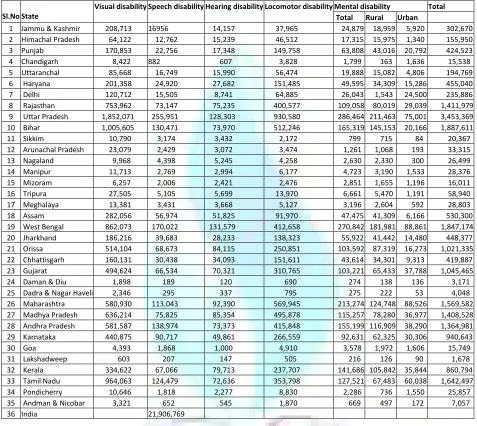
No statistical estimates are available on the disabled population up to 1981, as only deaf and blinds were only treated as disabled people by these census. Later in 1981, the kinds of disability were clearly defined in the Census. According to the Report on survey conducted by the National Sample Survey Organization sponsored by the Ministry of Welfare, twelve millions Indians about 1.8 percent of India’s population have at least one disability or the other. About 10 percent of the handicapped are having more than one type of physical disability. Considering each type of disability separately, those having locomotor disabilities constitute the maximum number (5.43 millions), followed by those with visual disability (3.47 millions) and hearing disabilities (3.02 million) and speech disabilities (1.75 million). The survey covers blind crippled and dumb persons but does not cover other disabilities, including mental retardation (Johri, 2005).
TABLE NO. 1: DISABILITY-WISE AND STATE-WISE NUMBER OF PERSONS WITH DISABILITIES IN INDIA (CENSUS OF INDIA, 2001)
Sl.No State
Visual disability
Speech disability
Hearing disability
Locomotor disability
Mental disability Total Total Rural Urban
1 Jammu & Kashmir 208,713 16956 14,157 37,965 24,879 18,959 5,920 302,670 2 Himachal Pradesh 64,122 12,762 15,239 46,512 17,315 15,975 1,340 155,950 3 Punjab 170,853 22,756 17,348 149,758 63,808 43,016 20,792 424,523 4 Chandigarh 8,422 882 607 3,828 1,799 163 1,636 15,538 5 Uttaranchal 85,668 16,749 15,990 56,474 19,888 15,082 4,806 194,769 6 Haryana 201,358 24,920 27,682 151,485 49,595 34,309 15,286 455,040 7 Delhi 120,712 15,505 8,741 64,885 26,043 1,543 24,500 235,886 8 Rajasthan 753,962 73,147 75,235 400,577 109,058 80,019 29,039 1,411,979 9 Uttar Pradesh 1,852,071 255,951 128,303 930,580 286,464 211,463 75,001 3,453,369 10 Bihar 1,005,605 130,471 73,970 512,246 165,319 145,153 20,166 1,887,611 11 Sikkim 10,790 3,174 3,432 2,172 799 715 84 20,367 12 Arunachal Pradesh 23,079 2,429 3,072 3,474 1,261 1,068 193 33,315 13 Nagaland 9,968 4,398 5,245 4,258 2,630 2,330 300 26,499 14 Manipur 11,713 2,769 2,994 6,177 4,723 3,190 1,533 28,376 15 Mizoram 6,257 2,006 2,421 2,476 2,851 1,655 1,196 16,011 16 Tripura 27,505 5,105 5,699 13,970 6,661 5,470 1,191 58,940 17 Meghalaya 13,381 3,431 3,668 5,127 3,196 2,604 592 28,803 18 Assam 282,056 56,974 51,825 91,970 47,475 41,309 6,166 530,300 19 West Bengal 862,073 170,022 131,579 412,658 270,842 181,981 88,861 1,847,174 20 Jharkhand 186,216 39,683 28,233 138,323 55,922 41,442 14,480 448,377 21 Orissa 514,104 68,673 84,115 250,851 103,592 87,319 16,273 1,021,335 22 Chhattisgarh 160,131 30,438 34,093 151,611 43,614 34,301 9,313 419,887 23 Gujarat 494,624 66,534 70,321 310,765 103,221 65,433 37,788 1,045,465 24 Daman & Diu 1,898 189 120 690 274 138 136 3,171 25 Dadra & Nagar Haveli 2,346 295 337 795 275 222 53 4,048 26 Maharashtra 580,930 113,043 92,390 569,945 213,274 124,748 88,526 1,569,582 27 Madhya Pradesh 636,214 75,825 85,354 495,878 115,257 78,280 36,977 1,408,528 28 Andhra Pradesh 581,587 138,974 73,373 415,848 155,199 116,909 38,290 1,364,981 29 Karnataka 440,875 90,717 49,861 266,559 92,631 62,325 30,306 940,643 30 Goa 4,393 1,868 1,000 4,910 3,578 1,972 1,606 15,749 31 Lakshadweep 603 207 147 505 216 126 90 1,678 32 Kerala 334,622 67,066 79,713 237,707 141,686 105,842 35,844 860,794 33 Tamil Nadu 964,063 124,479 72,636 353,798 127,521 67,483 60,038 1,642,497 34 Pondicherry 10,646 1,818 2,277 8,830 2,286 736 1,550 25,857 35 Andman & Nicobar 3,321 652 545 1,870 669 497 172 7,057 36 India 21,906,769
TABLE NO. 2: DISTRIBUTION OF TOTAL POPULATION, DISABLED POPULATION AND PERCENTAGE OF DISABLED POPULATION TO TOTAL POPULATION BY RESIDENCE AND SEX FOR INDIA
Particulars Males Females Total Total Population 532156772 496453556 1028610328
Rural 381602674 360887965 742490639 Urban 150554098 135565591 286119689
Total Disabled Population 12605635 9301134 21906769
Rural 9410185 6978197 16388382 Urban 3195450 2322937 5518387
Percentage of Disabled Population to Total Population
TABLE NO. 3: SEX-WISE, LOCATION-WISE AND DISABILITY TYPE OF TOTAL DISABLED POPULATION IN INDIA
Type of Disability Rural Urban Total
Males Females Males Females Males Females Seeing (Visually) impaired 4222717 3650666 1509621 1251877 5732338 4902543 Speech Impaired 713966 529888 228129 168885 942095 698773 Hearing impaired 549002 473814 124795 114111 673797 587925 Orthopedically disabled 2975127 1679425 927625 523300 3902752 2202725 Mentally disabled 949373 644404 405280 264764 1354653 909168 Total 9410185 6978197 3195450 2322937 12605635 9301134
REHABILITATION OF THE DISABLED
The disabled persons have an equal right to participate in social and economic activities like the rest of the community. The Central and State Governments express concern regarding the needs of the disabled through various policies and programmes. There is a need to examine the relevance and efficacy of these measures (Vaswani, 1997). On rehabilitation of the disabled people, Visvesaran (1997) stated that the attitudes of people towards the physically handicapped and mentally retarded are changing. They are no more isolated and looked upon as outcasts but are accepted as a social responsibility and efforts by various voluntary organizations and the Government are being made to make them feel very much a part of the community. It has been rightly said that emphasis should be placed on what a handicapped person has, not on what he does not have. Therefore, parents and the public are being educated on how to deal with the handicapped and help them advance towards a fuller life. The steps to rehabilitate the disabled people were done by both central as well as different state government as under.
1. PROMOTION OF VOLUNTARY SERVICES
Earlier, the services delivery for the disabled was concentrated in the voluntary sector. Social welfare services, especially in the fields of medicine and rehabilitation were undertaken by missionary activists as a part of their general programmes of social and economic development. As a result, a large number of societies in the non-governmental sectors were established, depending mainly on public support and donations, who would look after the sick and the infirm, the destitute and the disabled. In recent years these services have gained importance and government has stepped in to a make these services standardized, professional and at par with such services offered all over the world. The government has since independence been focusing attention on the prevention of disabilities, provision of physical restorative services, development of personnel and resource persons through the training of professionals, development of services through research and field trails and social and economic measures such as executive orders and enactments to ensure just distribution of the fruits of development to the handicapped population. There are over 1000 voluntary organizations in India working in the field of welfare of the handicapped. Out of these about 350 receive grants from the Government of India. The state governments have their own schemes of financial assistance to NGOs.
2. GRANTS TO NON-GOVERNMENTAL ORGANIZATIONS (NGOs)
The Ministry of Social Justice and Empowerment has two major schemes for giving grants-in-aid to Non-Governmental Organizations and voluntary organizations. These are the schemes of assistance under which grants are given for recurring and non- recurring expenditure up to 90 per cent of the budget of the grantee organization. The grantee organization is expected to meet the balance of 10 per cent by raising its own resources. Assistance is given under this scheme for developing services for the disabled for the prevention of disability, special education and vocational training, training of resource persons, provision of therapeutic services such as physical therapy and occupational therapy, placement services, etc. Grants are also given for the construction of buildings and purchase of equipments.
The second major scheme under which grants are given to NGOs and voluntary organisations is the scheme of assistance to disabled persons for purchase and fitting of artificial aids and appliances. Under this scheme, needy physically handicapped persons are assisted in procuring durable and sophisticated standard aids and appliances to promote their physical, social and psychological rehabilitation. Aids and appliances are given to all categories of disabled persons. These include orthotic and prosthetic aids for the orthopaedically handicapped, hearing aids for the hearing handicapped and educational kits such as Braille slates and Braille measuring devices. Braille writers and tape-records for the visually handicapped and carder seats and prone boards for the spastics. Tricycles and wheel chairs and orthopaedic shoes are also provided in deserving cases to physically handicapped persons. The aids and appliances are given free of cost to those persons whose income is upto Rs. 1200 per month and at 50% of the cost to those whose income is between Rs. 1201 to Rs. 2500. Aids and appliances costing between Rs. 25 to Rs. 3600 are covered under this scheme (Sachdeva, 2006).
3. ESTABLISHMENT OF NATIONAL INSTITUTES FOR THE DISABLED
There are four National Institutes in each major area of disability under the Ministry of Social Justice and Empowerment. They are: the National Institute for the Orthopaedically handicapped at Kolkata, the National Institute for the Visually Handicapped at Dehradun, the National Institute for the Mentally Handicapped at Secunderabad, and the Ali Yavar Jung National Institute for the Hearing Handicapped at Mumbai. These institutes have been designated as apex organisations for training of professionals, production of education materials and other aids for the handicapped, conducting research in rehabilitation and development of suitable model services for the handicapped. These institutes work in coordination with each other and other training centres in the country, leading voluntary organizations, state governments as well as international agencies to enforce standards in various institutions of the handicapped and standardization of training programmes. The activities of these institutes are stated as under.
1.SHYAMA PRASAD MUKHERJEE NATIONAL INSTITUTE FOR THE ORTHOPEDICALLY HANDICAPPED (NIOH), KOLKATA
N1OH established in 1978 at Kolkata is an autonomous Institution under the Ministry of Social Justice and Empowerment, Govt. of India, being the apex level organization in the country for the welfare of locomotor disabled persons, its main aim is to provide comprehensive rehabilitation to them. It offers treatment to both inpatients and outpatients and conducts research and training in the area of rehabilitation. The services and facilities of the institute include, training, research, facilitating aids and appliances to orthopedically handicapped people.
2. NATIONAL INSTITUTE FOR THE MENTALLY HANDICAPPED (NIMH), SECUNDERABAD
VOLUME NO.3(2013),ISSUE NO.10(OCTOBER) ISSN2231-5756
INTERNATIONAL JOURNAL OF RESEARCH IN COMMERCE, IT & MANAGEMENT
3. NATIONAL INSTITUTE FOR THE VISUALLY HANDICAPPED, DEHRADUN (NIVH)The National Institute for the Visually Handicapped, Dehradun is the apex body in the field of welfare of the blind. The Institute commenced working as Training Centre for the Blind on January 1, 1950 under the Union Ministry of Education. Other units were added to it later on. They all were brought under a single administration in 1967 bringing National Centre for the Blind into existence. The Institute today has extremely broad-based functions and responsibilities aimed at opening up new vistas of opportunities for the visually handicapped in different spheres. The Institute's role, at present comprises : organizing meaningful and need-based programmes at personnel training; undertaking and coordination research and development activities; running model services for the blind; collection and dissemination of information on work for the blind; preparing material for parent/employer/ community education; manufacturing of aids and appliances; producing books in Braille and cassettes. Like other institutes it also promotes the research and extension activities, training, etc. A revolutionary step initiated by the Institute has been its exercise to explore the possibility of providing computer training to the visually handicapped. For this purpose, the Institute has designed suitable syllabi and developed at appropriate interface in collaboration with a reputed agency in Mumbai to give out tactile/audio output on different PCs. It has also identified specific computer based jobs/operations which could be taken up by the blind in private and public sectors.
4. ALI YAVAR JUNG NATIONAL INSTITUTE FOR THE HEARING HANDICAPPED (AYJNIHH), MUMBAI
Rehabilitation programmes for the hearing handicapped was started with the establishment of the Ali Yavar Jung National Institute for the Hearing Handicapped on 9th August, 1983 at Bombay. It was named in honour of the former Governor of Maharashtra, the Late Shri Ali Yavar Jung, who was instrumental in its establishment. The institute is the focal point for activities encompassing all aspects of rehabilitation of the hearing handicapped under the administrative control of the Ministry of Social Justice| and Empowerment, Government of India. Its activities are shown as under.
The National Sample Survey of India (1981) indicated that there are approximately 3.02 million persons with hearing impairment, of this 0.78 million are children who need specialized help for their education. Approximately, 54,000 trained teachers are needed to cover this group as compared to the 3,000 currently available. Thus, it may be seen that the number of trained professionals is woefully inadequate. With a view to bridge this wide gap, the institute has taken as one of its main objectives, the generation of trained manpower at various levels.
AYJNIHH, Mumbai and its regional centres at Kolkata, Delhi, Hyderabad. Bhubaneshwar and Valakom offer two Diploma courses in rehabilitation of die deaf. In addition to this, AYJNIHH, Mumbai conducts two degree courses, i.e., B.Sc. in Audiology and Speech Therapy and B.Ed, (deaf) (Special Education for the Deaf). These degree courses have been accorded recognition by the University of Bombay. About 25 students enroll every year for each course. Provision is made for reservation of seats for various states to ensure wide representation of the trained personnel. Apart from these, many short term training programmes are conducted to acquaint allied professionals and to update professionals in this field on various aspects of hearing impairment. They include : (i) Custom ear mould making and hearing aid repairs; (ii) Refresher courses for speech and hearing professionals; (m) Orientation programmes for ENT specialists, General Medical Practitioners; psychologists, social workers, regular teachers and other allied professionals; and (iv) Refresher courses for speech and hearing professionals; (v) Workshop symposia and seminars for professionals and parents. It also promotes research and extension services which are funded by UNICEF. It has also regional centres which offer clinical, therapeutic and educational services to the hearing handicapped. It provides services to a large number of hearing handicapped adults in different areas such as : Counselling, Career guidance, Training, Job placement, Self-employment, Scholarship, Pension, Referral. The Institute is constantly exploring new avenues of employment, especially self-employment opportunities suitable to the hearing handicapped. To achieve this, workshops, discussions and seminars are held regularly Employers and prospective employers are also involved in these programmes so as to foster mutual understanding and co-operation. Professionals like vocational counsellors, placement officers, employment officers and social workers are annually trained in the effective management of socio-economic rehabilitation. Training of the adult deaf in various trades is conducted both at Mumbai and Hydrabad. The Training Centre for the Adult Deaf at Hyderabad offers vocational training in seven trades which are at par with special ITI level. At AYJNIHH, training in “Welding” at ITI level under the apprenticeship Act, has been initiated for the first time in India.
The above institutes are specialized in providing services in specific kinds of disabilities. Apart from these institutes, various composite institutes, schemes, programmes and projects to serve all the kinds of disabled people were also set up and functioning by the Ministry of Social Justice and Empowerment and the major schemes of these institutes include Indian Spinal Injury Centre, New Delhi, District Disability Rehabilitation Centres (DDRCs), Artificial Limbs Manufactoring Corporation of India (ALIMCO), Kanpur, National Handicapped Finance and Development Corporation (NHFDC), National Trust for the Welfare of Persons with Autism, Cerebral Palsy,-Mental Retardation and Multiple Disabilities, Rehabilitation Council of India, District Rehabilitation Centre (DRC) Scheme, Science and Technology Projects in Mission Mode, UNDP Funded Project Support to Children with Disabilities, etc.
CONCLUDING REMARKS
Disabled persons especially children in India are the most vulnerable group. Unfortunately, disabled persons irrespective of their economic status are subjected to social exclusion in the society. Economic, psychological and social confidence building is therefore immediately necessary. Services and welfare programmes for the disabled, to some extent will relieve the pain of being dependent.
It is the society, which has to be blamed for the alienation of the disabled in the society. Hence, there is need to create awareness among the people, so that there should be increase in sympathy and assistance from the society to the disabled for satisfactory living. Society have to love the disabled, show affection to them, provide assistance them and increase self-confidence and motivate the disabled to perform and work like normal people. This is of immense values to the disabled children, which strengthens and encourage the disabled to work like common people by forgetting that they are disabled in one or other ways.
REFERENCES
1. Akhileshwari, R (2008): Disabled among most left out: World Bank Report. Deccan Herald-05th February 2008.
2. Census of India, 1981. 3. Census of India, 2001.
4. Government of India, Ministry of Social Justice and Empowerment (2006): National Policy for the Disabled. 10th February 2006. 5. Johri, Pradeep Kumar (2005): Social Developments and Social Welfare. New Delhi: Anmol Publications, 2005.
6. Lal Das, DK (1997): Evaluation of Scheme of Assistance to Organizations for the Disabled (Andhra Pradesh). IN: Social Services to Disabled. Edited by A.S. Kohli. New Delhi: Anmol Publications, 1997. P. 1-10.
7. Sachdeva, DR (2006): Social Welfare Administration in India. New Delhi: Kitab Mahal, 2006.
8. Singh, YP (1997): Central Assistance to Disabled Persons and Voluntary Organizations Helping the Disabled: An Evaluation of the Centrally Sponsored Schemes in Uttar Pradesh. IN: Social Services to Disabled. Edited by A.S. Kohli. New Delhi: Anmol Publications, 1997. P. 81-94.
9. Vaswani, TG (1997): Evaluation Study of Scheme of Assistance to Voluntary Organizations and Scheme of Assistance to Disabled Persons for Purchase/Fitting of Aids and Appliances in Gujarat. IN: Social Services to Disabled. Edited by A.S. Kohli. New Delhi: Anmol Publications, 1997. P. 11-22. 10. Visvesaran, PK (1997): Restoring the Disabled to Usefulness in Tamil Nadu. IN: Social Services to Disabled. Edited by A.S. Kohli. New Delhi: Anmol
Publications, 1997. P.35-41.
REQUEST FOR FEEDBACK
Dear Readers
At the very outset, International Journal of Research in Commerce, IT and Management (IJRCM)
acknowledges & appreciates your efforts in showing interest in our present issue under your kind perusal.
I would like to request you to supply your critical comments and suggestions about the material published
in this issue as well as on the journal as a whole, on our E-mail i.e.
for further
improvements in the interest of research.
If you have any queries please feel free to contact us on our E-mail
.
I am sure that your feedback and deliberations would make future issues better – a result of our joint
effort.
Looking forward an appropriate consideration.
With sincere regards
Thanking you profoundly
Academically yours
Sd/-
VOLUME NO.3(2013),ISSUE NO.10(OCTOBER) ISSN2231-5756