Perceptions of medical students
towards antibiotic prescribing for
upper respiratory tract infections
in Saudi Arabia
Steve Harakeh,1Musab Almatrafi,2Haifa Ungapen,3Rotana Hammad,4
Feras Olayan,5Reema Hakim,6Mohammed Ayoub,7Noura Bakhsh,5
Saad B Almasaudi,8Elie Barbour,9Suhad Bahijri,10Esam Azhar,1
Ghazi Damanhouri,10Yousef Qari,11Taha Kumosani,12Zeena Harakeh,13
Muhammad S Ahmad,14JochenW L Cals15
To cite:Harakeh S, Almatrafi M, Ungapen H,
et al. Perceptions of medical
students towards antibiotic prescribing for
upper respiratory tract infections in Saudi Arabia.
BMJ Open Resp Res2015;2:
e000078. doi:10.1136/ bmjresp-2014-000078
Received 30 December 2014 Revised 20 April 2015 Accepted 21 April 2015
For numbered affiliations see end of article.
Correspondence to Professor Steve Harakeh; [email protected]
ABSTRACT
Introduction:This survey evaluates knowledge, attitudes and practices of medical students towards use of antibiotics for upper respiratory infections (URTIs).
Methodology:Cross-sectional questionnaire study among 1042 randomly selected medical students in Saudi Arabia.
Results:Respondents were mostly Saudis (97.5%), had previous knowledge of antibiotics (99.7%) and their usage (98.3%) against bacterial infections (93.7%). 18.1% thought that they could be used for viral infections. Nearly all students (97.2%) used antibiotics themselves during the previous year and self-medication without a prescription was high at 49% of cases. Most antibiotics were taken for URTI symptoms (61.8%). Female medical students had better knowledge on antibiotic effectiveness against bacteria and viruses, and overall knowledge increased with study year. Health seeking behaviour rates for symptoms of RTI and associated estimated necessity for antibiotics varied but were highest for cough with yellow/green phlegm.
Conclusions:The depth of knowledge that healthcare professionals have in relation to the proper use of antibiotics is essential in spreading the right message within communities. This is the first large study among medical students in Saudi Arabia, shedding important light on areas for improvement in the medical curriculum as well as antibiotic practices of medical students themselves.
INTRODUCTION
Upper respiratory tract infections (URTIs)
are defined as illnesses caused by an acute
infection involving the upper respiratory tract, such as the nose, sinuses, pharynx
and/or larynx.1 They cause diseases such as
the common cold and tonsillitis. They are considered the most common infections in
Saudi Arabia.2–4 Most URTIs are viral and
self-limiting and do not need antibiotic
treatment.5 6
The improper and excessive use of antibio-tics has resulted in the emergence of highly resistant bacteria. In developing countries, including Saudi Arabia, antibiotics are exces-sively prescribed and can be obtained, in many instances, without a prescription. Apart
from patients’perceptions and expectations,7
knowledge held by healthcare professionals is a major determinant with regard to the prescription of antibiotics. The depth of knowledge healthcare professionals have in relation to the proper use of antibiotics is essential in spreading the right message within communities. A doctor or a medical graduate student undergoes excessive train-ing to be able to prescribe antibiotics. Medical students are the future of medicine and one of the pillars of healthcare. Their beliefs, attitudes and behaviours regarding the use of antibiotics have a tremendous impact on the consequences associated with such uses in Saudi Arabia. For this reason, it is important to evaluate their knowledge,
atti-tudes and practices towards antibiotics’ use,
specifically in the treatment of URTIs. Based
on the above, this study was undertaken to assess the knowledge, attitudes and practices of Saudi Arabian medical students towards the use of antibiotics in the treatment of URTIs. In Saudi Arabia, medical school
con-sists of 6 years. During the first 3 years,
stu-dents take courses related to basic sciences. This is followed by another 3 years where stu-dents study clinically related courses and do
their rotations in the different fields of
medicine.
Protected by copyright.
on September 18, 2020 by guest.
METHODOLOGY
We performed a cross-sectional study among medical students in the two universities, Umm Alqura University, Makkah (UQU), and King Abdulaziz University (KAU), in Saudi Arabia, in 2013, using a paper-based question-naire. Respondents were randomly selected from the venue of the medical school building and its surround-ing university-associated hospital, and were interviewed by one of our trained data collectors.
We asked 20 questions with subitems with different response options including multiple choice, Likert-type scale response items, and dichotomised yes or no options. We developed the survey based on previously published international qualitative and quantitative
sci-entific surveys.8 9 Ethical approval was obtained from
KAU ethical committee and participants signed a consent form before participating.
We entered all results into a SPSS 20.0 data file. The
records were double-checked and cleaned by two researchers. Data were then analysed using descriptive
statistics.χ2Test were performed to identify associations
between variables such as gender, year of study, agree-ment with the principle of antibiotic resistance and pre-vious antibiotic use; as well as accurate knowledge of antibiotic effectiveness against bacteria but not against viruses.
RESULTS Demographics
As respondents were randomly contacted within the premises of their university medical faculties, 1500 medical students were approached and 1042 of them agreed to participate (response rate 69.5%). Of these, 97.5% were Saudis and 47.3% were male. The majority (57.5%) of respondents were older than 21, but younger than 24 years of age. All were medical university stu-dents, more or less equally distributed among the 2nd
to 6th year of schooling, with only 7.4% still in theirfirst
year. They were distributed UQU (56.8%) and KAU (43.2%) (table 1).
Knowledge, attitudes and practice
The majority of respondents indicated that they had pre-vious knowledge of antibiotic agents (99.7%) and of their usage (98.3%). Only 86.6% of them, however,
cor-rectly identified penicillin as an antibiotic, while 51.8%
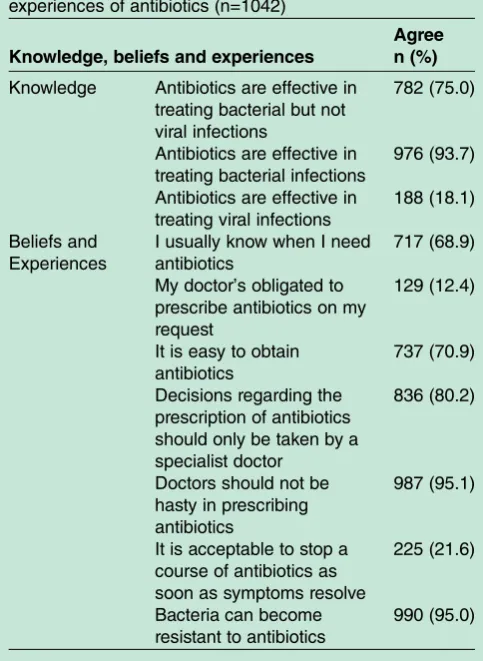
did not know whether codeine was an antibiotic or not. While 93.7% knew that antibiotics should be used in the treatment of bacterial infections, 18.1% thought that they may also be used in the treatment of viral infec-tions. When these two questions were combined, 75.0% of respondents correctly stated that antibiotics are effect-ive against bacterial but not against viral infections (table 2).
Of the respondents, 97.2% had used antibiotics during the past year. Of these medicines, 51% were obtained
through a doctor’s prescription. Most of them, 61.8% of
cases, were used for a RTI. In the past year, 87.1% of respondents had obtained some information on antibio-tics from one source or another. Among the top three sources of information cited were doctors (43.6%),
fol-lowed by the internet (41.2%) and ‘other sources’
(47.2%), which was the most common answer, ahead of
the other choices given to respondents, namely:
Table 2 Respondents’knowledge, beliefs and experiences of antibiotics (n=1042)
Knowledge, beliefs and experiences
Agree n (%)
Knowledge Antibiotics are effective in
treating bacterial but not viral infections
782 (75.0)
Antibiotics are effective in treating bacterial infections
976 (93.7)
Antibiotics are effective in treating viral infections
188 (18.1)
Beliefs and Experiences
I usually know when I need antibiotics
717 (68.9)
My doctor’s obligated to prescribe antibiotics on my request
129 (12.4)
It is easy to obtain antibiotics
737 (70.9)
Decisions regarding the prescription of antibiotics should only be taken by a specialist doctor
836 (80.2)
Doctors should not be hasty in prescribing antibiotics
987 (95.1)
It is acceptable to stop a course of antibiotics as soon as symptoms resolve
225 (21.6)
Bacteria can become resistant to antibiotics
990 (95.0)
Table 1 Characteristics of the study population (n=1042) (always put tables outside of text. Insert at end of main text or as separate file)
Demographics
Respondents n (%)
Gender
Males 493 (47.3)
Females 549 (52.7)
Age groups
18–20 280 (26.9)
21–23 599 (57.5)
24–26 162 (15.6)
Nationality
Saudi Arabia 1016 (97.5)
Others 26 (2.5)
University
Umm Alqura 592 (56.8)
King Abdulaziz 450 (43.2)
Protected by copyright.
on September 18, 2020 by guest.
http://bmjopenrespres.bmj.com/
pharmacists, drugstores, leaflets/publications related to a
disease or a health condition, medicine notice/leaflet
and the media (television, newspapers or magazines).
Those who answered ‘other sources’ reported that
medical textbooks were their source of knowledge. Where RTI symptoms were mentioned, the perceived need to consult with a doctor ranged from 60.3% for a continuous cough lasting 2 weeks, to 20.4% for a cough with clear phlegm. On the other hand, the perceived need for taking antibiotics was 72.3% for a cough with yellow phlegm, and 13.4% for a cough with clear phlegm (table 3).
Variables associated with accurate knowledge of antibiotic effectiveness
Bivariate analysis of the data indicated that women had better knowledge of the effectiveness of antibiotics against bacteria but not against viruses (table 4). Knowledge of the effectiveness of antibiotics steadily rose with the year of study. Finally, those who acknowl-edged the emergence of developing bacterial resistance were more likely to have accurate knowledge on anti-biotic effectiveness.
On the other hand, no significant associations were
noted between knowledge of the effectiveness of antibio-tics and previous use of antibioantibio-tics ( p=0.097), previous prescription of antibiotics within the year ( p=0.987) or previous prescription of antibiotics for respiratory infec-tions within the year ( p=0.457).
DISCUSSION
In this large questionnaire study, we identified that
Saudi Arabian medical students have extensive experi-ence in using antibiotics for URTI themselves, but knowledge on antibiotic effectiveness vary widely with differences in gender and years of experience as medical student. Practices to obtain antibiotics without a prescription are also common among medical students themselves.
LIMITATIONS AND STRENGTHS
The study’s limitations lay in that it was conducted
among medical students in two big universities in the western region of Saudi Arabia. As such, the study popu-lation inherently showed a high knowledge of the use of antibiotics. Students from other disciplines as well as the population at large may have different levels of knowl-edge in relation to the subject at hand. Currently, a study is being conducted to evaluate the knowledge, atti-tudes and behaviour regarding the use of antibiotics among the public in Saudi Arabia. In the future, it would be interesting to expand the study to include rural communities from different regions of Saudi
Arabia to be able to formulate specific
recommenda-tions to target and inform the public.
On the other hand, this study managed to include
more than 1000 participants, which marks the first time
for a study of such scale to be conducted in Saudi Arabia. This is an important study as it sheds the light on the knowledge, attitude and behaviours of a highly
Table 4 Factors significantly associated with accurate knowledge of antibiotics’effectiveness (782 of 1042 who had accurate knowledge)
Factors Accurate knowledge OR p Value
Gender
Males 349 (70.8%) – 0.003
Females 433 (78.9%) 1.540
Study year
1st 22 (28.6%) – 0.001
2nd 95 (54.6%) 3.006
3rd 130 (65.7%) 4.779
4th 158 (84.9%) 14.107
5th 195 (92.4%) 30.469
6th 182 (92.9%) 32.500
Bacterial resistance to antibiotics
Agree 764 (77.2%) 6.385 0.000
Disagree 18 (34.6%) –
Table 3 Respondents’perceived need for antibiotic treatment, perceived need to consult a doctor for respiratory tract symptoms and perceived need for antibiotic treatment for RTIs (n=1042)
Symptoms and RTIs
Perceived need for antibiotic treatment (always/often) n (%)
Perceived need to consult a doctor (always/often) n (%)
Symptoms
Throat congestion 383 (36.8) 274 (26.3)
Nose congestion with headache 219 (21.0) 232 (22.3)
Cough with transparent phlegm 139 (13.4) 213 (20.4)
Cough with yellow/green phlegm 753 (72.3) 537 (51.6)
Cough with fever 607 (58.3) 449 (43.1)
Cough lasting more than 2 weeks 615 (59.1) 628 (60.3)
RTIs
Common cold and or flu 153 (14.7) NA
Acute bronchitis 664 (63.9)
Pneumonia 861 (82.9)
NA, not applicable; RTIs, respiratory tract infections.
Protected by copyright.
on September 18, 2020 by guest.
specialised section of the Saudi community, namely, future doctors, who will be responsible for the prescrip-tion of antibiotics for years to come.
Knowledge, attitudes and practices
The data on the use of antibiotics against bacterial and not viral infections, and on the need to complete the course of treatment to reduce antimicrobial resistance, are much higher than what has been reported in a survey on the
public in the Netherlands.8 The medical background of
our participants may account for those differences. Those
who answered incorrectly were mostly first year students
who had not received courses related to antibiotics, similar
tofindings of a large study among Chinese students.9The
results on the need for careful prescription of antibiotics by a physician are in contrast to those of an Italian study that reported that 22.7% of their respondents were willing
to take an antibiotic without doctor’s prescription.10
Again, the medical background of our study population could explain this. Bacterial resistance to antibiotics was indicated among our study group and only a small per-centage thought it acceptable to stop the course of antibio-tics as soon as the symptoms subside, and the participants were aware of the adverse effects associated with the exces-sive and improper use of antibiotics in the emergence of bacterial resistance.
Obtaining antibiotics over the counter, without a
phy-sician’s prescription, has been a common practice in
developing countries and is consistent with other
studies.11The familiarity of our respondents with the
dif-ferent antibiotics is due to their medical background and is contrary to the results from an Italian study that
indicated some superficiality in the knowledge of
anti-biotics and resistance.10In a study conducted in the UK,
final year medical students were given the names
‘Ciproxin’ and ‘ciprofloxacin’ as an example, and were
asked to name six generic or approved antibiotics by their proprietary name. Sixty per cent of them only knew the generic names for Augmentin and Fucidin, 40% were correct on Flagyl and 10% on Zinacef, but none had the correct generic name for either Targocid
or Magnapen.12In another study conducted in Malaysia,
also on final year medical and pharmacology students,
diphenhydramine was correctly identified by 97% of the
students as the antibiotic used for treatment of URIs,
while only 75.6% correctly identified that cefotaxime
belonged to third-generation cephalosporins.13 The
patient’s pressure on their doctors to prescribe
antibio-tics were similar to others.14 This is especially true
among the middle-income and low-income settings, as
reported in a study in Peru,15 and among parents and
paediatricians in Venezuela, where 87% of doctors felt
pressured by parents into prescribing antibiotics.16
Health seeking behaviour rates for symptoms of RTI and the associated estimated necessity for antibiotics were slightly lower than what has been reported
else-where and again a reflection of the medical background
of the study population.8Our respondents thought that
antibiotics should always be prescribed when experien-cing cough with yellow/clear phlegm. This is a
miscon-ception, and a reflection of wrong knowledge among
our respondents, which is not consistent with the results
obtained by others.8
Other studies in low-income and middle-income countries Studies conducted in many developing countries, includ-ing Palestine and southwest Nigeria, have indicated that
people rely on the advice of their ‘medical’ friends to
self-medicate.17 18In addition, in many instances, people
reported copying a doctor’s prescription without a
second consultation with a physician or without the need for a fresh prescription. In contrast to this, respon-dents in this study stated that they relied on their doctors for the prescription of antibiotics. Also, the
same was reported in other published studies.11
Being in the medical field, participants to this study
had a good background in relation to the time to start
antibiotics treatment. These findings are consistent with
what has been reported by others.9 19 20
Older students were more likely to be knowledgeable
in relation to antibiotics’effectiveness. This is consistent
with what has been reported by others in a study among Chinese medical students, which indicated that the
stu-dents’ knowledge improved as they progressed in their
study, attaining the highest scores at third and fourth-years, suggesting that the medical curriculum enhanced their understanding of antibiotics use. Similarly, their atti-tude on the use of antibiotics was only slightly improved (year 4) over the same period with a clearer recognition of antibiotic abuses and development of drug resistance
in bacteria.9 The reason behind this could be that
courses on medical microbiology are not given during
thefirst year. Another reason could be that other relevant
courses, such as pharmacology, internal medicine and epidemiology, also are not provided to students during
their first year of medical school. The increase of
knowl-edge of participants with their years of study would indi-cate that their cumulative curricula enhanced their knowledge about antibiotics usage and the dangers of
encountering resistance. This is contrary to the findings
of a study conducted on house staff physicians at the Johns Hopkins University Hospital in Baltimore, which showed that physicians had a suboptimal knowledge about antimicrobials, and their knowledge was not
enhanced over the course of their training.21
The results showed that young women had more
accur-ate knowledge of antibiotics’ effectiveness than young
men did ( p=0.003). In Saudi society, women are more inclined to spend time with their mothers and be involved in raising children. As such, they become more aware of the medications children take and the diseases they encounter throughout their childhood. This is con-sistent with what has previously been reported by others who also found that women consult more frequently, often with their children, and therefore receive more
accurate information on antibiotics; however, thefinding
Protected by copyright.
on September 18, 2020 by guest.
http://bmjopenrespres.bmj.com/
that women had more accurate knowledge was
independ-ent of having children in the household in that study.8
CONCLUSION
The knowledge on antibiotic effectiveness varies widely with differences in gender and years of experience as medical student in this large study among medical stu-dents in Saudi Arabia. Self-medication of antibiotics without a prescription is common among students in Saudi Arabia, which is worrying. The results may shed important light on areas for improvement in the medical curriculum as well as antibiotic practices of medical stu-dents themselves.
Author affiliations
1Special Infectious Agents Unit, King Fahd Medical Research Center, King Abdulaziz University, Jeddah, Saudi Arabia
2Obstetrics and Gynecology Department, King Abdulaziz Medical City, National Guard Health Affair, Riyadh, Saudi Arabia
3Manchester, UK
4Department of Pediatric, King Fahad Armed Forces Hospital, Jeddah, Saudi Arabia
5Medical School, Umm Alqura University, Makkah, Saudi Arabia 6Department of Family Medicine, National Guard Hospital, Jeddah, Saudi Arabia
7Department of Pediatric, National Guard Hospital, Jeddah, Saudi Arabia 8Biology Department, King Abdulaziz University, Jeddah, Saudi Arabia 9Department of Animal and Veterinary Sciences, American University of Beirut, Lebanon; Adjunct to Biochemistry Department, Faculty of Science and Production of Bioproducts for Industrial Application Research Group, King Abdulaziz Univeristy, Jeddah, Saudi Arabia
10King Fahd Medical Research Center, Jeddah, Saudi Arabia 11Department of Gastroenterology, Faculty of Medicine, King Abdulaziz University, Jeddah, Saudi Arabia
12Biochemistry Department, Faculty of Science and Experimental Biochemistry Unit, King Fahd Medical Research Center, Jeddah, Saudi Arabia
13Department of Interdisciplinary Social Science, Utrecht University, Utrecht, The Netherlands
14Drug Metabolism Unit, King Fahd Medical Research Center, Jeddah, Saudi Arabia
15Department of Family Medicine, School of Primary Care and Public Health (CAPHRI), Maastricht University, Maastricht, The Netherlands
Competing interests None declared.
Ethics approval The University Ethical Committee.
Provenance and peer review Not commissioned; externally peer reviewed.
Data sharing statement No additional data are available.
Open Access This is an Open Access article distributed in accordance with the Creative Commons Attribution Non Commercial (CC BY-NC 4.0) license, which permits others to distribute, remix, adapt, build upon this work non-commercially, and license their derivative works on different terms, provided the original work is properly cited and the use is non-commercial. See: http:// creativecommons.org/licenses/by-nc/4.0/
REFERENCES
1. Eccles MP, Grimshaw JM, Johnston M,et al. Applying psychological theories to evidence-based clinical practice: identifying factors predictive of managing upper respiratory tract infections without antibiotics.Implement Sci2007;2:26.
2. Sabra SM, Omar SR, Abdel-Fattah MM. Surveillance of Some common infectious diseases and evaluation of the control measures used at Taif, KSA (2007–2011).Middle-East J Sci Res
2012;11:709–17.
3. Alghamdi AA, Alamoudi OS, Ghabrah TM. Pattern of infectious diseases in the western region of Saudi Arabia; a study of 495 hospitalized patients.J King Abdulaziz Univ Med Sci2009;16:3–15. 4. Chowdhury MN. Empiric therapy of common bacterial infections in
Saudi Arabia; a review.J Hyg Epidemiol Microbiol Immunol 1992;36:63–84.
5. Gonzales R, Malone DC, Maselli JH,et al. Excessive antibiotic use for acute respiratory infections in the United States.Clin Infect Dis
2001;33:757–62.
6. Heikkinen T, Järvinen A. The common cold.Lancet2003;361:51–9. 7. Alumran A, Hou XY, Hurst C. Assessing the overuse of antibiotics in
children in Saudi Arabia: validation of the parental perception on antibiotics scale (PAPA scale).Health Qual Life Outcomes
2013;11:1–8.
8. Cals JWL, Boumans D, Lardinois RJM,et al. Public beliefs on antibiotics and respiratory tract infections: an internet-based questionnaire study.Br J Gen Pract2007;57:942–7.
9. Huang Y, Gu J, Zhang M,et al. Knowledge, attitude and practice of antibiotics: a questionnaire study among 2500 Chinese students.
BMC Med Educ2013;13:163.
10. Napolitano F, Izzo MT, Di Giuseppe G,et al. Public knowledge, attitudes, and experience regarding the use of antibiotics in Italy.
PLoS ONE2013;8:e84177.
11. Widayati A, Suryawati S, de Crespigny C,et al. Beliefs about the use of nonprescribed antibiotics among people in Yogyakarta City, Indonesia: a qualitative study based on the theory of planned behavior.Asia Pac J Public Health2015;27:NP402–13.
12. Wright EP, Jain P. Survey of antibiotic knowledge amongst final year medical students.J Antimicrob Chemother2004;53:550–1. 13. Jamshed SQ, Elkalmi R, Rajiah K,et al. Understanding of antibiotic
use and resistance among final-year pharmacy and medical students: a pilot study.J Infect Dev Ctries2014;8:780–5. 14. Thriemer K, Katuala Y, Batoko B,et al. Antibiotic prescribing in DR
Congo: a knowledge, attitude and practice survey among medical doctors and students.PLoS ONE2013;8:e55495.
15. García C, Llamocca LP, García K,et al. Knowledge, attitudes and practice survey aboutantimicrobial resistance and prescribing amongphysicians in a hospital setting in Lima, Peru.BMC Clin Pharmacol2011;11:18.
16. ML NL, Martin A. Influencia de los padres en la prescripcion de antibioticos hecha por los pediatras.Arch Venez Pueric Pediatr 2002;65:21–7.
17. Sapkota AR, Coker ME, Goldstein RER,et al. Self-medication with antibiotics for the treatmentof menstrual symptoms in southwest Nigeria: across-sectional study.BMC Public Health2010;10:610. 18. Sawalha AF. Self-medication with antibiotics: a study in Palestine.
Int J Risk Saf Med2008;20:213–22.
19. Dyar OJ, Pulcini C, Howard P,et al. European medical students: a first multicentre study of knowledge, attitudes and perceptions of antibiotic prescribing and antibiotic resistance.J Antimicrob Chemother2014;69:842–6.
20. Bala R, Singh H, Kaur K. Knowledge and attitude towards antimicrobial self medication usage: a cross sectional study among medical and nursing students.Int J Basic Clin Pharmacol
2013;2:428–32.
21. Srinivasan A, Song X, Richards A,et al. A survey of knowledge, attitudes, and beliefs of house staff physicians from various specialties concerning antimicrobial use and resistance.Arch Intern Med2004;164:1451–6.
Protected by copyright.
on September 18, 2020 by guest.