TRANSLATOR TRAINING BY DISTANCE LEARNING -
A DUAL APPROACH
Karnedi
Universitas Terbuka, Indonesia [email protected]
First draft received: 15 April 2015 Final draft received: 29 June 2015
Abstract
A variety of approaches have been adopted by institutions of higher education offering programmes in translator training. Some of these approaches are centred on early training; while others on socio-constructivism. Presenting a facet of training that differs from those generally used in most programmes, this paper examines how task-based approaches used over the course of the curriculum and the project-based approaches adopted in the final year in the form of translation portfolio can be an integral part of an undergraduate degree programme in translation run by distance learning. Translation students' performance while completing the project online is used as the data supported with online questionnaires. A critical analysis of these two approaches engenders a crucial discussion of increased student autonomy. The project-based translation portfolio is better suited to more advanced students, whereas task-based translation activities are for students at the early stages of training. Nevertheless, the two approaches are compatible and complementary.
Keywords: distance learning, translation portfolio, translator training, dual approach
As an integral part of curricular and syllabus planning and design, assessment is considered one of the most important elements of teaching and learning, including translator training (Dick & Carey & Carey, 2005; Gouadec, 2007; Hatim & Mason, 1997; House, 1981, 1997, 2001; Király, 1995; Kussmaul, 1995; Wilss, 1976; Wu, 2010). Various methods from both formative and summative perspectives have been applied in this area (Angelelli & Jacobson, 2009; Martinez & Hurtado, 2001), encompassing peer and self-assessment or learning portfolios (Kelly, 2005). Irrespective of the methods used, developing student autonomy plays a vital role as this social process is congruous with the notion of student-centred assessment that is not fully supported by task-based approaches. Kelly (2005) reasoned that more emphasis should be placed on student autonomy and teaching approaches as mostly practised in face-to-face classrooms.
This article focuses on the ways in which student autonomy can be achieved in a translation teaching situation, where task-based approaches (González, 2003, 2004; Hurtado, 1999) are adopted in the initial stages, and project-based approaches (Gouadec, 2002; Király, 2000; Vienne, 1994) later on. Thus, the research question is that to what extent are these two distinctive approaches applicable, complementary and effective within the distance learning ( D L ) teaching and learning environment? (Kenny, 2008, pp. 139–64) The undergraduate degree programme in translation (UDPIT) at Universitas Terbuka / UT (Indonesia Open University) is used as a basis for addressing this question.
It is the University's compulsory requirement that undergraduate and postgraduate students produce a research article, referred to as Karya Ilmiah (abbreviated
as Karil). To fulfil the requirement which is considered as part of the assessment process (Şahin & Dungan, 2014), the UDPIT at UT has adopted what Kelly (2005) referred
2
to as the Translation Portfolio (TP). The term is defined as “a collection of items that demonstrate in the individual student's view the learning which has actually taken place. The items should be related to the intended outcomes of the module or the programme.” (p.138). However, she also maintained that the TP could be a single item that demonstrates the translation competence achieved by translation students at the end of their studies.
The TP policy at UT has been a mandatory academic activity for all of the final year students since 2013. Thus, this paper also examine as to how such TP-oriented translation assessment, as part of the final programme academic requirements, is conducted within the context of distance higher education in order to increase student autonomy.
This type of assessment can therefore be considered as a form of summative assessment embodying both theoretical knowledge and skills pointed out by Martinez and Hurtado (2001), “This [summative function] is used to determine the end results of and to judge the knowledge required, as well as to determine whether or not the objectives have been achieved. It is compulsory and is performed at the end of the learning process ….” (p. 277).
Approaches to translator training
the U D P I T. Kelly (2005, 11–8), for instance, summarized at least eight types of approaches to translator training. One of the reasons why these approaches are highlighted in this section is to identify the position of the TP among those approaches that are applicable within the DL systems.
To begin with, the early training approaches assume that the students learn how to translate texts from the source language (SL) into the target language (TL) without having any early preparations and also without being exposed to some models of correct translation beforehand. In other words, such approaches are teacher-centred in nature, also referred to as teacher-centred transmissionist.
Unlike the previous type of approach, the second type of approach places training objectives for the benefits of student translators as the top priority (i.e., the importance of establishing teaching objectives). Delisle (1993, p.16) proposed eight objectives for translator training: (1) metalanguage of translation for beginners; (2) basic documentary research skills for the translator; (3) a method for translation work; (4) the cognitive process of translation; (5) writing convention; (6) lexical difficulties; (7) syntactic difficulties; and (8) drafting difficulties. The objectives are both general and specific in nature.
The third type of approaches is more oriented toward profession-based-learner-centred scheme (Nord, 1991). Nord contended that such approaches give more emphasis on giving a stimulus to professional practice. In brief, translator training should not only be clearly
purpose-based but also more realistic (Nord, 1997). Meanwhile, Gile (1995) placed emphasis on student's translation as a product compared to both Delisle and Nord who focused more on the process of translator training.
On the other hand, Király (1995) adopted empirical approaches to translation studies that are based on Cognitive Science. Among the notions proposed by Kelly are self-concept and think-aloud protocol study that puts emphasis onthetranslation process.
There are also situational approaches, alternatively known as project-based approaches (Vienne, 1994), which rely on a logical thinking that translation activities done in the classrooms should be in the form of a series of translation tasks that have professionally completed by the tutors. In this respect, the tutors play a role as initiators in the process of translation. According to Gouadec (2003), translator trainers incorporate real translation commission by real clients into the training programme.
On the other hand, the task-based approaches (Gonzáles, 2004, 2005; Hurtado, 1999) have been applied in teaching and learning foreign languages. Such approaches are based on a series of translation activities having similar aims and also final translation products. The task-oriented approaches are in line with the curriculum design based on learning outcomes. Hurtado (1993, 1999, 49–50) defined the notion as “a unit of activities in the classroom, representative of communicative processes, intentionally aimed at learning, and designed with a specific purpose, a given structure and a working sequence . . . a set of tasks geared
to achieve the chosen aims.”
Gonzáles (2003, 2004) also proposed a similar notion as to how to design a series of translation learning activities which are task-based in nature, namely “concrete and brief exercises that help to practice specific points [...] leading along the same path towards the same end, or task [understood as] a chain of activities with the same global aim and a final product. On the way, both procedural (know-how) and declarative (know-what) knowledge are practiced and explored” (pp. 22–3). Hurtado (2007) then suggested a model of teaching unit based on some guidelines as shown in Table 1.
Yet, Nunan (2004, 35–7) within the context of language teaching proposed seven principles associated with task-based approaches: (1) Scaffolding (i.e., “lessons and materials should provide supporting frameworks within which the learning takes place”); (2) Task dependency (i.e., “within a lesson, one task should
grow out of, and build upon, the ones that have gone before”; (3) Recycling (“recycling language maximizes opportunities for learning and activates the 'organic' learning principle”): (4)Active learning (i.e., “learners learn best by actively using the language they are learning”); (5) Integration (i.e., “learners should be taught in ways that make clear the relationships between linguistic form, communicative function and semantic meaning”); (6) Reproduction to creation (i.e., “learners should be encouraged to move from reproductive to creative language use”); and (7) Reflection (i.e., “learners should be given opportunities to reflect on what they have
3
learned and how well they are doing”).
Robinson (2003) also proposed an approach that attempts to balance between slow academic learning (i.e., conscious, analytical, rational, logical and systematic) and fast, real-world learning (i.e., holistic, subliminal), as seen in the following quote.
Table 1. Teaching unit structure
UNIT: OBJECTIVE(S):
UNIT STRUCTURE TASK 1:
[T]ranslation is [an] intelligent activity involving complex processes of conscious and unconscious learning; we all learn in different ways, and institutional learning should therefore be as flexible and as complex and rich as possible, so as to activate the channels through which each student learns best (Robinson, 2003, p. 49).
Robinson's thought about professional translators is in fact generally parallel with the latest development in higher education that allows for design of a variety of translating texts used in the classrooms and self-learning situations such as in the case of DL systems employed by UT.
Socioconstructive approaches, pioneered by Király (2000), are considered as a shift from the previous cognitive approaches to social constructivism approaches, having an orientation to collaborative approaches in translator training. The essence of such approaches is integrating student's self-concept into socialisation in translator's professional community through authentic translation practice (Király, 2005). To some extent, such approaches are slightly contradictive with the task-based approaches due to the fact that emphasis is placed on different points on a continuum of
student progress (Kelly, 2005). However, other scholars claimed that the two sets of approches can be compatible within the same training programme (Marco, 2004; Kelly & Martin, 2009).
Translation theories vs translation practice, student autonomy, and challenges
Within the context of curriculum design, including the curriculum for the UDPIT at UT, designing translation-oriented activities is regarded as one of the most important elements prior to designing the assessment methods. Kelly (2005, 113–28) affirmed that several aspects need to be taken into consideration when d e s i g n i n g t r a n s l a t i o n l e a r n i n g a c t i v i t i e s : ( 1 ) theory/practice; (2) language learning/ translation; (3) the sequence of learning activities involving the tasks to be set and a project to be assigned at the end of the training programme; and (4) the criteria for selecting text types.
There have been debates among translation curriculum experts and designers on what comes first, either translation theories or translation practice (Li, 2002; Nord, 2005). For those who are in favour of deductive approaches, they might teach the students
relevant translation theories in the first place before doing translation activities; meanwhile, those who prefer adopting the inductive methods would start with translation practice and then learning translation theories in order to deal with translation problems (Newmark, 1988; Nord, 1991). Kelly insisted that whatever the methods that the students use will depend on their learning styles even though the inductive methods normally contribute to the notion of deeper learning.
The sequences of the learning activities related to translating the ST(s), according to Kelly (2005, 115–7), should start from task-based approaches and end with project-based approaches. This is meant not only to increase student autonomy but also give teachers/trainers the opportunity to select the teaching approaches appropriately (see in Figure 1).
Relevant research with a particular emphasis on teaching translators through Self-Directed Learning (SDL) was conducted by Zhong (2008). The research revealed that SDL could be applied in order to acquire translation expertise and also to achieve the learners' learning goals and objectives. In addition, SDL proved to be effective if learners had clear-cut objectives, positive attitude, active use of learning resources, support and supervision, as well as a sense of accountability and self-responsibility. Finally, generally speaking, the learners liked the translation pedagogy and also had comparable perceptions to the academic literature on the pedagogy.
In terms of translator training, Kasandrinou (2006) asserted that translators need specialist training and that great attention must be given to the notion of quality assurance pertaining to all components of the translation training process. Over and above, Pym (2009) within the context of e-learning contended that “distance learning is becoming easier to organize and presents many advantages (notably mixed-language groups for tandem learning, and greater student catchment areas for highly specialized courses), although we still know very little about how it affects basic pedagogical practices in this field [translator training]” (p. 11).
METHOD
In order to achieve the research objectives, the research methodology comprises three parts: a brief description of the participants involved in the research, the procedures followed, and data collection (Marco, 2009, pp. 13–35). Participants
A total of 69 end-of-programme translation students, who had registered for the semester 1 of 2014, involved in writing the TP. The project that takes the form of a research article is one of the requirements for qualifying a Bachelor's Degree in Translation at UT, as stipulated by the national education policy. Both TP and
end-of-4
programme written examinations are parts of the
Task-based approaches Project-based approaches
Increasing student autonomy
summative assessments in the curriculum structure. The TP participants were then divided into four virtual classes; by design, each class has a maximum of thirty students. As a result, some classes may have less than thirty students. By doing so, the students would receive adequate feedback from their tutors.
The translation students who had registered for the end-of-programme written translation examinations were automatically registered as the participants in the
TP (Karil) virtual classes. To do so, they must pass all the prerequisite and core courses dealing with both translation theories and practice, which are basically task-based-oriented. Since its introduction in 2012 and application at UT in 2013, the two different summative functions have been integrated as a single final year assessment. However, starting from semester 1 of academic year 2015, both will contribute to the final grades awarded to the translation students.
Procedures
The TP online tutorial package is divided into eight weeks, including the Introductory Week, by using the Moodle Learning Management Software (LMS). The first three weeks (i.e., Weeks 1–3) are intended for providing initiation materials (e.g., guidelines for the TP
5
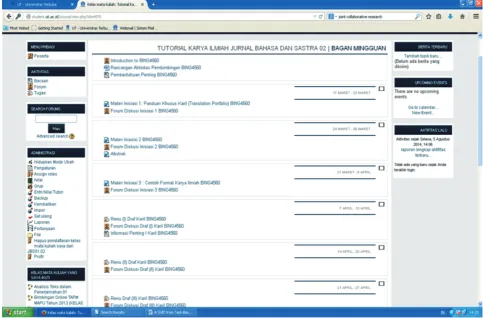
and its format, tasks setting ) along with the slots for Discussion Forums; Weeks 4–6 are the slots for submitting drafts of the TP online; Discussion Forums (a tool available in the software through which tutor-student and student-student interactions can take place) are also provided for the students (see Figure 2).
The tutor in charge provides online feedbacks on each draft of the TPs, particularly in relation to the research questions, relevant literature review (Baker, 1992; Hoed, 2006; Munday, 2001; Newmark, 1988;
6 7
Nord, 1997), methodology, results, and discussion, as
well as conclusions. Data collection
Both the qualitative and quantitative data for analysis were taken from two sources respectively, namely the students' performance in the TP to be assessed based on some review criteria (i.e., originality, title-content reflection, research objectives, relevant literature review, appropriate methods (Hurtado, 1995), deep translation analysis, findings-and-literature review discussion, and conclusions) by the tutor in charge and also through the distribution of online questionnaires to the translation students who had registered for the TP.
t h e m a t i c , e n c y c l o p a e d i a ) , t r a n s f e r p ro b l e m s, psychophysiological and professional/ instrumental aspects (House 1981, 1997; Martinez & Hurtado, 2001)
8 9 1 0
ranging from excellent, very good, good,
11 12
satisfactory, and unsatisfactory (Kelly, 2005, 141–2). These criteria (i.e., criterion-referenced assessment) were not rigidly applied during the first few semesters when the policy was introduced by the Ministry concerned in 2012. There are two reasons for this: one is that UT actually has a compulsory end-of-programme written translation examination, referred to as Tugas Akhir Program (TAP) having four credit points, and thus contributes to the students' cumulative achievement index; the second reason has to do with the fact that the project has zero credit point. Still, it is compulsory in
13
terms of the national education policy.
The data taken from the semester 1 of academic year 2014 were processed by continuously assessing the first four drafts submitted online by the students. Online feedback associated with research questions, relevant literature review, research methodology, results (i.e., Indonesian translated texts) and discussion (i.e., translation phenomena analysed qualitatively) and conclusions (i.e., answers to the research questions) was given on each draft of the TP.
RESULTS AND DISCUSSION
This section gives an account of how both the task-based and project-based approaches are integrated into the curriculum of the UDPIT at UT for the sake of increasing student autonomy. Besides, translation students' perception of the TP is further discussed.
Translator training based on task-based approaches at UT
Inspired by the notions put forward by Hurtado (1999), Gonzáles (2004, 2005), Nunan (2004, 2006), Willis (1996), and Wills and Willis (2012), UT adopted the task-based approaches to design and deliver translation course materials by DL. There are fifteen translation core courses, apart from English Language Skills courses (i.e., Reading 1 up to Reading 4 and Writing 1 up to Writing 4), in the curriculum of UDPIT at UT. The 2010 curriculum has been under revision since 2013, particularly in
relation to subject areas re-grouping, representativeness of text types (i.e., descriptive, narrative/recount, procedural, report, explanatory, expository, and discussion text) in the printed self-instructional translation learning modules (Karnedi, 2011), as well as the development of translation theories (Hurtado, 1992).
The application of the task-oriented approaches can also be found in each learning activity of the twelve translation core courses. The students have a lower degree of autonomy in this respect as a series of translation tasks provided for the translation students in the learning activities (task dependency) is mostly controlled by the translation course book writers (Nunan, 2004).
In terms of the curriculum structure, there are at least three translation core courses that the translation students at UT must take (i.e., Translation Theories, Text Analysis in Translation, and Summarising the ST) before they take twelve other core courses, including the TP at the end of the programme. On the basis of inductive method, these three core courses are intended for theoretical background before the students start doing translation exercises.
English for Translation course is aimed to provide the students with English-to-Indonesian translation activities operating at the sentence level. A short intermediate-level text written in English is given as a context for translation in each learning activity (Hatim, 2004) based on which a model translation is also given along with a brief explanation in terms of relevant translation theories. This is then followed by a series of translation tasks, in which a number of English sentences associated with particular grammatical patterns are extracted from a specially designed corpus using a concordance programme. In other words, the translation activities are task-based in nature having similar aims (Nunan, 2004, 2006; Shaoqin & Baoshu, 2011), namely to make the students able to translate short English sentences into Indonesian as accurately, clearly and naturally as possible.
Similar format of learning activities and translation tasks is also applied to the second translation course (i.e., Grammar Translation Exercises), but with the emphasis on Indonesian-to-English translation as expected
Table 2. Teaching unit structure by DL
MODULE:
SPECIFIC OBJECTIVE(S):
LEARNING ACTIVITY STRUCTURE
TASK 1: ST Analysis + Theoretical Justification
TASK 2: Model Translation + Theoretical Justification [Paragraph 1]
TASK 3: Translation Exercises + Model Translation + Theoretical Justification [Paragraph 2]
TASK 4: Translation Exercises + Model Translation + Theoretical Justification [Paragraph 3]
TASK ... [Paragraph 4 and so on]
SUMMARY
competence. As far as the student-centered learning concept is concerned (Simonson, et al, 2012, p. 195), alternative translation versions are also provided so that the students have the answer keys to compare with. This is one of the characteristics of distance education in which some of the tutor's functions in terms of feedback on the students' own translational work are integrated into the printed self-instructional translation learning modules.
Unlike the previous translation courses, ten other core courses (i.e., Translation 1–10) have similar aims —translating various text types or discourse genre of certain subject areas from English as the SL into Indonesian as the TL, vice versa (Hatim & Mason, 1990; Hatim & Munday, 2004; Larson, 1984). However, as an UDPIT (González, 2004, 2005; Malmkjær, 2004; Nord, 2005), more emphasis is placed on the English-to-Indonesian translation, as opposed to English-to- Indonesian-to-English translation. The translation tasks in each learning activity are set on the basis of paragraphs as units of translation. Alternative translation versions as feedback or comparison for the students' work are also given together with relevant translation theoretical justification. Table 2 presents the structure of teaching units provided in the printed self-instructional translation learning modules at UT.
The twelve translation core courses are specially designed on the basis of task-based approaches delivered online; each is supported by an online tutorial package comprising eight translation-oriented initiations posted weekly, three other self-translation assignments, forums of discussion; all contribute 30% to the end-of-semester written examination that is worth 70%. Still, the online tutorial packages are task-based in nature, having similar aims and producing final translation products. Kelly and Martin (2009, p. 298) argued that the task-based approaches are more appropriate for early stages of learning.
Translator training based on project-based approaches at UT
As highlighted earlier, the previous task-based approaches are applied during a semester, either through a self-study option or online learning.The project-based approach is also applied at the UDPIT at UT. As mentioned earlier, it is the university's requirement that in order to qualify for a Bachelor's Degree, or Master's Degree, graduates must publish a research article in a scientific journal.
To address the Ministry regulation, the UDPIT at UT requires its end-of-programme translation students to write a TP (Kelly, 2005), which is project-based in nature, through which student autonomy would increase when they write a TP, either individually or in groups (2005, pp. 138–9). By adopting the project-based approaches, the students have more freedom to select a particular type of
14
text as the ST (i.e., English) to be rendered into the TL (i.e., Indonesian). This practice is also in line with the last two principles suggested by Nunan (2004), namely reproduction to creation through which the students have
the opportunities to reproduce or to even create a new Indonesian target text (TT), and also with the notion of reflection based on which the tutor carried out continuous assessment during the period of TP online academic counselling (i.e., online clinic), which shows their translation competence (Hurtado, 2007; Pym, 2003; Schäffner & Adab, 2000) in completing the TP that they submitted online.
In terms of structure, like most research papers, the TP at UT has the following sections: (1) introduction comprising the background, research questions, objectives, and benefits of the TP for the readers; (2) literature review; (3) methodology consisting of subjects, research design, and data collection; (4) results and discussion focusing on the link between translation problems encountered in the selected text and the translation strategies (i.e., translation theories) to use; (5) conclusions and recommendations; and (6) references (Marco, 2009, pp. 13–35).
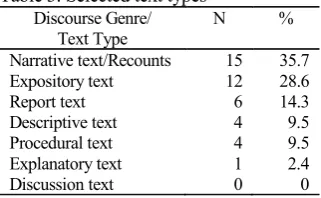
Unlike the task-based approaches, the TP is specially designed to assess individual students' competence in producing a piece of scientific research writing associated with translational work, or products (Király, 1995; Nord, 1991). For this purpose, an online tutorial package is also provided for the translation students to get online counselling from the tutors. They are required to upload their first, second, third and fourth drafts using Moodle LMS in order to obtain feedback from the tutors. The students are given an opportunity to choose a particular text type or discourse genre that they are familiar with. Thus, this pre-translation activity is closely relevant to what the translators usually do when completing the given translation tasks (Vienne, 1994; Gouadec, 2007). Table 3 presents a distribution of discourse genre that the translation students choose for writing their individual projects. The data are taken from semester 1 of academic year 2014.
Narrative texts/recounts have been mostly chosen (35.7 %), followed by expository texts (28.6 %) and report texts(14.3 %) respectively. There are at least two reasons, among others, why narrative texts are popular among the translation students. First, this type of text is easily found, either in printed forms or via the Internet, compared to other types of text. Second, it can also attract students' emotional feelings since it presents a context, or tells a story that most readers like to read, even to translate it from one language into another. In other words, context is very important in setting translation tasks. This translation phenomenon supports the notions of students'
Table 3. Selected text types
Discourse Genre/ Text Type
N %
Narrative text/Recounts 15 35.7
Expository text 12 28.6
Report text 6 14.3
Descriptive text 4 9.5
Procedural text 4 9.5
Explanatory text 1 2.4
interest and relevancy, as claimed by Widdowson (1978). Moreover, it is interesting to note that none of the students choose the discussion text as it is likely to be the most difficult text types to translate, compared to descriptive text, partly due to its higher level of difficulty in relation to its structure which consists of issue, argument for and against, and conclusion (Hatim& Mason, 1990; Larson, 1984; Nord, 1991). To put it briefly, getting familiar with all the text types and their degree of difficulty is something that the translation students need to master before they take the TP.
Online initiations on the TP components are posted
15
weekly through UT-Online (the university OER facilities). As for the introduction, most students have difficulties to write their research aims, which are translation-oriented due to the absence of sources associated with research methods in translation studies. To solve this problem, individual students are given online feedback on their first draft using Microsoft Word track changes to show how they could revise their research aims, which should be more specific and translation-oriented.
Writing a literature review related to the translation theories used for the data analysis seems to be one of the major problems faced by most translation students at UT. This is as a result of having only one translation theory course book available for them to refer to. To sort out this problem, they are encouraged to use other translation
16
textbooks or references for their articles, especially translation strategies as part of translation theories (i.e., translation techniques and translation methods operating at the micro level) as suggested by some scholars (Newmark, 1988; Baker, 1992; Hatim, 2001; Molina & Hurtado, 2002; Hoed, 2006).
Methodology is the third section in the students' articles which consists of methods (e.g. qualitative method, comparative model), data (a text type with 500 to 1000 words in length translated into Indonesian by individual students, including the reasons for choosing the text), and data processing (i.e., stages of obtaining the ST and TT for a comparative analysis (Nord, 1991) in order to determinethe strategies to be adopted in solving certain translation problems that may surface up when completing the project. A solution to these problems was also given to individual students by giving feedback on their methodology again using the track changes tools (Marco, 2009).
Meanwhile, the results and discussion section seems to be the most difficult part of the article. In this section, the students need to analyse the data comparatively (ST ≈ TT) in order to identify translation problems in the ST and find alternative strategies in dealing with those problems (Williams & Chesterman, 2002). Translation analysis is done for each paragraph of the ST and the TT focusing on translation phenomena. Things became even more difficult for the students when they did not have sound knowledge in the translation theories highlighted in the literature review section of the TP (Kearn, 2006). To put it simply, data (i.e., ST and TT) and translation theory are mixed together in the
discussion section with the research questions in mind. At the end of the discussion section, the students write a summary of translation techniques (Molina & Hurtado, 2002) adopted as the research findings before making a conclusion in which answers to the research questions are presented.
Students' reflections on the project-based approaches The TP also reflects the translation students' perception (Kenny, 2008; Şahin & Dungan, 2014) on the online tutorial package specially designed for the students to writean end-of-programme project, which is in line with the notion that the project-based approaches are more appropriate for later stages of learning (Kelly & Martin, 2009, p. 298). The thirteen questions in the online questionnaires can be grouped into three main sections: (1) the design of the TP online tutorial package (i.e., questions 1–4,7, 8, 13); (2) the theory-related project (i.e., questions 5–6); and (3) the tutor (i.e., questions 9–12).
As seen in Appendix, the translation students who participate in the online tutorial package of the project generally have a positive perception on the ways in which the online tutorial was conducted. This is quantitatively shown by the scores (ranged from four to five) given to each question in the online questionnaire by the respondents with some questions even received much higher scores, especially in relation to the project-based approaches (19%), expectation (16%), tutor's knowledge (16%), as well asthe TP content and format (15%), as seen in the following translation students' comments.
To me, the tutorial designed for the TP was very helpful because I could understand those mistakes available in the drafts of my project; this made me realize that I had written it rather carelessly. (My Translation)
I received feedback from you that gave me, as a student, strong motivation; your supervision is highly appreciated; the weaknesses are not merely on the tutor's side but also on the students because of their limited knowledge leading to low self-confident, limited time available due to heavy workload, or unreliable Internet connection. I am sure that you have done your best; I realize that you cannot stay online all the time to help the students. They are required to study independently at UT. (My Translation)
It is good and thanks.
However, other aspects of the TP online tutorial package still need to be enhanced. As for the first section, the TP organization, aims, and frequencies of feedback given need to be improved. Furthermore, the tutor also needs to show higherlevel of interest and enthusiasm in running the online tutorial, including the degree of feedback provided, either individually or collectively through the existing forums of discussions, as seen in the following students' comments.
need to be enriched with the materials taken from other textbooks; second, the tutor in charge needs to give feedback daily so that the participants are getting more motivated and productive; third, the computer system used for the tutorial was not user-friendly; the software has many unfamiliar features and the available operational information is also inadequate. (My Translation)
In my opinion, the online counselling is already good. But, I hope in the future the tutor will be more active and give immediate responses to the students' questions. (My translation)
The tutor should be more enthusiastic in giving supervision on the TP so that it is easier for the students to complete their own project that might have taken much energy in order to get the best results. (My translation)
One of the reasons for the weaknesses highlighted hereis the fact that there is only one tutor in charge, who is responsible for 5 classes of the TP online tutorial (i.e., 69 translation students), apart from running online tutorials for three other core translation courses, each with one class. The former (i.e., the TP online tutorial package) seems to be relatively more time consuming from the tutor's point of view since it deals with providing a series of back-and-forth feedback on each (out of four) draft of the TP that the students submitted online. In total, the tutor runs eight virtual classes altogether in one semester, even though the tutors at UT by design are only required to handle four classes at the most. In comparison, tutors from other Distance Education universities are mostly assigned to teach one or two virtual classes per semester (i.e., low student-to-tutor ratios). Lentell and O'Rourke (2004) alleged that tutoring a large number of students as in the case of Open Distance Learning (ODL) institutions in Africa, Asia (including at UT), and the Carribean seemed to be a challenge that might not be met. The authors even gave an early warning to all ODL stakeholders who “ignoring this issue will lead to the failure of ODL to deliver on its promise, [namely to increase] accessibility for large numbers of learners to education and training opportunities” (p. 7).
One of the alternative solutions to the above problems is perhaps by forming a team of tutors dealing with the TP virtual classes as mostly practised in face-to-face translation classes. To do so, recruiting more tutors is necessary, so that translation students who do their translation projects will receive sufficient feedback on the drafts of their TP (Li, 2002). Nevertheless, recruiting new tutors will have impacts on the provision of not only the technical training for those tutors but also those content-related preparations that need to be periodically evaluated by the translation course coordinators in charge, leading to high quality of tutors and online tutorial materials.
Students' reflections on the task-based approaches Within the context of DL, adopting the task-based approaches at UT is reflected in a series of translation tasks that are set in each learning activity in the translation modules. Unlike the responses given to the project-based approaches, questionnaires were also distributed to the translation students to evaluate aspects related to the modules in terms of clarity of instruction, impact on learners, and feasibility. Below are some of their responses.
Clarity of Instruction:
Good and adequate. (My translation)
Impact on learner:
In my opinion, the modules need some revisions. I mean, they need to be replaced with other new, up-to-date, and current reading passages and sources, for instance. However, they should be relevant to the topics raised in each module of the translation courses. This is intended not only to widen the students' knowledge about translation but also to increase their awareness of those issues that are currently taking place, both nationally and internationally. I believe that those aspects can be taken into consideration. (My translation)
Feasibility:
Good. (My translation)
CONCLUSION
This study explores the methodology adopted in a translator training programme (i.e., the UDPIT) within the context of DL. Translation approaches and their effectiveness have been highlighted, includingthe challenges faced and the solutions implemented.The discussionhas specially addressed some issues related toboth the task-based and the project-based approaches. The former approaches seems to be more suitable for those who are still in the early stages of their training during which they are usually exposed to controlled translation activities in the existing translation learning modules. Nevertheless, the latter approaches taking the form of TP as an alternative summative method for assessing the translation students' competence proves to be more suitable for the students in the later stages of learning.
By the time they take the TP at the end of the translator training programme, they should have a strong background not only in translation theories, but also in research methods in the translation studies. In other words, the two sets of translation approaches put emphasis on different points along a continuum of students' progress. Nonetheless, the two approaches (the task-based approaches and the project-based approaches) are compatible and complementary in nature.
student autonomy in learning translation online, apart from exploring online teaching approaches by making use of online learning technologies. This finding again supports relevant research associated with student autonomy in translator training programmes that have so far been conducted by other scholars.
The TP, to a certain extent, also creates “wash-back effects” on the learning and teaching process of translation through ODL system that is rich in the task-based approaches. Those didactic aspects of translation, such as translation theories, and research methods that are not fully explored in the existing printed self-instructional learning materials could be delivered online during the process of writing the TP as “compensation.”
In conclusion, the idea of integrating the end-of-programme translation written examination and the TP into a single end-of-programme grade, which are based on different sets of marking criteria, seem to be an appropriate academic policy issued by UT policymakers as part of ODL stakeholders and also by other institutions of higher education offering translator training programmes. This effort is therefore congruous with the project-based approaches as part of summative assessment.
Endnotes
1. An abbreviated version of this paper was presented at the Second International Conference on Research into the Didactics of Translation, Departament de Traducció i d'Interpretació Universitat Autònoma de Barcelona, Spain, 8-9 July 2014.
2. Apart from the TP, appraisal methods are also the most recent methods adopted in translation evaluation.
3. The principles of task-based approach proposed by Nunan (2004) are closely linked to learning activities that are set in translator training. Within the DL context at UT, the translation students are usually provided in the learning units or modules with various text types to translate from the SL into the TL. Analyzing the source text (ST) is the first step (i.e., Task 1) they need to follow in order to identify its aim and social function, linguistics features, and organization. A model of TT along with its ST as well as a theoretical explanation is then provided for the students to learn (i.e., Task 2) prior to self-translation exercises dealing with translating the rest of the text which belong to Task 3 and so on (i.e.,integration, task dependency). Model translations for this are available in the Answer Key section for them to consult with. Having gone through the process of translation (i.e., textual level, referential level, cohesive level and the level of naturalness), or a series of tasks that are learner-centred, they are expected to able to translate a particular text type based on purposes (i.e.,learning objective).
4. The examination deals with English-to-Indonesian-to-English translation core courses (i.e., translation theory, the ST analysis in translation, translation
practice, and translated text editing.
5. As for the tasks' setting, the TP must be English-to-Indonesian translation-oriented.
6. A translation of a particular text type chosen, either descriptive, narrative, procedural, report, explanatory, expository, or discussion text that belongs to one of the categories/subcategoriesof a particular field; the ST is between 500 and 1000 words in length.
7. A comparative analysis involving the ST and the TT which shows the learning process that the students have gone through, especially in relation to the theoretical aspects of translation appeared during the process of translating the selected ST. The students are advised to refer to translation theories they have learned in the translation course books, or to that relevant translation literature available on the Internet.
8. The students have been able to identify all cultural differences involving the ST and the TT and have suggested appropriate solutions to all or almost all existing translation problems in the ST.
9. The students have been able to identify almost all cultural differences involving the ST and the TT and have suggested appropriate solutions to most translation problems existing in the ST.
10. The students have been able to identify most cultural differences involving the ST and the TT and have significantly suggested appropriate solutions to the existing translation problems in the ST.
11. The students have been able to identify a significant number of cultural differences involving the ST and the TT and have occasionally suggested appropriate solutions to the existing translation problems in the ST.
12. The students have not been able to identify a significant number of cultural differences involving the ST and the TT and have not suggested appropriate solutions to the existing translation problems in the ST.
13. Commencing in the semester 1 of academic year 2015, the Karil contributes 20% to the final grades together with the marks given to the end-of-programme examination (i.e., TAP) that is worth 80% deriving from 50% of the translation written examination plus 30% from the students' participation in its online tutorial package.
14. The text types' selection is also relevant to the fact that in professional translation practice, translators often come across some of these text types, and they should therefore be familiar with them.
15. “OER [Open Educational Resources] are teaching, learning, and research resources that reside in the public domain or have been released under an intellectual property license that permits their free use or re-purposing by others” (UNESCO, 2011). 16. To widen their theoretical knowledge about research
( h t t p : / / w w w . j b e -platform.com/content/journals/15699986), Babel (http://www.jbe-platform.com/content/journals/ 15699668), Meta (https://meta.erudit.org), The I n t e r p r e t e r a n d T r a n s l a t o r T r a i n e r ( h t t p : / / w w w. s t j e r o m e . c o . u k ) , a n d m a n y others.They are available online in electronic edition.
REFERENCES
Aken, L.R. (1996).Rating scales and checklists: Evaluating, behaviour, personality, and attitudes.New York: John Wiley & Sons, Inc. Angelelli, C. V. &Jacobson, H.E. (Eds.) (2009).Testing
and assessment in translation and interpreting studies.Amsterdam: John Benjamins B.V. Baker, M. (1992).In other words.London: Routledge. Delisle, J. (1993). Latraductionraisonnee:
Manueld'initiation a la traductionprofessionnelle de l'anglaisverslefrançais. Ottawa: Presses de l'Universitéd'Ottawa.
Dick, W.,Carey, L. &Carey, J. (2005).The systematic design of instruction (6th ed). Boston: Pearson. Gile, D. (1995). Basic concepts and model for
interpreter and translator training. Amsterdam: John Benjamin.
González D., M. (coord.) (2003).
Secuencias.Tareaspara el aprendizajeinteractivo de la traducciónespecializada.
Barcelona:Octaedro-EUB.
Gonzáles D., M. (2004). Undergraduate and postgraduate translation degrees:Aims and expectations.In Martha Tennent (Ed.),Translation in undergraduate degree programmes. Amsterdam: Benjamins.
Gonzáles D., M. (2005). Minding the process, improving the product: Alternatives totraditional translator training'.In Martha Tennent
(Ed.),Training for the new millennium. pedagogies for translation and interpreting. Amsterdam: Benjamins.
Gouadec, D. (2002). Profession traducteur.Alias ingénieur en communication multilingue (et) multimédia. Paris:Maison du Dictionnaire.
Gouadec, D. (2003). Position paper: Notes on translator training.In Anthony Pym, CarminaFallada, José Ramón Biau& Jill Orenstein (Eds.),Innovation and E-learning in translator training.Tarragona: Octaedro-EUB.
Gouadec, D. (2007).Training translators: translation as aprofession. Amsterdam & Philadelphia: John Benjamins.
Hatim, B.& Mason, I. (1990).Discourseand the translator.London: Longman.
Hatim, B. & Mason, I. (1997).Thetranslator as communicator.London:Routledge.
Hatim, B. (2001).Teaching and researching translation. Essex: Pearson Education Limited.
Hatim, B. &Munday, J. (2004).Translation: An
advanced resource book.New York: Routledge. Hatim, B. (2004).Translating text in context.In Jeremy
Munday(Ed.),The Routledgecompanion to translation studies. London: Routledge. Hoed, B. H. (2006).Penerjemahandankebudayaan
(Translating and culture). Jakarta: Pustaka Jaya. House, J. (1981). A model for translation quality
assessment, Tubinger: Narr.
House, J. (1997).Translation quality assessment: A model revisited,TubingerBeitragezurLinguistik. House, J. (2001).Translation quality assessment:
linguistic description vs social evaluation. Meta 46(2), pp. 243–57.
HurtadoA., A.(1992) Didactique de la traduction des textes specialises.Actes de la3ème Journée ERLA-GLAT.Lexiquespécialiséetdidactique des langues, Brest: UBO-ENST, pp. 9–21.
Hurtado,A., A.(1993).Unnuevoenfoque de la didáctica de la traducción. Metodologíay diseño curricular. In RoserGauchola, Claude Mestreit& Manuel Tost(Eds),Les languesétrangèresdansl'Europe de l'Acte Unique. Barcelona: ICE de la
UniversitatAutònoma de Barcelona, PP. 239–52. HurtadoA., A.(1995). La didáctica de la traducción:
evolución y estado actual.In PurificaciónFernández (Ed.),Perspectivas de la traducción, Valladolid: Universidad de Valladolid, PP. 49–74.
HurtadoA., A. (1999).Enseñar a traducir.Metodología en la formación de traductores e intérpretes, Madrid: Edelsa.
Hurtado A., A. (ed.) (1999).Enseñar a traducer. Madrid: Edelsa.
Hurtado A., A. (2007). Competence-based curriculum design for training translators.The Interpreter and Transaltor Trainer 1(2),pp. 163–195.
Karnedi (2011). Analisis Teks dalam Penerjemahan (Text Analysis in Translation). Jakarta: Universitas Terbuka.
Kasandrinou, M. (2006).Training for translation: The case of specialized translation training and art texts.PhD Thesis, Portsmouth: University of Portsmouth
Kearn, J. (2006). Curriculum renewal in translator training:Vocational challenges in academic environments with reference to needs and situation analysis and skills transferability from the
contemporary experience of Polish translator training culture.PhD Thesis. Dublin:School of Applied Language and Intercultural Studies, Dublin City University.
Kelly, D. (2005).Handbook for translator trainers. Manchester: St. Jerome Publishing.
Kelly, D. & Martin, A. (2009). Training and education. In Mona Baker & Gabriela Saldanha (eds.) Routledgeencyclopedia of translation Studies (2nd edition) (pp. 294–9). Abingdon: Routledge. Kenny, M.A. (2008). Discussion, cooperation,
Király, D. (2000).A social constructivist approach to translator education.Empaworment from theory to practice.Manchester: St Jerome.
Király, D. (2005). Project-based learning: A case for situated translation. Meta: Translators' Journal 50(4),pp. 1098–1111.
Kussmaul, P. (1995) Training the translator. Amsterdam: Benjemins.
Larson, M.(1984).Meaning-basedtranslation: A Guide to cross-language equivalence, 2nd edition'. USA: University Press of America.
Lentell,H. &O'Rourke, J.(2004).Tutoring large numbers: An unmet challenge.International Review of Research in Open and Distance Learning5(1), pp. 7–17.
Li, D. (2002).Translator training: What translation students have to say.Meta, 47(4), pp. 513–531. Malmkjær, K. (Ed.) (2004).Translation in
undergraduate degree programmes.Amsterdam & Philadelphia: Benjamins.
Marco, J. (2004) '¿Tareas o proyectos? ¿Senderos que se bifurcan en el desarrollo de la competencia traductora?', Trans 8, pp. 75–88.
Marco, J. (2009). Training translation researchers: An approach based on models and best practice. The Interpreter and Translator Trainer, Special Issue on Training for Doctoral Research 3(1), pp. 13−35.
Martinez, M., N.&Hurtado A., A. (2001). Assessment in translation studies: Research needs'.MetaXLVI, 2, pp. 272-287.
Molina, L. &Hurtado,A., A. (2002) 'Translation techniques revisited: A Dynamic and functionalist approach. Meta: Translators' Journal 47(4),pp. 498–512.
Munday, J. (2001).Introducing translation studies. New York: Routledge.
Newmark, P. (1988).A textbook of
translation.Hertforshire: Prentice Hall International (UK) Limited.
Nord, C. (1991).Text analysis in translation: Theory, methodology, and didactic application of a model for translation-oriented text analysis. Amsterdam: Rodopi.
Nord, C. (1997). Translating as a purposeful activity. Manchester: St. Jerome.
Nord, C. (2005). Training functional translators. In Martha Tennent (Ed.),Training for the New Millennium. Pedagogies for translation and interpreting.Amsterdam: Benjamins.
Nunan, D. (2004).Task-based language teaching. Cambridge: Cambridge university Press.
Pym, A. (2003).Redefining translation competence in an electronic age.In defence of a minimalist approach.Meta Translators Journal48(4), pp. 481–97.
Pym, A. (2009).Translator training.Retrieved 2 July 2014)
from:[usuaris.tinet.cat/apym/on-line/training/2009_translator_training.pdf], Robinson, D. (2003). Becoming a translator: An
introduction to the theory andpractice of translation.London: Routledge.
Şahin, M.&Dungan, N. (2014). Translation testing and evaluation: A case study on methods and
needs.The International Journal for Translation & Interpreting6(2), pp. 67–89.
Schäffner, C.&Adab, B. (2000).Developing translation competence: introduction. In Schäffner, Christina andAdab, Beverly (eds.) Developing Translation Competence, Amsterdam &Philadelphia: Benjamins, vii–xvi.
Shaoqin, L. & Baoshu, Y. (2011). TBLT in China (2001-2011): The Current Situation, Predicament and Future. Indonesian Journal of Applied Linguistics, 2(2), pp. 147-55.
Simonson, M.&Smaldino, S. E.& Albright,
M.&Zvacek, S. (2012).Teaching and learning at a distance: Foundations of distance education, Boston: Pearson.
UNESCO & COL. (2011).Guidelines for Open Educational Resources (OER) in Higher
Education. France & Canada: UNESCO & COL. Vienne, J. (1994). Towards a pedagogy of translation in
situation.Perspectives,2(1), pp. 51–9. Widdowson, H. G. (1978). Teaching language as
communication. Oxford: Oxford University Press. Wills, D. & Willis, J. (2012).Doing task-based
teaching. Oxford: Oxford University Press. Willis, J. (1996).A framework for task-based learning.
Harlow: Addison Wesley Longman.
Wilss, W. (1976).Perspectives and limitations of a didactic framework for the teaching of translation.In Richard W. Brislin (Ed.) Translation.Applications and research, New York:Gardner Press, pp. 117–37.
Wu, G. (2010). Translating differences –A hybrid model for translation
training.Translation&Interpreting2(1), pp. 24–37. Williams, J. &Chesterman, A. (2002).The MAP.A
beginner's guide to doing research in translation studies. Manchester: St. Jerome Publishing. Zhong, Y. (2008).Teaching translators through
Appendix
Students Responses to the TP Online Questionnaires
(adapted from Aken, 1996)
NO QUESTION 1 2 3 4 5 N/A*
1 The TP online tutorial package is well-organised. 1 1 1 9 7
2 The aims of the TP online tutorials have been defined and met. 1 1 1 8 8
3 The materials ofinitiation for the TP online tutorial have been
appropriate in terms of content.
1 1 1 6 10
4 The given TP format makes it easier for you to complete the
project (TP).
2 2 5 9 1
5
Through the project (TP), you have the freedom toselecta particular text type as the source text or data (project-based approach).
1 4 13 1
6
Translator training programmes should start from the task-based approaches (through controlled translation exercises provided in the course books, or given in the end of semester examinations) and end with the project-based approach (TP)
1 1 1 6 7 1
7 The TP standard of expectation is quite reasonable and fair/can
be met.
1 6 11 1
8 The frequencies of guidance/online clinics are reasonable and
fair).
1 3 8 2
9 The tutor has sound knowledge about the TP materials. 2 5 11 1
10 The tutor shows high interest and enthusiasm is running the
online tutorials (TP).
2 2 14
11 The tutor provides adequate feedback, either individually or
through forums discussions.
2 6 9 2
12 Generally speaking, the tutor is excellent. 1 1 5 11 1
13 In general, the quality of the online tutorial package (TP) is
excellent.
1 1 8 8
For future improvement, please type below if you have any suggestions related to the online tutorial package (TP).………
*