SemEval-2010 Task 5: Automatic Keyphrase Extraction from Scientific
Articles
Su Nam Kim,♠Olena Medelyan,♥Min-Yen Kan♦ and Timothy Baldwin♠ ♠Dept of Computer Science and Software Engineering, University of Melbourne, Australia
♥Pingar LP, Auckland, New Zealand
♦School of Computing, National University of Singapore, Singapore
[email protected], [email protected],
[email protected], [email protected]
Abstract
This paper describes Task 5 of the Workshop on Semantic Evaluation 2010 (SemEval-2010). Systems are to automat-ically assign keyphrases or keywords to given scientific articles. The participating systems were evaluated by matching their extracted keyphrases against manually as-signed ones. We present the overall rank-ing of the submitted systems and discuss our findings to suggest future directions for this task.
1 Task Description
Keyphrases1are words that capture the main
top-ics of a document. As they represent these key ideas, extracting high-quality keyphrases can ben-efit various natural language processing (NLP) ap-plications such as summarization, information re-trieval and question-answering. In summariza-tion, keyphrases can be used as a form of se-mantic metadata (Barzilay and Elhadad, 1997; Lawrie et al., 2001; D’Avanzo and Magnini, 2005). In search engines, keyphrases can supple-ment full-text indexing and assist users in formu-lating queries.
Recently, a resurgence of interest in keyphrase extraction has led to the development of several new systems and techniques for the task (Frank et al., 1999; Witten et al., 1999; Turney, 1999; Hulth, 2003; Turney, 2003; Park et al., 2004; Barker and Corrnacchia, 2000; Hulth, 2004; Mat-suo and Ishizuka, 2004; Mihalcea and Tarau, 2004; Medelyan and Witten, 2006; Nguyen and Kan, 2007; Wan and Xiao, 2008; Liu et al., 2009; Medelyan, 2009; Nguyen and Phan, 2009). These
1We use “keyphrase” and “keywords” interchangeably to
refer to both single words and phrases.
♦ Min-Yen Kan’s work was funded by National Research
Foundation grant “Interactive Media Search” (grant # R-252-000-325-279).
have showcased the potential benefits of keyphrase extraction to downstream NLP applications.
In light of these developments, we felt that this was an appropriate time to conduct a shared task for keyphrase extraction, to provide a standard as-sessment to benchmark current approaches. A sec-ond goal of the task was to contribute an additional public dataset to spur future research in the area.
Currently, there are several publicly available data sets.2 For example, Hulth (2003) contributed
2,000 abstracts of journal articles present in In-spec between the years 1998 and 2002. The data set contains keyphrases (i.e. controlled and un-controlled terms) assigned by professional index-ers — 1,000 for training, 500 for validation and 500 for testing. Nguyen and Kan (2007) col-lected a dataset containing 120 computer science articles, ranging in length from 4 to 12 pages. The articles contain author-assigned keyphrases as well as reader-assigned keyphrases contributed by undergraduate CS students. In the general newswire domain, Wan and Xiao (2008) devel-oped a dataset of 308 documents taken from DUC 2001 which contain up to 10 manually-assigned keyphrases per document. Several databases, in-cluding the ACM Digital Library, IEEE Xplore, Inspec and PubMed provide articles with author-assigned keyphrases and, occasionally, reader-assigned ones. Medelyan (2009) automatically generated a dataset using tags assigned by the users of the collaborative citation platform CiteU-Like. This dataset additionally records how many people have assigned the same keyword to the same publication. In total, 180 full-text publi-cations were annotated by over 300 users.3
De-spite the availability of these datasets, a standard-ized benchmark dataset with a well-defined
train-2All data sets listed below are available for
download from http://github.com/snkim/
AutomaticKeyphraseExtraction
3http://bit.ly/maui-datasets
ing and test split is needed to maximize compara-bility of results.
For the SemEval-2010 Task 5, we have compiled a set of 284 scientific articles with keyphrases carefully chosen by both their authors and readers. The participants’ task was to develop systems which automatically produce keyphrases for each paper. Each team was allowed to sub-mit up to three system runs, to benchmark the contributions of different parameter settings and approaches. Each run consisted of extracting a ranked list of 15 keyphrases from each docu-ment, ranked by their probability of being reader-assigned keyphrases.
In the remainder of the paper, we describe the competition setup, including how data collec-tion was managed and the evaluacollec-tion methodol-ogy (Section 2). We present the results of the shared task, and discuss the immediate findings of the competition in Section 3. In Section 4 we as-sess the human performance by comparing reader-assigned keyphrases to those reader-assigned by the au-thors. This gives an approximation of an upper-bound performance for this task.
2 Competition Setup 2.1 Data
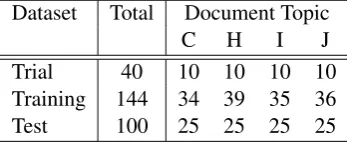
We collected trial, training and test data from the ACM Digital Library (conference and work-shop papers). The input papers ranged from 6 to 8 pages, including tables and pictures. To en-sure a variety of different topics was represented in the corpus, we purposefully selected papers from four different research areas for the dataset. In particular, the selected articles belong to the following four 1998 ACM classifications: C2.4 (Distributed Systems), H3.3 (Information Search and Retrieval), I2.11 (Distributed Artificial In-telligence – Multiagent Systems) and J4 (Social and Behavioral Sciences – Economics). All three datasets (trial, training and test) had an equal dis-tribution of documents from among the categories (see Table 1). This domain specific information was provided with the papers (e.g. I2.4-1 or H3.3-2), in case participant systems wanted to utilize this information. We specifically decided to strad-dle different areas to see whether participant ap-proaches would work better within specific areas.
Participants were provided with 40, 144, and 100 articles, respectively, in the trial, training and test data, distributed evenly across the four
re-search areas in each case. Note that the trial data is a subset of the training data. Since the original for-mat for the articles was PDF, we converted them into (UTF-8) plain text usingpdftotext, and sys-tematically restored full words that were originally hyphenated and broken across two lines. This pol-icy potentially resulted in valid hyphenated forms having their hyphen (-) removed.
All collected papers contain author-assigned keyphrases, part of the original PDF file. We addi-tionally collected reader-assigned keyphrases for each paper. We first performed a pilot annotation task with a group of students to check the stabil-ity of the annotations, finalize the guidelines, and discover and resolve potential issues that may oc-cur during the actual annotation. To collect the ac-tual reader-assigned keyphrases, we then hired 50 student annotators from the Computer Science de-partment of the National University of Singapore.
We assigned 5 papers to each annotator, esti-mating that assigning keyphrases to each paper should take about 10-15 minutes. Annotators were explicitly told to extract keyphrases that actually appear in the text of each paper, rather than to cre-ate semantically-equivalent phrases, but could ex-tract phrases from any part of the document (in-cluding headers and captions). In reality, on av-erage 15% of the reader-assigned keyphrases did not appear in the text of the paper, but this is still less than the 19% of author-assigned keyphrases that did not appear in the papers. These values were computed using the test documents only. In other words, the maximum recall that the partici-pating systems can achieve on these documents is 85% and 81% for the reader- and author-assigned keyphrases, respectively.
As some keyphrases may occur in multiple forms, in our evaluation we accepted two differ-ent versions of genitive keyphrases: AofB→B A(e.g. policy of school=school policy) andA’s
B → A B (e.g. school’s policy =school pol-icy). In certain cases, such alternations change the semantics of the candidate phrase (e.g.,matter of factvs.?fact matter). We judged borderline cases by committee and do not include alternations that were judged to be semantically distinct.
Table 1 shows the distribution of the trial, train-ing and test documents over the four different re-search areas, while Table 2 shows the distribution of author- and reader-assigned keyphrases.
Dataset Total Document Topic
C H I J
Trial 40 10 10 10 10
Training 144 34 39 35 36
Test 100 25 25 25 25
Table 1: Number of documents per topic in the trial, training and test datasets, across the four ACM document classifications
Dataset Author Reader Combined
Trial 149 526 621
Training 559 1824 2223
Test 387 1217 1482
Table 2: Number of author- and reader-assigned keyphrases in the different datasets
keywords, 125 keywords match exactly with reader-assigned keywords, while many more near-misses (i.e. partial matches) occur.
2.2 Evaluation Method and Baseline
Traditionally, automatic keyphrase extraction sys-tems have been assessed using the proportion of top-N candidates that exactly match the gold-standard keyphrases (Frank et al., 1999; Witten et al., 1999; Turney, 1999). In some cases, inexact matches, or near-misses, have also been consid-ered. Some have suggested treating semantically-similar keyphrases as correct based on simi-larities computed over a large corpus (Jarmasz and Barriere, 2004; Mihalcea and Tarau, 2004), or using semantic relations defined in a the-saurus (Medelyan and Witten, 2006). Zesch and Gurevych (2009) compute near-misses using ann -gram based approach relative to the gold standard. For our shared task, we follow the traditional ex-act match evaluation metric. That is, we match the keyphrases in the answer set with those the sys-tems provide, and calculate micro-averaged preci-sion, recall and F-score (β= 1). In the evaluation, we check the performance over the top 5, 10 and 15 candidates returned by each system. We rank the participating systems by F-score over the top 15 candidates.
Participants were required to extract ex-isting phrases from the documents. Since it is theoretically possible to retrieve author-assigned keyphrases from the original PDF arti-cles, we evaluate the participating systems over the independently-generated and held-out
reader-assigned keyphrases, as well as the combined set of keyphrases (author- and reader-assigned).
All keyphrases in the answer set are stemmed using the English Porter stemmer for both the training and test dataset.4
We computed a TF×IDFn-gram based baseline using both supervised and unsupervised learning systems. We use 1, 2, 3-grams as keyphrase can-didates, used Na¨ıve Bayes (NB) and Maximum Entropy (ME) classifiers to learn two supervised baseline systems based on the keyphrase candi-dates and gold-standard annotations for the train-ing documents. In total, there are three baselines: two supervised and one unsupervised. The per-formance of the baselines is presented in Table 3, whereRindicates reader-assigned keyphrases and C indicates combined (both author- and reader-assigned) keyphrases.
3 Competition Results
The trial data was downloaded by 73 different teams, of which 36 teams subsequently down-loaded the training and test data. 21 teams partici-pated in the final competition, of which two teams withdrew their systems.
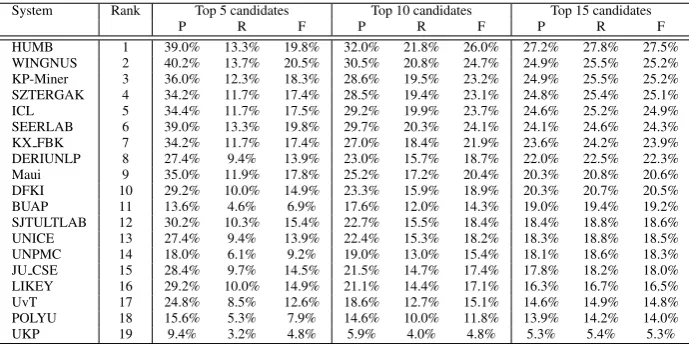
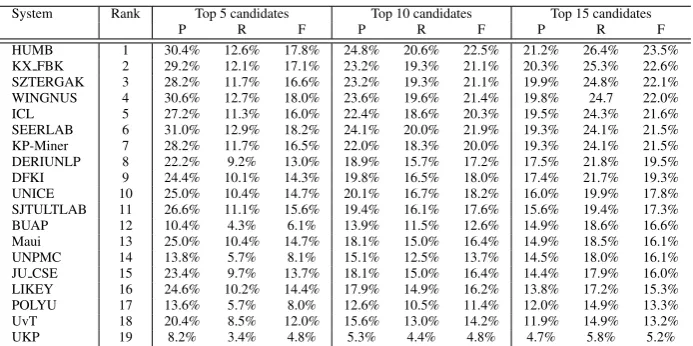
Table 4 shows the performance of the final 19 submitted systems. 5 teams submitted one run, 6 teams submitted two runs and 8 teams sub-mitted the maximum number of three runs. We rank the best-performing system from each team by micro-averaged F-score over the top 15 can-didates. We also show system performance over reader-assigned keywords in Table 5, and over author-assigned keywords in Table 6. In all these tables, P, R and F denote precision, recall and F-score, respectively.
The best results over the reader-assigned and combined keyphrase sets are 23.5% and27.5%, respectively, achieved by the HUMBteam. Most systems outperformed the baselines. Systems also generally did better over the combined set, as the presence of a larger gold-standard answer set im-proved recall.
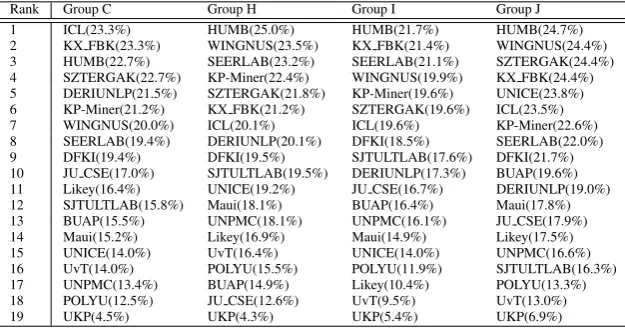
In Tables 7 and 8, we ranked the teams by F-score, computed over the top 15 candidates for each of the four ACM document classifications. The numbers in brackets are the actual F-scores
4Using the Perl implementation available at http://
Method Top 5 candidates Top 10 candidates Top 15 candidates by P R F P R F P R F TF×IDF R 17.8% 7.4% 10.4% 13.9% 11.5% 12.6% 11.6% 14.5% 12.9%
C 22.0% 7.5% 11.2% 17.7% 12.1% 14.4% 14.9% 15.3% 15.1% NB R 16.8% 7.0% 9.9% 13.3% 11.1% 12.1% 11.4% 14.2% 12.7% C 21.4% 7.3% 10.9% 17.3% 11.8% 14.0% 14.5% 14.9% 14.7% ME R 16.8% 7.0% 9.9% 13.3% 11.1% 12.1% 11.4% 14.2% 12.7% C 21.4% 7.3% 10.9% 17.3% 11.8% 14.0% 14.5% 14.9% 14.7%
Table 3: Baseline keyphrase extraction performance for one unsupervised (TF×IDF) and two supervised (NB and ME) systems
System Rank Top 5 candidates Top 10 candidates Top 15 candidates P R F P R F P R F HUMB 1 39.0% 13.3% 19.8% 32.0% 21.8% 26.0% 27.2% 27.8% 27.5% WINGNUS 2 40.2% 13.7% 20.5% 30.5% 20.8% 24.7% 24.9% 25.5% 25.2% KP-Miner 3 36.0% 12.3% 18.3% 28.6% 19.5% 23.2% 24.9% 25.5% 25.2% SZTERGAK 4 34.2% 11.7% 17.4% 28.5% 19.4% 23.1% 24.8% 25.4% 25.1% ICL 5 34.4% 11.7% 17.5% 29.2% 19.9% 23.7% 24.6% 25.2% 24.9% SEERLAB 6 39.0% 13.3% 19.8% 29.7% 20.3% 24.1% 24.1% 24.6% 24.3% KX FBK 7 34.2% 11.7% 17.4% 27.0% 18.4% 21.9% 23.6% 24.2% 23.9% DERIUNLP 8 27.4% 9.4% 13.9% 23.0% 15.7% 18.7% 22.0% 22.5% 22.3% Maui 9 35.0% 11.9% 17.8% 25.2% 17.2% 20.4% 20.3% 20.8% 20.6% DFKI 10 29.2% 10.0% 14.9% 23.3% 15.9% 18.9% 20.3% 20.7% 20.5% BUAP 11 13.6% 4.6% 6.9% 17.6% 12.0% 14.3% 19.0% 19.4% 19.2% SJTULTLAB 12 30.2% 10.3% 15.4% 22.7% 15.5% 18.4% 18.4% 18.8% 18.6% UNICE 13 27.4% 9.4% 13.9% 22.4% 15.3% 18.2% 18.3% 18.8% 18.5% UNPMC 14 18.0% 6.1% 9.2% 19.0% 13.0% 15.4% 18.1% 18.6% 18.3% JU CSE 15 28.4% 9.7% 14.5% 21.5% 14.7% 17.4% 17.8% 18.2% 18.0% LIKEY 16 29.2% 10.0% 14.9% 21.1% 14.4% 17.1% 16.3% 16.7% 16.5% UvT 17 24.8% 8.5% 12.6% 18.6% 12.7% 15.1% 14.6% 14.9% 14.8% POLYU 18 15.6% 5.3% 7.9% 14.6% 10.0% 11.8% 13.9% 14.2% 14.0% UKP 19 9.4% 3.2% 4.8% 5.9% 4.0% 4.8% 5.3% 5.4% 5.3%
Table 4: Performance of the submitted systems over the combined author- and reader-assigned keywords, ranked by F-score
for each team. Note that in the case of a tie in F-score, we ordered teams by descending F-score over all the data.
4 Discussion of the Upper-Bound Performance
The current evaluation is a testament to the gains made by keyphrase extraction systems. The sys-tem performance over the different keyword cat-egories (reader-assigned and author-assigned) and numbers of keyword candidates (top 5, 10 and 15 candidates) attest to this fact.
The top-performing systems return F-scores in the upper twenties. Superficially, this number is low, and it is instructive to examine how much room there is for improvement. Keyphrase extrac-tion is a subjective task, and an F-score of 100% is infeasible. On the author-assigned keyphrases in our test collection, the highest a system could the-oretically achieve was 81% recall5and 100%
pre-cision, which gives a maximum F-score of 89%. However, such a high value would only be possi-ble if the number of keyphrases extracted per doc-ument could vary; in our task, we fixed the thresh-olds at 5, 10 and 15 keyphrases.
5The remaining 19% of keyphrases do not actually appear
in the documents and thus cannot be extracted.
Another way of computing the upper-bound performance would be to look into how well peo-ple perform the same task. We analyzed the performance of our readers, taking the author-assigned keyphrases as the gold standard. The au-thors assigned an average of 4 keyphrases to each paper, whereas the readers assigned 12 on average. These 12 keyphrases cover 77.8% of the authors’ keyphrases, which corresponds to a precision of 21.5%. The F-score achieved by the readers on the author-assigned keyphrases is 33.6%, whereas the F-score of the best-performing system on the same data is 19.3% (for top 15, not top 12 keyphrases, see Table 6).
System Rank Top 5 candidates Top 10 candidates Top 15 candidates P R F P R F P R F HUMB 1 30.4% 12.6% 17.8% 24.8% 20.6% 22.5% 21.2% 26.4% 23.5% KX FBK 2 29.2% 12.1% 17.1% 23.2% 19.3% 21.1% 20.3% 25.3% 22.6% SZTERGAK 3 28.2% 11.7% 16.6% 23.2% 19.3% 21.1% 19.9% 24.8% 22.1% WINGNUS 4 30.6% 12.7% 18.0% 23.6% 19.6% 21.4% 19.8% 24.7 22.0% ICL 5 27.2% 11.3% 16.0% 22.4% 18.6% 20.3% 19.5% 24.3% 21.6% SEERLAB 6 31.0% 12.9% 18.2% 24.1% 20.0% 21.9% 19.3% 24.1% 21.5% KP-Miner 7 28.2% 11.7% 16.5% 22.0% 18.3% 20.0% 19.3% 24.1% 21.5% DERIUNLP 8 22.2% 9.2% 13.0% 18.9% 15.7% 17.2% 17.5% 21.8% 19.5% DFKI 9 24.4% 10.1% 14.3% 19.8% 16.5% 18.0% 17.4% 21.7% 19.3% UNICE 10 25.0% 10.4% 14.7% 20.1% 16.7% 18.2% 16.0% 19.9% 17.8% SJTULTLAB 11 26.6% 11.1% 15.6% 19.4% 16.1% 17.6% 15.6% 19.4% 17.3% BUAP 12 10.4% 4.3% 6.1% 13.9% 11.5% 12.6% 14.9% 18.6% 16.6% Maui 13 25.0% 10.4% 14.7% 18.1% 15.0% 16.4% 14.9% 18.5% 16.1% UNPMC 14 13.8% 5.7% 8.1% 15.1% 12.5% 13.7% 14.5% 18.0% 16.1% JU CSE 15 23.4% 9.7% 13.7% 18.1% 15.0% 16.4% 14.4% 17.9% 16.0% LIKEY 16 24.6% 10.2% 14.4% 17.9% 14.9% 16.2% 13.8% 17.2% 15.3% POLYU 17 13.6% 5.7% 8.0% 12.6% 10.5% 11.4% 12.0% 14.9% 13.3% UvT 18 20.4% 8.5% 12.0% 15.6% 13.0% 14.2% 11.9% 14.9% 13.2% UKP 19 8.2% 3.4% 4.8% 5.3% 4.4% 4.8% 4.7% 5.8% 5.2%
Table 5: Performance of the submitted systems over the reader-assigned keywords, ranked by F-score
System Rank Top 5 candidates Top 10 candidates Top 15 candidates P R F P R F P R F HUMB 1 21.2% 27.4% 23.9% 15.4% 39.8% 22.2% 12.1% 47.0% 19.3% KP-Miner 2 19.0% 24.6% 21.4% 13.4% 34.6% 19.3% 10.7% 41.6% 17.1% ICL 3 17.0% 22.0% 19.2% 13.5% 34.9% 19.5% 10.5% 40.6% 16.6% Maui 4 20.4% 26.4% 23.0% 13.7% 35.4% 19.8% 10.2% 39.5% 16.2% SEERLAB 5 18.8% 24.3% 21.2% 13.1% 33.9% 18.9% 10.1% 39.0% 16.0% SZTERGAK 6 14.6% 18.9% 16.5% 12.2% 31.5% 17.6% 9.9% 38.5% 15.8% WINGNUS 7 18.6% 24.0% 21.0% 12.6% 32.6% 18.2% 9.3% 36.2% 14.8% DERIUNLP 8 12.6% 16.3% 14.2% 9.7% 25.1% 14.0% 9.3% 35.9% 14.7% KX FBK 9 13.6% 17.6% 15.3% 10.0% 25.8% 14.4% 8.5% 32.8% 13.5% BUAP 10 5.6% 7.2% 6.3% 8.1% 20.9% 11.7% 8.3% 32.0% 13.2% JU CSE 11 12.0% 15.5% 13.5% 8.5% 22.0% 12.3% 7.5% 29.0% 11.9% UNPMC 12 7.0% 9.0% 7.9% 7.7% 19.9% 11.1% 7.1% 27.4% 11.2% DFKI 13 12.8% 16.5% 14.4% 8.5% 22.0% 12.3% 6.6% 25.6% 10.5% SJTULTLAB 14 9.6% 12.4% 10.8% 7.8% 20.2% 11.3% 6.2% 24.0% 9.9% Likey 15 11.6% 15.0% 13.1% 7.9% 20.4% 11.4% 5.9% 22.7% 9.3% UvT 16 11.4% 14.7% 12.9% 7.6% 19.6% 11.0% 5.8% 22.5% 9.2% UNICE 17 8.8% 11.4% 9.9% 6.4% 16.5% 9.2% 5.5% 21.5% 8.8% POLYU 18 3.8% 4.9% 4.3% 4.1% 10.6% 5.9% 4.1% 16.0% 6.6% UKP 19 1.6% 2.1% 1.8% 0.9% 2.3% 1.3% 0.8% 3.1% 1.3%
Table 6: Performance of the submitted systems over the author-assigned keywords, ranked by F-score
5 Conclusion
This paper has described Task 5 of the Workshop on Semantic Evaluation 2010 (SemEval-2010), fo-cusing on keyphrase extraction. We outlined the design of the datasets used in the shared task and the evaluation metrics, before presenting the offi-cial results for the task and summarising the im-mediate findings. We also analyzed the upper-bound performance for this task, and demon-strated that there is still room for improvement over the task. We look forward to future advances in automatic keyphrase extraction based on this and other datasets.
References
Ken Barker and Nadia Corrnacchia. Using noun phrase heads to extract document keyphrases. In
Proceedings of BCCSCSI : Advances in Artificial In-telligence. 2000, pp.96–103.
Regina Barzilay and Michael Elhadad. Using lexi-cal chains for text summarization. InProceedings
of ACL/EACL Workshop on Intelligent Scalable Text Summarization. 1997, pp. 10–17.
Ernesto D’Avanzo and Bernado Magnini. A Keyphrase-Based Approach to Summarization: the LAKE System at DUC-2005. In Proceedings of DUC. 2005.
Eibe Frank and Gordon W. Paynter and Ian H. Witten and Carl Gutwin and Craig G. Nevill-Manning. Do-main Specific Keyphrase Extraction. InProceedings of IJCAI. 1999, pp.668–673.
Annette Hulth. Improved automatic keyword extrac-tion given more linguistic knowledge. In Proceed-ings of EMNLP. 2003, 216–223.
Annette Hulth. Enhancing Linguistically Oriented Automatic Keyword Extraction. In Proceedings of HLT/NAACL. 2004, pp. 17–20.
Mario Jarmasz and Caroline Barriere. Using semantic similarity over tera-byte corpus, compute the perfor-mance of keyphrase extraction. In Proceedings of CLINE. 2004.
Rank Group C Group H Group I Group J 1 HUMB(28.3%) HUMB(30.2%) HUMB(24.2%) HUMB(27.4%) 2 ICL(27.2%) WINGNUS(28.9%) SEERLAB(24.2%) WINGNUS(25.4%) 3 KP-Miner(25.5%) SEERLAB(27.8%) KP-Miner(22.8%) ICL(25.4%) 4 SZTERGAK(25.3%) KP-Miner(27.6%) KX FBK(22.8%) SZTERGAK(25.17%) 5 WINGNUS(24.2%) SZTERGAK(27.6%) WINGNUS(22.3%) KP-Miner(24.9%) 6 KX FBK(24.2%) ICL(25.5%) SZTERGAK(22.25%) KX FBK(24.6%) 7 DERIUNLP(23.6%) KX FBK(23.9%) ICL(21.4%) UNICE(23.5%) 8 SEERLAB(22.0%) Maui(23.9%) DERIUNLP(20.1%) SEERLAB(23.3%) 9 DFKI(21.7%) DERIUNLP(23.6%) DFKI(19.3%) DFKI(22.2%) 10 Maui(19.3%) UNPMC(22.6%) BUAP(18.5%) Maui(21.3%) 11 BUAP(18.5%) SJTULTLAB(22.1%) SJTULTLAB(17.9%) DERIUNLP(20.3%) 12 JU CSE(18.2%) UNICE(21.8%) JU CSE(17.9%) BUAP(19.7%) 13 Likey(18.2%) DFKI(20.5%) Maui(17.6%) JU CSE(18.6%) 14 SJTULTLAB(17.7%) BUAP(20.2%) UNPMC(17.6%) UNPMC(17.8%) 15 UvT(15.8%) UvT(20.2%) UNICE(14.7%) Likey(17.2%) 16 UNPMC(15.2%) Likey(19.4%) Likey(11.3%) SJTULTLAB(16.7%) 17 UNIC(14.3%) JU CSE(17.3%) POLYU(13.6%) POLYU(14.3%) 18 POLYU(12.5%) POLYU(15.8%) UvT(10.3%) UvT(12.6%) 19 UKP(4.4%) UKP(5.0%) UKP(5.4%) UKP(6.8%)
Table 7: System ranking (and F-score) for each ACM classification: combined keywords
Rank Group C Group H Group I Group J 1 ICL(23.3%) HUMB(25.0%) HUMB(21.7%) HUMB(24.7%) 2 KX FBK(23.3%) WINGNUS(23.5%) KX FBK(21.4%) WINGNUS(24.4%) 3 HUMB(22.7%) SEERLAB(23.2%) SEERLAB(21.1%) SZTERGAK(24.4%) 4 SZTERGAK(22.7%) KP-Miner(22.4%) WINGNUS(19.9%) KX FBK(24.4%) 5 DERIUNLP(21.5%) SZTERGAK(21.8%) KP-Miner(19.6%) UNICE(23.8%) 6 KP-Miner(21.2%) KX FBK(21.2%) SZTERGAK(19.6%) ICL(23.5%) 7 WINGNUS(20.0%) ICL(20.1%) ICL(19.6%) KP-Miner(22.6%) 8 SEERLAB(19.4%) DERIUNLP(20.1%) DFKI(18.5%) SEERLAB(22.0%) 9 DFKI(19.4%) DFKI(19.5%) SJTULTLAB(17.6%) DFKI(21.7%) 10 JU CSE(17.0%) SJTULTLAB(19.5%) DERIUNLP(17.3%) BUAP(19.6%) 11 Likey(16.4%) UNICE(19.2%) JU CSE(16.7%) DERIUNLP(19.0%) 12 SJTULTLAB(15.8%) Maui(18.1%) BUAP(16.4%) Maui(17.8%) 13 BUAP(15.5%) UNPMC(18.1%) UNPMC(16.1%) JU CSE(17.9%) 14 Maui(15.2%) Likey(16.9%) Maui(14.9%) Likey(17.5%) 15 UNICE(14.0%) UvT(16.4%) UNICE(14.0%) UNPMC(16.6%) 16 UvT(14.0%) POLYU(15.5%) POLYU(11.9%) SJTULTLAB(16.3%) 17 UNPMC(13.4%) BUAP(14.9%) Likey(10.4%) POLYU(13.3%) 18 POLYU(12.5%) JU CSE(12.6%) UvT(9.5%) UvT(13.0%) 19 UKP(4.5%) UKP(4.3%) UKP(5.4%) UKP(6.9%)
Table 8: System ranking (and F-score) for each ACM classification: reader-assigned keywords
Zhiyuan Liu and Peng Li and Yabin Zheng and Sun Maosong. Clustering to Find Exemplar Terms for Keyphrase Extraction. InProceedings of EMNLP. 2009, pp. 257–266.
Yutaka Matsuo and Mitsuru Ishizuka. Keyword Ex-traction from a Single Document using Word Co-occurrence Statistical Information. International Journal on Artificial Intelligence Tools. 2004, 13(1), pp. 157–169.
Olena Medelyan and Ian H. Witten. Thesaurus based automatic keyphrase indexing. In Proceedings of ACM/IEED-CS JCDL. 2006, pp. 296–297.
Olena Medelyan. Human-competitive automatic topic indexing. PhD Thesis. University of Waikato. 2009. Rada Mihalcea and Paul Tarau. TextRank: Bringing Order into Texts. InProceedings of EMNLP. 2004, pp. 404–411.
Thuy Dung Nguyen and Min-Yen Kan. Key phrase Extraction in Scientific Publications. In Proceed-ings of ICADL. 2007, pp. 317–326.
Chau Q. Nguyen and Tuoi T. Phan. An ontology-based approach for key phrase extraction. InProceedings of the ACL-IJCNLP. 2009, pp. 181–184.
Youngja Park and Roy J. Byrd and Branimir Bogu-raev. Automatic Glossary Extraction Beyond
Termi-nology Identification. InProceedings of COLING. 2004, pp. 48–55.
Peter Turney. Learning to Extract Keyphrases from Text. InNational Research Council, Institute for In-formation Technology, Technical Report ERB-1057. 1999.
Peter Turney. Coherent keyphrase extraction via Web mining. In Proceedings of IJCAI. 2003, pp. 434– 439.
Xiaojun Wan and Jianguo Xiao. CollabRank: to-wards a collaborative approach to single-document keyphrase extraction. In Proceedings of COLING. 2008, pp. 969–976.
Ian H. Witten and Gordon Paynter and Eibe Frank and Car Gutwin and Graig Nevill-Manning. KEA:Practical Automatic Key phrase Extraction. In Proceedings of ACM conference on Digital li-braries. 1999, pp. 254–256.
Torsten Zesch and Iryna Gurevych. Approximate Matching for Evaluating Keyphrase Extraction. In