Issues
ISSN: 2146-4138
available at http: www.econjournals.com
International Journal of Economics and Financial Issues, 2018, 8(2), 357-369.
The Causal Effect of Stock Market Development, Financial
Sector Reforms and Economic Growth: The Application of
Vector Autoregressive and Error Correction Model
Charles O. Manasseh
1*, Jonathan E. Ogbuabor
2, Charles N. Anumudu
3, Felicia C. Abada
4,
Martins A. Okolie
5and Okoro E. Okoro
61Department of Economics, Coal City University Enugu, Nigeria.2Department of Economics, University of Nigeria Nsukka, Nigeria. 3Department of Economics, Michael Okpara University, Umudike Umuahia, Nigeria. 4Social Science Unit, School of General
Studies, University of Nigeria Nsukka, Nigeria. 5Department of Business Administration, Coal City University Enugu, Nigeria. 6Department of Banking & Finance, University of Nigeria, Enugu Campus, Nigeria. *Email: [email protected]
ABSTRACT
The study examined the causal relationship between stock market development, financial sector reform and economic growth in Nigeria, using Vector autoregressive and error correction model for the analysis. We observed bidirectional causality between stock market development and economic growth, along with financial sector reform and economic growth. This implies that stock market development and economic growth and; financial sector development and economic growth promote each other. More so, the findings reveal a unidirectional causality running from financial sector reform to stock market development. Hence, there is an evidence of positive long-run relationship between the variables of cointegrating equations. Furthermore, more inquiries on the relationship between business environment, legal framework and stock market development, show a positive long run relationship between the variables of the cointegrating vectors, suggesting that good business environment and quality legal framework could be a prerequisite for stock market development through confidence building and investors protection.
Keywords: Economic Growth, Stock Market Development, Financial Sector Reform
JEL Classifications: G10, EO2, E44
1. INTRODUCTION
It is a clear fact that an organized, developed and efficient stock markets increases domestic savings, and also provide individuals and corporate investors with an additional financial instrument which stimulate the quality of transactions, investments and economic growth of a country. There is no doubt that development of every economy is partly dependent on the development to fits financial sector, and apparently the stockmarket in particular. The acceleration of high level of confidence amongst market players or investors, as the off sprin of market development, to a greater extent, provides opportunities for domestic savings mobilization and allocation from surplus spending units and diversification of risk associated with investment portfolios, reducing the crunch of over dependency of firms, government and corporate bodies on
banks funding vis-à-vis causing increase in business activities, through the increase in stock market indicators such as, number of companies listed, volume and values of shares traded alongside the overall market capitalization.
public companies, even corporate organizations generate more funds to expand their business horizon instead of over reliance on bank credit.
In the Nigerian financial sector, different phases of reforms have been launched in order to promote efficiency and development of the Stock Market and other financial institutions. The reforms includes; interest rate liberalization and banking sector deregulation of 1986, consolidation of 2004, 2006 post consolidation and 2009 blue print policy reforms. These policy reforms were launched to address the issues of over-dependency on public sector deposits, neglect of small and medium class savers, inadequate disclosure and transparency about the financial position of banks and other financial institutions, shareholder protection, gross insider abuses resulting in huge non-performing insider related credits, weak regulatory and supervisory framework and macroeconomic volatility (Ogujiuba and Obiechina 2011). Hence, the aim is to build a formidable, transparent, and efficient develop stock market that could supports the investment process through the mobilization of household and foreign savings for investment purposes. This savings are allocated to the most productive ways which thus, promote growth and development. Indeed, considering the enormous policy reforms in the Nigerian financial sector, it is expected that stock market should have done relatively well in terms of market capitalisation and number of domestic companies listed when compared to other countries like South Africa and Egypt stock market. For example, from 1990 to 2011, Nigerian Stock Exchange on average listed only 189.090 domestic companies with 14.323 market capitalization (% of gross domestic product [GDP]) while South Africa and Egypt Stock Exchange on average listed 535.682 and 689.591 domestic companies with 181.159 and 34.918 recorded market capitalization (% of GDP) respectively.
In view of the above discussion, the ability of the stock market to play its role of accelerating economic growth has been punctuated by its vulnerabilitytosystemicdistress,inherent security problems, macro-economic volatility, and weak institutional framework (Kama, 2006). The ugly trend of inaptitude behaviour of authorities, high level of corruptions and massive pursuit of individual interest have always question the relevance of the reforms as a veritable tool to promote stock market development, financial sector development and economic growth despite the fact that these policy reforms cut across the entire policy requirement needed for the development of the market. This situation is threatened by the vulnerability of business environment caused by the rampage of militants and insurgent, which is evidenced in the World Bank ease of doing business rating. Recently, Nigeria was ranked 133rd out of
183 countries in the latest ease of doing business (World Bank/IFC, 2012) as at the time of the study. This has affected the performance of the market recently because of fear of the unknown. These have been highlighted as a major drawback of growth and development of the market. Be that as it may, despite the market upheavals, the current resurgence of the Nigerian economy and financial sector, particularly the stock market in recent time has been a source of interest and inspiration. This could be as a result of recent effort by the authorities to revitalize the sector through the adoption of new practices and introduction of new policy reforms in the Nigerian
Stock Market, not just to restore investor’s confidence but to meet G-30 recommended standard for emerging economies. Some of these reformsinclude the introductions of automated trading system, Desk for phone-in-service, the central securities clearing system (CSCS), trade alert introduced by CSCS, a day transaction clearance (T+1) as against T + 14, introduction of the capital trade point by investment securities Act (ISA), the establishment of investment security tribunal, introduction of market makers, the establishment of Real Estate Investment Schemes, and the ongoing electronic dividend payment that would be launched soon (NSE fact book, various years), supported with the introduction of entrepreneurship development, skilled acquisition and amnesty programme with the aim of empowering the youth and to arrest the environmental restiveness caused by youth unemployment. In view of the above, it is therefore imperative to investigate the relationship between stock market development, financial sector reform and economic growth.
Given the enormous body of evidence shown in the literature, no single research had constituted an in-depth study on the causal relationship between stock market development, financial sector reforms and economic growth in Nigeria. Therefore, there is the need to further extend the already existing knowledge on the causal link between stock market development, financial sector reforms
and economic growth. Hence, earlier studies focus more on
stock market development and macroeconomic determinants but following the works of Manasseh (2007), Pagano (1993) and North (1990), institutional quality and other business environmental factors play a significant role in stock market development and thus were considered important in this study. However, this paper is divided into five sections. Section two is a review of literature, Section three outlines the methodology, and Section four discusses the empirical findings while section five is the conclusion and policy suggestions.
2. REVIEW OF LITERATURE
2.1. Theoretical LiteratureThere has been a serious debate on the link between stock market development and economic growth among different schools of thought. The first “school―supply leading” is of the view that financial development may lead to growth in that a well-developed financial system performs several critical functions to enhance the efficiency of intermediation namely by reducing information, transaction, and monitoring costs (McKinnon, 1973; King and Levine 1993; Schumpeter (1912) and Shaw, 1973). Studies such as Creane et al.(2003) argued that a modern and efficient financial system mobilizes savings for investment through funding business opportunities. They further argued that an efficient financial system monitors the performance of managers, enables and facilitates the exchange of goods and services. Other studies like, Bencivenga et al. (1996) and Levine (1991) pointed that stock market liquidity plays a key role in economic growth through the provision of assets to savers.
a financial sector is repressed then it can only respond passively to the real-sector needs. Also, studies by Argrawall and Tuteji (2007), Azam et al. (2016), Levine and Zervos (1998), N‘zue (2006), Ozturk, 2008, Deb and Mukherjee (2008), Acaravci et al., 2009, Nowbutsing (2009), Caporale et al. (2004), Acaravci et al. (2011), Naceur et al. (2007), Schumpeter (1912), Rahman and Salahuddin (2010) conformed to this school. They demonstrated that stock market development is a prerequisite condition for growth even though, Shleifer and Summers (1988), Mayer (1988) and Stiglitz (1993) pointed out strongly that the development of stock exchange markets can be detrimental to economic growth by encouraging counter productive corporate takeovers and promote short-term profits which donotaccord corporate managers a chancet of ocus on the long-term prospects of investment. However, this school of thought was subdivided into Structuralists and Repressionists. The structuralists are of the view that the quantity and the composition of financial variables induce economic growth by directly increasing savings in the form of financial assets, thereby spawning capital formation and economic growth, while the Repressionists on the other hand contend that financial liberalisation in the form of an appropriate positive real rate of return on real cash balances is a vehicle for promoting economic growth. Hence, a liberalized financial system causes an increase in saving and investment.
The second school of thought “the demand-following” argued that financial development follows economic growth. They are of the view that as the economy expands, the demand for certain financial instruments increases and this in turn lead to financial market development. The school was supported by the findings of Gurley and Shaw (1960) and Gelb (1989) which argued that growth promotes financial deepening, and that the demand for financial services increases with economic development. In addition, Singh (1997) also maintain that stock markets do not in any way lead to long run economic growth due to macroeconomic instability, volatility and arbitrariness of pricing process. But added Charkravarty (2005) added that stock exchange prices are highly sensitive to some fundamental macroeconomic indicators. He pointed that as the economy expands, the demand for certain financial instruments increases, leading to the growth of these services and the end result is that the developments in macroeconomic activity influences on the stock market development.
The third school of thought contends that there is bi-directional causality between financial market development and economic growth. The school opines that a country with a well-developed financial system could promote high economic expansion through technological changes, products and services innovation, which in turn create a high demand for the financial institutions. Furthermore, as the financial institutions effectively respond to this demand, the changes will stimulate higher economic achievement. Therefore, order than separating the role of financial market development and economic growth, Majid (2007), Dawson (2008) and Hongbin (2007) findings suggest that both are interdependent, suggesting that there exists a two-way causality between stock market development and economic growth. Thus, this would in turn create a high demand for the financial institutions, and as the financial institutions effectively respond to this demand,
these changes will stimulate higher economic achievement. However, Demirguc-Kunt and Levine (2008), Odhiambo (2005), Enison and Olufisayo (2009), Puryan (2017), and Shahbaz et al. (2008) respective studies on the causal link between stock market development and economic growth also conforms to the idea of this school of thought. The fourth school of thought supported by Mazur and Alexander (2001) referred to as the independent hypothesis, argued that financial market development and economic growth is not causally related. This school was supported by Mulambo (2010) findings.
2.2. Review of Related Empirical Literature
Studies such as Levine and Zervos (1996a, b); Hansson and Jonung (1997); Levine (1997, 2002); Khan and Senhadji (2000); M‘Rad and Wyeme (2000); Blackburn et al. (2001); Arestis et al. (2001); Wachtel (2002); Trabelsi (2002); Rioja and Valev (2003); Levine et al. (2000); Beck et al. (2001); Quartey and Prah (2008); Demirguc-Kunt and Levine (1996) and Levine and Zervos (1999) in developed countries shows that predetermined component of stock market development was positively and robustly associated with long-run growth. Further inquiries also show that the level of stock market development is positively correlated with the development of financial intermediaries and consequently economic growth, and that stock market development induces the substitution of equity finance for debt finance. In addition, Agarwal (2001), Odhiambo (2005), Zivengwa et al. (2011), Deb and Majid (2008), Hossain et al. (2010) and Olweny and Danson (2011) studies on financial development and economic growth, using time series data shows that financial viability promotes economic growth. Also, McKinnon (1973), King and Levine (1993), Schumpeter (1912) and Shaw (1973) are of the view that the development of financial system is a prerequisite for economic growth. The findings of the aforementioned studies contradict the works of Odhiambo (2005) and Mulambo (2010) which concluded that financial development and economic growth interdependent.
Burundi, Cameroon and Mali while economic growth promote financial development in Benin, Bukina Faso, Madagascar and Malawi. From the two remaining countries the result indicates bidirectional causality between financial development and economic growth.
In addition, examining the relationship between stock market developments and economic growth, Nurudeen (2009) find that the development of stock market promotes economic growth. He concluded that the removal of impediments such as tax, legal, and regulatory barriers as well as the poor development of infrastructure could create an enabling business environment and employment of policies may increase productivity and efficiency of firms and as well, encourage forms to access capital on the stock market. Other studies such as Odeniran and Udeaja (2010), Riman et al. (2008) and, Alajekwu and Achugbu (2012) also show that financial development play a significant role in promoting output growth. Furthermore, their findings suggest a long run relationship between stock market and economic growth. Though, Olofin and Afangideh (2008) argued that a developed financial structure has no independent effect on output growth through bank credit and investment activities. They believed that financial sector development merely allows these activities to positively respond to growth in output. In like manner, Osinubi (2001), Akinlo et al. (2009), Ezeoha et al. (2009), Ewah et al. (2009) and Tachiwou (2010) studies in Africa on stock markets and economic growth reveal a positive relationship between stock market development and economic growth. Further investigation also shows a strong cointegration between stock market development and economic growth in Egypt and South Africa. But the findings in Nigeria show a weak evidence of growth-led finance. Based on the findings, they suggest the pursuit of policies geared towards rapid development of the stock market.
3. RESEARCH METHODOLOGY
3.1. Model, Data and Methodological Framework Based on the theoretical underpinnings which assert that stock market development cause economic growth (McKinnon, 1973; King and Levine 1993; Schumpeter (1912) and Shaw, 1973), the study is therefore designed to investigate the causal link between stock market development, financial sector reform and economic growth in Nigeria. The study employed vector autoregressive (VAR) model of Sims (1980), which is transformed into the VECM – that is if the variables are cointegrated. This will aid the estimation of the short-run dynamic relationship and account for the speed of adjustment in the short and long run. The study used quarterly time series data which cover the period between 1981Q1-2010Q4. The data for study was extracted from world development indicator database and Central Bank of Nigeria (CBN) Statistical bulletin.Model 1: Financial sector reforms and stock market development
Smdt=α0+α1Fsrt+α2Fintgt+εt (1)
Model 2: Business environment, institutional framework and stock
market development
Smdt= β0+β1Benvt+β2Legfrwkt+µt (2) Model 3: Stock market development, financial sector reforms and economic growth
Growtht= λ0+λ1Smdt+λ2Fsrt+υt (3) Where; Smdt, Fsrt and Fintgt in eq.1 are vectors of stock market development, financial sector reforms and financial integration respectively. Smdt is captured with market capitalisation while we measure Fsrt with domestic credit to the private sector, domestic credit from banking sector and capital flow is proxied with foreign direct investment. Hence, Fintgt is thus, proxied with private capital flow. In addition, Smdt, Benvt and Legfrwkt in eq.2 are vectors of stock market development, business environment and legal framework/institutional quality respectively. While Smdt remain as defined in eq.1, Benvt is measured with gross domestic private investment which is capture with gross fixed capital formation. Hence, Legfrwkt captures the effect of poor legal system/institution and macroeconomic instability measured with inflation and interest rate. Thus, we measured legal framework using country rating indices of freedom house indicators (FH 2001) as suggested by work of Lee (1992), Sala-i-Martin (1997) and de Melo et al. (1997). According to Rajasalu (2002), in FH country ratings, the indices between 1 and 2.5 are given to countries that are considered to be free; indices between 3 and 5.5 indicate ― partly free countries, while indices between 5.5 and 7 describe countries that are ―not free. These indices were interpreted as proxies for institutional/legal framework. Therefore, the smaller the value of index, the more freedom the country enjoy property rights (legally granted and protected private property), commercial code defining contracts, government expropriation of property and reduction in government influence on judicial system and delays in receiving judicial decisions withinjudiciary. However,considering the fact that Nigeria was ranked 133rd out of 183 countries in the
latest ease of doing business report of the World Bank/IFC (2012) and 4th (i.e., partly free) in the freedom of world country rating
report associated with her political right and civil liberties, the study therefore regarded the Nigerian legal framework as partly developed which assume the indices of 3 and 5.5.
In eq.3, Fsrt remain as defined above while Smdt is measured with market capitalization and market liquidity. Thus, in this case, market liquidity is captured with total values of shares traded and percentage turnover ratio. Hence, growtht is measured with GDP at 1990 constant basic price.
The Mathematical form of VAR
Yt = A1Yt-1 + A2Yt-2 +….. + ApYt- p + BXt + et (4)
variables.
VAR form of Model 1
10 11 1 12 1
1 1
13 1 14 1 1
1 1
n n
t t t
i i
n n
t t t
i i
Mc DctpsPGDP Fdi
PcfloPGDP BsdcPGDP
e
− − = = − − = = = + + + + +
∑
∑
∑
∑
( )5
20 21 1 22 1
1 1
23 1 24 1 2
1 1
n n
t t t
i i
n n
t t t
i i
BsdcPGDP DctpsPGDP Fdi
Mc PcfloPGDP
e
− − = = − − = = = + + + + +
∑
∑
∑
∑
( )6VAR form of Model 2
10 11 1 12 1 13 1
1 1 1
14 1 15 1 1
1 1
n n n
t t t t
i i i
n n
t t t
i i
Mc Gfcf CrpIndx Inf
Rintr LegFrwk − − − = = = − − = = = + + + + + +
∑
∑
∑
∑
∑
( )7
10 11 1 12 1 13 1
1 1 1
14 1 15 1 1
1 1
n n n
t t t t
i i i
n n
t t t
i i
Gfcf Mc CrpIndx Inf
Rintr LegFrwk − − − = = = − − = = = + + + + + +
∑
∑
∑
∑
∑
( )8
VAR form of Model 3
10 11 1 12 1
1 1
13 1 14 1
1 1
15 1 16 1 1
1 1
n n
t t t
i i
n n
t t
i i
n n
t t t
i i
GDP Mc ToR
Tvst DctpspGDP BsdcpGDP Fdi − − = = − − = = − − = = = + + + + + + +
∑
∑
∑
∑
∑
∑
( )9
10 11 1 12 1
1 1
13 1 14 1
1 1
15 1 16 1 1
1 1
n n
t t t
i i
n n
t t
i i
n n
t t t
i i
Fdi Mc ToR
Tvst DctpspGDP BsdcpGDP GDP − − = = − − = = − − = = = + + + + + + +
∑
∑
∑
∑
∑
∑
(10)
The error term such as e1t, e2t, µ1t, µ
2t υ1t andυ2t are white noise
with standard deviation σe1t, σe2t, σµ1t, σµ2t, σσυ1tand σσυ2twhile αi,
βi and λi are the intercepts and the coefficients of the variables respectively. To test for the existence of a long-run cointegrating relationship between stock market development, financial sector development and economic growth proxies, equations (5), (6), (7), (8), (9) and (10) were transformed into VECM model as shown in equations (11), (12), (13), (14), (15) and (16). Hence, the error correction term measures the speed of adjustment to restore equilibrium in the dynamic model.
10 11 1 12 1
1 1
13 1 14 1
1 1
15 1 1
n n
t t t
i i
n n
t t
i i
t t
Mc DctpsPGDP Fdi
PcfloPGDP BsdcPGDP Ec e − − = = − − = = − ∆ = + ∆ + ∆ + ∆ + ∆ + +
∑
∑
∑
∑
(11)20 21 1 22 1
1 1
23 1 24 1
1 1
25 1 2
n n
t t t
i i
n n
t t
i i
t t
BsdcPGDP DctpsPGDP Fdi
Mc PcfloPGDP Ec e − − = = − − = = − ∆ = + ∆ + ∆ + ∆ + ∆ + +
∑
∑
∑
∑
(12)
10 11 1 12 1
1 1
13 1 14 1
1 1
15 1 16 1 1
1
n n
t t t
i i
n n
t t
i i
n
t t t
i
Mc Gfcf CrpIndx
Inf Rintr LegFrwk Ec − − = = − − = = − − = ∆ = + ∆ + ∆ + ∆ + ∆ + ∆ + +
∑
∑
∑
∑
∑
(13)
10 11 1 12 1
1 1
13 1 14 1
1 1
15 1 16 1 1
1
n n
t t t
i i
n n
t t
i i
n
t t t
i
Gfcf Mc CrpIndx
Inf Rintr LegFrwk Ec − − = = − − = = − − = ∆ = + ∆ + ∆ + ∆ + ∆ + ∆ + +
∑
∑
∑
∑
∑
(14)10 11 1 12 1 13 1
1 1 1
14 1 15 1
1 1
16 1 17 1 1
1
n n n
t t t t
i i i
n n
t t
i i
n
t t t
i
GDP Mc ToR Tvst
DctpspGDP BsdcpGDP Fdi Ec − − − = = = − − = = − − = ∆ = + ∆ + ∆ + ∆ + ∆ + ∆ + ∆ + +
∑
∑
∑
∑
∑
∑
10 11 1 12 1 13 1
1 1 1
14 1 15 1
1 1
16 1 17 1 1
1
n n n
t t t t
i i i
n n
t t
i i
n
t t t
i
Fdi Mc ToR Tvst
DctpspGDP BsdcpGDP
GDP Ec
− − −
= = =
− −
= =
− −
=
∆ = + ∆ + ∆ + ∆
+ ∆ + ∆
+ ∆ + +
∑
∑
∑
∑
∑
∑
(16)
The choice of a VAR model is made on the basis of its superiority to other models that are highly vulnerable to simultaneity bias. It has the ability to test for weak exogeneity and parameter restrictions. It also assumes that there is no apriori direction of causality among the variables. VAR models offer a way of analyzing the dynamic relationship between choice variables of the study. It helps to account for the delayed response with parsimonious lag structure (Agenor et al., 2005). When a direct interpretation of the estimated individual variables is difficult, a joint F-test on the lagged variables could be used to provide the information regarding the impact of the anticipated portion of the independent variables. Thus an important feature of VAR model is its use in estimating residuals called VAR innovations and it obviates a decision as to what contemporaneous variables are exogenous with only lagged variables on the right hand side. It therefore recognizes all variables as dependent variable Greenwood and Jovanovic (1990).
3.2. Testing for Causality
Following Deb et al. (2008), to establish the causation between the variables, Granger Causality test was adopted.
0 1
1 1
m n
t k t k t t t
k l
y y− x−
= =
= +
∑
+∑
+0
1 1
m n
t k t k l t l t
k l
x y− x− v
= =
= +
∑
+∑
+µt and νt are mutually uncorrelated error terms while “k” and “l” are the number of lags. Granger causality assume α1=0 and δk=0 for all l’s and k’s for null hypothesis. When the coefficient α’1s is statistically significant while δ’ks is not, then x granger causes y. If otherwise, y granger causes x. But in a situation where α1and δk
are significant, the causality run both direction.
4. DISCUSSION OF THE EMPIRICAL
FINDINGS
This section presents the findings on the causal effect of stock market development, financial sector reforms and economic growth and the results were discussed as follows. First, we discussed the findings on causal relationship between financial sector reforms and stock market development. Second is the discussion on the causal relationship between business environment, institutional framework and stock market development. Third, we discussed the findings on causal relationship between economic growth and stock market development. But before that it should be noted that during the estimation we discovered that all the VAR
residuals fail the normality test and for this, we account for the influence of structural break by the introduction of dummies.
For example, SAPDUM, ERRDUM and BCODUM represent
the structural adjustment programme, exchange rate regime and bank consolidation period to normalize the residuals. After this we proceeded to discuss the number of cointegrating vectors presented in Table 1, under the assumption that the series have a linear deterministic trend (Table 1). Its critical values were derived assuming no exogenous series. The Eigen value statistics indicates two cointegrating equations at 95% confidence level, suggesting rejection of the hypothesis at 5% critical value. However, the existence of co-integration indicates a long run relationship between variables of financial sector reforms and market capitalisation.
4.1. Financial Sector Reforms and Stock Market Development in Nigeria
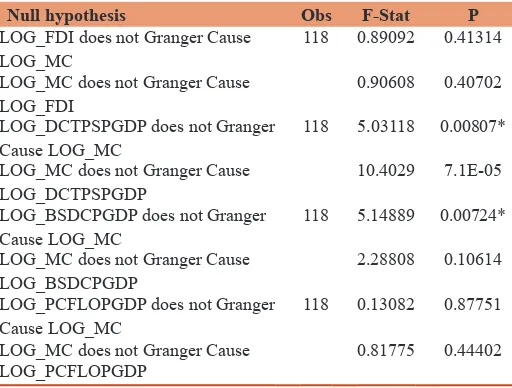
This section present and discussed the results on the causal relationship between stock market development, financial sector reforms and financial market integration as shown on Table 2:
The results of Granger causality test between the variables of financial sector reforms (% of GDP) and stock market development reveals that unidirectional causality running from financial sector reform. The breakdown of the analyses shows that two out of three proxies of financial sector reforms such as domestic credit to the private sector (DCTPSPGDP) as % of GDP and banking sector domestic credit (BSDCPGDP) as % GDP granger causes stock market development (proxy; market capitalisation – MC). This implies that banking sector development and increase in private sector credit induces stock market development. This means that the development of the Nigeria stock market is linked to the development of the banking sector and the private sector vis-à-vis promoting private investment. Further inquiry also shows no granger causality between stock market development and financial market integration (proxied with private capital flow - PCFLOPGDP) as a percentage of GDP. These findings reflect the recorded performance of the market after 2004 banking consolidation reform in Nigeria. Prior to the reform, there are total of 89 banks and thereafter the reform, it reduced to 24. During the post consolidation in 2006, the number of banks further reduced to 16 and since then, there has been a tremendous improvement in the stock market because of its bank-based nature. For example, the market made an impressive record of US$32,819.36 million market capitalisation with more than double of the record which stood at US$86,346.84 and made deep and favourable impression to the investors before world economic meltdown crisis late 2007. Though, in 2008 (US$49,802.82), 2009 (US$33,324.90) and 2010 (US$50,882.97) respectively, the market performed below expectation. Thus, our findings are consistent with De la Torre et al. (2007) and Jbili et al. (1997).
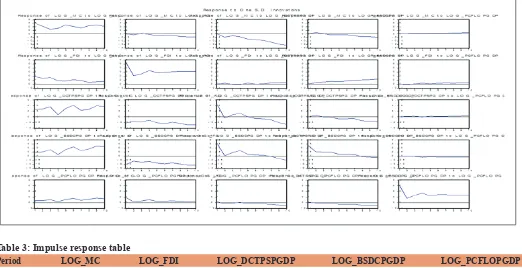
that market capitalization (Mc) positively and permanently respond to itself in the first quarter of the first period but with the tendency of transiting to zero in the long run. Also, Mc response to innovation on domestic credit to the private sector (DCTPSPGDP) as % of GDP and foreign direct investment (FDI) was negative but the
responses of MC to shock on DCTPSPGDP waspermanentwhile
MCresponsestoinnovationonFDI was temporal in the short run then after a while it becomes negative. Hence, MC response to shock on banking sector domestic credit (BSDCPGDP) as % of GDP was positive in the short run but after the third quarter of the third period, its responses was negative to shock on BSDCPGDP. The results suggests that banking sector domestic credit as % of GDP has positive influence on market capitalisation (MC) in the short run while FDI and DCTPSPGDP has negative influence on market capitalisation over the long run. It also show that private capital flow (PCFLOPGDP)as % of GDP, both in the short and long run, have positive influence on market capitalization (MC). See the impulse response graph below as indicated in Figure 1.
To determines how much of the forecast error variance of each of the variables can be explained by exogenous shocks to the other variables; we discuss the results of variance decomposition as presented.
The result in Table 4 shows that market capitalisation (MC) is largely driven by itself. It account for 100% of its forecast error in the first period but the error reduces over time indicating the relevance of other variables in predicting MC. Thus, as time increases domestic credit to the private sector (DCTPSPGDP) as % of GDP, banking sector domestic credit (BSDCPGDP) as % of GDP and foreign direct investment (FDI) account for 28%, 2.3%
and 2.2% of MC forecast error respectively but in the long run, say the tenth quarter of the tenth period, DCTPSPGDP account for nearly 40% forecast error suggesting strong long run effect on MC. The importance of MC predicting itself is highly significant in the short run while the importance DCTPSPGDP in predicting MC is also significant in the long run.
4.2. Business Environment, Institutional Framework and Stock Market Development
Under this section, we discussed the relationship between business environment, legal framework and stock market development. From our results as shown on Table 5, null hypothesis assumption of the absence of cointegrating equations among the variables is rejected because, there are three cointegrating equations at 5% significant level in the model suggesting a long run relationship between the variables of business environment, legal framework and stock market development.
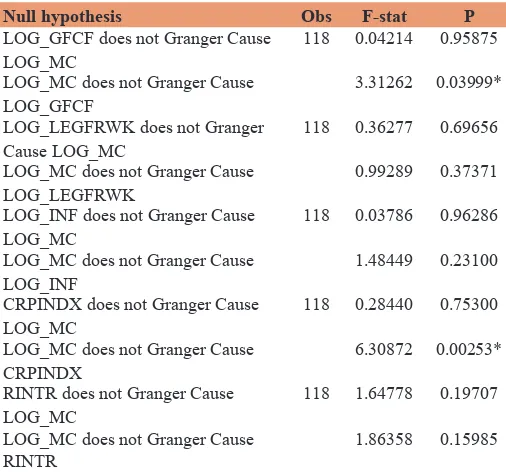
In addition, the results on Table 6 shows no causality running from the measures of business environment, legal framework/ institutional quality to market capitalization rather, we observed unidirectional causation running from Mc to gross fixed capital formation (GFCF), Mc to corruption index (CrpIndx) and gross fixed capital formation (GFCF) to CrpIndx.
Results show no causation running from business environment and legal framework measures to stock market development rather, we observed the opposite. Hence, the findings suggest that stock market development causes business environment especial the improvement in infrastructures and social amenities accounted by gross fixed capital formation (GFCF). We also discovered that development in the market granger causes corruption. This finding may be inconsistent with theory. But the implication may be traced through the improvement in ICT such as the situation where investors can trade at the comfort of their office and receive their share certificate immediately through e-transaction. Furthermore, Table 7 shows the response of market capitalisation to one standard deviation innovation in the model. Moreso, in second quarter of the second period, market capitalisation respond negatively and insignificantly to innovations on GFCF, legfrwk,
Inf, Crpindx and Rintr while positively and permanently respond
to innovation on itself both in the short and long run. From the fourth quarter of the fourth period, MC response to shock on Inf was positive and temporal.
Results on variance decomposition as shown in Table 8 apportion the total fluctuations in a particular variable to the constituent innovations in the system. The results show that market capitalization (MC) is largely driven by itself. For example, about
Table 1: Cointegration test results
Eigen value Likelihood ratio 5% critical value 1% critical value Hypothesized No. of CE (s)
0.358103 98.21428 68.52 76.07 None**
0.155778 47.23159 47.21 54.46 At most 1*
0.113403 27.75753 29.68 35.65 At most 2
0.099753 13.91559 15.41 20.04 At most 3
0.015794 1.830749 3.76 6.65 At most 4
*(**) denotes rejection of the hypothesis at 5%(1%) significance level. L.R. test indicates 2 cointegrating equation (s) at 5% significance level
Table 2: Granger causality test results
Null hypothesis Obs F-Stat P
LOG_FDI does not Granger Cause
LOG_MC 118 0.89092 0.41314
LOG_MC does not Granger Cause
LOG_FDI 0.90608 0.40702
LOG_DCTPSPGDP does not Granger
Cause LOG_MC 118 5.03118 0.00807*
LOG_MC does not Granger Cause
LOG_DCTPSPGDP 10.4029 7.1E-05
LOG_BSDCPGDP does not Granger
Cause LOG_MC 118 5.14889 0.00724*
LOG_MC does not Granger Cause
LOG_BSDCPGDP 2.28808 0.10614
LOG_PCFLOPGDP does not Granger
Cause LOG_MC 118 0.13082 0.87751
LOG_MC does not Granger Cause
100 per cent of the variations in MC are due to its own innovations
during the first quarter of the forecast error. Meanwhile, as the time progresses, the forecast error reduces and the importance of predicting itself becomes highly significant between the first and MC
Figure 1: Impulse response graph
Table 3: Impulse response table
Period LOG_MC LOG_FDI LOG_DCTPSPGDP LOG_BSDCPGDP LOG_PCFLOPGDP
1 0.608319 0.000000 0.000000 0.000000 0.000000
2 0.437131 −0.048964 −0.189085 0.076168 0.009689
3 0.256256 0.010706 −0.106269 0.005987 0.014618
4 0.318390 −0.029410 −0.165361 −0.058943 0.012174
5 0.511901 −0.108764 −0.297600 −0.053322 0.029057
6 0.419205 −0.077414 −0.337801 −0.052384 0.035214
7 0.333013 −0.079019 −0.372278 −0.108687 0.039088
8 0.459879 −0.147781 −0.473741 −0.156712 0.050553
9 0.505875 −0.171468 −0.581282 −0.161174 0.063715
10 0.436899 −0.171149 −0.648962 −0.196387 0.073300
Table 4: Variance decomposition table
Period S.E. LOG_MC LOG_FDI LOG_DCTPSPGDP LOG_BSDCPGDP LOG_PCFLOPGDP
1 0.608319 100.0000 0.000000 0.000000 0.000000 0.000000
2 0.777934 92.72183 0.396161 5.907859 0.958643 0.015512
3 0.826139 91.83840 0.368072 6.893175 0.855286 0.045062
4 0.903167 89.26884 0.414001 9.119746 1.141543 0.055872
5 1.087122 83.78639 1.286696 13.78843 1.028476 0.110003
6 1.217232 78.69241 1.430798 18.69979 1.005563 0.171436
7 1.323151 72.93237 1.567546 23.74197 1.525757 0.232358
8 1.495193 66.57432 2.204447 28.63159 2.293369 0.296277
9 1.699658 60.37882 2.723720 33.85364 2.674010 0.369809
10 1.890530 54.14299 3.021061 39.14630 3.240415 0.449235
Table 5: Cointegration tests results
Eigen value Likelihood ratio 5% critical value 1% critical value Hypothesized No. of CE (s)
0.363961 143.8123 94.15 103.18 None**
0.318634 91.77543 68.52 76.07 At most 1**
0.189396 47.65505 47.21 54.46 At most 2*
0.143642 23.50791 29.68 35.65 At most 3
0.037444 5.675275 15.41 20.04 At most 4
0.011125 1.286530 3.76 6.65 At most 5
fifth quarter of the periods. The contribution of Rintr and legfrwk to variation in MC becomes significant in the third and seventh quarters of the periods when it reaches 2.7% and 2.0% respectively. Hence, the total contribution of the remaining three variables to variation in MC in the tenth quarter of the period is <4%. Thus, these results suggest that in the tenth quarter of the tenth period,
GFCF, LEGFRWK, INF, CRPINDX and RINTR account for about
23% of MC forecast error which shows weak long run effect.
4.3. Stock Market Development, Financial Sector Reforms and Economic Growth
In this section, we present the results on the relationship between stock market development, financial sector reforms and economic growth. The proxy for stock market development defers from that
of model 1 and 2. For in-depth inquiry, stock market development is captured with captured with MC and market liquidity. In this regard, market liquidity is proxied with total values of shares traded (TVST) and percentage of turnover ratio (TOR) while others variables remain as defined above.
From the estimates of the cointegration test, Eigen value and likelihood ratio presented in Table 8 indicates three cointegrating equations suggesting the rejection of null hypothesis at 5% significance level. The result suggests a positive co-integration between some variables of the cointegrating vectors. Therefore, there is existence of long run relationship between the variables in the variables in the model.
The causality results as indicated in Table 9 shows bidirectional causality between measures of stock market development (MC,
TVST and TOR) and economic growth (GDP). This implies that
stock market development and economic growth granger causes each other. These findings support the third school of thought which contends that a country with a well developed financial system could promote high economic expansion through technological changes, products and services innovation, creating high demand for the financial institutions in turn. It is also consistent with the findings of Hongbin (2007), Majid (2007), Dawson (2008), Akinlo (2009 and 2010), Odeniran, S.O and Udeaja, E. A (2010), Odhiambo (2005), Enisan and Olufisayo (2009), Shahbaz et al. (2008) and Demirguc-Kunt and Levine (2008). In addition, we also noticed bidirectional causation between BSDCPGDP as % of GDP and economic growth. This could beas a result of pre and post consolidation policy reforms in 2004 and 2006 in Nigeria which centered mostly on Banking sector. However, since the Nigerian financial sector is dominated by Banks, any policy reforms targeted on banks could promote growth. In view of the above, we conclude that there exist a bidirectional causal effect between financial sector reform and economic growth. Furthermore, there exists a unidirectional causality running from foreign direct investment
Table 6: Granger causality test results
Null hypothesis Obs F-stat P
LOG_GFCF does not Granger Cause
LOG_MC 118 0.04214 0.95875
LOG_MC does not Granger Cause
LOG_GFCF 3.31262 0.03999*
LOG_LEGFRWK does not Granger
Cause LOG_MC 118 0.36277 0.69656
LOG_MC does not Granger Cause
LOG_LEGFRWK 0.99289 0.37371
LOG_INF does not Granger Cause
LOG_MC 118 0.03786 0.96286
LOG_MC does not Granger Cause
LOG_INF 1.48449 0.23100
CRPINDX does not Granger Cause
LOG_MC 118 0.28440 0.75300
LOG_MC does not Granger Cause
CRPINDX 6.30872 0.00253*
RINTR does not Granger Cause
LOG_MC 118 1.64778 0.19707
LOG_MC does not Granger Cause
RINTR 1.86358 0.15985
Table 7: Impulse response table
Period LOG_MC LOG_GFCF LOG_LEGFRWK LOG_INF CRPINDX RINTR
1 0.662258 0.000000 0.000000 0.000000 0.000000 0.000000
2 0.581896 −0.030878 −0.029904 −0.009005 −0.020882 −0.104030
3 0.425882 0.005242 −0.071183 −0.014209 −0.032700 −0.126995
4 0.465712 −0.053140 −0.109528 0.020685 −0.065286 −0.179359
5 0.507846 −0.070561 −0.094915 0.025916 −0.073619 −0.225887
6 0.475593 −0.057985 −0.089777 0.032202 −0.081523 −0.248042
7 0.492757 −0.082729 −0.102430 0.045273 −0.094805 −0.278717
8 0.521064 −0.098180 −0.098577 0.054306 −0.103392 −0.312026
9 0.516970 −0.098680 −0.094786 0.061868 −0.110540 −0.335200
10 0.525962 −0.112131 −0.098981 0.071063 −0.118902 −0.359184
Table 8: Cointegration test results
Eigen value Likelihood ratio 5% critical value 1% critical value Hypothesized No. of CE (s)
0.599781 225.3871 124.24 133.57 None **
0.352561 120.0767 94.15 103.18 At most 1 **
0.224494 70.08256 68.52 76.07 At most 2 *
0.176594 40.84504 47.21 54.46 At most 3
0.086204 18.49983 29.68 35.65 At most 4
0.065318 8.132777 15.41 20.04 At most 5
0.003166 0.364625 3.76 6.65 At most 6
(FDI) to GDP and from GDP to domestic credit to private sector
(DCTPSPGDP), suggest that government should focus more on
reforms that encourages capital flow in order to promote growth. On the other hand, we check the causal direction between SMD and FSR and discovered a unidirectional causality that runs from
BSDCPGDP to MC, DCTPSPGDP to TVST and from BSDCPGDP
to TVST while DCTPSPGDP and MC causes each other. The
evidence shows that financial sector reforms play significant role in promoting stock market development.
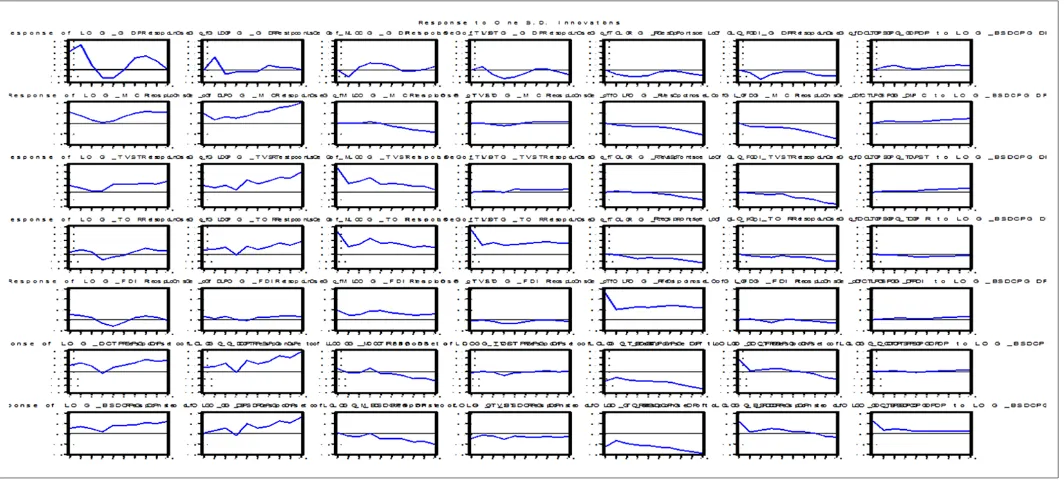
The impulse response reported in Table 10 and Figure 2 below shows that each of the variables respond differently to its own shock. For instance, GDP response to innovation on itself was positive from first to third quarter of the period then became negative in the fourth and fifth quarter of the period but drifted after and transited. However, it responses to one standard
deviation innovation on other variables of both SMD and
FSR were insignificantly negative (e.g. FDI & DCTPSPGDP) and positive BSDCPGDP respectively both in short and long
run. Meanwhile, GDP response to shocks on MC is positive
in the first quarter of the period then became negative from the third quarter to sixth quarter, from the seventh quarter of the period it became positive while its response to shock on TVST in the second quarter of the period is negative but temporarily return to zero in the long run and thereafter, it
became positive. In addition, GDP responded to innovation
on turnover ratiopositively in the second quarter of the period and temporarily tend to zero, after the third quarter of the perioditbecame permanently positive but in log run, that is, period nine and ten, the influence on GDP became negative.
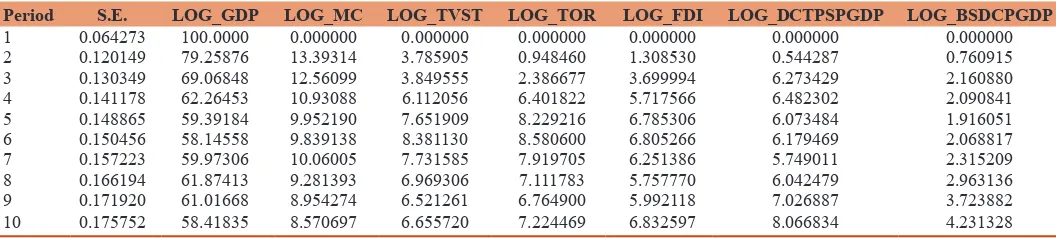
The variance decomposition, as shown in Table 11 in the appendix 3, indicated that GDP largely and significantly driven by itself in the first quarter of the period. GDP, account for about 99.9% of its forecast error. In the second, fifth and tenth quarter of the period, all the variables of stock market development and financial sector reforms on average account for about 18%, 37.1% and 42% of GDP forecast error.
Table 9: Causality test results
Null hypothesis Obs F-stat P
LOG_MC does not Granger Cause LOG_GDP 118 25.9140 5.5E-10
LOG_GDP does not Granger Cause LOG_MC 6.23447 0.00270
LOG_TVST does not Granger Cause LOG_GDP 118 12.4604 0.00013
LOG_GDP does not Granger Cause LOG_TVST 5.23609 0.0669
LOG_TOR does not Granger Cause LOG_GDP 118 0.64487 0.2665
LOG_GDP does not Granger Cause LOG_TOR 8.57138 0.00034
LOG_FDI does not Granger Cause LOG_GDP 118 3.63850 0.02942
LOG_GDP does not Granger Cause LOG_FDI 2.59799 0.07886
LOG_DCTPSPGDP does not Granger Cause LOG_GDP 118 1.24700 0.29129
LOG_GDP does not Granger Cause LOG_DCTPSPGDP 32.5088 7.0E-12
LOG_BSDCPGDP does not Granger Cause LOG_GDP 118 4.28440 0.01609
LOG_GDP does not Granger Cause LOG_BSDCPGDP 11.1347 3.9E-05
Table 10: Impulse response table
Period LOG_GDP LOG_MC LOG_TVST LOG_TOR LOG_FDI LOG_DCTPSPGDP LOG_BSDCPGDP
1 0.064273 0.000000 0.000000 0.000000 0.000000 0.000000 0.000000 2 0.085502 0.043970 −0.023378 0.011701 −0.013744 −0.008864 0.010481 3 0.017138 −0.014171 0.010371 −0.016389 −0.020971 −0.031422 0.016041 4 −0.025977 −0.006667 0.023752 −0.029503 −0.022604 −0.015036 0.007041 5 −0.027415 −0.005179 0.021852 −0.023403 −0.019081 −0.007344 0.002807 6 0.000843 −0.004669 0.014195 −0.010896 −0.006069 −0.007274 0.006611 7 0.040772 0.016108 −0.003734 0.003910 −0.002186 −0.004718 0.010197 8 0.047593 0.008764 −0.003712 0.002575 −0.006711 −0.015744 0.015689 9 0.030734 0.009111 0.001585 −0.005930 −0.013444 −0.020198 0.016799 10 0.003198 0.000894 0.011332 −0.015234 −0.018424 −0.020367 0.014365
Table 11: Variance decomposition
Period S.E. LOG_GDP LOG_MC LOG_TVST LOG_TOR LOG_FDI LOG_DCTPSPGDP LOG_BSDCPGDP
5. CONCLUSION AND POLICY
SUGGESTIONS
The empirical results suggest that stock market development and economic growth is positively co-integrated indicating a long-run equilibrium relationship. The findings also suggest that there is a bidirectional causality between stock market development and economic. This means that development of the Nigerian stock market would lead to economic growth vis-à-vis, high sustainable economic growth also promote stock market development. Also, bidirectional causality existed between financial sector reform and economic growth. This suggests that financial sector reforms, other thing being equal, lead to sustainable economic growth in Nigeria. Therefore, sound policy reform influences growth in the economy as well as economic activities.
The pre and post consolidation policy reforms of the Nigerian banking sector in 2004 and 2006 championed by CBN remains‘ a hand writing on the wall. The results also shows that business environment and institutional or legal framework play a significant role in promoting stock market development. Therefore, strong property right protection with friendly business environment would increase the confidence level of the market players thereby increasing market activities in the country. Hence, authorities in the government should design good policies reforms that could enhance the efficiency of the stock market and the economy at large.
REFERENCES
Acaravci, S.K., Acaravci, A., Ozturk, I. (2011), Stock returns and inflation nexus in Turkey: Evidence from ARDL bounds testing approach. Economic Computation and Economic Cybernetics Studies and Research, 45(3), 143-154.
Acaravci, S.K., Ozturk, I., Acaravci, A. (2009), Financial development
and economic growth: Literature survey and empirical evidence from sub-Saharan African countries. South African Journal of Economic and Management Sciences, 12(1), 11-27.
Adegbite, E.O. (2005), Development Finance Institutions in Nigeria. In: Fakiyesi, O., Akano, O., editors. Issues, In Money Finance and Economic Management in Nigeria. Lagos: University of Lagos Press. Agarwal, S. (2001), Stock Market Development and Economic Growth:
Preliminary Evidence from African Countries. Available from: http// www.2001/Articles pdf.
Akinlo, A.E., Akinlo, O. (2009), Stock market development and economic growth: Evidence from seven sub-Sahara African countries. Journal of Economics and Business, 61(2), 162-171.
Akinlo, A.E., Egbetunde, T. (2010), Financial development and economic growth: The experience of 10 sub-Saharan African countries revisited. The Review of Finance and Banking, 2(1), 17028. Alajekwu, U., Achugbu, A.A. (2012), The role of stock market
development on economic growth in Nigeria: A Time Series Analysis. An International Multidisciplinary Journal, Ethiopia, 6(1), 51-70. Andrezo, A. F., Lima, I. S, Financeiro, M (2002), Mercado Financeiro:
Aspectos Históricos e Conceituais. 2nd ed. São Paulo: Thompson Learning.
Arestis, P., Demetriades, P., Luintel, K. (2001), Financial development and economic growth: The role of stock markets. Journal of Money, Credit and Banking, 33, 16-41.
Argrawall, R., Tuteja, S.K. (2007), Causality between Stock Market Development and Economic Growth. India Journal of Management Research, 7(3), 158-168.
Azam, M., Haseeb, M., Samsi, A., Raji, J. (2016), Stock market development and economic growth: Evidences from Asia-4 countries. International Journal of Economics and Financial Issues, 6(3), 1200-1208.
Beck, T., Lundberg, M., Majnoni, G. (2001), Financial Intermediary Development and Growth Volatility: Do Intermediaries Dampen or Magnify Shock? Policy Research Working Paper No. 2707. Blackburn, K., Bose, N., Capasso, S. (2001), Financial Development,
Financing Choice and Economic Growth. UK: Centre for Growth and Business Cycle Research, School of Economics Studies, University of Manchester.
Caporale, G.M., Howells, P.G.A., Soliman, A.M. (2004), Stock market
development and economic growth: The causal linkage. Journal of Economic Development, 33(29), 23-40.
Creane, S., Goyal, A., Mushfiq, M., Sab, R. (2003), Financial Development and Growth in the Middle East and North Africa. IMF Working Paper, Washington, DC.
Dawson, P.J. (2008), Financial development and economic growth in developing Countries. Progress in Development Studies, 4(8), 325-331.
De la Torre, A., Gozzi, J.C., Schmukler, S.L. (2007), Emerging capital market and globalization. The Latin America Experience. Washington, D.C: Stanford University Press. p6-161.
Deb, S.G., Mukherjee, J. (2008), Does stock market development cause economic growth? Time series analysis for Indian economy. International Research Journal of Finance and Economics, 21, 142-149.
Demirguc-Kunt, A., Levine, R. (2008), Finance Sector Policies and Long-Run Growth, Working Paper 11, Commission on Growth and Development.
Demirguc-Kunt, A., Ross, L. (1996), Stock Market Development and Financial Intermediary Growth, World Bank, Policy Research Department, WPS No. 1159.
Egbetunde, T., Mobolaji, H.I. (2010), An empirical analysis of causality between financial development and economic growth; further evidence from Sub-Sahara Africa. Journal of Economic Theory, 4(2), 50-58.
Gelb, A. (1989), Cross-Section Analysis of Financial Policies, Efficiency and Growth, Staff Working Paper series, WPS 202. Washington; World Bank.
Gurley, J.G., Shaw, E.S. (1960), Money in Theory of Finance, Washington, D.C: Brookings Institutes.
Hansson, P., Jonung, L. (1997), Finance and Economic Growth: The Case of Sweden, 1834-1991, Stockholm School of Economics, The Economic Research Institute, Working Paper No. 176.
Hongbin, D. (2007), Stock Market Development and Economic Growth: Evidence of China, the Index of Science and Engineering, (SEI) Database.
Hossain, S.M.D., Kamal, M., Khnd, M.D. (2010), Does Stock Market Development Cause Economic Growth? A Time Series Analysis for Bangladesh Economy. International Conference on Applied Economics.
Jbili, A., Enders, K., Treichel, V. (1997), Financial Sector Reforms in Algeria, Morocco, and Tunisia: A Preliminary Assessment (July 1997). IMF Working Paper, 1-38.
Jbirli, A., Klaus, E., Treichel, V. (1997), Financial Sector Reform in Algeria, Morocco and Tunisia: A Preliminary Assessment Working Paper of the International Monetary Fund, WP/97/81.
Kama, U. (2006), Recent Reforms in the Nigerian Banking Industry: Issues and Challenges, CBN Bullion, 30, 3.
Khan, M.S., Senhadji, A.S. (2000), Financial Development and Economic Growth: An Overview, IMF Working Paper WP/00/209.
King, R.G., Levine, R. (1993), Finance and growth: Schumpeter might be right. Quarterly Journal of Economics, 108, 717-738.
Lee, B.S. (1992), Causal relations among stock returns, interest rates, real activity and inflation. Journal of Finance, 47, 1591-1603.
Levine, R. (1997), Stock Markets: A Spur to Economic Growth. Available from: http://www.actrav.itcilo.org/actrav-English/telearn/global/ilo/ equity/fdstock.htm.
Levine, R. (2002), More on Finance and Growth: More Finance, More Growth? USA: University of Minnesota, Department of Finance, Carlson School of Management.
Levine, R., Sara, Z. (1996b), Stock Markets, Banks, and Economic Growth, The World Bank, Policy Research Working Paper No. 1690. Levine, R., Zervos, S. (1996), Stock Market Development and Long-Run
Economic Growth. World Bank Policy Research Paper No. 582, p1-27.
Levine, R., Zervos, S. (1996a), Stock Market Development and Long-Run Growth. World Bank, Policy Research Working Paper No. 1582. Available from: http://www.econ.worldbank.org.
Levine, R., Zervos, S. (1998), Stock markets, banks, and economic growth. The American Economic Review, 88(3), 537-558. M’Rad, B., Wyeme, F. (2000), Financial Development and Economic
Growth: Evidence from South Mediterranean Countries. Universite Paris IX Dauphine.
Majid, M.S.A. (2007), Re-examining the finance-growth nexus: Empirical evidence from Indonesia. Gadjah Mad International Journal of Business, 9(2), 137-15.
Majid, M.S.A. (2008), Does the Financial Development Matter for Economic Growth in Malaysia; An ARDL Bound Testing Approach. Malaysia: Kulliyyah of Economic and Management Sciences, International Islamic University.
Mayer, C. (1988), New issues in corporate finance. European Economic Review, 32, 1167-1189.
Mazur, E.M., Alexander, R. (2001), Financial sector development and economic growth in New Zealand. Applied Economics Letter, 8, 545-549.
McKinnon, R.I. (1973), Money and Capital in Economic Development. Washington, D.C:
Mishkin, F.S. (2001), The Economics of Money, Banking, and Financial Markets. 6th ed. New York: Addison Wesley Longman.
Mulambo, S. (2010), Stock Market Development and Economic Growth: A Case for Zambia. University of Stellenbosch.
Naceur, S.B., Ghazouani, S., Omran, M. (2007), The determinants of stock market development in the Middle-Eastern and North African region. Managerial Finance, 33(7), 477-489.
Nowbutsing, B.M. (2009), Stock market development and economic growth: The case of Mauritius. International Business and Economic Research Journal, 2(8), 77-88.
Nurudeen, A. (2009), Does stock market development raises economic growth? Evidence from Nigeria, The Review of Finance and Banking, 1(1), 15-26.
Odeniran, S.O., Udeaja, E.A. (2010), Financial sector development and economic growth: Empirical evidence from Nigeria. Economic and Financial Review, 48(3), 91-124.
Odhiambo, N.M. (2005), Financial development and economic growth in Tanzania: A dynamic causality test, Africa Finance Journal, 7, 1-17. Ogujiuba, K., Obiechina, M.E. (2011), Financial sector reforms in
Nigeria: Issues and challenges. International Journal of Business and Management, 6(6), 222-233.
Olweny, T.O., Danson, K. (2011), Stock market performance and economic growth Empirical evidence from Kenya using causality test approach. Advances in Management and Applied Economics,1(3), 153-196. Ozturk, I. (2008), Financial development and economic growth: Empirical
evidence from Turkey. Applied Econometrics and International Development, 8(1), 85-98.
Pagano, M. (1993), Financial markets and growth: An overview. European Economic Review, 37, 613-22.
Puryan, V. (2017), The causal relationship between economic growth, banking sector development and stock market development in selected middle-East and North African Countries. International Journal of Economics and Financial Issues, 7(3), 575-580.
Quartey, P., Prah, F. (2008), Financial development growth in Ghana: Is there a causal link? The African Finance Journal, 10(1), 28-48. Rahman, M.M., Salahuddin, M. (2010), The Determinants of Economic
Rioja, F., Neven, V. (2003), Finance and the sources of growth at various stages of economic development. Economic Inquiry, 42(1), 127-140. Schumpeter, J. (1912), The Theory of Economic Development. Oxford:
Oxford University Press.
Shahbaz, M., Ahmed, N., Ali, L. (2008), Stock market development and economic growth: ARDL causality in Pakistan. International Research Journal of Finance and Economics, 14, 1-9.
Shaw, E.S. (1973), Financial Deepening In Economic Development. New York: Oxford University Press.
Shleifer, A., Summers, L. (1988), “Breach of Thrust in Hostile Corporate: Causes and Consequences. Chicago: University of Chicago Press. p33-56.
Singh, A. (1997), Tock markets, financial liberalisation and economic development. Economic Journal, 107(442), 771-782.
Stiglitz, J. (1993), The Role of the State in Financial Markets, Proceedings of the World Bank Annual Conference on Development Economics. Vol. 1. Supplement to World Bank Economic Review and World Bank Research Observer. p19-62.
Trabelsi, M. (2002), Finance and growth, empirical evidence from developing countries, 1960-1990. Tunisia: Institut des Hautes Etudes Commercials de Carthage (IHEC).
Wachtel, P. (2002), How Much Do We Really Know about Growth and Finance? Federal Reserve Bank of Atlanta Conference on Finance and Growth.
World Bank/IFC. (2012), Ease of Doing Business in a More Transparent World. Available from: http://www.doingbusiness.org/~/media/ FPDKM/Doing%20Business/Documents/Annual-Reports/English/ DB12-FullReport.pdf.
Manasseh, C.O. (2007), Macroeconomic and Institutional Determinants of Stock Market Development in Nigeria. University of Nigeria Nsukka, Unpublished Master’s Thesis.
North, D.C. (1990), Institutions, Institutional Change and Economic Performance. Cambridge: Cambridge University Press.
Bencivenga, V.R., Smith, B.D., Starr, R.M. (1996), Equity markets, transaction costs, and capital accumulation: An illustration. World Bank Economic Review, 10(2), 241-265.
Levine, R. (1991), Stock market, growth and tax policy. Journal of Finance, 46, 1445-1465.
N’zue, F.F. (2006), Stock market development and economic growth: Evidence from Cote D’Ivore. African Development Review, 18(1), 123-143.
Enisan, A.A., Olufisayo, O. (2009), Stock market development and economic growth: Evidence from seven sub-Saharan African countries. Journal of Economics and Business, 61, 162-171. Levine, R., Loayza, N., Beck, T. (2000), Financial intermediation and
growth: Causality and Causes. Journal of Monetary Economics, 46, 31-77.
Zervos, S., Levine, R. (1999), Stock Market Development and Long-Run Growth. World Bank Policy Research Working Paper No. 1582. https://www.ssrn.com/abstract=614946.
Zivengwa, T., Mashika, J., Bokosi, F.K., Makova, T. (2011), Stock market development and economic growth in Zimbabwe. International Journal of Economics and Finance, 3(5). Available from: http://www. ccsenet.org/ijef; http://www.ccsenet.org/ijef.
Deb S.G., Mukherjee, J. (2008), Does stock market development cause economic growth: Time series analysis for Indian economy. International Research Journal of Finance and Economics, 21, 142-149.
Charkravarty, S. (2005), Stock Market and Macroeconomic Behavior in India. New Delhi, India: Institute of Economic Growth.
Riman, H.B., Esso, I.E., Eyo, E. (2008), Stock market performance and economic growth in Nigeria: A causality investigation. Global Journal of Social Sciences, 7(2), 88-891.
Olofin, S., Afangideh, U.J. (2008), Financial structure and economic growth in Nigeria. Nigerian Journal of Securities and Finance, 13(1), 47-68.
Osinubi, T.S. (2001), Does Stock market Promote Economic Growth in Nigeria?. https://www.uwivet.edu/.../Does%20the%20Stock%20 Market%20promote%20Economic%20Growth.
Akinlo, A.E., Akinlo, O. (2009), Stock market development and economic growth: Evidence from seven sub‐Sahara African countries. Journal of Economics and Business, 61(2), 162‐171.
Ezeoha, A., Ogamba, E., Onyiuke, N.O. (2009), Stock market development and private investment growth in Nigeria. Journal of Sustainable Development in Africa, 11(2), 20-35.
Ewah, S.O.E., Esang, A.E., Bassey, J.U. (2009), Appraisal of capital market efficiency on economic growth in Nigeria. International Journal of Business and Management, 4, 219-225.
Tachiwou, A.M. (2010), Stock market development and economic growth: The case of west African monetary union. International Journal of Economics and Finance, 2(3), 79-103.
Sala-i-Martin, X. (1997), I Just Ran Four Million Regression. National Bureau of Economic Research, Working Paper No. 6252.
De Melo, M., Denier, C., Gelb, A., Tenet, S. (1997), Circumstances and Choice: The Role of Initial Conditions and Policies in Transition Economies. Policy Research Working Paper 1866. Washington, DC: The World Bank.
Rajasalu, T. (2002), Indicators of Economic Freedom and Economic Structure as Determinants of Growth and Convergence in Enlarging EU and Priorities for Estonia. Tallinn: Estonian Institute of Economics at Tallinn Technical University
Greenwood, J., Jovanovic, B. (1990), Financial development, growth, and the distribution of income. Journal of Political Economy, 98, 219-240. Akinlo, A.E., Egbetunde, T. (2010), Financial development and economic
growth: The experience of 10 sub-Saharan African countries revisited. The Review of Finance and Banking, 2(1), 17-28. Odeniran, S.O., Udeaja, E.A. (2010), Financial sector development and