57
An Analysis of Language Use in Analogical
Indigenous Knowledge Presented in Science
Texts
M. Mukwamboa, L.F. Ramasikeb and K. M. Ngcozac
Corresponding author: M. Mukwambo ([email protected])
aUNAM (Katima Mulilo Campus), b,cRhodes University, Grahamstown, South Africa
Keywords: Physical Science, scientific knowledge, analogy, privilege, cultural context, language and misconceptions.
International Journal of Innovation in Science and Mathematics Education, 26(2), 57–73 2018. Special Issue: Supporting Indigenous Student Engagement with STEM in Higher Education
Abstract
Analogy use in science teaching practices has occurred since the origin of science. Analogies are used in knowledge construction to create ways that enable learners to visualize abstract concepts in order to overcome misconstructions. The language of teaching and learning which a curriculum adopts has an influence on how analogies are presented. This makes the analogy used adopt the context of the cultural group whose language is favoured. This may pose a challenge in the Southern African Development Community (SADC) where many official languages are in use. This study aims to answer the main research question: To what extent do analogies from other cultural groups constrain and/or enable the teaching of science? To respond to the research question posed above, this study analysed how the concepts in electricity are presented using analogies in curriculum materials to promote effective teaching and learning of electricity. Document analysis, observations and interviews were used to collect and validate the data. The findings were: analogies in some curriculum materials provided a pedagogical style responsive to underprivileged groups and culturally contextualized the teaching of concepts in electricity. In addition, misconstructions of concepts from the text analogies were revealed. The study thus recommends that analogies presented as practical activities might be useful in science teaching and learning.
Introduction and background
58
ages (Aikenhead & Ogawa, 2007). This made Eurocentric science extremely powerful as it was modified to fit Eurocentric worldviews. Manifesting isolation from the sites of local knowledge from which it emerged, resulted in Eurocentric science developing its technical language, while technical language in indigenous knowledge and indigenous analogies from where analogies are expressed, remained stagnant, silent or developed at a slow pace (Van Rooyen & Jordaan, 2009). This poses challenges in teaching Physical science due to the lack of connection with context, thus perpetuating the Eurocentric view.
Also, technical terms such as capacitor, to be discussed later in the section, as used in Physical science analogies have very specific meanings and mastering them is an integral part of Physical science learning (Bravo & Cervetti, 2009). Further challenges are noticeable in cases where an analogy in the language used is not relevant in an area where language is diverse, such as in the case of Southern African Development Community (SADC) countries.
Language use in SADC schools
SADC is characterized by the use of many official languages in its education systems. South Africa, for example, has eleven official languages through which learners receive tuition legally, as revealed by Ferreira (2011). In South Africa, any of the eleven official languages can be considered as a language of teaching and learning depending on the region the school is located. These languages find their use at different levels. For example, at lower primary level (foundation phase), Grade 0 to 3 learners receive tuition in their mother tongues (Tshotsho, 2013).
It is at the foundation level where learning is achieved through storytelling, use of analogies and analysis of cultural practices communicated to learners in their mother tongue. For example, adult members of a community, as custodians of indigenous knowledge, tell stories discouraging walking in an open space, or taking cover under a tall tree or playing in the river when lightning is pending. Instead, their advice is to lie down or take cover under the shortest tree and avoid any contact with water (Cooper, 1995). Cooper (1995) opines that the mentioned precautions can be used to protect one from being struck by lightning. In our understanding, lying down must be avoided because lightning causes electric currents along the top of the ground that can pass through the human body and electrocute a person. In addition, touching water or wet bodies does allow one to be struck by lightning since water is a conductor of electricity in particular when there are some dissolved particles or salts from the body in it. Analogies can come from cultural practices such as in the case when euphorbia ingens shown below or other varieties of euphorbia are used to protect homesteads from lightning.
59
In some communities, euphorbia ingens is planted at a homestead to shield the homestead from lightning. Supporting this view is Dlamini (1981) who revealed that the Swazi people plant a euphorbia plant in and around homesteads to repel lightning. The Ndau people inhabiting the eastern parts of Zimbabwe, where the Chimanimani Mountains are found, also value this belief. This might compel us to believe that the myth or traditional knowledge is valid and comes with some stories and therefore analogies which can be used for teaching electricity concepts.
Indigenous communities believe that the sharp branches are capable of discharging a cloud. This phenomenon is analogous to what happens in a Van de Graaff generator. The sharp points are the ones that are good at allowing charges to escape. The ideas from these analogies and cultural practices might act as knowledge in the base domain an analogy can then be mapped to target domain knowledge. However, usage of analogies gradually becomes less used as learning progresses from lower primary to tertiary level. Starting from upper primary, Grade 4 to 7, learners start using official language, English or Afrikaans as in the South African context, and English in the Namibian context. Most schools use English and others use Afrikaans as a language of teaching and learning. From the view of Sabatin (2013) most learners whose background is not English or Afrikaans are disadvantaged as they might fail to contribute in classroom talks. Isaacs (1999) proposes that classroom talk might be promoted by using analogies such as the example of a euphorbia used as an earth wire and discussion of cultural practices to culturally contextualize knowledge. So, language and analogies might help to bring cultural context or indigenous knowledge into the science world. The bridging of knowledge into the cultural space is referred to as cultural translation according to Bhabha (1994).
Bhabha (1994) understands cultural translation as the adapting of a curriculum so that it meets the cultural needs of the learners. In this case the analogies teachers use in their practices need to take into account how the same phenomenon is viewed in the learners’ communities. This allows the emerging of a hybrid curriculum that Bhabha (1994) proposes. Bhabha also argues that knowledge structures in different cultures operate in the same space. Thompson (2013) supports this as he proposes that teachers need to adjust the way in which scientific ideas are communicated to new culturally diverse audiences. As teachers use language of teaching and learning to engage with analogies, they need to facilitate ‘border crossing’ (Aikenhead & Jegede, 1999; Ramorogo & Ogunniyi, 2010), the process of moving from what learners have experienced in their home language context to reconciling it with language the curriculum emphasizes. This fuels cultural translation which aligns with socio-cultural theory (see the next section) and is what most curriculum materials in SADC regions emphasize. Cultural translation enables teachers to translanguage (Childs, 2016; Probyn, 2015), a practice multilingual individuals use to move between the languages that they know in order to transfer into a range of social contexts. To address language barrier, a science teacher teaching alkaline substances can select ashes as an analogy and translanguaging allows the teacher to mention ashes as madota. Ashes or madota have some similarities with alkaline substances in that they are used to neutralize acidic soil, make soap as evidenced from girls using madota to wash fat spoiled cooking utensils and when a tanner removes fat from a hide (Mukwambo, 2017).
60
due to having gained sufficient knowledge in the analogy during intrapsychological and interpsychological levels that Vygotsky (1978) proposes. Analogies related to language that learners are familiar with brings harmony with nature (Sengupta, 2015). Teaching through analogies relies on language being understood by both teachers and learners.
Even though Glynn and Takahashi (1998) refute the use of analogies to be rarely promoted at lower primary level this might be an ill-conceived idea as storytelling embedded with analogies still comes as the main method of teaching to construct Physical science knowledge. In support is Jonāne (2015) stating that analogies use analogical reasoning done in our daily activities. The stories communicated through any of the languages of teaching and learning (LTL) when learners are progressing to upper grades, might not necessarily encourage meaning making of Physical science ideas.
Meaning making of analogies in one cultural group does not necessary influence sense making to another cultural group (Kimbrough & Cooper, 2008). Gaps in understanding which emerge when indigenous analogies are communicated using LTL which the learners are not well versed in are not only peculiar to Namibia. This is also common in South Africa, so an understanding of the origin of the analogy can be useful to mitigate the situation.
Origins and uses of analogies
An analogy is a comparison as Lakoff suggest between two domains of knowledge namely one that is familiar and one that is unfamiliar. The familiar domain is the analogy and is referred to as the base domain. On the other hand, the domain that needs to be learned is the target domain (Orgill & Bodner, 2004). According to Venville and Treagust (1996), in support of Bartha (2010), analogies can be seen as a process of identifying similarities between two objects, processes or systems for the purpose of explanation or extrapolation and has been in existence since the ontogenesis of BAAS in 1831 (Knight, 2002). A charged cloud separated by air from the ground has base domain concepts that can be found in the target domain, a capacitor in Eurocentric science. Eurocentric science appropriated from other science knowledge systems with the analogies found in indigenous knowledge reflecting a particular Physical science (Aikenhead & Ogawa, 2007). Ideas which might have been taken from indigenous communities might be that of plants such as Euphorbia ingens and cultural artefacts, such as placing a wet sharp pointed stick at the roof apex of a hut. This might have been used as base domain to come up with a lightning rod used to discharge a cloud. However, the difference is that an analogy in Eurocentric science if well written has specific technical terms. This means that analogies from a familiar context presented in the learner’s language easier to understand than one from another culture. Text presented ideas demand higher order of reasoning because they involve language and the mathematical skills of communication which evolve from science culture.
61
the force to communicate with anyone in faraway distances. This problem of language still surfaces in SADC countries where learners lack the socio-cultural credentials such as the LTL used in the curriculum materials. Up to today analogies still surface in learners’ curriculum materials, but are conveyed through a cultural lens they do not have. However, some other authors of curriculum materials include indigenous analogies which can support the learning of electricity concepts as will be seen from data from the document analysis. To mitigate the situation this study sought to respond to the study’s research question, to what extent do analogies from other cultural groups constrain and/or enable the teaching of science?
To respond to the research question an analogy of electric charge flow was explored and others related to electricity concepts. The aim was to identify the elements in the base analogy which are in the learners’ Indigenous Knowledge (IK) which can be compared with electric charge flow and explore the extent to which they could be used properly in Physical science teaching practices. Scott (1996) entertains the idea that IK makes use of analogies as he points out that all knowledge systems make use of analogies to guide thinking of scientific phenomenon observed in the environment. The crucial stage of using language to develop Physical science understanding founded from indigenous analogies is the focus of this study. In particular, this study shares an analogy of fluid flow to electric charge flow where language used in the base domain analogy, such as those related to lightning, are examined.
Analogy of water flow and electrical charge flow
Physical Science practioners state and use the water flow analogy to relate to electric charge flow. A number of authors have discussed this analogy (Evans, 1982; Gentner & Jeziorski, 1993; Ramasike, 2017). Ramasike (2017) used the ‘straw electricity’ to teach about resistance. Maclurcan and Radywyl (2011) also focus on an indigenous analogy as they illustrate how indigenous communities use nanotechnology, generation of an electric charge in response to applied mechanical stress. Nanotechnology indigenous communities use is suitable as base domain for piezoelectric effect a target domain, used in the community. Curriculum materials found in schools in the SADC also have got the water flow analogy and other indigenous analogies. Some of these ideas are presented below.
A fluid flow is taken as the analogy of electric charge flow. However, it is known that electrical charge movement is not exactly like particle flow in a fluid. This is only taken as an analogy to conceptualize electric charge flow. Resistance which the charged particles encounter as they move in a conductor can be taken as a point where there is a throttle. A throttle is a regulator, similar to the one learners use when they limit water flow in a canal used for irrigation. Also, learners engage with a throttle when they partially block water coming from a hose pipe they use to irrigate a garden aiming at reducing the diameter of the device. The electrical resistance that the charged particles encounter as they flow in a conductor is very much similar to the resistance to the flow of water particles in pipes caused by the size of the diameter of the pipe.
62
to kinetic energy once the water particles start flowing. In an electrical circuit electromotive force causes the movement of electrons.
Many of the dimensions, the fundamental measurables of a water flow and charge flow system, or those which we refer to as variables can be mapped to the other in the target domain. They can constitute a one-to-one function (Gentner & Jeziorski, 1993). The same dimensions which are discussed in analogies expressed in a language that is not of the learner are some of the practices learners socially and culturally interact with. Social and cultural factors are components expressed in socio-cultural theory.
Sociocultural theory
Socio-cultural theory is based on the premise that learning is a product of social interactions, involving adults, teachers and peers (Vygotsky, 1978).Vygotsky further observed that everything is learned on two levels, namely, interpsychological and intrapsychological (1978). The interpsychological also known as the lower mental function, where base domain analogies are learnt is characterized by interacting socially with knowledgeable individuals (Berge, 1999). Communication is important in the interpsychological plane and very often, knowledge is transmitted using analogies. Knowledgeable adults and peers mostly use language in the base domain analogy to develop an individual’s understanding in his/her environment by mapping it to the knowledge in the target domain.
Vygotsky distinguishes between two types of language/speech that are used and developed in an analogy during the interpsychological level. These are namely, the emotional release and the social contact (1978). It is the social contact which allows a developing individual to understand his/her environment. The social contact has elements of Physical science terminology which allows an individual to be aware of his/her immediate environment and this is the one found in analogies as they aim to embrace familiarity with the environment. In the case of curriculum materials in use in schools, the social contacts elements might be there, but they lack the cultural context. Wolf (2008) in support of social and environmental contact suggests that emotional contact is required in order to express desire. This can be a motivation to acquire knowledge which an individual need (intrapsychological level) in order to interact socially in certain circumstances. Also, it plays a role in revealing the nature of his or her environment. In the presence of adverse environmental changes emotional contact is used.
63
The second aspect of the socio-cultural theory of learning is the zone of proximal development (ZPD) (Vygotsky, 1978; Stott, 2016). Vygotsky (1978) never discussed the ZPD in relation to an analogy. So, the ZPD, using the lens of an analogy, can be explained as the difference between the knowledge in a learner’s base domain and that in the target domain a learner can achieve without assistance and what she/he can do with assistance. The knowledge a learner has in the base domain is what he can achieve and for him to acquire knowledge in the target domain the teacher needs to relate how the elements in each domain are related through cultural translation discussed above or mapping (Gentner & Jeziorski, 1993). The language which learners use and how they interpret was the focus of this study and the methodology used is discussed below.
Methodology
The aim of this study was to respond to the research question:
What are the constraints and enablers of bringing analogies reflecting electricity which are culturally contextualized?
To answer the research question in this exploratory qualitative and interpretive study, document analysis was done first, observations followed and interviews completed after observations and curriculum material analysis were used to generate data. The documents analysed were the curriculum materials, namely, four recommended Physical science textbooks that Grade 11 Namibian teachers and learners use in their classrooms.
The recommended textbook analysed were; Focus on Physical science Grade 11 by Hendricks, Logan, Sadeek, Body-Evans, Clitheroe, Collet, … Shreuder (1996), Physics for life by Warren (1988), Physics alive by Warren (1996), Physics for IGCSE by Foxcroft and Lewis (1996). Only four were selected because they are commonly found in the schools where the study was conducted and used by teachers and learners in Grade 11.
Ethical issues were considered by requesting permission from the subject advisor, headmasters of six schools, six Physical Science teachers coming from six different schools teaching Grade 11 as well as their learners, although data were not to be sourced from learners. Codes for the six participating teachers were used, for instance, were coded as teacher A to teacher F. Participants were briefed on the purpose of the study before the research process took place. This ensured transparency by the researchers. Confidentiality and anonymity were also recognized as elements of ethical considerations by using the assigned codes for the participants. In addition, permission to video-record observations and interviews was sorted and granted by teachers and their learners. Thereafter, observation of lessons of the six teachers was done. This was followed by an interview.
64
The selection of the teachers was purposefully done. Only Physical science teachers teaching Grade 11 who were teaching electricity concepts were selected. Among the six teachers who participated only four were observed during the teaching and learning process. The other two teachers who were participants had already taught the concept to their learners before the observation period. Their inclusion enabled obtaining a reasonable group to interview so that the excerpts come from a wide spectrum. Semi-structured interviews where questions are predetermined and researchers had control of them (Edwards & Holland, 2013) were used to generate qualitative data.
The compiling of the data took into account the unit of analysis that Graneheim and Lundman (2004) propose as useful in content analysis. The units of analysis selected were excerpts from the interviews reflecting analogies. From the documents analysed, the unit of analysis was the frequency with which analogies appear in the recommended textbooks in sections where electricity is discussed and the language used. The units of analysis took into account, enablers and constraints in order to relate to the research questions. Coding of areas revealing analogies, language use, enablers and constraints was done to the generated data and the codes were then placed into categories. The categories formed from themes which emerged and these were; analogy use, context of analogy, language misuse and proper use. The content analysis enabled the analysis of data from the findings.
Findings and discussion
Data from the analysis of curriculum materials is presented first. This is followed by presenting data from observations of teachers whose profile were as follows. All the six teachers share the same first language with the majority of learners since they are from the same community. Two of the teachers, E and F are graduates of the local university and the remainder is diploma holders from a former college of education in the area. Scarcity of teachers for the higher level created way for them to teach the upper secondary phase even though they are equipped with skills to teach junior secondary school. The four teachers have taught for more years than the two and this might have assisted to elevate them to teach senior secondary level. Finally data from interviewing the teachers are presented. During presentation, data was also analysed to see how it answered the research question.
Document analysis
65
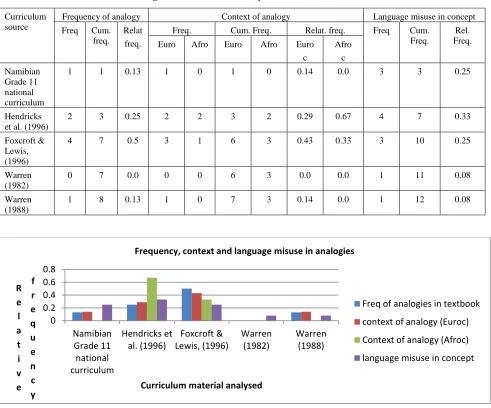
Table 1: Data related to analogies found from analysis of curriculum materials
Curriculum source
Frequency of analogy Context of analogy Language misuse in concept
Freq Cum. freq.
Relat freq.
Freq. Cum. Freq. Relat. freq. Freq Cum. Freq.
Rel. Freq. Euro Afro Euro Afro Euro
c Afro c Namibian Grade 11 national curriculum
1 1 0.13 1 0 1 0 0.14 0.0 3 3 0.25
Hendricks et al. (1996)
2 3 0.25 2 2 3 2 0.29 0.67 4 7 0.33
Foxcroft & Lewis, (1996)
4 7 0.5 3 1 6 3 0.43 0.33 3 10 0.25
Warren (1982)
0 7 0.0 0 0 6 3 0.0 0.0 1 11 0.08
Warren (1988)
1 8 0.13 1 0 7 3 0.14 0.0 1 12 0.08
Figure 2: Relative frequency histogram of analogies from five analysed science textbooks
From the plot, the Foxcroft and Lewis (1996) textbook has the greatest number of analogies used. An example of an Afrocentric analogy featuring in some of the books is that of a cloud, air and ground compared to a capacitor. In other textbooks, a Eurocentric analogy occurring the most is that in which flow of electricity is compared with that of water flowing from a tank, yet most learners in the communities where the schools are situated do not have prior knowledge of water tanks with pipes connected to them. Other textbooks employed fewer analogies, for example Hendricks et al. (1996) and the least were the other two Warren (1992) textbooks which did not employ analogies in the sections analysed. From the analysis of the textbooks treating concepts of electric charge flow, these curriculum materials use the view of analogy to present some of the concepts related to electricity. All the textbooks employ analogies, but Warren’s (1982) textbook does not use the lens of an analogy in its explanation of electricity concepts (see Figure 2). The most commonly presented analogies are based on a Eurocentric view, as evidenced in Figure 2,
0 0.2 0.4 0.6 0.8 Namibian Grade 11 national curriculum Hendricks et al. (1996) Foxcroft & Lewis, (1996) Warren (1982) Warren (1988) R e l a t i v e f r e q u e n c
y Curriculum material analysed
Frequency, context and language misuse in analogies
Freq of analogies in textbook
context of analogy (Euroc)
Context of analogy (Afroc)
66
where each curriculum material analysed has an analogy, but anchored on a Eurocentric view. Hendricks et al. (1996) deviates from this as he uses analogies which are from the two views; Eurocentric and Afrocentric (see Figure 2). The hope was to see if home language terms or concepts within the learners’ context were extended, as Tshotsho (2013) suggests, but none of the teachers were observed doing this.
In some of the curriculum, materials from some of the learners’ community were mentioned in the analogy for learners to relate to. For example, Hendricks et al. (1996) gives an example of a cloud, ground and air as a base analogy to map concepts of a capacitor that acts as the target domain. The use of an analogy is also recommended in the syllabus prescribed in the current curriculum which points out that a suitable analogy must be used to ensure that learners understand concepts in electricity. The water analogy that most of the analysed textbooks use as the base domain, as evidenced in Figure 2, takes water particles as flowing. Higher percentage occurrence of analogies in the curriculum material analysed, indicates higher probability of using the base domain knowledge in an analogy, the water analogy and other analogies (as revealed in Table 1) to be mapped to the target domain, the electric circuit, water is stored in a tank which then provides the pressure to force the water particles to move in the pipe (Lakoff, 1993). On account of some textbooks restricting themselves to use electricity, it was found that this is mapped into capacitor stores electricity. This also brought constraint to the understanding of a capacitor as most textbooks analysed define a capacitor as a device that stores a charge or electricity. Figure 2 shows that there is a higher level of misuse of subject language terms as evidenced from the fact that all textbooks misused some of the terms related to electricity except the Namibian grade 11 curriculum materials (see Figure 2). An example is where all the textbooks understand a capacitor as a device which stores a charge. Electricity cannot be stored and also a charge. What can be stored by a capacitor is the electric energy as opposite charges are piled on the two negatively and positively charged plates in a capacitor.
The analysis done above supports the idea that analogies are used in textbooks analysed and some reflect the context of the learner (see Figure 2). This supports sociocultural theory (Vygotsky, 1978; Berge, 1999; Wolf, 2008). Even though some analogies are from the learners’ context, learners still had some misconceptions attributed to teachers’ failure to have an in depth discussion of analogies specified in textbooks using Eurocentric terminology or the cultural context based terminology. That is borrowing from analogies used in everyday casual talk of concepts taught Probyn (2015) suggests and we referred to it as translanguaging was not done. This is still evidenced in Table 1 in the last column where some terms related to concepts in electricity are not used properly and this comes as a constraint. This will be further discussed in the following sections. So, analogies conveyed in a language of a different culture from those of the learners contribute in adding misconstructions and do not create ways to understand Physical science concepts if the language used is not properly situated.
67
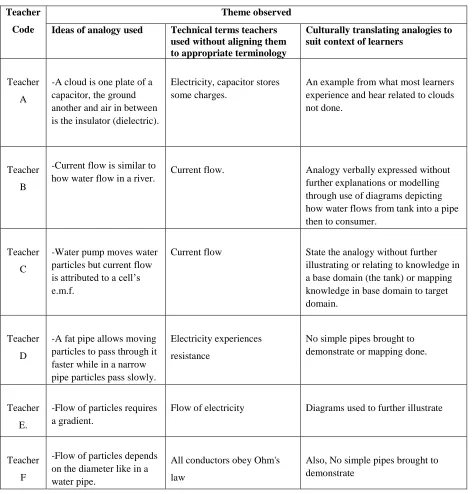
the curriculum (Thompson, 2013). Failure to adapt brought some mismatch observed from data from observation in Table 2.
Data generated from observation
The table below presents the themes which emerged when observation was done to the six teachers. The teachers were observed teaching concepts related to electricity. However, it was difficult to ask them to teach a specific concept in electricity as some had already covered some of the concepts that others were teaching.
Table 2: Data generated from observation of teachers
Teacher
Code
Theme observed
Ideas of analogy used Technical terms teachers used without aligning them to appropriate terminology
Culturally translating analogies to suit context of learners
Teacher A
-A cloud is one plate of a capacitor, the ground another and air in between is the insulator (dielectric).
Electricity, capacitor stores some charges.
An example from what most learners experience and hear related to clouds not done.
Teacher B
-Current flow is similar to
how water flow in a river. Current flow. Analogy verbally expressed without further explanations or modelling through use of diagrams depicting how water flows from tank into a pipe then to consumer.
Teacher C
-Water pump moves water particles but current flow is attributed to a cell’s e.m.f.
Current flow State the analogy without further illustrating or relating to knowledge in a base domain (the tank) or mapping knowledge in base domain to target domain.
Teacher D
-A fat pipe allows moving particles to pass through it faster while in a narrow pipe particles pass slowly.
Electricity experiences resistance
No simple pipes brought to demonstrate or mapping done.
Teacher E.
-Flow of particles requires a gradient.
Flow of electricity Diagrams used to further illustrate
Teacher F
-Flow of particles depends on the diameter like in a water pipe.
All conductors obey Ohm's law
68
Most of the observed teachers mentioned that current flows, instead of electrical charged particles flow to allow learners to see that electrical current is the flow of charged particles. This responds to the first research question as this constrains the understanding of concepts of electricity. Language of a different culture from those of the learners might constrain learning instead of helping learners to overcome misconstructions and create ways to understand electricity concepts
Flow of electric current is understood as the electricity. Electricity is a broad topic such as optics, mechanics, heat, thermodynamics and other sections in the textbooks analysed. Statements like electricity produces the heating experienced in an ohmic resistor were very common in the materials analysed and also from observations. Instead it is the electric charge flow which brings about the heating as they all squeeze to pass through a given point. It is not only resistance and electric charge flow which are not properly mapped into the target domain but capacitance also is not and will be discussed.
The treatment of electricity concepts was done theoretically as evidenced in Table 2 column 4. No use of strategies promoting multiple understanding to co-exist was embraced as Churchland (1989) suggests. No effort was made by the teachers to improvise like what Ramasike (2017) did. She used a straw electricity analogy using easily accessible resources to demonstrate concepts used for learning Ohm’s law. The teachers under observation made little attempt to make the concepts appear concrete besides the use of analogy that most of the teachers mentioned (see Table 2 column 2) and also in most of the textbooks as evidenced from Figure 2. There was no further elaboration or improvising to bring understanding. This was only done by teacher E who might have been exposed to the ideas during his formation. Teacher E attempted to draw the diagram of how water in a tank flows in a pipe to a tape. Some other explanations such as pressure of the liquid provide the force for the water particles to move were explained but faced challenges when he tried to show how a complete circuit operates in a water system. He later then made a comparison with electric charge flow. The teacher explained that in the case of the flow of electrically charged particles, the electromotive force is responsible for providing the force to move the charged particles. The other five teachers, mainly holders of diploma qualification and one degreed confined their teaching on using an analogy provided in the textbook without culturally translating (Bhabha, 1994) as revealed in Table 2 column 4.
69
The opportunity given to learners to explain newly learned concepts pointed to limitations revealed through the use of text based analogies without further elaboration even though analogies were from the learners’ cultural background as supported in sociocultural theory. Learners mostly justified their answers using language in the base domain, also given questions were responded using language or terms in base domain. Orgill and Bodner (2004) observe this and suggest that if there is no conceptual change when an analogy is used; learners manifest this through repeating ideas in the base domain. This is also attributed to teachers who failed to map the elements in the base domain with those in the target domain perhaps on account of them lacking the language of teaching required thereby further constraining the use of analogies.
It was also observed that teachers only used the prescribed textbooks to teach during the time they were observed teaching the one class. No any other Physical science textbooks or materials discussing analogy were used. This further constrained the teaching of the concepts in electricity. Schematic models Gentner and Jeziorski (1993) use for an electric circuit and water system could have addressed the short comings experienced when language used is not that of the learner as evidenced in Table 2 column 4. This could have also aligned the teaching to sociocultural theory of learning Vygotsky (1978) proposes as learners would have been exposed to cultural artefacts they know. Some of the findings generated in observation and document analysis are validated in interviews.
Data generated from interviews
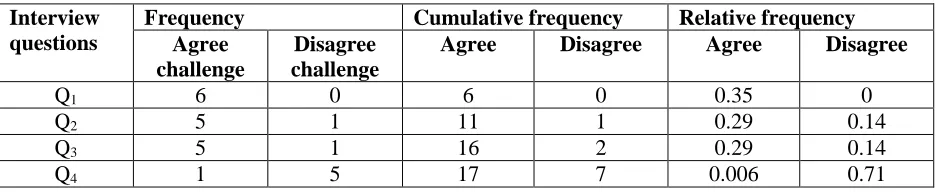
Table 3 below presents the frequency of how the teachers answered the interview questions. Relative frequency was computed and thereafter a chart constructed with the aim to answer the research questions. The interview done after observation had the following questions to facilitate answering the research questions were: (i) Does the language in analogies in curriculum materials assist learners to understand electricity concepts? (Q1), (ii) How does analogy use constrain or enables the teaching of electricity concepts? (Q2), (iii) What can be done to ensure analogies in curriculum material assist learners understand electricity concepts? (Q3) and (iv) Are there terms in electricity concepts you think are wrongly used by you or in the curriculum materials? (Q4).
Table 3: Data generated from interviews
Interview questions
Frequency Cumulative frequency Relative frequency
Agree challenge
Disagree challenge
Agree Disagree Agree Disagree
Q1 6 0 6 0 0.35 0
Q2 5 1 11 1 0.29 0.14
Q3 5 1 16 2 0.29 0.14
Q4 1 5 17 7 0.006 0.71
70
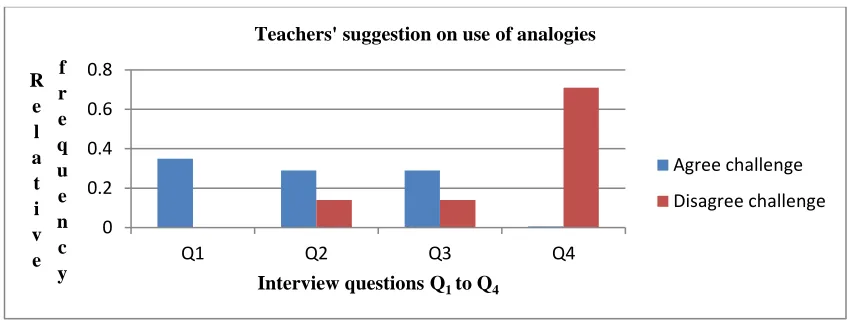
Figure 3:Relative frequency histogram of teachers’ view on use of analogies
Challenges on the use of an analogy result since teachers have the notion that only conventional apparatus are needed to present the Physical science concepts studied as suggested by the bar representing Q2 in Figure 3 above. Consequently, learners are constrained to access Physical science concepts related to the topic of electricity as revealed in the two bars representing Q2.
Despite the flaws observed in the analysis of the textbook and those surfaced during observations, the teachers did not realize them as supported by the bar representing how Q4 was answered. A higher percentage of teachers agreed that textbooks in use do not have errors. A taller bar reveals that there are no errors and only a small percentage of the teachers do agree as evidenced from a small bar in Q4. This made the teachers unknowingly spread the authors’ misconceptions as five of the teachers agree that Physical science knowledge in textbooks is free from errors and must not be changed. Furthermore, insight into what can be done to ensure analogies address the cultural needs of the learners is revealed in Table 3 Q3 bar where the majority of the teachers reveal that examples must come from the learners’ background and a few percentage disagree to this.
Bar representing Q1 reveals that a higher percentage of teachers agree that LTL used to express an analogy plays a crucial role and no one disagreed. However, that was only an observation not put into practice. The failure to bring LTL responsive to learners lead to the direct transfer of knowledge without creativity and understanding of learning outcomes pertaining to the concept of electric current which could mean that Physical science was posing a different culture (Kimbrough & Cooper, 2008). From the data generated from the interview questions, the views of the teachers are the analogies in textbooks and other curriculum material cannot be changed. To the Physical science teachers, the analogies in the textbooks are already culturally contextualized and this comes as a constraint when analogies are used. Mapping as suggested by Gentner & Jeziorski, (1993) and Lakoff, (1993) was not done, so this did not allow learners to connect what they know from the base domain.
Summary of findings
Despite the high frequency of occurrence of indigenous analogies in curriculum materials as seen in Table 1, (Foxcroft & Lewis, 1996; Hendricks et al. 1996; Warren, 1988) the analogy used did not help. Learners could not overcome misconstructions and create ways to understand electricity concepts. The explanations from the teachers were not adapted to meet the needs of the cultural
0 0.2 0.4 0.6 0.8
Q1 Q2 Q3 Q4
R e l a t i v e
f r e q u e n c
y Interview questions Q
1 to Q4
Teachers' suggestion on use of analogies
Agree challenge
71
context of the learners. The curriculum materials suggest some analogies in the context of the learner supporting the sociocultural perspective Vygotsky (1978) proposes, but were not fully exploited. An example is that of the analogy of a cloud air ground reflecting the base domain which can be used to teach a capacitor (the target domain) (Hendricks at el., 1996. This idea was mentioned without going into detail but a thorough engagement would have enabled mapping knowledge in the base domain into knowledge in the target domain as Gentner and Jeziorski (1993) suggest. Also, translanguaging as Probyn (2015) and Childs (2016) suggest, could have been done but from the interviews conducted teachers feel no changes must be made. This further added some constraints. This was worsened when some errors were seen in the textbook (see Table 2) and explanation from the teachers (see Table 3).
To ensure analogies address the cultural needs of the learners, which facilitate border crossing Ramorogo and Ogunniyi (2010) suggest teachers needed to understand the meaning which the terms in the analogy carry. This in turn might have enabled them to come up with relevant terms expressing the same meaning as the term in the base domain as they map it into target domain.
The constraints noted were those related to a lack of materials to consolidate and is supported by the teachers’ views as evidenced in Table 3 where they disagree that terms in electricity concepts were properly used yet observations dispute this. The teachers could have explained using first, an analogy and then explaining what is happening in the target domain. This came as a constraint since most of the teachers did not think of improvising to come up with materials from the learners’ community to mitigate the situation. Some further constrains observed were that teachers viewed the textbook as the material which has information which must not be altered (Table 3). Unknowingly spreading the authors' misconceptions also constrained the use of analogies in teaching and learning of Physical science concepts as illustrated in Table 2 column 3 and in Table 1. This constrained the process of adapting the material to meet the needs of the learners as Bhabha (1994) proposes. No enablers were observed.
Conclusion
As shown throughout this analysis of language use in analogical indigenous knowledge presented in science texts, it may appear simpler to use words in an analogy and appear as if they address learners’ understanding but we are not achieving our goals because of the flaws which the words might convey. Learning to use terminology correctly is fundamental to learning any Physical science concepts and this requires teachers to successfully make analysis of terms which are in an analogy in order to translate the analogy properly. In doing so, analogies conveyed in a language of a different culture from those of the learners might help learners overcome misconstructions and create ways to understand Physical science concepts. Secondly, contextual translation ensures that analogies address the cultural needs of the learners as warned by Kimbrough and Cooper (2008). Finally, once these are in place constrains encountered when analogies are used to teach the concepts in electricity might be lessened.
72
References
Aikenhead, G. S., & Jegede, J. (1999). Cross-cultural science education: A cognitive explanation of a cultural phenomenon. Journal of Research in Science Teaching, 36(3), 269–287.
Aikenhead, G. S., & Ogawa, M. (2007). Indigenous knowledge and science revisited. Cultural Study of Science Education, 2(4), 530–620.
Attard, C. (2014). ‘I don't like it, I don't love it, but I do it and I don't mind’: Introducing a framework for engagement with mathematics. Curriculum Perspectives, 34(3), 1–14.
Berge, Z. L. (1999). Interaction in post-secondary web-based learning. Educational Technology, 39(1), 5–11. Bhabha, H. K. (1994). The location of culture. London: Routledge.
Bartha, P. (2010). By parallel reasoning: The construction and evaluation of analogical arguments. New York: Oxford University Press.
Bravo, M. A., & Cervetti, A. (2009).Teaching vocabulary through text and experience in content areas. In M.F. Graves (Ed.), Essential readings on vocabulary instruction. Newark: International Reading Association. Childs, M. (2016). Reflecting on translanguaging in multilingual classrooms: Harnessing the power of poetry and
photography. Educational Research for Social Change, 5(1), 22–40.
Churchland, P. M. (1989). A neurocomputational perspective: The nature of mind and the structure of science.
Massachusetts: MIT Press.
Cooper, M. A. (1995). Myths, miracles, and mirages. Retrieved from http://lightninginjury.lab.uic.edu/ltnfacts.htm Dlamini, B. (1981). Swaziland flora: Their local names and uses. Ministry of Agriculture and Cooperatives,
Forestry Section, Mbabane, Swaziland.
Edwards, R. Holland, J. (2013). What is qualitative interviewing? London: Bloomsbury Academic.
Evans, D. H. (1982).Analogies as aids to learning.Unpublished master’s dissertation, Montana State University,
Montana.
Faraday, M. (1851).Experimental researches in electricity. London: Red Lion.
Ferreira, J. G. (2011). Teaching life sciences to English second language learners: What do teachers do? South African Journal of Education, 31, 102–113.
Foxcroft, G. E., & Lewis, J. L. (1996). Physics for ICCSE. Oxford: Heinemann.
Gentner, D., Jeziorski, M. (1993).The shift from metaphor to analogy in western science. In A. Ortony (Ed.),
Metaphor and thought (2nd ed.) (pp. 447-480). Cambridge, England: Cambridge University Press.
Glynn, S. M. (1991). Explaining science concepts: A teaching-with-analogies model. In S. Glynn, R. Yeany & B. Britton (Eds), The psychology of learning science. New Jersey: Erlbaum.
Glynn, S. M., & Takahashi, T. (1998). Learning from analogy-enhanced science text. Journal of Research in Science Teaching, 35(10), 1129–1149.
Graneheim U.H., & Lundman B. (2004). Qualitative content analysis in nursing research concepts, procedures and measures to achieve trustworthiness. Nurse Education Today 24, 105–112.
Hendricks, A., Logan, M., Sadeek, A., Body-Evans, A., Clitheroe, F., Collet, H., ….Shreuder, B. (1997). Focus on physical science grade 11. Cape Town: Maskew Miller Longman.
Isaacs, J. W. (1999). Dialogue and the art of thinking together. New York: Doubleday. Jonāne, L. (2015). Analogies in science education. Pedagogy, 119(3), 116–125.
Jonassen, D. H. (2004). Handbook of research on educational communications and technology (2nd ed.). New Jersey: Lawrence Erlbaum Associates.
Kimbrough, D., & Cooper, S.J. (2008). Embracing diverse and English language learners in Chemistry. In S. Lowery-Bretz (Ed.), Chemistry in the National Science Education Standards: Models for meaningful learning in the classroom. Washington DC: American Chemical Society.
Knight, D. (2002). The Oxford companion to British history. Oxford: Oxford University Press.
Lakoff, G. (1993). The contemporary theory of metaphor: In A. Ortony (Ed.), Metaphor and thought, Second Edition. New York: Cambridge University Press.
Maclurcan, D., & Radywy L. (2011). Nanotechnology and global sustainability. London: Taylor & Francis Group. Maxwell, J. C. (1881). Elementary treatise on electricity. Oxford, England: Clarendon Press.
Mukwambo, M. (2017). Exploring and expanding situated cognition in teaching science concepts: The nexus of indigenous knowledge and Western modern science. Unpublished doctoral thesis, Rhodes University, Grahamstown.
73 Parsons, T. (1991). The social system. London: Routledge.
Probyn, M. (2015). Pedagogical translanguaging: Bridging discourses in South African science classroom.
Language and Education, 29(3), 218–234.
Ramasike, L. F. (2017). The use of an analogy in conjunction with a conventional practical activity to mediate Grade 11 learners’ sense making of Ohm’s law. Unpublished master’s thesis, Rhodes University: Grahamstown. Ramorogo, G., & Ogunniyi, M. (2010). Exploring teachers’ conceptions of the rainbow using an
argumentation-based intervention. African Journal of Research in Mathematics Science and Technology, 14(1), 24–35.
Ritchie, S.M. (1991). The construction and use of a metaphor for science teaching. Research in Science Education,
21(1), 281–289.E CONSTRUCTION AND USE OF A METAPHOROR SCIENCE TEACHING
Sabatin, I.M. (2013). The effect of cultural background knowledge on learning English language. International Journal of Science Culture and Sport, 1(4),2148–1148
Scott, C. (1996). Science for the west, myth for the rest? The case of James Bay Cree knowledge construction. In L. Nader (Ed.), Naked Science: Anthropological inquiry into boundaries, power, and knowledge. New York: Routledge. pp. 69-86.
Scott, S. (2013). Socio-cultural theory. Retrieved from http://www.education.com/reference/article/socio-cultural-theory/.
Scott, K. (2001). Unified modelling language explained. Boston: Addison-Wesley.
Sengupta, M. (2015). Obstacles to the use of indigenous knowledge. Developmental Practices, 25(6), 880–894. Stott, D. (2016). Making sense of the ZPD: An organising framework for mathematics education research. African
Journal of Research in Mathematics, Science and Technology,20(1), 25– 34.
Thompson, P. (2013). Learner-centered and cultural translation. International Journal of Educational Development, 33(13), 48–58.
Tshotsho, B. P. (2013). Mother tongue debate and language policy in South Africa. International Journal of Humanities and Social Science, 3(13), 39–44.
Van Rooyen, D., & Jordaan, H. (2009). An aspect of language for academic purposes in secondary education: Complex sentence comprehension by learners in an integrated Gauteng school. South African Journal of Education, 29, 271–287.
Venville, G. J., & Treagust, D. F. (1996). The role of analogies in promoting conceptual change in Biology.
Instructional Science, 24, 295–320.
Vygotsky, L. S. (1978). Mind in society: The development of higher psychological processes. Harvard: Harvard University Press.
Warren, P. (1988). Physics alive. London: John Murray. Warren, P. (1996). Physics for life. London: John Murray.