Formulation and evaluation of
mosquito repellent ointment prepared
with the essential oil of
Zanthoxylum
acanthopodium
DC. Indigenous to
Northeast India
Monawara Begum
1, Wandalin Lyngdoh
2, H. K. Sharma
11Department of Pharmaceutical Sciences, Dibrugarh University, Dibrugarh, Assam, India, 2Department of Zoology, Lady Keane College, Shillong, Meghalaya, India
Abstract
Background: Medicinal plants have sanitary properties due to the bearing of several complex chemical substances of different composition, which are found as secondary plant metabolites in one or more parts of the plants. The genus Zanthoxylum covered to have many useful orthodox uses including antifungal, hepatoprotective, antibacterial, cytotoxic, and antioxidant activity. This Zanthoxylum genus is a rich source of alkaloids, ligands, steroids, coumarins, benzenoids, terpenes, flavonoids, fatty acids, and amides. Zanthoxylum acanthopodium DC is an aromatic plant and has been reported as an excellent mosquito repellent. Aim: The determination of the study was to formulate and evaluate the mosquito repellent ointment from the essential oil of the fruits of Z. acanthopodium DC. Methods: The formulated ointment was subjected to evaluation of the compatibility of essential oil and ointment base, measurement of pH, viscosity, spreadability, extrudability, stability study, drug content of ointment, and especially mosquito repellent evaluation such as first larvicidal evaluation of oil then repellent evaluation of ointment against Aedes aegypti and Culex quinquefasciatus. Acute and subchronic dermal irritation studies were also done. Results and Discussion: Our analysis shows that Z. acanthopodium DC has high potential as a mosquito repellent agent when formulated as ointment for topical use. Thus, the study resolves that the formulated ointment formulations of the essential oil from the fruits of Z. acanthopodium were safe and effective carriers with potent mosquito repellent activity.
Key words: Malaria, vector, dermal toxicity, dengue, permeation
Address for correspondence:
Dr. H. K. Sharma, Department of Pharmaceutical Sciences, Dibrugarh University, Dibrugarh - 786 004, Assam, India. E-mail: [email protected]
Received: 11-03-2018 Revised: 16-09-2018 Accepted: 22-09-2018
INTRODUCTION
P
revention of mosquito bite is of extreme importance in the present day with developing a number of mosquito-borne sicknesses. Specialty products like mosquito repellents are used to fight mosquitoes. A piece of the products used for mosquito control has departing degrees of potency. Carbon dioxide and lactic acid in the sweat of warm-blooded animals act as attractive substances for mosquitoes. The sensing of the smell is through chemoreceptors present in the aerial part of mosquitoes. Mosquito repellents normally work by covering human scent; natural and chemical mosquito repellents are available for this and thereby to repel mosquitoes. Chemical mosquito repellents have singular safety visibility, but they cause toxicity against the skinand nervous systems such as rashes, swelling, eye irritation, and more high-risk problems including brain swelling in children, anaphylactic shock, and low blood pressure.[1]Most
of the mosquito repellents prepared using non-perishable synthetic chemicals such as N,N-Diethyl-3-methylbenzamide and dimethyl phthalate are unaccepted due to health risks [2]
With an increasing interest on human safety, a regenerated interest on the use of natural products of plant origin is trusted, because natural products are effective, environmentally
ORIGINAL
AR
friendly, biodegradable, inexpensive, and readily available in comparison to synthetic products.[3] Appreciable research attempts have proved that plant containing essential oil and their derivatives are good alternative measures for controlling mosquitoes.[4] The consideration of essential oils as mosquito
repellent or any other insect repellent lies in the concept that the constituents of essential oils are fairly toxic or generally found to be non-toxic to human, birds, and the ecosystem.[5]
While there are several progresses in the field of synthetic drugs, plants still cover to be one of the major crude materials for drugs dealing with various ills of human.[6] Herbal drugs
are formulated in various dosages forms. Ointment bases are virtually anhydrous, and it contains one or more medicaments in suspension or solution or dispersion form intended for topical use. The delivery of drugs through the skin has long been a predicting construct because of the comfort of access, large surface area, huge vulnerability to the circulatory, and lymphatic networks, and non-incursive cause of the treatment.[7]
Zanthoxylum acanthopodium DC [Figure 1] is an aromatic shrub or a small tree, also known as lemon paper, has been an important herb in the ayurvedic and indigenous medical systems for over 4000 years. This herb is indigenous to Northern India and the Tibetan highlands across to Eastern and Southeast, Asia (Bangladesh, Bhutan, China, Myanmar, Cambodia, Vietnam, Thailand, and Malaysia). The essential oil of the fruits of this plant has been studied for its composition, antibacterial activity, and mosquito repellent activity.[8-10] The objective of the study was to formulate and
evaluate the mosquito repellent ointment containing the essential oil of the fruits of Z. acanthopodium.
MATERIALS AND METHODS
Materials
The essential oil of Z. acanthopodium DC was obtained by hydrodistillation with the appropriate amount of distilled water for 48 h using the original Clevenger-type apparatus. The plant was collected from Shillong (Meghalaya) and was authenticated by Botanical Survey of India, Eastern Region Circle, Meghalaya. Wool fat, hard paraffin, soft paraffin, and cetostearyl alcohol were purchased from HiMedia Laboratories Pvt., Ltd., Mumbai, India. Double distilled water was used for formulation and evaluation. All the chemicals and reagents were of analytical grade and were used as received.
Methods
Formulation of ointments
Selection of ingredients was done according to their melting point acquit. Different batches of ointment formulations were prepared using a changing concentration of essential oil
of Z. acanthopodium in simple ointment IP. The ointments were prepared by incorporating 0.1%, 0.2%, 0.3%, 0.4%, and 0.5% of the essential oil of Z. acanthopodium in simple ointment IP, which served as a base.[11] In this method, the
ingredients were melted together in decreasing order of their melting points according to composition given in Table 1 and were stirred to ensure homogeneity. Five batches of ointment (F1, F2, F3, F4, and F5) were prepared.
Physicochemical evaluations of the formulated ointment batches organoleptic parameters of formulations
Organoleptic parameters corresponding to their color, homogeneity, consistency, and phase separation of the formulations were carried out by visual observation.
Compatibility Study of Essential Oil and Ointment Formulation
The compatibility between the essential oil of Z. acanthopodium and ointment base was studied by Fourier transformed-infrared spectroscopy (FT-IR) spectroscopy. The FT-IR spectra were recorded in the wavelength region between 1000 cm−1 and 3500 cm−1.[12] The spectra obtained
for essential oil, the ointment base of the formulation and physical mixture of essential oil in ointment base were compared.[12]
Determination of pH
The pH of all five ointment formulations was measured by taking 5 g of formulation in 45 ml of water. The pH was then checked with a pH meter, which was calibrated before use with standard buffer solutions.[13]
Viscosity Measurement
Viscosity measurements can be counted as sensitive tools for detecting morphologic changes in ointment formulations.
Viscosities of all the batches were measured using Brookfield DV-I (spindle T-D spindle code S94) at 50 rpm.[14]
Spreadability Study
Spreadability is demonstrated in terms of time in seconds required by two slides to drowse off from the ointment on the application of certain load. It was determined by placing 10 g of ointment between the two glass slides (10 cm × 20 cm), and 25 g of weight was placed on the upper slide and the time required to separate the two slides was measured. Spreadability was calculated using the formula.[15]
Table 1: Composition of ointment batches
Formulation code (%) Composition Total quantity (g)
Amount of oil (µl) Ingredient Quantity (g)
F1 0.1 10 Wool fat 2.5 50
Hard paraffin 2.5
Cetostearyl alcohol 2.5 White soft paraffin 42.5
F2 0.2 20 Wool fat 2.5 50
Hard paraffin 2.5
Cetostearyl alcohol 2.5 White soft paraffin 42.5
F3 0.3 30 Wool fat 2.5 50
Hard paraffin 2.5
Cetostearyl alcohol 2.5 White soft paraffin 42.5
F4 0.4 40 Wool fat 2.5 50
Hard paraffin 2.5
Cetostearyl alcohol 2.5 White soft paraffin 42.5
F5 0.5 50 Wool fat 2.5 50
Hard paraffin 2.5
Cetostearyl alcohol 2.5 White soft paraffin 42.5
Figure 2: Fourier transformed-infrared spectrum of the fruit oil of Zanthoxylum acanthopodium
Figure 3: Fourier transformed infrared spectrum of ointment base
Spreadability=wt. tied to the upper slide×length of glass sslides time taken to separate the slides
Tube Extrudability Studies
It is a usual confirmable test to evaluate the force required to compact out the ointment from the tube. For this test, clean collapsible tube of 3 mm opening was filled with formulation, and then the pressure was applied on tube with a finger. Tube extrudability for all batches was then determined by measuring the amount of ointment squeezed out through the tip when the force was applied on tube.[16]
Stability Studies
All five formulations were subjected to stability testing for about 35 days at room temperature. Room temperatures were maintained at 25°C as per the ICH guidelines 1993. The parameter of formulation such as color, texture, spreadability, pH, phase separation, and viscosity was determined for all the formulations.[17]
Preparation of Standard Calibration Curve
Calibration curve of EO was prepared in phosphate buffer at pH 7.4 given in Figure 5. The concentration was increased, and regression equation was calculated and utilized for drug content studies and in vitro skin penetration study.
Drug Content Studies
The drug content of ointment formulations was determined using 1g of each ointment formulation in 100 ml of saline phosphate buffer (pH 7.4), and the solution was shaken for 30 min, then the resultant solution was filtered, and the absorbance was measured by a spectrophotometer[18] at λ
max
280.20 nm.
In Vitro Skin Permeation Study
In vitro skin permeation study of all the ointment formulations was carried out by Franz diffusion cells using pig ear skin. The skin was struck from 4-month-old domestic pig ears, obtained from a local commercial supplier. Full-thickness skin was collected with a surface area of 3.14 cm2. The pig
ears were cleaned under running water immediately after excision. Then, the hair from the outer region of the ears was removed, and the skin was carefully separated from cartilage using a scalpel. Subsequently, fatty tissue was removed. A thickness of 1 mm for all the samples was maintained with the help of scale. The skin was instantly placed on the diffusion cells for 3 days. Then, 1g of ointment formulation was applied to the skin, and the skin was placed on Franz diffusion cells, between the donor and receptor compartments. Sink conditions were maintained in the receptor compartment with saline phosphate buffer at pH 7.4 with a volume of receptor fluid of 15 ml. The receptor compartment was incessantly homogenized with the help of a stirring magnetic bar, and the temperature was kept at 32°C using a water circulation system. The skin-mounted in the cell was allowed to rest for an hour in contact with PBS before the application of the compositions. Serial sampling was performed after 15 min, 30 min, and 45 min, 1 h, 2 h, 3 h, and 4 h, and fresh receptor liquid was added to receptor compartment to replace the buffer. Then, samples were measured by spectrophotometer at 280.20 nm.[19]
Mosquito Repellency Test of the Ointments against
Aedes aegypti and Culex quinquefasciatus
The mosquito-repellency of the formulations such as F1 (0.1%), F2 (0.2%), F3 (0.3%), F4 (0.4%), and F5 (0.5%) was evaluated using an arm-in-cage method.[20] The technique
needs counting of the number of mosquitoes biting a hand introduced into a 1.5 cubic feet mosquito cage containing 50–60, 3–5 days old, male and female mosquitoes. Counting was done for the first 0–5 min, 5–10 min, 10–15 min, and 15–20 min of every half-hour exposure. The formulations were applied to the forearm. The marketed product ODOMOS® (Dabur, India), was used as a positive control to compare the repellent activity of the ointment. Simple ointment base was used as negative controls. The repellency test was carried out against A. aegypti, and C. quinquefasciatus species, which were identified by their physical characteristics. Control readings were obtained by putting a hand inside the repellent chamber without applying any repellent before the experiment.
The percentage of repellency is calculated by the following formula.[20]
% Repellency= [(Ta – Tb)/Ta] ×100
Where,
Ta=Number of mosquitoes landing in untreated forearms (control).
Tb=Number of mosquitoes landing in the treated forearms.
Dermal Toxicity Study of Ointment in Albino Rats
The acute and long-term dermal toxicity study of the prepared ointment was carried out using Rats as per the OECD guidelines of 434 and 410. This study was conducted on the approval of the Animal Ethics Committee, Department of Pharmaceutical Sciences, Dibrugarh University.
Acute Dermal Toxicity Study
Acute dermal toxicity study was performed for prepared ointment according to the acute toxic classic method as per the OECD guidelines 434. Female albino rats were used for acute dermal toxicity study. Approximately 24 h before the study, fur was removed from the dorsal area of the trunk of the test animals by clipping or shaving. 10% of the body surface area was cleared for the application of the ointment. The ointment was then applied uniformly over an area which is close to 10% of the total body area. The test substance at 50 μg/ml, 100 μg/ml, and 1000 μg/ml of ointment formulations was applied to 10% of the body surface area of experimental animals and positive control animals, severally. Unprocessed portions of the body surface area of all animals sufficed as negative controls. The shaved areas of all the animals were covered with cloth mucilage then animals were kept for a period of 2–3 h, and the skin of each animal was investigated in intervals of 1, 24, 48, and 72 h.[21] The observation for the toxicity signs
such as presence of any edema, erythema, or any type of dermal change at 1 h, 24 h, and 72 h was observed. Body weight (BW) variation and body temperature variations of all the tested animals were investigated for the day of or immediately before the application of the tested ointments and at least weekly thereafter. Observations for toxicity were continued for 14 days. In the 1st day of the observation,
the animals were observed frequently, and then observations were made daily. For acute dermal toxicity as per the OECD guideline 434 total number of animal required is five for each dose.
Long-term Dermal Toxicity Study
Long-term dermal toxicity study was performed for prepared ointment as per the OECD guidelines 410. For the subchronic test, a group of 10 animals (5 animals per sex) were used. Before 24 h of the study, fur was removed from the abaxial area of the trunk of the test animals by cutting and shaving. Close to 10% of the body surface area of each animal was cleared for the application of the ointment.[22] The shaved
skin of observational animals was scratched 5 times per week with the test ointment at 100, 1000, and 10000 μg/ml and skin of positive controls was chafed with 100 μg/ml of ointment. The other parts of body in all treated groups were kept untreated as a negative control. The application of ointment was performed once daily for 5 days per week over a period of 28 days.[23] The observation for the toxicity signs was BW variation, individual weight of all the animals was determined on the day of, or immediately before the application of the tested ointments, and at least weekly thereafter. At the end of the test surviving animals was again weight out. Hematological analysis of all tested animals was done on the 1st day, 14th day, and at the end of the test, which
includes hemoglobin concentration, red blood cells (RBC) count, white blood cells (WBC) count, clotting time, and platelet count.
RESULTS AND DISCUSSION
Physical Evaluation of Ointment Formulations
In this investigation of all the batches of prepared ointment, formulations were subjected for physical evaluations such as organoleptic parameters corresponding of their color, homogeneity, consistency, and phase separation of the formulations were carried out by visually. The visual evaluation showed same color white, depending on the different concentrations of active ingredient which was used in this study with a smooth and homogenous appearance, and no phase separation occurred as given in Table 2.
Compatibility of Essential Oil and Ointment Base
The compatibility of the oil and the ointment base was studied by FT-IR spectroscopy. The infrared spectra of oil [Figure 2], ointment base [Figure 3], and formulation
Table 2: Physical evaluation of ointment formulations
Sl. No. Formulation code Color Homogeneity Consistency Phase separation
1 F1 White Good ++ Nil
2 F2 White Good ++ Nil
3 F3 White Good + Nil
4 F4 White Good ++ Nil
[Figure 4] were observed in between 1000 cm−1 and 3500 cm−1 and the characteristic peaks of the oil were found in the formulation which indicates that there is no change in the chemical structure of the oil thus leading to conclusion that no reaction in the formulation has taken place. Thus, it can be said that oil and ointment base is compatible with each other.
Evaluation of pH, Viscosity, Spreadability, and Extrudability of the Formulations
The evaluating parameters such as pH, viscosity, spreadability, and extrudability of the Z. acanthopodium oil containing formulations were found to be like pH in the range of 6.78–7.3, for the ointments, which lies within the normal pH range of the skin and all formulations had optimal viscosity. Since the type and quantity of the ointment in each formulations were the same, comprehension of different cognitive content seems to have brought about some difference in the viscosity of ointment. The spreadability and extrudability value of all the batches indicated that the Z. acanthopodium ointment formulations were easily spreadable by a small amount of shear and tube extrudability of all the formulations was found to be good and average Table 3.
Stability Study
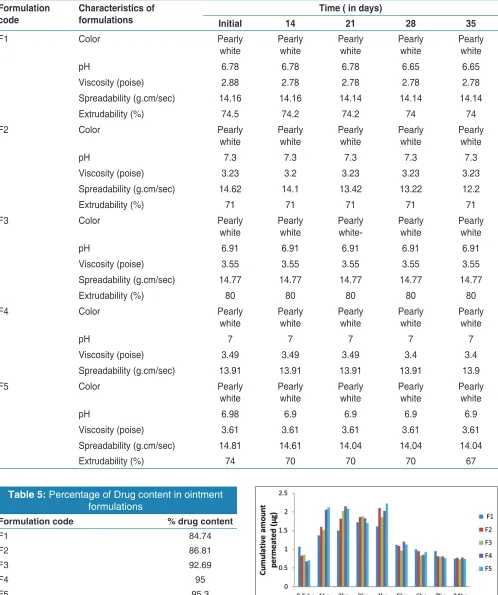
After 35 days stability study, the parameter of formulation such as color, spreadability, pH, extrudability, and viscosity results indicated that the results were satisfactory and acceptable for all formulations [Table 4], but pH was little went down in the formulation F1 and F2.
Drug Content Studies
All the ointment formulations were found to contain EO in the range of 84.74–95.3%, which indicated uniformity in drug content. The percentage of drug content of the formulations was given in Table 5.
In Vitro Skin Permeation Study
The in vitro permeation profiles of ointment formulations (F1, F2, F3, F4, and F5) through skin were investigated in vitro for a period of 24 h. The permeation profile [Figure 6] indicated that the release of drug (oil) from the ointment formulations initially increased for up to 4 h, but the release of the drug became slower after 4 h due to the evaporation of oil at body temperature. This indicated that the oil release pattern from ointment formulations mainly depends on time and temperature of exposure. It also signifies the safety aspect of the oil.
Mosquito Repellency Test of the Ointments against
A. aegypti and C. quinquefasciatus
The result of repellency effects of ointment formulations against A. aegypti and C. quinquefasciatus is shown in Tables 6 and 7. It indicated that the essential oil of Z. acanthopodium containing ointment strongly repelled both A. aegypti and C. quinquefasciatus even at a very low concentration. The repellency of all application in case of A.aegypti was 85–100% while that for C. quinquefasciatus was 76–100% during 20 min of periods. The prepared ointment showed a 100% repellent activity, i.e., zero landed mosquitoes for all exposed arms at 0.5% concentration.
Acute and Subchronic Dermal Toxicity Study of Formulated Ointment in Albino Rats
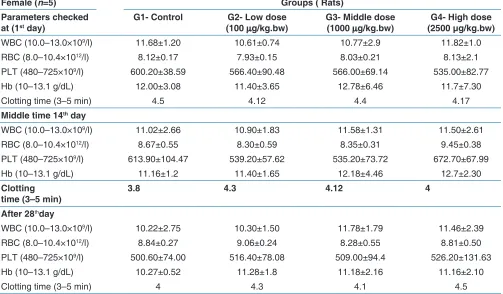
The dermal toxicity study was performed on Wister albino rats. This test is significant as it gives an idea about the hazards of the prepared formulations against the skin. Complying 14 days application of ointment, the result of acute dermal toxicity test was tabulated in Tables 8-10, which could be concluded that dermal administration of ointment containing essential oil of Z. acanthopodium had no effect on the growth and functions of rats at the concentration studied. The values for intake are based on the average BW of the past time interval. The effects
Table 3: Evaluation of pH, viscosity, spreadability, and extrudability of all the formulations
Formulation
code Evaluating parameters Results
F1 pH 6.78
Viscosity (poise) 2.88±0.14 Spreadability (g.cm/sec) 14.16
Extrudability 74%
F2 pH 7.3
Viscosity (poise) 3.23±0.52 Spreadability (g.cm/sec) 14.62
Extrudability 71%
F3 pH 6.91
Viscosity (poise) 3.55±0.27 Spreadability (g.cm/sec) 14.77
Extrudability 80%
F4 pH 7.09
Viscosity (poise) 3.49±0.45 Spreadability (g.cm/sec) 13.91
Extrudability 77%
F5 pH 6.98
Viscosity (poise) 3.61±0.41 Spreadability (g.cm/sec) 14.81
of different doses of ointment prepared with the essential oil of Z. acanthopodium on repeated exposures by the dermal route over a limited period of time are summarized in Table 11. The result obtained from indicated that the change in the BW of rats from Groups 2, 3, and 4 did not show significant differences
Table 4: Stability study of all the formulated ointment batches
Formulation
code Characteristics of formulations Initial 14 Time ( in days)21 28 35
F1 Color Pearly
white Pearly white Pearly white Pearly white Pearly white
pH 6.78 6.78 6.78 6.65 6.65
Viscosity (poise) 2.88 2.78 2.78 2.78 2.78
Spreadability (g.cm/sec) 14.16 14.16 14.14 14.14 14.14
Extrudability (%) 74.5 74.2 74.2 74 74
F2 Color Pearly
white Pearly white Pearly white Pearly white Pearly white
pH 7.3 7.3 7.3 7.3 7.3
Viscosity (poise) 3.23 3.2 3.23 3.23 3.23
Spreadability (g.cm/sec) 14.62 14.1 13.42 13.22 12.2
Extrudability (%) 71 71 71 71 71
F3 Color Pearly
white Pearly white Pearly white- Pearly white Pearly white
pH 6.91 6.91 6.91 6.91 6.91
Viscosity (poise) 3.55 3.55 3.55 3.55 3.55
Spreadability (g.cm/sec) 14.77 14.77 14.77 14.77 14.77
Extrudability (%) 80 80 80 80 80
F4 Color Pearly
white Pearly white Pearly white Pearly white Pearly white
pH 7 7 7 7 7
Viscosity (poise) 3.49 3.49 3.49 3.4 3.4
Spreadability (g.cm/sec) 13.91 13.91 13.91 13.91 13.9
F5 Color Pearly
white Pearly white Pearly white Pearly white Pearly white
pH 6.98 6.9 6.9 6.9 6.9
Viscosity (poise) 3.61 3.61 3.61 3.61 3.61
Spreadability (g.cm/sec) 14.81 14.61 14.04 14.04 14.04
Extrudability (%) 74 70 70 70 67
Table 5: Percentage of Drug content in ointment formulations
Formulation code % drug content
F1 84.74
F2 86.81
F3 92.69
F4 95
F5 95.3
Figure 6: Permeation profiles of ointment formulations (µg)
the midterm observation (after 14 days) and at the end of the experiment (after 28th day) that there was no significant
difference in hemoglobin, RBC count, WBC count, platelet count, and clotting time between the untreated and ointment treated groups. From the result, it could be concluded that ointment containing essential oil of Z. acanthopodium had no effects on the circulating blood cells or their production. However, to minimize the rate of evaporation, if the oil
Table 6: Repellency activity of ointments A. aegypti
Treatment (%) Number of landed mosquitoes (min) (%) Repellency
5 10 15 20
Control (-ve) 25 20 20 25
-F1 (0.1) 4 2 2 6 85.05
F2 (0.2) 1 1 3 3 91.5
F3 (0.3) 0 0 2 3 94.7
F4 (0.4) 0 0 0 4 95.7
F5 (0.5) 0 0 0 0 100
Control (+ve) 0 0 0 0 100
A. aegypti: Aedes aegypti
Table 7: Repellency activity of ointments against C. quinquefasciatus
Treatment (%) Number of landed mosquitoes (min) (%) Repellency
5 min 10 min 15 min 20 min
Control (-ve) 50 50 50 50
-F1 (0.1) 11 12 12 9 76.13
F2 (0.2) 13 10 10 8 79.5
F3 (0.3) 0 0 9 11 80.7
F4 (0.4) 0 0 4 4 92
F5 (0.5) 0 0 0 0 100
Control (+ve) 0 0 0 0 100
C. quinquefasciatus: Culex quinquefasciatus
Table 8: BW (in g) variation of the animals during experiment
Group BW (g) 0th day BW (g) 5th day BW (g) 10th day BW (g) 14th day
G1- control 112.8±5 113.7±35 114.8±45 114.0±4.0
G2-low dose (50 µg/kg.BW) 90.67±2 91.33±2 94.56±1 100.67±2
G3-middle dose (100 µg/kg.BW) 80±3 80.23±4 83.02±21 83.48±4.0
G4-high dose (1000 µg/kg.BW) 83.3±1.2 86.2±2.0 86.4±5.6 88.15±6.0
BW: Body weight
Table 9: Temperature variation of the animals during experiment
Group Temperature (oF)
0th day Temperature ( oF)
5th day Temperature ( oF)
10th day Temperature ( oF)
14th day
G1- control 98.20±0.38 98.26±0.403 98.00±0.24 97.97±0.27
G2 -low dose (50 µg/kg.BW) 97.20±0.26 96.93±0.34 97.00±0.24 96.97±0.26
G3 -middle dose (100 µg/kg.BW) 97.06±0.22 97.36±0.82 97.17±0.33 97.87±0.31 G4- high dose (1000 µg/kg.BW) 97.33±0.65 97.7±0.47 98.26±0.64 98.53±0.42
BW: Body weight
globules are encapsulated, and nanoformulation is prepared then the possibility of toxicity aspects need to be evaluated with suitable toxicity study model.[24]
CONCLUSION
or subchronic dermal toxicity and the pH range was within the normal skin pH. The ointment formulations also exhibited significant mosquito repellent activity when compared with marketed product. Formulation F5 exhibited the highest activity in comparison to the rest of the ointment formulations. Thus, it can be concluded that the effort of formulating mosquito repellent ointment was successful and carries the potential for commercialization. The oil may be encapsulated to
Table 10: BW variation of ointment on treated rats according to time and sex
Days G1- control G2- low dose
(100 µg/kg.BW) G3- middle dose (1000 µg/kg.bw) (2500 G4- high doseµg/kg.bw)
Female
1st day BW (g) 120.1±5.4 110.0±1.73 140.32±11.1 140.10±10.7
7th day BW in (g)) 137.1±2.13 120.4±4.4 150.20±1.9 160.0±12.8
14th day BW in (g) 150.23±0.2 132.16±5.7 165.7±12.3 210.15±11.2
21th day BW in (g) 184.01±1.7 150.06±4.0 180.21±7.7 240.02±16.1
28th day BW in (g) 218.21±3.2 205.12±1.2 210.10±1.4 260.13±8.7
Male
1st day (BW in (g) 120.14±0.3 122.7±4.9 125.8±8.1 127.3±10.1
7th day (BW in (g) 160.6±8.3 150.23±1.6 164.4±4.9 140.34±6.0
14th day (BW in (g) 192.4±10.5 210.12±14.1 198.6±6.4 170.26±10.1
21th day (BW in (g) 219.0±10.7 261.2±14.1 222.13±13.7 220.12±11.2
28th day (BW in (g) 240.5±10.4 292.17±11.0 247.2±11.1 250.06±13.1
BW: Body weight
Table 11: Hematological evaluation of ointment on treated rats in the times ( 1st day, 14st day, and 28th day)
Female (n=5) Groups ( Rats)
Parameters checked
at (1st day) G1- Control (100 G2- Low dose µg/kg.bw) G3- Middle dose (1000 µg/kg.bw) (2500 µg/kg.bw)G4- High dose
WBC (10.0–13.0×10⁹/l) 11.68±1.20 10.61±0.74 10.77±2.9 11.82±1.0
RBC (8.0–10.4×10¹²/l) 8.12±0.17 7.93±0.15 8.03±0.21 8.13±2.1
PLT (480–725×109/l) 600.20±38.59 566.40±90.48 566.00±69.14 535.00±82.77
Hb (10–13.1 g/dL) 12.00±3.08 11.40±3.65 12.78±6.46 11.7±7.30
Clotting time (3–5 min) 4.5 4.12 4.4 4.17
Middle time 14th day
WBC (10.0–13.0×10⁹/l) 11.02±2.66 10.90±1.83 11.58±1.31 11.50±2.61
RBC (8.0–10.4×10¹²/l) 8.67±0.55 8.30±0.59 8.35±0.31 9.45±0.38
PLT (480–725×109/l) 613.90±104.47 539.20±57.62 535.20±73.72 672.70±67.99
Hb (10–13.1 g/dL) 11.16±1.2 11.40±1.65 12.18±4.46 12.7±2.30
Clotting
time (3–5 min) 3.8 4.3 4.12 4
After 28thday
WBC (10.0–13.0×10⁹/l) 10.22±2.75 10.30±1.50 11.78±1.79 11.46±2.39
RBC (8.0–10.4×10¹²/l) 8.84±0.27 9.06±0.24 8.28±0.55 8.81±0.50
PLT (480–725×109/l) 500.60±74.00 516.40±78.08 509.00±94.4 526.20±131.63
Hb (10–13.1 g/dL) 10.27±0.52 11.28±1.8 11.18±2.16 11.16±2.10
Clotting time (3–5 min) 4 4.3 4.1 4.5
BW: Body weight, WBC: White blood cell, RBC: Red blood cell, Hb: Hemoglobin
prevent the rate of evaporation for higher activity and increased shelf life.
ACKNOWLEDGMENT
REFERENCES
1. Hallem EA, Nicole Fox A, Zwiebel LJ, Carlson JR. Olfaction: Mosquito receptor for human-sweat odorant. Nature 2004;427:212-3.
2. Nerio LS, Olivero-Verbel J, Stashenko E. Repellent activity of essential oils: A review. Bioresour Technol 2010;101:372-8.
3. Siriporn P, Mayura S. The effects of herbal essential oils on the oviposition-deterrent and ovicidal activities of Aedes aegypti (Linn.), Anopheles dirus (Peyton and Harrison) and Culex quinquefasciatus (Say). Trop Biomed 2012;29:138-50.
4. Antwi FB, Shama LM, Peterson RK. Risk assessments for the insect repellents DEET and picaridin. Regul Toxicol Pharmacol 2008;51:31-6.
5. Koul O, Walia S, Dhaliwal GS. Essential oils as green pesticides: Potential and constraints. Biopesticide Int 2008;4:63-84.
6. Patel EK, Gupta A, Oswal RJ. A review on: Mosquito repellent methods. Int J Pharm Chem Biol Sci 2012;2:310-7.
7. Solomon B, Sahle FF, Gebre-Mariam T, Asres K, Neubert RH. Microencapsulation of citronella oil for mosquito-repellent application: Formulation and in vitro permeation studies. Eur J Pharm Biopharm 2012;80:61-6.
8. Majumder M, Sharma HK, Zaman K,
Lyngdoh W. Evaluation of physico-chemical properties and antibacterial activity of the essential oil obtained from the fruits of Zanthoxyllum acanthopodium DC. Collected from Meghalaya, India. Int J Pharm Pharm Sci 2014;6:543-6.
9. Das D, Begum M, Sharma R, Sharma HK. Investigation for Mosquito Repellent, Larvicidal and In-Vivo Dermal Absorption Study of the Essential oil Extracted from the Fruits of Zanthoxylum acanthopodium DC. Collected From Meghalaya, India. In: Sharma HK, Zaman K. (Eds) The Marvel Plant of Meghalaya: Zanthoxylum acanthopodium DC. Lap Lambert Academic Publishing; Deutschland; Germany, 2016. P. 57-65.
10. Sonowal S, Desai C, Kapadia JD, Desai MK. A survey of knowledge, attitude, and practice of consumers at a tertiary care hospital regarding the disposal of unused medicines. J Basic Clin Pharm 2016;8:4-7.
11. Ministry of Health and Family Welfare. The Pharmacopoeia of India. 2nd ed. India: Ministry of Health
and Family Welfare, Government of India; 1966. p. 656. 12. Pandey A, Jagtap JV. Formulation and evaluation of anti-bacterial and anti-fungal activity of a herbal ointment containing Aloe-vera, Azadirachta indica and Curcuma-longa. J Chem Pharm Res 2010;2:182-6.
13. Kuntal D, Raman D, Manjunath MU, Ugandar RE, Lalitha BR. Evaluation for safety assessment of formulated vanishing cream containing aqueous Stevia extract for topical application. Indian J Nov Drug Deliv2002;4:43-51.
14. Indian Standard. Specification for Hair Creams. New Delhi: Indian Standard Institution; 1978. p. 11-2.
15. Patel RP, Kamani R. Formulation optimization and evaluation of mometazone furoate cream. J Pharm Res 2002;10:1565-9.
16. Gupta GD, Gaud RS. Release rate of tenoxicam from acrypol gels. Indian Pharm 2005;5:69-76.
17. Haase M. Stability testing requirements for vaccines - draft guidelines of the international conference on harmonization. Dev Biol Stand 1996;87:309-18. 18. Vats A, Sharma P. Formulation and evaluation of topical
anti-acne formulation of coriander oil. Int J Pharm Pharm Sci Res 2012;2:61-6.
19. Purushothamrao K, Khaliq K, Sagare P, Patil SK, Kharat SS, Alpana.K. Formulation and evaluation of vanishing cream for scalp psoriasis. Int J Pharm Sci Tech 2010;4:33-41.
20. Aidaross M, Kokob WW, Galalb M. Evaluation of repellent and larvicidal activity of Ocimum basilicum and Cymbopogon citratus DC. Against Culex quinquefasciatus. Int Chern Pharm Med J 2005;2:243-6. 21. OECD Guidance Document on the Recognition,
Assessment and Use of Clinical Signs as Humane Endpoints for Experimental Animals Used in Saftey Evaluation. Enviromental Health and Saftey Monograph Series on Testing and Assessment No.19; 2000.
22. OECD. OECD Guidelines for Testing of Chemicals: Acute Dermal Toxicity; 1987. p. 402.
23. Kim YS, Song MY, Park JD, Song KS, Ryu HR, Chung YH, et al. Subchronic oral toxicity of silver nanoparticles. Part Fibre Toxicol 2010;7:20.
24. Sharma HK. Risk assessment of nanoformulations. Recent Pat Drug Deliv Formul 2015;9:106.