_____________________________ Iliria International Review – 2015/1
Abstract
This paper aims at analysing activities of the privatisation process in Kosovo, seeing that privatisation is treated as a fundamental factor of overall transformation of the whole society.
It may be established that the primary aim of privatisation process is increasing economic efficiency, reflection of the current state and directions of development in general. Privatisation as a process has as primary aim of opening new areas of freedom, economic efficiency and individualism.
Key aim of privatisation process in Kosovo must be increase of economic efficiency, preservation of the healthy economic potential created up to date, and ensuring of the long-term concept, which enables growth and macroeconomic stability. The policy of privatisation should give a response related to strategic aspects of privatisation of these sectors: of models, procedures, potential investors, technological modernisation and overtaking of social barriers.
Process of privatisation and transition, which has now covered countries of the Eastern and Central Europe, aims at profound economic and political transformation of these countries. To achieve this, it is necessarily required to have some basic preconditions, which are related to incitement of general efficiency of the enterprises, expansion of the capital market, introduction of competition, development of business
Dr.sc. Hysni TERZIU
The Privatisation Process in Kosovo
_____________________________ Iliria International Review – 2015/1
culture in private property and freedom of entrepreneurship. Impacts of privatisation in economic development of Kosovo take a considerable place compared to other countries, therefore our aim is that through this paper we analyse factors and methods of implementation in this process.
Key Words: Control and transparency, application of respective laws, ensuring efficiency, selection of the best model, incitement of economic development, professional practice, transition.
1. Privatisation process in Kosovo
Privatisation generally means the process of changes through which the conjecture and the equilibrium of different social groups’ interests are generated. Meanwhile, privatisation may be understood also as a process of changes and transfers of rights on property, which certainly lead towards social progress. Privatisation also means changes and transfers towards creation of an optimal structure of property at a certain time and space. However, privatisation of economies that are built on bases of non-ownership of property can be treated as a transformation process of such economies. Thus, privatisation process of property does not mean only the change of ownership relations but also the change of the role of state and self-government bodies in economy.
In general, privatisation process in developed economies of market is diffracted into these goals: 1) in transformation of institutions and enterprises in the field of public sector aiming the privatisation of property, 2) opening of public sector activities towards competition within the scope of general policy of liberalisation, 3) release of public sector from some activities which go with private sector competencies, 4) cede from the services without compensation of the sector for the benefit of total or partial participation 1.
Privatisation process in Kosovo is explained through two points: 1. The stage of initial state of a certain process; and 2. The target intended, at which each process should be transferred from one state into another. The initial state of this process in Kosovo can be explained based on the fact that there is a significant number of enterprises with social capital, from which
1 Selman Selmanaj, Globalizimi dhe tranzicioni: dilemat dhe sfidat (Globalisation and Transition:
_____________________________ Iliria International Review – 2015/1
some are rentable but need reconstruction and new capital, whereas dome others do not have any perspective, however, they have means and assets, such as land, infrastructure and premises, but these means are either not used or used illegally.
Due to economic and political inconsistency in the region, entanglements and uncertainties about the title of the property, high risk, neither local capital nor the foreign one have raised any interest to engage in these enterprises and in privatisation process, in general. Privatisation in Kosovo did not start before 2003. There were many reasons for this, but the main one was the political status of Kosovo, which was not fully defined until 2007, the ownership rights were not defined, yet, and principal cadastral documents were taken away by Serbian forces during their transference to Serbia in 19992.
Privatisation process in Kosovo has a specific nature and differs from other countries of Central and Eastern Europe. Following the constitutional changes in 1989, different actions were undertaken by Serbian reign towards destroying the organisational, personnel and material-financial structures of enterprises and other economic entities of Kosovo in all spheres: industry, agriculture, forestry, energetics etc3. In the period of transition, the privatisation process has its specifics and characteristics, which may be treated from the aspect of their economic, politic, and social acceptability. Economic acceptability of relevant privatisation strategy should be regarded from the viewpoint of its positive impacts in the entire economic development of a country, usually, expressed with the increase of
the scale of social gross product4. Compilation of the strategy of
privatisation in Kosovo, and within its scope, the finding of a relevant model of the privatisation of large, medium and small enterprises should primarily be based on the determination of premises and main criteria, in the compilation of a relevant concept and, in the end, in clarification of relevant models.
2 Florin Aliu, Procesi i Privatizimit në Kosovë, (Privatisation Process in Kosovo) Iliria International Review – 2014/1, Prishtina, 2014
3 Sinan Ademaj, Probleme dhe dilema që e përcjellin procesin e privatizimit në Kosovë (Issues and
Dilemma which follow the provatisation process of Kosovo), The system of open economy of trade and transition in Kosovo, page 134, Institute on Scientific Researches Riinvest, May 1998
4 Safet Merovci, Privatizimi dhe inxhinieringu social në tranzicion (Privatisation and social
_____________________________ Iliria International Review – 2015/1
Therefore, existence of all forms of property in Kosovo is necessary, in which case their legal definition presents the first preparatory step in the execution of privatisation process in Kosovo.
Privatisation process of social enterprises in Kosovo has its specifics and characteristics, which can be treated from the aspect of their economic, political and social acceptability. Economic acceptability of the relevant strategy of privatisation should be analysed from the viewpoint of its positive impacts and from the entire economic development of a country5.
Kosovo may learn a lot from the experience of the implementation of privatisation in other countries. Best comparative examples are as in the following: a) privatisation is fundamental unit of the transformation process; b) successful privatisation requires a broad privatisation strategy; c) privatisation has a positive effect in the work of enterprises; d) privatisation has a positive effect the re-structuring of enterprises, particularly, by the aid of foreign investments; e) Speed is essential and f) efficacy of privatisation is closely related with a certain model of privatisation used6.
The privatisation process in Kosovo was initially led by Kosovo Trust Agency (KTA), whereas now, it is led by Privatisation Agency of Kosovo (PAK). Fundamental duty of KTA was the management of privatisation process of enterprises with social capital and public enterprises and liquidation of enterprises with no perspective. KTA dealt with the so called liquidation “bared capital”, but meanwhile, also with the transformation and privatisation of enterprises with social capital through ordinary SPIN-OFF and special SPIN-SPIN-OFF. Now, KTA’s duty belongs to PAK.
1.1. Explanation of normal Spin-off and special Spin-off
The essence of normal SPIN-OFF can be explained by the fact that the agency monitors the privatisation process of a socially owned capital enterprise, moreover it establishes one or more subsidiary companies, to which the rights or the interests in all or some of the parts of means of enterprise are transferred to social capital. Following the transfer of rights and means, the shares of these corporate may be sold to most trustful
5 Sinan Ademaj, Macroeconomic aspects of transformation and privatisation of socially owned
enterprises in Kosovo, International Scientific Review, Iliria University, February 2009 6 Malcolm Toland, Privatisation is a necessary process in Kosovo, Socially owned enterprises
_____________________________ Iliria International Review – 2015/1
investors. However, the fact that the socially owned capital enterprise will continue exist further, is that that will only be a shareholder within the corporate or the new subsidiary corporate. But the shares of the corporate are under possession of the socially owned enterprise, which is subject to privatisation and it is administered by the privatisation agency.
The essence of special SPIN-OFF stands at the fact that it constitutes some other qualitative elements in itself compared to the normal SPIN-OFF. In addition to the higher price bid, other bidding criteria are also taken into consideration, based on tender rules. Within such rules, there are taken into consideration some other conditions such as such as: minimum number of employed persons, including the investment by potential investors, continuation of the same activity etc. This model can be used for privatisation of large non-controversial enterprises, whereas small and medium enterprises are mainly privatised through normal SPIN-OFF. According to special SPIN-OFF model, the bidders take 50% of their scores based on the offered price, 25% of the score they take based on committed investment amount and 25% based on jobs they offer7.
Moreover “Spin-off”, gives no guarantee to former employees of privatised enterprises. Each new buyer can either hire or terminate employees from work as per their needs, only in accordance with current draft-regulation nothing obliges the successful bidder to provide job security to employees.
Special “Spin-off” model has been considered as the most important form and the most complicated one because the selected companies through this form had a higher economic impact and contained a higher number of employees. This form of privatisation has the meaning of transferring the ownership to the new owner with the purpose of creating a “New-Co”, the responsibilities remain with the Privatisation Agency of Kosovo – PAK (electrical energy, water supply, etc.)8.
Therefore, privatisation shall be accompanied by good governance mechanisms for the enterprises, distribution of property through shares must be avoided as it creates vacuum out of which only managers benefit, but not the shareholders9.
7 Selman Selmanaj, Contemporary Economic Systems, Prishtina, 2006
8 Florin Aliu, Privatisation Process in Kosovo, Iliria International Review – 2014/1, Prishtina, 2014
9 Sinan Ademaj, Macroeconomic aspects of transformation and privatisation of social enterprises in
_____________________________ Iliria International Review – 2015/1
2. Infrastructure and the methods of privatisation process
2.1. Legal infrastructure
KTA activity has been regulated by the following normative acts.
• UNMIK Regulation 2002/12: Kosovo Trust Agency was established pursuant to this Regulation and subsequently its competences have been defined,
• Regulation 2002/13: Special Chamber of Supreme Court was established pursuant to this Regulation, for adjudication and making decisions related to privatisation process,
• Regulation 2003/13, or Regulation for use of land, issued by the Security Council of United Nations in New York,
• Tender rules: These rules provide for the tender procedures. According to these rules, KTA management is to be consulted for each tender10.
2.2. Methods of privatisation of socially owned capital enterprises From the analysis of the concept of privatisation of socially owned enterprises, it derives that the duty of Kosovo Trust Agency (KTA), is to manage the privatisation process of socially owned capital enterprises and of the public enterprises and liquidation of enterprises which do not have a promising future. But the agency can decide to what degree it takes the responsibilities estimated in such a corporate. According to Article 8. paragraph 8.1., the Agency shall decide for each case individually whether it takes the obligations of the enterprise and if so, to what level shall the Agency take the obligations of the respective company established in this way which is subject to privatisation. The Agency has the right to administrate the income in cash or in shares as deriving from the property exchange from a socially owned enterprise by this institution. According to Article 6. paragraph (R), it is provided that issuing by a special sub-contract of a part of activities of the enterprise, and in paragraph (S) initiation of bankruptcy procedure is foreseen or representation of such enterprises in bankruptcy procedures (Regulation 18/ 2005). The Agency shall not take the obligation towards the owners of the property of socially owned enterprises. Hence, the Agency is not liable for any debt, action or omission attributed to enterprises, and vice-versa, the enterprises are not held liable
_____________________________ Iliria International Review – 2015/1
for the debts, actions or inactions attributed to the Agency (Article 18, Regulation 18/ 2005)7.
From a study made by Riinvest institute, it has been noticed that socially owned enterprises mainly suffered by shortcomings in capital, almost half of them stated that capital shortcomings was their main barrier in accomplishment of their activities, another handicap was the lack of adequate technology which would fulfil the requirements and standards of market limitations11.
In addition to normal SPIN-OFF, transformation and privatisation of socially owned enterprises, according to Regulation 18/ 2005, is foreseen to be also completed through special OFF. The essence of special SPIN-OFF stands at the fact that it constitutes some other qualitative elements in itself compared to the normal SPIN-OFF. In addition to the higher price bid, other bidding criteria are also taken into consideration, based on tender rules. Within such rules, there are taken into consideration some other conditions such as such as: minimum number of employed persons, including the investment by potential investors, continuation of the same activity etc. This model can be used for privatisation of large non-controversial enterprises, whereas small and medium enterprises are mainly privatised through normal OFF. According to special SPIN-OFF model, the bidders take 50% of their scores based on the offered price, 25% of the score they take based on committed investment amount and 25% based on jobs they offer (Tender rules for special SPIN-OFF-in). The results achieved based on implementation of these two models during privatisation in Kosovo may also have their advantages.
Advantages of special SPIN-OFF can be illustrated through privatisation of metal sheet factory “Llamkos” in Vushtrri. This factory was privatised with the fourth wave in 2005 and was sold with a price of 4.151.000 Euros. The investor foresees an investment of 15.000.000 Euros in three coming years. At the same time the investor foresees employment of 500 new employees in two coming years12.
In case promises of the investor are fulfilled, then we can rightly say that privatisation of this enterprise will undoubtedly be successful and thus
11 Florin Florin Aliu, Privatisation Process in Kosovo, Iliria International Review – 2014/1, Prishtina, 2014
12 Bashkim Isufi, Process of transformation and privatisation of property in Kosovo and in countries
_____________________________ Iliria International Review – 2015/1
Kosovo will benefit, in particular the municipality of Vushtrri and the investor.
In addition to normal SPIN-OFF and special SPIN-OFF there is also a third model: Voluntary liquidation. Voluntary liquidation allows a quick exit of enterprises, which do not see a safe perspective of surviving from the market.
3. Development of privatisation process
3.1. Drawbacks and obstacles
In order to have a clear overview of the course of the privatisation process in Kosovo, as a highly complicated process, we have carried out a research project: The analysis of the development of privatisation process, where privatised enterprises from the first and second round were visited.
This survey aimed at seeing how the privatisation process went, what were the deficiencies of this process in implementation of the policies and regulations issued before.
Management staff of the enterprises that were bid for privatisation in the first and second wave were interviewed, heads of employee councils and of labour unions of these enterprises were interviewed too.
Like in other countries of the region, in Kosovo too, this process was accompanied by lots of critics and remarks. According to the results from the survey it turns that all employees and the managing staff support the process of privatisation and consider it as a crucial matter for economic development of Kosovo. Nevertheless, the observations raised are mainly related to non-transparency of KTA work, in particular towards KILU (Kosovo Independent Labour Union), towards the managing staff and employees of the enterprises. Remarks were mainly made related to definition of the price. According to evaluation of many institutions, the prices of enterprises were not defined according to realistic criteria of market prices.
Interest of many investors for the enterprises put in auction did not result in their purchase because of the existing fiscal policy, thus not only being a barrier for the investors, but at the same time suffocates the local production capacities too.
_____________________________ Iliria International Review – 2015/1
• Lack of harmonisation of the privatisation process to the specific political circumstances on Kosovo,
• Lack of transparency, lack of cooperation and consultation with the professional cadre of Kosovo institutions (Drafters of policies of privatisation in Kosovo, led by the motto “... that even the worst privatisation is better than the best commercialisation”, by not being transparent, not only towards the broad public opinion, but also towards the legitimate bodies of Kosovo Government as well and this way ignoring cooperation with them, by not cooperating and consulting the scientific circuits of Kosovo Academy of Sciences and Arts, nor with the professional cadre of University of Kosovo, thus fading the process of privatisation),
• The privatised property according to the 99 year contract means
change of the owner of the property, but it represents a long term commercialisation, that for the existing circumstances in Kosovo is quite doubtful and carries potential risks with it,
• Lack of lobbying to business communities,
• Irrespective interest of banks to evaluate and support the potential buyers,
• Lack of provision of training programs for participants in
privatisation and for exchange of experiences with countries which have already finished the privatisation process,
• Lack of will to make the impact unable from certain political
structures,
• Lack of mechanisms to avoid transformation of social property by
mafia groups.
3.2. Progress of privatisation process
Economic difficulties faced by Kosovo despite the potentials and resources it has, are a consequence of implementation of wrong policies of UNMIK, by not annulling the discriminatory laws applicable since March 1989 in Kosovo and abiding by a policy dictated by Serbia.
_____________________________ Iliria International Review – 2015/1
of crucial importance for economic development of Kosovo, thus reducing the unemployment rate and creating sustainable jobs13.
The condition of enterprises following beginning of privatisation process seems as follows:
1. Social enterprises in the list for privatisation 478 2. Public enterprises under direct management of KTA 5 3. Public enterprises of waste and water supervised by KTA 45 4. Commercialised enterprises 18 5. Privatisation process is currently blocked by UNMIK Pillar IV
Following all the critics addressed to KTA, the privatisation process finally restarted as a necessary process of economic development. Carefully following the flow of procedures developed regarding the submitted bids, we have established that since opening of the offers, and on, everything was within the rules and procedures as foreseen by applicable KTA regulations. For the first time in this process, respectively in the commissions for acceptance of bids and heir opening, the representatives of civil staff of MTI attended.
But also following the initiation of the privatisation process, other rounds also were not developed without delays and dragging based on further analysis of deficiencies noticed in up to date privatisation process.
4. Privatisations carried out by Kosovo Trust Agency
Kosovo Trust Agency (KTA) was established as an Agency responsible for administration of socially owned and public enterprises (SOE), and to carry out privatisation and liquidation of all of them (SOE-s) pursuant to UNMIK Regulation 2002/12 from 13 June 2002 (KTA Regulation). This regulation was amended on 22 April 2005 whereby the new UNMIK Regulation 2005/18 was issued.
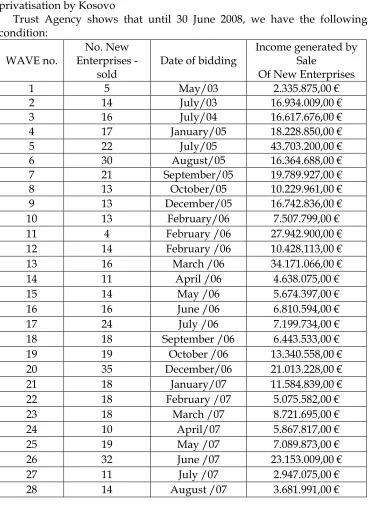
A general observation of the privatisation program shows that until 30 June 2008, Kosovo Trust Agency (KTA) had initiated the process of 30 privatisation waves. The amounts collected by both tenders SOR and SOS developed since May 2003 until January 2008 is € 392.281.978.498,oo
An overview of privatisation program shows that until 30 June 2008 the previous agency (KTA) published 30 waves of privatisation. 498 new
_____________________________ Iliria International Review – 2015/1
enterprises were tendered for sale and 397 contracts were signed, reaching total income from privatisation (received and deposited) in amount of € 392,280,728.
Benefits of employees reached the amount of € 76,166,646 out of which € 15,558,654 were paid by Kosovo Independent Labour Union for distribution to the employees. Likewise, the Board of the previous Agency approved a total of 120 liquidations with income reaching an amount of € 3,804,99214.
Over 590 business enterprises in Kosovo were identified as potential Socially Owned Enterprises (SOE). Sector of SOE-s employed around 20,000 people, whereas the number of people in employee lists reaches up to 60,000 (e.g. 40,000 were in unpaid leave). SOE-s operated in a variety of sectors including processing of metals, plastic, paper, in hotels, mines, agro-industry, agriculture, forestry, construction materials, construction, textile, winery and vineyards, beer production, tobacco, retail and wholesale.
It has been calculated that SOE-s have constituted around 90% of the industrial base and mines of Kosovo, 50 per cent of the area for retail commercial sale and less than 20 per cent of the agricultural land, including the whole commercial agricultural land and the largest part of forests of Kosovo.
The largest part of Kosovo industrial assets, agricultural land, forests, commercial urban land and commercial properties were possessed by SOE-s. Privatisation of these assets and attraction of foreign investors, those from Diaspora, from the region and the country in the privatisation program is expected to have a high and positive impact in economy and in creation of jobs.
New enterprises have been offered for sale and 397 sale contracts were signed, with the total amount of privatisation reaching the income of € 392.280.728,oo (paid and deposited).
Kosovo Trust Agency (KTA) stopped carrying out its activity on 30 June 2008.
_____________________________ Iliria International Review – 2015/1
Table 1: A general observation of the program of 31 waves of privatisation by Kosovo
Trust Agency shows that until 30 June 2008, we have the following condition:
WAVE no.
No. New Enterprises -
sold Date of bidding
Income generated by Sale
Of New Enterprises
1 5 May/03 2.335.875,00 €
2 14 July/03 16.934.009,00 €
3 16 July/04 16.617.676,00 €
4 17 January/05 18.228.850,00 €
5 22 July/05 43.703.200,00 €
6 30 August/05 16.364.688,00 €
7 21 September/05 19.789.927,00 €
8 13 October/05 10.229.961,00 €
9 13 December/05 16.742.836,00 €
10 13 February/06 7.507.799,00 €
11 4 February /06 27.942.900,00 €
12 14 February /06 10.428.113,00 €
13 16 March /06 34.171.066,00 €
14 11 April /06 4.638.075,00 €
15 14 May /06 5.674.397,00 €
16 16 June /06 6.810.594,00 €
17 24 July /06 7.199.734,00 €
18 18 September /06 6.443.533,00 €
19 19 October /06 13.340.558,00 €
20 35 December/06 21.013.228,00 €
21 18 January/07 11.584.839,00 €
22 18 February /07 5.075.582,00 €
23 18 March /07 8.721.695,00 €
24 10 April/07 5.867.817,00 €
25 19 May /07 7.089.873,00 €
26 32 June /07 23.153.009,00 €
27 11 July /07 2.947.075,00 €
_____________________________ Iliria International Review – 2015/1
29 9 October /07 2.876.859,00 €
30 6 December /07 1.457.715,00 €
31 8 January /08 13.707.715,00 €
Total: 498 392.280.728,00 €
Source: Kosovo Trust Agency, Work Report 2008
5. An outline to the privatisation process
Comparison of the current situation of global economic development, impact of privatisation in all economic, political and social spheres of the society, the deficiencies shown during this process in respecting the Resolution 1244, the odds of many international personalities and showing of their specific interests, varying from the countries where they come from, or where their friends are from, etc., makes a fact clear that the process of privatisation as a vital process of transformations in economic development of Kosovo, needs to be tackled in complementary and very serious manner, not only by the institutions of the Government of Kosovo, but also by the scientific and academic institutions.
Kosovo, as the least developed region of the South-eastern Europe by implementing an economic policy, by the international administration, based on Resolution 1244 and in many old fashioned regulations and laws of a destroyed state, was obstructed in implementing the transitory processes, the economy entered a deep recession, whereas a system of commanded economy was imposed to Kosovo.
Therefore, the policy of privatisation in Kosovo needs to be in function of:
• Macroeconomic, developmental, technological and innovative
consolidation of economy,
• Promotion of economic activities based on market resources,
establishment of new companies and increase of efficiency of the existing ones,
• Construction and rounding of market economy institutions,
• Eliminating the consequences from irrespective and inefficient
current administration,
_____________________________ Iliria International Review – 2015/1
• Promotion of private investments in SME-s, in particular in direct foreign investment,
• Mobilisation of savings and potential from Diaspora, investment and increase of budget income,
• Appropriate transparency of institutions towards private sector and investors.
Taking into consideration the political reflection of majority of activities are related to the privatisation process and the need for achievement of a political consensus, for majority of activities related to development of this process, the need of planning is incontestable, coordination, leading and control, respectively management of these activities. It is the Government of Kosovo that needs to be holder of this management and also the governmental and non-governmental organisations. By this management, the following would be achieved:
• Planning and coordination,
• Ensuring efficiency,
• Control and transparency.
5.1.Planning and coordination
Planning and coordination of activities is necessary because the privatisation process involves all subsystems of socio-economic system. Consequently, in these activities many entities are involved: the parliament, executive power, judicial system, local administration, scientific and academic institutions, the private sector in general, through different associations of business, and the civil society through various nongovernmental organisations. Activity of these entities should necessarily be supported by the technical assistance which must also be well planned and coordinated intending to be highly effective. Coordination needs to ensure harmonised development of these activities and avoiding the conflicts related to aims, competences and stages of activity development.
5.2. Ensuring efficiency
_____________________________ Iliria International Review – 2015/1
5.3. Control and transparency
Control and transparency must ensure social supervision in the process of use, transformation and management of socially owned property, as a preventive against misuses, which have appeared in many economies of countries which have completed or are in the stage of transition, and have appeared as one of risks of compromising and slowing down of the processes which resulted into conflicts and high social tensions (Albania, Serbia, Croatia, etc.).
Control and transparency must be conducted through regular activity of: • Assembly and respective state bodies, as a daily and specific work for
certain problems,
• Control and transparency must have in consideration evaluation of the opinion shown through public information means, as an essential part of activities related to creation of the state of law.
6. Development of the process of privatisation by Privatisation Agency of Kosovo
6.1. General Program of Privatisation in Kosovo
Privatisation Agency of Kosovo was established as a successor of Kosovo Trust Agency regulated pursuant to UNMIK Regulation 2002/12 “On Establishment of Kosovo Trust Agency”, as amended, and all its assets and responsibilities will be assets and responsibilities of PAK.
Over 590 business enterprises in Kosovo have been identified to be potential Socially Owned Enterprises (“SOE”). SOE-s operate in various sectors, including processing of metals, plastics, paper, hotels, mines, agro-industrial processing, forestry, construction materials, construction, winery and vineyards, brewery, wholesale and retail trade.
An overview of privatisation program shows that until 30 June 2008 there were 30 waves of privatisation published which were successfully privatised by the previous agency (KTA), and 3 waves of privatisation until December 2008 from the Privatisation Agency of Kosovo with the sale of SOE-s in various sectors of local, regional and international investors.
6.2. Privatisation Agency of Kosovo continued with privatisation through three patterns
_____________________________ Iliria International Review – 2015/1
Companies”) with shares of new companies subsequently tendered for sale to the private investors. The remaining liabilities and he employees remain within the SOE. Most successful Spin off-s are expected to be in the sectors which carry out the work in the best way; these are agricultural processing activities including the winery and the entities dealing with food processing, the sector of construction material, mines, and metal processing.
● “Special Spin off”: Is similar to the Spin-off, but it allows PAK to put conditions on the tender (for example the minimum employment rate, commitment for investment, maintaining the same business line). In general the Special Spin off-s are used only for larger and highly strategic SOE-s.
● Voluntary liquidation: SOE-s which do not have chances to have
success, and it is clear that they do not have a perspective to survive, Liquidations allow for exiting the market without expenses. In general their assets will be liquidated through public auction.
Privatisation Agency of Kosovo (in the following text referred to as “PAK”) was established as a successor agency to Kosovo Trust Agency regulated by UNMIK Regulation 2002/12 “on establishment of Kosovo Trust Agency” as amended, all its assets and responsibilities shall be assets and liabilities of PAK. PAK was established following the issuance of the Law on Privatisation Agency of Kosovo (Law no. 03/L-067) which entered into force on 15 June 2008 (in the following text referred as the “Law”) This law implements relevant provisions of the Comprehensive Proposal for Deciding on the Status of Kosovo, dated 26 March 2007 (Annex VII, Article 2), which is a constituting process of the Constitution of the Republic of Kosovo (Article 145 of the Constitution of the Republic of
Kosovo)15. PAK was established as an independent public body,
which shall exercise the functions and responsibilities with a full autonomy.
_____________________________ Iliria International Review – 2015/1
7. Privatisation by Privatisation Agency of Kosovo
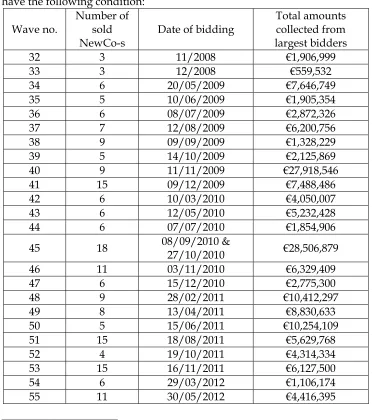
Taking a glance at the privatisation program in Kosovo, we have noticed that until 12 August 2009 PAK announced 28 waves of privatisation which we will present below as per this table:
Table 2:A general overview of the program of 28 waves of privatisation by the Privatisation Agencyof Kosovo shows that until 12 August 2008, we have the following condition:
Wave no.
Number of sold
NewCo-s Date of bidding
Total amounts collected from largest bidders
32 3 11/2008 €1,906,999
33 3 12/2008 €559,532
34 6 20/05/2009 €7,646,749 35 5 10/06/2009 €1,905,354 36 6 08/07/2009 €2,872,326 37 7 12/08/2009 €6,200,756 38 9 09/09/2009 €1,328,229 39 5 14/10/2009 €2,125,869 40 9 11/11/2009 €27,918,546 41 15 09/12/2009 €7,488,486 42 6 10/03/2010 €4,050,007 43 6 12/05/2010 €5,232,428 44 6 07/07/2010 €1,854,906
45 18 08/09/2010 & 27/10/2010 €28,506,879
_____________________________ Iliria International Review – 2015/1
56 17 19/09/2012 €12,118,731 57 13 29/05/2013 €7,590,247 58 6 29/05/2013 €3,212,435 59 13 09/10/2013 €4,238,109
Total: 251 €186,952.507
Source: Privatisation Agency of Kosovo, Annual Report, March 2013
It is important to note that the privatisation process in Kosovo cannot be compared to privatisation in other countries because of the political and economic specifications. SOE-s in Kosovo have been disintegrated for more than a decade through the interim measures. Kosovo is a state that has suffered a lot during the war and the SOE-s have not been excluded from this process. We must have in mind that leading of Kosovo economy was centralised by the earlier regime in former Yugoslavia, and a large number of factories was built for specific markets. We must also note that earlier markets have been lost and the products of other countries dominate the current market. All issues mentioned above make the privatisation in Kosovo even more specific and they also constitute a general problem for PAK16.
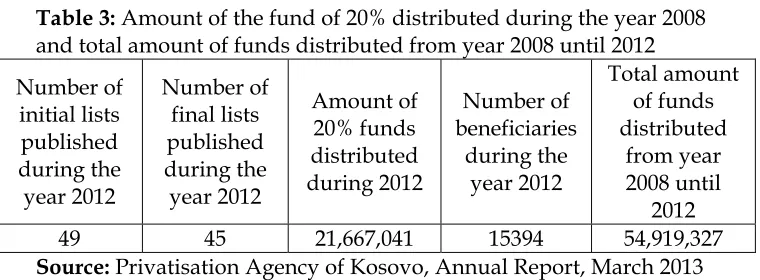
One of the main activities set as priorities by PAK Board of Directors is distribution of 20% for the lists from the sale of enterprises. Within this short period of time, PAK despite all difficulties managed to distribute the employee lists.
7.1. Unit of employee lists
During the reporting period, one of the main activities of the Unit of Employee Lists has been the publication of initial and final lists, part of 20% distribution deriving from the sale of SOE-s, provision of guidance and various clarifications for the interested parties (employees, leading the SOE-s and other involved parties in this process) and preparation of various reports for PAK management and other interested parties. Distribution of funds of 20% still remains an issue of high priority for the Unit of Employee Lists and for PAK in general.
_____________________________ Iliria International Review – 2015/1
Table 3:Amount of the fund of 20% distributed during the year 2008 and total amount of funds distributed from year 2008 until 2012 Number of
initial lists published during the year 2012
Number of final lists published during the year 2012
Amount of 20% funds distributed during 2012
Number of beneficiaries
during the year 2012
Total amount of funds distributed
from year 2008 until
2012
49 45 21,667,041 15394 54,919,327
Source: Privatisation Agency of Kosovo, Annual Report, March 2013
8. Privatisation process with the third method through liquidation
Socially Owned Enterprises that do not have other opportunities for success and it is evident that they do not have any perspective to survive, liquidations allow an exit from the market without any expenses. In general, their assets shall be liquidated via public auction.
Upon the establishment of Privatisation Agency of Kosovo (PAK) as a successor of the former KTA, Agency exercises its mandate also for the liquidation of enterprises in accordance with Law No. 03/L-067 and UNMIK Regulation 2005/48 through Liquidation Commissions.
During the last mandate of the former Kosovo Trust Agency (KTA), through its Board of Directors and under its authority, initiated the liquidation process on 6 July 2005 and later approved the commencement of liquidation of about 120 SOE properties, until the end of their mandate.
The Board of Directors agreed that (i) the Process of Liquidation is re-confirmed and re-started on 01 February 2009 or on a later date since two Deputy-Managing Directors, in their discretion, can determine and condition, where it is applicable, the sales of privatisation that enter into force; and (ii) Two Deputy-Managing Directors are authorised to nominate members of Liquidation Commission for each liquidation and to nominate such substitutes which might be deemed necessary occasionally.
_____________________________ Iliria International Review – 2015/1
There are 120 Liquidation Commissions, which are working in the liquidation of 120 SOE assets. Each Liquidation Commission should have an international member, who is nominated by International Civil OFFICE
(ICO) (paragraph 9.2 Law on Establishment of PAK). ICO members are
segregated in Regional Offices of PAK, and preparation on the sale of liquidations shall commence17.
It should be mentioned that during the mandate of the predecessor agency there were no unique procedures of liquidation in order to help Liquidation Committees in fulfilling their daily duties, which derive from applicable laws and operational policies of Agency. However, there were only bits and pieces created by the so-called Regional Steering Committee of Liquidation, which was established to coordinate activities of Privatisation Department and Liquidation Unit (during KTA mandate). PAK compiled successfully the Liquidation Guidance for Liquidation Committees, reflecting changes of applicable law, more precisely, Law on Establishment of PAK, Law on Trade Organisations as well as Operational Policies of PAK18.
With the purpose to prepare in the best way the re-initiation of liquidation process, Regional Offices places work with the verification of all requests registered in database, their scanning, regulation of activities as well as installation of documents in database.
Due to control and identification of requests in liquidation, their registration in accordance with groups and priorities, 5 working groups were appointed and started their work in April. In such working groups two representatives were selected by the central office of Privatisation Agency of Kosovo, as well as representatives/leaders of the liquidation teams. Upon signing of the Contract between Liquidation Authorities, regional offices, respectively, Liquidation Officials in these offices, are engages in the constitution of Liquidation Authorities as Case Officials19.
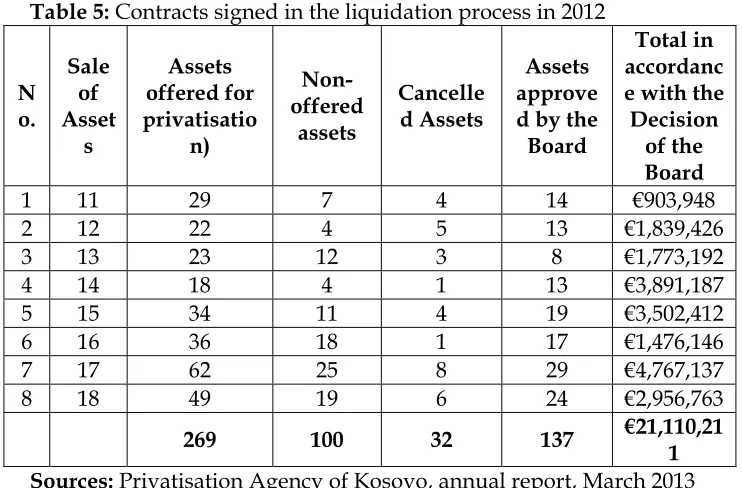
Regarding the sale of assets through liquidation, during the period January – December 2012, regional offices prepared all documentation for eight (8) waves of sales through liquidation that contain 177 assets from
17 Privatization Agency of Kosovo (PAK), Work Report August 2008 – August 2009, March 2009
18 Privatization Agency of Kosovo (PAK), Work Report August 2008 – August 2009, March 2009
19 Privatization Agency of Kosovo (PAK), Annual Report of Privatisation Agency of Kosovo for
_____________________________ Iliria International Review – 2015/1
which 269 assets are tendered. These waves of liquidation included 269 documents with the data on Enterprises, Information Memorandums on the Sale of Assets with Liquidation (IMSAL) in the room of enterprises and CLOR.
Table 5: Contracts signed in the liquidation process in 2012
N o.
Sale of Asset
s
Assets offered for privatisatio
n)
Non-offered
assets
Cancelle d Assets
Assets approve d by the
Board
Total in accordanc e with the
Decision of the Board
1 11 29 7 4 14 €903,948
2 12 22 4 5 13 €1,839,426
3 13 23 12 3 8 €1,773,192
4 14 18 4 1 13 €3,891,187
5 15 34 11 4 19 €3,502,412
6 16 36 18 1 17 €1,476,146
7 17 62 25 8 29 €4,767,137
8 18 49 19 6 24 €2,956,763
269 100 32 137 €21,110,211
Sources: Privatisation Agency of Kosovo, annual report, March 2013
9. Conclusions and Recommendations
● It is an emergent need to change the current legislation related with PAK activities and the Special Chamber of the Supreme Court of Kosovo and their full compliance with the provisions of the Extensive Proposal on the Status by President Ahtisaari. These necessary amendments in the current legislation are require in order to enable the proper functioning of PAK and SCSC of Kosovo and which certainly would precipitate all privatisation process and, particularly, the liquidation process and allocation of 20% for eligible employees allowing PAK to fulfil its mandate within the time limit prescribed.
_____________________________ Iliria International Review – 2015/1
foresees that the completion of a sole process of liquidation for a SOE, after the privatization of its assets, takes approximately 42 months. Taking into account the fact that portfolio of enterprises under the administration of PAK, reaches 599 SOES, regardless of the proof that a significant number of SOEs can be conducted at the same time and that the liquidation process of 120 SOEs was re-initiated, yet in practice, it is impossible to finish all these within at least for following 5 years.
● Because of vast uncertainty regarding the assets of SOEs outside the territory of the Republic of Kosovo, inability of PAK to privatise strategic SOEs through special Spin-Off method, PAK is expected shall encounter possible delays in the conclusion of privatisations and relevant liquidations.
● Legal Department considers that there is a need to make amendments and update the Law on PAK. As well as, regarding the liquidation procedure, although, through this law this procedure takes very long time and it is fussy, and as such, it is unfavourable for the parties and the agency. Pursuant to the Law on PAK, the liquidation procedure up to the final fulfilment of the applications of creditors including also the procedure of complaint, lasts up to 270 days for each application.
● Despite gaps, weaknesses and difficulties caused, privatisation
process in Kosovo must continue with foreseen rhythm, including young experts and extending the legitimacy base of the process;
● In future, special Spin-Off should be taken into consideration,
attenuation of criteria of the special Spin-Off and taking into account the strategic importance of some enterprises for the economy of Kosovo, assets from privatisation are put into function of credit purchasers of these enterprises;
● Precipitation of the payment process for the means that belong to employees, in the amount of 20% of the value from the sale of the enterprise, in order to not raise any mistrust against the privatisation process;
_____________________________ Iliria International Review – 2015/1
10. Summary
Privatisation process in Kosovo cannot be compared with privatisations in other countries, because of its politic and economic specifics. SOEs of Kosovo have been de-integrated for more than one decade by discriminatory measures. Kosovo as a state has suffered a lot during the war and SOEs were not excluded from this process. We should bear in mind that directing the economy of Kosovo was centralised by the former reign of Yugoslavia and a significant number of factories were built for specific markets. In addition, it should be emphasised that former markets are gone and the current trade is dominated by foreign products. All issues mentioned above render the privatisation in Kosovo specific and also present a general problem to PAK.
Prior to the applicability of the Constitution of the Republic of Kosovo, operations of Kosovo Trust Agency – now inherited by Privatisation Agency of Kosovo – were governed by UNIM laws, in accordance with competencies so-called as reserved to the Special Representative of the Secretary General (SRSG). Acting in accordance with such reserved competencies, SRSG was assigned in the contract as the authority to approve certain transactions, for example, to approve exercising the option for withdrawal of shares within the agreement of commitments signed between the Agency and purchaser of a SOE in accordance with the procedures of special Spin-Off. SRSG is obliged as an authorised to assure that UNMIK controls operations that have been undertaken under reserved competencies of SRSG and to assure compliance with the Resolution 1244. This is not necessary any longer according to the order of the new constitution of Kosovo. Whereas, Law on PAK is regulated to substitute any reference to UNMIK and SRSG, this did not happen yet with the new laws that relate with the activity of the Agency. Furthermore, there is number of contracts where the Agency is a party, which also should be regulated in order to reflect new legal framework in accordance with Constitution and Extensive Proposal on the Solution of the Status of Kosovo (Proposal). Newly proposed Article 31,4 intends to serve as a clause that allows the Board to have success in the authority of SRSG in the approval of certain transactions.
_____________________________ Iliria International Review – 2015/1
exclusive authority to administer, privatise and liquidate Socially-Owned Enterprises and their assets. The Agency is established as an independent body, which responds to the Assembly and which is independent from the Executive. Therefore, the Prime-minister and Government were excluded, as potential successors of the aforementioned authority of SRSG, adversely, the Agency as an independent body would be placed below a certain scale of control by the executive branch, which is in the opposition with the formulation and spirit of the existing legislation and Proposal.
List of References
Ademaj Sinan, Macroeconomic aspects of transformation and privatisation of socially owned enterprises in Kosovo, International Scientific Review, Iliria University, February 2009.
Ademaj Sinan, (Issues and Dilemma which follow the privatisation process of Kosovo), The system of open economy of trade and transition in Kosovo, page 134, Institute on Scientific Researches Riinvest, May 1998.
Aliu Florin, Privatisation Process in Kosovo, Iliria International Review – 2014/1, Prishtina, 2014.
Bashota Genc, Privatisation of large, medium and small companies in Kosovo, Systems of open market economy and transition in Kosovo, page 149, Scientific Research Institute - Riinvest, May 1998.
Isufi Bashkim, Process of transformation and privatisation of property in Kosovo and in countries of Western Balkans, page 84, Prishtina, 2005.
Kosovo Trust Agency (KTA), Work Report 2002 - 2008, Prishtina, 2009. Merovci Safet, Privatisation and social engineering in transition, Systems of
open market economy and transition in Kosovo, page 139, Scientific Research Institute - Riinvest, May 1998.
Privatisation Agency of Kosovo (PAK), Work Report, August 2008 – August 2009, March 2009.
Privatisation Agency of Kosovo (PAK), Annual Report of Privatisation Agency of Kosovo for the Parliament of the Republic of Kosovo, March 2013.
Sadiku Muhamet, Models and Methods of Privatisation, Systems of open market economy and transition in Kosovo, page 121, Scientific Research Institute - Riinvest, May 1998.
Selmanaj Selman, Contemporary economic systems, Prishtina, 2006.
_____________________________ Iliria International Review – 2015/1
Scientific Research Institute - Riinvest, Stances of Riinvest as regards to privatisation of socially owned enterprises, Socially Owned Enterprises and their privatisation, page 135, Scientific Research Institute - Riinvest & International Private Enterprises, Prishtina, June 2001.