Online Personas: Who We
Become When We Learn
with Others Online
Margaret Lloyd, Carol Skyring,
& Daniel Fraser
Abstract
At the beginning of the millennium, Gladwell (2000)
intro-duced the people who “do” the work within networks.
These were dubbed connectors, mavens and salesmen. A decade on, Ochman (2013) intriguingly suggested that there were 181,000 social media gurus, ninjas, masters and mavens on Twitter. But who are these unexplained characters or personas? Have connectors, mavens and salesmen translated into contemporary social media and
personal learning networks? This paper is therefore about
the “who” rather than the “what” and “how” that are
typi-cally the focus of investigations into personal learning net-works and social media interactions. This paper will con-tend that connectors, mavens and salesmen are still iden-tifiable and active in network interactions, with the defini-tion of the maven being concatenated into the role of men-tor. The findings from an online survey also revealed an-other set of an-other discrete personas with characteristics created and affirmed by interactions with others. Interest-ingly, individuals can adopt different personas dependent
on context. Thus “who” we are depends on “where” we are and “who” is with us.
T
he term social mediais used to define “a varietyof networked tools or technologies that empha-size the social aspects of the Internet as a chan-nel for communication, collaboration, and
crea-tive expression” (Dabbagh & Kitsantas, 2012, p. 3). Social
media, through services such as Twitter, Facebook, Insta-gram, Google+ and LinkedIn (amongst others), enable us to share and access information and advice from and with-in a global network. Henderson (2015) explawith-ined that what
these services have in common is that they “use the
inter-net to share user-generated content … [and] allow users to create profiles and build networks or connections” (p. 116).
This paper will move beyond formally and carefully drafted profiles and look to enacted identities, that is, who we are and who we become in those of our learning net-works which use social media. The research aims were
things and people might learners want to be in contact
with in order to learn?” (p. 78, emphases added). By this,
Illich (1971) meant that information could be stored in things and in people, and that in order to learn, we need both information and critical response to its use from somebody else.
When digital technologies are added to learning, the question remains unchanged; only now it is better ex-pressed through the theory of connectivism based on un-derstandings that:
• Learning and knowledge rests in diversity of opinions.
• Learning is a process of connecting specialised nodes or information sources.
• Learning may reside in non-human appliances.
• Capacity to know more is more critical than what is currently known.
• Nurturing and maintaining connections is needed to facilitate continual learning.
• Ability to see connections between fields, ideas, and concepts is a core skill.
• Currency (accurate, up-to-date knowledge) is the intent of all connectivist learning activities.
• Decision-making is itself a learning process. Choosing what to learn and the meaning of incoming information is seen through the lens of a shifting reality. While there is a right answer now, it may be wrong tomorrow due to alterations in the information climate affecting the decision. (Siemens, 2004, para 26)
Acknowledging the principles of connectivism,
par-ticularly the notion of a “shifting reality,” this paper adopts the premise that “identity is created and recreated
challenged, transformed or stabilised on a moment-by-moment basis. It is understood that identity is ever
chang-ing and flexible” (Johnston, 2012, p. 5) and we can adopt
multiple identities (Terry & Hogg, 2012).
This paper contends that people take on multiple online identities, here called personas, depending on
con-text. These emphasise the “social” in social media and
me-diate our relationship with others and how we fit within the networks we join. In this paper, identity is used as a lens for investigation (Gee, 2000; Johnston, 2012), particu-larly the interpretation of identity as a social construct de-pendent on context and reciprocal interactions with others,
that is, how we respond to the “diversity of opinions” and how we nurture and maintain the “connections … needed to facilitate continual learning” (Siemens, 2004, para. 26).
An alternate view is that personas are deliberately
con-structed to establish “satisfactory” exchanges in social life
through:
… our behavior, our clothing, our words, … to give
a certain self-image, which we expect to be con-firmed by others. In fact, in social interactions, in-dividuals show a symbolic armory that allows them to play roles acceptable to others. The individual has several identities which updates within the constraints of the situation and according to his de-sires and interests. (Gmidene & Gharbi, 2015, para. 7)
Costa and Torres (2011) described two “macro are-as” of digital identity: presentation and reputation. For
them, presentation “deals with the way we showcase our
spaces, i.e., how we present ourselves and which ‘persona’ we assume as part of our presence online” (p. 49). Further
to this, Costa and Torres (2011) added that reputation:
… focuses on what others think of us. … Our
repu-tation, independently of having an online presence, is socially bound. Our behaviour is socially and cul-turally modelled, and socially and culcul-turally
judged. Other people’s judgements of our conduct
and performance determine the way people consid-er us. (p. 49)
This paper has adopted the term ‘persona’ (after Costa and Torres, 2011) although the terms ‘identity’ and ‘role’ are also used in the literature to describe the same
phenomena. The study described in this paper began with
Gladwell’s (2000) classic examination of social connected-ness which introduced the roles of “connector,” “maven” and “salesman.” These roles were critical to the dissemina-tion of informadissemina-tion referred to as “social epidemics.” They
were not exclusively digital roles, they were, rather, the characters we would encounter in any network. These
three roles were the active “20% who do 80% of the
work” (Gladwell, 2000). This study aimed to identify if/how
these roles have translated to social media as it is used in personal learning networks.
This study also looked to see what other personas might have emerged in learning networks that are unique to, and enabled through, the social media platform sup-porting the network. Apart from systematic investigations of lurking (see Edelmann, 2013), much of the current com-mentary on online personas is populist and anecdotal. For example, Ochman (2013) reported that Twitter users
firm-ly planted in cheek” (para. 5). These, typicalfirm-ly predicated with the term “social media,” included: authority,
evange-list, expert, guru, ninja, maven, and warrior. Other list-ings of online personas are based on personal observation and experience. For example, White (2001) compiled a list
of “community member roles and types” that she
encoun-tered: core participants; readers/lurkers; dominators; link-ers, weavers and pollinators; flamers; actors and charac-ters; energy creatures; defenders; needlers; newbies or
New Bees; Pollyannas, spammers; “black and white” folks; “shades of grey” folks; and untouchable elders. A salient
difference here is that Ochman (2013) lists how people
de-scribed themselves while White’s (2001) list uses
catego-ries applied from an objective distance.
Despite the hype, it has been shown that, in all communities and networks reliant on interaction, individ-uals adopt differing roles. Cover (2012) explained that
“through friendship and relationality, identifications
[identities] are stabilised through commentary, updates,
discussions communication and interactivity” (p. 185).
Thus, this study poses the following questions:
RQ1: If/how have connectors, mavens and salesmen (Gladwell, 2000) translated as personas in online personal networks?
RQ2: What personas have emerged shaped by af-fordances of social media and interactions with oth-ers?
A further motivation for the study was to respond
to Welser, Gleave, Fisher and Smith’s (2007) call, albeit in
terms of formal social networking methodologies:
helpful for users and organizers of online forums who may be able to use these techniques to build reputation systems which identify helpful or
delete-rious users. … [and to] contribute to our ability to
identify social roles and thus provide a foundational step towards the development of a taxonomy of con-tributors to online discussion spaces. (p. 3)
It is hoped that this study will contribute to a tax-onomy of contributors to personal learning networks. It is further hoped that it will add some rigour to the populist commentary and anecdotal reporting currently available and open opportunities for further research.
The Study
Conducted in 2016, this study aimed to develop a greater understanding of the personas adopted by those who use social media to further their own personal learn-ing and to investigate the presence and current nature of
the identified roles of “connectors,” “mavens” and
“salesmen” (Gladwell, 2000). This, the authors hasten to
add, was not about deception or investigating instances where people purport to be someone else as part of inap-propriate or criminal activities. It is rather about how we present ourselves in often unknown company. This ranges from silent observation, akin to lurking online, to being the life of the party, akin to those who vigorously promote themselves online as gurus or ninjas, often without the evidence to warrant this descriptor.
Methodology
anonymous online survey (Dillman, 2007) that asked par-ticipants to comment upon their interactions with mem-bers of their personal learning network(s) and the per-ceived importance of the personas they identified.
The study opted to define personas through their actions and to ask survey respondents to provide examples of those they identified. This followed Cover’s (2012)
sug-gestion that:
… an alternative approach to understanding social
networking and identity is to take into account some of the ways in which social networking activi-ties are performative acts of identity which consti-tute the user. That is, conscious,
non-voluntarist uses of online social networking that retroactively produce the user with a particular selfhood, demographic of user, connections and identifications. (p. 178, emphasis added)
The research participants were educators (n=59) who regularly engage in social networking and who con-tribute resources and ideas to their peers. A general call,
through the authors’ own networks, was made to ask those
who met the criteria to complete an online survey. The findings of the study were, therefore, drawn from a pur-posive sample of educators whose responses would be based on their first-hand experience.
Data Collection and Analysis
An online survey is, by default, aligned to the social
media it seeks to investigate, that is, “conducting a survey
pur-pose’” (Murphy, Hill, & Dean, 2014, p. 1). The survey
con-sisted of 10 items, investigating five topics: (a) Back-ground/social media use (Q.1-2); (b) Reciprocity and appli-cation of learning to practice (Q.3-4); (c) Connectors, ma-vens and salesman (Gladwell, 2000) (Q.5-8); (d) Multiplici-ty of roles (Q.9); and (e) Identifying other roles (Q.10). The responses to Questions 5-10, that is, concerning roles ob-served in PLNs, provided the data for this paper. The find-ings from other topics are reported elsewhere. No question in the survey was set as mandatory allowing respondents to leave any question blank. Despite this, all participants (n=59) in the online survey responded to the majority of items.
Questions 5-7 asked, in turn, about the roles identi-fied by Gladwell (2000). The same format for each role was used; a definition was offered followed by the simple Yes/
No question which asked “Is there anyone in your PLN
who could be described as a connector (or maven, or
sales-man).” If “Yes” was selected, survey respondents were then
asked to add further detail or an example of characteristic behaviours. The request for additional explanation was, for example: Please share some examples of their ing. What have they done which marks them as connect-ors? (Q.5).
im-portant they are and how they might affect others’
learn-ing.
The majority of survey questions (Q.5, 6, 7, 9, 10) began with a request to provide a simple Yes/No response. Tallies were made to indicate general trends and percep-tions. Following this simple binary, a request was made for an extended text response and a de-identified example. These were later subjected to independent thematic coding (Corbin & Strauss, 2008) to assure validity of the findings. Overall, an open approach was taken to the data and sur-vey responses were used to guide analysis (Corbin & Strauss, 2008).
Findings and Discussion
The findings of this study are presented and dis-cussed in two sections: Revisiting connectors, mavens and salesmen; and, Identifying additional personas.
Revisiting Connectors, Mavens and Salesmen
Gladwell’s (2000) roles can be comparatively de-scribed as: “Mavens are data banks. They provide the mes-sage. Connectors are social glue: they spread it. But there is also a select group of people –salesmen– with the skills to persuade us when we are unconvinced of what we are
hearing” (p. 70, emphases added). Each role was identified
by the majority of survey respondents as being present, that is, persisting into social media and personal learning networks, albeit exhibiting and enacting behaviours unique to social media.
Connector
range of positions and with differing expertise. They link their networks of people to each other. Connectors are
es-sentially masters of the “weak social tie” (Giraldi, 2016),
being able to network with people of different backgrounds despite not interacting with them regularly. Gladwell
(2000) explained that connectors are “people with a special gift for bringing the world together” (p. 38).
In social media, a connector is someone who con-nects you with other people to expand your PLN. This may happen as a consequence of the connector being asked by other members of the PLN or where the connector sponta-neously offers connections believed to benefit others. The
survey asked if someone in the respondent’s PLN could be described as a “connector,” someone who links people by
having a large network of contacts that they refer to oth-ers to assist them with their problems or needs. Almost all, (n=55, 93.22%) replied in the affirmative with just un-der half of this subset (n=27, 49.09%) providing a credible example. Some examples are:
• Responding to a question with a reply & also #tags for
the topic, contact info for others …, creating
“TwitterLists,” FB Groups, based around particular
topics to allow people to connect through interests.
• Referring/tagging people in posts/messages and intro-ducing them to each other; referring others onto their work; making suggestions for PD; introducing people to each other at F2F conferences; seeing/hearing
some-thing and passing it on with a “saw this and thought of you” message.
• They reply to a Facebook comment saying they don't
original question.
• They introduce people via a contextual tweet, e.g. "Hey @X you may be interested in what @Y is working on [link]"
The form of the connections described were digital, namely, hashtags, Twitter handles, website addresses. This is a different to the connectors that Gladwell (2000) had described. These connectors had moved into online spaces and used online tools and associated conventions to consolidate and share their connections.
Maven
Mavens are “information brokers, sharing and trad-ing what they know” (Gladwell, 2000, p. 69). In social
me-dia, mavens are regularly consulted within their PLN. They post regularly about a myriad of topics and frequent-ly engage in discussions within their PLN. Gladwell (2000)
explained that “to be a maven is to be a teacher. But it is also, even more emphatically, to be a student” (p. 69). The
survey respondents were asked if anyone in their PLN
could be described as a “maven,” an expert in a particular
field or is knowledgeable in a range of topics and who gathers and shares information they believe is useful to
know. As with the response regarding “connectors,” almost
all (n=54, 91.53%) replied in the affirmative with two thirds of this subset (n=34, 62.96%) providing credible
ex-amples of “maven” behaviour, including:
• Writing regularly controversial posts to spark debate and share knowledge.
• Collating resources in one central area and sharing the site with thousands of educators. Providing links to research during heated discussions on Yammer.
• Share information across (within & across communi-ties), search for answers to questions, collate infor-mation and share.
Interestingly, some respondents offered example behaviours, which, outside of a digital space, would better
fit the definition of a “connector.” This shows that there is
parity between static information and the information that people hold, something unique to learning networks.
• Always respond to queries with personal knowledge, or links to information or other people.
• When someone asks a question, they tag an expert so they can provide assistance.
The survey respondents identified a maven-like
identity: the mentor. This “wise elder” role was noted as
being important in PLNs and various synonymous terms were used, for example, mentor, coach, and expert. These were noted as people who:
• immediately jump in to assist someone who is applying for a job and needs help preparing ... and all the other times a teacher needs a coach;
• you can ask for feedback and discuss any issues with discretion and support;
• are willing to openly share their personal experiences to guide others, thus encouraging everyone to reflect on their professional practice and how it can be and,
Further, in a response to Q.10 asking about online
personas, one participant described a “translator” with the
explanation that: Translators pass ideas on from one PLN to another. The passing of ideas between networks is a uniquely digital action. The respondents were speaking of someone who is not a passive collector of information, but more importantly, is someone who actively shares their knowledge to inform and encourage others. Mentors and translators are thus clearly related to mavens.
Salesman
A salesman is someone who has the ability to per-suade others, when they are unconvinced, to participate in an idea or movement. Salesmen are charismatic and able to present information, coupled with body language and tone of voice, in a way that seems enticing and to your benefit (Gladwell, 2000). Online, salesmen replace voice, facial expressions and body language with emojis, excla-mation marks and images (Skyring, 2014).
Survey respondents were asked if anyone in their
PLN could be described as a “salesman,” someone who has
the ability to persuade others to participate in an idea or movement and able to present information in a way that seems enticing to our benefit. There was mixed response, in contrast to the confidence of previous responses. In this instance, there were 57 responses (n=59, 96.61%). Roughly two thirds (n=36, 63.16%) said “Yes” with the remainder saying “No” (n=21, 36.84%). This lack of confidence (cf. >90% affirmative responses in previous items) is further evident in the fewer number of credible examples provided (n=20, 55.56%). The examples of “salesman” behaviour
• Enthusiastic representation of teaching strategies that are new to me [and] encourage me to expand upon my own teaching practice.
• Write often and lots. High list presence, frequently point out applications of a technology.
• Encourages others to attend professional learning op-portunities.
• Encouraging/facilitating participation in groups, #tag discussions and similar.
A number of comments (n=16, 16.67%) indicated that salesmen were regarded in a negative light. For ex-ample:
• Trying to get me involved because I am me, not be-cause it may actually suit me.
• X posts long rants on a small number of topics, and usually has a resource they have written on this topic to direct people to.
• … any form of sales or self-promotion or pushing of
ide-as is likely to turn me off and I might drop them from my PLN (i.e. stop following them).
• Actively spruiking concepts (rather than presenting these ideas with a reflective or critical wrapper)
• A few in my PLN could be considered salesman, but I am a reluctant purchaser!
• … People who actually sell stuff I avoid in my PLN.
A response to Q.10 concerning the possibility of
people assuming multiple roles offered that “‘salesmen’ are
more credible if they are also Connectors and Mavens.”
in other interactions with the community/network.
Assuming Multiple Roles
Following the previously-cited understanding that identities are not fixed and that we can adopt multiple identities (Johnston, 2012; Terry & Hogg. 2012), survey respondents were asked if they believed that people as-sume more than one of the three roles (connector, maven, salesman) within their PLN. Of those who responded to this question (n=55, 93.22%), the majority (n= 52, 94.55%) believed this to be the case, with only three responding in
the negative including one who offered “probably not.”
Comments and explanations included:
• Particularly maven/salesman - mavens can often be quite evangelical about their knowledge and seek to convince others of the cause.
• Definitely. Information and connections are shared on a reciprocal basis so people swap between roles. My
PLN doesn’t really have a salesman but has such
strong faith in the expertise of other members that a
recommendation from them doesn’t need much of a
sell.
• Yes, in fact it is hard to separate out the functions. Of-ten experts connect with other experts and share those connections with the PLN making them both Maven and Connectors. And their success in their field of ex-pertise gives them elevated influence making them both Maven and Salespeople.
One respondent succinctly offered “Yes. Me. All”
Yes - the three examples …[I offered] were all
cho-sen from the same person and there are a number of these in my PLN. I believe that the roles often
overlap and that some “behaviours” fall into more
than one role. I try myself to take all of those roles
but know I am not good at [being a]… a “salesman.”
This indicated to us that, while remaining distinct, the differences between these roles were reducing. In par-ticular, the distance between connector and mavens was reducing because of the curious affordance of social media
to enact Illich’s (1971) contention that information can be stored in “things and people.” A connector shares people,
while a maven shares things.
Finally, assuming more than one of the three roles (connector, maven, salesman) was seen as acceptable and even valuable. The following responses encapsulate this sense of value:
• Yes - the most valuable members are those that slip
into different roles depending on the context. …
Con-nected educators are able to switch hats often.
• Balance between roles can make members of the PLN engage more deeply and critically.
• Yes, it’s a fact, I do it! I can see how some people may
prefer to take on only a maven role, say - but it seems natural, if the circumstances are right, to be both a maven and a connector - you are sharing your
knowledge on where to find information in both cases. Not everyone can be salesmen though, as - if they be-long to a community - it requires some (usually self-initiated) involvement in behind-the-scenes planning of
Relative Importance of Roles
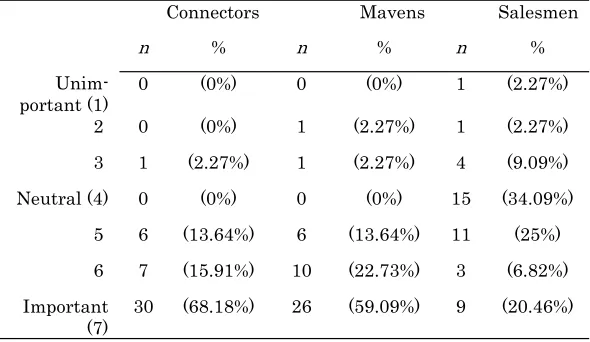
Respondents (n=44) were asked to rank the relative importance of connectors, mavens and salesmen to a PLN on a 7-point scale (with “7” being the highest and “1” being
the lowest) (see Table 1).
The most important roles, indicated by a rating of
“7,” were connectors (n=30, 68.18%) and mavens (n=26,
59.09%). When the ratings for “6” and “7” were added
to-gether, the results remained the same for connectors (n=37, 84.09%) and mavens (n=36, 81.82%). The affordanc-es of social media are attuned to the connector and maven role, namely, the capacity to communicate on a 1:many platform and to collate and curate information. Further, a response to Q.9 concerning the possibility of people assum-ing multiple roles offered that:
I think people can switch roles depending on how passionate they are about certain things they want
Table 1
Importance of Connectors, Mavens and Salesmen in a PLN (n=44)
Connectors Mavens Salesmen
n % n % n %
Unim-portant (1) 0 (0%) 0 (0%) 1 (2.27%)
2 0 (0%) 1 (2.27%) 1 (2.27%)
3 1 (2.27%) 1 (2.27%) 4 (9.09%)
Neutral (4) 0 (0%) 0 (0%) 15 (34.09%)
5 6 (13.64%) 6 (13.64%) 11 (25%)
6 7 (15.91%) 10 (22.73%) 3 (6.82%)
Important
to share. … the connector role comes with a lot of
trust and many, many, posts so the network trusts their input because they see their name around all
the time. Mavens are helpful for clarity …
neces-sary to stop people guessing.
This response provides an explanation as to why collectors and mavens are so valued and yet how they re-tain distinct identities in terms of both presentation and reputation (see Costa & Torres, 2011).
The response to the importance of salesmen was intriguing with a third (n=15, 34.09%) opting to choose
“neutral.” There was no parallel indecision for connectors or mavens, that is, no respondent chose “neutral.” Further,
only one fifth (n=9, 20.46%) believed that the role of
sales-man was “7” rising to over one quarter (n=12, 27.27%)
when the ratings for “6” and “7” are combined. This result,
combined with the previously cited descriptions of sales-men indicates an underlying mistrust or dislike of their behaviour in learning networks. By comparison, as noted, it would seem that the respondents in this survey clearly valued and trusted the contributions of connectors and mavens to their personal learning networks.
Identifying Additional Personas
Respondents were asked if they could identify per-sonas other than connectors, mavens, and salesmen in their PLN(s). Fifty-five (93.22%) responded and in most cases provided multiple options. For example, in a single comment, one respondent described five explicit roles:
a coach. Mentor - someone whose length and depth of service places them as provider of wisdom and encouragement. Creative - someone who has a flair for design and is consulted when pizzazz or pa-nache is needed. Tech early adopter - the PLN member who buys every edutech toy and gadget and tests them and provides reviews. Tech nerd - the one to go to when the hard drive fails.
(emphases added)
Others offered depth in their response and a syn-thesis of their observations with the roles considered in the survey, namely connectors, mavens and salesmen. One offered that:
• Followers are sometimes important if they occasionally comment on how the ideas of the mavens and connect-ors have actually helped them in pointing them to-wards people or ideas that they have found useful. Otherwise - the motivation behind being a maven or
connector might be lacking! … Mavens and connectors
see this as a higher calling and get the reciprocal bene-fit of being considered positive social capital!
• … I also think there is another critical role which could be called “seeker.” Many of us turn to our PLN when
are grappling with a new idea, facing a technical
chal-lenge. We seek the wisdom of the community. I’m also wondering about the “lurker” role. In some
communi-ties I may not contribute much, or even agree with the
contributors’ perspectives, but want to “keep my finger on the pulse.” The other role, which I hesitate to
per-suading towards one’s own viewpoint. Which can be
healthier than the debates created by salesman.
Others positioned roles in relationship to connect-ors, mavens and salesmen. For example:
• Supporters- may not contribute directly but their lik-ing & sharlik-ing affirms what the mavens, connectors, and salespeople are doing
• Yes, diplomats. These moderate the tensions that arise, particularly between Mavens and Salesmen.
• I think there is a role of happy participant. Someone who is keen to follow the people who are connectors, mavens and salesmen.
From this rich description, a number of personas,
were identified including the previously cited “mentor” and “translator” which have been reported with the
de-scription of mavens. A number of roles were identified that
could be characterised as White’s (2001) “core partici-pants” which she described as:
… a small group of people who quickly adapt to
online interaction and provide a large proportion of
an online group’s activity. Some speculate that 10%
of the membership make up 90% of the community activity. These individuals visit frequently and post often. They are important members. (para. 2)
Core participants, a persona which encompasses
used, such as: supporters (who give positive feedback);
con-scientious objectors; criticisers; cheerleaders; and “the choir.” Further, core participants were also categorised by expertise. One was “technical” who provided responses to
request for help on IT problems, while another, as
previ-ously noted, was “creative” described as “someone who has
a flair for design and is consulted when pizzazz or panache
is needed.” Anyone active or who contributes in online spaces could be deemed to be a ”core participant.” This role was seen as “vital” in a PLN and was evidenced in the
sharing of knowledge, ideas, strategies and lessons. One
survey respondent spoke of contributors as being “the hu-man face of the PLN. They show it belongs to everyone, not just a handful. They contribute helpful learning points, and comments, that are often a different perspective than frequent contributors may have grown used to.”
Another survey respondent identified the role of
“occasional” contributor as someone who “is learning how to use and interact in a PLN.” Where contributions were limited, the persona of the “responder” was suggested.
This described someone who only replies to people, com-ments or information but does not initiate discussion or pose questions. The remaining roles (presented in no par-ticular order) are: lurkers, challengers, facilitators, irri-tants, and leeches. They are distinctly different from
Gladwell’s (2000) connectors, mavens and salesmen.
Lurkers
• I think lurker is a valid role. I lurk often, more in some networks than others. I learn a great deal and only contribute when it seems like I have something to of-fer.
• Those who belong but do not contribute for whatever
reason. Even if something is shared without a prior query, there is the likelihood that it will enable the
learning of someone who is otherwise “invisible.”
• They watch and observe but don’t interact. They do
ab-sorb and refer where required.
• … learners or passive recipients. These are important
as people like to have an audience.
Interestingly, there were other personas suggested who could be classified as lurkers. For example, newbies
might also lurk “before they feel they are worthy to con-tribute.” One respondent suggested the persona of “reader”
explained as:
… this person is getting benefit from the PLN and
values it, but does not contribute. They are im-portant in the PLN as they may be spreading the word in other face-to-face ways and may crop up to help in unexpected places when called upon in a more direct way.
Further, there was a subset of lurkers referred to
as “‘The Lost’ who were active once upon a time but seem
to have disappeared... without deleting their profiles/
logins/identities.” These simply appear to lurk but are
gen-uinely absent.
What was surprising was the genuinely positive attitude to lurking with one response ending with the
ca-veat, “that’s okay, they’re learning.” The general
participation (Lave & Wenger, 1991). There was an unex-pected breadth and nuance in how the respondents to the survey described lurking. It could be contended that lurk-ing was a persona (and behaviour) that all had adopted at different times and therefore there was empathy toward it. The negative end of the continuum from the lurker was
the “leech” (described later in this section).
Challengers
These were variously described as: people who chal-lenge your thinking by responding in different ways or
helping to deepen your thinking; “stirrers” who take a
con-troversial position to create reaction (who are also
catego-rised as ‘irritants’); and “thought leaders” (also categocatego-rised as ‘salesmen’) who initiate debates. Challengers may add
their own experience or question certain suggestions and/ or resources, or play the role of asking questions that
oth-ers won’t ask because they are not sure whether the
ques-tions are silly or make sense. Irrespective of how they per-ceive themselves, challengers appear across categories and are perceived in distinctly different ways.
Facilitators
This persona was identified as important but was not discrete; it overlapped with other roles. It was noted that, in any learning situation, effective facilitation has a highly positive impact on learning. A facilitator is someone who keeps the conversation going, maintains cohesion and ensures that others are heard. It was noted that
were seen as people who are often, but not always, a group administrator or a discussion moderator. They were vari-ously described as: diplomat, negotiator, peacemaker, sup-porter, custodian, carer or nurturer. The importance of fa-cilitation was evident in comments such as:
• Without these attentive gardeners, the PLN will grad-ually decay in quality over time and be nothing but cat memes, Buzzfeed grammar quizzes, pointless questions and trolling responses before you know it.
• These people play an important “lubrication” role
ena-bling discussion to flow productively but with mutual respect.
• These people often help others find common ground or refocus on topics rather than personalities or politics.
• These people give the heart to PLNs by looking out for the wellbeing of individuals and groups, offering sup-port at times of need and by their behaviour reminding everyone in the PLN that the network is primarily a people space.
• These people take a long term role in maintaining the
“memory” of the network, especially its shared values
and culture as well as its more mundane operational side.
Interestingly, one respondent added facilitation to the role of connector (in response to Q.5) by offering that:
[they] help moderate a group or community, gather people around them, encourage people to connect, put people in touch with others who can help.
Irritants
Some were noted as being annoying and/or disruptive. These personas have, for the purpose of this paper, been
labelled as “irritants” in that they make others in the
net-work feel angry or annoyed or discourage participation. Various forms of behaviour were described as falling into this category:
• knockers (people who automatically trash an idea);
• negative mavens (people who seem to go out of their way to have an opinion different to yours but not in a constructive way).
• stirrers (people who take a controversial position just to create reaction);
• sycophants (people who automatically gush praise even if the idea is not praiseworthy);
• ‘groupies’ - they jump on the bandwagon of what the
‘salesman’ has to offer to give the message critical
mass.
• self promoters (people whose only posts are to promote their company or products);
• preachers (people who preach the same thing over and
over again);
• “icky” motivators (people who “post icky motivational
empowering messages that they have cut and pasted
from Hallmark cards”);
• takers (people who you never or rarely see or hear,
ex-cept as a name on a list of ‘members’ in a group, exex-cept
very occasionally when they ask a question).
• The Kardashians (in reference to an article describing teachers on social media who want you to know what an amazing teacher they are and frequently post about
what a difference they are making. (“Secret teacher,”
One reason why irritants arouse annoyance is
en-capsulated in the following response. The “user” persona is
used here in a pejorative sense.
• User - this person will ask questions - often to do with their university assignment, for instance - but makes no other contributions to help others, and frequently does not even say thank you for responses made. They are not helpful group members and do not affect learn-ing - in fact they may have a detrimental effect if not diluted by more useful discussion.
The nub of the irritation here is the lack of reciproc-ity (see McCabe, 2003; Pelaprat & Brown, 2012) that is the hallmark of the behaviours of connectors and mavens, which are so evidently valued in a personal learning net-work (see Table 1). This response goes on to articulate the
“detrimental effect” that this kind of behaviour (similar to the “takers” and “responders”) can have on a network.
Leeches
The final persona in this list, viewed the most
nega-tively of all, was given the label “leech” by respondents to
the survey. A leech was variously described as someone
who: takes without contributing; “just leeches”
infor-mation/resources; views and uses the information but nev-er shares; watches and takes and contributes nothing but actively uses information from the site with or without
cit-ing the source; and who “sucks the goodness out of every-thing, uses it for their own good, and doesn’t acknowledge where they got it from.” Leeches were described with
empathetically, to orientation and learning. They were
al-so distanced from “users” who, while broadly fitting in this
category, were spared the vitriol reserved for leeches. In sum, there was an extraordinary range of per-sonas described in vivid language. While these were
dis-crete, there are instances of overlaps with Gladwell’s
(2000) list of connectors, mavens and salesmen. The de-scriptions offered by the survey respondents were personal and tended to describe nuanced personalities and inten-tions rather than generic behaviours.
Conclusion
The first research question of this study was to
ex-plore the roles of “connectors,” “mavens” and
“salesmen” (Gladwell, 2000) in the personal learning
net-works of educators. From a purposive sample of educators (n=59), the study concludes that these three roles remain current but have taken on uniquely digital characteristics. While there was some suspicion of salesmen, the roles of connectors and mavens were valued within personal learn-ing networks. The distinction between the roles was clear-ly articulated although the distance between maven and connector was reducing in discernible ways and it ap-peared that these two roles were often combined. Interest-ingly, the participants in this study noted that individuals could assume multiple personas (Terry & Hogg, 2012) with one respondent admitting to selecting examples of
connect-or, maven and salesman behaviour from one individual’s
mul-tiple roles depending on circumstance and context
epito-mised in the cited response, “Yes. Me. All.”
The second research question sought to identify any additional roles observed or encountered in online spaces. The intention was to generate a list based on reported per-sonal experience. The identified personas added to our un-derstanding of connectors, mavens and salesman. Those outside of these roles were categorised as: lurkers, core participants, challengers, facilitators, irritants and leech-es. The descriptions provided were often self-explanatory and provided a rich array of who we might become when we learn online with others. Of particular interest were the subsets of personas which indicated a genuine idiosyn-cracy in how people represent themselves and they are, in turn, viewed by others.
Finally, this study brought home how personally engaged participants in personal learning networks are. They were as concerned with their fellow participants as they were with the topics under discussion. It also gave us cause to see contemporary social media platforms as being transparent – personas can be discerned behind the words, or, perhaps, are embodied in the words. People online are as varied and reactive as they are in the real world. The study has shown some significant additions to who does the work in an online network (after Gladwell, 2000) and how rich are the roles that they adopt.
References
Corbin, J., & Strauss, A. (2008). The basics of qualitative re-search (3rd ed.) Los Angeles, CA: Sage.
im-portance of digital identity in the networked society. Re-vista Educação, Formação & Tecnologias, n.º extra, 47‐
53. Retrieved from http://eft.educom.pt/index.php/eft/ article/view/216/126
Cover, R. (2012). Performing and undoing identity online: Social networking, identity theories and the incompatibility of online profiles and friendship regimes. Convergence: The International Journal of Research into New Media Tech-nologies, 18(2) 177-193. doi: 10.1177/1354856511433684 Dabbagh, N., & Kitsantas, A. (2012). Personal Learning
Envi-ronments, social media, and self-regulated learning: A natural formula for connecting formal and informal learning. Internet and Higher Education, 15, 3–8. Dillman, D. A. (2007). Mail and internet surveys: The tailored
design method. Hoboken, NJ: Wiley.
Edelmann, N. (2013). Reviewing the definitions of “lurkers” and
some implications for online research. Cyberpsychology, Behavior, and Social Networking, 16(9), 645-649. Gee, J. P. (2000). Identity as an analytic lens for research in
ed-ucation. Review of Research in Education, 25, 99–125. Giraldi, N. A. (2016). The strength of weak social ties: Social
ac-tivism and Facebook. Sociology & Criminal Justice The-ses & Dissertations (Paper 3). Retrieved from http:// digitalcommons.odu.edu/cgi/viewcontent.cgi?
article=1002&context=sociology_criminaljustice_etds Gladwell, M. (2000). The tipping point: How little things can
make a big difference (1st ed.). Boston, MA: Little, Brown.
Gmidene, A., & Gharbi, J-E. (2015). The process of identity building in Second Life. Journal of Internet Social Net-working & Virtual Communities, 2015, Article ID 828614. doi: 10.5171/2015.828614
Henderson, M. (2015). Using social media: Assumptions, chal-lenges and risks. In M. Henderson & G. Romeo (Eds.),
questions (pp. 115-126). Melbourne, Australia: Cam-bridge University Press.
Illich, I. D. (1971). Deschooling society. London: Calder and Bo-yars.
Johnston, J. (2012). Using identity as a tool for investigation: A
methodological option in the researcher’s toolbox. Inter-national Journal of Arts & Sciences, 5(5), 1-9.
Lave, J., & Wenger, E. (1991). Situated learning: Legitimate pe-ripheral participation. Cambridge, UK: Cambridge Uni-versity Press.
McCabe, K. A. (2003). A cognitive theory of reciprocal exchange. In E. Ostrom & J. Walker (Eds.), Trust and reciprocity: Interdisciplinary lessons for experimental research (pp. 147-169). New York: Russell Sage Foundation.
Murphy, J., Hill, C. A., & Dean, E. (2014). Social media, sociality and survey research. In C. A. Hill, E. Dean, & J. Murphy (Eds.), Social media, sociality and survey research (pp. 1-33). New York: John Wiley & Sons.
Ochman, B. L. (2013, January 7). There are 181,000 social me-dia gurus, ninjas, masters and mavens on Twitter. Ad-vertising Age. Retrieved from http://adage.com/article/ digitalnext/181-000-social-media-gurus-ninjas-masters-mavens-twitter/239026
Pelaprat, E., & Brown, B. (2012). Reciprocity: Understanding online social relations. Retrieved from http://
firstmonday.org/ojs/index.php/fm/article/view/3324/3330 Secret teacher: I refuse to be a Kardashian with a PGCE.(2016,
January 30). The Guardian. Retrieved from http:// www.theguardian.com/teacher-network/2016/jan/30/ secret-teacher-refuse-kardashian-with-a-pgce-social-media-toxic
Siemens, G. (2004). Connectivism: A learning theory for the digi-tal age. Retrieved from http://www.elearnspace.org/ Articles/connectivism.htm
for professional learning. Unpublished doctoral thesis, Queensland University of Technology, Australia. Re-trieved from http://eprints.qut.edu.au/65854
Terry, D., & Hogg, M.A. (2012). Social identity processes in or-ganizational contexts. New York: Taylor & Francis. Welser, H. T., Gleave, E., Fisher, D., & Smith, M. (2007).
Visual-izing the signatures of social roles in online discussion groups. Journal of Social Structure, 8(2), 1-32.
White, N. (2001). Community member roles and types. Retrieved from http://www.fullcirc.com/community/