What do Exporters Know?
∗
Michael J. Dickstein
New York University and NBER
Eduardo Morales
Princeton University and NBER
May 5, 2018
Abstract
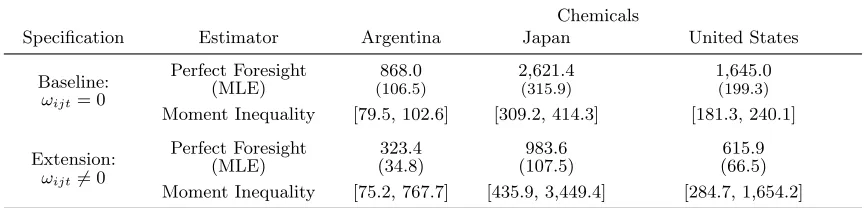
Much of the variation in international trade volume is driven by firms’ extensive margin
deci-sions of whether to participate in export markets. We evaluate how the information potential
exporters possess influences their decisions. To do so, we estimate a model of export
partic-ipation in which firms weigh the fixed costs of exporting against the forecasted profits from
serving a foreign market. We adopt a moment inequality approach, placing weak assumptions
on firms’ expectations. The framework allows us to test whether firms differ in the
informa-tion they have about foreign markets. We find that larger firms possess better knowledge of
market conditions in foreign countries, even when those firms have not exported in the past.
Quantifying the value of information, we show that, in a typical destination, total exports rise
while the number of exporters falls when firms have access to better information to forecast
export revenues.
Keywords: export participation, demand under uncertainty, discrete choice methods,
mo-ment inequalities
∗
1
Introduction
In 2014, approximately 300,000 US firms chose to export to foreign markets (Department of
Commerce, 2016). The decision of these firms to sell abroad drives much of the variation in
trade volume from the US (Bernard et al., 2010). Thus, to predict how exports may change
with lower trade costs, exchange rate movements, or other policy or market fluctuations,
researchers need to understand firms’ decisions of whether to participate in export markets.
A large literature in international trade focuses on modeling firms’ export decisions.
1Empirical analyses of these decisions, however, face a data obstacle: the decision to export
depends on a firm’s expectation of the profits it will earn when serving a foreign market,
which the researcher rarely observes. Absent direct data on firms’ expectations, researchers
must impose assumptions on how firms form these expectations. For example, researchers
commonly assume firms’ expectations are rational and depend on a set of variables observed
in the data. The precise specification of agents’ information, however, can influence the overall
measurement, as Manski (1993, 2004), and Cunha and Heckman (2007) show in the context
of evaluating the returns to schooling. In an export setting, the assumptions on expectations
may affect both the estimates of the costs firms incur when exporting and predictions of how
firms will respond to counterfactual changes in these trade costs.
In this paper, we first document that estimates of the parameters underlying firms’ export
decisions depend heavily on how researchers specify the firm’s expectations. We compare the
predictions of a standard model in the international trade literature (Melitz, 2003) under two
specifications: the “perfect foresight” case, under which we assume firms perfectly predict
observed profits from exporting, and a minimal information case, under which we assume
firms use a specific set of observed variables to predict their export profits. For each case, we
recover the fixed costs of exporting and the mean profits of firms predicted to export. Finding
important differences in the predictions from the two models, we then estimate an empirical
model of export participation that places fewer restrictions on firms’ expectations.
Under our alternative approach, we do not require the researcher to have full knowledge
of an exporter’s information set. Instead, the researcher need only specify a subset of the
variables that agents use to form their expectations. The researcher must observe this subset,
but need not observe any remaining variables that affect the firm’s expectations. The set of
unobserved variables may vary flexibly across firms, markets, and years.
The trade-off from specifying only a subset of the firm’s information is that we can only
partially identify the parameters of interest. To do so, we develop a new type of moment
inequality, the odds-based inequality, and combine it with inequalities based on revealed
pref-erence. Using these inequalities, we show that placing fewer assumptions on expectations
1
affects the measurement of the parameters of the exporter’s problem. Further, we show our
approach generates bounds on these parameters that are tight enough to be informative.
This paper makes four main contributions. First, we demonstrate the sensitivity of the
estimated export fixed costs to assumptions the researcher imposes on firms’ export profit
forecasts. Second, we employ moment inequalities to partially identify the exporter’s fixed
costs under weak assumptions, applying insights from Pakes (2010) and Pakes et al. (2015).
Third, we address the question of “what do exporters know?”. We show that, under rational
expectations, our moment inequality framework allows us to test whether potential exporters
know and use specific variables to predict their export profits. Finally, fourth, we use our
model’s estimates to quantify the value of information.
To illustrate the sensitivity of export fixed estimates to the researcher’s assumptions on
exporters’ information, we start by estimating a perfect foresight model under which firms
perfectly predict the profits they will earn upon entry. Using maximum likelihood, we find
fixed costs in the chemicals sector from Chile to Argentina, Japan, and the United States to
equal $868,000, $2.6 million, and $1.6 million, respectively. We compare these estimates to
an alternative approach, suggested in Manski (1991) and Ahn and Manski (1993), in which
we assume that firms’ expectations are rational and we specify the variables firms use to form
their expectations. Specifically, we assume that firms know only three variables: distance to
the export market, aggregate exports from Chile to that market in the prior year, and their
own domestic sales in the prior year. We estimate fixed costs of exporting under this approach
that are 40-60% smaller than those found under the perfect foresight assumption.
That the fixed cost estimates differ under the two approaches reflects a bias in the
estima-tion. Both require the researcher to specify the content of the agent’s information set. If firms
actually employ a different set of variables–containing more information or less– to predict
their potential export profits, the estimates of the model parameters will generally be biased.
Specifically, if the researcher wrongly assumes that firms have perfect foresight, the bias arises
for a similar reason to the bias affecting Ordinary Least Squares estimates in linear models
when a covariate contains classical measurement error; we show that, in our setting, this bias
leads the researcher to overestimate fixed export costs. Thus, we move to employ moment
inequalities to partially identify the exporter’s fixed costs under weaker assumptions.
Here, we again assume that firms know the distance to the export market, the aggregate
exports to that market in the prior year, and their own domestic sales from the prior year.
However, unlike the minimal information approach described earlier, the inequalities we define
do not restrict firms to use only these three variables when forecasting their potential export
profits. We require only that firms know at least these variables. Using our inequalities, we
find much lower fixed costs, representing only 10-15% of the perfect foresight values.
Comparing these findings to those in the existing literature is not simple. Our baseline
2010), adjustment costs (Ruhl and Willis, 2017), persistent unobserved heterogeneity (Roberts
and Tybout, 1997; Das et al., 2007), and buyer-seller relationships (Eaton et al., 2016; Bernard
et al., 2017). In extensions to our baseline model, we account for path dependence in export
status, as in Das et al. (2007), and allow firms to decide which markets to enter in reaction to
unobserved (to the researcher) firm-country specific revenue shocks, as in Eaton et al. (2011).
We next employ our framework to investigate the set of information potential exporters
use to forecast export revenues. We run alternative versions of our moment inequality model,
holding fixed the model and data but varying the firm’s presumed information set. Using the
specification tests described in Bugni et al. (2015), we look for evidence against the null that
potential exporters use particular variables in their forecasts.
We begin by testing our baseline assumption that exporters know
at least
distance, their
own lagged domestic sales, and lagged aggregate exports when making their export decisions.
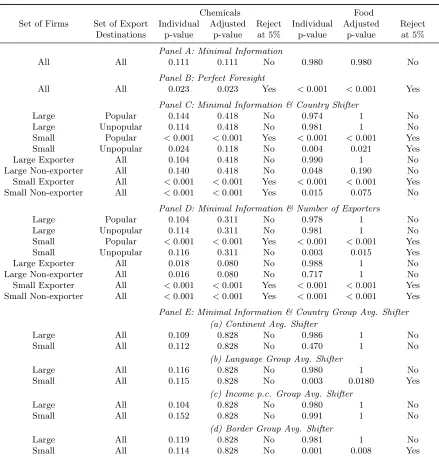
Using data from both the chemicals and food sectors, we cannot reject this null hypothesis.
We then test (a) whether firms have perfect foresight about their potential export profits
in every country, and (b) whether firms have information on last period’s realizations of a
destination-time period specific shifter of firms’ export revenues that, according to our model,
is a sufficient statistic for the effect of all foreign market characteristics (i.e. market size,
price index, trade costs and demand shifters) on these revenues. In both sectors, we reject
the null that firms have perfect foresight. For the market-specific revenue shifters, we find
interesting heterogeneity: we fail to reject that large firms know these shocks, but reject that
small firms do. This distinction is not driven by prior export experience. That is, even when
we focus only on large firms that did not to export in the previous year, we nonetheless fail to
reject the null that these firms use knowledge of past revenue shifters when forecasting their
potential export revenue. Large firms therefore have not only a productivity advantage over
small firms, but also an informational advantage in foreign markets.
Finally, we use our model’s estimates to quantify the value of information. Using our
estimated bounds on fixed export costs, we compute counterfactual entry decisions,
firm-level profits, and aggregate exports to each destination and in each year under different firm
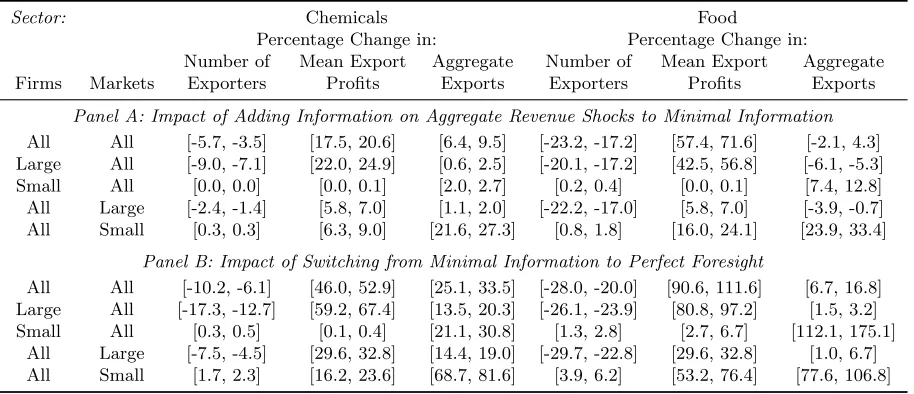
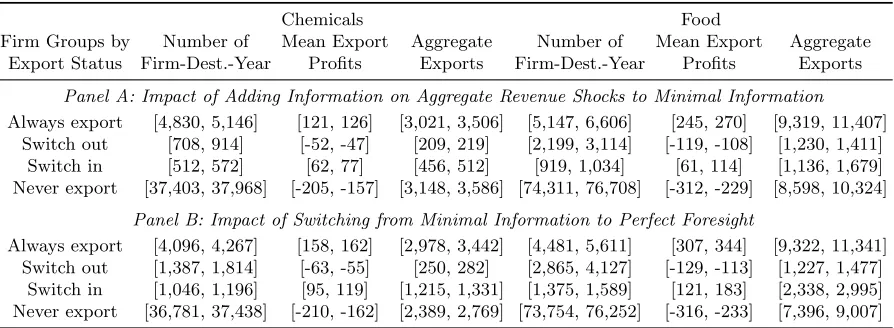
information sets. We find that, as we provide information to potential exporters, these firms
choose to export to fewer markets: in the chemicals sector, the expected number of
firm-destination pairs with positive export flows
decreases
between 3.5% and 5.7%. Interestingly,
although the total number of firm-destination pairs decreases, the overall (aggregated across
firms and destinations) export revenue in the sector
increases
between 6.4% and 9.5%. Were
all firms able to access information on past export revenue shifters, fewer firms would make
mistakes when choosing export markets and, consequently, the average firm’s ex post profits in
a typical market would increase between 17.5% and 20.6%. In comparison, with information
to predict export revenues perfectly, the average firm’s ex post profits in a typical market
We demonstrate our contributions using the exporter’s problem. However, our estimation
approach can apply more broadly to discrete choice decisions that depend on agents’ forecasts
of key payoff-relevant variables. For example, to determine whether to invest in R&D projects,
firms must form expectations about the success of the research activity (Aw et al., 2011;
Doraszleski and Jaumandreu, 2013; Bilir and Morales, 2016). When a firm develops a new
product, it must form expectations of its future demand (Bernard et al., 2010; Bilbiie et al.,
2012; Arkolakis et al., 2015). Firms deciding whether to enter health insurance markets must
form expectations about the type of health risks that will enroll in their plans (Dickstein et al.,
2015). Firms paying fixed costs to import from foreign markets must form expectations about
the sourcing potential of these markets (Blaum et al., 2017; Antr`
as et al., 2017). Finally, in
education, the decision to attend college crucially depends on potential students’ expectations
about earnings with and without a college education (Freeman, 1971; Willis and Rosen, 1979;
Manski and Wise, 1983). In these settings, even without direct elicitation of agents’ preferences
(Manski, 2004), our approach allows the researcher both to test whether certain covariates
belong to the agent’s information set and to recover bounds on the economic primitives of the
agent’s problem without imposing strong assumptions on her expectations.
Our estimation approach contributes to a growing empirical literature that employs
mo-ment inequalities derived from revealed preference argumo-ments, including Ho (2009), Holmes
(2011), Crawford and Yurukoglu (2012), Ho and Pakes (2014), Eizenberg (2014), Morales et
al. (2017), Wollman (2017), and Maini and Pammolli (2017). We follow a methodology closest
to Morales et al. (2017), but add two features. First, we introduce inequalities in a setting
with structural errors that are specific to each observation. The cost of allowing this flexibility
is that we must assume a distribution for these structural errors, up to a scale parameter. We
also cannot handle large choice sets, such as those considered in Morales et al. (2017). Second,
we combine the revealed preference inequalities employed in the prior literature with our new
odds-based inequalities, to gain identification power.
We proceed in this paper by first describing our model of firm exports in Section 2. We
describe our data in Section 3. In sections 4 and 5, we discuss three alternative estimation
approaches and compare the resulting parameter estimates. In sections 6 and 7, we use our
moment inequalities both to test alternative information sets and to conduct counterfactuals
on the value of information. In Section 8, we discuss extensions of our baseline model. Section
9 concludes. All appendix sections referenced below appear in an Online Appendix.
2
Empirical Model
We model firms’ export decisions. All firms located in a country
h
choose whether to sell in
each export market
j
. We index the firms located in
h
and active at period
t
by
i
= 1
, . . . , N
t.
2We index the potential destination countries by
j
= 1
, . . . , J
.
We model firms’ export decisions using a two-period model. In the first period, firms
choose the set of countries to which they wish to export. To participate in a market, firms
must pay a fixed export cost.
3When choosing among export destinations, firms may differ in
their degree of uncertainty about the profits they will obtain upon exporting. In the second
period, conditional on entering a foreign market, all firms acquire the information needed to
set their prices optimally and obtain the corresponding export profits.
2.1
Demand, Supply, Market Structure, and Information
Firms face isoelastic demand in every country:
x
ijt=
ζ
ijt1−ηp
−η ijt
P
η−1
jt
Y
jt. Here, the quantity
demanded
x
ijtdepends on:
p
ijt, the price firm
i
sets in destination
j
at
t
;
Y
jt, the total
expenditure in the sector in which
i
operates;
P
jt, a price index that captures the competition
firm
i
faces in market
j
from other firms selling in the market; and,
ζ
ijt, a demand shifter.
Firm
i
produces one unit of output with a constant marginal cost
c
it.
4When firm
i
chooses
to sell in a market
j
, it must pay two export costs: a variable cost,
τ
ijt, and a fixed cost,
f
ijt.
We adopt the “iceberg” specification of variable export costs and assume that firm
i
must ship
τ
ijtunits of output to country
j
for one unit to arrive. The total marginal cost for firm
i
of
selling one unit in country
j
at period
t
is thus
τ
ijtc
it. Fixed costs
f
ijtare paid by firms selling
a positive amount in market
j
at period
t
, independently of the actual quantity exported.
We denote the firm’s potential sales revenue in market
j
and period
t
as
r
ijt≡
x
ijtp
ijt,
and use
J
ijtto denote the information firm
i
possesses about its potential revenue
r
ijtwhen
deciding whether to participate in market
j
at
t
. We assume firm
i
knows the determinants
of fixed costs
f
ijtfor every country
j
when deciding whether to export. Therefore, if relevant
to predict
r
ijt, these determinants of fixed costs will also enter
J
ijt.
2.2
Export Revenue
Upon entering a market, a firm observes both
η
and its marginal cost of selling in this market,
and sets its price optimally taking other sellers’ prices as given:
p
ijt= (
η/
(
η
−
1))
τ
ijtc
it. Thus,
the revenue firm
i
would obtain if it were to sell in market
j
at period
t
is:
r
ijt=
η
η
−
1
τ
ijtc
itζ
ijtP
jt 1−ηY
jt.
(1)
We can write an analogous expression for the sales revenue in the domestic market
h
. As we
3
In Section 8.1, we consider a fully dynamic export model in which forward-looking firms must also pay a sunk export entry cost as in Das et al. (2007).
4
show in Appendix A.1, taking the ratio of export revenue to domestic revenue for each firm
in year
t
, we can rewrite potential export revenues in a destination market
j
as
r
ijt=
α
ijtr
iht,
with
α
ijt≡
ζ
ihtτ
ijtζ
ijtτ
ihtP
htP
jt 1−ηY
jtY
ht.
Here,
α
ijtis a firm-destination-year specific shifter of export revenues that accounts for the
destination’s market size, price index, and the effect of variable trade costs and demand shocks
across firms. We can further split this shifter into a component common to firms in a given
market and year, and a component that varies across firms:
r
ijt=
α
jtr
iht+
e
ijt,
where
α
jt≡
E
jtζ
ihtτ
ijtζ
ijtτ
ihtP
htP
jt 1−ηY
jtY
ht,
(2)
where
E
jt[
·
] denotes the mean across firms in a given country-year pair
jt
. The term
e
ijtaccounts for firm-market-year specific relative revenue shocks. We assume firms do not know
these shocks when deciding whether to export to market
j
at period
t
:
5E
jt[
e
ijt|J
ijt, r
iht, f
ijt] = 0
.
(3)
Conversely, we do not restrict the relationship between the information set
J
ijtand the
com-ponent of revenue
α
jtr
iht. Thus, for example, more productive firms may be systematically
better informed than less productive firms about variables affecting their future domestic sales,
r
iht, or about the country-year export shifters accounted for by the term
α
jt. Similarly, we
allow firms to have more information about markets that are closer to the domestic market.
2.3
Export Profits
We model the export profits that
i
would obtain in
j
if it were to export at
t
as
π
ijt=
η
−1r
ijt−
f
ijt.
(4)
We model fixed export costs as
f
ijt=
β
0+
β
1dist
j+
ν
ijt,
(5)
where
dist
jdenotes the distance from country
h
to country
j
, and the term
ν
ijtrepresents
determinants of
f
ijtthat the researcher does not observe. As discussed in Section 2.1, we
5Appendix A.2 describes a set of assumptions on the distribution of demand shiftersζ
ijt and variable costs
τijt under which the mean independence condition in equation (3) holds. Furthermore, we extend the model
assume that firms know
f
ijtwhen deciding whether to export to
j
at
t
.
6The estimation procedure introduced in Section 4.2 requires
ν
ijtto be distributed
inde-pendently of
J
ijt, and its distribution to be known up to a scale parameter. To match one
typical binary choice model, we assume
ν
ijtfollows a normal distribution and is independent
of other export determinants:
7ν
ijt|
(
J
ijt, dist
j)
∼
N
(0
, σ
2)
.
(6)
The assumed independence between
ν
ijtand
J
ijtimplies that knowledge of
ν
ijtis irrelevant
to compute the firm’s expected export revenue. However, we impose no assumption on the
relationship between
J
ijtand the observed determinants of fixed export costs, here
dist
j.
2.4
Decision to Export
A risk-neutral firm
i
will decide to export to
j
in year
t
if and only if
E
[
π
ijt|J
ijt, dist
j, ν
ijt]
≥
0,
where the vector (
J
ijt, dist
j, ν
ijt) includes any variables firm
i
uses to predict potential export
profits in country
j
. Combining equations (4) and (5), we can write
E
[
π
ijt|J
ijt, dist
j, ν
ijt] =
η
−1E
[
r
ijt|J
ijt]
−
β
0−
β
1dist
j−
ν
ijt.
(7)
Here,
E
[
r
ijt|J
ijt, dist
j, ν
ijt] =
E
[
r
ijt|J
ijt], following our definition of
J
ijtas the set of variables
firm
i
uses to predict
r
ijt. Given the expression for
r
ijtin equations (2) and (3), we write:
E
[
π
ijt|J
ijt, dist
j, ν
ijt] =
η
−1E
[
α
jtr
iht|J
ijt]
−
β
0−
β
1dist
j−
ν
ijt.
(8)
Let
d
ijt=
1
{
E
[
π
ijt|J
ijt, dist
j, ν
ijt]
≥
0
}
, where
1
{·}
denotes the indicator function. From
equation (8), we can write:
d
ijt=
1
{
η
−1E
[
α
jtr
iht|J
ijt]
−
β
0−
β
1dist
j−
ν
ijt≥
0
}
,
(9)
and, given equations (6) and (9), we can write the probability that
i
exports to
j
at
t
condi-tional on
J
ijtand
dist
j:
P
(
d
ijt= 1
|J
ijt, dist
j) =
Z
ν
1
{
η
−1E
[
α
jtr
iht|J
ijt]
−
β
0−
β
1dist
j−
ν
≥
0
}
(1
/σ
)
φ
(
ν/σ
)
dν
6
At a computational cost, we can allow fixed export costs to depend on additional variables the firm knows when deciding whether to export to a market, such as shared language (Morales et al., 2017) and the quality of institutions (Antr`as et al., 2017). In Appendix B.3, we generalize the specification in equation (5) and present estimates for a model in which we assumefijt=βj+νijt, whereβjvaries freely across countries. In Appendix
A.11, we discuss an extension in which firms face unexpected shocks to fixed costs.
7The assumption that ν
ijt is distributed normally is a sufficient but not a necessary condition to derive
our moment inequalities. We provide the precise requirements for the distribution ofνijt when we derive the
= Φ
σ
−1η
−1E
[
α
jtr
iht|J
ijt]
−
β
0−
β
1dist
j,
(10)
where
φ
(
·
) and Φ(
·
) are, respectively, the standard normal probability density function and
cumulative distribution function.
8Equation (10) indicates that, after integrating over the
unobserved heterogeneity in fixed costs,
ν
ijt, we can write the probability that firm
i
exports
to country
j
at period
t
as a probit model whose index depends on firm
i
’s expectation of the
revenue it will earn in
j
at
t
upon entry. The key hurdle in estimation, which we discuss in
Section 4, is that researchers rarely observe these expectations.
From equation (10), even if the researcher were to observe firms’ actual expectations, data
on export choices alone would not allow us to identify the scale of the remaining parameter
vector (
σ, η, β
0, β
1). To normalize for scale in export models, researchers typically use
addi-tional data to estimate the demand elasticity
η
(Das et al., 2007). In our estimation, we set
η
= 5.
9For simplicity of notation, we use
θ
≡
(
θ
0, θ
1, θ
2) to denote the remaining parameter
vector and
θ
∗≡
(
β
0, β
1, σ
) to denote its true value, as determined by equation (10).
3
Data
Our data come from two separate sources. The first is an extract of the Chilean customs
database, which covers the universe of exports of Chilean firms from 1995 to 2005. The second
is the Chilean Annual Industrial Survey (
Encuesta Nacional Industrial Anual
, or ENIA), which
surveys all manufacturing plants with at least 10 workers. We merge these two datasets using
firm identifiers, allowing us to observe both the export and domestic activity of each firm.
10The firms in our dataset operate in one of two sectors: the manufacture of chemicals
and the food products sector.
11For each sector, we estimate our model restricting the set of
countries to those served by at least five Chilean firms in all years of our data. This restriction
leaves 22 countries in the chemicals sector and 34 countries in the food sector.
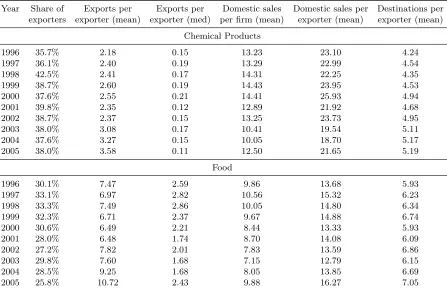
We observe 266 unique firms across all years in the chemicals sector; on average, 38% of
these firms participate in at least one export market in a given year. In Table 1, we report
8
If knowledge ofdistj helps predictrijt, thendistj∈ Jijt andP(dijt= 1|Jijt, distj) =P(dijt= 1|Jijt). 9This value is within the range of values in the literature (Simonovska and Waugh, 2014; Head and Mayer,
2014). Given our model, one can estimateη using data on firms’ total sales and variable costs (Das et al., 2007; Antr`as et al., 2017). We do not implement this estimation approach given limitations in our measure of variable costs. When presenting our estimates, we indicate which conclusions are sensitive toη.
10
We aggregate the information from ENIA across plants to obtain firm-level information to match to the customs data. ENIA sometimes identifies firms as exporters when we do not observe exports in the customs data; in these cases, we follow the customs database and treat these firms as non-exporters. We lose a number of small firms in the merging process because, as indicated in the main text, ENIA only covers plants with more than 10 workers. The remaining firms account for roughly 80% of total export flows.
11
the mean firm-level exports in this sector, which are $2.18 million in 1996 and grow to $3.58
million in 2005, with a dip in 2001 and 2002.
12The median level of exports is much lower, at
around $150,000. In the food sector, we observe 372 unique firms, 30% of which export in a
typical year. The mean exporter in this sector sells $7.7 million, while the median exporter
sells approximately $2.24 million abroad. In the chemicals sector, the average exporter serves
4-5 countries. Firms in the food sector typically export to 6-7 markets on average.
Table 1: Summary Statistics
Year Share of Exports per Exports per Domestic sales Domestic sales per Destinations per exporters exporter (mean) exporter (med) per firm (mean) exporter (mean) exporter (mean)
Chemical Products
1996 35.7% 2.18 0.15 13.23 23.10 4.24
1997 36.1% 2.40 0.19 13.29 22.99 4.54
1998 42.5% 2.41 0.17 14.31 22.25 4.35
1999 38.7% 2.60 0.19 14.43 23.95 4.53
2000 37.6% 2.55 0.21 14.41 25.93 4.94
2001 39.8% 2.35 0.12 12.89 21.92 4.68
2002 38.7% 2.37 0.15 13.25 23.73 4.95
2003 38.0% 3.08 0.17 10.41 19.54 5.11
2004 37.6% 3.27 0.15 10.05 18.70 5.17
2005 38.0% 3.58 0.11 12.50 21.65 5.19
Food
1996 30.1% 7.47 2.59 9.86 13.68 5.93
1997 33.1% 6.97 2.82 10.56 15.32 6.23
1998 33.3% 7.49 2.86 10.05 14.80 6.34
1999 32.3% 6.71 2.37 9.67 14.88 6.74
2000 30.6% 6.49 2.21 8.44 13.33 5.93
2001 28.0% 6.48 1.74 8.70 14.08 6.09
2002 27.2% 7.82 2.01 7.83 13.59 6.86
2003 29.8% 7.60 1.68 7.15 12.79 6.15
2004 28.5% 9.25 1.68 8.05 13.85 6.69
2005 25.8% 10.72 2.43 9.88 16.27 7.05
Notes: All variables (except “share of exporters”) are reported in millions of year 2000 US dollars.
Our data set includes both exporters and non-exporters. Furthermore, we use an
unbal-anced panel that includes not only those firms that appear in ENIA in every year between
1995 and 2005 but also those that were created or disappeared during this period. Finally, we
obtain information on the distance from Chile to each destination market from CEPII.
134
Empirical Approach
In the model we describe in Section 2,
r
ijt, firm
i
’s potential export revenue to market
j
at
t
, is a function of its own marginal costs and demand shifter, and of country
j
’s market size
12
The revenue values we report are in year 2000 US dollars.
13
and price index. In Section 2.2, we split these determinants into two terms:
α
jtr
ihtand
e
ijt,
where the latter reflects idiosyncratic shifters of firm
i
’s demand and variable trade costs in
j
. Crucially, while the data described in Section 3 allow us to compute a consistent estimate
of
α
jtr
ihtfor every firm, market and year (see Appendix A.3),
e
ijtis not observed for all
firm-market-year triplets. We thus henceforth refer to the first term as the
observable
determinant
of export revenue and label it
r
oijt=
α
jtr
iht. We label
e
ijtas the
unobservable
determinant.
14Our model implies that
E
[
e
ijt|J
ijt] = 0 and, thus,
E
[
r
ijt|J
ijt] =
E
[
r
ijto|J
ijt]. The model
does not restrict the relationship between
J
ijtand
r
oijt. However, identifying the parameter
vector
θ
underlying the fixed export costs
f
ijtrequires additional assumptions (Manski, 1993).
First, we consider a perfect foresight model. With this model, researchers assume an
infor-mation set
J
aijt
for potential exporters such that
E
[
r
oijt|J
ijta] =
r
oijt. That is, firms are assumed
to have ex ante (before deciding whether to enter a foreign market) the same information that
the researcher has ex post (when data becomes available). Thus, firms predict
r
ijtoperfectly.
15Second, we consider a model in which we allow firms to face uncertainty when predicting
r
ijto—for example, they may lack perfect knowledge of the size of the market or the degree of
competition they will face. In this model, potential exporters forecast their export revenues
in every foreign market using information on three variables: (1) their own domestic sales
in the previous year,
r
iht−1; (2) sectoral aggregate exports to destination
j
in the previous
year,
R
jt−1; and (3) distance from the home country to
j
,
dist
j. That is, we assume that
the actual information set
J
ijtis identical to a vector of covariates
J
aijt
observed in our data:
J
aijt
= (
r
iht−1, R
jt−1, dist
j). In practice, firms can easily access these three variables in any
year. However, this information set is likely to be strictly smaller than the actual information
set firms possess when deciding whether to export.
16Furthermore, specifying
J
ijtas in this
second model implies that all firms base their entry decision on the same set of covariates. It
does not permit firms to differ in the information they use.
Third, we discuss how to identify the model parameters imposing weaker assumptions on
the information firms use to predict
r
oijt. We propose a moment inequality estimator that can
handle settings in which the econometrician observes only a
subset
of the elements contained
in firms’ true information sets. That is, we assume that the researcher observes a vector
Z
ijtsuch that
Z
ijt⊆ J
ijt. The researcher need not observe the remaining elements in
J
ijt. Those
unobserved elements of firms’ information sets can vary flexibly by firm and by export market.
14
As an alternative micro-foundation for this structure, one can rule out firm-specific shifters of demand and variable trade costs, and instead assumeeijt reflects error in the researcher’s observation ofroijt.
15
Although we denote this case as “perfect foresight”, perfectly predicting export revenues only refers to the observable component,ro
ijt. Firms’ information sets are still orthogonal to the unobserved componenteijt. 16
When we indicate that information setJa
ijt is smaller than information setJijt, we formally mean that
the distribution ofJa
4.1
Perfect Knowledge of Exporters’ Information Sets
Under the assumption that the econometrician’s specified information set,
J
aijt
, equals the
firm’s true information set,
J
ijt,
E
[
r
ijto|J
ijta] =
E
[
r
oijt|J
ijt] and one can estimate
θ
∗as the
value of the unknown parameter
θ
that maximizes the log-likelihood function
L
(
θ
|
d,
J
a, dist
) =
X
i,j,t
d
ijtln(
P
(
d
jt= 1
|J
ijta, dist
j;
θ
)) + (1
−
d
ijt) ln(
P
(
d
jt= 0
|J
ijta, dist
j;
θ
))
,
(11)
where the vector (
d,
J
a, dist
) includes all values of the corresponding covariates for every firm,
country and year in the sample, and, according to equation (10) and the definition of
r
oijt,
P
(
d
jt= 1
|J
ijta, dist
j;
θ
) = Φ
θ
2−1η
−1E
[
r
oijt
|J
ijta]
−
θ
0−
θ
1dist
j.
(12)
To use equations (11) and (12) to estimate
θ
∗, one first needs to compute
E
[
r
oijt|J
aijt
]. When
the researcher assumes perfect foresight,
E
[
r
ijto|J
aijt
] =
r
ijto. When the researcher assumes
J
ijtais equal to a set of observed covariates, one can consistently estimate
E
[
r
oijt
|J
ijta] as the
non-parametric projection of
r
oijton
J
aijt
.
17The key assumption underlying these two procedures
is that the researcher correctly specifies the agent’s information set.
Bias in estimation will generally arise when the agent’s true information set,
J
ijt, differs
from the researcher’s specification,
J
aijt
, for some firms, countries or years in the sample. To
characterize this bias, we begin by defining two types of errors: the agent’s expectational error
and the researcher’s specification error. For the agent, we define
ε
ijt≡
r
oijt−
E
[
r
ijto|J
ijt] as
the true expectational error that firm
i
makes when predicting the observed component of its
export revenue. This error reflects the firm’s uncertainty about
r
ijto.
18In contrast, we denote
the difference between firms’ true expectations and the researcher’s proxy as
ξ
ijt:
ξ
ijt≡
E
[
r
oijt|J
ijta]
−
E
[
r
oijt|J
ijt]
.
(13)
Whenever this error term differs from zero, estimates based on equations (11) and (12) will
be biased. In Appendix D, we present simulation results that illustrate the direction and
magnitude of the bias that arise in three cases: when the researcher assumes perfect foresight,
when the researcher’s information set is larger than the firm’s information set, and when the
researcher’s information set is smaller than the firm’s information set.
To provide intuition on the direction of the bias, we focus here on the perfect foresight
case. In this case, we find an upward bias in the estimates of the fixed costs parameters
β
0,
β
1and
σ
.
The upward bias arises for a similar reason to the attenuation bias that
17
See Manski (1991) and Ahn and Manski (1993) for additional details on this two-step estimation approach.
18The total expectational error that the firm makes when forecasting export revenuer
affects Ordinary Least Squares estimates in linear models when a covariate contains classical
measurement error (see Wooldridge, 2002). Under perfect foresight, the researcher assumes the
firm perfectly predicts the observable part of its export revenue, such that
E
[
r
ijto|J
aijt
] =
r
ijto.
Thus, the measurement error affecting the researcher’s specification,
ξ
ijt≡
r
ijto−
E
[
r
oijt|J
ijt], is
the same as the firm’s true expectational error,
ε
ijt. Rational expectations implies that firms’
expectational errors are mean independent of their true expectation and, therefore, correlated
with the ex-post realization of the variable being predicted; i.e. rational expectations implies
that
E
[
ε
ijt|J
ijt] = 0 and
cov
(
ε
ijt, r
oijt)
6
= 0. Thus, if we were in a linear regression setting,
wrongly assuming perfect foresight and using
r
ijtoas a regressor instead of the unobserved
expectation,
E
[
r
ijto|J
ijt], would generate a downward bias on the coefficient on
r
ijto.
The probit model in equation (12) differs from this linear setting in two dimensions. First,
our normalization by scale
η
= 5 sets the coefficient on the covariate measured with error,
E
[
r
ijto|J
ijt], to a given value. Thus, the bias generated by the correlation between the
expec-tational error,
ε
ijt, and the realized export revenue,
r
ijto, will be reflected in an upward bias
in the estimates of the remaining parameters
β
0,
β
1and
σ
. Second, the direction of the bias
depends not only on the correlation between
ε
ijtand
r
oijtbut also on the functional form of
the distribution of unobserved expectations and the expectational error.
194.2
Partial Knowledge of Exporters’ Information Sets
In most empirical settings, researchers rarely observe the exact covariates that form the firm’s
information set. However, they can typically find a vector of covariates in their data that
represents a subset of the firm’s information set. For example, in each year, exporters will
likely know past values of both their domestic sales,
r
iht−1, and the aggregate exports from
their home country to each destination market,
R
jt−1; the former appears in firms’ accounting
statements, while the latter appears in publicly available trade data. Similarly, firms can easily
obtain information on the distance to each destination,
dist
j. Thus, while (
r
iht−1, R
it−1, dist
j)
might not reflect firms’ complete information, they likely know at least this vector.
In this section, we show how to proceed in estimation using a vector of observed covariates
Z
ijtthat is a subset of the information firms use to forecast export revenues, i.e.
Z
ijt⊆ J
ijt.
We show how to test formally whether firms possess this information in Section 6. We form
two types of moment inequalities to partially identify
θ
∗.
2019
If both firms’ true expectations and expectational errors are normally distributed,E[roijt|Jijt]∼N(0, σe2)
andεijt|(Jijt, νijt)∼N(0, σε2), one can apply the results in Yatchew and Griliches (1985) and conclude that
there is an upward bias in the estimates ofβ0,β1andσ. This bias increases in the variance of the expectational
error,σε2, relative to the variance of the true expectations,σe2. When either firms’ true expectations,E[rijto |Jijt],
or the expectational error, εijt, are not normally distributed, there is no analytic expression for the bias.
However, our simulations in Appendix D illustrate that the upward bias in the estimates of all elements ofθ∗
generally persists under different distributions ofE[ro
ijt|Jijt] andεijt. 20
4.2.1
Odds-based Moment Inequalities
For any
Z
ijt⊆
(
J
ijt, dist
j), we define the conditional odds-based moment inequalities as
M
ob(
Z
ijt;
θ
) =
E
"
m
obl
(
d
ijt, r
ijto, dist
j;
θ
)
m
obu(
d
ijt, r
ijto, dist
j;
θ
)
Z
ijt#
≥
0
,
(14a)
where the two moment functions are defined as
m
obl(
·
) =
d
ijt1
−
Φ
θ
−21η
−1r
oijt−
θ
0−
θ
1dist
jΦ
θ
−21η
−1r
oijt
−
θ
0−
θ
1dist
j−
(1
−
d
ijt)
,
(14b)
m
obu(
·
) = (1
−
d
ijt)
Φ
θ
−21η
−1r
oijt−
θ
0−
θ
1dist
j1
−
Φ
θ
−21η
−1r
oijt
−
θ
0−
θ
1dist
j−
d
ijt.
(14c)
We denote the set of all possible values of the parameter vector
θ
as Θ and the subset of
those values consistent with the conditional moment inequalities described in equation (14)
as Θ
ob0.
Theorem 1
Let
θ
∗=
β
0, β
1, σ
be the parameter defined by equation
(10)
. Then
θ
∗∈
Θ
ob0.
Theorem 1 indicates that the odds-based inequalities are consistent with the true value of the
parameter vector,
θ
∗. We provide here an intuitive explanation of Theorem 1. The formal
proof appears in Appendix C.1.
We focus on the intuition behind the moment function in equation (14c); the intuition for
equation (14b) is analogous. From the definition of
d
ijtin equation (9) and the definition of
r
oijt
, we can write
1
{
η
−1E
[
r
oijt|J
ijt]
−
β
0−
β
1dist
j−
ν
ijt≥
0
} −
d
ijt= 0
.
(15)
This equation, using revealed preference, implies the condition that expected export profits
are positive,
η
−1E
[
r
ijto|J
ijt]
−
β
0−
β
1dist
j−
ν
ijt≥
0, is both necessary and sufficient for
observing firm
i
exporting to country
j
in year
t
,
d
ijt= 1. Equation (15) cannot be used
directly for identification, as it depends on the unobserved terms
ν
ijtand
J
ijt. To account for
the term
ν
ijt, we take the expectation of equation (15) conditional on (
J
ijt, dist
j). Given the
distributional assumption in equation (6), we use simple algebraic transformations to rewrite
the resulting equality as
E
(1
−
d
ijt)
Φ(
σ
−1(
η
−1E
[
r
ijto|J
ijt]
−
β
0−
β
1dist
j))
1
−
Φ(
σ
−1(
η
−1E
[
r
oijt
|J
ijt]
−
β
0−
β
1dist
j))
−
d
ijtJ
ijt, dist
j= 0
.
(16)
If we write this equality as a function of the unknown parameter
θ
, it would only hold at
its true value
θ
∗. This equality, however, still depends on the unknown true information
set,
J
ijt, through the unobserved expectation,
E
[
r
ijto|J
ijt].
We exploit the property that
the moment function in equation (14c) is convex in the unobserved expectation
E
[
r
oijt|J
ijt];
i.e. Φ(
·
)
/
(1
−
Φ(
·
)) is convex. Thus, applying Jensen’s inequality, equation (16) becomes an
inequality if we introduce the observed proxy,
r
oijt
, in place of the unobserved expectation
E
[
r
ijto|J
ijt] and take the expectation of the resulting expression conditional on an observed
vector
Z
ijt⊆ J
ijt. Consequently, if the equality in equation (16) holds at the true value of the
parameter vector, the inequality defined in equations (14) and (14c) will also hold at
θ
=
θ
∗.
21The moment functions in equations (14b) and (14c) are not redundant. For example,
consider the identification of the parameter
θ
0. Given observed values of
d
ijt,
r
oijt, and
dist
j,
and given any arbitrary value of the parameters
θ
1and
θ
2, the moment function
m
obl(
·
) in
equation (14b) is increasing in
θ
0and, therefore, will identify a lower bound on
θ
0. With the
same observed values,
m
obu(
·
) in equation (14c) is decreasing in
θ
0and will thus identify an
upper bound on
θ
0. The same intuition applies for identifying bounds for
θ
1and
θ
2.
4.2.2
Revealed Preference Moment Inequalities
For any
Z
ijt⊆
(
J
ijt, dist
j), we define a conditional revealed preference moment inequality as
M
r(
Z
ijt;
θ
) =
E
"
m
rl(
d
ijt, r
oijt, dist
j;
θ
)
m
ru(
d
ijt, r
oijt, dist
j;
θ
)
Z
ijt#
≥
0
,
(17a)
where the two moment functions are defined as
m
rl(
·
) =
−
(1
−
d
ijt)
η
−1r
oijt−
θ
0−
θ
1dist
j+
d
ijtθ
2φ θ
−21(
η
−1r
ijto−
θ
0−
θ
1dist
j)
Φ
θ
−21(
η
−1r
oijt
−
θ
0−
θ
1dist
j)
,
(17b)
m
ru(
·
) =
d
ijtη
−1r
oijt−
θ
0−
θ
1dist
j+ (1
−
d
ijt)
θ
2φ θ
2−1(
η
−1r
ijto−
θ
0−
θ
1dist
j)
1
−
Φ
θ
2−1(
η
−1r
oijt
−
θ
0−
θ
1dist
j)
.
(17c)
We denote the values of
θ
consistent with the moment inequalities in equation (17) as Θ
r0.
Theorem 2
Let
θ
∗=
β
0, β
1, σ
be the parameter defined by equation
(10)
. Then
θ
∗∈
Θ
r0.
We provide a formal proof of Theorem 2 in Appendix C.2. Theorem 2 indicates that the
revealed preference inequalities are consistent with the true value of the parameter vector,
θ
∗.
Heuristically, the two moment functions in equations (17b) and (17c) are derived using
standard revealed preference arguments. We focus our discussion on the moment function
21The assumption thatν
ijt follows a normal distribution is sufficient but not necessary to derive the
odds-based inequalities. For any distribution ofνijtwith cumulative distribution functionFν(·), we need simply that
Fν(·)/(1−Fν(·)) and (1−Fν(·))/Fν(·) are globally convex. This condition will be satisfied if the distribution of
in equation (17c); the intuition behind the derivation of the moment in equation (17b) is
analogous. If firm
i
decides to export to country
j
in period
t
, so that
d
ijt= 1, then by
revealed preference, it must expect to earn positive returns; i.e.
d
ijtη
−1E
[
r
ijt|J
ijt]
−
β
0−
β
1dist
j−
ν
ijt≥
0. Taking the expectation of this inequality conditional on (
d
ijt,
J
ijt, dist
j)
and taking into account that
E
[
r
ijt|J
ijt] =
E
[
r
oijt|J
ijt], we obtain
d
ijtη
−1E
[
r
ijto|J
ijt]
−
β
0−
β
1dist
j+
S
ijt≥
0
,
(18)
where
S
ijt=
E
[
−
d
ijtν
ijt|
d
ijt,
J
ijt, dist
j]. The term
S
ijtis a selection correction that accounts
for how
ν
ijtaffects the firm’s decision to export, where again
ν
ijtcaptures determinants
of profits that the researcher does not observe.
22We cannot directly use the inequality in
equation (18) because it depends on the unobserved agents’ expectations,
E
[
r
oijt|J
ijt], both
directly and through the term
S
ijt. However, the inequality in equation (18) becomes weaker
if we introduce the observed covariate,
r
oijt, in the place of the unobserved expectations,
E
[
r
ijto|J
ijt], and take the expectation of the resulting expression conditional on
Z
ijt. As in
the case of the odds-based inequalities, we need the moment function in equation (17c) to
be globally convex in the unobserved expectation
E
[
r
oijt|J
ijt]; i.e.
φ
(
·
)
/
(1
−
Φ(
·
)) is convex.
Consequently, if the inequality in equation (18) holds at the true value of the parameter vector,
the inequality in equations (17) and (17c) will also hold at
θ
=
θ
∗.
23The inequalities in equation (17) follow the revealed preference inequalities introduced in
Pakes (2010) and Pakes et al. (2015). In our setting, our inequalities feature structural errors
ν
ijtthat may vary across (
i, j, t
) and that have unbounded support. The cost of allowing this
flexibility is that we must assume a distribution for
ν
ijt, up to a scale parameter.
24,254.2.3
Combining Inequalities for Estimation
We combine the odds-based and revealed preference moment inequalities described in
equa-tions (14) and (17) for estimation. The set defined by the odds-based inequalities is a singleton
22
Appendix C.2 shows that, under the assumptions in Section 2,
Sijt= (1−dijt)σ
φ σ−1(η−1E[ro
ijt|Jijt]−β0−β1distj)
1−Φ σ−1(η−1E[ro
ijt|Jijt]−β0−β1distj)
.
23As in footnote 21, the assumption of normality ofν
ijt is sufficient but not necessary. For the inequality
equations (17) and (17c) to hold, we need a distribution forνijt such thatE[νijt|νijt< κ] is globally convex
in the constant κ. An analogous condition is needed to derive equation (17b). In addition to the normal distribution, the logistic distribution also satisfies this condition.
24
In our empirical application, we findσ, the standard deviation ofνijt, to be greater than zero. Therefore,
including the selection correction term Sijt in our inequalities is important: given that Sijt ≥ 0 whenever
σ > 0, if we had generated revealed preference inequalities without Sijt, we would have obtained weakly
smaller identified sets than those found using the inequalities in equation (17).
25
Pakes and Porter (2015) and Shi et al. (2017) show how to estimate discrete choice models in panel data settings without imposing distributional assumptions onνijt. Both models, however, impose a restriction that
only when firms make no expectational errors and the vector of instruments
Z
ijtis identical
to the set of variables firms use to form their expectations. In this very specific case, the
revealed preference inequalities do not have any additional identification power beyond that
of the odds-based inequalities. However, in all other settings, the revealed preference moments
can provide additional identifying power.
The set of inequalities we define in equations (14) and (17) condition on particular values
of the instrument vector,
Z
ijt. Exploiting all the information contained in these conditional
moment inequalities can be computationally challenging.
26In this paper, we base our inference
on a fixed number of unconditional moment inequalities implied by the conditional moment
inequalities in equations (14) and (17).
We describe in Appendix A.5 the unconditional
moments we use to compute the estimates discussed in Section 5. We denote the set of values
of
θ
consistent with our unconditional odds-based and revealed-preference inequalities as Θ
0.
Conditioning on a fixed set of moments, while convenient, entails a loss of information.
Thus, the identified set defined by our unconditional moment inequalities may be larger than
that implied by their conditional counterparts. However, as the empirical results in sections
5, 6 and 7 show, the moment inequalities we employ nonetheless generate economically
mean-ingful bounds on our parameters and on counterfactual choice probabilities, and also allow us
to explore hypotheses about the information firms use to forecast export revenue.
4.2.4
Characterizing the Identified Set
Theorems 1 and 2 imply that
θ
∗will be contained in the set Θ
0defined by our odds-based
and revealed-preference moment inequalities when the instrument vector
Z
ijtused to define
these inequalities satisfies
Z
ijt⊆ J
ijtfor all
i
,
j
, and
t
. However, these theorems do not fully
characterize the set Θ
0. That is, they do not indicate the values of
θ
other than
θ
∗that are
also included in this set. A full characterization is beyond the scope of this paper, but we
conduct a simulation, with full results reported in Appendix E, to explore the content of Θ
0.
In particular, we design a simulation in which the researcher has access to three possible
information sets: (1) a small information set,
J
sijt
, that contains too few variables relative to
the true information set; (2) a medium-sized set,
J
mijt
, that coincides with the true information
set; and (3) a large information set,
J
lijt
, that contains more information than the firm actually
possesses. Here, under
J
lijt
, every firm can predict perfectly the observable component of its
potential export revenues; i.e.
E
[
r
ijto|J
lijt
] =
r
oijt. We denote the probability limits of the
corresponding maximum likelihood estimators as
θ
s,
θ
m, and
θ
l. For example, the maximum
likelihood estimator with probability limit
θ
sis computed under the incorrect assumption
that the true information set equals
J
sijt
. We similarly denote the corresponding identified
26Recent theoretical work, including Andrews and Shi (2013), Chernozhukov et al. (2013), Chetverikov
sets defined by our moment inequalities as Θ
0s, Θ
0m, and Θ
0l. For example, the identified set
Θ
0s
is computed under the correct assumption that the true information set includes
J
ijts.
Using our moment inequalities, both the assumptions that exporters know at least the
variables in
J
si
and
J
imare compatible with the data generating process. Thus, as discussed
in Section 4.2, Θ
0s
and Θ
0mwill both contain
θ
∗. Of the maximum likelihood estimators, only
J
mi
is compatible with the data generating process and, consequently, as discussed in Section
4.1, only
θ
mcoincides with the true parameter
θ
∗.
The informational assumptions imposed to compute
θ
sand
θ
lare compatible with the
weaker information assumption imposed to compute Θ
0s. However, as we show in Appendix
E, it need not be the case that Θ
0scontains
θ
sand
θ
l. Their inclusion depends on (a) how
different
θ
sand
θ
lare from the true value
θ
∗and (b) the span of points in the identified set
Θ
0saround
θ
∗.
The distance between
θ
sand
θ
∗depends on the importance of those predictors of export
revenues contained in the true information set,
J
mijt
, and excluded from the assumed one,
J
ijts;
i.e.
θ
sand
θ
∗move further apart as the variance of
ξ
ijts≡
E
[
r
ijto|J
ijts]
−
E
[
r
oijt|J
ijtm] increases.
The distance between
θ
land
θ
∗increases in the importance of the variables included in the
assumed information set,
J
lijt
, and excluded from the true one,
J
ijtm.
Here, the distance
increases in the variance of the firm’s true expectational error,
ε
ijt≡
r
ijt0−
E
[
r
oijt|J
ijtm].
The identified set Θ
0swill be larger when
J
si
excludes important predictors of potential
export profits,
r
oijt. Specifically, as the variance of
r
oijt−
E
[
r
ijto|J
sijt
] =
ε
ijt−
ξ
ijtlincreases, the
identified set grows larger. Therefore, the same factors that increase the difference between
both
θ
sand
θ
land the true parameter vector
θ
∗will also make the identified set Θ
slarger.
However, as we show in Appendix E, these factors have a larger effect on the bias of the
mis-specified maximum likelihood estimators than on the size of the identified set. Consequently,
θ
sand
θ
lwill tend to belong to Θ
0swhen the two chosen information sets, respectively, are
close to the true information set.
5
Results
We estimate the parameters of exporters’ participation decisions using the three different
empirical approaches discussed in sections 4.1 and 4.2. First, we use maximum likelihood
when we assume perfect foresight. Second, we again use maximum likelihood methods, but
under the two-step procedure in which we project realized revenues on a set of observable
covariates that we assume form a firm’s information set. Third, we carry out our moment
inequality approach under the assumption that the firm knows the same observed variables
as in the two-step approach, but may also use additional variables to forecast revenues.
Before implementing these three procedures, we first need to compute our proxy for the
observable component of export revenue,
r
oTable 2: Parameter estimates
Chemicals Food
Estimator σ β0 β1 σ β0 β1
Perfect Foresight 1,038.6 745.2 1,087.8 1,578.1 2,025.1 214.5
(MLE) (393) (280) (394) (225) (292) (26)
Minimal Information 395.5 298.3 447.1 959.9 1,259.3 129.4
(MLE) (83) (56) (102) (146) (188) (16)
Moment Inequality
[85.1, 115.9] [62.8, 81.1] [142.5, 194.2] [114.9, 160.0] [167.1, 264.0] [36.4, 80.2] (OB and RP)
Moment Inequality
[85.1, 133.3] [34.8, 129.3] [101.3, 293.4] [114.9, 1,000] [115.1, 1,310] [6.8, 485] (OB only)
Moment Inequality
[80.0, 133.3] [44.0, 133.3] [110.0, 333.3] [66.7, 487.8] [64.7, 659.7] [3.3, 731.4] (RP only)
Notes: All estimates are reported in thousands of year 2000 USD and their values scale proportionally withη, which is set equal to 5 (see Section 2.4). For the two ML estimators, bootstrap standard errors are computed according to the procedure described in Appendix A.6 and reported in parentheses. For the three moment inequality estimates, extreme points of the 95% confidence set are reported in square brackets. These confidence sets are projections of a confidence set for (β0, β1, σ) computed according to the procedure described in Appendix A.7. The “OB and RP” confidence sets exploit both odds-based and revealed-preference moment inequalities. The “OB only” use only odds-based moment inequalities. The “RP only” use only revealed-preference moment inequalities.
this proxy, which requires estimating revenue shifters,
α
jt, for each market
j
and period
t
. We
report the estimates
{
α
ˆ
jt;
∀
j, t
}
for both the chemicals and food sectors in Appendix B.1.
275.1
Average Fixed Export Costs
In Table 2, we report the estimates and confidence regions for our model parameters. The first
coefficient,
σ
, is the standard deviation of the structural error
ν
ijt. It controls the heterogeneity
across firms and time periods in the fixed costs of exporting to a particular destination
j
. The
remaining coefficients,
β
0and
β
1, represent a constant component and the contribution of
distance to the level of the fixed costs. We normalize the demand elasticity,
η
, to equal five.
From Table 2, we see the models that assume researchers have full knowledge of the
exporter’s information set produce much larger average fixed export costs than does our
moment inequality approach. For example, consider the coefficient on the distance variable
in models estimated using data from the chemicals sector. Under the moment inequality
approach, we find an added cost of $142,500 to $194,200 when the export destination is 10,000
kilometers farther in distance. Under the two maximum likelihood procedures, estimates of
the added cost equal $1,087,800 and $447,100 for the same added distance.
The moment inequality bounds on each of the elements of the parameter vector
θ
re-ported in Table 2 arise from projecting a three-dimensional 95% confidence set for the vector
27
(
β
0, β
1, σ
), computed following the procedure in Appendix A.7.
28The results in Table 2
illus-trate the value of using the revealed-preference and odds-based inequalities jointly. Re-running
our estimation using each set of inequalities separately, we obtain much larger bounds on the
fixed export costs than when we combine both types of inequalities.
We translate the coefficients reported in Table 2 into estimates of the average fixed costs of
exporting by country. We report the results in Table 3 for three countries: Argentina, Japan,
and the United States. Total exports to these countries account for 29% of total exports of
the Chilean chemicals sector and 56% of the food sector in the sample period. In addition,
these three countries span a wide range of possible distances to Chile and thus provide an
illustration of the impact of distance on average fixed export costs.
29Table 3: Average fixed export costs
Chemicals Food
Estimator Argentina Japan United States Argentina Japan United States
Perfect Foresight 868.0 2,621.4 1,645.0 2,049.3 2,395.1 2,202.5
(MLE) (150.1) (468.2) (290.7) (213.8) (259.4) (233.8)
Minimal Information 348.7 1,069.4 668.1 1,273.9 1,482.4 1,366.3
(MLE) (49.9) (142.2) (90) (221.8) (272.9) (244.2)
Moment Inequality [79.5, 102.6] [309.2, 414.3] [181.3, 240.1] [175.6, 270.1] [269.1, 361.0] [227.3, 308.9]
Notes: All estimates are reported in thousands of year 2000 USD and their values scale proportionally withη, which is set equal to 5 (see Section 2.4). For the two ML estimators, bootstrap standard errors are computed according to the procedure described in Appendix A.6 and reported in parentheses. For the three moment inequality estimates, extreme points of the 95% confidence set are reported in square brackets. These confidence sets are projections of a confidence set for (β0, β1, σ) computed according to the procedure described in Appendix A.7.
Table 4: Average fixed export costs relative to perfect foresight estimates
Chemicals Food
Estimator Argentina Japan United States Argentina Japan United States
Minimal Info. 40.2% 40.8% 40.6% 62.2% 61.9% 62.0%
Moment Ineq. [9.1%, 11.9%] [11.8%, 15.8%] [11.1%, 14.6%] [8.6%, 1