RESEARCH
Pan-genome analyses of 24
Shewanella
strains re-emphasize the diversification
of their functions yet evolutionary dynamics
of metal-reducing pathway
Chaofang Zhong, Maozhen Han, Shaojun Yu, Pengshuo Yang, Hongjun Li and Kang Ning
*Abstract
Background: Shewanella strains are important dissimilatory metal-reducing bacteria which are widely distributed in
diverse habitats. Despite efforts to genomically characterize Shewanella, knowledge of the molecular components, functional information and evolutionary patterns remain lacking, especially for their compatibility in the metal-reducing pathway. The increasing number of genome sequences of Shewanella strains offers a basis for pan-genome studies.
Results: A comparative pan-genome analysis was conducted to study genomic diversity and evolutionary
relation-ships among 24 Shewanella strains. Results revealed an open pan-genome of 13,406 non-redundant genes and a core-genome of 1878 non-redundant genes. Selective pressure acted on the invariant members of core genome, in which purifying selection drove evolution in the housekeeping mechanisms. Shewanella strains exhibited extensive genome variability, with high levels of gene gain and loss during the evolution, which affected variable gene sets and facilitated the rapid evolution. Additionally, genes related to metal reduction were diversely distributed in Shewanella strains and evolved under purifying selection, which highlighted the basic conserved functionality and specificity of respiratory systems.
Conclusions: The diversity of genes present in the accessory and specific genomes of Shewanella strains indicates
that each strain uses different strategies to adapt to diverse environments. Horizontal gene transfer is an important evolutionary force in shaping Shewanella genomes. Purifying selection plays an important role in the stability of the core-genome and also drives evolution in mtr–omc cluster of different Shewanella strains.
Keywords: Pan-genome, Shewanella, Metal-reducing, Evolution
© The Author(s) 2018. This article is distributed under the terms of the Creative Commons Attribution 4.0 International License (http://creat iveco mmons .org/licen ses/by/4.0/), which permits unrestricted use, distribution, and reproduction in any medium, provided you give appropriate credit to the original author(s) and the source, provide a link to the Creative Commons license, and indicate if changes were made. The Creative Commons Public Domain Dedication waiver (http://creat iveco mmons .org/ publi cdoma in/zero/1.0/) applies to the data made available in this article, unless otherwise stated.
Background
Shewanella are well known for their extensively res-piratory versatility and widely distributed in a range of aquatic habitats [1, 2]. Currently, the genus She-wanella is composed of more than 50 species [1], over 20 of which have abilities to reduce metal [3–5]. Due
to their metal-reducing capability, some members of Shewanella such as Shewanella oneidensis MR-1, She-wanella loihica and Shewanella putrefaciens have been recognized as useful tools for bioremediation [6–8]. They were used to bio-remediate toxic elements and heavy metals contamination [9], and serve as biocata-lyst in microbial fuel cells to produce H2 [10]. Despite their close evolutionary relationship, Shewanella strains from diverse habitats have great differences in genetic content [11]. S. oneidensis MR-1, a well-studied model of Shewanella, discovered to have the capabil-ity of heavy metal reduction in lakes, is the first species
Open Access
*Correspondence: [email protected]
of Shewanella to be sequenced and assembled [12]. Some genes identified in S. oneidensis MR-1, such as mtrBAC and omcA, are essential for metal reduction [13, 14], but the features of their variations are still poorly understood. S. putrefaciens W3-18-1, a kind of psychrophile having the ability to reduce metals, has different molecular mechanisms of iron reduction from S. oneidensis MR-1 [15]. S. piezotolerans WP3 living at elevated hydrostatic pressures [16], also shows diverse electron transport pathways from S. oneidensis MR-1, although they have a close evolutionary relationship [17].
The pan-genome analysis provides a systematic way to assess the genomic diversity and evolution across diverse organisms [18, 19]. The availability of whole genome sequences for a number of Shewanella strains makes it possible to examine both the pan and core genome and provides insights into gene clusters of metal reduction in other members of this genus. A series of genome analyses of Shewanella strains have demonstrated gene diversity of electron acceptors for respiration [11, 20–22]. Investi-gations into several Shewanella baltica isolates have been conducted to analyze the complete genomic sequences and expressed transcriptomes [23], but only a few of the lineages are considered in genetic exchange analy-sis. Genome analysis of 10 closely related Shewanella strains suggested that variations in expressed proteomes correlated positively with the extent of environmental adaptation, but adaptive evolution in the core compo-nents of other species has still not been well studied [24]. Genome-wide molecular selection analyses, designed to assess selection pressure across the entire core-genome of different strains of Shewanella have not been reported, and also no comprehensive reports have attempted to address the important role of selection functions in the diversification of the core-genome of Shewanella. Most studies focus on identification of electron transport system and genes which are essential to the different metabolism [25]. To date, the whole genome sequence of certain Shewanella strains have been sequenced and some of their genetic features well characterized. How-ever, only a limited number of strains have been exten-sively studied, the metabolic and genetic diversity of many species remain unknown. Therefore, a comparative pan-genome analysis in Shewanella is very necessary to study evolution and genetic diversity.
In this study, we estimated both the sizes of pan and core genomes, functional features, phylogeny, and hori-zontal gene transfer (HGT) to characterize population diversity and determine the forces driving adaptive evo-lution in 24 Shewanella strains. In addition, we attempted to assess selection pressure and selection functions in the diversification across the single copy core genomes
within this genus. Furthermore, genetic organization and evolution of mtr–omc clusters were investigated for their evolutionary patterns at the genomic level.
Results and discussion
Core and pan‑genome of Shewanella
A large proportion (94%) of genes from 24 Shewanella strains were grouped into 7830 homologous clusters (Additional file 1: Table S1). The pan-genome pos-sessed 13,406 gene families, members of gene families in these strains were divided into three categories (core, accessory, specific) based on their appearance in differ-ent genomes. Among these gene families, 1878 families existed in all 24 genomes and hence represented the core gene complements (core genome). And 1788 fami-lies from core genome harbored only one gene from each strain (single-copy core families). Although these strains shared a core gene set, there were individual dif-ferences among the subsets of genes. The 5801 families existed in only one genome comprising the unique genes or singletons (strain-specific genome) and the remaining 5727 families (accessory genome) were present in more than one, but not all 24 genomes. The number of non-redundant strain-specific genes across different genomes varied from 58 to 782, and S. piezotolerans WP3 had the largest number of unique gene families (782) while S. sp. MR-4 possessed the smallest number of unique gene families (58) (Fig. 1a). This was consistent with the pre-vious study that S. piezotolerans WP3 had the largest genome size among the sequenced Shewanella genomes [26]. The large proportion of specific genes suggested that the Shewanella strains harbored a high level of genomic diversity and uniqueness of each strain, showing their ability to survive in different environments. The size of pan-genome got large unboundedly with the increase of new genomes even including 13,406 non-redundant genes (Fig. 1b), which indicated that the Shewanella pan-genome was still “open”. This open pan-genome showed great potential for discovering novel genes with more Shewanella strains sequenced. In contrast to the pan-genome, the size of core genome appeared to reach a steady-state approximation after including 1878 non-redundant genes. In addition, only 14% of the pan-genome was found to be kept constant, while the remain-ing 86% was variable across the strains, which indicated that the pan-genome exhibited a high level of genome variability.
Phylogeny of Shewanella
presence of each gene families (Fig. 1d). In the two trees, strains were grouped into two clades. The first clade was made up of most sediment strains, and the second one consisted mostly of water strains. S. loihica PV-4, iso-lated from iron-rich microbial mats [27], was phyloge-netically distant from the rest strains, suggesting it had a low degree of similarity within core genes to the other strains. The separation tendency of different subgroups bore a high resemblance in the two trees in spite of the strains having different relative positions. S.
frigidima-rina NCIMB 400 showed much evolutionary
related-ness to the S. denitrificans OS217 on the single-copy core
gene tree, but they were no longer the sisters on the pan-genome tree, which indicated that non-core genes were likely to make them diverged. In addition, the S. loihica PV-4 was the sister with the S. amazonensis SB2B on the pan-genome tree, but had substantial distance on the sin-gle-copy core gene tree, suggesting that the variable genes made up a dominant proportion of the phylogenetic sig-nal and played a role in the evolution of these two strains. It was also noted that those divergent strains, including S. frigidimarina NCIMB 400, S. denitrificans OS217, S. amazonensis SB2B, S. violacea DSS12, S. woodyi ATCC 51908, S. sediminis HAW-EB3, S. halifaxensis HAW-EB4,
Core genomes 1878
357 145 109
72 74
118
91
61
60
91 159
297
138 782
220
225
S. halifaxensis HAW-EB4
S . piezotolerans WP3
S. sp. MR-4
S. sp. MR-7
S. baltica OS155
S. sp.ANA-3
S. loihica PV-4
S. baltica OS195
S. putrefaciens CN-32
S. sediminis HAW-EB3
S. oneidensis MR-1
S. pealeana ATCC 700345
S. baltica OS185
S. sp. W3-18-1
S. denitrificans OS217 S. amazonensis SB2B
S. woodyi ATCC 51908
S. putrefaciens 200
S. baltica BA175
S. frigidimarina NCIMB 400
S. violacea DSS12
S. baltica OS678
S. baltica OS223
S. baltica OS117 731
650
215 99 58
385 188
476
0 5 10 15 20 25
0
200
0
400
0
6000
8000
10000
14000
Number of genomes
Genome si
ze
1878 13406 Pan−genome
Core−genome
b a
c d
S. baltica OS155
S. sp. ANA-3
S. sediminis HAW-EB3
S. baltica OS117
S. baltica OS195
S. putrefaciens CN-32 S. loihica PV-4
S. halifaxensis HAW-EB4
S. baltica OS678
S. denitrificans OS217
S. frigidimarina NCIMB 400 S. pealeana ATCC 700345 S. woodyi ATCC 51908
S. baltica OS185
S. sp. MR-4
S. oneidensis MR-1
S. baltica OS223
S. sp. MR-7
S. amazonensis SB2B S. piezotolerans WP3
S. baltica BA175
S. sp. W3-18-1 S. putrefaciens 200 S. violacea DSS12
S. putrefaciens 200 S. denitrificans OS217
S. baltica OS678
S. putrefaciens CN-32 S. frigidimarina NCIMB 400
S. baltica BA175
S. oneidensis MR-1 S. violacea DSS12
S. halifaxensis HAW-EB4
S. baltica OS155
S. sp. MR-4
S. sp. W3-18-1 S. pealeana ATCC 700345 S. piezotolerans WP3
S. loihica PV-4 S. sediminis HAW-EB3
S. baltica OS195
S. sp. MR-7
S. amazonensis SB2B
S. sp. ANA-3
S. baltica OS117
S. woodyi ATCC 51908
S. baltica OS223
S. baltica OS185
Water Sediment Other
I
II
II I
S. pealeana ATCC 700345, S. piezotolerans WP3 and S. loihica PV-4, contained more specific genes. Hence, it was likely that the larger differences of genes lead to evo-lutionary divergence, which suggested that different gene gain and loss might play important roles in the evolution of some Shewanella strains and make them apart from their relatives.
CAZyme identification and profiling
Carbohydrate metabolism was one of the most impor-tant metabolic activities [28]. Members of Shewanella can anaerobically transfer electrons from cell metabo-lism to versatile electron acceptors [6]. The process of obtaining electrons from carbohydrates by Shewanella was the hydrolysis of complex carbohydrates present in biomass [29]. This was achieved through the presence of a repertoire of secreted or complexed carbohydrate active enzymes (CAZymes). To further understand the mechanism of polysaccharide hydrolysis in Shewanella, we identified the CAZymes in pan-genome. These strains contained an abundance of glycosyltransferases (GT), glycoside hydrolases (GH), carbohydrate esterases (CE), carbohydrate binding molecules (CBM), and a small number of auxiliary activities (AA) and polysaccharide
lyases (PL) (Fig. 2a). In addition, these CAZymes were more abundant in accessory and specific genome than in core genome. This diversification of the Shewanella CAZyme-encoding genes allowed for different electron-transporting roles in cellular metabolism. In addition, strains varied in their number of unique CAZyme-encod-ing genes, suggestCAZyme-encod-ing the metabolic abilities of carbohy-drates were specialized among Shewanella strains. There were 18 strains possessing specific genes for CAZymes, and GTs and GHs were most abundant (Fig. 2b).
Additionally, we found that strains isolated from the water seemed to contain less specific CAZyme-encod-ing genes than other strains from more diverse environ-ments. The diversity of such specific CAZyme-encoding genes was important to the strategies of carbohydrate metabolism that would result in metabolism specializa-tion and environment adaptaspecializa-tion. The S. woodyi ATCC 51908 had the most strain-specific CAZymes (28), fol-lowed by S. violacea DSS12 (17) and S. sediminis HAW-EB3 (13). The three strains had more strain-specific CAZyme-encoding genes and they were isolated from detritus or sediment. Such high number of strain-specific CAZyme-encoding genes might contribute to their metabolic diversity in more diverse environments.
2 10 0 0 1 3 3 1 1 1 2 2 5 2 3 6 2 1 1 0 0 0 0 0 0 0 0 0 0 0 0 1 0 0 2 0 1 1 1 0 0 0 0 0 0 0 0 0 1 2 1 1 0 0 9 1 1 2 2 0 0 0 0 0 0 0 0 1 2 1 2 1 7 0 1 1 0 1 0 0 0 0 0 0 1 1 2 3 4 6 8 1 1 0 0 0 0 1 0 0 0 0 0 2 2 6 1 3
GT PL AA CE GH CB
M
S. woodyi ATCC 51908 S. sediminis HAW−EB3 S. loihica PV−4
S. pealeana ATCC 700345
S. oneidensis MR−1 S. baltica OS223
S. putrefaciens 200
S. sp. MR−7
S. sp. ANA−3
S. sp. W3−18−1 S. baltica BA175
S. sp. MR−4
S. halifaxensis HAW−EB4 S. denitrificans OS217
S. piezotolerans WP3 S. violacea DSS12 S. frigidimarina NCIMB 400
S. amazonensis SB2B
0 2 4 6 8 10 PL AA CBM CE GH GT
0 10 20 30 40 50
Gene families
Specific Accessory Core
a b
Fig. 2 CAZyme distribution. a Distribution of CAZymes in pan-genome. The counts of orthologous genes assigned by CAZymes in the core genome (blue bars), the accessory genome (green bars) and the specific genome (red bars) are shown. b Distribution of specific genes assigned by CAZymes in each Shewanella strain. Strains are colored according to their isolation sites (blue: water, red: sediment and yellow: other).
GT glycosyltransferases, GH glycoside hydrolases, CE carbohydrate esterases, CBM carbohydrate-binding molecules, AA auxiliary activities, PL
Furthermore, GTs were the most common in the unique genes, such patterns suggested that GTs might be important in the environmental adaptation of these strains. However, GEs, CBMs and GHs were the most
abundant among the S. woodyi ATCC 51908 unique
genes, suggesting that GEs, CBMs and GHs might be important in the detritus adaptation of S. woodyi ATCC 51908.
Functional profiling of pan‑genome
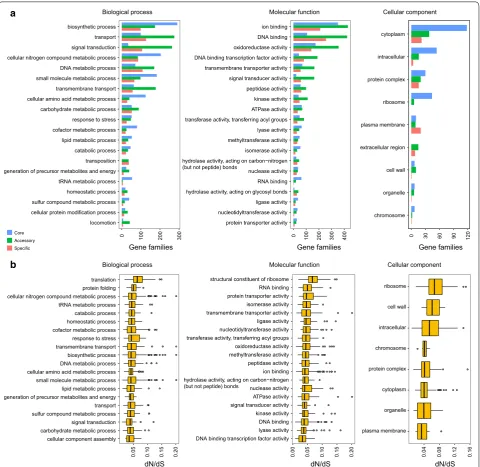
To gain insights into functional diversity in these strains, the pan-genome from the 24 genomes was also com-pared using functional gene ontology categories. All of the GO terms fell into three categories: biological pro-cesses (BP), molecular function (MF) and cellular com-ponent (CC) (Fig. 3a). Genes with biosynthetic process, transport and signal transduction were more abundant in the BP category. Genes related to ion binding, DNA
cellular component assembly carbohydrate metabolic process signal transduction sulfur compound metabolic process transport generation of precursor metabolites and energy lipid metabolic process small molecule metabolic process cellular amino acid metabolic process DNA metabolic process biosynthetic process transmembrane transport response to stress cofactor metabolic process homeostatic process catabolic process tRNA metabolic process cellular nitrogen compound metabolic process protein folding translation
0.05 0.10 0.15 0.20
dN/dS
plasma membrane organelle cytoplasm protein complex chromosome intracellular cell wall ribosome
0.04 0.08 0.12 0.16
dN/dS
DNA binding transcription factor activity lyase activity DNA binding kinase activity signal transducer activity ATPase activity nuclease activity hydrolase activity, acting on carbon−nitrogen (but not peptide) bonds
ion binding peptidase activity methyltransferase activity oxidoreductase activity transferase activity, transferring acyl groups nucleotidyltransferase activity ligase activity transmembrane transporter activity isomerase activity protein transporter activity RNA binding structural constituent of ribosome
0.00 0.05 0.10 0.15 0.20
dN/dS
b
locomotion cellular protein modification process sulfur compound metabolic process homeostatic process tRNA metabolic process generation of precursor metabolites and energy transposition catabolic process lipid metabolic process cofactor metabolic process response to stress carbohydrate metabolic process cellular amino acid metabolic process transmembrane transport small molecule metabolic process DNA metabolic process cellular nitrogen compound metabolic process signal transduction transport biosynthetic process
0 100 200 300
protein transporter activity nucleotidyltransferase activity ligase activity hydrolase activity, acting on glycosyl bonds RNA binding nuclease activity hydrolase activity, acting on carbon−nitrogen (but not peptide) bonds
isomerase activity methyltransferase activity lyase activity transferase activity, transferring acyl groups ATPase activity kinase activity peptidase activity signal transducer activity transmembrane transporter activity DNA binding transcription factor activity oxidoreductase activity DNA binding ion binding
0 100 200 300 400
chromosome organelle cell wall extracellular region plasma membrane ribosome protein complex intracellular cytoplasm
0 30 60 90 120
Gene families Gene families Gene families
a Biological process Molecular function Cellular component
Cellular component Molecular function
Biological process Core
Accessory Specific
binding and oxidoreductase activity were enriched in MF category. For the CC category, genes involved in cyto-plasm, intracellular and protein complex were dominant. Pan-genome processed a great number of genes involved in various metabolic pathways and enzymes. The pres-ence of so many carbon and energy utilization pathways, material transport and synthesis systems was a reflection of the high-pressure and deep-sea extreme environment. In addition, the existence of so many genes involved in transport, transmembrane transport and ion binding pro-vided supports for iron reduction. The vast majority of genes in the core genome were involved in housekeeping functions, such as biosynthetic process, metabolic func-tions, cytoplasm, intracellular and ribosome (Fig. 3a). These categories were also present, but hardly appeared in the accessory and specific genome, whereas the acces-sory and specific genes were enriched in transport, sig-nal transduction, binding and enzymatic activity (Fig. 3a). The non-core genes could be important for adaptation to specific habitats. Such functional enrichment patterns of accessory and specific genes reflected their notable res-piratory diversity.
In addition, cluster of orthologous group (COG) func-tions of the pan-genome were compared. Genes with predicted functions and unknown functions were more abundant in the pan-genome (Additional file 2: Fig-ure S1). The majority of genes in the core genome were involved in ‘Energy production and conversion’ (C), ‘Amino acid transport and metabolism’ (E) and ‘Transla-tion, ribosomal structure and biogenesis’ (J) (Additional file 2: Figure S1). Whereas the accessory and specific genome had a slight increase in genes involved in ‘Amino acid transport and metabolism’ (E), ‘Transcription’ (K) and ‘Signal transduction mechanisms’ (T) (Additional file 2: Figure S1).
To reveal the uniqueness of the strains, we detected several specific genes that might be related to the sur-vival environment. Among the strain-specific genes in pan-genome, S. loihica PV-4 had a gene encoding menaquinone biosynthesis protein MenD that facili-tated electron transfer. Previous study suggested that menaquinone was the electron transporter in the res-piratory chain and was essential for the survival of S. loihica PV-4 [27]. This menD gene did not exist in other strains, which might be important for the survival of S. loihica PV-4 in the iron-rich environment. In addition, S. woodyi ATCC 51908, S. pealeana ATCC 700345, S. sedi-minis HAW-EB3 and S. halifaxensis HAW-EB4 possessed one or two strain-specific genes encoding nitrite reduc-tase that were involved in nitrogen oxide reduction. The S. amazonensis SB2B, also had a specific gene encoding glutamine synthetase that was a key enzyme of nitrogen metabolism. It was reported that Shewanella was capable
of nitrate reduction using nitrate as the electron accep-tor under certain conditions [30]. These five strains had such strain-specific genes related to nitrogen utilization, which indicated that they had characteristics that were more complex in response to nitrogen. In addition, S. amazonensis SB2B and S. sediminis HAW-EB3 possessed genes encoding inorganic diphosphatase. The specificity of this enzyme has been reported to vary with the source and the activating metal ion [31]. S. violacea DSS12 had a specific gene-encoding related cytochrome oxidase that was responsible for oxidative phosphorylation. This gene was adjacent to other electron transfer genes in S. violacea DSS12 genome, suggesting that it might inter-act with those adjacent genes and function in the related pathways.
Selective pressure analysis
To investigate conservation and evolution of house-keeping genes, functional diversification and evolution-ary pressure of single-copy core genes were detected. In addition, the non-synonymous (dN) to synonymous (dS) substitution rates (dN/dS) were estimated for each sin-gle-copy core family. The analysis showed that all of the single-copy core genes encountered a strong purifying selection (Fig. 3b). Such an important pattern of strong purifying selection indicated that the single-copy core genes were highly conservative and purifying selection contributing to their long-term stability.
evolution in the essential life functions across all 24 She-wanella strains.
Gene gain and loss
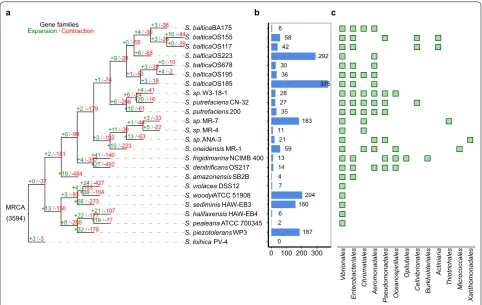
Gene gain and loss during evolution can increase the fit-ness of bacteria within habitats [32, 33]. To obtain deeper insight into the evolution of gene families over a phylog-eny, we performed an analysis of gene expansion and con-traction at each branch of speciation. Diversification at branches was associated with a large number of changes in gene family size across the Shewanella tree. The 3594 gene families were more likely to have been inherited from the most recent common ancestor (MRCA) of She-wanella, and 1805 of which (50.22%) families experienced size changes (Fig. 4a). In the tree, each strain branch of the phylogeny has changed in evolution (Fig. 4a). In addi-tion, S. loihica PV-4, the most distantly related strain based on single-copy phylogeny, had only six changed genes. Furthermore, contractions outnumbered expan-sions on all branches except the branch of S. loihica PV-4, S. putrefaciens CN-32, and S. baltica OS195. An average of 15 gene families was under expansion, whereas 123
gene families contracted in each strain branch, indicating that loss function played an important role in dynamic evolution. The gene families expanded in those branches of strains were mainly enriched in categories of oxida-tion–reduction process, catalytic activity and membrane. (Additional file 3: Figure S2A). Gene enrichment analysis showed that these strains have lost the majority of genes involved in oxidation–reduction process, DNA bind-ing and membrane (Additional file 3: Figure S2B). The enrichment of changed genes in reduction process and membrane seemed to be ecologically important and con-tribute to the successful adaptation of the strains.
Due to recent acquisition and deletion, the gene that is not in the MRCA is more variable than the core gene [34]. HGT is the main driver of bacterial evolution and adaptation [35]. To infer the recent evolutionary dynam-ics of Shewanella on a larger scope of strains, we exam-ined all horizontally acquired genes and obtaexam-ined 1800 genes that were of horizontal origin and the number of HGT-origin genes detected each strain was differ-ent (Fig. 4b). Gene transfer occurred in many genes, which indicated that horizontal transfer genes played
S. baltica OS155
S. sp. ANA-3
S. sediminis HAW-EB3
S. baltica OS117
S. baltica OS195
S. putrefaciens CN-32
S. loihica PV-4
S. halifaxensis HAW-EB4
S. baltica OS678
S. denitrificans OS217
S. frigidimarina NCIMB 400
S. pealeana ATCC 700345
S. woodyi ATCC 51908
S. baltica OS185
S. sp. MR-4
S. oneidensis MR-1
S. baltica OS223
S. sp. MR-7
S. amazonensis SB2B
S. piezotolerans WP3
S. baltica BA175
S. sp. W3-18-1
S. putrefaciens 200
S. violacea DSS12
MRCA (3594)
+3/-36 +10/-44
+0/-39 +3/-36 +4/-30
+6/-68 +0/-55
+0/-10 +4/-2 +3/-33
+3/-18 +1/-53 +9/-39
+4/-41 +20/-16 +6/-24
+10/-61 +6/-266 +1/-74
+3/-33 +5/-22 +1/-44
+13/-63 +11/-30
+10/-223 +3/-102 +2/-179
+41/-140 +27/-492 +4/-357 +0/-99
+19/-484 +2/-181
+24/-427 +38/-104 +4/-193
+56/-273 +3/-93
+21/-107 +19/-77 +22/-177
+32/-176 +8/-280 +13/-150 +0/-37
+3/-3
6 58 42
292 30
36
375 28
27 35
183 11
21 59 13 14 4 7
204 160 6 2
187 0
0 100 200 300
Vi
brionales
Enterobacteriale
s
Chromatiale
s
Aeromonadales
Pseudomonadales Oceanospirillales
Opitutales
Cellvibrionales Burkholderiales
Actiniaria
Thiotrichale
s
Micrococcale
s
Xanthomonadales
a
Gene families Expansion/Contraction
b c
an important role in the gene flow and acquisition and contributed to the open pan-genome of the Shewanella. Among these strains, S. baltica OS185 appeared to gain the largest number of genes, whereas S. loihica PV-4 did not detect the horizontal gene. S. loihica PV-4 showed closest evolutionary relatedness in core gene similarity to the nearest common ancestor, and the numbers of gene expansion, contraction and HGT genes were minimum, probably because the strain’s living environment is simi-lar to the ancestor. To infer the contribution of donors to horizontal gene transfer, we identified donors for these horizontal transfer genes (Fig. 4c, Additional file 4: Table S2). These transferred genes appeared to origi-nate from members of Vibrionales and Enterobacteriales family, particularly the genera Vibrio, which suggested that HGT events were more effective to occur in closely related organisms rather than in distantly related organ-isms. In addition, these HGT-origin genes were enriched in DNA metabolic process, transposition and DNA bind-ing (Additional file 3: Figure S2C). The acquisition of genes in DNA metabolic process, transposition and DNA binding could aid in their survival in different environ-ments. For example, the S. woodyi ATCC 51908, S. sedi-minis HAW-EB3, S. sp. MR-4 and S. sp. MR-7 acquired two or three genes encoding the nitrate reductase. The S. woodyi ATCC 51908, S. sediminis HAW-EB3, S. baltica OS185, S. baltica OS223 and S. piezotolerans WP3 strains acquired a gene encoding glutamine synthetase. These genes were involved in the nitrogen cycle, which was apparently important for the successful adaptation. These results suggested that HGT was an important driver of the evolution of these genomes. Therefore, the available gene pool for HGT could explain the difference in non-MRCA genomes and the increased pan-genome size of these strains. These findings suggested that gain and loss of genes that were apparently accessory for the majority of the strains of a genus might be a successful strategy for biological diversification, rapid evolution and environ-mental adaptation.
Evolution of the mtr clusters in Shewanella
Previous studies on S. oneidensis MR-1 indicated that genes within a cluster (mtrBAC–omcA–mtrFED) were involved in the metal-reducing pathway, while the S. denitrificans OS217 did not possess this cluster [17,
36]. In particular, this cluster comprised seven genes that were clustered in sequential order of mtrD–mtrE– mtrF–omcA–mtrC–mtrA–mtrB [37]. The feoA–feoB operon involved in ferrous iron transport was common to all strains and adjacent to the mtr–omc cluster. To explore new features of metal reduction pathways, we compared this kind of mtr–omc gene cluster in these 24 strains. Although genes within this cluster shared a high
degree of similarity with the homologues described in S. oneidensis MR-1, the number and composition carried out by different Shewanella strains were still changed (Fig. 5a). The complete mtrBAC–omcA–mtrFED cluster was conserved in 15 out of the 24 strains. In addition, the mtrABC operon was conserved in all the genomes except for S. denitrificans OS217 and S. violacea DSS12. The mtrDEF operon, homologues of mtrABC, was virtu-ally absent from S. sp. W3-18-1, S. putrefaciens CN-32, S. putrefaciens 200, S. frigidimarina NCIMB 400, S. deni-trificans OS217, S. violacea DSS12 and S. woodyi ATCC 51908. The mtr–omc clusters of 17 strains were consid-erably different from that of S. oneidensis MR-1 since there were gene duplication, gene loss, or new gene gains within it. Such change of this cluster reflected the evolu-tionary history and possibly metal respiratory specializa-tion, which agreed well with the previous study that the absence of genes in this mtr–omc cluster would result in slower iron reduction [38]. For example, S. denitri-ficans OS217 and S. violacea DSS12, which both lacked the entire cluster, showed limited anaerobic growth capacity that may be due to gene loss in the process of ecological specialization [4]. In addition, expansion of omcA gene occurred in S. amazonensis SB2B, S. sedi-minis HAW-EB3, S. pealeana ATCC 700345 and S. loi-hica PV-4, which reflected gene acquisition and dynamic evolution in metal respiration. The tree of genes within the cluster and the cymA gene showed that each gene formed a group with its orthologs from different strains (Additional file 5: Figure S3). Branches of each gene clus-tered into two distinct groups, which imply two distinct evolutionary paths for different strains. In addition, the evolutionary relationship of omcA between these strains was determined according to their genetic characteris-tics. These S. baltica strains showed much evolutionary relatedness in each gene, and the omcA genes from multi-locus in S. loihica PV-4, S. sediminis HAW-EB3 and S. pealeana ATCC 700345 formed the relatively independ-ent branch, showing the duplication evindepend-ents (Additional file 6: Figure S4).
mtrC–mtrA–mtrB, indicating that the order of the hom-ologues genes was highly conserved. This was in accord-ance with the previous study that homologues of the metal-reducing pathway were found in a series of other dissimilatory metal-reducing bacteria and might have co-evolved in these bacteria [40]. The protein products of these mtr genes worked together to facilitate electron transfer across the cell envelop [37], which had been rec-ognized as an early form of respiration, although it was widespread among the bacteria [41], there were still fewer strains containing complete orthologous genes of metal reduction system. The genes mtrA and mtrD were present in most strains, but few mtrBCEF and omcA genes were present. The lack of apparent mtr genes in the most metal-reducing strains was consistent with pre-vious studies that the electron-transfer pathways used by metal-reducing strains for extracellular reduction of Fe(III)-containing minerals had evolved independently [17].
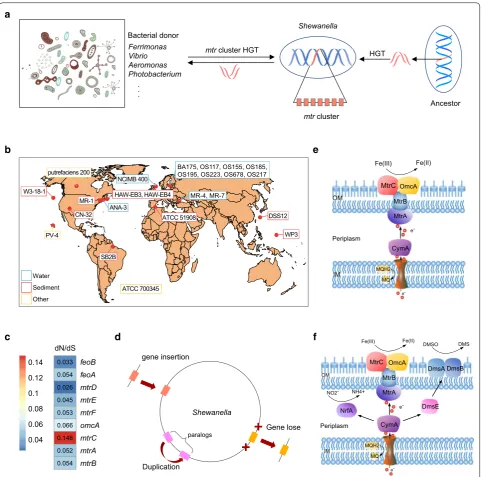
The metal-reducing pathway was generally consid-ered as one of the most ancient microbial metabo-lisms on earth a long time ago [39]. Previous study had described that Shewanella contained regions, which were likely to be horizontally acquired from members of the Enterobacteriaceae family bacteria [4]. To infer the evolutionary relationships of mtr–omc cluster on a larger scope of strains, individual phylogenetic trees of mtr genes from different organisms were constructed (Additional file 7: Figure S5). Phylogenetic trees of mtrE, mtrF, mtrA and mtrD showed that Shewanella strains exhibited very similar evolutionary relatedness among each other and were relatively independent from other bacteria. However, several Shewanella strains were scattered to different branches in phylogenetic trees of mtrB, mtrC, omcA (Additional file 7: Figure S5). These mtr genes of Shewanella strains showed evo-lutionary relatedness to Ferrimonas species, probably because of the extensive horizontal gene transfer events
Gammaproteobacteria
Betaproteobacteria Deltaproteobacteria
Alphaproteobacteria
Terrabacteria group
Acidobacteria
Aquificae
Deferribacteraceae
PVC group
mtrD mtrE mtrF omc
A
mtrC mtrA mtrB
100 0
Escherichia coli K12 MG1655
Escherichia albertii Citrobacter rodentium
Salmonella enterica CT18
Salmonella enterica RSK2980
Shigella flexneri
Edwardsiella tarda
Edwardsiella ictaluri
Pectobacterium atrosepticum Providencia stuartii Manheimia succiniciproducens Haemophilus influenzae
Actinobacillus pleuropneumoniae 1
Actinobacillus pleuropneumoniae 5b
Aggregatibacter actinomycetemcomitans Pasteurella dagmatis
Mannheimia haemolytica Gallibacterium anatis Shewanella oneidensis Shewanella putrefaciens Ferrimonas balearica Vibiro vulnificus Aliivibrio salmonicida Nitrosococcus halophilus Halorhodospira halophila Aeromonas veronii Pelobacter propionicus Desulfuromonas acetoxidans Geobacter metallireducens Anaeromyxobacter dehalogenans Haliangium ochraceum Desulfurivibrio alkaliphilus Desulfobacterium autotrophicum Desulfonatronospira thiodismutans Rubrivivax benzoatilyticus Leptothrix cholodnii Rhodoferax ferrireducens Sutterella wadsworthensis Gallionella capsiferriformans Sideroxydans lithotrophicus Dechloromonas aromatica
Rhodopseudomonas palustris DX1
Rhodomicrobium vannielii Magnetosirillum magneticum Thermincola potens Dethiobacter alkaliphilus Carboxydothermus hydrogenoformans Dehalogenimonas lykanthroporepellens Terriglobus saanensis
Koribacter versatilis Acidobacterium capsulatum Solibacter usitatus Thermovibrio ammonificans Desulfurobacterium thermolithotrophum Persephonella marina Deferribacter desulfuricans Denitrovibrio acetiphilus Flexistipes sinusarabici Rhodopirellula baltica Opitutus terrae Thermodesulfatator indicus Muricauda ruestringensis Thermodesulfovibrio yellowstonii
a b
S. baltica OS155
S. sp. ANA-3
S. sediminis HAW-EB3
S. baltica OS117
S. baltica OS195
S. putrefaciens CN-32
S. loihica PV-4
S. halifaxensis HAW-EB4
S. baltica OS678
S. denitrificans OS217
S. frigidimarina NCIMB 400
S. pealeana ATCC 700345
S. woodyi ATCC 51908
S. baltica OS185
S. sp. MR-4
S. oneidensis MR-1
S. baltica OS223
S. sp. MR-7
S. amazonensis SB2B
S. piezotolerans WP3
S. baltica BA175
S. sp. W3-18-1
S. putrefaciens 200
S. violacea DSS12
mtrD mtrE mtrF omcA mtrC mtrA mtrB
feoB feoA
Fig. 5 Global comparison of the mtr–omc clusters in Shewanella and orthologous gene clusters in other strains. a Genetic comparative
(Fig. 6a). In addition, the differences of the metal-reducing pathway of Shewanella strains might be due to the result of multiple gene gains and loss events during the evolution. As these isolates originated from diverse geographic locations and habitats, such as marine water, sediments and subsurface, they carried out a
diverse range of metabolic processes (Fig. 6b). And the mtr genes had changed during the evolution since they were under strong purifying selection (Fig. 6c). The strong purifying selection played a key role in select-ing for such iron respiration changes in their evolution. The mtrC had lower similarity with the homologues Ferrimonas
Vibrio Aeromonas Photobacterium
.. .
b
mtr cluster HGT
dN/dS 0.033 0.054 0.026 0.045 0.053 0.066 0.148 0.052 0.054
feoB feoA mtrD mtrE mtrF omcA mtrC mtrA mtrB
0.04 0.06 0.08 0.1 0.12 0.14
Fe(III) Fe(II)
CymA eˉ Periplasm
MtrB
MtrC
MtrA
MQH2 MQ
eˉ OmcA
c Fe(III) Fe(II)
CymA eˉ MtrB MtrC
MtrA
MQH2 MQ
eˉ OmcA
DmsA DmsB DMSO DMS
NrfA NO2ˉ NH4+
DmsE DSS12
SB2B
MR-4, MR-7 ANA-3
BA175, OS117, OS155, OS185, OS195, OS223, OS678, OS217 NCIMB 400
WP3 putrefaciens 200
W3-18-1
ATCC 51908 CN-32
PV-4
MR-1
ATCC 700345
HAW-EB3, HAW-EB4 OM
OM d
IM
Periplasm
IM
Ancestor Bacterial donor
gene insertion
Shewanella
Duplication
Gene lose paralogs
a
mtr cluster
e
f
Shewanella
HGT
Water Sediment Other
Fig. 6 A hypothetical model for the evolution of the Mtr pathway in Shewanella. aShewanella may acquire the mtr genes from the ancestor by HGT and exchange with other bacteria. b The geographic origin of 24 Shewanella genomes used in this study. c Selection pressure of mtr genes, with each box showing the ratio of nonsynonymous (dN) over synonymous substitution (dS) rate. Red boxes represent genes that with high ratios, blue boxes represent genes that with low ratios. d Dynamic changed of mtr clusters. Gene gains and losses derived from HGT events and genes duplication. e The metal-reducing pathway of S. oneidensis MR-1 (OM outer membrane, IM inner membrane, MQH2 reduced form of menaquinone,
compared with other genes, underwent more diversify-ing selection. Besides, due to the constraint of purifydiversify-ing selection, some of the mtr experienced gene loss and gene duplication, as well as new gene gains (Fig. 6d). In the metal-reducing pathway, electrons from the inner membrane passed through the periplasm and across the outer membrane to the extracellular minerals via the protein components encoding by mtr–omc cluster [42] (Fig. 6e). With the gain and loss of genes, genes of mtr–omc cluster were no longer core genes, and the ability for Shewanella to adapt to environmental con-ditions by metal-reducing pathway was presumably no longer essential for survival. Another possible explana-tion could be that other pathways had been developed to utilize different types of electron acceptors during their evolution to facultative anaerobic environments [43] (Fig. 6f). In particular, mtr genes experienced addi-tional contraction events with some of them lost during evolution, which indicated that respiration had become less competitive as the environment changed.
Conclusions
In this study, a comparative pan-genome analysis has been conducted to study the genomic diversity and evolutionary relationships among these 24 Shewanella strains. The pan-genome exhibited a high level of genome variability, about 86% of which was variable. And this pan-genome was found to be open and had a high percentage of strain-specific genes within it. Moreover, the existence of several strain-specific genes and abundant CAZymes in the accessory and specific genomes reflected the functional diversity and meta-bolic diversity of the pan-genome. And also the essen-tial function of single-copy core genes would evolve under purifying selection, which illustrated the impor-tance of the housekeeping function to each strain for survival. We also found that HGT played a key role in the shaping of the Shewanella accessory and specific genome and accelerated the evolution of strains. Fur-thermore, purifying selection played an important role in the stability of the core-genome and facilitated the evolution of mtr–omc clusters in different Shewanella strains to different habitats. We re-emphasized that the number of Shewanella strains was expanded to 24, which had not been reported by others in the previous studies.
The work presented here would help carry out further research on the genetic basis of Shewanella, and better enhance understanding of metal-reducing pathway and
the impact of HGT on the evolution. It could also con-tribute to research on applications of metal-reducing bacteria in bioremediation and metabolic engineering.
Methods
Datasets
The genomic features, geographical origin and isola-tion site characteristics of the genomic sequences used in this study are provided in Additional file 8: Table S3. Genomes and protein sequences were downloaded from National Center for Biotechnology Information (NCBI), representing 24 different strains.
Gene family
To understand the evolutionary relationship of She-wanella, we conducted systematic comparative genomic studies. Full protein-coding genes of 24 Shewanella strains were used to construct gene families using OrthoMCL (v2) [44] with a BLAST E-value cut-off of 1e−5 and an inflation parameter of 1.5. Here, the clus-tering results yielded 7830 homologous clusters, 1788 of which were single-copy gene families, and then they were parsed and concatenated.
Phylogeny construction
Protein sequences for these single-copy gene families were concatenated and aligned by MUSCLE(v3.8) [45] with default parameters. The alignments were curated by GBlock (v0.91b) [46] to filter out poorly aligned posi-tions. The phylogenetic tree was constructed using the maximum likelihood algorithm with 100 bootstraps as implemented in Phylip (v3.696).
The pan-genome tree based on the absence or pres-ence of each gene family in all genomes used the Manhat-tan disManhat-tance to measure the evolutionary relationship of strains. Each gene in the genome was scored on basis of the presence (1 value) or absence (0 value), a 0/1 matrix was built and Manhattan distance was calculated, then a phylogenetic tree of the pan-genome was generated using MEGA (v5).
Gene distribution expansion
To gain a great insight into the evolutionary dynamics of the genes, the expansion and contraction of the gene families among these 24 Shewanella strains were deter-mined. CAFE (v2.1) [48] was used to infer the change in gene family size in each branch. Gene gain and loss were along with each branch of the single-copy gene family tree, and significant levels of expansion and contraction were determined at 0.05.
Detection of horizontal gene transfer
To infer mobile elements of Shewanella genome, all non-recent common ancestral genes were aligned to plasmid sequences, insertion sequences, phage sequences availa-ble in the NCBI RefSeq database, ISfinder and ACLAME database, respectively. A gene was used as input for HGTector (v0.2.1) [49] searches in terms of its best BLASTp hit with a sequence identity of above 50% and a cutoff E value of 10−5. The identification of HGT-origin genes used HGTector with BLAST parameter thresh-olds 90% identity, an E-value of 10−5 and 500 top-scoring matches. The Shewanella and Shewanellaceae were set as self-group and close group, respectively.
Functional annotations
Hmmscan was used to determine carbohydrate activity enzymes (CAZymes) by comparing all gene families to dbCAN [50] database. Gene ontology (GO) terms were identified using InterProScan (v.5) [51]. GO term assign-ments for each of the genes were retrieved from Interpro-Scan results. Since GO slims were particularly useful for giving a summary of the genome-wide GO annotation, all of the GO terms were mapped to GO slim (http://www. geneo ntolo gy.org/GO.slims .shtml ). Additionally, gene annotation was based on COG databases, using BLAST with a cutoff E-value of 1e−5.
Selective pressure analysis
To estimate the rate of evolution and test the selection pressure on each single-copy orthologous genes, the program PAML (v. 4.4c) [52] was used. For each pair of strains, the Codeml model was used to calculate dN and dS values. The single ω (dN/dS, the ratio of non-synon-ymous to synonnon-synon-ymous divergence) across sites was esti-mated using M0, M7, M8 models that were fixed across the phylogeny for each alignment (referred to as ω of a gene). To avoid convergence problems, each analysis was repeated three times with different initial values of ω and adopted results from the analysis with the highest likelihood.
Authors’ contributions
The whole study was designed by KN. CFZ collected datasets. CFZ and SJY analyzed the data. CFZ, MZH explained the results. CFZ, SJY, MZH, PSY, HJL and KN wrote the initial draft of the manuscript. All authors read and approved the final manuscript.
Acknowledgements
The authors are grateful to Zhiwei Song who provided assistance during preparation of this report.
Competing interests
The authors declare that they have no competing interests.
Availability of data and materials
All data generated or analyzed during this study are included in this manu-script and its additional files.
Consent for publication Not applicable.
Ethics approval and consent to participate Not applicable.
Funding
This work was partially supported by National Science Foundation of China Grant 31671374, Ministry of Science and Technology’s high-tech (863) Grant 2014AA021502.
Additional files
Additional file 1: Table S1. Summary of homologous genes identified by OrthoMCL. Protein sequences from 24 Shewanella genomes were used as input for OrthoMCL orthologous gene clustering (Input Genes). Clusters containing single genes or genes from a single strain were eliminated (Clusters). Genes from a single strain (Clustered as single strain).
Additional file 2: Figure S1. Distribution of genes based on COG category of the pan-genome. Distribution of COG categories between the core (blue bars), accessory (green bars) and specific genes (red bars) of Shewanella.
Additional file 3: Figure S2. GO annotation of gained and lost genes. (A) Function enrichment of expanded gene families. (B) Function enrichment of contracted gene families. (C) Function enrichment of HGT-origin genes.
Additional file 4: Table S2. Possible donors of HGT genes in each strain.
Additional file 5: Figure S3. Phylogenetic tree of mtr–omc gene clusters in 24 Shewanella genomes. The phylogenetic tree was constructed using a multiple sequence alignment of the full mtr–omc clusters and cymA genes of all 24 Shewanella.
Additional file 6: Figure S4. Comparison of omcA genes in 24 Shewanella genomes. Left: Phylogenetic tree of omcA genes. Right: omcA genes similarities of pairwise comparison. The omcA from multi-locus that are not located in the mtr–omc cluster are colored red, omcA from multi-locus that located in the mtr–omc cluster that no longer sisters are colored green, respectively.
Additional file 7: Figure S5. Phylogenetic relationship of mtr–omc clusters within different bacteria. The phylogenic trees built by protein sequences were showed for (A) mtrB, (B) mtrC, (C) mtrE, (D) mtrF, (E) omcA, (F) mtrA and (G) mtrD, respectively. The branches of Shewanella and clade of S. oneidensis MR-1 are marked in red.
Publisher’s Note
Springer Nature remains neutral with regard to jurisdictional claims in pub-lished maps and institutional affiliations.
Received: 28 April 2018 Accepted: 10 July 2018
References
1. Janda JM, Abbott SL. The genus Shewanella: from the briny depths below to human pathogen. Crit Rev Microbiol. 2014;40(4):293–312.
2. Nealson KH, Scott J. Ecophysiology of the genus Shewanella. In: Dworkin M, editor. The prokaryotes: proteobacteria: Gamma subclass, vol. 6. New York: Springer; 2006. p. 1133–51.
3. Lovley D. Dissimilatory Fe(III)-and Mn(IV)-reducing prokaryotes. In the prokaryotes. Berlin: Springer; 2006. p. 635–58.
4. Konstantinidis KT, et al. Comparative systems biology across an evolutionary gradient within the Shewanella genus. Proc Natl Acad Sci. 2009;106(37):15909–14.
5. Lovley DR. Dissimilatory Fe(III) and Mn(IV) reduction. Microbiol Rev. 1991;55(2):259–87.
6. Tiedje JM. Shewanella—the environmentally versatile genome. London: Nature Publishing Group; 2002.
7. Kim HJ, et al. A microbial fuel cell type lactate biosensor using a metal-reducing bacterium, Shewanella putrefaciens. J Microbiol Biotechnol. 1999;9(3):365–7.
8. Gorby YA, et al. Electrically conductive bacterial nanowires produced by Shewanella oneidensis strain MR-1 and other microorganisms. Proc Natl Acad Sci. 2006;103(30):11358–63.
9. Bendall ML, et al. Exploring the roles of DNA methylation in the metal-reducing bacterium Shewanella oneidensis MR-1. J Bacteriol. 2013. https :// doi.org/10.1128/jb.00935 -13.
10. Dehaut A, et al. Phenotypic and genotypic characterization of H2S-posi-tive and H2S-negaH2S-posi-tive strains of Shewanella baltica isolated from spoiled whiting (Merlangius merlangus). Lett Appl Microbiol. 2014;59(5):542–8. 11. Shanafield HA. Evolution of the set of signal transduction proteins in 10
species of Shewanella. 2008.
12. Camila Odio JS. Shewanella oneidensis MR-1: background and applica-tions. 2016.
13. Coursolle D, Gralnick JA. Modularity of the Mtr respiratory pathway of Shewanella oneidensis strain MR-1. Mol Microbiol. 2010;77(4):995–1008. 14. Shi L, et al. Isolation of a high-affinity functional protein
com-plex between OmcA and MtrC: two outer membrane decaheme c-type cytochromes of Shewanella oneidensis MR-1. J Bacteriol. 2006;188(13):4705–14.
15. Yang Y, et al. Roles of UndA and MtrC of Shewanella putrefaciens W3-18-1 in iron reduction. BMC Microbiol. 2013;13:267.
16. Wang F, et al. Isolation of extremophiles with the detection and retrieval of Shewanella strains in deep-sea sediments from the west Pacific. Extre-mophiles. 2004;8(2):165–8.
17. Fredrickson JK, et al. Towards environmental systems biology of Shewanella. Nat Rev Microbiol. 2008;6(8):592.
18. Vernikos G, et al. Ten years of pan-genome analyses. Curr Opin Microbiol. 2015;23:148–54.
19. Bentley S. Sequencing the species pan-genome. London: Nature Publish-ing Group; 2009.
20. Dikow RB. Genome-level homology and phylogeny of Shewanella (Gammaproteobacteria: lteromonadales: Shewanellaceae). BMC Genomics. 2011;12(1):237.
21. Caro-Quintero A, et al. Unprecedented levels of horizontal gene transfer among spatially co-occurring Shewanella bacteria from the Baltic Sea. ISME J. 2011;5(1):131.
22. Ong WK, et al. Comparisons of Shewanella strains based on genome annotations, modeling, and experiments. BMC Syst Biol. 2014;8(1):31. 23. Caroquintero A, et al. Unprecedented levels of horizontal gene transfer
among spatially co-occurring Shewanella bacteria from the Baltic Sea. Isme J Emultidiscip J Microbial Ecol. 2011;5(1):131–40.
24. Konstantinidis KT, et al. Comparative systems biology across an evolu-tionary gradient within the Shewanella genus. Proc Natl Acad Sci USA. 2009;106(37):15909–14.
25. Shi L, et al. Molecular underpinnings of Fe(III) oxide reduction by Shewanella oneidensis MR-1. Front Microbiol. 2012;3:50. 26. Wang F, et al. Environmental adaptation: genomic analysis of the
piezotolerant and psychrotolerant deep-sea iron reducing bacterium Shewanella piezotolerans WP3. PLoS ONE. 2008;3(4):e1937.
27. Gao H, et al. Shewanella loihica sp. nov., isolated from iron-rich microbial mats in the Pacific Ocean. Int J Syst Evol Microbiol. 2006;56(8):1911–6. 28. Maughan R. Carbohydrate metabolism. Surgery (Oxford). 2009;27(1):6–10. 29. Serres MH, Riley M. Genomic analysis of carbon source metabolism of
Shewanella oneidensis MR-1: predictions versus experiments. J Bacteriol. 2006;188(13):4601–9.
30. Chen Y, Wang F. Insights on nitrate respiration by Shewanella. Front Mar Sci. 2015;1:80.
31. Owen A, Larry GB. Yeast inorganic pyrophosphatase. J Biol Chem. 1972;247:7315–9.
32. Ochman H, Moran NA. Genes lost and genes found: evolution of bacterial pathogenesis and symbiosis. Science. 2001;292(5519):1096–9.
33. Oh PL, et al. Diversification of the gut symbiont Lactobacillus reuteri as a result of host-driven evolution. ISME J. 2010;4(3):377.
34. Li Y-H, et al. De novo assembly of soybean wild relatives for pan-genome analysis of diversity and agronomic traits. Nat Biotechnol. 2014;32(10):1045.
35. Gyles C, Boerlin P. Horizontally transferred genetic elements and their role in pathogenesis of bacterial disease. Vet Pathol. 2014;51(2):328–40. 36. Gao H, et al. Probing regulon of ArcA in Shewanella oneidensis MR-1 by
integrated genomic analyses. BMC Genomics. 2008;9(1):42.
37. Shi L, et al. Mtr extracellular electron-transfer pathways in Fe(III)-reducing or Fe(II)-oxidizing bacteria: a genomic perspective. London: Portland Press Limited; 2012.
38. Yang Y, et al. Roles of UndA and MtrC of Shewanella putrefaciens W3-18-1 in iron reduction. BMC Microbiol. 2013;13(1):267.
39. Vargas M, et al. Microbiological evidence for Fe(III) reduction on early Earth. Nature. 1998;395(6697):65–7.
40. Cairns-Smith AG, Hall AJ, Russell MJ. Mineral theories of the origin of life and an iron sulfide example. Berlin: Springer; 1992. p. 161–80. 41. Lonergan DJ, et al. Phylogenetic analysis of dissimilatory Fe(III)-reducing
bacteria. J Bacteriol. 1996;178(8):2402.
42. Clarke TA, Richardson DJ. Structure of a bacterial cell surface decaheme electron conduit. Proc Natl Acad Sci USA. 2011;108(23):9384–9. 43. Chen Y, Wang F. Insights on nitrate respiration by Shewanella. Front Mar
Sci. 2014;1:80.
44. Li L, Stoeckert CJ Jr, Roos DS. OrthoMCL: identification of ortholog groups for eukaryotic genomes. Genome Res. 2003;13(9):2178–89.
45. Edgar RC. MUSCLE: multiple sequence alignment with high accuracy and high throughput. Nucleic Acids Res. 2004;32(5):1792–7.
46. Talavera G, Castresana J. Improvement of phylogenies after removing divergent and ambiguously aligned blocks from protein sequence align-ments. Syst Biol. 2007;56(4):564–77.
47. Snel B, et al. STRING: a web-server to retrieve and display the repeatedly occurring neighbourhood of a gene. Nucleic Acids Res. 2000;28(18):3442–4.
48. De Bie T, et al. CAFE: a computational tool for the study of gene family evolution. Bioinformatics. 2006;22(10):1269–71.
49. Zhu Q, Kosoy M, Dittmar K. HGTector: an automated method facilitat-ing genome-wide discovery of putative horizontal gene transfers. BMC Genomics. 2014;15:717.
50. Yin Y, et al. dbCAN: a web resource for automated carbohydrate-active enzyme annotation. Nucleic Acids Res. 2012;40(W1):W445–51. 51. Finn RD, et al. InterPro in 2017—beyond protein family and domain
annotations. Nucleic Acids Res. 2016;45(D1):D190–9.