Institutional Co-Creation Interfaces for Innovation Diffusion
during Disaster Management
Adrian SOLOMON
South East European Research Centre (SEERC) Proxenou Koromila 24, 546 22, Thessaloniki, Greece
Panagiotis KETIKIDIS
University of Sheffield International Faculty, CITY College Proxenou Koromila 24, 546 22, Thessaloniki, Greece
Felicia SIAVALAS
University of Sheffield International Faculty, CITY College Leontos Sofou 3, 546 26, Thessaloniki, Greece
Abstract. This paper discusses the concept of Resilient and Green Supply Chain Management (RGSCM) implementation in South Eastern Europe (SEE) from the point of view of understanding the structure of the inter-organizational (institutional) interfaces involved in this process as well as how are these interfaces evolving and transforming over time. As social and environmental concerns are growing in importance through normative and coercive directions, all the regional actors (triple/quadruple/quintuple helix) that supply chains interact with need to bridge their inter-organizational interfaces to properly ensure co-creation at the entire stakeholder level towards increasing the chances of a homogenous implementation of RGSCM. In this context, this paper adopts a three-stage mixed methodology of interviews, survey, focus groups, modelling and simulation case studies. The results show that the key pillars of inter-organizational interface integration and evolution reside in the proper identification of the key goals (performance indicators) of the involved institutions, which will maintain market-optimized competition levels. Then, institutions will steadily adhere to the market trends as explained by the ST and INT and in the process of adopting the RGSCM eco-innovation (DIT), the new entrant institutions will transform their inter-organizational interface to properly bridge with the core market stakeholder group. Finally, the key driver of interface alteration resides in the ability of disruptive (eco) innovators to set new standards. This research has core academic implications by extending the INT, DIT and ST under the context of RGSCM, policy implications in terms of proper policy making to support the required co-creation as well as practical implications by helping organizations to manage their inter-organizational interfaces.
Introduction
The unpredictable nature of extreme weather-induced disruptions (heavy rain, blizzards, snow, icy roads, fog, and heat waves) is posing tremendous pressure on nowadays supply chains. Longer transports, increased fuel consumption, hazardous wastes, unsatisfied clients, social unrest and risks, damage to the environment, infrastructure and assets are only few of the pressuring outcomes of such disruptions (Chhetri et al., 2016; Contestabile, 2013; Hale & Moberg, 2005; Jarvis, Leedal & Hewitt, 2012; Keohane & Victor, 2016; Linnenluecke, Griffiths & Winn, 2012; Natarajarathinam, Capar & Narayanan, 2009; Surminski, 2013; Thompson et al., 2014; UNISDR, 2015; Van der Vegt, Essens, Wahlstrom & George, 2015; Walch, 2015; World Economic Forum, 2015).
As social and environmental concerns are growing in importance through normative and coercive directions, supply chain management must rapidly adapt to such requirements when aiming to achieve resilience in an environmentally and socially aware manner. To this end, resilient and green supply chain management (RGSCM) acts as core enabler of modern growth with tremendously increased social pressures that demand innovative approaches for leveraging institutional level practices to a wider scale (i.e. stakeholder) in order to support eco-modernization with a greater impact (Baresel-Bofinger, Ketikidis, Koh & Cullen, 2011; Bell et al., 2012; Cardoso, et al., 2015; Fallah, Eskandari & Pishvaee, 2015; Genovese et al., 2014; Govindan et al., 2014; Ketikidis et al., 2013; Koh, 2014; Sarkis, Zhu & Lai, 2011; Seuring et al., 2008; Shi et al., 2012; Torabi et al., 2015; Wong et al., 2016; Zhu, Sarkis & Lai, 2012). Such actors that pressure RGSCM and RGFT comprise of the key developmental institutions of a low carbon economy: research/eco-innovation, effective environmental policies, industries that innovate or incorporate eco-innovations, and the environment and society which act as core influencers of such an integrated eco & co-evolution framework (Carayannis, Barth & Campbell, 2012).
necessary mechanisms, research, and infrastructure to properly adopt a quintuple helix level approach when aiming to enable environmentally sustainable resilience within its main transportation mode (road freight). This way, RGFT, and RGSCM pose a core challenge for research and practice.
Nevertheless, the critically needed co-creation for innovation (among triple/quadruple/quintuple helix institutions) can happen only if inter-organizational interfaces and communication boundaries are properly established and at the moment, such inter-organizational interface across the five main actors is not fully developed, limited the extent of the co-creation to properly adopt eco-innovations such as GSCM across the entire stakeholder group.
Scientifically, especially in relation to inter-organizational interfaces, eco-innovation adoption has often been studied through various theoretical frameworks such as the diffusion of innovation theory (DIT) for investigating how eco-innovations diffuse among the RGSCM actors as well as institutional and stakeholders theory (INT and ST) for reasoning how institutions adopt eco-innovations triggered by stakeholder groups (and vice-versa). However, all these theories have been studied in a mere isolation when it comes to RGSCM (Bendell, 2003; Bhattacharya et al., 2014; Björklund, Martinsen & Abrahamsson, 2012; Fahimnia et al., 2015; Hervani, Helms & Sarkis, 2005; Seuring, 2013; Shepherd & Gunter, 2010; Tajbakhs & Hassini, 2015; Tang, Cao & Schvaneveldt, 2008; Taticchi, Tonelli & Pasqualino, 2013; Varsei et al., 2014; Winter & Knemeyer, 2013). This leads thus to a substantial research gap that this research aims to fill by answering the following research questions:
RQ1: How does the institutional theory influences supply chain actors (institutions) to adopt eco-innovations (RGSCM) promoted at the stakeholder/inter-organizational level?
RQ2: How does the stakeholder theory trigger/promote/enable inter-organizational interfaces to support enhanced inter-inter-organizational communication/co-creation?
RQ3: How is the diffusion of innovation theory influences by the emerging and constantly changing inter-organizational interfaces within supply chains and what exactly is the content of the interface (i.e., in this case, it will be KPIs/common goals)?
Institutional and stakeholder theories as inter-organizational interface enabler for RGSCM
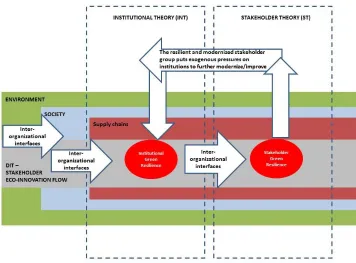
practice based on exogenous pressures channeled via proper inter-organizational interfaces (Dubey, Gunasekaran & Ali, 2015; Gobbo, Fusco & Junior, 2014; Govindan, Diabat & Shankar, 2015; Tian, Govindan & Zhu, 2014; Zhu et al., 2012). Such pressures/ drivers can be coercive, mimetic and normative and in the view of (Clemens & Douglas, 2006; Zhu et al., 2012), the INT has been constantly used as a framework to understand eco-innovation adoption, providing thus a core potential for explaining the behavior of RGSCM practice adoption within the supply chain stakeholder group (Ball & Craig, 2010; Zhu & Liu, 2010).
In a related manner, the stakeholder theory (ST) (Freeman, 1984) proposes that within a stakeholder group, stakeholders propagate externalities, which diffuse later on both internally and externally (influencing thus the other stakeholders of the group), leading to mutual growth at the ecosystem level (Delmas & Toffel, 2004; Sarkis et al., 2011) – only if proper inter-organizational interfaces exist. There is a core implication thus of the ST which explains the production of externalities and of the INT which explains the adoption of externalities within an ecosystem with multiple stakeholders. In the view of Sarkis (2001) and Brito, Carbone, and Blanquart (2008), the ST is highly used in supply chain management, however it has certain criticism on RGSCM due to the fact that environmentalism is not seen by all stakeholders (yet) as an economic benefit and thus, such exogenous pressures do not always impact on the stakeholder group overall, however, efforts towards overcoming this gap are being performed (Sarkis et al., 2011; Tate, Ellram & Kirchoff, 2010). Nevertheless, there is a still a substantial gap in the literature in terms of defining what is the inter-organizational interface structure (i.e. channels) that will ensure a higher level of RGSCM implementation and co-creation across all the actors involved in the RGSCM stakeholder group.
To this end, the core two research questions derived from the literature gap in relation to INT, ST, and inter-organizational interfaces are:
RQ1: How does the institutional theory influences supply chain actors (institutions) to adopt Eco-innovations (RGSCM) promoted at the stakeholder/inter-organizational level?
Figure 1. The role of INT and ST within the cross-stakeholder environment
The diffusion of innovation theory as inter-organizational interface enabler for RGSCM
The diffusion of innovation theory (DIT) plays a critical role in understanding resilience in GSCM especially in the moment of disruptions where eco-innovations should be adopted within stakeholder groups in order to self-adapt. For this purpose, one of the core articles that relate DIT with GSCM is provided by Hervani et al. (2005) which argue that the ability & resources (financial, staff, knowledge, monitoring) of an organization as well as exogenous stakeholder related pressures to foster RGCM are critical for a proper diffusion of innovation across the ecosystem (Florida, Atlas & Cline, 2001; Sharma, 2000) – but this is highly biased on the capacity of the inter-organizational interfaces to enable such diffusion.
discussion. Specifically, the authors argue that RGSCM stakeholder groups are highly consistent with the core five innovation pillars (Zhu et al., 2012): Relative advantage; Compatibility; Complexity; Trialability; and Observability (outcome monitoring and performance measurement at the stakeholder group). All these pillars can properly be monitored at the stakeholder group only if the inter-organizational interfaces across the actors are well-established.
Furthermore, Zhu et al. (2012) argue that internal and external factors (market, society, institutions, - thus tangent with INT and ST) put pressure on RGSCM towards adopting and diffusing ecological innovation across the entire stakeholder group. Such factors are related to the other actors of the group (Carayannis et al., 2012). To this end, the authors propose a framework for diffusion of innovation within RGSCM stakeholder groups through the Bass model which builds up the DIT by arguing that innovation diffuses through two channels (Akinola, 1986; Firth, Lawrence & Clouse, 2006; Kalish & Lilien, 1996): Imitation innovation (consistent with the transformative innovation); Independent (internal) innovation (consistent with the disruptive innovation). These two channels are perceived to highly influence the inter-organizational interfaces of the RGSCM stakeholder group boundaries.
Figure 1. Impact of DIT on RGSCM
Methodology
The philosophical fundament of the chosen methodology resides in the boundaries of critical realism which bridges natural and social worlds by emphasizing the need for special methods required to model/adapt to social structures (as compared to basic scientific experimentations such as modeling numbers or discrete events). This is deemed the key starting point when aiming to understand inter-organizational interfaces. Social structures, in the views of critical realism, are capable of pursuing post-event reflection and self-adaptation - as the entire goal of social structures is always to progress (Archer et al., 2013; Laclau & Bhaskar, 2015). Overall, critical realism has substantial influence in economics, social structures and movements, international relations and in modern social science research, which proves the evolution of this paradigm to support nowadays research necessities.
natural and social worlds and thus, by adopting this paradigm, the emerged research capacity is supported by the literature.
The peculiarity of this research (in terms of identifying the inter-organizational boundaries for RGSCM implementation) resides in the need to bridge research methods corresponding to various disciplines. To this end, a systematic literature review in terms of the availability of suitable methods points towards the following claims: research claiming for the need for mixed methods research in RGSCM (Dubey et al., 2015; Faisal, 2016); research claiming for the need of quantitative based modelling & decision support in RGSCM (Heckmann, Comes & Nickel, 2015; Qazi et al., 2015; Taticchi et al., 2015); research claiming for the need of mixed methods when analyzing systems that include environment, society and cross-system innovation/ practice diffusion(Smith & Rupp, 2015; Soosay & Hyland, 2015).
In this context, the following methodology is being adopted by this research:
Stage one: Qualitative exploratory interviews at the institutional level (N=6, one in each different country from SEE chosen as key representative ones for SEE) to consolidate the scarce literature findings (from SEE) and to enable a more targeted approach for Stage two. Telephone interviews (45-50 minutes) have been undertaken with an expert sample (key representative manufacturers, transporters, and supply chain companies) from six different countries from SEE (Romania, Bulgaria, Greece, Slovenia, FYROM, Serbia). The interview questions have been tailored around the three main research questions aiming to tackle the concept of inter-organizational interfaces in the target area. Inductive content analysis following the guide of Thomas (2006) has been applied in order to analyze the transcribed data. The main goal of this stage is to understand how the researched concepts pertain at the institutional level (with certain implications to the stakeholder level).
and ANOVA) in order to analyze the coded data (with reliability and validity coefficient denoting moderate relevance of the findings – considering the revealed limited know-how of the respondents over the questioned items).
Results and discussion
The findings of this research have the following key outcomes for each research question:
RQ1: How does the institutional theory (INT) influences supply chain actors (institutions) to adopt eco-innovations (RGSCM) promoted at the stakeholder/inter-organizational level?
Over time, more institutions have inner (hence, INT) transformational desire towards incorporating eco-innovations in order to adapt to global standards/trends by shaping their interfaces to fit an inter-organizational context (i.e. “[…] I am always in seek for new such eco-innovations to be
ahead of competition and in trend with societal demands”. Such outcomes are
in high coherence with the literature (Bahadur & Doczi, 2016; Dubey et al., 2015; Govindan et al., 2015; Zhu et al., 2012). This is also quantitatively confirmed by Stage two where, for example, a specific part of the survey targeted to test the adoption level of eco-innovations under three main behavioral variables (behavioral intention to adopt eco-innovations (BI), perceived usefulness of eco-innovations (PU) and perceived ease of use of eco-innovations (PEU). More specifically, whether the respondents declare a high PU (4.00/5) of RGSCM innovations, the PEU of such eco-innovations is considerably low (2.38/5). The PEU is linked to the limited information and knowledge on this topic described also by (Al Zaabi, Al Dhaheri & Diabat, 2013; Drohomeretsk, Gouvea da Costa & Pinheiro de Lima, 2014; Govindan et al., 2015). Still, the BI element (which is the core measurement of the willingness to adopt eco-innovations and thus support the INT statements) is moderately high (3.53/5).
These institutions will perform partnerships/co-create only with institutions with similar values inducing thus a transformational change in other institutions (peer-pressure to adhere to eco-innovations)- leading thus to a homogenous inter-organizational interface – aspect which is in line with the literature on coercive adoption eco-innovations under the INT/ST/INT assumptions (Chakrabarty & Wang, 2013; Govindan et al., 2015; Hsu et al., 2013; Ivanaj et al., 2015; Rehman & Shrivastava, 2011; Shi et al., 2012; Zhu et al., 2012).
RQ2: How does the stakeholder theory (ST) trigger/promote/enable inter-organizational interfaces to support enhanced inter-inter-organizational communication/co-creation?
institution that aims to join this network/chain with a homogenized inter-organizational interface. Such aspects are in line with the previously identified literature (Chakrabarty & Wang, 2013; Govindan et al., 2015; Hsu et al., 2013; Ivanaj et al., 2015; Shi et al., 2012) in relation to the mesosystem induced coercive adoption of institutional practices (paving thus the link between INT, ST and DIT) – as well as the adoption of practices under normative compliance (Drohomeretsk et al., 2014; Govindan et al., 2015; Lee & Kim, 2011). These findings are partly sustained by Stage one as well as largely confirmed by Stage two (N=311) under the framework of assessing the drivers of the implementation of eco-innovations imposed from the stakeholder level. The qualitative consolidation (N=3) of the modelling & simulation based quintuple helix RGFT/RGSCM implementation framework from Stage three (second part) also sustains these findings by arguing that “[…] if we trigger an eco-innovation which slowly becomes a key market trend, then everybody will adopt it to become competitive […] and the government and other actors will develop mechanisms to support this and thus lagging institutions will have to adapt […]”. The remaining issue in this context resides in isolated micro-chains/microsystems within the mesosystem, which may serve much localized purposes and may not be affected by such pressures and desires to join the wider stakeholder block.
Ultimately, even in this peer – moderated/normalized mesosystem, there still is a drive to be more competitive (for institutional level survival) and to this end, individual institutions will continue to eco-innovate and induce peer transformational pressure that will become stakeholder wide and will generate exogenous pressures on new chain entrants by constantly altering the inter-organizational interface to fit the latest requirements.
RQ3: How is the diffusion of innovation theory influences by the emerging and constantly changing inter-organizational interfaces within supply chains and what exactly is the content of the interface (i.e., in this case, it will be KPIs/common goals)?
This continuous eco-innovation diffuses across the stakeholder block via inter-organizational (institutional) co-creation. Firstly, stage one reveals unilaterally the need for “[…] co-creation as a core enabler” of RGSCM eco-innovation diffusion & scale-up (DIT) across the stakeholder group via inter-organizational interfaces. From the data collected, the following factors are key enablers of highly robust interfaces: “mutual support […] and
standardization of practices/policies”; “transparency of operations”;
“technology usage”; “better regional planning […]“; “[…] enhanced
RGSCM practices (that would trigger co-creation) as initially suggested by (Bahadur & Doczi, 2016; Darnall et al., 2008; Dubey et al., 2015; Hu et al., 2008; Zhu & Liu, 2010).
Secondly, stage three (focus groups part, N=3), reveals the critical importance of co-creation towards ensuring faster diffusion of eco-innovations (DIT) from the institutional level to the stakeholder level and this is achieved through: “ […] focusing on the smart specialization pillars of
Greece” – which are based on eco-innovation and technology (Ketikidis,
Solomon & Hajrizi, 2016) – providing thus a potential incentive to align inter-organizational interfaces of heterogeneous institutions; or “[…]
aligning the incentives, goals and KPIs” – aspect also highlighted by
(Bahadur & Doczi, 2016; Bhattacharya et al., 2014) or “mimetic
transformation […] for competitive advantage purposes” appears to play a
critical role in the specific mesosystem’s context (the greater the competition, the greater the inter-organizational interface expansion) – aspect also in line with (Dornfeld et al., 2013; Govindan et al., 2015; Tian et al., 2014; Zhu & Geng, 2013).
Still, according to the results of Stage three (modelling and simulation) consolidated by qualitative interviews (N=3), such diffusion would be quite problematic to implement as “[…] the suitability of such solution for one company may not be the same for another company, or may not be properly
integrated with the government and society” – posting thus a key barrier to
establishing a proper inter-organizational interface. This supports similar claims performed by (Carter & Rogers, 2008; Steensma & Corley, 2000; Zhu et al., 2012). As well, “disruptive transformation is […] preferred” was of the innovators’ claims during the focus groups, however, industry and government were very reluctant to disruptive eco-innovations in the current stakeholder group context of Greece and argued for transformative innovation as a more financially secured method for enabling RGSCM under a fast-track timeline (informing thus DIT). This aspect is also in line with the literature with regards to the financial aspect involved by such investments (Al Zaabi et al., 2013; Alkhidir & Zailani, 2009; Connell, 2010; Diabat & Govindan, 2011; Drohomeretsk et al., 2014; Govindan et al., 2015) as well as with Stage one (i.e. “[…] our main barrier is cost rather than flexibility and
willingness to try such practices”) and Stage two findings (where the cost
Conclusion
This paper discusses the concept of Resilient and Green Supply Chain Management (RGSCM) implementation in South Eastern Europe (SEE) from the point of view of understanding the structure of the inter-organizational (institutional) interfaces involved in this process as well as how are these interfaces evolving and transforming over time. A three-stage mixed methodology is adopted (stage one having sample size N=6 interviews; stage two N=311 survey respondents; stage three N=3 focus groups and N=3 modelling and simulation case studies) to underpin how the institutional, stakeholders and diffusion of innovation theories reason the inter-organizational interfaces required to enable cross-stakeholder co-creation for leading to the implementation of RGSCM at the entire stakeholder block. The results show that the key pillars of inter-organizational interface integration and evolution (triple/ quadruple/ quintuple helix) reside in the proper identification of the key goals (performance indicators) of the involved institutions, which will maintain market-optimized competition levels. Then, institutions will steadily adhere to the market trends as explained by the ST and INT and in the process of adopting the RGSCM eco-innovation (DIT), the new entrant institutions will transform their inter-organizational interface to properly bridge with the core market stakeholder group. Finally, the key driver of interface alteration resides in the ability of disruptive (eco) innovators to set new standards. This research has core academic implications by extending the INT, DIT and ST under the context of RGSCM, policy implications in terms of proper policy making to support the required co-creation as well as practical implications by helping organizations to manage their inter-organizational interfaces. The core limitations of this research reside in bias resulted from expert sampling, limited quantitative confirmation of the findings and the sectoral heterogeneity of the chosen sample.
References
Akinola, A.A. (1986). An application of the Bass model in the analysis of diffusion of coco-spraying chemicals among Nigerian cocoa farmers. Journal of Agricultural Economics, 37(3), 395-404.
Al Zaabi, S., Al Dhaheri, N., and Diabat, A. (2013). Analysis of interaction between the barriers for the implementation of sustainable supply chain management.
International Journal Advanced Manufacturing Technology, 68(1-4), 895-905. AlKhidir, T., and Zailani, S. (2009). Going green in supply chain towards
environmental sustainability. Global Journal of Environmental Research, 3(3), 246-251.
Essential readings. Abingdon: Routledge.
Bahadur, A., and Doczi, J. (2016). Unlocking resilience through autonomous innovation. London: Overseas Development Institute.
Ball, A., and Craig, R. (2010). Using neo-institutionalism to advance social and environmental accounting. Critical Perspectives on Accounting, 21(4), 283–293. Baresel-Bofinger, A.C.R., Ketikidis, P.H., Koh, S.C.L., and Cullen, J. (2011). Role of
'green knowledge' in the environmental transformation of the supply chain: The case of Greek manufacturing. International Journal of Knowledge-Based Development, 2(1), 107-128.
Bell, J.E., Autry, C.W., Mollenkopf, D.A., and Thornton, L. M. (2012). A natural resource scarcity typology: Theoretical foundations and strategic implications for supply chain management. Journal of Business Logistics, 33(2), 158-166. Bendell, J. (2003). Talking for change? reflections on effective stakeholder dialogue.
In J.Andriof, S. Waddock, B. Husted, and S. Rahman (Eds.), Unfolding Stakeholder Thinking 2: Relationships, Communication, Reporting and Performance (pp.53-69). Sheffield: Greenleaf.
Bhattacharya, A., Mohapatra, P., Kumar, V., Dey, P.K., Brady, M., Tiwari, M.K., and Nudurupati, S.S. (2014). Green supply chain performance measurement using fuzzy ANP-based balanced scorecard: a collaborative decision-making approach. Production Planning & Control, 25(8), 698-714.
Björklund, M., Martinsen, U., and Abrahamsson, M. (2012). Performance
Measurements in the Greening of Supply Chains. Supply Chain Management: An International Journal, 17(1), 29-39.
Brito, M.P., Carbone, V., and Blanquart, C.M. (2008). Towards a sustainable fashion retail supply chain in Europe: organisation and performance. International Journal of Production Economics, 114(2), 534-553.
Carayannis, E.G., Barth, T.D., and Campbell, D.F. (2012). The Quintuple Helix innovation model: global warming as a challenge and driver for innovation.
Journal of Innovation and Entrepreneurship, 1(1), 1-12.
Cardoso, S.R., Barbosa-Póvoa, A.P., Relvas, S., and Novais, A.Q. (2015). Resilience metrics in the assessment of complex supply-chains performance operating under demand uncertainty. Omega, 56(1), 53-73.
Carter, C., and Rogers, D.S. (2008). A Framework of Sustainable Supply Chain Management: Moving Toward New Theory. International Journal of Physical Distribution & Logistics Management, 38(5), 360-387.
Chakrabarty, S., and Wang, L. (2013). Climate change mitigation and
internationalization: the competitiveness of multinational corporations.
Thunderbird International Business Review, 55(6), 673-688.
Chhetri, P., Jayatilleke, G.B., Gekara, V.O., Manzoni, A., and Corbitt, B. (2016). Container terminal operations simulator (CTOS)–Simulating the impact of extreme weather events on port operation. European Journal of Transport and Infrastructure Research, 16(1), 195-213.
Clemens, B., and Douglas, T.J. (2006). Does coercion drive firms to adopt ‘voluntary’ green initiatives? Relationships among coercion, superior firm resources, and voluntary green initiatives. Journal of Business Research, 59(4), 483-491. Connell, K.Y.H. (2010). Internal and external barriers to eco-conscious apparel
Contestabile, M. (2013). Energy Policy: China's green jobs. Nature Climate Change, 3(6), 536-536.
Darnall, N., Jolley, G.J., and Handfield, R. (2008). Environmental management systems and green supply chain management: complements for sustainability?
Business Strategy and the Environment, 17(1), 30-45.
Delmas, M., and Toffel, M.W. (2004). Stakeholders and environmental management practices – an institutional framework. Business Strategy and the Environment, 13(4), 209-222.
Diabat, A., and Govindan, K. (2011). An analysis of the drivers affecting the implementation of green supply chain management. Resources, Conservation and Recycling, 55(6), 659-667.
Dornfeld, D., Yuan, C., Diaz, N., Zhang, T., and Vijayaraghavan, A. (2013). Introduction to Green manufacturing. In D.A. Dornfeld (Ed.), Green Manufacturing (pp.1-23). New York, NY: Springer.
Drohomeretski, E., Gouvea da Costa, S., and Pinheiro de Lima, E. (2014). Green supply chain management: Drivers, barriers and practices within the Brazilian automotive industry. Journal of Manufacturing Technology Management, 25(8), 1105-1134.
Dubey, R., Gunasekaran, A., and Ali, S.S. (2015). Exploring the relationship between leadership, operational practices, institutional pressures and environmental performance: A framework for green supply chain. International Journal of Production Economics, 160(2), 120-132.
Fahimnia, B., Sarkis, J., Boland, J., Reisi, M., and Goh, M. (2015). Policy insights from a green supply chain optimisation model. International Journal of Production Research, 53(21), 6522-6533.
Faisal, M. (2016). Research Analysis on Barriers to Green Supply Chain
Management in Pharmaceutical Industries. Review of Public Administration and Management, 3(1), 176-180.
Fallah, H., Eskandari, H., and Pishvaee, M.S. (2015). Competitive closed-loop supply chain network design under uncertainty. Journal of Manufacturing Systems, 37(3), 649-661.
Firth, D.R., Lawrence, C., and Clouse, S.F. (2006). Predicting Internet-based online community size and time to peak membership using the Bass model of new product growth. Interdisciplinary Journal of Information, Knowledge, and Management, 1(1), 1-12.
Florida, R., Atlas, M., and Cline, M. (2001). What Makes Companies Green? Organizational and Geographic Factors in the Adoption of Environmental Practices. Economic Geography, 77(3), 209-224.
Freeman, R.E. (1984). Strategic Management: A Stakeholder Approach. Marshfield: Pittman.
Genovese, A., Koh, S.C.L., Kumar, N., and Tripathi, P.K. (2014). Exploring the challenges in implementing supplier environmental performance
measurement model: A case study. Production Planning and Control, 25(13-14), 1198-1211.
in Brazil. International Journal of Advanced Operations Management, 6(2), 178-198.
Govindan, K., Azevedo, S.G., Carvalho, H., and Cruz-Machado, V. (2014). Impact of supply chain management practices on sustainability. Journal of Cleaner Production, 85(2014), 212-225.
Govindan, K., Diabat, A., and Shankar, K.M. (2015). Analyzing the drivers of green manufacturing with fuzzy approach. Journal of Cleaner Production, 96(2015), 182-193.
Hale, T., and Moberg, C.R. (2005). Improving supply chain disaster preparedness: a decision process for secure site location. International Journal of Physical Distribution & Logistics Management, 35(3), 195-207.
Heckmann, I., Comes, T., and Nickel, S. (2015). A critical review on supply chain risk–Definition, measure and modeling. Omega, 52, 119-132.
Hervani, A.A., Helms, M.M., and Sarkis, J. (2005). Performance measurement for green supply chain management. Benchmarking: An international journal, 12(4), 330-353.
Hsu, C.C., Tan, K.C., Zailani, S.H.M., and Jayaraman, V. (2013). Supply chain drivers that foster the development of green initiatives in an emerging economy.
International Journal of Operations & Production Management, 33(6), 656-688. Hu, A.H., Hsu, C.W., Kuo, T.C., and Wu, W.C. (2008). Risk evaluation of green
components to hazardous substance using FMEA and FAHP. Expert Systems with Applications, 36, 7142–7147.
Huang, C.K., Chenga, T.L., Kao, T.C., and Goyal, S.K. (2011). An integrated inventory model involving manufacturing setup cost reduction in compound Poisson process. International Journal of Production Research, 49(4), 1219–1228. Ivanaj, S., Ivanaj, V., McIntyre, J., Da Costa, N.G., and Lozano, R. (2015). Multinational
Enterprises' strategic dynamics and climate change: drivers, barriers and impacts of necessary organisational change. Journal of Cleaner Production. ttp://dx.doi.org/10.1016/j.jclepro.2015.06.071.
Jarvis, A.J., Leedal, D.T., and Hewitt, C.N. (2012). Climate-society feedbacks and the avoidance of dangerous climate change. Nature Climate Change, 2(9), 668-671. Kalish, S., and Lilien, G.L. (1996). A market entry timing model for new
technologies. Management Science, 32(2), 194-205.
Keohane, R.O., and Victor, D.G. (2016). Cooperation and discord in global climate policy. Nature Climate Change, 6(6), 570-575.
Ketikidis, P., Solomon, A., and Hajrizi, B. (2016). Focusing on the Triple Helix: a strategy for ensuring continuity and growth in crisis struck countries. Paper presented at University – Industry Interaction Conference, 1-3rd June,
Amsterdam, Netherlands.
Ketikidis, P.H., Hayes, O.P., Lazuras, L., and Gunasekaran, A. (2013). Environmental practices and performance and their relationships among Kosovo construction companies: A framework for analysis in transition economies. International Journal of Services and Operations Management, 14(1), 115-130.
Koh, S.C.L. (2014). Challenges in Implementing Models for Suppliers Environmental Performance Measurement. Production Planning and Control, 25(13-14), 1198-1211.
Lee, K.H., and Kim, J.W. (2011). Integrating Suppliers into Green Product Innovation Development: an Empirical Case Study in the Semiconductor Industry.
Business Strategy and the Environment, 20(8), 527-538.
Linnenluecke, M.K., Griffiths, A., and Winn, M. (2012). Extreme weather events and the critical importance of anticipatory adaptation and organizational resilience in responding to impacts. Business Strategy and the Environment, 21(1), 17-32. Natarajarathinam, M., Capar, I., and Narayanan, A. (2009). Managing supply chains
in times of crisis: a review of literature and insights. International Journal of Physical Distribution & Logistics Management, 39(7), 535-573.
Qazi, A., Quigley, J., Dickson, A., and Gaudenzi, B. (2015). A New Modelling Approach of Evaluating Preventive and Reactive Strategies for Mitigating Supply Chain Risks. In F. Corman, S. Voß, and R. Negenborn (Eds.), Computational Logistics. Lecture Notes in Computer Science (pp.569-585). Heidelberg: Springer. Rehman, M.A., and Shrivastava, R. (2011). An Innovative Approach to Evaluate
Green Supply Chain Management (GSCM) Drivers by Using Interpretive Structural Modeling (ISM). International Journal of Innovation and Technology Management, 8(2), 315-336.
Rogers, E.M. (1995). Diffusion of Innovation. New York: Free Press.
Sarkis, J. (2001). Benchmarking for agility. Benchmarking: An International Journal, 8(2), 88-108.
Sarkis, J., Zhu, Q., and Lai, K.H. (2011). An organizational theoretic review of green supply chain management literature. International Journal of Production Economics, 130(1), 1-15.
Seuring, S. (2013). A review of modeling approaches for sustainable supply chain management. Decision Support Systems, 54(4), 1513–1520.
Seuring, S., Sarkis, J., Müller, M., and Rao, P. (2008). Sustainability and Supply Chain Management: An Introduction to the Special Issue. Journal of Cleaner
Production, 16(15), 1545-1551.
Sharma, S. (2000). Managerial interpretations and organizational context. The Academy of Management Journal, 43(4), 681-697.
Shepherd, C., and Günter, H. (2010). Measuring supply chain performance: current research and future directions. In C. Shepherd, and H. Günter (Eds.),
Behavioral Operations in Planning and Scheduling (pp.105-121). Heidelberg: Springer.
Shi, G., Koh, S.C.L., Baldwin, J., and Cucchiella, F. (2012). Natural resource based green supply chain management. Supply Chain Management: An International Journal, 17(1), 54-67.
Smith, A.D., and Rupp, W.T. (2015). Supply chain integration and innovation in a global environment: case studies of best business practices. International Journal of Logistics Systems and Management, 22(3), 313-330.
Soosay, C.A., and Hyland, P. (2015). A decade of supply chain collaboration and directions for future research. Supply Chain Management:An International Journal, 20(6), 613-630.
Steensma, H.K., and Corley, K.G. (2000). On the performance of technology-sourcing partnerships: the interaction between partner interdependence and
Surminski, S. (2013). Private-sector adaptation to climate risk. Nature Climate Change, 3(11), 943-945.
Tajbakhsh, A., and Hassini, E. (2015). Performance measurement of sustainable supply chains: a review and research questions. International Journal of Productivity and Performance Management, 64(6), 744-783.
Tang, O., Cao, D., and Schvaneveldt, S.J. (2008). Institutional perspectives on supply chain management. International Journal of Production Economics, 115(2), 261.
Tate, W.L., Ellram, L.M., and Kirchoff, J.F. (2010). Corporate Social Responsibility Reports: A Thematic Analysis Related to Supply Chain Management. Journal of Supply Chain Management: A Global Review of Purchasing & Supply, 46(1), 19-44.
Taticchi, P., Garengo, P., Nudurupati, S.S., Tonelli, F., and Pasqualino, R. (2015). A review of decision-support tools and performance measurement and sustainable supply chain management. International Journal of Production Research, 53(21), 6473-6494.
Taticchi, P., Tonelli, F., and Pasqualino, R. (2013). Performance measurement of sustainable supply chains: a literature review and a research agenda.
International Journal of Productivity and Performance Management, 62(8), 782-804.
Thomas, D.R. (2006). A general inductive approach for analyzing qualitative evaluation data. American journal of evaluation, 27(2), 237-246.
Thompson, T.M., Rausch, S., Saari, R.K., and Selin, N.E. (2014). A systems approach to evaluating the air quality co-benefits of US carbon policies. Nature Climate Change, 4(10), 917-923.
Tian, Y., Govindan, K., and Zhu, Q. (2014). A system dynamics model based on evolutionary game theory for green supply chain management diffusion among Chinese manufacturers. Journal of Cleaner Production, 80(2014), 96-105.
Torabi, S.A., Namdar, J., Hatefi, S.M., and Jolai, F. (2015). An enhanced possibilistic programming approach for reliable closed-loop supply chain network design.
International Journal of Production Research, 54(5), 1358-1387.
UNISDR (2015). Global Assessment Report on Disaster Risk Reduction. Geneva: UNISDR.
Van Der Vegt, G., Essens, P., Wahlstrom, M., and George, G. (2015). Managing Risk and Resilience. Academy of Management Journal, 58(4), 971.
Varsei, M., Soosay, C., Fahimnia, B., and Sarkis, J. (2014). Framing sustainability performance of supply chains with multidimensional indicators. Supply Chain Management: An International Journal, 19(3), 242-257.
Walch, C. (2015). Expertise and policy-making in disaster risk reduction. Nature Climate Change, 5(8), 706-707.
Winter, M., and Knemeyer, A.M. (2013). Exploring the integration of sustainability and supply chain management: Current state and opportunities for future inquiry. InternationalJournal of Physical Distribution & Logistics Management,
43(1), 18-38.
World Economic Forum (2015). Global Risks. 10th Edition. Geneva: World Economic Forum.
Zhu, Q., and Geng, Y. (2013). Drivers and barriers of extended supply chain practices for energy saving and emission reduction among Chinese manufacturers. Journal of Cleaner Production, 40(2013), 6-12.
Zhu, Q., and Liu, Q. (2010). Eco-design planning in a Chinese telecommunication network company: benchmarking its parent company. Benchmarking: An International Journal, 17(3), 363-377.
Zhu, Q., Sarkis, J., and Lai, K.H. (2012). Green supply chain management innovation diffusion and its relationship to organizational improvement: An ecological modernization perspective. Journal of Engineering and Technology
Management, 29(1), 168-185.