Motivations for Classification Shifting
A Systematic Review
Nisreen Mohammed Said Almaleeh
Accounting department, Faculty of Commerce
Menofia University, Egypt
Tel: 20-100-133-4221 E-mail: [email protected]
Received: Jan. 20, 2019 Accepted: Feb. 19, 2019 Published: June 1, 2019
doi:10.5296/ajfa.v11i1.14242 URL: https://doi.org/10.5296/ajfa.v11i1.14242
Abstract
The purpose of the current paper is to highlight the motivations that may encourage managements of firms to shift core expenses to special items in order to inflate core or operating earnings i.e. to practice classification shifting, which would have an effect on the decisions of financial statements' users. This was done through conducting a systematic review on the available literature about classification shifting. The most obvious findings to emerge from this study is that management may engage in classification shifting for the reason that it is less costly than other earnings management methods, the firm being in current or potential state of financial distress, the desire of the management of the firm to meet or beat earnings benchmarks, the ownership structure of the firm having some characteristics that encourage management to engage in such a practice, the firm performing in a weak corporate governance environment, or due to the fact that classification shifting is tough to be detected by external monitors compared to other earnings management methods.
1. Introduction
Earnings management is increasingly recognized as a serious accounting research concern, a considerable amount of accounting literature has been published on earnings management in the last two decades. That literature has documented two main methods of earnings management, accrual management and manipulation of real activities. Accruals-based earnings management is done when managers borrow earnings from future periods through the acceleration of revenues and/or deceleration of expenses with the intent to improve current earnings. (Dechow and schrand, 2004; Dechow et.al. 2010).While real activities manipulation include actions such as reduction in the discretionary spending on research and development ,selling, general ,and administrative expenses, price discounts to increase sales, or overproduction to reduce cost of goods sold expense (Roychodhury, 2006; Gunny, 2010; Zang,2011) such actions can increase revenues or net income.
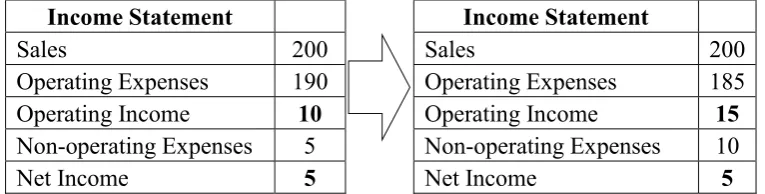
Classification shifting is the third tool to manage earnings. It was first introduced by McVay (2006) and it is defined as the deliberate misclassification of operating expenses to special items in order to inflate core or operating earnings without affecting the bottom line net income or loss. In addition to that, classification shifting may take the form of shifting of income-increasing special items such as gains on sale of assets and equity income on investment against operating expenses. Some businesses have used gains on sale of assets to offset operating expenses (Maremont & Bulkeley, 2002; McVay, 2006; Noh et. Al., 2017) this is done to decrease operating expenses and/or increase core earnings (Nagar & Sen, 2016). The mechanism of classification shifting can be illustrated by the following figure:
Income Statement Income Statement
Sales 200 Sales 200
Operating Expenses 190 Operating Expenses 185
Operating Income 10 Operating Income 15
Non-operating Expenses 5 Non-operating Expenses 10
Net Income 5 Net Income 5
Figure 1. Mechanism of classification shifting
Source: Chae& Nakano, 2015
Recently, research indicates that investors focus more on core earnings compared to total earnings because total earnings include non-recurring items which provide relatively little information that has less predictability about the future performance of the company (Bradshaw& Sloan,2002; Lougee & Marquardt, 2004) therefore, companies have significant incentives to misclassify core earnings. (Desai& Nagar,2016).
2015). Furthermore, classification shifting was proved to be practiced by UK firms, evidence suggested that large UK firms engage in classification shifting of core expenses to other non-recurring items to meet analysts' forecasts. (Athanasakou et.al, 2009; Athanasakou et.al, 2011; Zalata& Roberts, 2017)
So far, however, there has been little discussion about the motivations that encourage management to practice classification shifting. Like other Earnings management methods, classification shifting is always a means to an end, and uncovering the motives behind it is a key to explain it. This study is trying to answer the question about the factors that do encourage firms to shift core expenses to special items in order to inflate core or operating earnings, i.e. it is trying to explore the reasons, incentives, and motivations behind such practice. So, this study systematically reviews the data available about the above mentioned motivations, aiming to provide a comprehensive understanding of this practice.
2. Research methodology: a systematic review
A systematic review was employed in order to answer the question of this study; it was defined by Denyer & Tranfield (2009) as a specific methodology that locates and selects existing studies, evaluates contributions, analyses data, and reports the evidence in a way that allows reasonably clear conclusions to be reached. It is different from the traditional narrative literature review (Khan et.al., 2003), the difference stems from the fact that a systematic review is considered to be a research project on its own that pursues to answer a specific research question by secondary analysis of existing studies. Applying a systematic review is expected to produce sound and robust evidence that can be applied to different contexts. Additionally, it can contribute to identifying knowledge gabs or findings inconsistencies that indicate a need for further future research (Denyer & Tranfield, 2009)
The methodology of a systematic review that was adopted in this study, was applied according to the five-steps approach that was introduced by Denyer & Tranfield (2009), the detailed description of applying these steps is explained below:
2.1 Identifying the research question
The objective of the study was specified in the form of a clear, unambiguous question before beginning the review work. i.e. what are the motivations of managements to practice classification shifting?
2.2 Material collection
As the search for studies should be extensive, a comprehensive database analysis was performed. For this purpose, five major databases that include accounting-related journals were identified: EBSCO academic search complete database, Emerald e-journals premier collection, ELSEVIER databases, JSTOR digital library of academic journals, and ProQuest dissertations and theses.
2.3 Selection and evaluation
allowed identification of relevant themes and interpretation of several findings. To perform a comprehensive gathering of the most relevant articles related to classification shifting, all articles that contained the term "classification shifting" in its title or keywords were included. On the other hand, book reviews, editorial notes and comments were excluded, as well as duplicates, which were certain to happen as a result of searching multiple data bases. This process resulted in the selection of all available articles related to classification shifting published up to the year 2017, which totaled 47 articles.
2.4 Descriptive analysis and synthesis
This analysis aimed to arrange the individual results of the selected articles into consistent parts by describing how each article complements the other in terms of identification of the underlying motives of management to practice classification shifting. The descriptive analysis and synthesis of previous studies are discussed in detail in the next section; they resulted in the identification of the motivations for classification shifting. Several previous studies have attempted to explain the association between classification shifting and other research variables (for example, Abernathy et.al. 2014; Chae& Nakano, 2015; Desai& Nagar, 2016). Overall, these studies provide important insights into the reasons that encourage management to practice classification shifting. Depending on the results of those studies, motivations for classification shifting can be summarized and classified into the following:
2.4.1 Weak corporate governance
Strong boards of directors and audit committees play an important role in protecting shareholders' interests and providing them with credible financial statements free from manipulation (Zalata & Roberts, 2016). This role can be either direct, by analyzing or discussing the financial statements with management, or indirect because CEOs who anticipate boards' oversight will have their manipulation incentives reduced (Laux& Laux, 2009).
There is an unambiguous relationship between classification shifting and weak corporate governance.(Narayanaswamy et.al.,2012) found that weak corporate governance and investor protection in any country may encourage managers to practice classification shifting especially because of the fact that it is less costly and tough to be detected (McVay,2006). Evidence that earnings management; in particular classification shifting is more prevalent in countries with weak corporate governance was introduced by numerous studies (for example, Leuz et.al., 2003; Haw et.al.,2011; Behn et.al.,2013)
Zalata & Roberts (2016) found that classification shifting is less prevalent in firms whose boards comprise of more independent directors or more directors with long tenure. Moreover, it is less prevalent when audit committees are characterized by more meetings, more members with financial expertise, or more members with long tenure.
2.4.2 Ownership structure
Previous studies have reported that the components of the ownership structure have an impact on the tendency of firm's management to practice earnings management techniques.
According to the agency theory, the separation of ownership and control encourages managers to select and apply accounting techniques that can increase their own wealth (Ali et.al, 2010). (Fan& Wong, 2002; Ding& Zhang, 2007; Haw et.al., 2011) found that earnings management practices are influenced by ownership concentration because large shareholders tend to maximize accounting earnings in order to gain benefits in the future. Moreover, concentrated ownership creates agency conflicts between controlling owners and other investors. Controlling owners are perceived to report accounting information for self-interest purposes, causing the reported earnings to lose credibility to outside investors.
As for private versus state ownership, (Fan& Wong, 2002) found that privately owned firms prefer earnings boosting methods more than their state-owned counterparts because of the pressure to report a better-than-real financial performance to reassure the market.
In the same context, (Siregar& Utama2008; Noh, et.al, 2014) suggested that classification shifting is more likely in family businesses or firms belonging to business groups. If family firms and business groups dominate a country's business landscape, and company founders or promoters hold a lot of the firms' shares, there is a higher chance that management will shift core expenses to inflate operating income.
2.4.3 Financial distress
A number of researchers have reported that financially distressed firms are likely to report more special items, and are more likely to value pro-forma earnings (for example, Francis et. Al., 1996; Lougee& Marquardt, A. 2004; McVay, 2006; Johnson et.al., 2011). (Hodgson & Clarke, 2000) found that these firms that are characterized by high debt-to-equity ratios and higher magnitudes of special items are more likely to disclose pro-forma earnings in their press releases than other firms.
As noted by (Nagar& Sen, 2017), managers of financially distressed firms misclassify more core expenses to income-decreasing special items; such as goodwill impairments, settlement costs, restructuring costs, and write offs. They are also more likely to cut dividends to save cash, as compared to those of healthy firms. Moreover, substituting real earnings management with classification shifting was found to be more prevalent in firms which are in poor financial condition (Abernathy, 2014).Further, classification shifting is also more likely to be practiced by management when management's ability to engage in accruals-based earnings management is limited due to prior accruals manipulation.(Fan et.al, 2010; Abernathy, 2014)
accumulation of inventories (Troy, 2003). Such a constraint prevents firms from engaging in accruals-based earnings management (Fan et.al, 2010), and makes it possible that firms in the decline stage prefer earnings manipulation through classification shifting (Nagar & Sen, 2017).
The incentives of financially distressed firms to engage in core expenses classification shifting must be accompanied by the opportunity to do it. (Francis et. al., 1996; McVay, 2006; Johnson et. al., 2011) agreed that these firms are likely to have more opportunities to shift core expenses to income-decreasing special items as they report more of such items.
2.4.4 Low costs
Managers may be motivated to use classification shifting when it provides them with a lower cost method to inflate core earnings. Classification shifting makes it possible to managers to avoid both accruals- based earnings management that reverse in subsequent periods, and the forgone returns or increased costs of real business activities manipulation (Athanasakou et. al, 2009)
Managers often have the capacity to use all of the three forms of earnings management to achieve earnings targets, making trade-off decisions among them based on the costs, constraints, and timing of each form. (Abernathy et.al, 2014). When constraints are imposed on managers not to use accrual-based earnings management, or when the cost of accruals management is high, management is likely to substitute it with other manipulation methods that may have lower detection costs. (Cohen& Zarowin, 2010; Fan et. al, 2010)
2.4.5 The desire to meet or beat earnings benchmarks
A large and growing body of literature has investigated the importance of earnings benchmarks and found that firms which meet or beat earnings benchmarks earn higher stock return than other firms which fail to do so (Barton & Simko, 2002). Mangers seem to value operating earnings to a great extent and that is the reason why they tend to manipulate these figures. (Wieland et. al, 2013)
Due to the fact that core or pro-forma earnings are primary determinants of stock prices, they are preferred to be announced by management. This is because the exclusion of non-recurring special items by analysts, and higher persistence of operating income than non-operating income and special items. (Nagar& Sen, 2017)
A number of previous studies reported that a primary incentive to engage in classification shifting comes from management's desire to meet or beat earnings benchmarks like zero core earnings, prior-period core earnings, and analysts' forecasts, They also may have the desire to achieve positive surprises to analysts' forecasts (for example, Fan et. al, 2010; Athanasakou et. al, 2011; Haw et. al, 2011). Managers were found to engage in classification shifting prior to seasoned equity offerings in order to influence the investment decision of potential investors. (Siu& Faff, 2013)
practice classification shifting than other firms because they want to meet or beat analysts' forecasts. This is due to the fact that high-growth firms suffer more negative price shocks when they fail to meet analysts' forecast. (Skinner& Sloan, 2002) In addition to that,( Bartov et. al,2002 ) suggested that rewards (future stock returns) for meeting or beating analysts' forecasts are higher for financially distressed firms compared to financially sound ones because financially distressed firms convey their survival ability to market participants when they meet or beat earnings benchmarks.
2.4.6 Undetectability by external monitors
McVay (2006) argued that internal and external monitors are less likely to have concerns about the proper classification of expenses. Managers that have motivations to manage earnings may resort to classification shifting because it is less likely to be detected than accrual-based earnings management, this is due to the fact that classification shifting does not change the bottom-line net income, In addition to the fact that regulators or external auditors pay it less attention.( Zalata & Roberts, 2017).
However, even if regulators or external auditors would pay classification shifting much attention, firms with misclassified nonrecurring items may be suffering declining performance. Thus, despite being high, reported core income may still fall below either previous periods' figures, or relevant industry benchmarks (McVay,2006), which means that the improper categorization of expenses is not obvious to monitors.
It is known that high audit quality is associated with effective monitoring, which limits managers' ability to take opportunistic choices. It is established in the auditing literature that the better the audit technology, the better the detection of earnings management, the greater the penalties for them, the less are the incentives of management to manipulate the performance measures, and the larger the sensitivity to earnings components. This will make the overall perceived core earnings more revealing of production effort. (Joo& Chamberlain, 2016). As a result, auditors could act as a deterrent to earnings management. Prior research indicated that the presence of a big N auditor has a significant positive effect on the quality of reported earnings.( Knechel et. al, 2012)
However, the detection of classification shifting by auditors is tough, as managers may keep the documentation too general (McVay, 2006). As a result, auditors cannot always accurately verify the appropriateness of core expenses classification. (Chae& Nakano,2015).
As net income does not change when operating income is manipulated due to classification shifting, auditors may pay less attention to the identification and verification of these accounts. (Chae& Nakano, 2015), they also may exert fewer efforts to correct these misclassifications as they have no impact on the bottom-line profits. (Nelson et. al, 2002)
3. Discussion and implications
The purpose of the current paper was to highlight the motivations that may encourage managements of firms to practice classification shifting. It has systematically presented the state of empirical research on classification shifting and analyzed the motives of practicing it using a qualitative approach. As the aim of this study was to demonstrate and discuss the underlying motives and incentives that encourage management to practice classification shifting, a comprehensive search was performed in five major data bases that relates to business and accounting subjects, this search resulted in identifying 47 articles discussing classification shifting that were published in English journals up to the year 2017.
The most obvious findings to emerge from this study is that management may engage in classification shifting for the reason that it is less costly than other earnings management methods, the firm is in current or potential state of financial distress, management of the firm has the desire to meet or beat earnings benchmarks, the ownership structure of the firm has some characteristics that encourage management to engage in such a practice, the firm is performing in a weak corporate governance environment, or due to the fact that classification shifting is tough to be detected by external monitors. The results of this paper support the idea that , when surrounded by the suitable circumstances, managements tend to resort to classification shifting as one of less costly, paid less attention earnings management methods.
As classification shifting is a relatively new method as opposed to other earnings management methods, it would be beneficial to accounting researchers to get deeper understanding about it, in order to be better able to explore its association with other variables.
The above mentioned findings provide the following insights for future research: exploring whether firms' managements in certain countries engage in classification shifting or not, comparing classification shifting practices in developed versus developing countries, and statistically testing the association between classification shifting and each of the motivations highlighted in this paper. Beyond these potentially interesting aspects and suggestions for future research, the findings of this systematic review can be used as a guideline for standard setters, policy makers and regulators with the purpose of controlling the practices of earnings management generally, and particularly, classification shifting.
References
Abernathy, J. L., Beyer, B., & Rapley, E. T. (2014). Earnings management constraints and classification shifting. Journal of Business Finance & Accounting, 41(5-6), 600-626. https://doi.org/10.1111/jbfa.12076
Ali, S. M., Salleh, N. M., & Hassan, M. S. (2010). Ownership structure and earnings management in Malaysian listed companies: the size effect. Asian Journal of Business and Accounting, 1(2).
Athanasakou, V., Strong, N. C., & Walker, M. (2011). The market reward for achieving analyst earnings expectations: does managing expectations or earnings matter?. Journal of Business Finance & Accounting, 38(1‐2), 58-94. https://doi.org/10.1111/j.1468-5957.2010.02219.x
Barton, J., & Simko, P. J. (2002). The balance sheet as an earnings management constraint. The accounting review, 77(s-1), 1-27. https://doi.org/10.2308/accr.2002.77.s-1.1
Bartov, E., Givoly, D., & Hayn, C. (2002). The rewards to meeting or beating earnings
expectations. Journal of accounting and economics, 33(2), 173-204.
https://doi.org/10.1016/S0165-4101(02)00045-9
Behn, B. K., Gotti, G., Herrmann, D., & Kang, T. (2013). Classification shifting in an international setting: Investor protection and financial analysts monitoring. Journal of International Accounting Research, 12(2), 27-50. https://doi.org/10.2308/jiar-50439
Bradshaw, M. T., & Sloan, R. G. (2002). GAAP versus the street: An empirical assessment of two alternative definitions of earnings. Journal of Accounting Research, 40(1), 41-66. https://doi.org/10.1111/1475-679X.00038
Chae, S. J., & Nakano, M. (2015). The effect of classification shifting on analyst forecast accuracy: evidence from Japan. Hitotsubashi Journal of commerce and management, 25-35.
Cohen, D. A., & Zarowin, P. (2010). Accrual-based and real earnings management activities around seasoned equity offerings. Journal of accounting and Economics, 50(1), 2-19. https://doi.org/10.1016/j.jacceco.2010.01.002
Dechow, P., & Schrand, C. (2004). Earnings Quality, The Research Foundation of CFA Institute.
Charlottesville, Virginia.
Dechow, P., Ge, W., & Schrand, C. (2010). Understanding earnings quality: A review of the proxies, their determinants and their consequences. Journal of accounting and economics,
50(2), 344-401. https://doi.org/10.1016/j.jacceco.2010.09.001
Denyer, D., & Tranfield, D. (2009). Producing a systematic review. In D. A. Buchanan & A. Bryman (Eds.), The Sage handbook of organizational research methods (pp. 671-689). Thousand Oaks, CA, : Sage Publications Ltd.
Desai, N., & Nagar, N. (2016). A research note: Are auditors unable to detect classification shifting or merely not willing to report it? Evidence from India. Journal of Contemporary Accounting & Economics, 12(2), 111-120. https://doi.org/10.1016/j.jcae.2016.06.002
Dickinson, V. (2011). Cash flow patterns as a proxy for firm life cycle. The Accounting Review,
86(6), 1969-1994. https://doi.org/10.2308/accr-10130
Ding, Y., Zhang, H., & Zhang, J. (2007). Private vs state ownership and earnings management: evidence from Chinese listed companies. Corporate Governance: An International Review,
15(2), 223-238. https://doi.org/10.1111/j.1467-8683.2007.00556.x
https://doi.org/10.1016/S0165-4101(02)00047-2
Fan, Y., Barua, A., Cready, W. M., & Thomas, W. B. (2010). Managing earnings using classification shifting: Evidence from quarterly special items. The Accounting Review, 85(4), 1303-1323. https://doi.org/10.2308/accr.2010.85.4.1303
Francis, J., Hanna, J. D., & Vincent, L. (1996). Causes and effects of discretionary asset write-offs. Journal of Accounting Research, 117-134. DOI: 10.2307/2491429
Gunny, K. A. (2010). The relation between earnings management using real activities manipulation and future performance: Evidence from meeting earnings benchmarks.
Contemporary Accounting Research, 27(3), 855-888. https://doi.org/10.1111/j.1911-3846.2010.01029.x
Haw, I. M., Ho, S. S., & Li, A. Y. (2011). Corporate governance and earnings management by classification shifting. Contemporary Accounting Research, 28(2), 517-553. https://doi.org/10.1111/j.1911-3846.2010.01059.x
Hodgson, A., & Stevenson‐Clarke, P. (2000). Earnings, cashflows and returns: Functional relations and the impact of firm size. Accounting & Finance, 40(1), 51-74. https://doi.org/10.1111/1467-629X.00035
Johnson, P. M., Lopez, T. J., & Sanchez, J. M. (2011). Special items: A descriptive analysis.
Accounting Horizons, 25(3), 511-536. https://doi.org/10.2308/acch-10116
Joo, J. H., & Chamberlain, S. (2016). The Effects of Governance on Classification Shifting and Compensation Shielding. https://doi.org/10.1111/1911-3846.12331
Khan, K. S., Kunz, R., Kleijnen, J., & Antes, G. (2003). Five steps to conducting a systematic review. Journal of the royal society of medicine, 96(3), 118-121.
Knechel, W. R., Krishnan, G. V., Pevzner, M., Shefchik, L. B., & Velury, U. K. (2012). Audit quality: Insights from the academic literature. Auditing: A Journal of Practice & Theory,
32(sp1), 385-421. https://doi.org/10.2308/ajpt-50350
Laux, C., & Laux, V. (2009). Board committees, CEO compensation, and earnings management.
The accounting review, 84(3), 869-891. https://doi.org/10.2308/accr.2009.84.3.869
Leuz, C., Nanda, D., & Wysocki, P. D. (2003). Earnings management and investor protection: an international comparison. Journal of financial economics, 69(3), 505-527. https://doi.org/10.1016/S0304-405X(03)00121-1
Lougee, B. A., & Marquardt, C. A. (2004). Earnings informativeness and strategic disclosure: An empirical examination of “pro forma” earnings. The Accounting Review, 79(3), 769-795. https://doi.org/10.2308/accr.2004.79.3.769
Maremont, M., & Bulkeley, W. M. (2002). IBM is resolute on accounting cited by SEC. The Wall Street Journal.
core earnings and special items. The Accounting Review, 81(3), 501-531. https://doi.org/10.2308/accr.2006.81.3.501
Nagar, N., & Sen, K. (2016). Earnings management in India: Managers’ fixation on operating profits. Journal of International Accounting, Auditing and Taxation, 26, 1-12. https://doi.org/10.1016/j.intaccaudtax.2016.02.003
Nagar, N., & Sen, K. (2017). Classification shifting: impact of firm life cycle. Journal of Financial Reporting and Accounting, 15(2). https://doi.org/10.1108/JFRA-11-2015-0102
Nagar, N., & Sen, K. (2017). Do financially distressed firms misclassify core expenses?.
Accounting Research Journal, 30(2). https://doi.org/10.1108/ARJ-04-2015-0054
Narayanaswamy, R., Raghunandan, K., & Rama, D. V. (2012). Corporate governance in the Indian context. Accounting Horizons, 26(3), 583-599. https://doi.org/10.2308/acch-50179
Nelson, M. W., Elliott, J. A., & Tarpley, R. L. (2002). Evidence from auditors about managers' and auditors' earnings management decisions. The accounting review, 77(s-1), 175-202. https://doi.org/10.2308/accr.2002.77.s-1.175
Noh, M., Moon, D.& Parte, L. (2017). Earnings management using revenue classification shifting–evidence from the IFRS adoption period. International Journal of Accounting & Information Management, 25(3), 333-355. https://doi.org/10.1108/IJAIM-07-2016-0071
Noh, M., Moon, D., Guiral, A., & Esteban, L. P. (2014). Earnings Management Using Income Classification Shifting–Evidence from the Korean IFRS Adoption Period. working paper, Yonsei University
Roychowdhury, S. (2006). Earnings management through real activities manipulation. Journal of accounting and economics, 42(3), 335-370. https://doi.org/10.1016/j.jacceco.2006.01.002
Shirato, K., & Nagata, K. (2012). Earnings management through classification shifting under Japanese GAAP. Working paper (Tokyo Institute of Technology).
Siregar, S. V., & Utama, S. (2008). Type of earnings management and the effect of ownership structure, firm size, and corporate-governance practices: Evidence from Indonesia. The international journal of accounting, 43(1), 1-27. https://doi.org/10.1016/j.intacc.2008.01.001
Siu, D. T., & Faff, R. W. (2013). Management of core earnings using classification shifting
around seasoned equity offerings. Working paper,SSRN.
https://dx.doi.org/10.2139/ssrn.1928578
Skinner, D. J., & Sloan, R. G. (2002). Earnings surprises, growth expectations, and stock returns or don't let an earnings torpedo sink your portfolio. Review of accounting studies, 7(2), 289-312. https://doi.org/10.1023/A:1020294523516
Wieland, M. M., Dawkins, M. C., & Dugan, M. T. (2013). The differential value relevance of S&P's core earnings versus GAAP earnings: the role of stock option expense. Journal of Business Finance & Accounting, 40(1-2), 55-81. https://doi.org/10.1111/jbfa.12013
Zalata, A. M., & Roberts, C. (2017). Managing earnings using classification shifting: UK evidence. Journal of International Accounting, Auditing and Taxation, 29, 52-65. https://doi.org/10.1016/j.intaccaudtax.2017.04.001
Zalata, A., & Roberts, C. (2016). Internal Corporate Governance and Classification Shifting Practices: An Analysis of UK Corporate Behavior. Journal of Accounting, Auditing & Finance,
31(1), 51-78. https://doi.org/10.1177%2F0148558X15571736
Zang, A. Y. (2011). Evidence on the trade-off between real activities manipulation and
accrual-based earnings management. The Accounting Review, 87(2), 675-703.