Issues
ISSN: 2146-4138
available at http: www.econjournals.com
International Journal of Economics and Financial Issues, 2016, 6(S1) 74-80.
Special Issue for “Theory and Practice of Organizational and Economic Problems of Territorial Development and the Effectiveness of Social and Economic Systems”
Features of Formation and Development of Innovation Centers
Generate
Natalia N. Kulikova
1, Oksana N. Kolomyts
2*, Inna L. Litvinenko
3, Lira K. Gurieva
4,
Svetlana S. Kamberdiyeva
51Moscow Technological University, Moscow, Russian Federation, 2Kuban State Technological University, Krasnodar, Russian Federation, 3Moscow State University of Humanities and Economics, Moscow, Russian Federation, 4Financial University under
the Government of the Russian Federation (Vladikavkaz Branch), Vladikavkaz, Russian Federation, 5North-Caucasian Institute of
Mining and Metallurgy (State Technological University), Vladikavkaz, Russian Federation. *Email: [email protected]
ABSTRACT
Russia entered the new millennium with the hope to build an updated state with a competitive economy. Today, competitive advantage is determined by either the size of the country, nor the level of reserves of natural resources, or even the power of financial capital. It is obvious that in the coming years will thrive on those states that provide the most complete manifestation of the professional skills and talents of its citizens will be able to excel in the development of new knowledge and practical achievements, transforming them into the most advanced technologies and products. For this is supposed to use market mechanisms to ensure a quick update, implementation and wide dissemination of advanced technologies, increasing production of competitive products in the world market. The basis of structural changes is the state innovation strategy and an active scientific and technical policy of firms and regions, focused on promoting the development of advanced research and technology breakthroughs. Scientific and technical progress affects the scope and structure of production has a significant impact on the entire world economy.
Keywords: Innovation, Innovative Development, Sectors of Economy JEL Classifications: О31, O33, P14
1. INTRODUCTION
In today’s economy, activation of innovative processes at all levels of the public sector should promote purposeful state policy. To perform this task, the formation of the national innovation system (NIS), i.e., the system of relations between the elements of the national economic complex, providing economic development and growth of the quality of life on the basis of innovation lies in the exchange activities related to the generation, dissemination and application of innovation. The essence of the system is to create an innovative equal partnership of the government and business. The government supports science and technology sector and the education system, provides easy access to the results of scientific research in the public sector, and creates conditions for their commercial use, the necessary innovation infrastructure, the training of qualified personnel and the
legal framework to stimulate innovative entrepreneurship. Business takes on the commercial risk of the work on innovative products and services market. Important factors of this partnership is mutual trust and reliable guarantees that must be backed up by legislation. The aim of the NIS is to ensure the sustainable development of the economy through the effective use of intellectual potential, the generation, dissemination and implementation of new knowledge.
2. DISCUSSIONS
The authors of the concept of NIS is a large group of Western economists (Freeman, Lundvall, Nelson), who in 80-90 years XX century. Almost at the same time we laid the foundation for the modern theory of innovation and developed a common methodological principle: Adherence to the ideas of Schumpeter competition based on innovation and scientific research in corporations as a major factor of economic dynamics; recognition of the special role of knowledge in economic development; consideration of the institutional context of innovation as a factor directly influencing its content and structure.
The basis of the infrastructure of the NIS is an innovative technology centers, business incubators, technology parks. They are designed for the rapid transmission of developments in production, development of high-tech and competitive products.
The prerequisites for the formation of a NIS are: The exchange of innovative activity; innovative interests, consisting of aspirations to improve the socio-economic status through innovation and thirst for novelty, variety; innovative values, finding practical expression in the innovation strategies of firms, regions, state, etc.
The innovative system is formed under the influence of a variety of objective factors for the country, including its size, the availability of natural and human resources, especially the historical development of the state institutions and forms of business. These factors are the long-term determinants of the direction and speed of evolution of innovation activity. In addition, each NIS characterized by a certain structure and some degree of order, is
assumed to be stable institutional interaction (in this configuration
develops a national institutional elements in each country).
The most simple model describing the interaction of NIS elements, shows that the role of the private sector is to develop a technology based on its own research and market development innovation, the role of the state - in promoting the production of fundamental knowledge (universities) and a set of strategic (military) nature of the technology, as well as in the creation and infrastructure, and an enabling institutional environment for innovation by private companies. Within this overall pattern formed national features NIS: The greater or lesser role of the state and the private sector in carrying out these functions; the relative importance of large and small businesses; the ratio of basic and applied research and development; development dynamics and industry structure innovation (Sandu and Ryzhenkova).
3. RESULTS
Russia’s place in world investment process is not adequately available in the country’s intellectual and educational potential. Further preservation of the current situation is fraught with the loss of the growth prospects of national competitiveness in the world markets of high technology products, irreversible delay in the transition leading powers in the post-industrial lifestyles technology.
World experience shows that progressive social and economic development of the country and ensuring its competitiveness in the international market (to overcome the technological gap) is provided primarily by the presence of a developed environment “generation of knowledge,” based on a significant sector of fundamental research in conjunction with an effective education system, developed the NIS, an integrated state policy and normative legal security in the field of innovation.
The main prerequisites for the formation of such a model of development in Russia - with the absolute necessity of reforming them - saved:
• The presence of a significant sector of basic science (especially scientific organizations of the Russian Academy of Sciences (RAS) and other academies of science that have state status, the leading higher education institutions);
• Provision of applied research and technology development and implementation of scientific and technical results in production (system of state scientific centers of the Russian Federation, the industry research organizations, corporate science), the availability of competitive advantages of Russia in a number of key technology areas, particularly in the aerospace and nuclear industry;
• An effective system of education, as well as the practice of training and certification of highly qualified personnel; • The presence of certain basic elements of an innovative
structure - innovation and technology centers, technology transfer centers, technology parks (including at leading universities), funds that specialize in supporting innovative entrepreneurship, including public and private venture capital, and others.
At the same time further formation of the innovation system in Russia that meets the new realities and the prospects for long-term development of the country, faced with such systemic problems as: • The availability of low demand from the real economy in the
long-term - in terms of their commercial application - the results of scientific and technological activities. The major economic factors hindering innovation activity of the real sector of the economy are the lack of own funds for the expansion of this activity, the high cost of innovation, economic risk and long payback periods;
• The absence of developed legal and regulatory (legislative) framework for innovation, as well as measures of its state support, including direct (government funding) and indirect (tax preferences, state guarantees, etc.,) mechanisms; • The lack of effective mechanisms for the implementation of
certain state priority areas of science, Russian technology and engineering, general “blurring” of the list of critical technologies of federal significance, the multiplicity of scientific organizations that claim to the appropriate government support. The result becomes inefficient spraying budget and under-funding of research (of knowledge) in the promising fields of science, providing, including the competitiveness of Russia’s economy in the global market; • Lack of overall coordination of funded individual federal
the implementation of major scientific and industrial projects, as well as inventory and introduction of commercializing the results of scientific and technological activities, received from the federal budget, in related sectors of the real economy; • The weakening of cooperation ties between research
organizations, educational institutions and industrial enterprises, including at the levels of the system of reproduction of scientific personnel, organizational support chain applied research - development activity - production of training for specific areas of innovation;
• Low informational transparency of the innovation sphere, first of all, the lack of information about new technologies and potential markets fundamentally new (innovative) products, as well as - for private investors and lending institutions - about the objects of capital investment with potentially high returns; • Low level of development of small innovative businesses
(including, without legal personality);
• Availability of legal restrictions, not allowing the use of budgetary funds allocated to the RAS and branch academies, having state status, departmental and other public research organizations for the development of innovation, first of all, the creation of affiliated academic institutions individuals (innovative enterprises and innovation infrastructure Academies);
• Underestimation of the part of the government and management bodies (including the administration of the Russian Federation), the socio-economic importance of the development of innovative processes in the country, which leads to not always evidence-based selection of sectoral and regional priorities of technological development and, consequently, decrease the efficiency of use of budgetary funds (Rusko, 2011).
As a result, for the Russian innovation sector is still characterized by:
• Low level of innovation activity of a significant part of the real sector of the economy;
• The imbalance in the development and the lack of economic interaction between the individual elements of the innovation infrastructure, and as a consequence, inefficient transfer mechanisms of knowledge and new technologies to the domestic and international markets;
• Low capitalization of research results, and, as a consequence, the lack of appeal of scientific organizations and innovative enterprises as an investment and lending;
• Underdevelopment of economic and legal mechanisms for the introduction of the results of intellectual activity in the economy.
However, at the state level are all necessary preconditions for sustainable innovative development of the national economic system. Consequently, we can highlight some of the features in the formation of centers of generation of innovations in Russia. All innovation centers developed in strict sequence.
Stage 1: Concentration of resources (for this phase is characterized by building up the research capacity of the region and the formation of a good business climate here in the first place
for beginners and small companies, where innovation center is formed, overcoming the “Great Chinese Wall” between research centers and industry).
Stage 2: Formation of innovative ecosystems (i.e., the symbiosis of technology startups, small businesses, large high-tech business, folded stable clusters of high-tech companies, regional governments are moving to an active policy of support for innovative entrepreneurship and the creation of necessary infrastructure, carried out large-scale advertising and PR-campaigns to generate new brand the region as an innovation center).
Stage 3: Breakthrough (rapid growth of the turnover of large - anchor - companies and turning them into global players, a significant increase in the number of technology start-ups, the formation of venture capital market and risk-sharing mechanism for venture capital investors, for example through public-private partnership).
Stage 4: Mature development (created by innovative enterprises support infrastructure works efficiently, it is becoming more “technological” and scalable; there is a development of its own brand innovation center; integration into existing and creation of new production chains on the basis of international cooperation) (Grishankov and Naumov, 2012).
Nevertheless, there are several components of success in the formation and development of the center generating innovative developments:
• The importance of the territorial proximity of universities and research centers, as well as the formation of horizontal relations between the participants of the innovation system; • Effective PR-support, strong brand innovation center; • The political will and the availability of long-term
development strategy of the innovation center, which the state (or local authorities) are willing to systematically implement (“patient state”);
• A stable business model of the management company, the management company’s ability to ensure financial self-sufficiency and generate income;
• The independence of the management company from the founders of the innovation center (state universities) in the decision-making process, the formation of the governing bodies of the innovation center of professionals with business experience;
• The correct definition of a competitive niche innovation center in relation to other innovation centers;
• Attracting major high-tech corporations as part of the innovation ecosystem and anchor investors;
• Proper identification of priority activities (priority areas of technological development) taking into account local conditions and benefits (Grishankov and Naumov, 2012).
However, it should highlight the factors impeding the successful establishment and development of centers of generation of innovations:
• Excessive attention to the physical infrastructure to the detriment of non-material services, attracting strong frames and projects;
in the work of the management company;
• Insufficient attention to the formation of a strong PR and brand innovation center;
• Insufficient attention to the business training of researchers and students (insufficient involvement of the scientific and university centers in the enterprise);
• Commitment to the strategy of pushing technology to the market, the concentration of resources on projects that do not address the specific problems of consumers;
• Excessive attention to the development of technology and research and development to the detriment of resident companies’ business development and business environment;
• Error in determining the priorities of specialization and innovation center (Mayer, 2016);
• The creation of innovative infrastructure on the basis of abstract projections, rather than the real needs of existing and potential companies - residents of the innovation center, low adaptability of the infrastructure under the request of a particular company (Mullakhmetov et al., 2015);
• Excessively strong influence of the state (local authorities), universities (as a rule, they talked about the state universities) and academic institutions in the management of the innovation center (Grishankov and Naumov, 2012).
Centers generation of innovation as a place of concentration of companies related to the production of high-tech production, relatively or really young - the oldest of them, 40-old years. Nevertheless, analysis of the history of these innovation centers reveals in their development of four major phases:
• The stage of concentration of resources;
• The stage of transformation of the regional economy, which is an innovation center, and the formation of an innovation ecosystem;
• The stage of innovation and technological breakthroughs; • The stage of maturity of the innovation center.
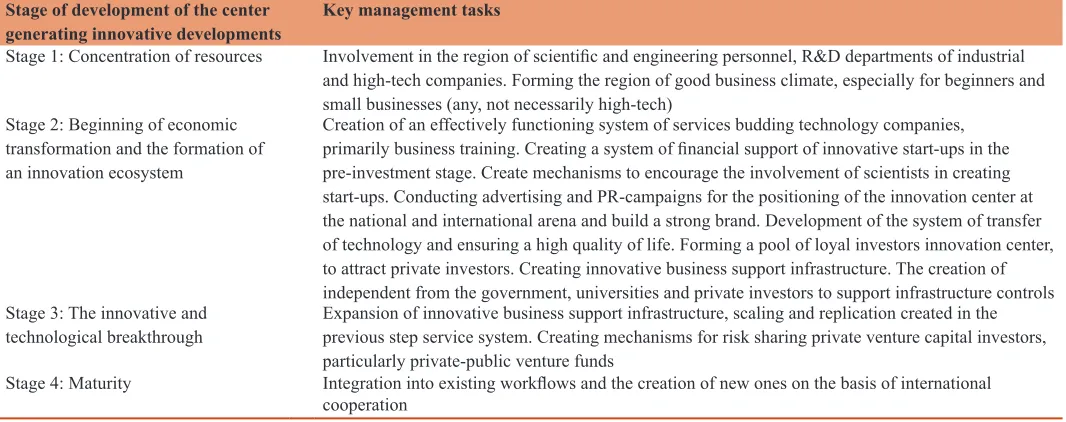
Of course, such a periodization is general in nature and should not be considered mandatory. Nevertheless, it can be useful as a kind of coordinate system for the generation of innovation center projects that are created in similar or at least do not have radically different conditions. Especially in the proven innovation centers at every stage hesitated a strictly limited number of priority management tasks, without the successful solution of which the following steps would be hardly possible. The content of these steps in more details present in the Table 1.
For all the variety of problems faced by the innovative enterprise in the different stages of development (Dobson, 2015), their technology solution, a kind of the building blocks of innovation infrastructure are grouped into six main blocks:
• Incubation of innovative start-ups; • Attracting external funding,
• Creation of an effective infrastructure of “TechnoPark;” • The organization of horizontal relations between the
participants of the innovation system; • Branding and PR;
• The creation of innovative control center officials.
Each of these technologies is made up of several other, more simple. Successful center generating innovative developments - The result of a combination of these blocks.
As an example of the center of innovation generating ideas can be represented by Center for generating ideas, based at the “TechnoPark” of the Chechen State University. The goal of implementing activities is the development of intellectual and innovative potential of young people of the Chechen Republic, the creation of competencies in young scientists in the field of invention, increasing interest in patenting their own development and results of intellectual activity, the formation of an effective training system using the most advanced international techniques.
Within the center of generation of innovations to create a platform, which is a laboratory of ideas generation, which brings together students of different specialties under a lead-coordinator and representative of the high-tech production. Lead coordinator chooses creativity techniques, explains its basic principles and techniques, and exercises control over execution. Task representative high-tech production put on the discussion of a technological or industrial real problem. Priority techniques at an early stage are: Brainstorming, the theory of inventive problem solving, Delphi method, literal thinking, Walt Disney method. As part of the center generating innovations envisaged that participants have knowledge and inventiveness of competences, which will lead to further development of projects based on BI CSU. With the commissioning of the physical infrastructure of the center generating innovation will be improved knowledge management and transfer of its base of development knowledge-based technological solutions. Center for generating innovation can also be used to implement a wide range of educational programs. The principles of the center:
• Attracting the leading experts in the field of creative thinking; • Encouraging the participation of business representatives in
the activities of the center generating innovations;
• Creation of an efficient infrastructure for the implementation of the center generating innovations;
• The professional choice of the direction of research, selection of partners and the leading coordinators;
• Support for generating innovation center with the regional authorities and agencies;
• Promotion of the generating center of mechanism innovation and scaling within the territory;
• Training for the operation of the network center for generating innovation (CHeTech, 2014).
Feature “TechnoParks” placement that their environment can be very different. If we talk about the origins of the “TechnoPark” structures, in the USSR, they were, in fact, academic and towns appeared at the new location. A large number of cities in the north and east of the country consists of the development of structures - “AkademGorodok” were based or on the basis of scientific center, or in the area of industrial development. Under the conditions of formation of “TechnoPark” structures can highlight some of the main forms of organization of industrial parks: 1. American (US, UK)
2. Japanese (Japan)
In the same manner the organization and characteristics of the formation they have distinctive features and ways of development. Generally, differences are guided by the level of development of the country, the methods of formation and urban planning, as well as on the economic situation. Consider the forms of organization of technological parks mentioned above (Remenny, 2011).
3.1. The American Model
In the US and the UK are three types of “science parks” stand at the moment:
• “Science parks” in the narrow sense of the word;
• “Research parks,” which differ from the first in that part of their innovations are developed only to the technical prototype stage;
• “Incubators” (in the US) and innovation centers (in the UK and Western Europe), under which universities “provide shelter” emerging companies, giving them a relatively moderate rents land, facilities, access to laboratory equipment and services.
The largest of the “science parks” USA - Stanford. He became the first technology park and has appeared in the US in 1949 on the basis of Stanford University (California). The idea was simple: Deliver the site of the university land rent applicable to companies for the deployment of their research units, which were combined with complex conditions for the development of research and development in advanced technologies from university laboratories and research groups. It is located on the university grounds, leased for a period of 51 year of “high-tech” companies cooperating with the University: The latter teaches a lot of research engineers. The park was declared filled in 1981-80 companies and 26 thousand workers employed in them. Among the companies - the three major US Geological survey offices, electronics giants (IBM, Hewlett Packard), aerospace company (Lockheed), chemical and biotechnology (Irac and Lopez, 2015).
“Science Park” or the “industrial park,” is for the development of high technology, knowledge-intensive firms. It is a kind of factory for production of small and medium innovative enterprises
risk. One of the most important functions of industrial park - the continuous formation of the new business and its support. Thus, the industrial park, or “Science Park” is the foundation of a business venture. A typical example of a “research park,” in which on land the university are not businesses and laboratories proper industrial companies and research non-commercial institutions that are closely related to the industry - Central Illinois Institute of Technology, a private US research center with a budget of about 68 million dollars a year. The ideal type of the research park is the oldest “science park” Scotland - Heriot-Uottsky: It is the only “science park” in Europe, which is only allowed to conduct research activities and banned mass production.
Since the beginning of the 80s in Western European countries it has spread to new countries this kind of technology parks, oriented to the needs of small “high tech” companies - innovation centers, similar to the American “incubators.” Their task - to connect ideas and inventions with capital and entrepreneurs to attract public and private funds to provide “starting period” new innovative companies.
Functions innovation centers cover different stages of the innovation process, in particular the promotion of the transition from pilot production to the commercial development of new products. This does not always need to create new businesses. Often innovation centers provide researchers, entrepreneurs help in the sale of a license for a new product already existing producers. A number of innovation centers are run by local authorities and a large part of the European network based in Brussels. It brings together around 40 innovation centers. Linking innovation centers in different countries, the European network of cross-country firms facilitates technology trade.
3.2. The Japanese Model
The Japanese model of “science parks,” unlike the American, involves the construction of entirely new cities - the so called “TechnoPolis,” focusing the research and pioneer in cutting-edge industries and high-tech manufacturing.
Table 1: Milestones and administrative problems of development of innovation centers generate
Stage of development of the center
generating innovative developments Key management tasks
Stage 1: Concentration of resources Involvement in the region of scientific and engineering personnel, R&D departments of industrial and high-tech companies. Forming the region of good business climate, especially for beginners and small businesses (any, not necessarily high-tech)
Stage 2: Beginning of economic
transformation and the formation of
an innovation ecosystem
Creation of an effectively functioning system of services budding technology companies, primarily business training. Creating a system of financial support of innovative start-ups in the pre-investment stage. Create mechanisms to encourage the involvement of scientists in creating start-ups. Conducting advertising and PR-campaigns for the positioning of the innovation center at the national and international arena and build a strong brand. Development of the system of transfer of technology and ensuring a high quality of life. Forming a pool of loyal investors innovation center, to attract private investors. Creating innovative business support infrastructure. The creation of independent from the government, universities and private investors to support infrastructure controls Stage 3: The innovative and
technological breakthrough Expansion of innovative business support infrastructure, scaling and replication created in the previous step service system. Creating mechanisms for risk sharing private venture capital investors, particularly private-public venture funds
“TechnoPolis” project - project of “TechnoPolis” - was adopted for implementation in 1982. As the creation of a “TechnoPolis” elected 19 zones uniformly scattered on the four islands. All the “TechnoPolis” must meet the following criteria: Be located no further than 30 min away from their “city-parents” (with a population of not <200 thousand people) and within one day’s drive from Tokyo, Nagoya and Osaka; occupy an area less than or equal to 500 square miles; have a balanced set of modern scientific and industrial complexes, universities and research institutions, combined with a comfortable life areas, equipped with cultural and recreational infrastructure; It is located in scenic areas and in harmony with local traditions and natural conditions.
35 miles northeast of Tokyo is “brain city” - Tsukuba. It lives of 11,500 people working in 50 public research institutes and 2 universities. In Tsukuba, are 30 of the 98 leading public research laboratories of Japan, making the town one of the largest research centers in the world. In contrast to the “TechnoPolis,” whose main goal - the commercialization of scientific research results, suggesting specialization in applied research works, Tsukuba - city of fundamental research, and the role of the private sector are low. Building “TechnoPolis” funded at the regional level - from local taxes and corporate contributions. The core of a number of “TechnoPolis” (Hiroshima, Ube, Kagoshima) is the construction of “science city” type of Tsukuba. Some are content with the expansion of scientific and engineering faculties of local universities. Most of the “TechnoPolis” create centers frontier technology - joint research incubators and venture business.
3.3. Mixed Model
An example of a mixed model of “science parks” focused on the Japanese and the American, can serve as a “scientific parks” of France, in particular, the largest of them, “Sophia Antipolis” (located on the Riviera, an area of over 2,000 hectares, in the middle of the 80 s the land. He was sold to companies and research organizations, and the maximum prescribed number of employees - about 6 thousand people).
The modern European model of industrial park has the following features:
• The presence of a building intended to accommodate the dozens of small firms (which contributes to the formation of a large number of new small and medium-sized innovative enterprises enjoying all the benefits of the collective system of services);
• The presence of several founders (this control mechanism is much more complicated mechanism with one founder, however, is much more effective, for example, in terms of access to finance).
In our country, yet there are no clear laws governing the formation of industrial parks within a given territory. But there is confidence that the country will go the way the relationship with universities or research institutes, which will improve the economic component of the university, will enable the development and application of new developments and technologies (Tsekhanovich, 2016). Universities that have a thorough enough base for the development and application know-how, as a rule, are located in the central part
of town where there are a large problem compaction construction. As a consequence, there is no possibility of “TechnoPark” structures (Kuleshova, 2013; Bondaletov et al., 2014).
4. CONCLUSIONS
Thus, generation of centers of innovation are an intermediary, which promotes a better use of science and put them into practice. As a rule, the centers generate innovations are created on the basis of technological parks. “TechnoPark” - A structure controlled by experts, the main purpose of which is to increase the welfare of the community by promoting the culture of innovation and competitiveness of innovative businesses and research organizations. To achieve these goals “TechnoPark” stimulates and manages the flow of knowledge and technology between universities, research institutes, companies and markets. It simplifies the creation and growth of innovative companies by means of incubation processes and elimination processes of new companies on the basis of existing ones. But the peculiarities of their formation are different. To this influence external factors, in particular the economic and political situation in the country, the rate of production and the development of industry, the state of the scientific areas, the prospects of development of the field of study, the human factor. Development of regional research centers that make up the “TechnoPark” focus today a gigantic scientific, industrial, technical, material capacity, a large number of people, hundreds of laboratory and production area. The distinguishing feature of such systems - constant development, growth and the inflow of new personnel, expansion of premises and territories, mobile rescheduling, the complexity of the internal organization. All this creates a number of problems and requires specific forms of their decision. The main critical issues:
• Bring the material and technical base of the complex into compliance with the requirements and objectives of science; • Creation of a complex system of spatial objects, corresponding
to the conditions and needs of the urban environment; • The planned deployment of new urban areas and industrial
parks in the implementation of the optimal places where science (proximity to universities and research institutes); • Competent placing “TechnoPark” environment in the
formation of a large city;
• Identification of ways of development of the complex, providing the flexibility and efficiency of the development.
The practical significance of the study lies in the possibility of using the results the regional authorities in the management of centers of generation of innovation in the region, part of the evaluation and development of the region’s industrial complex, development of institutional mechanisms for creating favorable conditions for innovation climate for enterprises in various industries in the redistribution of the region.
REFERENCES
Bondaletov, V.V., Medvedeva, N.V., Senicheva, L.V., Frolova, E.V., Santos, E. (2014), Local politics, business, people: Issues and cooperation strategies. Journal of Advanced Research in Law and Economics, 5(2), 63-73.
CHeTech. (2014), Center for the Generation of Ideas Opens its Doors. Available from: http://www.chetech.ru/tsentr-generatsii-idey.html. Dobson, S. (2015), Urban translations: Regeneration through the lens of
actor-networking. Local Economy, 30(8), 944-960.
Grishankov, D., Naumov, S. (2012), Guidelines for the Creation and Development of Innovation Centers (Technology and Law). Moscow, Hong Kong, Dedok, Lund, Montpellier, Oxford, Beijing, San Francisco, Singapore, Helsinki: Skolkovo, Expert RA. p144.
Irac, D., Lopez, J. (2015), Euro area structural convergence? A multi-criterion cluster analysis. International Economics, 143, 1-22. Kuleshova, G. (2013), The development of innovation centers and the
transformation of the urban environment as complementary resources.
Bulletin of the Russian Academy of Sciences, 83(7), 626-638. Mayer, H. (2016), Capital city dynamics: Linking regional innovation
systems, locational policies and policy regimes. Cities, 50, 206. Mullakhmetov, K.S., Nazmiev, E.F., Akhmetshin, E.M. (2015), Control in
the system of public administration in Russia. International Business Management, 9(7), 1732-1736.
Remenny, A. (2011), Effective TechnoPark. The Board of Directors of Siberia, 6(69), 7. Available from: http://www.sovetdirectorov.info/ 5613027/6271926/6271931/6311051/.
Rusko, R. (2011), The characteristics of the triple helix nexus in Finnish business incubation. International Journal of Techno Entrepreneurship, 2(3-4), 324.
Sandu, I., Ryzhenkova, N. (2015), Problems and Strategies for the Formation of Regional Innovation Systems. Moscow: Russian Scientific Research Institute of Agricultural Economics. p1-12. Tsekhanovich, A. (2016), Features of the spatial organization of science