Journal of Applied Linguistics and Language Research Volume 6, Issue 2, 2019, pp. 133-138
Available online at www.jallr.com ISSN: 2376-760X
* Correspondence: Somayeh Bavaqar, Email: S.bavaqar gmail.com © 2019 Journal of Applied Linguistics and Language Research
The Relationship between Self-Efficacy Perception of Iranian
Intermediate EFL Learners
’
Speaking and Oral Ability
Somayeh Bavaqar *
MA degree in TEFL, Islamic Azad University, Bandar Abbas, Iran
Abstract
This study investigated the relationship between self-efficacy perception of oral ability and speaking ability of Iranian intermediate EFL learners. The purpose of this study was to see whether there was any significant relationship between self-efficacy and speaking ability of learners or not. This study has been conducted to investigate differences, if any, in self-efficacy in speaking English among 20 learners from Islamic Azad University of Bandar Abbas, Iran based on gender during two different semesters. Research was conducted using a questionnaire adapted from previous research. The students perceived self-efficacy of speaking ability was measured using three constructs, namely ability, activity perception and aspiration. In general, the findings have shown that female students and male students tended to possess high levels of self-efficacy. The results also show that the students who have high efficacy tend to get higher score in oral performance test than those who have low self-efficacy. All in all, the students’ level of self-efficacy can influence their speaking ability or oral performance in the English language class. This study has some implications for syllabus designers to incorporate into the pedagogical language courses. This study has implications for both EFL as to the implications of the study for L2 research and pedagogy, it is suggested that, given the documented intricate reciprocity between the two levels of pragmatics research should attempt to approach pragmatic variability on the two pragma-linguistic and socio-pragmatic planes of language use in context.
Keywords: self-efficacy, oral ability, EFL learners
INTRODUCTION
learners often seem passive, and reluctant in speaking English in the classroom (Hamouda, 2012).
For people especially students to be able to speak English, they must first want to learn and believe that they can learn. Thus, they must have not only the motivation to learn but also the confidence in performing those practices and tasks. Hamouda (2012) highlights some factors that make students feel reluctant to speak English as a foreign language, namely anxiety, lack of interest in English class, shyness, low self-belief and confidence on their speaking capability.
Since one of the most important factors to control students in speaking English is their belief and confidence on their capability, or the so called self-efficacy as defined by Bandura (1995, p.2) which said that self-efficacy is “the belief in one’s capabilities to organize and execute the course of action required to manage prospective situations”. In
other words, self-efficacy can be seen as the confidence that people have in their ability to do the things they try to do, accomplish the goal and perform task competently (Dornyei, 2005). It is believed that self-efficacy can determine what people think or behave, as well as the choices they make in particular situation (Bandura, 1994). Thus, the belief that students have about their ability to speak can either encourage or make them hesitate to speak English in front of others in the classroom.
Self-efficacy refers to a person’s beliefs concerning his or her completion of a task and
perceived competency level in performing the task (Bandura, 1977). Self-efficacy is
believed to play a key role in the learning process by helping or hindering a learner’s progress (Bandura, 1984). Bandura further proposed that a person’s attitudes, abilities,
and cognitive skills comprise what is known as a ‘self-system’. This system plays a major
role in how one perceives situations and how one behaves in response to demanding
situations. A person’s belief in his or her ability to succeed in a particular situation forms
an essential part in this self-system. Thus, self-efficacy can have an impact on everything from psychological states to behavior and motivation. This study seeks to find out whether there is any significant relationship between self-efficacy and speaking ability of learners.
In this research, we attempt to answer the following questions:
▪ Is there any difference in self-efficacy in speaking English between intermediate learners?
Hypothesis is a temporary prediction that can be proved. It can also give some direction in conducting research and how to solve the problems. In this research it assumes an
alternative one that there is a significant relationship between students’ self-efficacy and their speaking ability.
METHODOLOGY
Participants
The participants of the study comprised 20 learners from Islamic Azad University of Bandar Abbas. They are chosen through purposive sampling. A total of 10 male and 10 female students are randomly chosen in this study.
Instruments
The collected using a 23-item 5 point Likert scale questionnaire designed by Hairuzila and Subarna (2007) which was adapted from Bandura (1990) and Mikulecky, Lloyd and Huang (1996). The questionnaire comprised four sections. Section A contains demographic information of the respondents such as gender, level of education, age and level of study. While Section B on group ability consisted of 14 items that focus on
students’ perception of their ability to speak in English. Items in this group measure
attributes such as ability to participate in discussions conducted fully in English, ability to communicate with lecturers and international students and ability to speak in English with peers. Section C measures grouped activity perception comprising 6 items which
address students’ perceptions on activity that require them to speak in English such as group discussion, role play and oral presentations. The final part of the questionnaire,
Section D, consisted of 3 items that measures student’s aspiration with respect to
speaking in English. Students responded to a 5-point Likert-scale ranging from ‘Strongly Agree’ to ‘Strongly Disagree’.
RESULTS
This section highlights the findings of the study. In this study, the mean score of 3.0 and below represents high self-efficacy while a mean of 3.1 to 5.0 signifies low self-efficacy. The first objective is on a comparison of self-efficacy between male and female students. Table 1 shows the mean score for male and female students on three dimensions: ability, attitude and aspiration. It revealed that the students in the present study possess low self-efficacy beliefs on all three dimensions. The results indicated that self-self-efficacy of female students (mean =3.32) was significantly higher than male students (mean=3.75) in terms of ability.
Table 1. Mean scores for male and female students by self-efficacy domains Dimension Female Male Mean Mean
Ability 3.32 3.75 Attitude 3.30 3.41 Aspiration 3.52 3.66
This finding on gender differences is similar to a number of previous studies on the relationship between gender and self-efficacy. Pajares (1996) found that female students exhibit higher self-efficacy in areas related to language.
female students showed higher self-efficacy levels compared to male students by ability dimension. This shows that female students are more confident than male students in speaking in English.
Meanwhile, the findings showed that there were slight differences in term of attitude and aspiration perception for both groups. This might be because the activities conducted such as group discussion and role-play are part of their course assessment. Therefore, the students found the activities relevant because these activities contribute some weight on their grades.
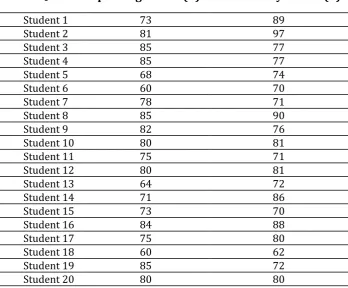
Table 2. Speaking and Self-efficacy Scores
Participants Speaking Scores (X) Self-efficacy Scores (Y)
Student 1 73 89
Student 2 81 97
Student 3 85 77
Student 4 85 77
Student 5 68 74
Student 6 60 70
Student 7 78 71
Student 8 85 90
Student 9 82 76
Student 10 80 81
Student 11 75 71
Student 12 80 81
Student 13 64 72
Student 14 71 86
Student 15 73 70
Student 16 84 88
Student 17 75 80
Student 18 60 62
Student 19 85 72
Student 20 80 80
According to table 2, the average score of the students’ self-efficacy questionnaire is 76,09. The median score is 75,50. The mode is 70. The highest score of self-efficacy is 97 while the lowest score is 62.
DISCUSSION
In general, the findings have indicated that female students and male students tended to possess high levels of self-efficacy. Language educators must be aware of factors that would contribute to the perceived speaking ability of these students and the reasons behind them so that they can be helped in facing any problems in the future. By increasing
Thus, as Dodds (2011) has explained before, the students’ self-efficacy can give positive impact on their speaking test and performance, as proved by the findings above. In line
with this, Bandura explained that “what people think, believe and feel affects how they behave” (p.19). Thus, it is true that students’ psychological factor such as self-efficacy or self-confidence will influence how they behave and perform.
CONCLUSION
The findings of this present study provide several pedagogical implications for lecturers wishing to produce confident speakers of English language. Increasing students’ self -efficacy might be useful as it involves a complex interface of behaviors, cognitions, and affect. According to Idrus and Saleh (2008), if lower levels of self-efficacy are identified among students, appropriate actions should be carried out to help boost students’ self -efficacy levels through verbal persuasion and encouragement. Persuasion is one of the four sources of self-efficacy listed by Bandura (1990) Therefore, it is important for teachers to give positive feedback and encouragement to enhance students’ self-efficacy in oral communication.
Students who show low self-efficacy tend to struggle to complete a task. They will find it hard to do, leading to frustration. Thus, having lectures and discussions in class helps them understand the nature of working in a group. In addition, students should be exposed to successful role models such as peers and lecturers. According to Schunk and Swartz (1991), students will learn more by watching successful peer role modeling than teacher role modeling, because students can identify more readily with their peers. Using their peers as a role model will make them more comfortable. Therefore, students should be given chances to observe their friends perform a task successfully, as these will help learners to foster positive beliefs about themselves (Nair et al., 2012).
Moreover, lecturers should be aware that all three elements, namely ability, activity
perception, and aspiration must be taken into consideration in enhancing students’ self -efficacy level in speaking English. These three elements may be integrated with teaching and assessing students.
REFERENCES
Abdullah, K.I., 2001. English for Specific Purposes in 35(1): 47-57. Malaysia: International influence, local flavour. 24. Southeast Asian Journal of Education, 2(2): 345-361. Bandura, A. 1977. Self-efficacy: Toward a unifying theory of behavioral change.
Psychological review. 84, 191- 215. http://dx.doi.org/10.1037/0033-295X.84.2.191
Bandura, A. 1984. Recycling misconceptions of perceived self-efficacy. Cognitive Theraphy and research, 8, 231-255.
Bandura, A. 1990. Conclusion: Reflections on notability determinants of competence. In R. J. Stenberg & J. Kolligian, Jr. (Eds.), Competence considered, pp. 315-362. New Haven &London: Yale University Press.
Hairuzila, Idrus. &Sivapalan, S. 2007. Perceived self-efficacy of ESL students with regard to their oral communication ability. Paper presented in International Conference on Social Sciences and Humanities 2007. Bangi, Malaysia.
HairuzilaIdrus &Rohani Saleh. 2008. Perceived self-efficacy of Malaysian ESL engineering and technology students on their speaking ability. The English Teacher, 37, 61-75. Huang, S. C., & Chan, S. F. (1996). Self-efficacy of English as a second language learner: An
example of four learners.
Kim, J. &Lorsbach, A. W. (2005). Writing self-efficacy in young children: Issues for the early grade environment. Learning Environments Research, 8, 157-175.
Mikulecky, L., Llyod, P. & Huang, S. C. 1996.Adult and ESL literacy learning self-efficacy questionnaire. ERIC#: ED394022
Nair, S. et al. 2012. Malaysian graduates English Adequacy in the Job Sector. Asian Social Science, 8(4), 143-147.
Pajares, F. 1996. Self-efficacy beliefs in academic settings. Review of Educational Research, Vol. 66, 543-578.
Pendergrass, N., Kowalczyk, R., Dowd, J., &Laoulache, R. 2001. Improving first year engineering education. Journal of Engineering Education. 90 (1), 33-41.
Prahbakar, B. (2004). The paradox of soft skills versus technical skills in hiring. The Journal of Computer Information Systems. Retrieved 15 May 2014 from
http://www.allbusiness.com/technology/1163965-1.html
Rahil Mahyuddin, Habibah Elias, Loh Sau Cheong, Muhd Fauzi Muhamad, Nooreen
Noordin and Maria Chong Abdullah. 2006. The relationship between students’ self -efficacy and their achievement. Jurnal Pendidik dan Pendidikan, Jil, 21, 61-71. Raoofi, S., Tan, B. H., & Chan, S. H. 2012. Self-efficacy in Second /Foreign language
Learning contexts. English Language Teaching, 5(11), 60-73.
Shell, D., Murphy, C & Burning, R. 1989. Self-efficiency and outcome Expectancy Mechanisms in Reading and Writing Achievement. J. Educ. Psychol. 81: 91-100. Wong, S. L. 2005. Language learning strategies and language self-efficacy. Investigating