www.ijtrd.com
Artificial Intelligence Techniques for Controlling PV-
Wind Powered Rural Zone in India
1
Sourabh Kumar and
2Somesh Chaturvedi,
1,2Career Point University
Abstract - In remote areas, electricity could still be available if stand-alone renewable electricity power sources are used. One of the most promising applications of renewable energy technology is the installation of hybrid energy systems, where a cost of grid extension is prohibitive and the price of fuel increases drastically with the remoteness of the location. It has been demonstrated that hybrid energy systems are significantly reduce the total life cycle cost of stand-alone power supply, while at the same time providing a more reliable supply of electricity .Due to the high nonlinearity characterizing the PV Wind hybrid system it would be impractical to develop rigorous mathematical model and at the same time obtain a simple and effective controller.
In this paper, a control system, which includes either the Neural Network Controller (NNC) or the Fuzzy Logic. Controller (FLC) controller is developed for achieving the coordination between the components of a PV-Wind hybrid system as well as control the energy flows. The performance of the system is evaluated by comparing the performance of the system using the NNC and the FLC. Also, this work presents a complete mathematical modeling and MATLAB simulink model for the different components of the hybrid system.
I. INTRODUCTION
Artificial intelligence (AI) techniques are becoming useful as alternate approaches to conventional techniques or as components of integrated systems. They have been used to solve complicated practical problems in various areas and are becoming more and more popular nowadays. AI-techniques have the following features: can learn from examples, are fault tolerant in the sense that they are able to handle noisy and incomplete data, are able to deal with non-linear problems, and once trained can perform prediction and generalization at high speed. AI-based systems are being developed and deployed worldwide in a myriad of applications, mainly because of their symbolic reasoning, flexibility and explanation capabilities. AI have been used and applied in different sectors, such as engineering, economics, medicine, military, marine, etc.
They have also been applied for modeling, identification, optimization, prediction, forecasting, and control of complex systems. Nowadays, considerable attention has been focused on use of artificial neural network (ANN) on system modeling and control applications. Neural networks, with their remarkable ability to derive meaning from complicated or imprecise data, can be used to extract patterns and detect trends which are too complex to be noticed by either humans or other computer techniques. A trained neural network can be thought of as an "expert" in the category of information it has been given to analyze. The ANN has several key features include Adaptive learning and Self-Organization. Also NNs are characterized by the rapidity of response and robustness, which make them attractive to control. Recently the concept of fuzzy logic control (FLC) has been employed in many industrial applications. The use of FLC significantly changes the control approach compared with that of conventional control approaches. A conventional controller adjusts the
system control parameters on the basis of an accurate mathematical model of the process dynamics. In the case of a fuzzy rules-based expert system, it is a logical model of the human behavior of the process operator (linguistic information). Also FLC usually leads to better results than those of the conventional controllers, in terms of response time, settling time and robustness. The emphasis of this paper is concerned with the control of the energy flow of PV-Wind hybrid system using either the NN or the FL techniques. The PV-Wind hybrid system is applicable in three buildings (i.e. school, home & emergency hospital) in a remote area in the Eastern Desert for supplying the required electrical loads.
II. REVIEW OF AI TECHNIQUES
Artificial Intelligence (AI) has been defined as the 377Artificial Intelligence Techniques for Solar Energy and Photovoltaic program that assimilates and reasons with knowledge obtained from some expert(s) with a view to solving problem(s) or giving ad-vice. Thus expert systems are software packages which translate human expertise into computer programs. Portability of software makes the use of expert systems very attractive where human expertise is scarce or costly or is likely to be lost through mobility. Applications of AI techniques to power and renewable energy systems has been an active area of research for over three decades and significant successes have been achieved. Among the AI techniques, artificial neural networks, fuzzy logic, expert or knowledge based systems have been the most successful.AI techniques play an important role in mode-ling, analysis and prediction of the performance and control of renewable energy processes
.
A. Artificial Neural Networks
Artificial Neural Networks (ANNs) are information-processing systems inspired by models formulated from the workings of the brain. An ANN consists of interconnected layers of neurons or processing elements. Information is passed between these units along the interconnections.
To achieve the desired relationship between the input and output of a network, values must be derived for the connection weights and the activation functions. The process of this derivation is called supervised training. ANNs while implemented on computers are not programmed to perform specific tasks.
B. Multi-Layer Perceptron (MLP)
www.ijtrd.com
Fig 2.1: A simple processing element
The processing units in an ANN are interconnected by links (synapses) with weights. The network has an input layer, an output layer and any number of hidden layers (usually one or two). A neuron is linked to all neurons in the next layer, as shown in Figure 2.2.Neuron x has n inputs and one output:
𝑦(𝑥) = 𝑓 𝑤𝑖𝑥𝑖 𝑛
𝑖=0
Where𝑤0, 𝑤𝑛 are the input weights and f is the non-linear activation function (Krishnamoorthy and Rajeev, 1996; Pham and Liu, 1995), usually a step function or a sigmoid. The step function output is y = 1 if x ≥ 0, and 0 otherwise. The sigmoid function, more commonly used, is asymptotic about 0 and 1 and anti-symmetric about (0, 0.5):
𝑓 𝑥 = 1
1 + 𝑒𝑥𝑝 −𝛽𝑥
However, as an assembly of neurons, a neural network can learn to perform complex tasks including pattern recognition, system identification, trend prediction and process control (Belu et al., 2003; Chen et al., 2008; Kalogirou, 2001; Kalogirou, 2007). Data are presented to the neural network via input layer, while the output layer holds the response of the network to the input. All hidden and output neurons process their layer input by multiplying each input by its weight (1), summing the products, and then processing the sum via activation (transfer) function to generate a result. Information flow is unidirectional in feed-forward ANNs, with no cycles, but in both directions in feedback ANNs so they have cycles, by which their states evolves to equilibrium (Fuller, 2000; Kalogirou, 2001). In a multi-layer perceptron (MLP), perhaps the most common type of feed-forward networks, input signals are propagated in gradually modified form in the forward direction, finally reaching the output layer.
Fig 2.2: An example of an artificial neural network
C. Radial Basis Function (RBF)
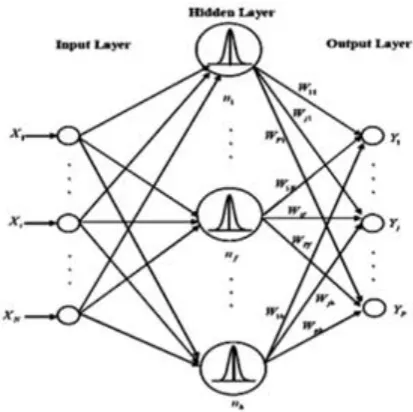
The RBF network is a type of network that is very useful for pattern classification (Belu et al., 2003; Tefler and Kadambe, 1992). Figure 2.3 shows the structure of a RBF network consisting of three layers of neurons.
The input layer neurons receive the input pattern (𝑥 1 to𝑥𝑁 ). The hidden layer neurons provide a set of activation functions that constitute an arbitrary “basis” for the input patterns in the input space to be expanded into the hidden space by the way of nonlinear transformation. At the input of each hidden neuron, the distance between the center of each activation or basis function and the input vector is calculated.
He basis function is generally chosen to be a standard function which is positive at its centre x =0, and then decreases uniformly to zero on either side. A common choice is the Gaussian distribution function.
The output of the RBF network 𝑦𝑗 is given by:
Where 𝑤𝑗𝑖is the weight of the hidden neuron i to the output j,
𝑐𝑖 Is the centre of the basis function i,
σ𝑖 Is the spread of the function, And K(x) is the activation function.
The purpose of training an RBF network is to determine the neuron weights 𝑤𝑗𝑖, RBF centres 𝑐𝑖 and spreads σ𝑖that enable the network to produce the correct outputs 𝑦𝑗corresponding to the input patterns x. The training of an RBF network involves the minimization of an error function.
Fig 2.3: Topology of an RBF network (adapted from Chen et al., 2008)
D. Fuzzy Logic
Fuzzy logic is a form of multi-valued logic derived from fuzzy set theory to deal with reasoning that is approximate rather than precise. In contrast with “crisp logic”, where binary sets have binary logic, fuzzy logic variables may have a truth value that ranges between 0 and 1 and is not constrained to the two truth values of classic propositional logic (Zadeh, 1965). Furthermore, when linguistic variables are used, these degrees may be managed by specific functions.
www.ijtrd.com
form of IF-THEN-ELSE statements. Fuzzy logic and fuzzycontrol feature a relative simplification of a control methodology description. This allows the application of a “human language” to describe the problems and their fuzzy solutions. In many control applications, the model of the system is unknown or the input parameters are highly variable and unstable.
Fuzzy logic techniques have been successfully applied in a number of applications like, computer vision, decision-making and system design including ANN training. The most extensive use of fuzzy logic is in the area of control, where examples include controllers for cement kilns, braking systems, elevators, washing machines, hot water heaters, air-conditioners, video cameras, rice cookers and photocopiers. Fuzzy logic has been used for the solar radiation prediction (Mellit et al., 2009) and for the development of a solar tracking mechanism (Kalogirou, 2007).
Fig 2.4: The main components of a fuzzy system
III. HYBRID SYSTEMS
Hybrid systems combine more than one of the technologies introduced above, either as part of an integrated method of problem solution, or to perform a particular task that is followed by a second technique, which performs some other task.
On the other hand, in design, control and operation of renewable energy systems, such as PV or solar-thermal energy systems, a detailed long-term series of meteorological data such as solar radiation, temperature or wind data is normally required. The effort is to design and operate systems that can make an efficient conversion and utilization of these renewable energy resources.
A. Fuzzy Neural Networks
Neural networks can be modified to incorporate fuzzy techniques and produce a neural network with improved performance. One approach is to allow the fuzzy neural network to receive and process fuzzy inputs. Another option is to add layers on the front end of the network to fuzzify crisp input data to the fuzzy neural processing (Fuller, 2000; Tefler and Kadambe, 1992). The fuzzy neuron is a fundamental concept used in many approaches to integrate fuzzy and neural technologies. In networks that map fuzzy input to crisp output, nodes in every layer of the network can have modified neurons.
B. Wavelet and Neural Networks
Wavelet Neural Networks (WNNs) is an approach towards the learning function. Wavelet networks, combining the wavelet theory and neural networks, utilize wavelets as the basic function to construct a network. A wavelet function is a local
function and influences the network’s output only in some local range.
The WNN shows surprising effectiveness in solving the conventional problems of poor convergence or even divergence encountered in other kinds of neural networks. The WNN consists usually of three layers. The detailed description of the calculation steps of WNN are explained in Telfer and Kadambe (1992).
Fig 3.1: The first model of fuzzy neural system
Fig 3.2: The second model of fuzzy neural system
C. Conventional methods for PV system seizing
Power output of a solar energy system varies according to the irradiation and global system functioning conditions. In any solar energy and PV system, sizing represents an important part of the system design. The optimal selection of the number of solar cell panels, collector selection, the size of the storage battery and the size of wind-generator to be used for certain applications at a particular site is an important economical task for electrification of villages in rural areas, telecommunications, refrigeration, water pumping, and water heating, etc. Besides being an economic waste, an oversized system can also adversely affect further utilization of the solar cells and the pollution-free PV energy.
1. AI Techniques for Seizing PV Systems
A comprehensive overview of the application of AI techniques in the PV-systems sizing is presented in next subsections of this chapter. Conti et al (2002) proposed one of the first applications of the AI techniques in the PV system sizing. It consists of an automatic procedure to perform the optimal sizing of a stand-alone solar electrical system with battery storage is developed by a FL based multi-objective optimization approach. The procedure aims at finding the configuration that yields the best compromise for the two considered objectives: the long-term average performance and the overall cost of the generating system.
www.ijtrd.com
These optimal sizing combinations allow to the users ofstand-alone PV systems to determine the number of solar panel modules and storage batteries necessary, to satisfy a given consumption, especially in isolated sites where the global solar radiation data is not always available.
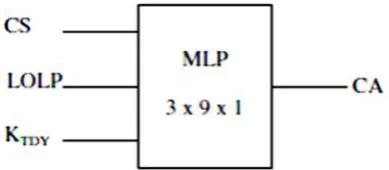
A developed model combines a Multi-Layer Perceptron (MLP), wavelets and infinite impulse response (IIR) filter. The wave-net model has been trained by using 200 known sizing coefficients data corresponding to 200 locations.
Fig 3.3: MLP architecture for the obtaining of the LLP curves (Adapted from Hontoria et al. 2006)
IV. SYSTEM DESCRIPTION AND MODELING
It consists of a PV generator, battery bank and wind turbine. An overall power management controller is designed for the system to coordinate the power flows among the different energy sources.
Fig 4.1: Proposed Control system of the hybrid PW/wind system
A. The Photovoltaic Array Model
The output current of the PV array consisting of several PV modules can be expressed as
𝐼𝑃𝑉 = 𝑀𝐼𝑙− 𝑀𝐼0 𝑒𝑥𝑝
𝑞 𝑁𝑉𝑃𝑉+𝐼𝑃𝑉𝑀𝑅𝑆𝑁
𝑁𝐴𝐾𝑇𝐶
− 1 𝑁𝑉𝑃𝑉+
𝐼𝑃𝑉𝑅𝑆𝑁
𝑀 𝑁𝑅𝑆
𝑀
Where IPV: output current of panel (A),
I1: light generated current per module (A),
I0: reverse saturation current per module (A),
M: number of module strings in parallel, N: number of modules in each series string, VPV:terminal voltage for module (V),
Rs: diode series resistance per module (ohms),
Rsh:diode shunt resistance per module (ohms),
q: electric charge (1.6 10–19 C),
k: the Boltzmann constant (1.38 10– 23 J/K), A: diode ideality factor for the module,
This model expresses Isc as a function of solar irradiance and
temperature.
I1 = Isc = P1 G [1 – P2 (G-Gr) – P3 (Tc– Tr)]
Where P1, P2, P3:constant coefficients for Isc,
Gr:reference solar irradiance (W/m2),
G: solar irradiance (W/m2), and Tr:reference temperature (K).
Normally, 1000 W/m2 and 298 K are selected as the reference solar irradiance and reference temperature, respectively.
The reverse saturation current is a small current flowing back through the PV arrays all the time. To estimate this current, an exponential expression which is a function of cell temperature is used
𝐼0= 𝐵𝑇𝐶3 𝑒𝑥𝑝 −
𝐸𝑔0
𝐾𝑇𝐶
Where Eg0:band gap energy at 0 K (1.16 eV for silicon)
and B :a material constant which has to be estimated by using both the manufacturer’s data and the I-V curve characteristic of PV module.
Table 4.1: PV module coefficients used in the PV array model
Coefficient Values Diode factors(A) 38.59 Series resistance (Rs) 2.58 ohm
Shunt resistance (Rsh) 250 ohm
Total surface area of the PV module (Sp)
0.617 m2
Total surface area of cells in module (Sc)
0.5625 m2
Coefficient of ISC
P1 P2 P3
4.1*10-3 m2/V -3.73*10-4 m2/W
-2.44*10-3 K-1 Coefficient of I0(B) 7100 A/K
3
Module efficiency at reference 12% Effective thermal capacity of
the PV module (mCp module)
9250 J/K Temperature coefficient (γ) 0.0045 K-1 Overall absorption coefficient
(αabs)
0.73
B. Discharge voltage modeling
The current and voltage during discharge case can be described in terms of the soc of the cell (ranging from 0 to 1.0) by
𝑉𝑏𝑑 = 𝑉𝑟 −
𝐼 𝐴𝐻
0.189 𝑠𝑜𝑐 + 𝑅𝑖
Where soc is the ratio of the charge at the time of interest to the maximum charge. The other symbols are defined as follows:
Vr=2.094[1.0-0.001(T-25°)]
Where Vr is the rest voltage (V)
V is the terminal voltage (V) I is the current (A)
AH is the ampere-hour rating of the battery for the discharge rate,
Ri= 0.15[1.0 − 0.02(Tair− 25°C)]
Is the internal resistance of the cell (Ω) Tair is the ambient temperature (°C).
www.ijtrd.com
V. CONTROL STRATEGY
During this operation of the hybrid PV/wind system, different situations may appear:
1The total current generated by the PV and Wind generators is greater than the current needed by the load.
In this case, the energy surplus is stored in the batteries and the controller puts the battery in charge condition. When the battery soc reaches a maximum value, the control system stops the charging process.
2.The total PV and wind generators current is less than the current needed by the load, the energy deficit is covered by the storage and the controller puts the battery in the discharge condition. If the battery capacity decreases to their minimum level, soc min, the control system disconnects the load and the energy deficit
3. In case of inverter input and total power equality, the storage capacity remains unchanged.
The NN controller is designed to give three outputs; these are as given the controller output current ΔIbattery, the PV Array
switching, the wind turbine switching. It is cleared that the used PV is able to generate electricity, whenever there is solar illumination; where the electric power is proportional to the incident insolation level. The wind turbine begins to produce output when the wind speed is greater than the cut-in speed until furling speed vf is reached, at which point the machine
shuts down. Off line training for the proposed NNC was applied.
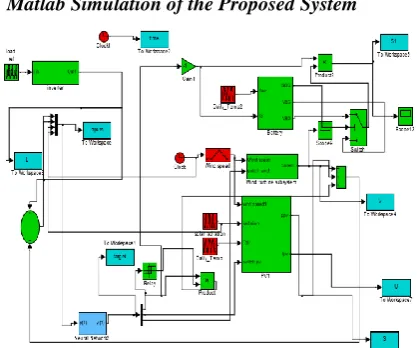
A. Matlab Simulation of the Proposed System
Fig 5.1: The simulink block diagram of the electrical system with NNC.
Fig 5.2: The simulink block diagram of the electrical system with FLC.
In this section, models of the basic components of suggested hybrid system are simulated using Matlab Software. These are the PV array, the wind turbine and the battery storage subsystems. A control system, which includes either the NNC or the FLC controller is developed for achieving the coordination between the components of a PV-Wind hybrid system as well as control the energy flows. The simulation models with both NNC and FLC are shown in Fig5.1&5.2 respectively.
B. NNC Results
One of the important aspects of applying a NN to any particular problem is to formulate the inputs and outputs of the NN structure under study. Off line training for the proposed NNC was applied. Data for off-line training can be obtained either by simulation or experiment. For this present work, the data is obtained by simulating the proposed system in an open-loop system. The simulation is carried out for different values of wind speeds, solar insolation and ambient temperature along one day
CONCLUSION
In this paper, a complete mathematical modeling and MATLAB simulink model for the different components of the PV-Wind hybrid system are developed and the system results are indicated a control system, which includes either the NNC or the FLC controller, is developed for coordinating the power flows among the different components of the PV-Wind hybrid system.
Simulation studies have been carried out to verify the PV-Wind hybrid system performance using an estimated electrical and load profiles and real weather data. The results show that the overall power management strategy is effective and the power flows among the different energy sources and the load demand is balanced successfully.
The performance of the system is evaluated by comparing the performance of the system using the Neural Network Controller (NNC) and the Fuzzy Logic Controller (FLC). The response of output generation using FLC is more accurate and better than using NNC.
References
[1] TimurGül, “Integrated Analysis of Hybrid Systems for Rural Electrification in Developing Countries”, M.Sc.Thesis, Stockholm 2004.
[2] Fukuda T, Shibata T. Theory and applications of neural networks for industrial control systems. IEEE IE 1992 [3] Zurada JM, Marks RJ, Robinson CJ. Computational
Intelligence Imitating Life. New York: IEEE Inc. Press, 1994.
[4] Y. Sukamongkol, S. Chungpaibulpatana, W. Ongsakul, "A simulation model for predicting the performance of a solar photovoltaic system with alternating current loads",(Vol. 27), 2002.
[5] F. Lasnier and T.G .AngPhotovoltaic Engineering Handbook, New York, 1990.
[6] Mike Robinson, Paul Veers, Wind Turbine Control Workshop, Santa Clara University, Santa Clara, CA, June, 1997.
[7] S.A. Salle, D. Reardon, W.E. Leithead, M.J. Grimble, “Review of wind turbine control, Int. J. Control”(Vol.52) , 1990.