The Thirty-Third AAAI Conference on Artificial Intelligence (AAAI-19)
One-Pass Incomplete Multi-View Clustering
Menglei Hu, Songcan Chen
∗1College of Computer Science & Technology, Nanjing University of Aeronautics & Astronautics 2Collaborative Innovation Center of Novel Software Technology and Industrialization
{ml.hu, s.chen}@nuaa.edu.cn
Abstract
Real data are often with multiple modalities or from multi-ple heterogeneous sources, thus forming so-called multi-view data, which receives more and more attentions in machine learning. Multi-view clustering (MVC) becomes its impor-tant paradigm. In real-world applications, some views often suffer from instances missing. Clustering on such multi-view datasets is called incomplete multi-view clustering (IMC) and quite challenging. To date, though many approaches have been developed, most of them are offline and have high computational and memory costs especially for large scale datasets. To address this problem, in this paper, we propose an One-Pass Incomplete Multi-view Clustering framework (OPIMC). With the help of regularized matrix factorization and weighted matrix factorization, OPIMC can relatively eas-ily deal with such problem. Different from the existing and sole online IMC method, OPIMC can directly get clustering results and effectively determine the termination of iteration process by introducing two global statistics. Finally, extensive experiments conducted on four real datasets demonstrate the efficiency and effectiveness of the proposed OPIMC method.
Introduction
With the increase of diverse data acquisition devices, real data are often with multiple modalities or from multiple het-erogeneous sources (Blum and Mitchell 1998), forming so-called multi-view data (Son et al. 2017). For example, a web document can be represented by its url and words on the page; images of a 3D object are taken from different view-points (Sun 2013). In multi-view datasets, the consistency and complementary information among different views need to be exploited for learning task at hand such as classifi-cation and clustering (Zhao, Ding, and Fu 2017). Nowa-days, multi-view learning has been widely studied in dif-ferent areas such as machine learning, data mining and ar-tificial intelligence (Xing et al. 2017; Tulsiani et al. 2017; Nie et al. 2018).
Multi-view Clustering (MVC), as one of the most impor-tant tasks of multi-view learning, has attracted unimagin-able attention due to preventing the expensive requirement of data labeling (Bickel and Scheffer 2004; Fan et al. 2017). The pursuit of MVC is how to make full use of both con-sistency and complementary information among multi-view
Copyright c2019, Association for the Advancement of Artificial Intelligence (www.aaai.org). All rights reserved.
data to get a better clustering result. To date, a variety of related methods have been proposed and these can roughly be divided into two main categories: subspace approaches (Ding and Fu 2014; Cao et al. 2015; Li 2016) and spec-tral approaches (Kumar and Daum´e 2011; Tao et al. 2017; Ren et al. 2018). The former try to learn a shared latent sub-space such that different dimensionality views are compa-rable in this space. Whereas the latter aim to learn a uni-fied similarity matrix among multi-view data by extending single-view spectral clustering approaches.
A normal assumption for most of above methods is that all the views are complete, meaning that all the instances appear in individual views and correspond to each other. However, in real-world applications, some views often suffer from in-stances missing which makes some inin-stances in one view unnecessarily have corresponding instances. Such incom-pleteness will bring a great difficulty for MVC. Clustering on such incomplete multi-view dataset is called incomplete multi-view clustering (IMC). So far, many approaches have also been developed (Li, Jiang, and Zhou 2014; Shao, He, and Philip 2015; Zhao, Liu, and Fu 2016; Liu et al. 2017; Wen et al. 2018; Hu and Chen 2018). Nevertheless, almost all these approaches are offline and can hardly handle large scale datasets because of their high time and space complex-ities.
In data explosion age, the size of individual views data is often huge. For example, video of hundreds of hours is up-loaded to YouTube every minute, which appears in multiple modalities or views, namely audio, text and visual views. Another example is in Web scale data mining, one may en-counter billions of Web pages and the dimension of the fea-tures may be as large asO(106). Data in such scale is hard to
store in the memory and process in offline way. To our best knowledge, to date, only one method OMVC is proposed for the large scale IMC problem (Shao et al. 2016). However, OMVC still suffers from some problems in such aspects as normalizing data matrix, handling missing instances, de-termining convergence and so on. Therefore, solving large scale IMC problem is still very urgent.
and Weighted Matrix Factorization (WMF) (Kim and Choi 2009). Furthermore, OPIMC can directly get clustering re-sults and effectively determine the termination of iteration by introducing the two global statistics which can yield a prominent reduction in clustering time.
In the following, we firstly give a brief review of some related work. Secondly, we detail our OPIMC approach and give the optimization. Thirdly, we report the experimental results. And finally, we conclude the paper.
Related Work
Multi-view Clustering. As mentioned in the introduction, a variety of multi-view clustering methods have been pro-posed and these can roughly be divided into two cate-gories: subspace approaches (Li 2016) and spectral ap-proaches (Ren et al. 2018). Contrasting with the spectral approaches, the subspace approaches have become a main paradigm due to less time and space complexities, they try to learn a latent subspace so that different dimension-ality views are close to each other in this space. Among the subspace approaches, nonnegative matrix factorization (NMF)(Lee and Seung 1999) has become a dominating technique because it can be conveniently applied for clus-tering and subsequently many NMF based methods and their variants have been proposed. For examples, (Liu et al. 2013) establishes a joint NMF model for multi-view clus-tering, which performs NMF for each view and pushes low dimensional representation of each view towards a com-mon consensus. Besides, manifold learning is also consid-ered for multi-view clustering problem. By imposing the manifold regularization on the objective function of NMF for data of individual views (Wang, Yang, and Li 2016; Zong et al. 2017), these methods get a relatively better re-sults. Here, just to name a few, for more related works on MVC, please refer to (Chao, Sun, and Bi 2017; Sun 2013)
Incomplete Multi-view Clustering. Most of these previous studies on multi-view clustering assume that all instances present in all views. However, this assumption is not al-ways to be held in real world applications. For example, in the camera network, for some reasons, such as the camera temporarily fail or be blocked by some objects, making the instance missing. This case will cause the incompleteness of multi-view data. Recently, some incomplete multi-view clustering methods have been proposed. For instance, (Li, Jiang, and Zhou 2014) proposes PVC to establish a latent subspace where the instances corresponding to the same ob-ject in different views are close to each other, and similar instances in the same view should be well grouped by uti-lizing instance alignment information. Besides, a method of clustering more than two incomplete views is proposed in (Shao, He, and Philip 2015)(MIC) by firstly filling the missing instances with the average feature values in each in-complete view, then handling the problem with the help of weighted NMF andL2;1-Norm regularization (Kong, Ding,
and Huang 2011; Wu et al. 2018). Moreover, (Hu and Chen 2018) proposes DAIMC, which extends PVC to multi-view case by utilizing instance missing information and aligning the clustering centers among different views simultaneously.
Online Incomplete Multi-view Clustering. In data
explo-sion age, multi-view data tends to be large scale. However the above approaches for incomplete multi-view are almost all offline and can hardly conduct the large scale datasets due to their high time and space complexities. Online learning, as an efficient strategy to build large-scale learning systems, has attracted much attention during the past years (Nguyen et al. 2015; Wan, Wei, and Zhang 2018). As a special case of online learning, one-pass learning (OPL) (Zhu, Ting, and Zhou 2017) has the benefit of requiring only one pass over the data and is particularly useful and efficient for stream-ing data. To our best knowledge, to date, only one method extends MIC to online case and develops so-called OMVC (Shao et al. 2016) by combining online learning and incom-plete multi-view clustering. Nevertheless, OMVC still suf-fers from some problems in the following aspects:
1. Normalization for dataset: OMVC normalizes the multi-view datasets by summing all elements of the data, which is unreasonable in online learning.
2. Imputation for missing instances: Due to the mechanism of online learning, it is difficult to get the average feature values in each incomplete view to fill the missing instances. 3. Efficiency: OMVC works by learning a consensus latent feature matrix across all the views and then appliesK-means on this matrix to get the clustering results, which brings high computational cost when both the instance number and the category number are large.
4. Termination determination for iterative convergence: OMVC terminates the iteration process by using all the scanned instances, which is not only unreasonable but also time-consuming and laborious.
Considering these disadvantages of the OMVC, we pro-pose a more general and feasible incomplete multi-view clustering algorithm, which can deal with large-scale incom-plete multi-view data efficiently and effectively.
Proposed Approach
Preliminaries
Given an input data matrixX∈RM×N, where each column ofXis an instance. Regularized Matrix Factorization (RMF) aims to approximately factorize the data matrixXinto two matricesUandVwith theFrobeniusnorm regularized con-straint forU,V. Then we can get the following minimization problem
min
U,V kX−UV
T
k2F+αkUk 2
F+αkVk 2
F (1)
where low-rank regularized factor matricesU∈RM×Kand
V ∈ RN×K,K denotes dimension of subspace.αis non-negative parameter. Obviously, this is a biconvex problem. Thus we can easily get the updating rules to find the locally optimal solution for this problem as follows:
UpdateU(while fixingV) using the rule
U=XV(VTV+αIK)−1 (2) UpdateV(while fixingU) using
for recommender systems (Xue et al. 2017). The WMF op-timization problem is formulated as:
min
U,Vk(X−UV
T
)Wk2
F (4)
whereWcontains entries only in{0,1}, andWij = 0when the entryXijis missing.
One-Pass Incomplete Multi-view Clustering
Given a set of input incomplete multi-view data matrices {X(i) ∈ Rdi×N, v = 1,2,· · ·, n
v}, where di, N repre-sent the dimensionality and instance number respectively. In order to describe directly and conveniently, the missing instances of individual views are filled with 0. Here we in-troduce an indicate matrixM∈Rnv×N for this incomplete multi-view dataset.
Mvj=
1 ifj-th instance is in thev-th view
0 otherwise (5)
where each row ofM represents the instance presence or absence for corresponding view. From the matrixM, we can easily get the missing information of individual views and aligned information across different views.
For thev-th view, inspired by Regularized Matrix Fac-torization, we can factorize the data matrixX(v) ∈ Rdv×N into two matrices U(v) and V(v), where U(v) ∈ Rdv×K,
V(v)∈RN×K, andKdenotes dimension of subspace, equal to the categories of the dataset. Furthermore, in order to avoid the third problem of OMVC, we apply an1-of-K cod-ing constraint toV(v), which causeskV(v)k2
F=N. Thus we
can get the following model:
min
U,V kX
(v)
−U(v)V(v)Tk2 F+αkU
(v)
k2 F
s.t. V(ikv)∈ {0,1},
K
X
k=1
V(ikv)= 1,∀i= 1,2,· · · , N
(6)
For multi-view dataset, (6) does not consider the constency information across different views. To address this is-sue, we assume that different views have distinct matrices {U(i)}nv
i=1 , but share the same matrix V. Meanwhile, we
consider the instance missing information to handle the in-completeness of each view with the help of Weighted Matrix Factorization. Thus, (6) is rewritten as:
min
U,V
nv
X
v=1
{k(X(v)−U(v)VT)W(v)k2 F+αkU
(v)
k2 F}
s.t. Vik∈ {0,1}, K
X
k=1
Vik= 1,∀i= 1,2,· · ·, N (7)
where the weighted matrixW(v)∈RN×N is defined as:
W(jjv)= 1
ifj-th instance is in thev-th view
0 otherwise (8)
In real-world applications, the data matrices may be too large to fit into the memory. We propose to solve the above
optimization problem in an online fashion with low compu-tational and storage complexities. We assume that the data of each view is get by chunks and whose size iss. Thus the objective function can be decomposed as:
J =
nv
X
v=1
{ dN/se
X
t=1
k(X(tv)−U(v)VTt)W(tv)k2 F+αkU
(v)k2 F}
s.t. Vik∈ {0,1}, K
X
k=1
Vik= 1,∀i= 1,2,· · ·, N
(9) whereX(tv)is thet-th data chunk in thev-th view,Vtis the clustering indicator matrix for thet-th data chunk, andW(tv)
is the diagonal weight matrix for thet-th data chunk.
Optimization
From (9), we can find that it is biconvex for{U(v)}andVt at each timet. So we update{U(v)}andVtin an alternating way. Firstly, we will give the normalization of the dataset.
Normalization:In multi-view data, there are scaling differ-ences among views. In order to reduce these differdiffer-ences and improve the clustering results, the appropriate normalization is necessary. However, due to the mechanism of online learn-ing, it is difficult to normalize the dataset using global infor-mation such as mean and variance. In this paper, instead we map all the instances to a hypersphere,i.e.X(v)(:, j) = 1.
Next, we describe the following subproblems for the OPIMC optimization problem.
Subproblem of {U(v)}nv
v=1. With Vt fixed, for eachU(v), the partial derivation ofJ(U(v))with respect toU(v)is
∂J
∂U(v) =
t
X
i=1
2(U(v)VTi −X(iv))Wi(v)W(iv)TVi+ 2αU(v) (10) From the definition of W(v), we can see that W(iv) = W(iv)W(iv)T. Meanwhile, due to the zero filling of dataset, let∂J/∂U(v)= 0, we get the following updating rule:
U(v)=
t
X
i=1
X(iv)Vi( t
X
i=1
VTi W
(v)
i Vi+αIK)−1 (11)
Here, for the sake of convenience, we introduce two terms
R(tv)andT
(v)
t as below:
R(tv)=
t
X
i=1
X(iv)Vi T
(v)
t =
t
X
i=1
VTi W(iv)Vi (12) Consequently, (11) can be rewritten as:
U(v)=R(tv)(Tt(v)+αIK)−1 (13) Then, when new chunk coming, the matricesR(tv)andT(tv)
can be updating easily as follows:
R(tv)=Rt(−v)1+X(tv)Vt
T(tv)=T(tv−)1+VTtW(tv)Vt
Subproblem of {Vt}. With{U(v)}nv=1v fixed and inspired
byK-means, we introduce a matrixD∈Rs×Kto record the distance between all the instances (the column ofX(tv)) and all the clustering centers (the column of{U(v)}nv
v=1) among
all the views.
Dij =
nv
X
v=1
k(X(t,iv)−Uj(v))W(t,iiv)k2F (15)
whereX(t,iv)denotes thei-th instance ofX(tv) andW
(v)
t,ii
de-notes the entry (i, i)of W(tv). Note that the indexes of all the row minimum values in matrixDrepresent the cluster-ing indicators of the correspondcluster-ing instances. Thus, we can get the following updating rule forVt:
[∼,index] = min(D,[ ],2),
Vt=full(sparse(1 :s,index,1,s,K,s)).
(16)
where (16) is twomatlabinstructions.
From the above procedure, we have solved the first three problems of OMVC (Shao et al. 2016). In the following we will present the solution to OMVC’s fourth problem.
Termination determination for iterative convergence:
By unfolding the objective function (9), we can get
J =
nv
X
v=1
{ dN/se
X
t=1
k(X(tv)−U
(v) VTt)W
(v)
t k2F+αkU
(v)
k2 F}
=
nv
X
v=1
{ dN/se
X
t=1
tr(X(tv)TX(tv))−2tr(U(v)TX(tv)Vt)
+tr(VTtW
(v)
t VtU(v)TU(v)) +αkU(v)k2F}
=N nv(1−ratio)−
nv
X
v=1
{2tr(U(v)TR(Nv))
+tr(U(v)TU(v)TN(v)) +αkU(v)k2 F}
(17) whereratiodenotes the incomplete rate of the dataset andtr
denotes the matrix trace. From (17), by recording the statis-tics ofRandT, we can easily get the loss of all the scanned instances. Moreover, the memory space requirement for this operation is very small,i.e.O(dvs).
It is worth noting that for the first initial chunk, because of the random initialization ofU,Vand the small size of the chunk, in updatingU, some clustering centers are likely to be degraded. In order to prevent this, in the iterative update of the first chunk, we use the chunk average values to fill the degenerative clustering centers. While in the iterative update for other chunks, we use the last corresponding values to fill. The experiment results verify the effectiveness of this operation.
The entire optimization procedure for OPIMC is summa-rized in Algorithm 1.
Convergence
The convergence of the OPIMC can be proved by the fol-lowing theorem.
Algorithm 1One-Pass Incomplete Multi-view Clustering
Require: Data matrices for incomplete views {X(v)}, weight matrices{W(v)}, parameterα, number of clus-tersK.
1: R(0v)=0,T(0v)=0for each viewv.
2: fort= 1 :dN/sedo
3: Draw{X(tv)}for all the views.
4: ift= 1then
5: Initialize the{U(v)},Vtwith random value.
6: else
7: Initialize theVtaccording to Eq.(15-16).
8: end if 9: repeat
10: forv= 1 :nvdo
11: UpdateU(v)according to Eq.(11-13).
12: end for
13: Fill the degenerative clustering centers
14: UpdateVtaccording to Eq.(15-16)
15: untilconverges
16: UpdateR(tv)andT(tv)according to Eq.(14).
17: end for
18: Get clustering results according toV.
19: return {U(v)}and clustering results.
Theorem 1 The objective function value of Eq.(9) is nonin-creasing under the optimization procedure in Algorithm 1.
Proof of Theorem 1: As shown in Algorithm 1, the opti-mization of OPIMC can be divided into two subproblems, each of which is convex w.r.t one variable. Thus, by finding the optimal solution for each subproblem alternatively, our algorithm can at least find a locally optimal solution.
Complexity
Time Complexity: The computational complexity of OPIMC algorithm is dominated by matrix multiplication and inverse operations. We discuss this problem in two aspects: optimizingU(v), optimizing{Vt}. Here we assume that K ≤ dv, s and N. Thus, the time complexities for updating U(v) and {Vt} are both O(dvKs). Suppose
L, dmax are the iteration times of the loop and the largest dimensionality of all the views respectively, by considering the chunk numberdN/se, we can get the overall computa-tional complexity ofO(LnvdmaxKN). It is worth noting that through experiments we find that OPIMC converges quickly, thus settingL= 20is enough.
Space Complexity: The proposed OPIMC algorithm only requiresO(nvdmaxs)memory space (s N). By record-ing two global statistics R and T, OPIMC can easily updateU,Vand determinate convergence with the scanned instances.
Experiment
DataSets
Table 1: Statistics of the datasets
Dataset Instance View Cluster
WebKB1 1051 Content(3,000), Anchor text (1,840) 2
Digit2 2000 Fourier (76), Profile (216), Karhunen-Loeve (64), Pixel (240), Zernike (47) 10 Reuters3 111740 English (21,531), French (24,893), German (34,279), Spanish (15,506), Italian (11,547) 6
Youtube4 92457 Vision (512), Audio (2,000), Text (1,000) 31
two large datasets, where Reuters and Youtube are known to be the largest benchmark datasets used for multi-view clustering experiments currently. The important statistics of these datasets are given in the Table 1.
Compared Methods
We compare OPIMC with several state-of-art methods.
OPIMC: OPIMC is the proposed one-pass incomplete multi-view clustering method in this paper. We search the parameterαin{1e-4,1e-3,1e-2,1e-1,1e0,1e1,1e2,1e3}.
IMC: As shown in (7), IMC is the offline case of OPIMC.
OMVC: OMVC is an online incomplete multi-view clus-tering method proposed in (Shao et al. 2016). To facilitate comparison, we set αvs(βvs) the same value for all the views. Meanwhile, we select the parameterαwithin the set of{1e-3,1e-2,1e-1,1e0}and select the parameterβ within {1e-7,1e-6,1e-5,1e-4,1e-3,1e-2}.
MultiNMF: MultiNMF is a classic offline method for multi-view clustering proposed in (Liu et al. 2013). We select the parameterαwithin{1e-3,1e-2,1e-1,1e0}.
ONMF: ONMF is an online document clustering algorithm for single view using NMF (Wang et al. 2011). In order to apply ONMF, we simply concatenate all the normalized views together to form a big single view. We compare two versions of ONMF from the original paper.ONMFIis the original algorithm that calculates the exact inverse of Hes-sian matrix, whileONMFDAuses diagonal approximation for the inverse of Hessian matrix.
Setup
To simulate the incomplete view setting, we randomly re-move some instances from each view. On WebKB and Digit datasets, we set the incomplete rate to 0.3 and 0.4 respec-tively for the experiment. Besides, we set the incomplete rate to 0.4 on Reuters and Youtube datasets. Meanwhile we shuf-fle the order of the samples to fit the more real online scene. The chunk sizesfor online methods is set to 50 for small datasets and 2000 for large datasets, respectively. Mean-while, it is worth mentioning that MultiNMF and ONMF can only deal with complete multi-view dataset, in order to the completeness of the experiment, we firstly fill the miss-ing instances in each incomplete view usmiss-ing average feature values.
1
http://vikas.sindhwani.org/manifoldregularization.html
2http://archive.ics.uci.edu/ml/datasets/Multiple+Features 3
http://archive.ics.uci.edu/ml/machine-learning-databases/ 00259/
4
https://archive.ics.uci.edu/ml/datasets/YouTube+Multiview +Video+Games+Dataset
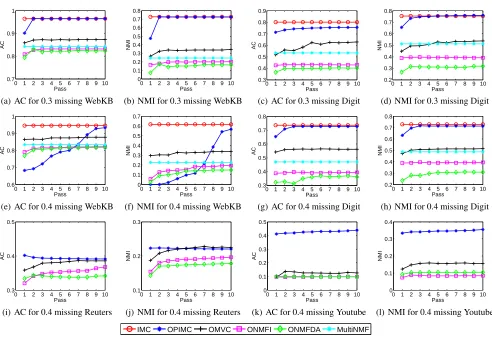
The normalized mutual information (NMI) and precision (AC) clustering evaluation measures are used in this paper. For online and one-pass methods, in order to more compre-hensively compare with OMVC and ONMF,we also con-duct the experiments for 10 passes and report both NMI and AC for different passes. The experimental results are shown in Figure 1.
Results
Figure 1 reports the performance of clustering on WebKB, Digit, Reuters and Youtube datasets for different passes with different incomplete rates. From Figure 1, we can get the following results.
From Figure 1(a) and Figure 1(b), we can see that on We-bKB dataset, the offline method IMC achieves the best per-formance, the proposed OPIMC gets close performance af-ter just two passes and outperforms the other four compar-ison methods. The same phenomena can be observed from Figures 1(c), 1(d), 1(g) and 1(h) on Digit dataset.
From Figure 1(e) and Figure 1(f), we can see that OPIMC performs terribly on WebKB dataset in the first few passes for the incomplete rate of 0.4. The main reasons are that the large incomplete rate and the small size of the chunk, which cause the matrices{U(v)}hard to be learned. However, af-ter few passes, through continuous correction of global in-formation, the clustering performance on WebKB dataset grows rapidly.
On large scale Reuters dataset, from Figure 1(i) and Fig-ure 1(j), we can see that OPIMC gets the best results after only one pass, but the clustering performance decreases with the pass number increasing.
From Figure 1(k) and Figure 1(l), we can find that on Youtube dataset, OPIMC produces excellent results and much better than the other methods. This fully demonstrates the effectiveness of OPIMC.
Complexity Study: All the experiments are run on com-puter with Intel(R)390 Core(TM) i5-3470 @ 3.20GHz CPU and 16.0 GB RAM with the help of Matlab R2013a. The complexity study results are reported in Table 2.
From Table 2, we can get some observations. Firstly, OMVC gets better results than ONMFI and ONMFDA, but the latter two methods run faster than OMVC. Secondly, the offline method IMC runs faster than the other methods ex-cept OPIMC. Thirdly, compared with OMVC, OPIMC takes much less running time (only 1%-2% of OMVC running time), while obtains relatively better clustering results. All these observations prove the efficiency and effectiveness of our model.
Mean-0 1 2 3 4 5 6 7 8 9 10 0.7
0.8 0.9 1
Pass
AC
(a) AC for 0.3 missing WebKB
0 1 2 3 4 5 6 7 8 9 10 0
0.1 0.2 0.3 0.4 0.5 0.6 0.7 0.8
Pass
NMI
(b) NMI for 0.3 missing WebKB
0 1 2 3 4 5 6 7 8 9 10 0.3
0.4 0.5 0.6 0.7 0.8 0.9
Pass
AC
(c) AC for 0.3 missing Digit
0 1 2 3 4 5 6 7 8 9 10 0.2
0.3 0.4 0.5 0.6 0.7 0.8
Pass
NMI
(d) NMI for 0.3 missing Digit
0 1 2 3 4 5 6 7 8 9 10 0.6
0.7 0.8 0.9 1
Pass
AC
(e) AC for 0.4 missing WebKB
0 1 2 3 4 5 6 7 8 9 10 0
0.1 0.2 0.3 0.4 0.5 0.6 0.7
Pass
NMI
(f) NMI for 0.4 missing WebKB
0 1 2 3 4 5 6 7 8 9 10 0.3
0.4 0.5 0.6 0.7 0.8
Pass
AC
(g) AC for 0.4 missing Digit
0 1 2 3 4 5 6 7 8 9 10 0.2
0.3 0.4 0.5 0.6 0.7 0.8
Pass
NMI
(h) NMI for 0.4 missing Digit
0 1 2 3 4 5 6 7 8 9 10 0.3
0.4 0.5
Pass
AC
(i) AC for 0.4 missing Reuters
0 1 2 3 4 5 6 7 8 9 10 0.1
0.2 0.3
Pass
NMI
(j) NMI for 0.4 missing Reuters
0 1 2 3 4 5 6 7 8 9 10 0
0.1 0.2 0.3 0.4 0.5
Pass
AC
(k) AC for 0.4 missing Youtube
0 1 2 3 4 5 6 7 8 9 10 0
0.1 0.2 0.3 0.4
Pass
NMI
(l) NMI for 0.4 missing Youtube
0 1 2 3 4 5 6 7 8 9 10
0.3 0.4 0.5 0.6 0.7 0.8
Pass
AC
IMC OPIMC OMVC ONMFI ONMFDA MultiNMF
Figure 1: Performance of clustering on WebKB, Digit, Reuters and Youtube for different passes.
Table 2: Run time for different methods Run Time (seconds)
WebKB Digit Reuters Youtube
OPIMC/Pass 0.25 0.56 27.89 26.76
OMVC/Pass 23.37 34.76 3753.02 2064.83 ONMFI/Pass 18.69 31.16 2887.12 1657.22 ONMFDA/Pass 20.09 30.63 2224.44 1307.14
IMC 2.91 6.31 / /
MultiNMF 149.7 647.2 / /
while, we set the incomplete rate as 0.3 for small datasets and 0.4 for large scale datasets respectively, and report the clustering performance of OPIMC by rangingαin the set of {1e-4,1e-3,1e-2,1e-1,1e0,1e1,1e2,1e3}. The results are shown in Figure 2.
From Figure 2, we can see that OPIMC gets best cluster-ing results inα={1e1,1e-1,1e-2,1e0}on WebKB, Digit, Reuters and Youtube datasets respectively.
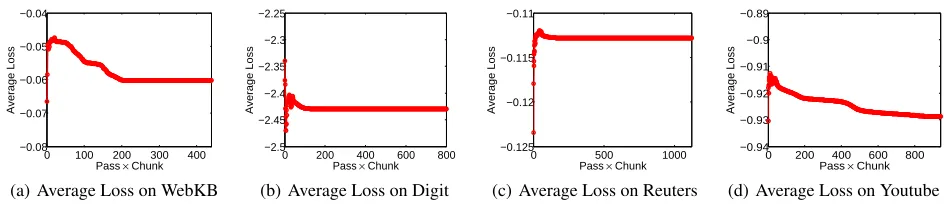
Convergence Study: The convergence experiments are con-ducted on the four aforementioned datasets for 20 passes. We set the incomplete rate as 0.4 for all the datasets and con-duct the experiments. According to the definition of R(v),
−4 −3 −2 −1 0 1 2 3 0
0.1 0.2 0.3 0.4 0.5 0.6 0.7 0.8 0.9 1
logα
AC
(a)
−4 −3 −2 −1 0 1 2 3 0
0.1 0.2 0.3 0.4 0.5 0.6 0.7
logα
NMI
(b)
0 0.1 0.2 0.3 0.4 0.5 0.6 0.7
NMI
WebKB Digit Reuters Youtube
Figure 2: Parameter studies on WebKB, Digit, Reuters and Youtube datasets, where the incomplete rate of WebKB and Digit experiment is set as 0.3, and the incomplete rate of Reuters and Youtube experiment is set as 0.4.
T(v), and inspired by ONMF, OMVC, for the first pass, the average loss is defined as follows:
L= 1
min{s×t, N}
nv
X
v=1
−2P(tv)+Qt(v)+αkU(v)k2 F
0 100 200 300 400 −0.08
−0.07 −0.06 −0.05 −0.04
Pass × Chunk
Average Loss
(a) Average Loss on WebKB
0 200 400 600 800 −2.5
−2.45 −2.4 −2.35 −2.3 −2.25
Pass × Chunk
Average Loss
(b) Average Loss on Digit
0 500 1000 −0.125
−0.12 −0.115 −0.11
Pass × Chunk
Average Loss
(c) Average Loss on Reuters
0 200 400 600 800 −0.94
−0.93 −0.92 −0.91 −0.9 −0.89
Pass × Chunk
Average Loss
(d) Average Loss on Youtube
Figure 3: Convergence studies on WebKB, Digit, Reuters and Youtube datasets, where the incomplete rate is set as 0.4, and the experiments are run for 20 passes, the corresponding average lossLis recorded. It is worth mentioning that since we ignore the loss oftr(X(v)TX(v)), the average lossLis negative.
0 1 2 3 4 5 6 7 8 9 10 0.2
0.3 0.4 0.5 0.6 0.7 0.8 0.9
Pass
AC
(a)
0 1 2 3 4 5 6 7 8 9 10 0.2
0.3 0.4 0.5 0.6 0.7 0.8
Pass
NMI
(b)
0 1 2 3 4 5 6 7 8 9 10
0.2 0.3 0.4 0.5 0.6 0.7 0.8
Pass
NMI
s=250 s=100 s=50 s=10 s=5 s=2
Figure 4: Different block size study on Digit dataset, where the incomplete rate is set as 0.4 and the experiment is run for 10 passes.
where
P(tv)=tr(U(v)TR(tv)) Q(tv)=tr(U(v)TU(v)Tt)
(19)
And for the other passes, since we can easily count the loss of scanned instances, we define the average loss as follows:
L= 1 N
nv
X
v=1
−2P(Nv)+QN(v)+αkU(v)k2 F
(20)
We cascade all pass losses and get the results as shown in Figure 3.
From Figure 3, we can see that, as the training goes on, the average loss converge gradually. Corresponding to Fig-ure 1, we can observe that when the average loss converges, both NMI and AC get stable values.
Block Size Study: In OPIMC, the size of data chunk is a vi-tally important parameter. In order to study the performance of OPIMC with different chunk sizes, we conduct a block size study on digit dataset. Besides, we set the incomplete rate to 0.4, and report the clustering performance of OPIMC by ranging s in the set of {2,5,10,50,100,250}. Mean-while, we run the experiment for 10 passes and the results are shown in Figure 4.
From Figure 4, we can see that generally the bigger the block size, the better the clustering results. Furthermore, whens= 250, the NMI and AC get a great value. However,
0 1 2 3 4 5 6 7 8 9 10 0.3
0.4 0.5 0.6 0.7 0.8
Pass
AC
(a)
0 1 2 3 4 5 6 7 8 9 10 0.3
0.4 0.5 0.6 0.7 0.8
Pass
NMI
(b)
0 1 2 3 4 5 6 7 8 9 10 0.3
0.4 0.5 0.6 0.7 0.8
Pass
NMI
OPIMC−F OPIMC−NF OMVC ONMFI ONMFDA
Figure 5: Clustering center degradation study on Digit dataset, where OPIMC-F and OPIMC-NF denote the OPIMC with filled and not filled degraded cluster centers, respectively. Besides, the incomplete rate is set as 0.4 and the experiment is run for 10 passes.
using larger chunk size will cause larger space complexity.
Clustering Center Degradation Study: In this experiment, we will prove the validity of filling the degraded cluster cen-ters. we conduct the experiment on Digit dataset with the incomplete rate of 0.4. We do not disrupt the instance or-der of the Digit dataset and implement OPIMC with filled (OPIMC-F) and not filled (OPIMC-NF) degraded cluster centers, respectively. We run the experiment for 10 passes and the results are shown in Figure 5, from which we can witness the effect of filling degenerate cluster centers very directly.
Conclusion
Acknowledgments
This work is supported in part by the NSFC under Grant No.61672281, and the Key Program of NSFC under Grant No.61732006
References
Bickel, S., and Scheffer, T. 2004. Multi-view clustering. In ICDM, 19–26.
Blum, A., and Mitchell, T. 1998. Combining labeled and unlabeled data with co-training. InCOLT, 92–100.
Cao, X.; Zhang, C.; Fu, H.; Liu, S.; and Zhang, H. 2015. Diversity-induced multi-view subspace clustering. InCVPR, 586–594.
Chao, G.; Sun, S.; and Bi, J. 2017. A survey on multi-view clustering.arXiv preprint arXiv:1712.06246.
Ding, Z., and Fu, Y. 2014. Low-rank common subspace for multi-view learning. InICDM, 110–119.
Fan, Y.; Liang, J.; He, R.; Hu, B.-G.; and Lyu, S. 2017. Robust localized multi-view subspace clustering. arXiv preprint arXiv:1705.07777.
Gunasekar, S.; Woodworth, B. E.; Bhojanapalli, S.; Neyshabur, B.; and Srebro, N. 2017. Implicit regulariza-tion in matrix factorizaregulariza-tion. InNIPS, 6151–6159.
Hu, M., and Chen, S. 2018. Doubly aligned incomplete multi-view clustering. InIJCAI, 2262–2268.
Kim, Y.-D., and Choi, S. 2009. Weighted nonnegative ma-trix factorization. InICASSP, 1541–1544.
Kong, D.; Ding, C.; and Huang, H. 2011. Robust nonneg-ative matrix factorization usingL21-norm. InCIKM, 673–
682.
Kumar, A., and Daum´e, H. 2011. A co-training approach for multi-view spectral clustering. InICML, 393–400. Lee, D. D., and Seung, H. S. 1999. Learning the parts of objects by non-negative matrix factorization. Nature 401(6755):788–791.
Li, S.-Y.; Jiang, Y.; and Zhou, Z.-H. 2014. Partial multi-view clustering. InAAAI, 1968–1974.
Li, Y. 2016. Advances in multi-view matrix factorizations. InIJCNN, 3793–3800.
Liu, J.; Wang, C.; Gao, J.; and Han, J. 2013. Multi-view clustering via joint nonnegative matrix factorization. In SDM, 252–260.
Liu, X.; Li, M.; Wang, L.; Dou, Y.; Yin, J.; and Zhu, E. 2017. Multiple kernel k-means with incomplete kernels. InAAAI, 2259–2265.
Nguyen, T. D.; Le, T.; Bui, H.; and Phung, D. Q. 2015. Large-scale online kernel learning with random feature repa-rameterization. InIJCAI, 2750–2756.
Nie, F.; Cai, G.; Li, J.; and Li, X. 2018. Auto-weighted multi-view learning for image clustering and semi-supervised classification. IEEE Transactions on Image Pro-cessing27(3):1501–1511.
Qi, M.; Wang, T.; Liu, F.; Zhang, B.; Wang, J.; and Yi, Y. 2017. Unsupervised feature selection by regularized matrix factorization.Neurocomputing593–610.
Ren, P.; Xiao, Y.; Xu, P.; Guo, J.; Chen, X.; Wang, X.; and Fang, D. 2018. Robust auto-weighted multi-view clustering. InIJCAI, 2644–2650.
Shao, W.; He, L.; Lu, C.-T.; and Yu, P. S. 2016. Online multi-view clustering with incomplete views. In ICBDA, 1012–1017.
Shao, W.; He, L.; and Philip, S. Y. 2015. Multiple incom-plete views clustering via weighted nonnegative matrix fac-torization withL2,1 regularization. InECML PKDD, 318–
334.
Son, J. W.; Jeon, J.; Lee, A.; and Kim, S.-J. 2017. Spectral clustering with brainstorming process for multi-view data. InAAAI, 2548–2554.
Sun, S. 2013. A survey of multi-view machine learning. Neural Computing and Applications23(7-8):2031–2038. Tao, Z.; Liu, H.; Li, S.; Ding, Z.; and Fu, Y. 2017. From en-semble clustering to multi-view clustering. InIJCAI, 2843– 2849.
Tulsiani, S.; Zhou, T.; Efros, A. A.; and Malik, J. 2017. Multi-view supervision for single-view reconstruction via differentiable ray consistency. InCVPR, 209–217.
Wan, Y.; Wei, N.; and Zhang, L. 2018. Efficient adaptive on-line learning via frequent directions. InIJCAI, 2748–2754. Wang, F.; Tan, C.; Li, P.; and K¨onig, A. C. 2011. Efficient document clustering via online nonnegative matrix factor-izations. InSDM, 908–919.
Wang, H.; Yang, Y.; and Li, T. 2016. Multi-view clustering via concept factorization with local manifold regularization. InICDM, 1245–1250.
Wen, J.; Zhang, Z.; Xu, Y.; and Zhong, Z. 2018. Incomplete multi-view clustering via graph regularized matrix factoriza-tion. arXiv preprint arXiv:1809.05998.
Wu, B.; Wang, E.; Zhu, Z.; Chen, W.; and Xiao, P. 2018. Manifold nmf withL21norm for clustering.
Neurocomput-ing273:78–88.
Xing, J.; Niu, Z.; Huang, J.; Hu, W.; Zhou, X.; and Yan, S. 2017. Towards robust and accurate multi-view and partially-occluded face alignment. IEEE Transactions on Pattern Analysis and Machine Intelligence40:987–1001.
Xue, H.-J.; Dai, X.; Zhang, J.; Huang, S.; and Chen, J. 2017. Deep matrix factorization models for recommender systems. InIJCAI, 3203–3209.
Zhao, H.; Ding, Z.; and Fu, Y. 2017. Multi-view clustering via deep matrix factorization. InAAAI, 2921–2927. Zhao, H.; Liu, H.; and Fu, Y. 2016. Incomplete multi-modal visual data grouping. InIJCAI, 2392–2398.
Zhu, Y.; Ting, K. M.; and Zhou, Z.-H. 2017. New class adap-tation via instance generation in one-pass class incremental learning. InICDM, 1207–1212.