The Thirty-Third AAAI Conference on Artificial Intelligence (AAAI-19)
Interleave Variational Optimization with Monte
Carlo Sampling: A Tale of Two Approximate Inference Paradigms
Qi Lou
University of California, Irvine Irvine, CA 92697, USA
Rina Dechter
University of California, Irvine Irvine, CA 92697, USA
Alexander Ihler
University of California, Irvine Irvine, CA 92697, USA
Abstract
Computing the partition function of a graphical model is a fundamental task in probabilistic inference. Variational bounds and Monte Carlo methods, two important approxi-mate paradigms for this task, each has its respective strengths for solving different types of problems, but it is often non-trivial to decide which one to apply to a particular problem instance without significant prior knowledge and a high level of expertise. In this paper, we propose a general framework that interleaves optimization of variational bounds (via mes-sage passing) with Monte Carlo sampling. Our adaptive inter-leaving policy can automatically balance the computational effort between these two schemes in an instance-dependent way, which provides our framework with the strengths of both schemes, leads to tighter anytime bounds and an unbiased estimate of the partition function, and allows flexible trade-offs between memory, time, and solution quality. We verify our approach empirically on real-world problems taken from recent UAI inference competitions.
Introduction
Probabilistic graphical models, including Bayesian networks and Markov random fields, are a set of powerful frame-works for representing and reasoning with probabilistic and deterministic information (Darwiche 2009; Dechter 2013; Dechter, Geffner, and Halpern 2010). Reasoning in a graph-ical model often requires computing the partition function, i.e., the normalizing constant of the underlying distribution. Exact computation of the partition function is known to be intractable (Valiant 1979) in general, leading to the develop-ment of many approximate schemes, the major categories of which are variational methods, Monte Carlo sampling, and search algorithms. Within these, techniques that provide some guaranteed confidence intervals on the correct value, and can be improved with additional computation, are valued for providing users with concrete information or certificates of accuracy within a reasonable amount of time, and allowing the user to decide the desired balance of quality versus time. Variational bounds (Wainwright and Jordan 2008) and closely related approximate elimination methods (Dechter and Rish 2003; Liu and Ihler 2011) provide deterministic guarantees on the partition function. However, these bounds
Copyright c2019, Association for the Advancement of Artificial Intelligence (www.aaai.org). All rights reserved.
are not anytime; their quality often depends critically on the amount of memory available, and do not continue to improve (approach the correct value) without additional memory.
Monte Carlo methods (Liu 2008), such as importance sam-pling (Dagum and Luby 1997; Liu, Fisher, and Ihler 2015) gives probabilistic bounds that improve with more samples at a predictable rate; in practice this means bounds that improve rapidly at first, but can be slow to become very tight.
Search algorithms (Henrion 1991; Viricel et al. 2016; Lou, Dechter, and Ihler 2017a) explicitly enumerate over the space of configurations and eventually provide an exact answer; however, while some problems are well-suited to search, others only improve their quality very slowly with more computation.
Several algorithms combine two or more strategies. Ap-proximate hash-based counting combines sampling (of hash functions) with CSP-based search (Chakraborty et al. 2014; Chakraborty, Meel, and Vardi 2016) or other MAP queries (Ermon et al. 2013; 2014), although these are not typ-ically formulated to provide anytime behavior. Some recent works combine importance sampling with (partially) exact inference (Broka et al. 2018; Friedman and Van den Broeck 2018), though they do not have guarantees on their estimates. A number of works use some form of approximate elimina-tion or variaelimina-tional bounds as search heuristics, such as Lou, Dechter, and Ihler (2017a), while Liu, Fisher, and Ihler (2015) develops an importance sampling proposal from variational bounds that provides strong probabilistic confidence intervals. More recently, Lou, Dechter, and Ihler (2017b) unifies these two works within the same framework.
opti-mization of variational bounds with importance sampling from the very beginning, and provides an instance-specific balance designed to give rapid anytime improvement.
Our contributions. First, we propose a general framework that interleaves optimization of variational upper bounds with importance sampling to achieve anytime upper and lower bounds of the partition function, which is directly applicable to a set of convex variational bounds including TRW (Wain-wright, Jaakkola, and Willsky 2005) and WMB (Liu and Ihler 2011). Second, we propose an effective adaptive policy that automatically balances the computational effort between these two processes on the fly in a problem-dependent fashion. Third, our experiments on real-world problems demonstrate that our interleaving framework with the adaptive policy is superior to several non-interleaving baselines and interleav-ing baselines with simple static policies in terms of anytime performance, gives competitive final bound quality, and is relatively insensitive to its hyperparameter, making it easy to use and automate in practice.
Background
In this section, we introduce some notations and background knowledge that are essential to present and understand our algorithm.
LetX = (X1, . . . , Xn)be a vector of random variables,
where eachXitakes values in a discrete domainXi; we use
lower case letters, e.g.xi∈ Xi, to indicate a value ofXi, and
xto indicate an assignment ofX. A graphical model overX
consists of a set of factorsF ={fα(Xα)|α∈ I}, where
each factorfαis defined on a subsetXα={Xi |i∈α}of
X, called its scope.
We associate an undirected graphG = (V, E)with F,
where each nodei∈V corresponds to a variableXiand we
connect two nodes,(i, j) ∈ E, iff{i, j} ⊆ αfor someα. The setIthen corresponds to cliques ofG. We can interpret
Fas an unnormalized probability measure, so that
f(x) = Y
α∈I
fα(xα), Z =
X
x
Y
α∈I
fα(xα).
Zis called thepartition function, and normalizesf(x).
Com-putingZ is often a key task in evaluating the probability
of observed data, model selection, or computing predictive probabilities.
Weighted Mini-bucket
In experiments, we apply our framework to a particular varia-tional bound called weighted mini-bucket (WMB) (Liu and Ihler 2011), which we briefly introduce here to make our paper self-contained. WMB is an approximate elimination algorithm that generalizes its elimination-based predeces-sors (e.g., bucket elimination (Dechter 1999), mini-bucket elimination (Dechter and Rish 2003)) by relaxing the exact summation using a “power sum” operation during variable elimination, and controls the computational complexity using a user-specified parameter called theibound.
Given an elimination order, WMB processes variables one by one. Upon reaching a variable, say,Xi, WMB first collects
all factors (including those intermediately generated ones,
termed “messages”) withXiin their scopes, which form a
factor set called “bucket”Bi. WMB then partitionsBiinto
several disjoint “mini-buckets”{Bij}to ensure that eachBij
involves no more than (ibound+ 1) variables.
After assigning a “weight”ρij to eachB
j
i, WMB
elimi-natesXiin factors ofB j
i using the power sum:
λi→πij = (
X
xi
Y
fα∈Bij f
1
ρij
α )ρij,
which sends a messageλi→πij toXπij, the earliest unelimi-nated variable in the scope ofλi→πij. This messageλi→πij is then placed in the bucket ofXπij for later processing.
When the weightsρij’s are nonnegative and sum to one,
H¨older’s inequality guarantees that the product of the mes-sagesλi→πij is an upper bound of the sum, i.e.,
X
xi
Y
fα∈Bi fα≤
Y
j
λi→πij.
Therefore, WMB eventually returns an upper boundUof the
partition functionZafter it terminates. Liu and Ihler (2011) also shows that the resulting bound is equivalent to a class of bounds based on tree reweighted (TRW) belief propa-gation (Wainwright, Jaakkola, and Willsky 2005), or more generally conditional entropy decompositions (Globerson and Jaakkola 2007).
U can be tightened by cost shifting (a.k.a., reparameteri-zation) and weight optimization, which can be implemented in a forward-backward message passing procedure. We refer readers to Liu and Ihler (2011) for details.
Weighted Mini-bucket Importance Sampling
This same relaxation of WMB can also be used to define a proposal distributionq(x)(Liu, Fisher, and Ihler 2015) as follows:
q(x) =Y
i
X
j
ρijqij(xi|xanj(i)), (1)
whereXanj(i)are variables included in the mini-bucketB
j i
excludingXi. Theqij(xi|xanj(i))’s are conditional distribu-tions:
qij(xi|xanj(i)) =
Y
fα∈Bji
fα/λi→πij
ρij1 .
One can show that importance weights derived from this proposal distribution are bounded and unbiased, i.e.,
f(x)/q(x)≤U, E
f(x)/q(x)
=Z, (2)
which leads to finite-sample bounds of the partition function (see Corollary 3.2 of Liu, Fisher, and Ihler (2015)).
Example. Fig. 1 shows an example of running WMB on a pairwise graphical model to produce an upper bound of the partition function and a proposal distribution when an
A" B"
C" D"
E" F"
G"
(a)
A
f(A,B) B
f(B,C)
C F f(B,F)
f(A,G) f(F,G) G f(B,E) f(C,E) E f(B,D) f(C,D) D
λF(A,B) λB(A)
λE(B,C) λD(B,C)
λC(B) λD(A)
f(A,D) D
mini-buckets
λG(A,F)
f(A)
U
(b)
...
(c)
Figure 1: (a) A graphical model over 7 variables. (b) Given an elimination orderG, F, E, D, C, B, A, andibound= 2, WMB
runs on this model to produce an upper bound of the partition function. (c) The same relaxation from (b) gives a proposal distribution with properties present in (2).
Interleaving Variational Optimization with
Importance Sampling
In this section, we present a general scheme that interleaves optimization of the variational upper bound with importance sampling, derive finite-sample bounds for this scheme, and discuss interleaving policies.
A General Interleaving Framework
Our general scheme is quite simple: we interleave the two processes according to some policy. Since optimization of variational bounds is typically through a message passing procedure, we consider interleaving message passing with importance sampling in our algorithm. Procedurally, we first build up an initial bound within a given memory budget, and then interleave the two processes following a policy that we will discuss in the sequel. Alg. 1 presents details of our framework.
Our framework actually serves as a “meta-algorithm” from which any optimizable proposal with properties in (2) can benefit; in particular this includes convex variational bounds such as WMB and TRW (see Liu, Fisher, and Ihler (2015) for more details on why this holds for TRW).
Interleaving these two processes leads to rapid early bound improvement, since the improvement provided by the proba-bilistic bounds is not delayed until after variational optimiza-tion converges or is otherwise terminated (e.g., in Liu, Fisher, and Ihler (2015) and Lou, Dechter, and Ihler (2017b)); this results in significant improvements in anytime behavior as we demonstrate in the empirical evaluation. A critical point is that, by interleaving updates to the proposal, our samples are no longer identically distributed; in fact, their variance is decreasing as the proposal improves, and for best results we should up-weight these more accurate samples in our es-timates. To this end, and analogous to that of Lou, Dechter, and Ihler (2017b), we define a weighted average estimatorZˆ
and apply an empirical Bernstein bound (Maurer and Pontil 2009) to derive finite-sample bounds on the error between
ZandZˆbased on independent samples from a sequence of
proposals satisfying (2):
Algorithm 1A General Interleaving Framework
Require: memory budget, time budget, confidence parame-terδ, interleaving policyP.
Ensure: N,U,Zb,HM(U),∆,Vard.
1: Build an initial variational upper bound that fits the mem-ory budget.
2: whilewithin the time budgetdo
3: Generate(R, S)via policyP.
4: forr←1toRdo
5: Run one round of message passing.
6: UpdateU.
7: end for
8: fors←1toSdo
9: Draw one sample from the current proposal.
10: UpdateN,Zb,HM(U),∆,Vardvia (3), (4), (6)
11: and (7) respectively.
12: end for
13: Update policyPif necessary.
14: end while
Theorem 1. Let{xi}N
i=1be a series of samples drawn from
proposal distributions {qi(x)}Ni=1 respectively via Alg. 1,
with{Zbi=f(xi)/qi(xi)}Ni=1the corresponding importance
weights, and{Ui}Ni=1 the corresponding variational upper
bounds respectively. Let
b
Z= HM(U)
N
N
X
i=1 b Zi
Ui
, (3)
where
HM(U) =h1
N
N
X
i=1
1
Ui
i−1
(4)
is the harmonic mean of{Ui}Ni=1. then, Zb is an unbiased
estimator ofZ, i.e.,
Define a deviation term
∆ = HM(U)
s
2Var ln(2d /δ)
N +
7 ln(2/δ) 3(N−1)
, (6)
where
d
Var = 1
N−1
N
X
i=1 h bZi
Ui
− Zb
HM(U)
i2
(7)
is the unbiased empirical variance of{Zbi/Ui}Ni=1. Since the
boundedness of eachZbiguarantees thatZbi/Ui≤1for alli,
applying standard empirical Bernstein results we have
Pr[Z ≤Zb+ ∆]≥1−δ,
Pr[Z ≥Zb−∆]≥1−δ,
(8)
i.e.,Zb+ ∆andZb−∆are upper and lower bounds ofZwith
probability at least1−δ, respectively.
Interleaving Policies
The key for our framework to work well is its interleaving policy. Our goal is to design a policy balancing the effort between message passing and sampling, so that the prob-abilistic bounds in (8) can improve as quickly as possible.
Alg. 1 controls this balance by alternating betweenRsteps
of message passing, andSsteps of sampling, within each
iteration.
Optimize-First Policy. In most prior work, the variational bound is optimized first, as a separate pre-processing step. Within the framework of Alg. 1, this takes the form of setting (R, S) = (1,0)(all message passing) until some convergence or time-out criteria are satisfied, then changing the policyP
so that(R, S) = (0,1)(all sampling). A simple strategy is to switch over after some fixed time. As noted previously, this approach suffers from several drawbacks. The determin-istic variational bounds are considerably weaker than those provided by sampling, and the early work serves mainly to improve the quality of later sampling, so that quality does not improve in a smooth, anytime way. A related point is that this makes it difficult to know how much effort to put into the optimization process; too little, and the probabilistic bounds will improve only slowly; too much, and we waste time that could have been used for sampling.
Static Policy. Alternatively, we can interleave updates us-ing a simple static policy, fixus-ing(R, S)in Alg. 1 to some constants. While this choice will alternate between update types, giving smoother performance, it is also non-trivial to automate for different types of problems. In particular, it is
difficult to know how any given(R, S)will perform a
pri-ori; the characteristics of the problem instance may make message updates more or less expensive and more or less
effective, changing the desired balance betweenRandS.
Adaptive Policy. The main issue with static policies is that they are “blind” to the current status and behavior of the in-ference process on a particular problem instance. We propose an adaptive policy that is able to adjust its behavior based
on information available on the fly. The basic idea of our adaptive policy is to select the action that is projected to have larger unit contribution to the probabilistic upper bound in each iteration. Details follow.
Suppose we have already drawnN samples so far. The
deviation term∆in (6) can be roughly approximated by∆0:
∆≈∆0 = HM(U)
r
ln(2/δ)
2N +
7 ln(2/δ) 3(N−1)
. (9)
∆0is derived from∆by substituting the empirical variance
d
Var(see (7)) with1/4, which is an upper bound of the em-pirical variance in expectation according to Popoviciu’s in-equality (Popoviciu 1935). This means that∆0is actually an
upper bound of the expectation of∆thanks to the concavity
of the square root function. Therefore, the probabilistic upper
boundZb+ ∆in (8) can be approximated byZ+ ∆0since
b
Zis an unbiased estimate ofZ(see (5)).
Thus, we define a gain function that approximates improve-ment in the probabilistic upper bound (difference between
current one and the projected one) if we drawN0 samples
from now with respect to the variational upper bound:
gain(N, U, N0) = (Z+ ∆0)−(Z+ ∆0N0) = ∆0−∆0N0
where
∆0N0 =
h 1 N+N0
N0 U+
N
X
i=1
1
Ui
i−1 s
ln(2/δ) 2(N+N0)+
7 ln(2/δ) 3(N+N0−1)
.
Assuming that one sampling step takes timetis, we can easily
define the unit gaingainisof drawing one sample:
gainis=gain(N, U,1)/tis (10)
However, to define the gain of running one message passing step is more complicated: message passing does not directly contribute to the current probabilistic bound, but rather, af-fects the deterministic upper bound and quality of all later
samples. We introduce a projected upper boundU0that one
message passing step can achieve from now, and assume one message passing step will affectNslater samples with this
projected bound. We then define the unit gaingainmsg of
one message passing step:
gainmsg =gain(N, U0, Ns)/tmsg (11)
where tmsg is the time it takes to complete one message
passing step. Note thatU0 is computed via a simple linear
interpolation in our experiments.
In a nutshell, our adaptive policy compares gainis and
gainmsgand takes the action with larger unit gain in the
fol-lowing step. Note that neithergainisnorgainmsginvolves
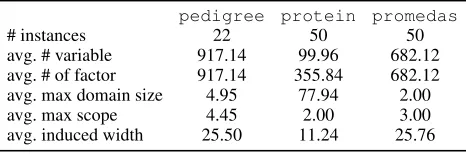
Table 1: Statistics of the three evaluated benchmark sets.
pedigree protein promedas
# instances 22 50 50
avg. # variable 917.14 99.96 682.12 avg. # of factor 917.14 355.84 682.12 avg. max domain size 4.95 77.94 2.00 avg. max scope 4.45 2.00 3.00 avg. induced width 25.50 11.24 25.76
Empirical Evaluation
In this section, we present empirical results to demonstrate the usefulness of our framework and the effectiveness of our adaptive policy.
We evaluated on three benchmarks of real-world problem instances from recent UAI competitions. Our benchmarks
include: pedigree, 22 genetic linkage instances from
the UAI’08 inference challenge1;protein, 50 instances
made from the “small” protein side-chains of (Yanover and
Weiss 2002);promedas, 50 medical diagnosis expert
sys-tems (Wemmenhove et al. 2007). These three sets are selected to illustrate different problem characteristics. Table 1 shows some summary statistics of these benchmarks.
We adopted WMB as our variational bound, and allocated
a maximum of 512MB memory, using the largestibound
that fit our memory budget. We set a maximum time budget
of 600 seconds. The confidence parameterδfor our
proba-bilistic bounds is set to0.025. In the experiments, we also usedZδb , a (1−δ) probabilistic lower bound by the Markov
inequality (Gogate and Dechter 2011), and switched to our
lower boundZb−∆when it becomes non-trivial. We also
replacedZb+ ∆with the best deterministic upper bound
reached so far if the latter is tighter.
Table 2 explains the evaluated algorithms, all of which share the same initial WMB structure. We test our adaptive ap-proach against several non-interleaved strategies (“fixed-X”) as well as statically interleaved strategies (“static-X”). The “equal time” strategy corresponds to “static(1, tmsg/tis)”
instead of “static(tis/tmsg,1)” because message passing
is usually much more expensive than sampling (typically,
tmsg/tis>103). Note that “static (0, 1)” can also be viewed
as an optimize-first (non-interleaving) strategy “fixed 0%”, because it does not spend any time improving the variational bound after the initial bound construction. During one round of message passing, i.e., one forward-backward pass (see Liu and Ihler (2011)), we do cost-shifting and weight optimiza-tion simultaneously. All implementaoptimiza-tions are in C/C++. We ran experiments on AMD Opteron 6276 processors with a clock speed of 2.3 GHz.
Interleaving versus Non-interleaving
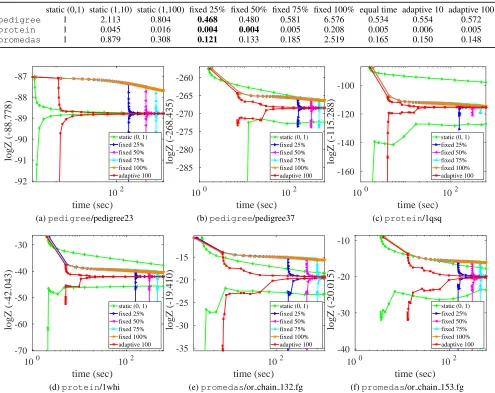
Fig. 2 shows anytime bounds from some typical instances of each benchmark for interleaving and non-interleaving strate-gies. We can observe from Fig. 2 that those non-interleaving strategies except “static (0, 1)” lack good anytime behav-ior compared to our adaptive interleaving strategy: they are
1
http://graphmod.ics.uci.edu/uai08/Evaluation/Report/ Benchmarks/
Table 2: Notations and abbreviations used in figures and tables for the evaluated algorithms.
fixedp%
optimize-first policy with the firstp%of time for message passing, and the rest for sampling.
static(R, S) static policy with some given(R, S). equal time static policy with(1, tmsg/tis).
adaptiveNs adaptive policy withNspseudo samples.
unable to compute a lower bound until they quit message passing and start sampling; their early upper bounds corre-spond to the deterministic variational bounds, which typically do not improve as fast as the probabilistic upper bound of our adaptive variant. “static (0, 1)” responds quickly but often gives looser results at longer time scales; see Fig. 2(c) and 2(f) for example. It performs very well when the initial bound is already close to the ground truth (see Fig. 2(a)), but such information is usually not available to users beforehand.
To quantify the anytime performance of the methods in each benchmark, we use two measures: one is the area
be-tween the upper bound oflogZand the (estimated) ground
truth oflogZ; the other is the area between the upper and
lower bound of logZ as introduced in Lou, Dechter, and
Ihler (2017b). The first facilitates comparison with those methods that do not provide lower bounds early on. These quantities are computed for each instance and method, and then normalized by those of “static (0, 1)”. Finally, we take the (geometric) mean over these scores across each bench-mark.
From Table 3, we observe that our adaptive policy performs significantly better in terms of anytime upper bound than any of the non-interleaving variants across all the benchmarks. We can also see differences in performance stemming from the different problem characteristics in the benchmarks: for example, the performance of the non-interleaved strategies degrades with higher time used for message passing on the
pedigreebenchmark, while this is less true of the other two benchmarks; this indicates the difficulty of deciding when to quit message passing and start sampling for good anytime behavior, especially when we do not know the time limit in advance. In contrast, our interleaving framework does not have such limitations.
We also examine performance at a fixed time limit, as opposed to anytime behavior. Table 5 shows the mean final
gap between the upper bound and the (estimated)logZ. We
can see that our adaptive variants perform almost as well as the best method for each benchmark, which implies that although our algorithm is designed for a more responsive, anytime behavior, it does not sacrifice much in terms of long-term bound quality.
Adaptive versus Static
Table 3: Mean area between upper bounds and (estimated) ground truthlogZ, normalized by that of “static (0, 1)”, for each benchmark. Smaller numbers indicate better anytime upper bounds. The best for each benchmark is bolded.
static (0,1) static (1,10) static (1,100) fixed 25% fixed 50% fixed 75% fixed 100% equal time adaptive 10 adaptive 100
pedigree 1 2.436 1.262 2.084 3.027 3.904 4.655 0.947 0.781 0.786
protein 1 0.145 0.077 0.161 0.231 0.285 0.329 0.054 0.051 0.050
promedas 1 1.217 0.615 0.898 1.408 1.855 2.268 0.414 0.354 0.349
Table 4: Mean area between upper and lower bounds oflogZ, normalized by that of “static (0, 1)”, for each benchmark. Entries for some non-interleaved strategies are missing because they do not give lower bounds early on. Smaller numbers indicate better anytime bounds. The best for each benchmark is bolded.
static (0,1) static (1,10) static (1,100) fixed 25% fixed 50% fixed 75% fixed 100% equal time adaptive 10 adaptive 100
pedigree 1 4.624 2.213 - - - - 2.061 1.544 1.529
protein 1 0.299 0.118 - - - - 0.104 0.080 0.078
promedas 1 2.674 1.203 - - - - 1.271 0.728 0.726
Table 5: Mean final gap between upper bound and (estimated) ground truthlogZ, normalized by that of “static (0, 1)”, for each benchmark. Smaller numbers are better; the best method for each benchmark is bolded.
static (0,1) static (1,10) static (1,100) fixed 25% fixed 50% fixed 75% fixed 100% equal time adaptive 10 adaptive 100
pedigree 1 2.113 0.804 0.468 0.480 0.581 6.576 0.534 0.554 0.572
protein 1 0.045 0.016 0.004 0.004 0.005 0.208 0.005 0.006 0.005
promedas 1 0.879 0.308 0.121 0.133 0.185 2.519 0.165 0.150 0.148
102
time (sec)
-92 -91 -90 -89 -88 -87
logZ (-88.778)
static (0, 1) fixed 25% fixed 50% fixed 75% fixed 100% adaptive 100
(a)pedigree/pedigree23
100 102
time (sec) -285
-280 -275 -270 -265 -260
logZ (-268.435)
static (0, 1) fixed 25% fixed 50% fixed 75% fixed 100% adaptive 100
(b)pedigree/pedigree37
100 102
time (sec) -160
-140 -120 -100
logZ (-115.288)
static (0, 1) fixed 25% fixed 50% fixed 75% fixed 100% adaptive 100
(c)protein/1qsq
100 102
time (sec) -70
-60 -50 -40 -30
logZ (-42.043)
static (0, 1) fixed 25% fixed 50% fixed 75% fixed 100% adaptive 100
(d)protein/1whi
102 time (sec) -35
-30 -25 -20 -15
logZ (-19.410)
static (0, 1) fixed 25% fixed 50% fixed 75% fixed 100% adaptive 100
(e)promedas/or chain 132.fg
100 102
time (sec)
-40 -30 -20 -10
logZ (-20.015)
static (0, 1) fixed 25% fixed 50% fixed 75% fixed 100% adaptive 100
(f)promedas/or chain 153.fg
Figure 2: Anytime bounds onlogZfor two instances per benchmark, comparing our adaptive interleaving strategy with
102 time (sec) -92
-91 -90 -89 -88 -87
logZ (-88.778)
static (0, 1) static (1, 10) static (1, 100) equal time adaptive 10 adaptive 100
(a)pedigree/pedigree23
100 102
time (sec) -285
-280 -275 -270 -265 -260
logZ (-268.435)
static (0, 1) static (1, 10) static (1, 100) equal time adaptive 10 adaptive 100
(b)pedigree/pedigree37
100 102
time (sec) -160
-140 -120 -100
logZ (-115.288)
static (0, 1) static (1, 10) static (1, 100) equal time adaptive 10 adaptive 100
(c)protein/1qsq
100 102
time (sec) -70
-60 -50 -40 -30
logZ (-42.043)
static (0, 1) static (1, 10) static (1, 100) equal time adaptive 10 adaptive 100
(d)protein/1whi
102 time (sec) -35
-30 -25 -20 -15
logZ (-19.410)
static (0, 1) static (1, 10) static (1, 100) equal time adaptive 10 adaptive 100
(e)promedas/or chain 132.fg
100 102
time (sec) -40
-30 -20 -10
logZ (-20.015)
static (0, 1) static (1, 10) static (1, 100) equal time adaptive 10 adaptive 100
(f)promedas/or chain 153.fg
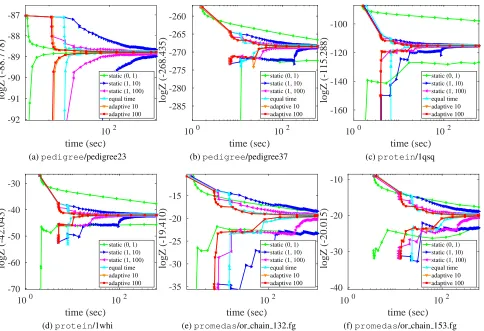
Figure 3: Anytime bounds onlogZfor two instances per benchmark, comparing our adaptive strategy with statically interleaved
strategies balancing message updates and sampling (see Table 2). The best fixed strategy is typically “equal time”, but adaptivity is usually slightly better, as it is able to change its behavior dynamically based on the observed improvement in bounds from message updates.
“equal time” variant performs better than a static choice of interleaving rate, since it is able to take into account how computationally expensive the message updates are. Even so, both of our adaptive variants (corresponding to a shorter or longer horizon when estimating the impact of a message update) perform better most of the time; they are able to make more informed decisions about the current benefits of sampling versus message updates. These observations are also supported by the statistical results in Table 3 and Table 4. From Fig. 3, Table 3, and Table 4, we can also see that the two adaptive variants perform fairly similarly. In fact, we found in our experiments that our adaptive policy works reasonably well within a wide range ofNs, i.e., it is not very sensitive to
the hyperparameter value, which simplifies its use in practice.
Conclusion
In this work, we propose a general framework that interleaves optimization of a variational upper bound with importance sampling based on its associated proposal, to obtain high-quality anytime bounds and estimates of the partition func-tion. This framework can be viewed as a meta-algorithm for
convex variational bounds such as TRW and WMB, giving them more responsive bounds without sacrificing long-term quality. Our proposed adaptive policy, which selects the ac-tion with larger unit gain for improving the probabilistic upper bound at each iteration, leads to excellent empirical anytime performance, both in comparison to simple non-interleaved baselines as well as simpler non-interleaved policies within our framework. Our approach is easy to use in practice since it does not appear to be sensitive to its hyperparame-ter in our experiments. For future work, one may consider incorporating importance sampling in the initial bound con-struction as well, to further boost the anytime performance.
Acknowledgements
We thank all the reviewers for their helpful feedback.
References
Broka, F.; Dechter, R.; Ihler, A.; and Kask, K. 2018.
Ab-straction sampling in graphical models. InProceedings of
the 34th Conference on Uncertainty in Artificial Intelligence, UAI’18.
Chakraborty, S.; Fremont, D. J.; Meel, K. S.; Seshia, S. A.; and Vardi, M. Y. 2014. Distribution-aware sampling and
weighted model counting for SAT. InProceedings of the
28th AAAI Conference on Artificial Intelligence, AAAI’14, 1722–1730.
Chakraborty, S.; Meel, K. S.; and Vardi, M. Y. 2016. Algorith-mic improvements in approximate counting for probabilistic
inference: From linear to logarithmic SAT calls. In
Proceed-ings of the 25th International Joint Conference on Artificial Intelligence, IJCAI’16, 3569–3576.
Dagum, P., and Luby, M. 1997. An optimal approximation algorithm for Bayesian inference.Artificial Intelligence 93(1-2):1–27.
Darwiche, A. 2009.Modeling and reasoning with Bayesian
networks. Cambridge University Press.
Dechter, R., and Rish, I. 2003. Mini-buckets: A
gen-eral scheme of approximating inference. Journal of ACM
50(2):107–153.
Dechter, R.; Geffner, H.; and Halpern, J. Y. 2010.Heuristics, Probability and Causality. A Tribute to Judea Pearl. College Publications.
Dechter, R. 1999. Bucket elimination: A unifying framework for reasoning.Artificial Intelligence113(1-2):41–85. Dechter, R. 2013. Reasoning with probabilistic and determin-istic graphical models: Exact algorithms.Synthesis Lectures on Artificial Intelligence and Machine Learning7(3):1–191. Ermon, S.; Gomes, C.; Sabharwal, A.; and Selman, B. 2013. Taming the curse of dimensionality: Discrete integration by hashing and optimization. InProceedings of the 30th Interna-tional Conference on InternaInterna-tional Conference on Machine Learning, ICML’13, 334–342.
Ermon, S.; Gomes, C.; Sabharwal, A.; and Selman, B. 2014. Low-density parity constraints for hashing-based discrete
integration. InProceedings of the 31st International
Con-ference on International ConCon-ference on Machine Learning, ICML’14, 271–279.
Friedman, T., and Van den Broeck, G. 2018. Approximate knowledge compilation by online collapsed importance
sam-pling. arXiv preprint arXiv:1805.12565.
Globerson, A., and Jaakkola, T. 2007. Approximate inference
using conditional entropy decompositions. InProceedings of
the 11th International Conference on Artificial Intelligence and Statistics, AISTATS’07, 131–138.
Gogate, V., and Dechter, R. 2011. Sampling-based lower bounds for counting queries.Intelligenza Artificiale5(2):171– 188.
Henrion, M. 1991. Search-based methods to bound diagnos-tic probabilities in very large belief nets. InProceedings of the 7th conference on Uncertainty in Artificial Intelligence, UAI’91, 142–150.
Liu, Q., and Ihler, A. 2011. Bounding the partition function using H¨older’s inequality. InProceedings of the 28th Interna-tional Conference on InternaInterna-tional Conference on Machine Learning, ICML’11, 849–856.
Liu, Q.; Fisher, III, J. W.; and Ihler, A. 2015. Probabilistic
variational bounds for graphical models. InAdvances in
Neu-ral Information Processing Systems, NIPS’15, 1432–1440. Liu, J. S. 2008. Monte Carlo strategies in scientific comput-ing. Springer Science & Business Media.
Lou, Q.; Dechter, R.; and Ihler, A. 2017a. Anytime anys-pace AND/OR search for bounding the partition function. InProceedings of the 31st AAAI Conference on Artificial Intelligence, AAAI’17, 860–867.
Lou, Q.; Dechter, R.; and Ihler, A. 2017b. Dynamic im-portance sampling for anytime bounds of the partition
func-tion. InAdvances in Neural Information Processing Systems,
NIPS’17, 3198–3206.
Maurer, A., and Pontil, M. 2009. Empirical Bernstein bounds and sample variance penalization. InProceedings of the 22nd Conference on Learning Theory, COLT’09.
Popoviciu, T. 1935. Sur les ´equations alg´ebriques ayant
toutes leurs racines r´eelles. Mathematica9:129–145.
Valiant, L. 1979. The complexity of computing the
perma-nent. Theoretical Computer Science8(2):189–201.
Viricel, C.; Simoncini, D.; Barbe, S.; and Schiex, T. 2016. Guaranteed weighted counting for affinity computation:
Be-yond determinism and structure. InInternational Conference
on Principles and Practice of Constraint Programming, 733– 750. Springer.
Wainwright, M., and Jordan, M. 2008. Graphical models, exponential families, and variational inference. Foundations and TrendsR in Machine Learning1(1-2):1–305.
Wainwright, M.; Jaakkola, T.; and Willsky, A. 2005. A new
class of upper bounds on the log partition function. IEEE
Transactions on Information Theory51(7):2313–2335. Wemmenhove, B.; Mooij, J. M.; Wiegerinck, W.; Leisink, M.; Kappen, H. J.; and Neijt, J. P. 2007. Inference in the
promedas medical expert system. InConference on Artificial
Intelligence in Medicine in Europe, 456–460. Springer. Yanover, C., and Weiss, Y. 2002. Approximate inference
and protein-folding. In Advances in Neural Information