Doctor of Education (EdD) Theses and Dissertations
5-1-2015
Exploring the Experiences of Higher Education
Students Involved with the Development of a
Responsive and Student-Centered Learning
Support Program
Debra Park
George Fox University, [email protected]
This research is a product of the Doctor of Education (EdD) program at George Fox University.Find out moreabout the program.
This Dissertation is brought to you for free and open access by the Theses and Dissertations at Digital Commons @ George Fox University. It has been accepted for inclusion in Doctor of Education (EdD) by an authorized administrator of Digital Commons @ George Fox University. For more information, please [email protected].
Recommended Citation
Park, Debra, "Exploring the Experiences of Higher Education Students Involved with the Development of a Responsive and Student-Centered Learning Support Program" (2015).Doctor of Education (EdD).Paper 56.
EXPLORING THE EXPERIENCES OF HIGHER EDUCATION STUDENTS INVOLVED
WITH THE DEVELOPMENT OF A RESPONSIVE
AND STUDENT-CENTERED LEARNING SUPPORT PROGRAM
By
DEBRA PARK
FACULTY RESEARCH COMMITTEE:
Chair: Terry Huffman, PhD
Members: Sue Harrison, PhD and Gary Tiffin, PhD
Presented to Doctor of Education Program and the College of Education, George Fox University
In partial fulfillment of the requirements for the degree of
Doctor of Education
ABSTRACT
This qualitative study explored the perceptions and experiences of students with college support
services. The researcher identified and presented training for students who had been involved
with student support services for more than one academic year, to act as focus group facilitators.
Another group of students who had received support services for less than one academic year,
was involved in the study as focus group participants. Two general themes and five subthemes
emerged from the data analysis. These include the general theme Supportive Campus
Environment (three subthemes: feeling isolated and alone; open academic and personal support;
and visibility/availability of support services), and the general theme Student-Faculty/Staff
Interaction (two subthemes: concerns with stigma; awareness and empathy). Data derived from
the focus group sessions clearly demonstrates that interaction with faculty and staff and the
visibility and availability of services are vital toward enhancing the use of support services.
Additionally, obstacles such as time constraints, awareness of services, and concerns with
stigmatization present barriers to seeking service. The findings of this research are compared to
similar, important studies previously conducted in Alberta, Toronto, and Surrey, United
Kingdom in order to draw significant conclusions about potential opportunities to create student
ACKNOWLEDGMENTS
To Terry Huffman, my dissertation chair, who guided me through the final preparation
for defense and understood how important this work with student voice is to me.
To the members of my dissertation committee: Gary Tiffin and Sue Harrison who shared
their time and expertise.
To Ginny Birky who also shared her time and expertise.
To the many students who have honored me with their story and their dreams—
specifically those who trusted that their perspectives, experiences, and aspirations for
student support would be valued and faithfully carried.
To Jack Hillyard who provided my first opportunity to experience the blessing of making
a difference for others when I was still in High School.
To Bob Backstrom, Bill Jordan, Kris Persson, and George Blue who taught me that being
an educator is an honor and responsibility.
To the students of Rogue River, who were the first group of students I was able to
support. I still remember the names and smiles and treasure the many who have
connected with me now they're grown and have families of their own.
To Mark Carlton and Marc Shelton who were very kind and showed me that I still gained
valuable knowledge from working with unethical educators, but that the vast majority
understood the responsibility and the gift.
Especially to my Mom and Dad, who encouraged me to dream big, follow my own path,
TABLE OF CONTENTS
ABSTRACT ... ii
ACKNOWLEGMENTS ... iii
TABLE OF CONTENTS ... iv
LIST OF TABLES ... vii
CHAPTER 1 ...1
INTRODUCTION ...1
Statement of Problem ...4
Research Questions ...5
Key Terms ...5
Limitations and Delimitations...7
Summary ...8
CHAPTER 2 ...10
REVIEW OF THE LITERATURE ...10
Introduction ...10
Support for Students identified with Learning Challenges ...12
First Year Student Support ...13
Mature Students ...14
Support for Diverse Students ...15
Development of Student Support Programs ...17
Conclusion ...19
CHAPTER 3 ...21
METHODS ...21
Introduction ...21
Research Design ...23
Setting and Participants ...24
Data Collection and Analysis...26
Research Ethics ...27
Role of the Researcher ...28
CHAPTER 4 ...31
FINDINGS ...31
Introduction ...31
Facilitator Planning Meetings and Focus Group Sessions ...31
Results ...34
General Theme 1: Supportive Campus Environment ...34
Subtheme: Feeling isolated and alone...35
Subtheme: Open academic and personal support ...35
Subtheme: Visibility/Availability of support services ...36
General Theme 2: Student-Faculty/Staff Interaction ...37
Subtheme: Consensus with stigma...37
Subtheme: Awareness and empathy ...38
Research Questions ...39
Research Question #1: What are Student Perceptions and Experiences with Support Services? ...40
Research Question #2: What are the Factors which Lead Students to be Engaged with Support Services?...40
Research Question #3: What are the Factors that Hinder Students’ Involvement with Support Services?...41
CHAPTER 5 ...42
DISCUSSION ...42
Introduction ...42
Additional Considerations ...43
Mature Students ...43
Non-Native English Speaking Students ...43
Students Transitioning from High School to College ...44
Implications and Recommendations of the Study ...45
Supportive College Environment ...45
Student-Faculty/Staff Interactions ...47
Suggestions for Further Study ...48
A Final Word ...49
REFERENCES ...50
APPENDIX A: Consent to Participate in Research Study ...56
APPENDIX B: Focus Group Guidelines ...59
APPENDIX C: Letter of Information and Invitation ...61
APPENDIX E: Focus Group Sessions 1 & 2 Responses ...65
APPENDIX F: Focus Group Session Summary ...67
APPENDIX G: Comparison of Themes ...68
LIST OF TABLES
Table 1: Facilitator and Participant Characteristics ...30
CHAPTER 1
INTRODUCTION
The real challenge lies in listening carefully to what students are telling us, reflecting upon it,
learning from it, and leading change with them by our sides.
Dr. Russell Quaglia
Higher education students with accessibility needs are unique and complex. In addition
to being students with identified learning disabilities that may co-exist with various conditions
including attention, behavioural and emotional disorders, sensory impairments or other medical
conditions (Learning Disabilities Association of Canada, 2002), these students may also be in
their first-year, first generation college attenders, mature students returning to learning, from
another culture with English as their second language, or students who did not complete high
school and have remedial courses to complete prior to pursuing a program of study.
A number of research studies have been conducted regarding students with learning
disabilities (Albert & Fairweather, 1990; Avramidis, & Skidmore, 2004; Bloom, Bryant, Hutson,
He, & Konkle, 2013). Support services are extremely important for students with identified
challenges affecting their learning, such as diagnosed learning disabilities or mental health
conditions (Mull, Sitlington, & Alper, 2001). These students often have a much more difficult
time completing degrees in post-secondary institutions. One particular study commissioned by
the Government of Alberta in 2004-2005 (hereafter referred to simply as the Alberta study) is
especially helpful as it provides a status review of post-secondary services and student
chose to participate in this study, which consisted of both student and accessibility provider
focus groups. The students involved with the focus groups were identified as being 59% female
and 41% male and an age range of 18 to 48 years of age, which is very similar to the students
served at Medicine Hat College. This large, year-long study provides not only a model for future
study, but also identifies effective and ineffective services using students’ perspectives as well as
documenting the views of service providers (Russell, 2005). An additional Canadian study
providing a useful comparison was a five-year effort by University of Toronto (hereafter simply
referred to as the Toronto study) that utilized student focus groups to gather detailed information
regarding areas of need (University of Toronto, 2010).
Given the variety of needs, as well as individual strengths, diverse programs of study and
interests, challenges abound for the students when their support services department operates as a
“one size fits all” program. In addition, when programs are identified from a problem-base, such
as being specifically titled as disabilities or mental health services, students may be hesitant to
connect with supports due to prior stigmatizing or even bullying experiences.
Programs delivered as being strength-based and presented in a positive manner, such as
Student Success Centers or peer mentoring based supports, may be more likely to be accessed by
all students, and be especially appealing for the student with learning challenges (Seligman,
1990). Examples of services and accommodations that are commonly provided in college and
university accessibility services offices include additional time for exam completion, alternate
format textbooks for accessing audio capabilities, and learning style and strategy planning
individually. Services that include opportunities to build connections and supports with other
students can help students overcome obstacles they may experience in their education, and
As a part of a strong and responsive program, many colleges and universities are adding a
peer mentoring component to increase connections and engagement. Increasingly, programs are
being developed to be student-centered and sustainable through student perspective and voice
and these efforts have been shown to lead to comprehensive and multi-tiered systems of support
for all students. The United Nations Educational, Scientific, and Cultural Organization
(UNESCO) has committed significant resources and energy into the concept of comprehensive
student support services in higher education, including their coordination of the 1998 World
Conference on Higher Education held in Paris. Guided by the efforts of Dr. Mary Louise
Kearney, Director of External Relations and in Higher Education, UNESCO created a manual
addressing the need for post-secondary institutions to provide services “designed to enable and
empower students to focus more intensely on their studies and their personal growth and
maturation, both cognitively and emotionally” (UNESCO 2002, p. 2). The manual also stresses
that programs must be student-centered, and recognizes that students must be equal partners in
the development of programs and services in higher education to those employed by each
institution.
The Quaglia Institute for Student Aspirations (QISA) has identified eight conditions that
make a significant difference in student academic, personal, and social potential. These
conditions include: Belonging, Heroes, Sense of Accomplishment, Fun and Excitement,
Curiosity and Creativity, Spirit of Adventure, Leadership, and Responsibility and Confidence to
Take Action (Quaglia, 2014). Based on more than two decades of research, these conditions
emphasize relationships, engaged learning, and students' sense of purpose. Student engagement
has been a term frequently found in educational research and innovation ranging in studies of
initially focused in higher education, but subsequently expanded to K-12 education. The
professionals at QISA provide resources with the perspective that “students are the potential, not
the problem, in today's educational system” (McNulty & Quaglia, 2007, p. 1). Their work has
identified conditions in each student's educational environment which contribute to student
aspirations and increased relevance and relationships.
While there are a few studies related to services with a number of specific populations
which are helpful by focusing on improving services for students with identified learning
disabilities (Powell, 1997; Thompson, 1991; Shotton, Oosahwe, & Cintron, 2007), there is a lack
of research on programs where students are key members in the development and delivery of
student support. This lack of study is especially apparent in higher education (West, 1993).
Thus, this qualitative study is an attempt to explore the perceptions and experiences of higher
education students involved with the development of a responsive learner support program.
Statement of the Problem
The purpose of this study was to explore the perceptions and experiences of higher
education students identified as having learning challenges and receiving support services.
Using a focus group approach, I conducted a qualitative study to discover the participants’
perceptions of and experiences with support services. My objectives for this effort were to gain
better understanding of the current strengths and opportunities in order to improve or enhance
resources to support our students. As such, this study contributes to both basic and applied
research aims. Student voice and the findings of this study provide an important perspective as
Research Questions
This was an exploratory investigation. There were number of specific questions I sought
to examine in order to establish foundational information and insight. Three research questions
served as a framework for structuring the research:
1. What are student perceptions and experiences with support services?
2. What are the factors which lead students to be engaged with support services?
3. What are the factors that hinder students’ involvement with support services?
Key Terms
Accessibility: The degree to which persons with disabilities can access a device, service or
environment without barriers. Accessibility is also a process; it is the proactive identification,
removal and prevention of barriers to persons with disabilities (McMaster University, 2014).
Appreciate inquiry: Is a group dynamic process that focuses on asking questions and gathering
information in a positive manner for strategic planning. It is based on “the cooperative search for
the best in people, their organizations, and the world around them” (Cooperrider & Whitney,
2005, p. 245). Appreciative Inquiry is often paired with the SOAR Framework (Strengths,
Opportunities, Aspirations, and Results).
Aspirations: The ability to set goals for the future while engaged in the steps to reach
these goals (Quaglia, 2007).
Disabilities Services: Provide on-campus academic support for college and university students
with disabilities at public and private post-secondary institutions in Canada (Canadian
Association of Disability Service Providers in Post-Secondary Education, 2004).
Engagement: Degree of attention, curiosity, interest, optimism, and passion that students show
learn and progress in their education. It also includes the degree of attention, curiosity, interest,
optimism, and passion that students show when they are learning or being taught, and extends to
the level of motivation they have to learn and progress in their education (Glossary of School
Reform, 2014).
Eight Conditions: Quaglia Institute term for the conditions that make a difference for student
success. The Eight Conditions are: Belonging, Heroes, Sense of Accomplishment, Fun and
Excitement, Curiosity and Creativity, Spirit of Adventure, Leadership, and Responsibility and
Confidence to Take Action (Quaglia Institute of Student Aspirations, 2013)
Learning Disabilities: Learning Disabilities refer to a number of disorders, which may affect
the acquisition, organization, retention, understanding, or use of verbal or nonverbal information.
These disorders affect learning in individuals who otherwise demonstrate at least average
abilities essential for thinking and/or reasoning. As such, learning disabilities are distinct from
global intellectual deficiency. Learning disabilities may co-exist with various conditions
including attentional, behavioural and emotional disorders, sensory impairments or other medical
conditions (Learning Disabilities Association of Canada, 2002).
Learning Strategies: Efforts designed to provide structure and organization so that learning can
be accomplished more effectively and efficiently (Alberta Learning, 2002).
Mature Student: A mature student is usually someone who has been out of school for at least
one year. Applications by mature students are evaluated differently from applicants who have
just finished high school (Ontario Settlement Organization, 2015).
Self-Determination: A combination of skills, knowledge and beliefs that enable a person to
strengths and limitations together with a belief in oneself as capable and effective are essential to
self-determination (Field, Martin, Miller, Ward, & Wehmeyer, 1998).
Student-Centered: Programs constructed to place the student in the center of the learning
process. In student-centered learning, students are active participants in their learning. That is,
learning is more individualized than standardized. Student-centered learning develops
learning-how-to-learn skills such as problem solving, critical thinking, and reflective thinking.
Student-centered learning accounts for and adapts to different learning styles of students (National Center
for Research on Teacher Learning, 1999).
Limitations and Delimitations
This qualitative study utilized one focus group with trained student facilitators and
student participants. Specifically, I used a series of facilitator trainings followed up by three
focus group sessions to elicit a significant amount of information. This design presents a
limitation in the ability to generalize findings to any group of students in the larger population or
the populations of other colleges. The small size of the focus group, combined with
non-probability sampling did not allow statistically significant generalization of responses to a larger
population. Also, the voluntary nature of focus group participation and challenges with student
time and commitments resulted in some attitudes and input to not be shared in detail. The risk of
incomplete data challenges all social researchers and is especially vexing for qualitative
researchers (Maxwell, 2005).
Delimitations included the process utilized to identify students included in this study.
Student facilitators for the focus groups were returning students who had received services for at
least one full academic year and who completed the initial group facilitation training. Effort was
continued support provided by myself and our college counselor. The student participants for
the focus groups included students eligible for accessibility services who at least utilize exam
accommodations. There also were some potential participants who left the school due to a
number of factors including academic or life challenges prior to the beginning of the focus
groups.
Due to concerns raised by the host institution regarding the potential dual role had I been
both the primary focus group facilitator as well as providing direct accessibility services to the
participants, the decision was made to use trained returning students as facilitators. These
students volunteered to be involved in sessions during the summer of 2014, as well as prior to the
focus group sessions beginning in 2015. I provided training in focus group facilitation using the
SOAR (Strengths, Opportunities, Aspirations, and Results) framework of Appreciative Inquiry.
Appreciative Inquiry is also being used as the foundation for the host college strategic planning,
so was an appropriate resource for student leadership development. Though this addition did
address the concern of the host college ethical board, it also created a limitation, as well as a
delay, in the launch of the project.
Summary
The transition into post-secondary education has many challenges for all students as they
adjust to an environment that requires them to be much more self-directed and have increased
responsibility for their own learning. For the student with learning challenges (including those
identified with learning disabilities, a mental health diagnosis, and/or who may be non-native
English speakers), this transition can be especially difficult. In many institutions, students must
have the skills and the confidence to self-identify as a student with a specific learning disability,
needed services on their own. This additional responsibility, without outreach and established
support prior to beginning courses, can add new independent learning requirements, including
how to organize these strategies and resources. These added burdens can cause many students to
struggle more than is necessary (Mrazik, Bender, & Makovichuk, 2010).
There is an emerging framework, however, that is changing this paradigm from one that
is problem or challenge focused to one that is appreciative, strengths-based, and utilizes student
experiences and voices in order to create a more welcoming and open system of support (Bloom,
Bryant, He, & Konkle, 2013). This first chapter thus provides an overview of the motivation for
and purpose of this study. Chapter 2 containing the literature review will explore key
components of research that have focused on both specific and general groups of students who
transition to post-secondary education with examples of particular programs to provide support.
Chapter 3 outlines the fundamental methodological processes and research ethics. Chapter 4
presents the major findings including themes and subthemes as well as integrating these insights
into summary answers to the three research questions. Finally, Chapter 5 offers a discussion on
CHAPTER 2
REVIEW OF THE LITERATURE
Introduction
Student engagement is of foundational importance in order to positively impact student
success. There are numerous conceptualizations of engagement. For the purposes of this study,
my use of engagement follows closely to the definition proved by Sinner and Pitzer (2012)
which regards engagement as a: “complex concept which consists of four distinct sections or
nested levels identified as (a) Engagement with Pro-social Institutions, (b) Engagement with
School, (c) Engagement in the Classroom, and (d) Engagement with Learning Activities” (p. 22).
Student engagement is a term frequently found in educational research and innovations including
public education studies of dropout, and/or school completion, as well as a specific data point
regarding graduation rates and higher education enrollment (Powell, 1997; Thompson, 1991).
The massive, The Handbook of Research on Student Engagement produced by the National
Center for Response to Intervention (2012), by its very breadth, indicates how important this
topic has become not only on a national scale but on a global scale too. This extensive document
addresses multiple areas of past study and identifies possible gaps for future research. A number
of studies cited in The 2012 Handbook for Student Engagement focus on the issue of resilience.
For example, Skinner and Pitzer (2012) linked student engagement and resiliency, as well as the
importance of relationships with instructors, peers, and parents. This study provided an early
strong resource for my own study due to the specific focus on the increasing importance of
positive peer connections in all areas of student learning and development. Discovering the
services across thirteen post-secondary institutions, made a significant difference in my
confidence in the importance of this work. The host college for this study, Medicine Hat
College, was not involved in this 2005 study, nor were staff aware of the recommendations for
service delivery. Administrators were especially interested in learning what students’
experiences have been and how best to respond to those experiences. One of the strongest areas
of consensus among the students involved in the Alberta study was that as learners with
accessibility needs, there is a desire to be much more engaged in active communication
regarding effective services and opportunities to support each other.
A variety of programs have been implemented across the United States, Canada, and the
United Kingdom to impact student engagement. Moreover, a number of research studies in this
area include those by organizations such as Search Institute which has centered its focus on
developmental assets (Benson & Scales, 2011), and the Quaglia Institute for Student Aspirations
(QISA), whose work has been founded on the importance of student voice (McNulty & Quaglia,
2007). Also, researchers have found that peer support and student leadership positively impact
attitudes toward school and lead to improved academic achievement (Powell, 1997; Thompson,
1991). Although there are a few studies conducted on post-secondary mentoring and support
from the 1970s to the early 1990s focusing on student retention and success (Goldschmid &
Goldschmid, 1976; Whitman, 1988), higher education interest began to increase for these types
of programs over the past 15 years. Budgetary reduction has been identified as one challenge that
caused post-secondary institutions to expand student support in creative and cost-saving ways. It
is often common for these innovations to include peer mentoring and learning strategy programs
(Topping, 1996). A report from the University of Dundee, Scotland references past thematic
in the development of learning (as well as reinforcement of cognitive abilities and social skills for
both mentors and mentees)(Topping, 1996).
This review of literature primarily focuses on the general theme of services for students
with identified disabilities and their accessibility needs. With that said, I divide the review into
five specific sections: support for students identified with learning challenges; first year student
support; mature students returning to learning; support for students of a specific cultural group;
and innovative efforts to develop student support programs.
Support for Students Identified with Learning Challenges
Expanded opportunities along with legislation designed to assist students with learning
challenges such as reading or math based learning disabilities; diagnoses including attention
deficit and autism spectrum, brain injury, and mental health conditions, has resulted in a
significant increase in the number of students seeking higher education. In addition to transition
difficulties, students with learning challenges experience an assortment of obstacles and needs
(Gregg, 2007; Hartman-Hall & Haaga, 2002; Wehman, 2006). Their requirements for support
have resulted in post-secondary institutions finding it necessary to develop and enhance
comprehensive student support programs. Some studies have reported a steady increase in the
number of students with learning challenges. Indeed, it is likely that these individuals average about
10% of campus enrollees (Adelman & Vogel, 1993; National Center on Education Statistics, 1999;
Sitlington, 2003). The increase in student attendance, however, does not result in significant
success for all these students. A study in 2002 focused on comparing degree completion rates
for students with a diagnosis to those without, found that 80% of students with diagnosed
conditions had not graduated after five years (Capps, Henslee, & Gere, 2002). Issues such as a
and the reality that students must seek interventions on their own due to personal responsibility
and confidentiality, can cause many students to be at additional risk of academic failure. This is
especially true when it may have been their parents, teachers, or school counselors who ensured
they received support in secondary school (Gregg 2007).
Higher education students under confidentiality laws are considered adults and records
are not automatically shared among programs at the institution (Greenbaum, Graham, & Scales,
1995; Wehman, 2006). One of the barriers identified by students as most challenging is that
post-secondary staff expect them to be able to articulate the impact of their disability as well as
the most effective strategies to meet their needs. Yet, most secondary program services are
driven by professional opinion and decision making, rather than teaching students how to
understand and articulate their own needs (Mrazik, Bender, & Makovichuk, 2010). Many
students report they are unsure what their diagnosis really means, have limited understanding of
the supports that would be most effective, and hesitate to make general statements about courses
they have not yet begun. Misunderstanding and frustration from and with instructional faculty is
frequently identified as contributing to the students’ reluctance to seek the supports necessary for
their success (Albert & Fairweather, 1990; Greenbaum, Graham, & Scales 1995; Wehman,
2006; Mrazik, Bender, & Makovichuk, 2010).
First Year Student Support
One of the most common forms of student support in higher education is directed toward
first year students as they transition into a new level of education. Transitioning to
post-secondary education has been identified as challenging for all students due to the many changes
they experience, including residency and living arrangements, social life and connections,
aspirations (Wehman, 2006). Jacobi (1991) discussed the challenges of researching the
effectiveness of programs offered to assist first year students due in part to the great variety of
programs, but also that the goals and objectives frequently are completely different from one
university to another. Current research clusters into three primary types of transitional support.
These types include: 1) formal large scale programs intended to support an entire group of first
year students; 2) formal programs targeted for students who are identified as being at risk for
academic challenges; and 3) less structured programs that are initiated through student request
alone.
A study conducted at the University of Western Ontario by Rodger and Tremblay (2003)
utilized an experimental design to explore whether involvement in a support program impacted
academics and retention of first year students, as compared to other first year students who did
not receive this additional support. These authors focused their research in three areas they
believed could potentially be impacted by peer support: academic/cognitive, motivation, and
social. This study involved a large group of students (537 participants) who were grouped as
either those applicants who were randomly selected to receive support (which included
mentoring), applicants randomly selected who did not receive this support, and first year students
who did not apply for any support. The researchers found a positive impact in the areas of focus,
especially among those students with the highest levels of participation in the support sessions.
Mature Students
Age is an aspect of diversity that may not often receive the level of attention or specialized
services that eligible disability or language learning engenders. However, particular focus on older
students entering post-secondary education is an emerging area of concentration. An extensive study
study) sought to discover from the perspective of mature students what was needed to be
successful in their studies (Newson, McDowall, & Saunders, 2011). This effort encompassed the
many factors that can affect older students including learning disabilities, complicated financial
obligations, family responsibilities, and limited experience with educational technology.
Personal interviews were used for this study and included coding for common themes that led to
program and policy re-design or development for the university.
A number of post-secondary institutions are developing specially designed resources
including webpages and orientation for the mature students. One example is the work being done
by Lethbridge College that includes a specific webpage dedicated to mature students
(http://www.lethbridgecollege.ca/admissions/what-describes-you-best/mature-students). This
particular webpage includes a welcome that reflects the life challenges that these students often face.
“Challenges like paying the mortgage, raising children and continuing to work full-time or
part-time while attending school demand you find a life balance to succeed. We can help maximize
your experience and minimize your anxiety”
(http://www.lethbridgecollege.ca/admissions/what-describes-you-best/mature-students).
Support for Diverse Students
Andrews and Clark (2011) conducted a study of support programs designed at five
universities that included a strong mentoring component. They identified the issue of numerous
definitions and lack of consistency in program design as challenges to their comparative study. In
an effort to overcome the lack of conceptual definition, the authors included the work of Topping
(1996) as a guiding principal for mutually beneficial mentoring. Nevertheless, conceptualizations
of services and needs for diverse students remains a challenge not only for researchers but for
Programs specifically developed to support students from an identified minority group
are an area of significant growth. This increase, particularly in the United States, has both led to
and been enhanced by the development of U.S. federal funding opportunities. The College
Access Challenge Grant is one of the most familiar federal funding programs to specifically
support first generation college students, particularly those who are Latin-American,
Native-American, or African-American. The funding received from this grant is the primary source for
programs such as TRIO and Upward Bound which provide services and transition support for
secondary students and student support services on post-secondary campuses. These are United
States Federal funding and training programs intended to develop outreach and student services
programs that identify and provide services for individuals from backgrounds described as
“disadvantaged” (U.S. Department of Education). Many community colleges and universities
which receive these program funds utilize a mentoring model to connect higher education
students, first with secondary students in their attendance area, and then to operate learning
support centers for students identified as disadvantaged as they transition into college. The
2012-13 Program Performance Measure for Student Support Services focuses on program of study
persistence and completion of post-secondary studies. The overall persistence rate for students
involved in these programs was 87.3% and the degree completion rate was 50.4% (US
Government Department of Education, 2013). Each of these percentages exceeded the target
rates for participating institutions.
A study completed by Native American doctoral candidates from University of Oklahoma
acknowledges that despite significant gains, Native American students are the lowest
participation group in higher education (Shotton, Oosahwe, & Cintron, 2007). This qualitative
individual interviews and focus groups. Important factors associated with retention identified by
these researchers were personal and relationship-based, consisting primarily of the peer mentors’
connection and conveyance of care for their mentee, and the subsequent responsiveness and
appreciation from the mentee to their supporter (Shotton, Oosahwe, & Cintron, 2007).
Development of Student Support Programs
The development of student support programs driven by student voice and strong
involvement is of particular interest. These types of programs have the potential to assist in
identifying students holistically. That is, in a manner that includes the broadest sense of their
needs including year in their studies, cultural identification, as well as social and academic
strengths and needs. It had been common in the past that educational professionals, operating
without student voice, create specific structure and focus for their higher education institutions in
one area such as disability services, or first generation students, without fully connecting
supports designed to meet the diversity of student needs. Students are contacted when the
program design is complete and are expected to seek these supports on their own. Bringle and
Hatcher (1990) focused on student-driven service learning program development in higher
education. The authors summarize recent presentations and efforts that stress the evolving
mission of institutions of higher education to develop multifaceted approaches committed to
career development and students’ growth. Many service learning programs, including peer
mentoring, are established solely as voluntary activities, but these authors recommend that,
whenever possible, the institution should consider offering credit for these efforts as a means to
convey the value of student service.
Significant decline in school involvement and engagement was documented by numerous
is made on the even greater decrease in activity for students who are not in residence, such as
community colleges. Early activities and efforts should be less complicated in order to have a
high likelihood of success to support students as they gain confidence and experience by
providing support and actively engaging in leadership endeavors.
The National Clearinghouse for Leadership Programs sponsored an investigative study to
explore the status of leadership capacity development across higher education (Dugan, &
Komives, 2007). This was an extensive effort that included 52 post-secondary institutions and
data gathered from over 50,000 students. This investigation intended to examine the significant
increase in studies and articles related to student leadership, service learning, and higher
education climate that had been noted since 1990. It was an important effort that introduced the
concept of student voice and input for the development of support programs in higher education.
In the past, development of support programs had primarily been led, either initially or
completely, by professionals often with limited involvement of students until they are recruited
and trained as mentors, or targeted as mentees. Additional studies that focus on the experiences
and perceptions of students engaged throughout the development and implementation of support
programs are needed and timely. One of the strongest supporters of student voice has been the
Quaglia Institute for Student Aspirations, and their website and resources provide essential
information and understanding of the best procedures and programs to impact motivation and
engagement (Quaglia Institute for Student Aspirations, 2015).
Mrazik, Bender, and Makovichuk (2010) hypothesize that the use of diverse peers as
mentors would provide a safe and less intimidating support to help students with disabilities to
share the story of their learning challenges, as well as realize their abilities. Recommendations
that would be most beneficial. This is increasingly reflected in the presence of learning
strategists and orientation courses for students with disabilities as they transition into higher
education. These offerings provide a more personal and individualized support than traditional
assistive technology and alternative format materials alone. The issue of perceptual differences
is one of the challenges that can develop when a program is not formally structured with the
opportunity for students to express their goals and interests. In contrast to prior studies, Mrazik
et al. (2010) were very specific in identifying the types of challenges (academic, organizational,
and social) faced by students with disabilities in post-secondary education.
Conclusion
While reviewing literature for this study, I found that there was an increase in the
diversity of students attending many post-secondary institutions. Canadian colleges and
universities are experiencing increased numbers of students with identified learning disabilities,
mental health diagnoses, and students who are non-native English speaking. Additionally, the
recent downturn in the oil industry, and subsequent company layoffs (particularly in southern
Alberta), has resulted in an increase in the number of older learners seeking to return to
post-secondary education in the hope to finding another area of employment. Though many students
in higher education would benefit from additional support, it has been very common for services
to not be easily accessible, multi-faceted, or utilized fully. When programs are developed with
input and significant student involvement, there is a correlated increase in engagement and
motivation (Quaglia Institute of Student Aspirations, 2015). Students who seek additional
supports in college are often a combination of first year students, students from another culture
for whom English may be a second language, and students with an identified learning disabilities
unique personality and learning profiles, that deserve to have support programs designed in a
student centered manner that best meets their needs. The addition of peer mentors who are also
diverse students with like experiences and who receive specialized training and ongoing support,
provides a personalized and real-life example for new students with challenges, which can be the
CHAPTER 3
METHODS
Introduction
This qualitative study explored the perceptions and experiences of college students
identified as having learning challenges and receiving support services. Prior to the 1990s, the
vast majority of research conducted in the area of post-secondary services for students with
learning challenges had been quantitative in nature, and most frequently compared students with
disabilities to their non-disabled peers (Pena, 2014). There have been a small number of
qualitative studies that focused on the perceptions of disability service professionals as a well as
a few studies that explored the perceptions and experiences of students with disabilities (Capps,
Henslee, & Gere, 2002; Wehman, 2006). It is clearly demonstrated that students with learning
disabilities experience greater obstacles and needs compared to students without learning
disabilities (Gregg, 2007). These studies have had significant impact on the manner in which
services are developed, delivered, and evaluated, although equal attention has not been given to
the perspectives of the student themselves (Bastian & Myers, 2010; Stage & Milne, 1996;
Troiano, 2003).
The Alberta Ministry of Advanced Education study from 2005 gathered perspectives of
both students and service professionals, which provided a useful regional resource for this
qualitative study. Committed to exploring the perceptions and experiences of students given the
opportunity to be involved in the development of a college learning support program, my study
began by identifying students who had received support services for at least one full academic
the spring of 2014 with an invitation to be involved in facilitator training and learn about the
Appreciative Inquiry and SOAR (Strength, Opportunities, Aspirations, and Results) methods.
These two methods were introduced as the foundation for the design for the college strategic
plan, and employees were also involved in workshops on these resources. Interested students
were brought together for two training and introduction sessions during the summer of 2014 with
materials derived with permission from the Omni Group Focus Group Toolkit (Omni Group,
2014), in addition to the Strength, Opportunities, Aspirations, and Results (SOAR) method.
Initial application for ethical discussion was presented to Medicine Hat College early in
2014, but concerns about dual role for me as the primary researcher, facilitator of focus groups,
and a service provider for student support caused a re-write of the proposal over the next several
months. Upon full approval by the ethical review boards at Medicine Hat College and George
Fox University, contact was again made with the students who had expressed interest in being
involved in the study as facilitators. Three training sessions were conducted to both increase the
student facilitators’ comfort and confidence in focus group facilitation, as well as to plan
activities that supported the three research questions. Participation agreements were signed by
all facilitators prior to communication being made with participants (see Appendix A).
As mentioned in chapter one, three research questions served to structure this
investigation:
1. What are the student perceptions and experiences with support services?
2. What are the factors which lead students to be connected with support services?
Research Design
The methodology of this exploratory study followed recommended qualitative research
guidelines for investigation focused on detailed descriptions of observations and information
gathered from participants. A number of studies on disabilities services in higher education were
gathered that utilized a qualitative format that included interviews and focus groups, though
these were mostly directed toward service professionals rather than students. In addition to the
Alberta study, another helpful example utilizing a student-centered design, was an investigation
by Hicks-Coolick and Kurtz (1997). These researchers were interested in discovering the
perceptions of disability services providers as to which characteristics were common among
students who succeeded. Prior to learning of the Alberta study, this resource provided initial
ideas for my own planning and reinforced the important concepts of motivation, preparation and
self-advocacy in students (Hicks-Coolick & Kurtz, 1997; Kohler & Field, 2003). These studies
strengthened my interest in gaining students’ own perspectives and experiences.
The configuration of this study was one focus group with nine participants that met for
three sessions. There were six trained student facilitators present for each of the focus group
sessions. These facilitators were set into pairs and responsible to lead one session each. I chose
to utilize focus groups for a number of reasons, including the opportunity to bring together
students from a variety of backgrounds as a community of focus to share their perceptions and
experiences with support. An additional motivation was to offer students who have experienced
challenges in post-secondary education an opportunity to support and learn from each other.
The purpose of the data collection was to gather student perceptions and insight. In order
to gain more detailed information on a personal level and to address concerns by the host
support services, with guidance and oversight by the college’s counselor and myself. These
students were identified during the 2013-14 academic year and received training in focus group
facilitation (see Appendix B). Additionally, a PowerPoint presentation on the theme of
“Celebrating what is right with the world” supplemented the training (Jones, 2012). Six students
representing five different programs of study with an age range from age 19 to 52 were trained as
focus group facilitators. To assist in both the training and the data collection/analysis process, I
kept a research journal throughout this study to organize important thoughts and impressions.
The journal included such considerations as any thoughts about the data being gathered,
questions that arose, and connections or themes as they began to appear.
The kaleidoscope metaphor provided a visual guide for the research design planning of
this proposal (Dye, Schatz, Rosenberg, & Coleman, 2000). As suggested by this model, it was
helpful to view the data collected through a qualitative study, as bits of glass in a kaleidoscope.
Using the visual image of a kaleidoscope where pieces gather and blend to create pictures (or
themes), helped to build a conceptual framework for the data. The intention of this research
study was to give voice, autonomy, and value to the perceptions and experiences of higher
education students with learning challenges overall, and to understand more about the unique,
yet complex, needs as well. Thus, the kaleidoscope approach proved appropriate and, ultimately,
beneficial.
Setting and Participants
The setting for this study was a small college in southern Alberta – Medicine Hat
College. Students included those eligible for accessibility/disabilities services who at least
utilized exam accommodations. The study ultimately included six student facilitators and nine
represented nine programs of study, seven different types of learning challenges, a grade point
average range from .6 to 4.0, and an age range of 19 to 54. Eight of the students received only
accessibility services, an additional four received both accessibility and counseling services, and
the final two received support as both accessibility and non-native English speaking students. In
regard to academic program involvement for remediation or English Language Learning, five
students received these types of support prior to pursuing specific programs of study. An
unanticipated component that became a significant finding was that all but two of the students
were identified as “mature students” due to being over the age of 21 when they entered the
college.
As previously discussed, arising from concerns regarding my potential dual role if I was
both the primary focus group facilitator as well as providing direct accessibility services to the
participants, the decision was made to use trained returning students as facilitators. These
students volunteered to be involved in two training sessions during the summer of 2014 on focus
group facilitation using the SOAR (Strengths, Opportunities, Aspirations, and Results)
framework of Appreciative Inquiry. Appreciative Inquiry is used as the foundation for the host
college strategic planning, so it was an appropriate resource for student leadership development.
Student facilitators for the focus groups were returning students who had received services for at
least one full academic year and who had also completed the initial group facilitation training
that occurred prior to the study. The focus group sessions were then facilitated by a group of
returning students who have also received support for their learning challenges. These students
reflected the diversity of the participants in age, program of study, and learning profile, and will
receive portfolio letters regarding their assistance with this study. Guidance and support for
participants for the focus groups included students eligible for accessibility services who at least
utilize exam accommodations.
Data Collection and Analysis
Initial connections were made with students through an introductory communication (see
Appendix C). Students who expressed an interest in being involved in this focus group
completed a consent for participation. The focus group facilitators also completed a consent for
participation form and confidentiality agreement based upon the Alberta FOIP guidelines. The
focus groups used the guide included in the appendix section as well as ideas developed during
the focus group facilitator trainings. These trainings were also video recorded, transcribed and
coded for response themes. Demographic and educational history data were gathered on all
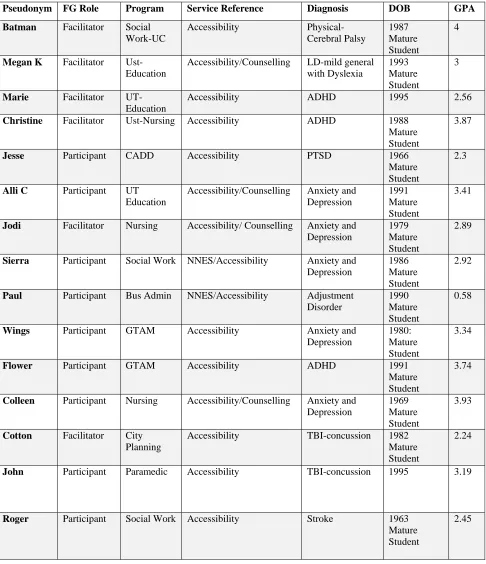
student facilitators and participants (Table 1).
Video recordings of each session were made and activity materials, such as small group
or partner visual representation and brainstorming, were collected and these responses codified
and tabulated (see Appendices D, E, and F). I chose to utilize assistive technology resources that
I routinely share with students needing support. These resources included Sonocent for audio
recording and transcription, and the Dragon Dictate phone app for speech to text processing of
ideas. These two technologies helped to increase the efficiency of my work, as Sonocent audio
note-taking is set up in columns where audio is presented as sound bites that can be edited,
color-coded and organized by topic or theme, and linked with images or text for a complete process.
Dragon Dictate allowed me to quickly and efficiently brainstorm ideas and themes with speech
to text. The text could then be edited, organized, and cited in reduced time, which was very
important process that modeled for students the types of assistive technology tools that are
available to them.
I followed the recommendations of established qualitative study procedures and paid
particular attention to multiple data collection sources including audio, transcription, flip chart
brainstorming by research question, and activity materials developed by the facilitator and
participants in order to strengthen credibility (Creswell, 2007). Data interpretation occurred
through a process of first open-coding with the transcribed audio, then with the materials
developed by the facilitators and participants. The next step was to gather the codes into patterns
and conceptual relationships using all of the data collected through the facilitator trainings and
focus group sessions. Themes and subthemes were identified and then compared first to the
2005 Alberta study and the 2010 University of Toronto study. Additional comparison was done
with the 2011 University of Surrey study on issues specific to mature students (see Appendix G).
Stakeholder checks with the participants and college counselor has also been utilized during and
since the completion of the last focus group session to establish transparency and trust with the
participants as well as for clarification of information gathered for accuracy.
Research Ethics
The foundation for the ethical considerations of this study was first those established by
the George Fox University to ensure the confidentiality and anonymity of participants. Initial
ethical review was conducted and approved by Medicine Hat College for approval of a research
study involving student participants (see Appendix H). Subsequently, the Institutional Review
Board at George Fox University approved the research review conducted by the Medicine Hat
College research ethics oversight board. A student consent agreement was completed prior to
students themselves. The identification key is kept, along with all other research materials, in a
locked file cabinet. Video recordings were made of each focus group, with great care taken to
keep all participant names from any transcription. These recordings will be destroyed by the
researcher after a period of three years following the completion of this study. The transcripts of
the focus group session recordings use only pseudonyms in reporting the findings. It was clearly
communicated to the students that their participation in this study was voluntary and they were
given the opportunity to withdraw at any time without negative consequences. Students were
also given the opportunity to remove data pertaining to themselves. This option was also
reiterated at the beginning of each focus group session by our counselor and me, as well as
discussed by the student facilitators.
Role of the Researcher
I am a graduate student completing this study to meet the requirements of the Doctor of
Education degree from George Fox University. I hold a position as a Learning Strategist at
Medicine Hat College in Alberta, Canada. My educational history began with a Bachelor’s
degree in education from Pacific University. My Master’s degree in counseling was completed
at Oregon State University, and I then continued with an administrative license and work toward
the doctoral degree in education from George Fox University. The majority of my career as an
educator has been as a school counselor and coordinator of student support teams for K-12
school districts. I have long been dedicated to responsive student support that provides young
people opportunities to discover their strengths and leadership abilities, so this area of research is
of great interest to me. It was an added benefit to be in a higher education position as a Learning
Strategist where the primary focus is supporting students as they utilize their strengths, learn
committed to ensuring that any bias that I had because of prior connections with some students
would not influence data interpretation or analysis, which was strongly reinforced by the student
facilitators for the focus groups.
Potential Contributions of Research
Research utilizing the perspectives of college students receiving learning services is
sparse. I anticipated that a conceptual model of student centered learning support might be
constructed as a result of this effort. A goal of this effort was that such a model would be of
assistance and beneficial primarily to my college in the development and sustainability of student
support programs. Interest in this study has been expressed by the leadership of the Canadian
Association of College and University Student Services (CACUSS). Indeed, the theme for the
May 2015 CACUSS is “Whole Campus, Whole Student” and includes focus on responsive
Table 1
Facilitator and Participant Characteristics
Pseudonym FG Role Program Service Reference Diagnosis DOB GPA
Batman Facilitator Social Work-UC
Accessibility Physical-Cerebral Palsy
1987 Mature Student
4
Megan K Facilitator Ust- Education
Accessibility/Counselling LD-mild general with Dyslexia
1993 Mature Student
3
Marie Facilitator UT-Education
Accessibility ADHD 1995 2.56
Christine Facilitator Ust-Nursing Accessibility ADHD 1988 Mature Student
3.87
Jesse Participant CADD Accessibility PTSD 1966
Mature Student
2.3
Alli C Participant UT Education
Accessibility/Counselling Anxiety and Depression
1991 Mature Student
3.41
Jodi Facilitator Nursing Accessibility/ Counselling Anxiety and Depression
1979 Mature Student
2.89
Sierra Participant Social Work NNES/Accessibility Anxiety and Depression
1986 Mature Student
2.92
Paul Participant Bus Admin NNES/Accessibility Adjustment Disorder
1990 Mature Student
0.58
Wings Participant GTAM Accessibility Anxiety and Depression
1980: Mature Student
3.34
Flower Participant GTAM Accessibility ADHD 1991
Mature Student
3.74
Colleen Participant Nursing Accessibility/Counselling Anxiety and Depression
1969 Mature Student
3.93
Cotton Facilitator City Planning
Accessibility TBI-concussion 1982 Mature Student
2.24
John Participant Paramedic Accessibility TBI-concussion 1995 3.19
Roger Participant Social Work Accessibility Stroke 1963 Mature Student
CHAPTER 4
FINDINGS
Introduction
In order to explore the perceptions and experiences of college students identified as
having learning challenges and receiving support services, three focus group sessions were
conducted, one for each specific research question structuring this investigation. These sessions
provided opportunities to gather student experiences with and perceptions of support services
during their time at the host college. Their responses were analyzed in a three stage process
specifically designed for the purposes of this investigation. The first stage involved the initial
coding of responses in which data were organized for more refined analyses. The second stage
included focused coding to identify themes and subthemes. Finally, I used a comparative
approach to examine themes and subthemes with findings reported in prior similar studies
conducted in Alberta, Toronto, and Surrey (UK).
Facilitator Planning Meetings and Focus Group Sessions
During the facilitator planning meetings, two of the facilitators who described themselves
as being more quiet and identified as being “listeners rather than talkers,” raised the concern that
we needed to make sure that everyone’s voice was heard. Cotton led this discussion by sharing
his own experiences with seeking support. He talked of being both an older student and as a
person whose learning challenges are a result of a concussion based brain injury. This injury has
caused a significant change in his life, as his plan was to pursue a career in sports. Cotton shared
that it was uncomfortable to ask for help and to admit that he has any trouble. He then discussed
the past 18 months I gained confidence to the point of being able now to share my story with the
young athletes that I coach, and with other students, too.” He said that his leadership style is
quieter and soft spoken, which was unique to the group of facilitators, but others expressed
appreciation for how impactful his input was to them.
The first focus group session began with an activity led by the student facilitators. They
shared after the sessions that they were quite nervous to be the ones in charge, but quickly
realized that the student participants were probably nervous as well. One of the facilitators, Jodi,
related that she was pleased because starting with the activity provided a way for everyone to
have a less intimidating way to engage with the topic. Marie felt that having dinner while the
students were directed to find a picture or pictures that represented their experiences and
perceptions of student support services at the college “was much more comfortable and created
an easy rapport.” The facilitators had each table group discuss among themselves and then
shared with the entire group. This approach seemed to lessen discomfort, and resulted in the
discussion both at the tables and with the whole group quickly becoming quite animated. Some
of the words used by the students to describe what their first experiences on campus were:
Alone, anxious, nervous
Foreign and far away from home
Lost
More questions than answers
Out of place
When the topic turned to discussing feelings the students experienced as they were
connected with services the energy increased as the students shared their thoughts. Prominent
among these sentiments include:
Never give up
Not alone anymore
Able to ask questions
It is possible to succeed
I’m okay with being a bit of a pain to get what I need
I want others to feel more supported from the start
The first session went an additional fifteen minutes because the students were very
engaged in discussing their experiences and perceptions. The openness of the question and the
activity with visual representation that the facilitators planned seemed to be engaging with
neither inherent bias nor influence. The data from the sessions indicated that although the
students individually had many differences and were unique individuals, there were common
experiences that included early feelings of uncertainty and being alone, and shared hope and
determination that was reinforced when connected with at least minimal support.
The second and third focus group sessions were active and the students seemed eager to
get started, as rapport had been previously established in session one. Jodi, a facilitator,
expressed appreciation that the introductory email for participants had included all the research
questions ahead of time, so they seemed ready and eager to discuss these two topics. We
discussed during facilitator training how these questions could be more emotionally impactful,
and, again, it was beneficial that both the facilitators and participants had connection with
used flip charts to record thoughts for each question, first as an open invitation for brainstorming,
and then with requests for additional detail. Discussion developed quickly and the environment
seemed informal with comfortable rapport.
One of the male students, John, who had been rather quiet during session one, in
subsequent sessions shared his experience seeking help just for headaches due to his brain injury.
He shared that initially he “was angry and reluctant to receive much support.” John went on to
say that he “now has an interest in being a resident assistant in order to help others in the next
year because many students are uncomfortable asking for help.” Jodi, Christine, and Megan,
who all have children, shared that they were relieved to have someone help them, but still felt
torn by their family obligations and responsibilities, so they did not always feel able to access all
that was available to them. Batman, Megan, Marie, and Jodi, who were all facilitators, shared
after the three focus group sessions were complete, how positive it was that a balance of
personalities and leadership styles existed. This allowed for the needs of all students—both quiet
and talkative, to be addressed.
Results
Two general themes and five subthemes emerged from the data analysis. These include
the general theme Supportive Campus Environment (three subthemes: feeling isolated and alone;
open academic and personal support; visibility/availability of support services), and the general
theme Student-Faculty/Staff Interaction (two subthemes: concerns with stigma; awareness and
empathy).
General Theme 1: Supportive Campus Environment
The first general theme relates to perceptions and experiences with the degree of