Methodological Note: Recent Advances in Hybrid
Brain-Computer Interface Systems: A Technological
and Quantitative Review
Sahar Sadeghi1 , Ali Maleki1*
1. Department of Biomedical Engineering, Faculty of New Sciences and Technologies, Semnan University, Semnan, Iran.
* Corresponding Author: Ali Maleki, PhD
Address: Department of Biomedical Engineering, Faculty of New Sciences and Technologies, Semnan University, Semnan, Iran.
Tel: +98 (23) 33383982
E-mail: [email protected]
Brain-Computer Interface (BCI) is a system that enables users to transmit commands to the computer using their brain activity recorded by electroencephalography. In a Hybrid Brain-Computer Interface (HBCI), a BCI control signal combines with one or more BCI control signals or with Human-Machine Interface (HMI) biosignals to increase classification accuracy, boost system speed, and improve user’s satisfaction. HBCI systems are categorized according to the type of combined signals and the combination technique (simultaneous or sequential). They have been used in several applications such as cursor control, target selection, and spellers. Increasing the number of articles published in this field indicates the significance of these systems. In this paper, different HBCI combinations, their important features, and potential applications are discussed. In most cases, the combination of a BCI control signal with a HMI biosignal yields higher information transfer rate than two BCI control signals. Article info:
Received: 06 June 2017
First Revision: 10 July 2017
Accepted: 29 May 2018
Available Online: 01 September 2018 Keywords:
Brain-Computer Interfaces (BCI), BCI control signal, Human-machine interface biosignal, Simultaneous and sequential HBCI
Citation:Sadeghi, S., & Maleki, A. (2018). Recent Advances in Hybrid Brain-Computer Interface Systems: A Technological and Quantitative Review. Basic and Clinical Neuroscience, 9(5), 373-388. http://dx.doi.org/10.32598/bcn.9.5.373
:
: http://dx.doi.org/10.32598/bcn.9.5.373 Use your device to scan
and read the article online
Funding:See Page 385
A B S T R A C T
Highlights
● In the hybrid brain-computer interface system, a brain-computer interface signal combines with other brain-computer interface signals or with human-machine interface biosignals.
● Sequential combination reduces errors and simultaneous combination increases the information transfer rate.
● Combination of brain-computer interface signal with human-machine interface biosignal yields higher information trans -fer rate than two brain-computer interface signals.
● The EEG+Eye Tracker and SSVEP+ERD have achieved highest and lowest information transfer rate, respectively.
1. Introduction
Brain-Computer Interface (BCI) system provides a non-muscular communication channel by creating a direct path between
brain and computer aimed at communicat
-ing with environment for people suffer-ing from severe paralysis, muscular atrophy, amyotrophic lateral sclerosis or brainstem stroke. BCI consists of
sensors and signal processing tools that directly con
-vert brain activity into commands or messages
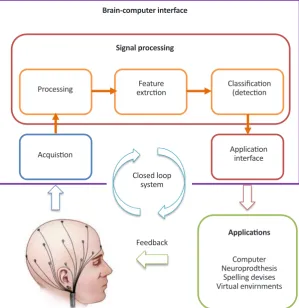
(Müller-Putz et al., 2012;Guger, Allison, & Müller Putz, 2015). The block diagram of the BCI system is illustrated in Figure 1. Brain activity is measurable using several
approaches such as electroencephalography, magneto
-encephalography, functional Magnetic Resonance Im
-aging (fMRI), Electrocorticography (ECoG), and
Near-Infrared Spectroscopy (NIRS) (Amiri, Rabbi, Azinfar,
& Fazel-Rezai 2013).
Electroencephalogram (EEG) signal is often consid
-ered as the input in most BCI systems. EEG electrodes are placed on the scalp and special devices record the electric field of neural activity. Six brain rhythms can
be distinguished in EEG signal based on the differenc
-es in frequency rang-es: Delta (1-4 Hz), theta (4-7 Hz), alpha (8-12 Hz), mu (8-13 Hz), beta (12-30 Hz), and gamma (25-100 Hz). Delta rhythm includes all rhythms
below 3.5 Hz and is generated during deep sleep, by children or the people with brain disorders.
Theta rhythm is further acquired from temporal and parietal areas and it is visible in children and some adults at the time of stress, disappointment, and heart -break. Alpha rhythm occurs in awake and eyes closed relax condition. It is significantly recorded from the oc -cipital lobes, but it can also be acquired from parietal and frontal regions. This rhythm completely disappears during sleep and when the subject is attracted to a par -ticular mental activity in the waking state, it is replaced with asynchronous waves with higher frequency and lower amplitude. Beta rhythm is mostly acquired from parietal and frontal areas.
It takes place at frequencies as high as 50 Hz in strong brain activities. It is divided into Beta I and Beta II. Beta I, with the frequency of about twice as Alpha rhythm, and influenced by similar mental activities af
-fecting the alpha rhythm. Beta II appears in the cen
-tral nervous system during intense activities and in the time of stress. The alpha activity, which is recorded from the sensory-motor areas, is called mu activity. Gamma rhythm acquired from somatosensory cortex is involved in high-level tasks such as cognitive functions and it is important for learning, memory, and data pro -cessing (Amiri et al., 2013;Bharne & Kapgate, 2015).
A
Plain Language Summary
Individuals with ALS, brainstem stroke, spinal cord injury and patients with numerous diseases may lose most or all voluntary muscle control so that sometimes they will not be able to speak well. The Brain-Computer Interface (BCI) system provides an alternative pathway between their brain and the system and enables these people to control their environment. It has been used in several applications such as cursor control, target selection, and spellers. Since a BCI system based on one method may not work on all subjects, the hybrid Brain-Computer Interface (HBCI) system has been introduced. In a HBCI system, a BCI control signal combines with one or more BCI control signals or with Human-Machine Interface (HMI) biosignals. Increasing the number of articles published in this field indicates the significance of these systems.
In this paper, different HBCI combinations, their important features, and potential applications are discussed. Clas -sification accuracy and Information Transfer Rate (ITR) are two important parameters to evaluate a BCI system. It is a trade-off between these two parameters; as one increases, the other one decreases and vice versa. Therefore, concern -ing the ultimate goal and depend-ing on the application, the appropriate combination type should be determined. This paper makes it easier to choose the optimal combination, by illustrating the correct location of the accuracy and the ITR corresponding to each combination. Results of this study show that in most cases, the combination of a BCI signal
with a HMI biosignal yields higher ITR than two BCI control signals. The highest and lowest ITR were achieved us
In general, BCI systems are categorized based on the brain activity patterns into four different types: P300
component of event-related potential, Steady-State Vi
-sual Evoked Potential (SSVEP), SCP, and Event-Relat
-ed Synchronization (ERS)/ Event-Relat-ed Desynchro
-nization (ERD).
P300 is an Event-Related desynchronization Potential
(ERP) that appears approximately 300 ms after a vi
-sual, auditory or tactile stimulation. Since P300-based BCI systems are vulnerable against noise, they require averaging of ERP responses from several stimuli. This reduces the speed and Information Transfer Rate (ITR). These systems also need less training and they have high validity among users and patients (Fazel-Rezai & Ahmad, 2011;Fazel-Rezai et al., 2012;Wolpaw & Wolpaw, 2012).
Visual Evoked Potentials (VEPs) are brain oscillations that occur after receiving a visual stimulation. Steady-State Visual Evoked Potential (SSVEP) is a kind of
VEP that occurs in response to stimulus with frequen
-cies higher than 6 Hz. Although higher stimulation fre -quencies reduce fatigue and discomfort, the recognition
of the signal is challenging. In general, SSVEP-based
BCI systems have many advantages such as better clas
-sification accuracy, higher ITR, and fewer numbers of required electrodes, compared to other methods such as
P300. These systems do not need training and if neces
-sary, the required time for training is very short. Al -though SSVEP-based systems are faster than systems
based on P300, they have shortcomings such as inap
-propriateness for patients with epilepsy, requirement of precise control of eye muscles, and the need for high-speed hardware (Guger et al., 2012;Guger et al., 2015).
Slow-Cortical Potentials (SCP) are negative slow po
-tential changes in EEG signals acquired in an imagined or actual movement from sensory-motor cortex of the brain (Allison et al., 2012; Faller, 2012). These poten -tials belong to the part of EEG signals with frequencies less than 1 Hz and are a reflection of cortical polariza -tion. The employment of these potentials is limited due to reasons such as long duration training time, high er -ror risk, and poor dimensional control.
Mu and Beta rhythms, both recorded from the
sensory-motor cortex, are caused by sensory stimulation or mo
-Figure 1. Block diagram of a BCI system
ﺰﻐﻣ ﻂﺳاو ﻢﺘﺴﯿﺳ
-ﺗﻮﯿﭙﻣﺎﮐ
ﺮ
لﺎﻨﮕﯿﺳ شزادﺮﭘ
شزادﺮﭘ ﺶﯿﭘ جاﺮﺨﺘﺳاﯽﮔﮋﯾو (يزﺎﺳرﺎﮑﺷآيﺪﻨﺑ ﻪﻘﺒﻃ)
بﺎﺴﺘﮐا
لﺎﻨﮕﯿﺳ يدﺮﺑرﺎﮐ ﻂﺳاو
ﻢﺘﺴﯿﺳ ﺴﺑ ﻪﻘﻠﺣ ﻪﺘ
دﺮﺑرﺎﮐ
ﺮﺗﻮﯿﭙﻣﺎﮐ ﯽﺒﺼﻋ ﺰﺗوﺮﭘ هﺪﻨﻨﮐ ﯽﺠﻫ يﺎﻫراﺰﺑا
يزﺎﺠﻣ يﺎﻫ ﻂﯿﺤﻣ ﮏﺑﺪﯿﻓ
Brain-computer interface
Signal processing
Processing extrctionFeature Classification(detection
Application interface Closed loop
system
Feedback Acquistion
Applications
Computer Neuroprodthesis
tor behavior. These rhythms include two types of am -plitude fluctuations named ERD and ERS. A voluntary movement causes a limited asynchronicity in the lower bands of Mu and Beta that is called ERD and it takes place about two seconds before starting the movement. In fact, the decrease in neuronal synchronization re -duces power in specific frequency bands and eventually
reduces the signal amplitude. After a voluntary move
-ment, with an increase in synchronization of neurons, the power is increased in brain rhythms and reaches its maximum level, 600 ms after the movement that is called ERS. The Motor Imagery (MI) is also a way to change in ERD/ERS favored in BCI applications. This method requires more training and may not applicable on some subjects (Pfurtscheller & Da Silva, 1999).
From another perspective, BCI systems are catego
-rized into synchronous and asynchronous. In a synchro
-nous system, the extraction and processing of signal features are prescheduled. It is based on the protocol that defines the starting and ending of each operation with specified duration. In an asynchronous system, called automated system, feature extraction and pro -cessing do not necessarily follow a fixed schedule.
2. Methods
2.1. Hybrid brain- computer interface systems
Since a BCI system based on one method may not work on all subjects, the Hybrid BCI (HBCI) system is introduced and this area is of interest to many research -ers over time.
The current study aimed at reviewing and analyz -ing the current state-of-the-art HBCI studies. In this review, articles were sought from the Google scholar database. Inclusion criteria were journal articles writ -ten in English from 2010 to December 2016. Other
publication forms (eg, books, proceeding papers, mas
-ter’s and doctoral dissertations, unpublished working papers, newspapers, etc.) were not included. Keywords used in search engines were “Hybrid” AND “Brain computer interface”, “Hybrid” AND “Brain machine
interface”, “Brain computer interface” AND “Electro
-encephalography”, “Brain computer interface” AND “Electrooculography”, “Brain computer interface”
AND “Electromyography”, “Brain computer inter
-face” AND “Near-infrared spectroscopy”, “Brain com
-puter interface” AND “evoked potential” OR “Brain computer interface” AND “Steady-state somatosensory evoked potential”.
After conducting the keyword search, some papers were found more than one time with different key
-words. Therefore, duplicates were excluded. Figure 2
shows the total number of articles published in different years based on Google Scholar database. There were 13 articles in 2010 and this number significantly rose in the following years. A total number of 60 and 61 articles were published in this context in 2015 and 2016, respec -tively. Increasing the number of articles published in the realm of HBCI indicates the high efficiency hybrid brain-computer interface of these systems.
In a HBCI, a BCI control signal combines with one or more BCI control signals or with Human Machine
Interface (HMI) biosignals. HBCI systems are catego
-rized according to the type of signals combined and the combination technique (Simultaneous/sequential). In
simultaneous combination, the systems work concur
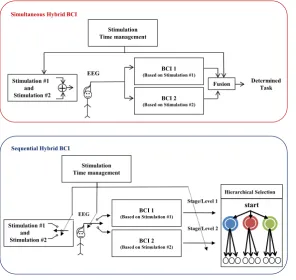
-rently with each other, while in sequential combination they act as time-sharing. In a sequential combination, the target is selected among several options by the first system and the second system does the process on the choice. A comprehensive block diagram with different modes of system operation is presented in Figure 3. This Figure completely describes the concept of system operation in both modes; simultaneous and sequential. The timing of stimulation in operation modes is depict -ed in this Figure.
In general, the most important goals of combining signals in HBCI systems are to increase the classifica -tion accuracy, enhancing system speed, improving user satisfaction, and overcoming the disadvantages of BCI systems. In contrast, most of these hybrid systems are associated with greater complexity.
2.2. Types of HBCI Systems
To date, different combinations are employed in
HBCI systems. Figure 4 shows the number of articles
published in different years based on the type of com
-bination, obtained from Google Scholar database. This Figure indicates that in the early years of the employ -ment of HBCI systems, the combination of BCI control signals was used in various studies. Over the time, the
combination of BCI control signals with HMI biosig
-nals was also considered. Figure 4 shows the gradual
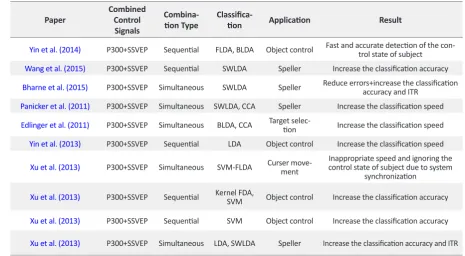
emphasis on the specific characteristics of each study is noted in Table 1. In the following, with the introduction of a variety of signal combinations in HBCI systems, methods and results of different studies are investigated.
2.2.1. The combination of P300 and SSVEP
Since both SSVEP and P300 are evoked by visual stimulation and none of them requires training, the combination of these two signals is used in various applications such as target selection, movement con
-trol, and spellers. In order to control the direction and speed of the movement, simultaneous combination of SSVEP and P300 is associated with shortages such as low speed and ignoring the resting state in synchronous systems (Bi, Lian, Jie, Lai, & Liu, 2014).
P300, associated with high ITR, is considered the main mechanism of data transfer in many applications, including spellers. One of the solutions to increase ITR in P300-based spellers is reducing the number of flash
-Figure 2. The Annual publication of articles based on Google Scholar database in the area of HBCI systems
Stimulation #1 and Stimulation #2
Stage/Level 2 EEG
Hierarchical Selection
start
Stage/Level 1 Stimulation
Time management Simultaneous Hybrid BCI
Determined Task Stimulation
Time management
BCI 1 (Based on Stimulation #1)
Fusion
BCI 2 (Based on Stimulation #2) EEG
Stimulation #1 and Stimulation #2
+
Sequential Hybrid BCI
BCI 1 (Based on Stimulation #1)
BCI 2 (Based on Stimulation #2)
Figure 3. The types of combinations in HBCI systems
es. There is a compromise between ITR and classifica -tion accuracy that by reducing one of them, the other one increases. In order to increase ITR, simultaneous combination of P300 and SSVEP is used. To this end, all characters are divided into subareas by two tech -niques: Row/Column (RC) or Subarea/Location (SL).
All of the characters in each subarea flicker at the same frequency. At the same time, cues highlight the
same location in each subarea in a pseudorandom se
-quence. Thus, only N1 flash codes for P300 and N2 frequencies for SSVEP are required to achieve the spelling of N1×N2 items. The RC mode is a better choice compared with SL mode, because of its higher average, faster speed, and lower standard deviation of ITR (Yin et al., 2014). To increase classification accu -racy, simultaneous combination of SSVEP and P300 is used to reduce errors occurred in rows or columns
2010 2011 2012 2013 2014 2015 2016
0 2 4 6 8 10 12 14
Year
T
he N
um
ber o
f P
ub
lis
hed
A
rt
icl
es
SSVEP+P300 SSVEP+ERD P300+ERD EEG+EOG EEG+Eyetracker EEG+EMG EEG+NIRS EEG+SSSEP
Figure 4. The annual publication of articles based on the type of HBCI combination obtained from Google Scholar database
Table 1. Comparison of the specific characteristics of The Studies in the field of HBCI
Result Application
Classifica
-tion
Combina-tion Type
Combined
Control Signals
Paper
Fast and accurate detection of the con -trol state of subject Object control
FLDA, BLDA Sequential
P300+SSVEP
Yin et al. (2014)
Increase the classification accuracy Speller
SWLDA Sequential
P300+SSVEP
Wang et al. (2015)
Reduce errors+increase the classification accuracy and ITR
Speller SWLDA
Simultaneous P300+SSVEP
Bharne et al. (2015)
Increase the classification speed Speller
SWLDA, CCA Simultaneous
P300+SSVEP
Panicker et al. (2011)
Increase the classification speed Target
selec-tion BLDA, CCA
Simultaneous P300+SSVEP
Edlinger et al. (2011)
Increase the classification speed Object control
LDA Sequential
P300+SSVEP
Yin et al. (2013)
Inappropriate speed and ignoring the control state of subject due to system
synchronization Curser
move-ment SVM-FLDA
Simultaneous P300+SSVEP
Xu et al. (2013)
Increase the classification accuracy Object control
Kernel FDA, SVM Sequential
P300+SSVEP
Xu et al. (2013)
Increase the classification accuracy Object control
SVM Sequential
P300+SSVEP
Xu et al. (2013)
Increase the classification accuracy and ITR Speller
LDA, SWLDA Simultaneous
P300+SSVEP
Result Application Classifica -tion Combina-tion Type Combined Control Signals Paper
Increase the ITR Speller
SVM, LDA Sequential
P300+SSVEP
Xu et al. (2013)
Increase the classification accuracy Curser
move-ment FLDA
Simultaneous SSVEP+ERD
Allison et al. (2010)
Decrease the positive error rate Orthotics
control LDA
Sequential SSVEP+ERD
Savić et al. (2011)
Increase the classification accuracy and ITR Curser move-ment LDA Simultaneous SSVEP+ERD
Brunner et al. (2011)
Reduce the time spent Neural
pros-thesis control
-Sequential SSVEP+ERD
Pfurtscheller et al. (2010)
Continuous and simultaneous move -ment in two dimensions Curser
move-ment LDA
Simultaneous SSVEP+ERD
Allison et al. (2012)
Simultaneous control of direction and speed Wheelchair control LDA Simultaneous SSVEP+ERD
Li et al. (2013)
Simultaneous set of direction and speed with spend the least possible time and
high classification accuracy Wheelchair
control SVM
Simultaneous SSVEP+ERD
Li et al. (2014)
Realization of eight control command Wheelchair
control RBF-SVM
Simultaneous SSVEP+ERD
Cao et al. (2014)
Achieve optimal performance Object control
SVM Simultaneous
SSVEP+ERD
Cao et al. (2014)
To determine and fulfill the stop com -mand Wheelchair control -Sequential P300+ERD
Rebsamen et al. (2008)
Direction and speed control Wheelchair
control LDA
Simultaneous P300+ERD
Long et al. (2012a)
Providing movement in various dimen-sions
Robot control FDA
Sequential P300+ERD
Finke et al. (2011)
Realization of more complex tasks Object control
SVM, FLDA Simultaneous
P300+ERD
Su et al. (2011)
Robot control Robot control
LDA Sequential
P300+ERD
Riechmann et al. (2011)
Increase the classification accuracy and ITR
Speller LDA
Sequential P300+ERD
Riechmann et al. (2011)
Increase the classification accuracy and ITR
Speller LDA
Sequential P300+ERD
Riechmann et al. (2011)
Affective robot control Robot control
-Sequential
EEG+EOG
Usakli et al. (2009)
Increase the classification accuracy Prosthesis
control SVM
Simultaneous EEG+EOG
Riccio et al. (2015)
Improve the performance Vigilance
estimation
-Simultaneous EEG+EOG
Riccio et al. (2015)
Increase the ITR Curser move-ment SVM Sequential EEG+Eye Tracker
Kim et al. (2015)
Increase the ITR Curser move-ment LDA Sequential EEG+Eye Tracker
Kim et al. (2015)
Increase the classification accuracy Speller
-Simultaneous EEG+EMG
Lin et al. (2015)
Increase the classification accuracy+ITR and the number of target items Speller
-Sequential
EEG+EMG
Leeb et al. (2011)
Improve the performance and ITR Speller
-Sequential
EEG+EMG
Riccio et al. (2015)
Increase the classification accuracy+the number of targets and ITR Speller
CCA Simultaneous
EEG+EMG
Riccio et al. (2015)
Increase the classification accuracy Object control
LDA Simultaneous
EEG+EMG
Riccio et al. (2015)
Improve the object control Object control
SVM Simultaneous
EEG+EMG
containing the target characters. Simultaneous with P300, several SSVEP frequencies are applied; hence, the characters in the same row or column may not have the same frequency (Yin et al., 2013). To increase clas -sification accuracy aimed at detecting the control state (period of time in which the subject is intended to con -vey information), the sequential combination of P300 and SSVEP is used (Edlinger, Holzner, & Guger, 2011; Panicker, Puthusserypady, & Sun, 2011).
In simultaneous combination of P300 and SSVEP, to avoid any disruption caused by unstable frequency of P300 on the frequency of flickering SSVEP, the P300 is used as the target deformation (Wang et al., 2015). In this approach, using the stop features of SSVEP
coupled with changing shape in P300 could also be ef
-fective (Xu et al., 2013).
2.2.2. The combination of ERD and SSVEP
SSVEP and ERD combination is employed in vari
-ous applications such as the control of wheelchair, or -thotics, and neural prosthesis. In combination of these signals, the ability to use the desired control signal at
any moment leads to the increase in classification ac
-curacy (Allison et al., 2010). This combination could also be effective in increasing the number of control commands. For example, if the classification of four di -rections of movement is realized using the right and left wrist motor imagery and taking into account the time of imagination, it is not possible yet to control the cursor in several directions in a moment (Bai, Lin, Huang, Fei, & Floeter, 2010).
SSVEP and ERD combination enable continuous
movement in two dimensions simultaneously (Allison
et al., 2012). Moreover, the possibility of simultaneous control of direction and speed of the wheelchair is pro
-vided and the move/stop command is made by spend
-ing a short time (Li et al., 2013;Cao, Li, Ji, & Jiang, 2014;Li et al., 2014). To increase the ITR, the combi -nation of these two signals is practical and better than switching from one state to another, since the fatigue resulting from this approach is not much (Brunner, Al
-lison, Altstätter, & Neuper, 2011).
To increase classification accuracy, their combina -tion is used to detect resting state in various applica -tions such as opening/closing orthotics and controlling neural prosthetics during grasping. The division of task into two steps and the possibility to turn off the LED after the completion of the first step reduce the fatigue and error rate by reduction of the adverse impact of LED flashes on ERD detection (Pfurtscheller, Solis-Es
-calante, Ortner, Linortner, & Muller-Putz, 2010;Savić, Kisić, & Popović, 2011).
2.2.3. The combination of P300 and ERD
The most common practical applications of P300 and ERD combination are wheelchair and robot control. In general, the control of these objects is done in two ways. In the first case, several targets are shown against the subject and the subject should select one of them. The subject automatically moves towards the target through a predetermined path. In this case, the indi -vidual has no control over the path. In the second case,
Result Application
Classifica
-tion
Combina-tion Type
Combined
Control Signals
Paper
Decrease the classification accuracy in simultaneous combination Curser
move-ment
-Sequential/ Simultaneous EEG+SSSEP
Ahn et al. (2013)
Providing multi-class BCI system Curser
move-ment
-Simultaneous EEG+SSSEP
Yao et al. (2014a)
Increase the classification accuracy Object control
LDA Simultaneous
EEG+SSSEP
Yao et al. (2014b)
Achieve optimal subjects’ performance Object control
LDA Simultaneous
EEG+SSSEP
Yao et al. (2014a)
Realization a large number of commands Wheelchair
control
-Simultaneous EEG+NIRS
Khan et al. (2014a)
Increase the ITR
-LDA Simultaneous
EEG+NIRS
Yao et al. (2014b)
Provide open access dataset
-LDA Simultaneous
EEG+NIRS
Yao et al. (2014a)
Increase the classification accuracy and improve sensitivity and specificity Stress
assess-ment SVM
Simultaneous EEG+NIRS
Al-Shargie et al. (2016)
the subject moves himself closer to the target with the voluntary movements in different directions. In order to
automatically move the wheelchair, sequential combi
-nation of P300 and ERD is used.
In the first stage, the target is selected using P300 and the subject moves himself closer to it from a predeter -mined path. In the second stage, the ERD is used for
stop command (Rebsamen et al., 2008;Rebsamen et al.,
2010;Riechmann, Hachmeister, Ritter, & Finke, 2011). On the other hand, when the voluntary control of direc -tion and the speed of movement are considered, both simultaneous and sequential combinations are used.
Typically, in applications that employ the simultaneous combination of these two control signals, ERD is used to move in different directions and P300 is applied to control the speed or stop command (Long et al., 2012a). In se -quential combination, ERD is used for routing and P300 is applied to achieve the desired object. Utilization of ERD for routing limits the number of commands and the P300 provides the control panel for the subject that allows him the possibility of further tasks (Finke, Knoblauch, Koes
-ling, & Ritter, 2011;Su et al., 2011).
2.2.4. The combination of EEG and EOG
EEG-based systems are a superior technology to in
-crease the communication of patients with disability and or paralysis that cannot move and speak. However, if there is little ability to move eyes in patients, this abil -ity can also be used in conjunction with EEG signals
in HBCI systems. Eye movement changes the orienta
-tion of the corneal-retinal potential and the electrodes placed around the eyes can record the effects named
EOG. The combination of EOG signal and other con
-trol signals is used in various applications such as con -trol of virtual keyboard, wheelchair, mobile robot, etc.
The input of eye movement does not require much train -ing and acts very fast. The amplitude of EOG signal is about several microvolts, hence, it could be easily clas -sified with high accuracy. This method is economically affordable since the number of electrodes is few. As an example of this combination in robot control, moving to the right and left direction is obtained using only two EOG electrodes. Direct movement and complete stop are also done by motor imagery and eye closing, respectively (Us
-akli, Gurkan, Aloise, Vecchiato, & Babiloni. 2009;
Pun-sawad, Wongsawat, & Parnichkun, 2010).
2.2.5. The combination of EEG and Eye-tracker
Eye tracking system is a wearable human-computer inter -face that provides the possibility to communicate through eye movements and blinking. The combination of this interface and EEG signals could be used in HBCI systems. The main use of this combination is curser movement on the screen. First, the subject guides the curser to the target as quickly as possible and then selects it. Eye motion indicates the cursor movement on the screen and the target is selected by EEG signal. Although the ITR in this combination is less than us -ing mouse, this rate is increased compared with that of BCI
(Kim, Kim & Jo, 2015).
2.2.6. The combination of EEG and EMG
Some patients may have little ability to move muscles in some organs. In many applications, this residual motion is not useful to control objects due to muscle weakness, exhaustion or disruption of natural tension. However, this ability can be effectively employed as a second signal in HBCI systems. For each patient, the suitable muscle is selected for electrode placement based on its ability to contract (Lalitharatne, Teramoto, Hayashi, & Kiguchi, 2013). The combination of EMG and motor imagery, P300 and SSVEP, is employed in various applications. SSVEP-based speller despite high ITR, high signal to noise ratio, and no need for training, only has appropriate response in a certain frequency range; it limits the number of target items.
To increase ITR and the number of characters in spellers, sequential combination of SSVEP and EMG is used, in such a way that all characters are divided into several groups and the ones that are in the same group flicker with different frequencies. The number of muscle activities determines the group number. Hence, after determining the desired group, the target item is
selected by SSVEP (Lin, Chen, Huang, Ding, & Gao,
2015). To increase classification accuracy, the simul -taneous combination of motor imagery and EMG has relatively better results in comparison with that of BCI system (Leeb, Sagha, Chavarriaga, & del R Millán,
2011). In this regard, P300 and EMG combination can be used to correct the error in spellers. In other words, contrary to BCI systems, which use backspace to delete the wrong letter, it is realized with the EMG in hybrid mode (Riccio et al., 2015).
2.2.7. The combination of EEG and SSSEP
Many people with stroke that their muscles are dam
Basic and Clinical
September, October 2018, Volume 9, Number 5
may have the ability to feel stimulation, which can be used in HBCI systems. For example, a combination of steady state somatosensory evoked potential retrieved from selective sensation and motor imagery is used in cursor control. Motor imagery is the activation of effer -ent motor nerves and selective sensation is receiving afferent neuron inputs related to stimulation perception. ERD and SSSEP are achieved by motor imagery and
tactile stimulation, respectively. In the simultaneous combination of these signals, increasing the classifica
-tion accuracy could not be achieved due to ERD deg
-radation caused by tactile signals (Ahn, Ahn, Cho, & Jun, 2013). In fact, ERD reduces the SSSEP amplitude and selective sensation increases it (Yao, Meng, Zhang, Sheng, & Zhu, 2014a).
Table 2. A comparison of the results of various researches in the field of hybrid BCI
Information Transfer Rate Classification Accuracy The Number of Channel Combination Type Combined Control Signal Paper 19 88.15 9 Sequential P300+SSVEP
Panicker et al. (2011)
34 97.5±6.2
32 Sequential
P300+SSVEP
Xu et al. (2013)
56.44±8.19 93.85±49.7
12 Simultaneous
P300+SSVEP
Yin et al. (2013)
48±4 95±5
12 Simultaneous
P300+SSVEP
Yin et al. (2014)
22±52.6 90.63±10.16
8 Simultaneous
P300+SSVEP
Wang et al. (2015)
-93±1
3 Sequential
P300+SSVEP
Wang et al. (2015)
-94±6
12 Sequential
P300+SSVEP
Wang et al. (2015)
32±5.5 93±7
14 Simultaneous
P300+SSVEP
Wang et al. (2015)
-81±8.9
6 Simultaneous
SSVEP+ERD
Allison et al. (2010)
4.7±2.4 95.6±6.7
8 Simultaneous
SSVEP+ERD
Brunner et al. (2011)
-85±6
2 Sequential
SSVEP+ERD
Pfurtscheller et al. (2010)
-98
6 Sequential
SSVEP+ERD
Savić et al. (2011)
-60
35 Simultaneous
SSVEP+ERD
Allison et al. (2012)
-90±2
15 Simultaneous
SSVEP+ERD
Cao et al. (2014)
SSVEP+P300 EEG+Eye Tracker SSVEP+ERD EEG+EMG ERD+P300 EEG+NIRS EEG+SSSEP EEG+EOG
0 10 20 30 40 50 60 70 80 90 100 110
30 40 50 60 70 80 90
Information Transfer Rate(bit/min)
C la ss if ic at io n A cc u ra cy (% ) SSVEP+P300 EEG+Eye Tracker
SSVEP+ERD ERD+P300 EEG+EMG
EEG+NIRS
EEG+SSSEP
EEG+EOG
Figure 5. The comparison of different combinations of HBCI systems based on classification accuracy and information transfer rates The range of classification accuracy and ITR were determined based on the conducted researches.
SSVEP+P300 EEG+Eye Tracker SSVEP+ERD EEG+EMG ERD+P300 EEG+NIRS EEG+SSSEP EEG+EOG
0 10 20 30 40 50 60 70 80 90 100 110
30 40 50 60 70
Information Transfer Rate(bit/min)
Information Transfer Rate Classification Accuracy The Number of Channel Combination Type Combined Control Signal Paper 11±77 13 Sequential SSVEP+ERD
Wang et al. (2015)
89±5.5 15
Simultaneous SSVEP+ERD
Wang et al. (2015)
1±17 91±1
14 Simultaneous
SSVEP+ERD
Wang et al. (2015)
1±22.5 95
19 Sequential
P300+ERD
Bhattacharyya et al. (2014)
-93.99
30 Sequential
P300+ERD
Long+et al. (2012b)
-12.7±85
14 Sequential
P300+ERD
Roula et al. (2012)
-79.5±2.5
16 Simultaneous
P300+ERD
Riechmann et al. (2011)
11±41 88±4
18 Sequential
P300+ERD
Riechmann et al. (2011)
10±43 87±4
18 Sequential
P300+ERD
Riechmann et al. (2011)
-96±2
5 Simultaneous
EEG+EOG
Punsawad et al. (2010)
86±5 97.88
5 Sequential
EEG+EOG
Ramli et al. (2015)
-11.5±87
10 Sequential
EEG+EOG
Ma et al. (2015)
56 80
10 Sequential
EEG+EOG
Koo et al. (2014a)
-1.7±91
15 Simultaneous
EEG+EOG
Riechmann+et al. (2011)
-5±60
2 Simultaneous
EEG+Eye Tracker
Meena et al. (2015)
-95.6±2.6
14 Sequential
EEG+Eye Tracker
Kim et al. (2015)
120±7.5 84±9.5
14 Sequential
EEG+Eye Tracker
Kim et al. (2015)
->80
32 Simultaneous
EEG+Eye Tracker
Dong et al. (2015)
85.5±2 16
Sequential EEG+Eye Tracker
Riechmann et al. (2011)
40.5±1 95.3±1.5
-Sequential
EEG+Eye Tracker
Riechmann et al. (2011)
60.4 79
4 Sequential
EEG+Eye Tracker
Riechmann et al. (2011)
83.7±24 80.8±15.6
11 Sequential
EEG+EMG
Lin et al. (2015)
-91
20 Simultaneous
EEG+EMG
Leeb et al. (2011)
12 100
9 Sequential
EEG+EMG
Riccio et al. (2015)
-88
16 Simultaneous
EEG+EMG
Leeb et al. (2010)
-84±7.7
16 Simultaneous
EEG+EMG
Kiguchi et al. (2012)
91±16 86±9
11 Simultaneous
EEG+EMG
Riechmann et al. (2011)
-64±5.5 64 Sequential/Si -multaneous SSSEP+EEG
Ahn et al. (2013)
1.2±1.14 77
64 Simultaneous
SSSEP+EEG
Ahn et al. (2013)
-83±8.5
64 Simultaneous
SSSEP+EEG
Yao et al. (2014a)
-44.5±7
32 Simultaneous
SSSEP+EEG
Riechmann et al. (2011)
-55.5±8.5
32 Simultaneous
SSSEP+EEG
2.2.8. The combination of EEG and NIRS
Non-invasive brain imaging technique that uses light with a wavelength range of 600 to 1000 nm is called NIRS. It is used to measure the hemodynamic response due to oxygenated hemoglobin, hemoglobin without oxygen, water, etc. EEG signal has good temporal resolution but poor spatial resolution, while NIRS has moderate temporal and spatial resolution and is also re -sistant to noise (Coyle, Ward, Markham, & McDarby, 2004; Herff et al. 2015). In HBCI systems, EEG, and NIRS combination is used to increase the number of commands without reduction in classification accuracy. For example, NIRS is used to measure brain activity caused by mental acts (mental counting or performing
subtraction) and EEG signal is applied to detect move
-ment (Khan, Hong, Naseer, Bhutta, & Yoon, 2014a).
3. Discussion
The current study assessed different HBCI systems that were the result of the combination of a BCI control signal and other BCI control signals or HMI control biosignals from the perspective of application, capabil -ities, and limitations. HBCI systems are used in many applications such as object control, movement control, spellers, etc. By the sequential combination of these systems, a complex task can be divided into several stages and only one BCI system is used at each stage. This method of combination assists to reduce the errors by better distinguishing the rest state from the attention state. On the other hand, the main goal of simultaneous combination of these systems is to increase the ITR.
Generally, HBCI systems have higher ITR and greater
classification accuracy compared to those of the con
-ventional BCI systems, but they are usually more com
-plex. This complexity can affect the ease of use of the system and its acceptance by the user.
From this perspective, the design and implementation of these systems including the number of channels play
an important role in the performance of system. Table
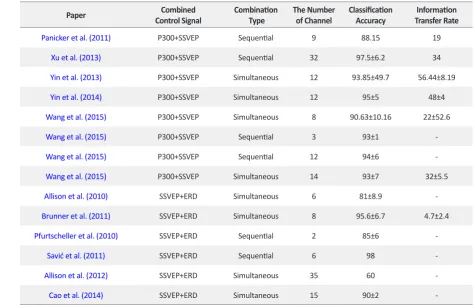
2 summarizes results of different studies with an em
-phasis on the number of channels, ITR, and classifica
-tion accuracy. The experimental condi-tions and signal recording considerations are different in these studies.
Accuracy and ITR measures are sensitive to the experi
-ment protocol, which makes it difficult to compare the results. Hence, to manage this issue, these measures are presented in the graphical form of Figure 5. In this Fig -ure, various HBCI combinations were compared with two quantitative criteria of classification accuracy and ITR. In this Figure, an ellipse is drawn for the ranges of ITR and classification accuracy of each method.
The center of ellipse and its diameters are set based on the mean and standard deviation of average values listed in Table 2. Classification accuracy and ITR are two impor -tant parameters to evaluate a BCI system. It is a tradeoff between these two parameters; as one increases, the other one decreases and vice versa. For a particular application, the increase in accuracy may be considered an advantage or an increase in ITR is desirable. Therefore, concerning the ultimate goal and depending on the application, the appropriate combination type should be determined. By having the correct location of the accuracy and the ITR
Information Transfer Rate Classification
Accuracy
The Number of Channel Combination
Type
Combined
Control Signal
Paper
->80
20 Simultaneous
EEG+NIRS
Khan et al. (2014a)
-86±5
37 Simultaneous
EEG+NIRS
Fazli et al. (2012)
-88±10
8 Simultaneous
EEG+NIRS
Koo et al. (2015b)
-80
3 Sequential
EEG+NIRS
Khan et al. (2014b)
-59
37 Simultaneous
EEG+NIRS
Lee et al. (2014)
-83
2 Simultaneous
EEG+NIRS
Ma et al. (2012)
-58±14.5
3 Simultaneous
EEG+NIRS
Herff et al. (2015)
13.9±10.5
-2 Simultaneous
EEG+NIRS
Tomita et al. (2014)
-94±3.5
23 Simultaneous
EEG+NIRS
Riechmann et al. (2011)
-95±4
31 Simultaneous
EEG+NIRS
corresponding to each combination, it is easy to determine the optimal combination.
The current study results showed that in most cases, the combination of a BCI control signal and HMI control biosignal had relatively higher ITR in comparison with those of the combination of the two BCI control signals. According to the Figure, the highest and lowest ITRs were achieved using EEG and Eye Tracker and SSVEP and ERD, respectively. The combination of EEG signal and NIRS also had the lowest classification accuracy in com -parison with those of the others, while the accuracy val -ues of other hybrid systems did not differ much from each other and they were located within the range of 70% to 100%. Generally, in using HBCI systems, the combination technique can be determined based on the type of applica -tion, the main goal, as well as the capabilities of patients.
Ethical Considerations
Compliance with ethical guidelines
There is no ethical principle to be considered doing this research.
Funding
This research did not receive any specific grant from funding agencies in the public, commercial, or not-for-profit sectors.
Authors contributions
The Authors contributions is as follows: Conceptualiza -tion, methodology, resources and supervision: Ali Maleki; Investigation and writing–original draft: Sahar Sadeghi; and Writing–review & editing: Both authors.
Conflict of interest
The authors declared no conflict of interest.
References
Ahn, S., Ahn, M., Cho, H., & Jun, S. C. (2013). hybrid
brain-computer interface based on motor imagery and tactile se -lective attention. In N.L. Millán, R. Leeb, J.D.R. Millán, N. Guechoul, T. Carlson, A. Sobolewski, et al. (Eds.),
Proceed-ings of TOBI Workshop IV (pp. 51-52). Switzerland: École
polytechnique fédérale de Lausanne.
Faller, J. (2012). BCIs that use steady-state visual evoked po-tentials or slow cortical popo-tentials. In J. Wolpaw, & E.
Win-ter Wolpaw (Eds.), Brain-Computer Interfaces, Principles and
Practice. Oxford: Oxford University Press.
Allison, B. Z., Brunner, C., Altstätter, C., Wagner, I. C., Griss-mann, S., & Neuper, C. (2012). A hybrid ERD/SSVEP BCI for continuous simultaneous two dimensional cursor control. Journal of Neuroscience Methods, 209(2), 299-307.
[DOI:10.1016/j.jneumeth.2012.06.022] [PMID]
Allison, B. Z., Brunner, C., Kaiser, V., Müller-Putz, G. R., Neu-per, C., & Pfurtscheller, G. (2010). Toward a hybrid
brain-computer interface based on imagined movement and visual attention. Journal of Neural Engineering, 7(2), 026007.
[DOI:10.1088/1741-2560/7/2/026007] [PMID]
Al Shargie, F., Kiguchi, M., Badruddin, N., Dass, S. C., Hani, A. F. M., & Tang, T. B. (2016). Mental stress assessment using
simultaneous measurement of EEG and fNIRS. Biomedical
Optics Express, 7(10), 3882-98. [DOI:10.1364/BOE.7.003882]
[PMID] [PMCID]
Amiri, S., Rabbi, A., Azinfar, L., & Fazel-Rezai, R. (2013). A review of P300, SSVEP, and hybrid P300/SSVEP brain-com-puter interface systems. In R. Fazel-Rezai (Eds.),
Brain-Com-puter Interface Systems-Recent Progress and Future Prospects.
Intech Open. [DOI:10.5772/56135]
Bai, O., Lin, P., Huang, D., Fei, D. Y., & Floeter, M. K. (2010). Towards a user-friendly brain-computer interface:
Ini-tial tests in ALS and PLS patients. Clinical
Neurophysiol-ogy, 121(8), 1293-1303. [DOI:10.1016/j.clinph.2010.02.157]
[PMID] [PMCID]
Bharne, P. P., & Kapgate, D. (2015). Hybrid visual BCI combin-ing SSVEP and P300 with high ITR and accuracy.
Internation-al JournInternation-al of Computer Science and Mobile Computing, 4(6), 1-5.
Bhattacharyya, S., Konar, A., & Tibarewala, D. N. (2014). “Motor imagery, P300 and error-related EEG-based robot arm movement control for rehabilitation purpose.
Medi-cal & BiologiMedi-cal Engineering & Computing, 52(12): 1007-17.
[DOI:10.1007/s11517-014-1204-4] [PMID]
Bi, L., Lian, J., Jie, K., Lai, R., & Liu, Y. (2014). A speed and direction-based cursor control system with P300 and SS-VEP. Biomedical Signal Processing and Control, 14, 126-33.
[DOI:10.1016/j.bspc.2014.07.009]
Breitwieser, C., Pokorny, C., & Gernot, R. M. (2016). A hy-brid three-class brain? Computer interface system utilizing SSSEPs and transient ERPs. Journal of Neural Engineering, 13(6), 066015. [DOI:10.1088/1741-2560/13/6/066015] [PMID]
Brunner, C., Allison, B. Z., Altstätter, C., & Neuper, C. (2011).
A comparison of three brain–computer interfaces based on
event-related desynchronization, steady state visual evoked potentials, or a hybrid approach using both signals.
Jour-nal of Neural Engineering, 8(2), 025010. [
DOI:10.1088/1741-2560/8/2/025010] [PMID]
Buccino, A. P., Keles, H. O., & Omurtag, A. (2016). Hybrid EEG-fNIRS asynchronous brain-computer interface for mul-tiple motor tasks. PloS One, 11(1), e0146610. [DOI:10.1371/
journal.pone.0146610] [PMID] [PMCID]
Cao, L., Li, J., Ji, H., & Jiang, C. (2014). A hybrid brain
com-puter interface system based on the neurophysiological
protocol and brain-actuated switch for wheelchair control.
Journal of Neuroscience Methods, 229, 33-43. [DOI:10.1016/j.
Capati, F. A., Bechelli, R. P., & Castro, M. C. F. (2016). Hybrid SSVEP/P300 BCI keyboard. In J. Gilbert, H. Azhari, H. Ali, C. Quintão, J. Sliwa, C. Ruiz, et al., (Eds.), Proceedings of the International Joint Conference on Biomedical Engineering
Sys-tems and Technologies (pp. 214-8). Setúbal: SciTePress-Science
and Technology Publications. [PMID]
Chang, M. H., Lee, J. S., Heo, J., & Park, K. S. (2016). Elicit-ing dual-frequency SSVEP usElicit-ing a hybrid SSVEP-P300 BCI.
Journal of Neuroscience Methods, 258, 104-13. [DOI:10.1016/j.
jneumeth.2015.11.001] [PMID]
Coyle, S., Ward, T., Markham, C., & McDarby, G. (2004). On the Suitability of Near-Infrared (NIR) systems for next-gen-eration brain-computer interfaces. Physiological Measurement, 25(4), 815. [DOI:10.1088/0967-3334/25/4/003] [PMID]
Dong, X., Wang, H., Chen, Z., & Shi, B. E. (2015). Hybrid brain
computer interface via Bayesian integration of EEG and eye gaze.
Paper presented at the 17th International IEEE/EMBS Con-ference on Neural Engineering (NER), Montpellier, France, 2 July 2015. [DOI:10.1109/NER.2015.7146582]
Edlinger, G., Holzner, C., & Guger, C. (2011). A hybrid
brain-computer interface for smart home control. Paper presented at
the International Conference on Human-Computer Interac-tion, Las Vegas, 15-20 July 2018. [
DOI:10.1007/978-3-642-21605-3_46]
Évain, A., Argelaguet, F., Casiez, G., Roussel, N., & Lécuyer, A. (2016). Design and evaluation of fusion approach for combining brain and gaze inputs for target selection.
Fron-tiers in Neuroscience, 10, 454. [DOI:10.3389/fnins.2016.00454]
[PMID] [PMCID]
Fazel-Rezai, R., & Ahmad, W. (2011). P300-based brain-com-puter interface paradigm design. In U. Hoffmann, J.M. Vesin, T. Ebrahimi (Eds.), Recent Advances in Brain-Computer
Interface Systems. IEEE Xplore Digital Library.
Fazel Rezai, R., Allison, B. Z., Guger, C., Sellers, E. W., Kleih, S. C., & Kübler, A. (2012). P300 brain computer interface: Current challenges and emerging trends. Frontiers in
Neu-roengineering, 5, 14. [DOI:10.3389/fneng.2012.00014] [PMID]
[PMCID]
Fazli, S., Mehnert, J., Steinbrink, J., Curio, G., Villringer, A., Müller, K. R., et al. (2012). Enhanced performance by a hy-brid NIRS–EEG brain computer interface. Neuroimage, 59(1), 519-29. [DOI:10.1016/j.neuroimage.2011.07.084] [PMID]
Finke, A., Knoblauch, A., Koesling, H., & Ritter, H. (2011). A
hy-brid brain interface for a humanoid robot assistant. Paper presented
at 2011 Annual International Conference of the IEEE Engineer-ing in Medicine and Biology Society, Boston, 30 August-3 Sep-tember, 2011. [DOI:10.1109/IEMBS.2011.6091728] [PMID]
Guger, C., Allison, B. Z., Großwindhager, B., Prückl, R., Hintermüller, C., Kapeller, C., et al. (2012). How many peo-ple could use an SSVEP BCI?. Frontiers in Neuroscience, 6,
169. [DOI:10.3389/fnins.2012.00169] [PMID] [PMCID]
Guger, C., Allison, B. Z., & Müller Putz, G. R. (2015). Brain-Computer Interface Research: A state-of-the-art summary 4. In Ch. Guger, B.Z. Allison, G. Edlinger (Eds.),
Brain-Computer Interface Research (pp. 1-8). Berlin: Springer.
[DOI:10.1007/978-3-319-25190-5]
Herff, C., Fortmann, O., Tse, C. Y., Cheng, X., Putze, F., Heger, D., & Schultz, T. (2015). Hybrid fNIRS-EEG based
discrimina-tion of 5 levels of memory load. Paper presented at 2015 7th In
-ternational IEEE/EMBS Conference on Neural Engineering (NER). Montpellier, France, 2-24 April 2015. [DOI:10.1109/
NER.2015.7146546]
Ji, H., Li, J., Lu, R., Gu, R., Cao, L., & Gong, X. (2016). EEG classification for hybrid brain-computer interface using a tensor based multiclass multimodal analysis scheme.
Computational intelligence and neuroscience, 2016, 51.
[DOI:10.1155/2016/1732836] [PMID] [PMCID]
Khan, M. J., Hong, K. S., Naseer, N., Bhutta, M. R., & Yoon, S. H. (2014a). Hybrid EEG-NIRS BCI for rehabilitation using
different-source brain signals. Paper presented at the Annual
Conference of the Society of Instrument and Control Engi -neers (SICE), Sapporo, Japan, 9 September 2014.
Khan, M. J., Hong, M. J., & Hong, K. S. (2014b). Decoding of four movement directions using hybrid NIRS-EEG
brain-computer interface. Frontiers in Human Neuroscience, 8, 244.
[DOI:10.3389/fnhum.2014.00244] [PMID] [PMCID]
Kiguchi, K., & Hayashi, Y. (2012). A study of EMG and EEG during perception-assist with an upper-limb power-assist robot.
Paper presented at Robotics and Automation (ICRA), Saint Paul, 14-18 May 2012. [DOI:10.1109/ICRA.2012.6225027]
Kim, M., Kim, B. H., & Jo, S. (2015). Quantitative evaluation of a low-cost noninvasive hybrid interface based on EEG and eye movement. IEEE Transactions on Neural Systems
and Rehabilitation Engineering, 23(2), 159-68. [DOI:10.1109/
TNSRE.2014.2365834] [PMID]
Kim, Y., & Jo, S. (2015). Wearable hybrid brain-computer interface
for daily life application. Paper presented at 2015 3rd Interna
-tional Winter Conference on Brain-Computer Interface, Sabuk, South Korea, 12-14 January 2015.
Koo, B., Lee, H. G., Nam, Y., Kang, H., Koh, C. S., Shin, H. C., et al. (2015a). A hybrid EOG-P300 BCI with dual monitors. Paper
presented at 2014 International Winter Workshop on Brain-Computer Interface (BCI), Jeongsun-kun, South Korea, 17-19 February 2014.
Koo, B., Lee, H. G., Nam, Y., Kang, H., Koh, C. S., Shin, H. C., et al. (2015b). A hybrid NIRS-EEG system for self-paced brain computer interface with online motor imagery.
Jour-nal of Neuroscience Methods, 244, 26-32. [
DOI:10.1016/j.jneue-meth.2014.04.016] [PMID]
Lalitharatne, T. D., Teramoto, K., Hayashi, Y., & Kiguchi, K. (2013). Towards hybrid EEG-EMG-based control approach-es to be used in bio-robotics applications: Current status, challenges and future directions. Paladyn, Journal of
Behavio-ral Robotics, 4(2), 147-54. [DOI:10.2478/pjbr-2013-0009]
Lee, M. H., Fazli, S., Mehnert, J., & Lee, S. W. (2014). Hybrid brain-computer interface based on EEG and NIRS
modali-ties. Paper presented at 2014 International Winter
Work-shop on Brain-Computer Interface (BCI), Jeongsun-kun, South Korea, 17-19 February 2014. [
DOI:10.1109/iww-BCI.2014.6782577]
Leeb, R., Sagha, H., & Chavarriaga, R. (2010). Multimodal
fu-sion of muscle and brain signals for a hybrid-BCI. Peper pre
-sented at 2010 Annual International Conference of the IEEE Engineering in Medicine and Biology, Buenos Aires, Argentina, 31 August- 4 September 2010. [DOI:10.1109/
IEMBS.2010.5626233] [PMID]
elec-troencephalographic and electromyographic activities.
Jour-nal of Neural Engineering, 8(2), 025011. [
DOI:10.1088/1741-2560/8/2/025011] [PMID]
Li, J., Ji, H., Cao, L., Gu, R., Xia, B., & Huang, Y. (2013). Wheel-chair control based on multimodal brain-computer interfaces.
Peper presented at International Conference on Neural In-formation Processing, Daegu, Korea, 3-7 November 2013.
[DOI:10.1007/978-3-642-42054-2_54]
Li, J., Ji, H., Cao, L., Zang, D., Gu, R., Xia, B., et al. (2014).
Evalu-ation and applicEvalu-ation of a hybrid brain computer interface
for real wheelchair parallel control with multi-degree of freedom. International Journal of Neural Systems, 24(04), 1450014. [DOI:10.1142/S0129065714500142] [PMID]
Lin, K., Chen, X., Huang, X., Ding, Q., & Gao, X. (2015). A hybrid BCI speller based on the combination of EMG
enve-lopes and SSVEP. Heidelberg: Springer Berlin Heidelberg.
[DOI:10.1186/s40535-014-0004-0]
Lin, K., Cinetto, A., Wang, Y., Chen, X., Gao, S., & Gao, X. (2016). An online hybrid BCI system based on SSVEP and EMG. Journal of Neural Engineering, 13(2), 026020.
[DOI:10.1088/1741-2560/13/2/026020] [PMID]
Liu, Y. H., Wang, S. H., & Hu, M. R. (2016). A self-paced P300 healthcare brain-computer interface system with SSVEP-based switching control and kernel FDA+SVM-SSVEP-based detec-tor. Applied Sciences, 6(5), 142. [DOI:10.3390/app6050142]
Liu, H., Li, Y., Liu, H., & Wang, S. (2016). Bagging regular-ized common spatial pattern with hybrid motor imagery and
myoelectric signal. Paper presented at 2016 IEEE
Interna-tional Conference on Acoustics, Speech and Signal Pro-cessing (ICASSP), Shanghai, China, 20-25 March 2016.
[DOI:10.1109/ICASSP.2016.7471793]
Long, J., Li, Y., Wang, H., Yu, T., Pan, J., & Li, F. (2012a). A
hybrid brain computer interface to control the direction and
speed of a simulated or real wheelchair. IEEE Transactions
on Neural Systems and Rehabilitation Engineering, 20(5), 720-9.
[DOI:10.1109/TNSRE.2012.2197221] [PMID]
Long, J., Li, Y., Yu, T., & Gu, Z. (2012b). Target selection with hybrid feature for BCI-based 2-D cursor control. IEEE
Trans-actions on Biomedical Engineering, 59(1), 132-40. [DOI:10.1109/
TBME.2011.2167718] [PMID]
Ma, J., Zhang, Y., Cichocki, A., & Matsuno, F. (2015). A nov-el EOG/EEG hybrid human-machine interface adopting eye movements and ERPs: Application to robot control.
IEEE Transactions on Biomedical Engineering, 62(3), 876-89.
[DOI:10.1109/TBME.2014.2369483] [PMID]
Ma, L., Zhang, L., Wang, L., Xu, M., Qi, H., Wan, B., et al. (2012). A hybrid brain-computer interface combining the EEG
and NIRS. Peper presented at IEEE International Confer
-ence on Virtual Environments Human-Computer Interfaces and Measurement Systems (VECIMS) Proceedings, Tianjin, China, 2-4 July 2012. [DOI:10.1109/VECIMS.2012.6273214]
Meena, Y., Prasad, G., Cecotti, H., & Wong-Lin, K. (2015). Si-multaneous gaze and motor imagery hybrid BCI increases
single-trial detection performance: A compatible incompatible study.
Paper presented at 9th IEEE-EMBS International Summer School on Biomedical Signal Processing, Pavia, Italy, Sep-tember 2015.
Mercado, L., Rodríguez-Li-án, A., Torres-Trevi-o, L. M., & Quiroz, G. (2016). Hybrid BCI approach to control an artificial
tibio-femoral joint. Paper presented at 38th Annual Interna
-tional Conference of the IEEE Engineering in Medicine and Biology Society (EMBC), Orlando, 16-20 August 2016. [DOI:
10.1109/EMBC.2016.7591302]
Müller-Putz, G. R., Leeb, R., Millán, J. D. R., Horki, P., Kreilinger, A., Bauernfeind, et al. (2012). Principles of hy-brid brain-computer interfaces. In B.Z. Allison, S. Dunne, R. Leeb, J. D. R. Millán, A. Nijholt (Eds.), Towards Practical
Brain-Computer Interfaces (pp. 355-373). Berlin: Springer.
[DOI:10.1007/978-3-642-29746-5_18]
Panicker, R. C., Puthusserypady, S., & Sun, Y. (2011). An asynchro-nous P300 BCI with SSVEP-based control state detection. IEEE
Transactions on Biomedical Engineering 58(6), 1781-8. [DOI:10.1109/
TBME.2011.2116018] [PMID]
Peng, N., Zhang, R., Zeng, H., Wang, F., Li, K., Li, Y., et al. (2016). Control of a nursing bed based on a hybrid
brain-com-puter interface. Paper presented at 2016 38th Annual Inter
-national Conference of the IEEE Engineering in Medicine and Biology Society (EMBC), Orlando, 16-20 August 2016.
[DOI:10.1109/EMBC.2016.7591008]
Pfurtscheller, G., & Da Silva, F. L. (1999). Event-related EEG/MEG synchronization and desynchronization: ba-sic principles. Clinical Neurophysiology, 110(11), 1842-57.
[DOI:10.1016/S1388-2457(99)00141-8]
Pfurtscheller, G., Solis-Escalante, T., Ortner, R., Linortner, P., & Muller-Putz, G. R. (2010). Self-paced operation of an SSVEP-Based orthosis with and without an imagery-based “brain switch:” A feasibility study towards a hybrid BCI. IEEE Transactions on Neural Systems and Rehabilitation Engineering, 18(4), 409-14. [DOI:10.1109/TNSRE.2010.2040837]
Pokorny, C., Breitwieser, C., & Müller-Putz, G. R. (2016). The role of transient target stimuli in a steady-state soma-tosensory evoked potential-based brain–computer inter-face setup. Frontiers in Neuroscience, 10, 152. [DOI:10.3389/
fnins.2016.00152] [PMID]
Punsawad, Y., Wongsawat, Y., & Parnichkun, M. (2010). Hy-brid EEG-EOG brain-computer interface system for practical
ma-chine control. Paper presented at 2010 Annual International
Conference of the IEEE Engineering in Medicine and Biol-ogy, Buenos Aires, Argentina, 31 August- 4 September 2010.
[DOI:10.1109/IEMBS.2010.5626745]
Ramli, R., Arof, H., Ibrahim, F., Mokhtar, N., & Idris, M. Y. I. (2015). Using finite state machine and a hybrid of EEG signal and EOG artifacts for an asynchronous wheelchair navigation. Expert Systems with Applications, 42(5), 2451-63.
[DOI:10.1016/j.eswa.2014.10.052]
Rebsamen, B., Burdet, E., Zeng, Q., Zhang, H., Ang, M., Teo, C. L., et al. (2008). Hybrid P300 and Mu-Beta brain computer
in-terface to operate a brain controlled wheelchair. Paper presented
at Proceedings of the 2nd International Convention on Reha-bilitation Engineering & Assistive Technology, Bangkok, Thailand, 13-15 May 2008.
Rebsamen, B., Guan, C., Zhang, H., Wang, C., Teo, C., Ang, M. H., et al. (2010). A brain controlled wheelchair to navigate in familiar environments. IEEE Transactions on Neural Systems
and Rehabilitation Engineering, 18(6), 590-8.[DOI:10.1109/
TNSRE.2010.2049862]
peo-ple with severe motor disability: Electromyography signals for error correction during a spelling task.
Archives of Physical Medicine and Rehabilitation, 96(3), S54-S61.
[DOI:10.1016/j.apmr.2014.05.029]
Riechmann, H., Hachmeister, N., Ritter, H., & Finke, A. (2011). Asynchronous, parallel on-line classification of P300 and ERD for an efficient hybrid BCI. Paper presented at 5th Interna -tional IEEE/EMBS Conference on Neural Engineering, NER 2011, Cancun, Mexiko, 27 April 2011. [DOI:10.1109/
NER.2011.5910574]
Roula, M. A., Kulon, J., & Mamatjan, Y. (2012). Brain-computer
interface speller using hybrid P300 and motor imagery signals. 4th
IEEE RAS & EMBS International Conference on Biomedical Robotics and Biomechatronics (BioRob), Rome, Italy, 24-27 June 2012. [DOI:10.1109/BioRob.2012.6290944]
Savić, A., Kisić, U., & Popović, M. B. (2011). Toward a hybrid BCI
for grasp rehabilitation. 5th European Conference of the Inter
-national Federation for Medical and Biological Engineering, Berlin: Springer. [DOI:10.1007/978-3-642-23508-5_210]
Severens, M., Farquhar, J., Duysens, J., & Desain, P. (2013). A multi-signature brain-computer interface: Use of transient and steady-state responses. Journal of Neural Engineering, 10(2), 026005. [DOI:10.1088/1741-2560/10/2/026005] [PMID] Shin, J., von Luhmann, A., Blankertz, B., Kim, D. W., Jeong,
J., Hwang, H. J., et al. (2016). Open access dataset for EEG+ NIRS single-trial classification. IEEE Transactions on Neural
Systems and Rehabilitation Engineering, 25(10), 1735-45.
Su, Y., Qi, Y., Luo, J. X., Wu, B., Yang, F., Li, Y., et al. (2011). A hybrid brain-computer interface control strategy in a vir-tual environment. Journal of Zhejiang University SCIENCE C, 12(5), 351-61. [DOI:10.1631/jzus.C1000208]
Tomita, Y., Vialatte, F. B., Dreyfus, G., Mitsukura, Y., Bakard-jian, H., & Cichocki, A. (2014). Bimodal BCI using simulta-neously NIRS and EEG. IEEE Transactions on Biomedical
En-gineering, 61(4), 1274-84. [DOI:10.1109/TBME.2014.2300492]
Usakli, A. B., Gurkan, S., Aloise, F., Vecchiato, G., & Babiloni, F. (2009). A hybrid platform based on EOG and EEG signals to
re-store communication for patients afflicted with progressive motor
neuron diseases. Paper presented at Engineering in Medicine
and Biology Society: Engineering the Future of Biomedicine, EMBC 2009, Minneapolis, 6 September 2009. [DOI: 10.1109/ IEMBS.2009.5333742] [PMID]
Wang, M., Daly, I., Allison, B. Z., Jin, J., Zhang, Y., Chen, L., et al. (2015). A new hybrid BCI paradigm based on P300 and SSVEP. Journal of Neuroscience Methods, 244, 16-25.
[DOI:10.1016/j.jneumeth.2014.06.003]
Wolpaw, J., & Wolpaw, E. W. (2012). Brain-computer
interfac-es: Principles and practice. Oxford: Oxford University Press.
[Doi:10.1093/acprof:oso/9780195388855.001.0001]
Xu, M., Qi, H., Wan, B., Yin, T., Liu, Z., & Ming, D. (2013). A hy-brid BCI speller paradigm combining P300 potential and the SSVEP blocking feature. Journal of Neural Engineering, 10(2), 026001. [DOI:10.1088/1741-2560/10/2/026001] [PMCID]
Yang, J., Su, X., Bai, D., Jiang, Y., & Yokoi, H. (2016). Hybrid EEG-EOG system for intelligent prosthesis control based on
common spatial pattern algorithm. Paper presented at IEEE
International Conference on Information and Automation
(ICIA), Ningbo, China, 1-3 August 2016.
Yao, L., Meng, J., Zhang, D., Sheng, X., & Zhu, X. (2014a). A novel hybrid BCI speller based on the incorporation of SS-VEP into the P300 paradigm. Journal of Neural Engineering, 10(2), 026012.
Yao, L., Meng, J., Zhang, D., Sheng, X., & Zhu, X. (2014b). Combining motor imagery with selective sensation toward a hybrid-modality BCI. IEEE Transactions on Biomedical
En-gineering, 61(8), 2304-12. [DOI:10.1109/TBME.2013.2287245]
Yin, E., Zhou, Z., Jiang, J., Chen, F., Liu, Y., & Hu, D. (2014). A speedy hybrid BCI spelling approach combining P300 and SSVEP. IEEE Transactions on Biomedical Engineering, 61(2), 473-83. [DOI:10.1109/TBME.2013.2281976] [PMID]
Yin, E., Zhou, Z., Jiang, J., Chen, F., Liu, Y., & Hu, D. (2013). A novel hybrid BCI speller based on the incorporation of SSVEP into the P300 paradigm. Journal of Neural Engineering, 10(2), 026012. [DOI:10.1088/1741-2560/10/2/026012] [PMID]
Yu, Y., Jiang, J., Zhou, Z., Yin, E., Liu, Y., Wang, J., et al. (2016).
A self-paced brain-computer interface speller by combining motor
imagery and P300 potential. Paper presented at 8th
Internation-al Conference on Intelligent Human-Machine Systems and Cybernetics (IHMSC), Hangzhou, China, 27-28 August 2016.
Yu, Y., Zhou, Z., Jiang, J., Yin, E., Liu, K., Wang, J., et al. (2016). Towards a hybrid BCI: Self-paced operation of a p300-based speller by merging a motor imagery-p300-based ‘brain switch’into a P300 spelling approach. International Journal of
Human-Computer Interaction, 33(8), 1-10.
Zheng, W. L., & Lu, B. L. (2017). A multimodal approach to estimating vigilance using EEG and forehead EOG. Journal