Design and Implementation of Electronic
Ballotting System; A case study of Nigeria
Steve A. Adeshina, Lukman E. Ismaila , Kaltume U. Ibrahim and Adegboyega Ojo
Abstract—Elections have been found to be a panacae for good governance. Governments become accountatble when voters are allowed to choose who represent them. Traditional manual based balloting system have been shown to be susceptible to elections malpractices. This is apart from the huge financial and other costs associated with manual ballotting. This work adresses the above issues by designing and implementing an Android tablet based Electronic ballotting System. An android-based application has been developed using android programming kit. An electronic ballot paper was simulated using a Graphical user interface (GUI) on a touchscreen device to eliminate the use of keyboard and mouse to avoid complications for voters. At the conclusion of polling, results are dispayed. An electronic based Voter Verified Audit Trail (VVAT) was implemented to ensure recount is possible where neccessary. Results of tests shows that usability of the system is high while accuracy have been shown to better and more cost effective than a manual ballotting system.
Index Terms—Polling Unit; Electoral Management Ballot Paper;Voter Verified Paper Audit (VVPAT);Electronic Ballotting
F
1
I
NTRODUCTIONAn election is a formal decision making process by which a population chooses an individual to hold public offices. Elections have been the usual mech-anism by which modern representative democracy has operated since the 17th century. Elections may fill offices in the legislature, sometimes in the ex-ecutive and judiciary, and for regional and local government. This process is also used in many other private and business organizations, from clubs to voluntary associations and corporations.
The universal use of elections as a tool for selecting representatives in modern democracies is in contrast with the practice in the democratic archetype, ancient Athens. As the Elections were considered an oligarchic institution and most politi-cal offices were filled using sortation, also known as allotment, by which office holders were chosen by lot [1]
• Steve Adeshina is with the Department of Electrical and Electron-ics Engineering, Nile University of Nigeria, Abuja, Nigeria. E-mail: [email protected]
• Lukman E. Ismaila and Kaltume U. Ibrahim are with the Depart-ment of Computer Sciences, Nile University of Nigeria
• Adegboyega Ojo is with Insight Centre, National University of Ireland, Galway
Electoral reform describes the process of intro-ducing fair electoral systems where they are not in place, or improving the fairness or effectiveness of existing systems. Psephology is the study of results and other statistics relating to elections (especially with a view to predicting future results) [2]
This work is intended to help developing na-tions conduct free and fair elecna-tions by implement-ing an electronic ballotimplement-ing system. The is an An-droid application which will replicate the ballot paper to the intended voter. The uniqueness in this work is the fact that it strives to replicate the ballot paper as much as possible. This is to the intent that illiterate users who vote by looking at symbols of political parties can still perform their franchise. It also implements an electronic based an electronic Voter Verified Paper (Electronic) audit. This makes recount possible in the event of a dispute. The objective of this work is as follows: The objectives of this thesis are as follows:
• To develop an android/tablet electronic
bal-loting system.
• To design a user (technical) customizable
Balloting system.
• To design Graphical User Interface using
An-droid APK
in a mode that is ready for electronic trans-mission
• To determine how the present system can be
improved upon.
• To implement electronic Voter Verified Paper
Audit Trail (VVPAT).
2
R
ELATEDW
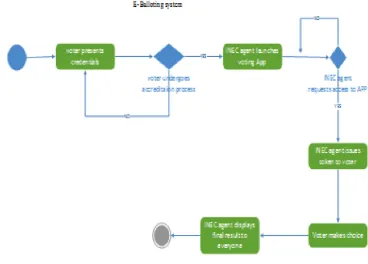
ORKElection is a key component in democracy because that is how most of the leaders are elected. G.O. Ofori-Dwumfuo et al.[3] carried out research to device an electronic voting system. Paying good attention to system security, their work is intended to avoid the use of ballot papers, punched cards and other mechanical voting system. Voting is the process of casting ballots to select desired can-didates for a position therefore they have to be transparent, secure and fair which are requirements for a successful election process [4]. Conducting free and fair elections is a major problem in most developing countries [7], they experience issues like ballot box snatching, coercion and violence because of insufficient security measures put in place. These fraudulent occurrences can easily weaken the con-fidence of the voter and support of the democratic system [6]. In Nigeria today we use the open ballot system where voters go through the election process life cycle in stages which are: accreditation process, voting, counting and result announcement. The ac-creditation process is done using a card reader to verify that the voter was registered, then a ballot paper is presented to the voter which he takes to the voting booth to vote. The voters thumb prints against desired candidate, then the ballot paper is folded in two and dropped in the appropriate box in the presence of the officials, party agents, other voters and security personnel [5]. Because of the high illiteracy rate in the country this sys-tem can bring about high number of invalid votes, because of the thumb printing method. It can be difficult for some to fit their thumbprint in the space provided without encroaching into another partys space or they could even vote outside the space provided totally, which will invalidate the vote also the process of folding the ballot paper before the ink dries which can smudge into another space. In the 2015 presidential general elections 844,519 out of the 29,432,083 cd votes were considered invalid [8]. The Independent National Electoral Commis-sion (INEC) is the body that regulates elections in Nigeria, they are constantly looking for ways to make the elections and voting process a success.
Fig. 1. Systems’ Process diagram
During the 2015 election, voters had to be ac-credited first then later went back for voting which was quite tiring as there was limited automobile movement. Several problems were also faced which included manual counting error and multiple vot-ing. E-voting is aimed at improving the outcomes of challenges by addressing the challenges faced using the traditional method [15]. M. Volkamer et al.[20] propose a vote casting device that does not storw votes but only prints a summary of the selection voters made at device. His work is similar to what we are trying to achieve with the E-balloting system but we are well focused on use of a simple android application to do this. We also agree with the claim made by H. Gllpunar [21] on the impact of ballot paper design on voter choice.
3
M
ETHODOLOGY3.1 Requirement Analysis
A this stage of the work, some observation and nec-essary interview on how elections are generally car-ried out in Nigeria and also to give an understand-ing of how a system like this is supposed to work a diverse environment like Nigeria. A closer look at past cases of election process mismanagement gave clear idea on potential threats to the proposed system. A typical ballot paper was obtained from INEC website.
3.2 System Diagrams/Designs
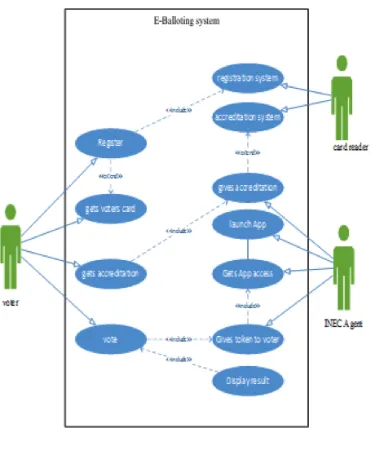
Fig. 2. Use case diagram
Fig. 3. User login page
Fig. 4. Token and Ballot page
4
S
YSTEMD
ESIGNS ANDI
MPLEMETATIONThe design of the proposed android E-Balloting application: the figure.1 and 2 above shows the layout view of the proposed android application.
4.1 Android Application
We used android Studio Android Development Toolkit (ADT) for the application development. The design procedure is as follow. Algorithm For An-droid application Development (E-Ballot Paper)
• Setup Android studio • Create new project
• Test run to see if project was created
success-fully else repeat step 2
• In the project directory go to res folder and
select layout.xml file
• Design the user interface with the xml file
and assign id to interface components
• Initialize variable for xml components using
the relative id in the MainActivity.java file
• Test run to adjust error and repeat step 6 if
needed
• Run the app on a virtual device or a real
device
• Generate Android application package
(APK) file for the android application.
• Generate Android application package
(APK) file for the android application
4.2 E-Voting Process
The various user interfaces provided to users for data input that will be used by the system or appli-cation in processing output result.
4.3 Output Screens
The user interfaces where processed user inputs are show in form of response or feedbacks.
4.4 System Cost Benefit Analysis
Fig. 5. Implementer Login Screen on an Android Tablet
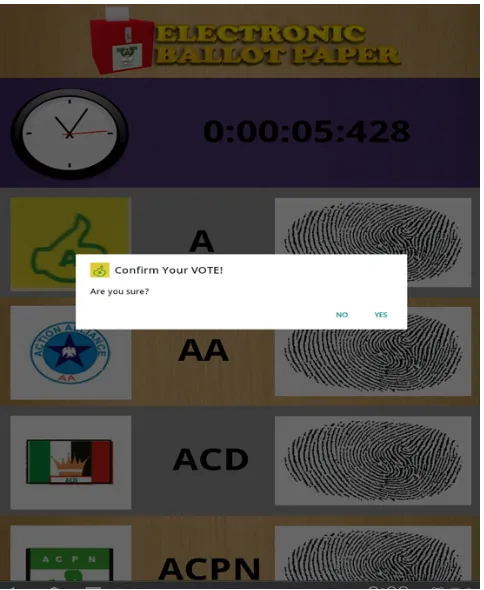
Fig. 6. Dialogue to confirm Vote selection
During the last elections every polling unit had at about 4 adhoc staff.
As compared to the purchase of the device which is a one time cost of say N10,000 per device which will sum up to N1,199,730,000. This could even come out cheaper if the electoral body goes to the manufacturers direct instead of buying off
Fig. 7. A request for token after a voter confirm his/her choice and before anyone else can vote
the market. The only recurring cost will be training of staff which with the application less hands will be needed and also security personnel. System Se-curity The E-Balloting System has a seSe-curity system designed to help issues that may arise during voting process. The agent will be informed of all hot keys in the application.
4.5 System Evaluation Important features of system Security
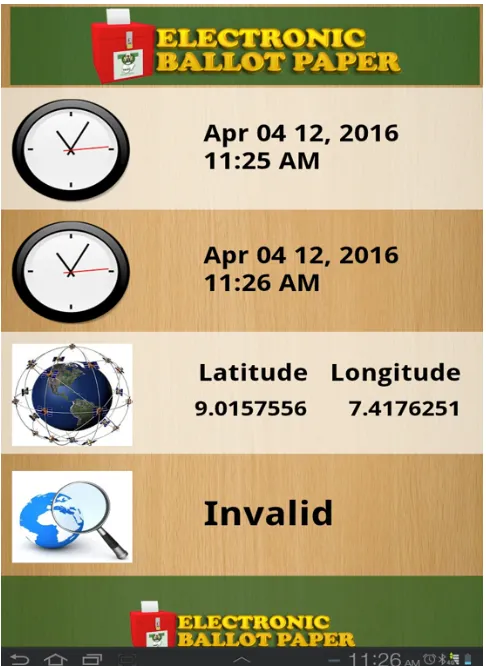
GPS: The system is equipped with a Global Posi-tioning System(GPS) feature which assist in retriev-ing the location where votes are carried out and confirms that the location is within the valid area that correspond with the voting point identification.
Timer: This timer is design to run as stop watch from the voting commence to when it officially closed.
Fig. 8. Selection display to voter after confirmation.
5
S
YSTEME
VALUATION ANDE
FFECTIVENESS ANALYSIS5.1 Android E-Balloting application
The tables below show the form format for android application usability test.
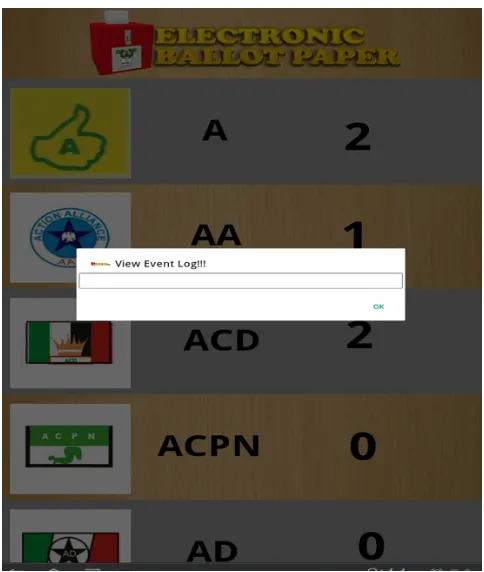
Alpha Testing: Android studio kit was used to debug the program to check for any bugs. Addi-tionally a test was run to confirm that the program was bug free. It was given to a software developer to check and it also came back okay. Recovery Testing: The system was tested to see if it can easily recover if it stops unexpectedly and if it will clear up previous votes or not. It was tested by not entering anything when a dialog box comes up that either username or password needs to be entered, ok was just clicked and the application exits. When it was logged into again, voting continued and at the end it totals the previous votes before the exit and the ones after the re-login. Security Testing: this is to verify that the security setting put in place incase of any malpractice is working properly. This is done by entering the token in reverse order which still allows voting to continue but when the voting process is over you can confirm by viewing the event log which says invalid. That way they know
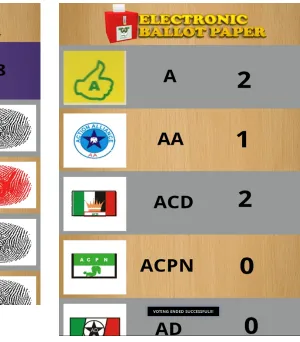
Fig. 9. Result display of individual party vote count and Total Vote count at a polling point.
E-balloting Feedback Form YES NO 1 Simplicity
2 Turnaround Time 5 Acurracy
TABLE 1
E-balloting Feedback Form
User Easy to Use Timliness Accuracy Above-50
User1 Y Y Y
User2 Y Y Y
User3 Y N Y
User4 Y Y Y
User5 Y N Y
User6 Y Y Y
User7 N N Y
User8 Y Y Y
User9 Y Y Y
User10 Y Y Y
User11 Y Y Y
User12 N N Y
User13 N N Y
User14 Y Y Y
User15 Y Y Y
Highly Illiterate
User1 Y Y Y
User2 Y Y Y
User3 N Y Y
User4 N Y Y
User5 Y N Y
User6 Y Y Y
User7 N Y Y
User8 N Y Y
User9 Y Y Y
User10 Y N Y
User11 Y Y Y
User12 Y Y Y
User13 Y Y Y
User14 Y Y Y
User15 N Y Y
Literate
User1 Y Y Y
User2 Y N Y
User3 Y Y Y
User4 Y Y Y
User5 Y Y Y
User6 Y Y Y
User7 Y Y Y
User8 Y Y Y
User9 Y Y Y
User10 Y Y Y
User11 Y N Y
User12 Y Y Y
User13 Y Y Y
User14 Y Y Y
User15 Y Y Y
TABLE 2
E-Balloting system result details
Fig. 10. Event Log for Security Purpose.
6
D
ISCUSSION ANDC
ONCLUSIONSThe e-voting system encompasses several aspects. These include electronic registration and authen-tication, electronic voting or balloting and results transmission, tabulation and display. In one of our recent works we discussed Results transmission [18]. The electronic balloting system strives to re-produce a ballot paper on an Android tablet. The essence is to make the system user friendly to the extent that individuals who are not literate and who would ordinarily find it difficult to used a Kiosk based Electronic Voting System will be able to use our device.
Unfortunately, countries where trust level is high may need to apply minimal technology to acheive transparency in Elections whereas other developing countries where the trust level is low often require complex systems to acheive the same objective of free and fair elections. This is the objec-tive that this work strived to acheive.
Fig. 11. Event log showing an invalid voting process.
This system can provide a bridge between an authentication system (like the Smart Card Reader as was done in Nigeria) and a Results transmission system to provide a seamless Electronic Voting Sys-tem.
The designed system will be very useful in coun-tries with large difficult terrrain, remote areas and a less than average literate population as obtainable in developing countries of the world.
A
CKNOWLEDGMENTSThe authors would like to thank the Director ICT, Independent National Electoral Commission (INEC) for his support.
R
EFERENCES[1] H. Velapure, S. Rai, S. Sharma, P. Naiknavre, P. Jadhav, K. Bamane Android based E-voting International Journal of Advance Foundation and Research in Computer (IJAFRC)Vol. 2, special issue (NCRTIT 2015) January 2015
[2] M. Stenbro A survey of Modern Electronic Voting Technolo-gies Unpublished MSc Thesis. Norway: Norwegian University of Science and Technology.
[3] G.O. Ofori-Dwumfuo and E. Pateey The Design of an Electronic voting system Research Journal of Information Technology.3(2): 91-98, 2011
[4] INEC Nigeria INEC Manual for election OfficialsFunded by the European Union through the UNDP Democratic Governance for Development (DGD II) Project
[5] C.O Kuye, J.O Coker, I.A Ogundeinde and C.A Coker Design and Analysis of Electronic Voting System in Nigeria Int. Arch. App. Sci. Technol.Vol 4 [2] June 2013: 15-20 [6] A. Casmir, E. Omeh and I. Chinedu Electoral fraud in
Nigeria: A philosophical evaluation of the framework of electoral violenceOpen Journal of Political Science 2167 174, 2013
[7] P. Anyanwu Innovation in the Nigerian Electoral System: A tool for DemocracyUnpublished MA thesis. Malta: University of Malta
[8] M. Ford Indian Democracy Runs on Briefcase-sized Voting Machines. http://www. theatlantic.com/international/archive/2014/04/
indian-democracy-runs-on-briefcase-sized-voting-machines/ 360554/ Retrieved on 10th April, 2016
[9] A. Riera,J. Sanchez and L. Tonas. INEC Nigeria (2016) Elections result, Results for 2015 presidential general elec-tions http://www.inecnigeria.org/?page id=31 Retrieved on 23th April, 2016
[10] J. Centenera. Assembly’s Electronic Election Stirs Interest Canberra Times10th February, p. C4.
[11] S. Mitchell S. ’On the E-Hustings’ The Australian1 August, p. 53.
[12] M. Achieng. and E. Ruhode The adoption and challenges of electronic voting technology within the South African context International Journal of Managing Information Tech-nology(IJMIT)5(4). 2013
[13] P. Omolaye, P. Daniel, and A. Orifa. Systematic evaluation of Semi-Electronic voting system adopted in Nigeria 2015 General Elections American Journal of Information Systems 2015, 3(1) 15 21
[14] N.A. Yekini, I.K. Oyeyinka , O.O. Oludipe , O.N. Lawal Computer-Based Automated Voting Machine (AVM) for Elections in NigeriaInternational Journal of Computer Science and Network Security (IJCSNS)12(5) May 2012
[15] S.A Adeshina and A. Ojo Towards Improved Adoption of e-Voting Analysis of the Case of Nigeria International Conference on e-Governance ICEGOV 2014.
[16] R. Tekade, R. Kharat, V. Magade, M. Shaikh and P. Mendhe E-voting system using Visual cryptography & Homomor-phic EncryptionInternational Journal of Advanced Research in Computer and Communication Engineering January 2016 [17] S.A Adeshina and A. Ojo Design Imperatives for
E-voting as a Sociotechnical System International Conference on Electronics, Computer and Computation (ICECCO) 2014 [18] S. Adeshina, L. Ismaila, and A. Ojo Mobile Based Elections
Results Transmission and Collation System: A case study of NigeriaInternational Journal of Computer Techniques, Vol 4, No 1. January 2017
[19] S. Kowalski, G. Karokola, and L. Yngstrom Secure e-Government Services: Protection Profile for Electronic vot-ing A case of TanzaniaInternational Information Management Corporation IIMCISBN : 978-1-905824-34-2
[20] M. Volkamer, Ju. Budurushi & D. Demirel Vote casting de-vice with VV-SV-PAT for elections with complicated ballot papers International Workshop on Requirements Engineering for Electronic Voting Systems2011
General election in Turkey e-Journal of New World Sciences Academy
Steve A. AdeshinaDr Steve A Adeshina is with the Nile Uni-versity of Nigeria, Abuja Nigera.
Lukman E. Ismaila Lukman E. Ismaila is with the Nile Univer-sity of Nigeria, Abuja Nigera
Kaltume U. IbrahimKaltume U. Ibrahim is with the Nile Univer-sity of Nigeria, Abuja Nigera