This work examines the association between personality dimensions (extraversion and neuroticism) and subjective well-being. Subjective well-being is associated both with extraversion and neuroticism, and currently, neuroticism is generally considered the more important. A total of 368 students from the University of Rovira i Virgili completed the Extraversion and Neuroticism subscales of the revised Eysenck Personality Questionnaire (Eysenck, Eysenck, & Barrett, 1985), the Satisfaction with Life Scale (SWLS; Diener, Emmons, Larsen, & Griffin, 1985), and the Positive and Negative Affect Scale (Watson, Clark, & Tellegen, 1988). Regression analyses revealed the personality variable of neuroticism as one of the most important correlates of subjective well-being. Regression analyses also showed that 44% of the variance of subjective well-being was accounted for by neuroticism, whereas extraversion only explained 8% of the variance.
Keywords: satisfaction with life, positive and negative affect, extraversion, neuroticism, subjective well-being
El presente trabajo estudia la relación existente entre las dimensiones de personalidad (extraversión y neuroticismo) y bienestar subjetivo. El bienestar subjetivo parece estar asociado tanto con la extraversión como con el neuroticismo, y el neuroticismo se considera la dimensión más importante. Un total de 368 estudiantes de la Universidad Rovira i Virgili cumplimentaron los siguientes cuestionarios: las subescalas de Extraversión y Neuroticismo del Cuestionario de Personalidad de Eysenck-Revisado (EPQ-R; Eysenck, Eysenck y Barrett, 1985), la Escala de Satisfacción en la Vida (SWLS; Diener, Emmons, Larsen, & Griffin, 1985), y la escala de Afecto Positivo y Afecto Negativo (PANAS; Watson, Clark, & Tellegen, 1988). Los análisis de regresión múltiple mostraron que, dentro de las variables de personalidad, el neuroticismo era la variable con mayor valor predictivo. Asimismo, el neuroticismo explicaba el 44% de la varianza de bienestar subjetivo, mientras que la extraversión solamente explicaba el 8%.
Palabras clave: satisfacción en la vida, afecto positivo y negativo, extraversión, neuroticismo, bienestar subjetivo
Personality Dimensions and Subjective Well-Being
Eliseo Chico Librán
Universidad Rovira i VirgiliThis research was partially supported by a grant from the Consejería de Universidades, Investigación y de la Sociedad de la Información de la Generalitat de Cataluña (2005SGR00017) and a grant by the Ministerio Español de Ciencia y Tecnología (SEJ2005-09170-C04-04/PSIC).
Correspondence concerning this article should be addressed to: Eliseo Chico Librán. Universidad Rovira i Virgili, Facultad de Psicología, Carretera de Valls s/n, 43007 Tarragona (Spain). Phone: 977558141. E-mail: [email protected]
Translation: Virginia Navascués Howard
Psychological well-being or happiness is a multidimensional construct that includes both emotional and cognitive elements. The origin of this construct can be traced back to Bradburn (1969), who considered well-being in terms of positive affect, as opposed to negative affect. In this sense, Bradburn stated that an individual who scored higher in positive affect than in negative affect would score high in psychological well-being, and vice versa. Costa and McCrae (1980) pointed out that positive and negative affect are balanced by a person, achieving a global subjective well-being index. Thus, positive and negative affect contribute independently to subjective well-being. Later, Andrews and Withey (1976) stated that a third variable should be added to psychological well-being: a cognitive element referring to satisfaction with life. When referring to satisfaction with life, we mean a mental process by which individuals appraise the quality of their lives using their own personal criteria. Although there may be some agreement about the most important components of satisfaction with life, individuals probably also assign different weights to each component. Diener, Emmons, Larsen, and Griffin (1985) subsequently asserted that satisfaction with life refers to a global appraisal of well-being. Pavot, Fujita, and Diener (1997) also pointed out that the experience of subjective well-being includes both the presence of positive affect and the absence of negative affect, as well as the cognitive element of satisfaction with life (Diener, 1984).
In the decade of the 90s, a meta-analysis performed by DeNeve and Cooper (1998) divulged the existence of an extensive number of studies on the relation between personality and the two dimensions of subjective well-being: the affective dimension (positive affect, negative affect, and the balance between them) and the cognitive dimension (satisfaction with life). According to the studies by Watson, Clark, and Tellegen (1988), positive and negative affect are related to the personality factors of extraversion and neuroticism, respectively.
In general, subjective psychological well-being is considered a stable trait and therefore, certain personality dimensions are related to this experience of happiness. Along these lines, Hayes and Joseph (2003) stated that certain people tend to be happier than others because of their personality. Likewise, Costa and McCrae (1980) believed that satisfaction with life is related to a high level of extraversion and a low level of neuroticism. Thus, Eysenck and Eysenck (1985) reported that extroverts tend to vary between positive affect and what they called a neutral element, whereas neurotics display changes that go from negative affect to neutrality. Subsequent research has confirmed these relations (Brebner, Donaldson, Kirby, & Ward, 1995; Chan & Joseph, 2000; Hills & Argyle, 2001a, 2001b). In fact, the personality traits of extraversion and neuroticism have been extensively investigated and are considered stable over time and observable in different situations and cultures (Kline, 1993). Costa and McCrae (1980, 1994) have shown that these two personality traits
can account for a significant amount of the variance of subjective well-being and that they can even predict the level of psychological well-being 20 years later.
Past studies have revealed that extraversion is related to psychological well-being. Some investigations have shown that extraversion has a consistent and strong correlation with psychological well-being (Headey & Wearing, 1989; Hotard, McFatter, McWhirter, & Stegall, 1989; Lu, 1995). This relation is based on the consideration that extraverts are happier because they seem to have more social skills; they are more assertive and more cooperative. Hence, it seems that the sociability component of extraversion accounts for this relation. Conversely, other authors believe that extraverts can experience higher levels of happiness. In a study of Lu and Shih (1997), they found that extraversion retained its direct (and the strongest) effects happiness or psychological well-being, whereas the effects of neuroticism was largely mediated by mental health. According to the literature about the correlation between extraversion, neuroticism, and subjective well-being, extraversion appears to be the most important predictor of happiness or subjective well-being. Apparently, this is because extraversion is associated with friendship and social activity, which are among the best sources of joy, happiness, and personal satisfaction, both in private and in public life (Campbell, Converse, & Rodgers, 1976).
Among the personality traits, it can be seen from the above comments that extraversion has received the most theoretical and empirical attention. Despite this, and although many authors consider extraversion to be the main trait of happiness and psychological well-being (Argyle & Lu, 1990; Argyle & Martin, 1991; Diener & Larsen, 1993; Lu & Shih, 1997), the above-mentioned meta-analysis of DeNeve and Cooper (1998) found that, when the personality traits were grouped in the Big Five model, emotional stability (the positive pole of neuroticism) was the best predictor both of negative affect and of satisfaction with life, whereas extraversion was identified as the dimension with the highest predictive capacity of positive affect. In most current studies that include extraversion and emotional stability, the latter generally has more weight than extraversion on subjective psychological well-being (David, Green, Martin, & Suls, 1997; Pavot et al., 1997; Ryan & Frederick, 1997). Thus, at least two important aspects about the relation between psychological, or subjective, well-being and personality traits should be mentioned. First, the relation between extraversion and subjective well-being, including subcomponents such as positive and negative affect, deserves clarification. Second, given that one gets the impression that extraversion is the most important trait related to subjective well-being, the effect size should be determined.
Taking all this into account, the strength of the zero-order relation between extraversion and subjective well-being, including components such as positive and negative affect and the balance between them, needs to be clarified. Thus, the purpose of this study is to determine the size of the relation between subjective well-being and its components and the personality dimensions of extraversion and neuroticism.
Method
Participants
A total of 368 persons participated in this study, mean age 24.2 years (SD= 4.76). All the participants in the study were students from various faculties of the University of Rovira i Virgili of Tarragona (faculties of law, psychology, pedagogy, economics, etc.). Participation was voluntary and anonymous; only the ID number of each participant was recorded in order to be able to provide the participants with the results of their questionnaires (direct scores, standardized scores, percentiles). Questionnaires lacking a response or that had more than one response marked were eliminated. Although the sample was made up of 214 women and 154 men, as no significant differences were found in the variables used, both groups were employed as the total sample.
Instruments
In this study, the participants filled in the following questionnaires:
Satisfaction with Life Scale (SWLS;Diener, Emmons, Larsen, & Griffin, 1985). This scale, 5-item version, developed in the USA, was subsequently revised by Pavot and Diener (1993). It is a measure of the concept of satisfaction with one’s personal life. In this work, I used the translation by Atienza, Pons, Balaguer, and García-Merita (2000). Examples of items are: In most ways, my life is close to my ideal,and
I am satisfied with my life.Responses are rated on a 7-point Likert-type scale that ranges from 1 (completely disagree) to 7 (completely agree). As noted by Atienza el al., the SWLS has high internal consistency, with alpha Cronbach values ranging between .89 and .79. As shown in Table 1, the internal consistency of the scale in this study was .82 (Cronbach’s alpha). With regard to the item-total correlation, Pavot and Diener obtained values between .80 and .51; Atienza et al. found values between .74 and .57, and in this study, values ranging from .75 to .56 were obtained.
Positive and Negative Affect Scale (PANAS; Watson, Clark, & Tellegen, 1988). In this study, I used the Spanish version by Sandín, Chorot, Lostao, Joiner, Santed, and Valiente (1999). This inventory has 20 items, 10 describe positive affect (PA) and 10 negative affect (NA). Each group of descriptors is added separately, providing scores in both scales. Respondents use a 5-point Likert-type scale, ranging
from 1 (nothing or almost nothing) to 5 (very much), to express the degree to which they generally experience the particular feeling or emotion described by the item. Watson et al. reported reliability (Cronbach’s alpha) of .88 and .87 for positive affect and negative affect, respectively. In this study, reliability (Cronbach’s alpha) for positive affect and negative affect was .87 y .85, respectively. In the Spanish version, although respecting the structure of the original version, the authors reformulated some items that seemed to present a lower degree of validity. In some cases, they also added a second descriptor to the formulation of a particular affect, because they believed that the original format of one simple descriptor for each of the 20 affective states was sometimes ambiguous. The balance (BAL) between these two variables is obtained with the following equation: positive affect minus negative affect (BAL = PA – NA).
Eysenck Personality Questionnaire-Revised (EPQ-R; Eysenck, Eysenck, & Barrett, 1985). I used the Spanish version by Aguilar, Tous, and Andrés (1990) to assess the dimensions of extraversion and neuroticism. The Extraversion scale is made up of 23 items, and the Neuroticism scale of 24 items. The scales are responded with a Yes/No format. The alpha reliability indexes of these dimensions are generally high. Specifically, in a study by Chico (2000), the following reliability indexes were found: Extraversion obtained an index of .84 and neuroticism of .82, In this study, the following reliability indexes were found: .83 and 84, for extraversion and neuroticism, respectively.
Subjective Well-Being (SWB). This variable was determined by combining the two subjective well-being dimensions: the affective dimension and the cognitive dimension. In other words, on the one hand, positive affect, negative affect, and their balance and, on the other, satisfaction with life. Thus, subjective well-being was calculated with the following formula: SWB = SWLS + (PA – NA).
Procedure and Statistical Analyses
Results
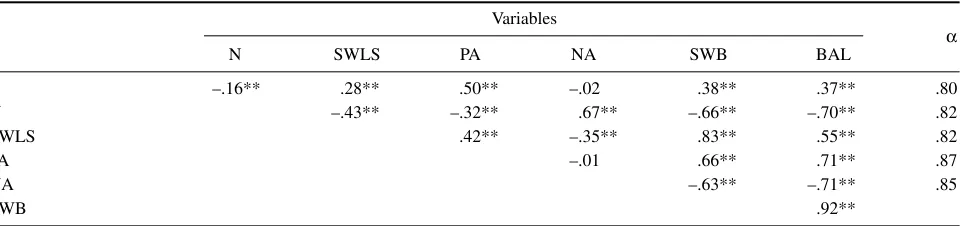
The correlation matrix of all the variables and the reliability of the instruments used are presented in Table 1. The results show that neuroticism is significantly associated with all the indicators of subjective well-being, yielding a correlation coefficient of –.66 with subjective well-being. Likewise, neuroticism is also highly correlated with affective balance (–.70). Extraversion correlated significantly with satisfaction with life (.28), with positive affect (.50), and with subjective well-being (.38), but not with negative affect (.02). As can be seen, the correlations of neuroticism with the variables of subjective well-being and satisfaction with life are higher than those obtained between these same variables and extraversion. These results indicate that neuroticism is more directly related with the dimension of well-being and satisfaction with life. That is to say, these correlations were
negative and show that the higher the level of neuroticism, the lower the level of well-being and satisfaction with life. Subsequently, the effects of neuroticism and extraversion— considered independent variables—on the dependent variables subjective well-being, satisfaction with life, positive and negative affect, and the balance between the two latter were calculated with a series of multiple regression analyses. The results obtained are shown in Table 2.
Table 2 displays the results of the stepwise multiple regression analysis, as this method reveals the relative importance of each of the independent variables and the corresponding changes in R2. The following results for the final model were obtained: All the standardized coefficients (β) were significant at the confidence level of p< .001, except for the case of extraversion with regard to negative affect, which was only significant at the level of p < .05. In each case, the variable neuroticism was entered into the equation
Table 1
Correlation Matrix and Reliability Coefficients (α) of all the Variables in this Study
Variables α
N SWLS PA NA SWB BAL
E –.16** .28** .50** –.02 .38** .37** .80
N –.43** –.32** .67** –.66** –.70** .82
SWLS .42** –.35** .83** .55** .82
PA –.01 .66** .71** .87
NA –.63** –.71** .85
SWB .92**
Note.E = Extraversion; N = Neuroticism; SWLS = Satisfaction with Life Scale; PA = Positive Affect; NA = Negative Affect; SWB = Subjective well-being, BAL = Balance (between positive and negative affect).
**p= .01.
Table 2
Results of the Stepwise Multiple Regression Analysis and Semi-Partial Correlation Coefficients between Dependent and Independent Variables
Dependent Variables Independent R2 Change β T Semi-Partial
Variables in R2 Correlation
Coefficients
Subjective Well-Being N .44 .44 –.62 –16.89*** –.61
E .52 .08 .28 7.54*** .27
Satisfaction with Life N .19 .19 –.40 –8.56*** –.39
E .23 .04 .21 4.63*** .21
Positive Affect E .25 .25 .46 10.47*** .45
N .30 .05 –.25 –5.60*** –.24
Negative Affect N .45 .45 .68 17.50*** .67
E .46 .01 .09 2.24** .08
Affective Balance N .49 .49 –.66 –18.82*** –.65
E .56 .07 .26 7.55*** .26
before extraversion, except for the case of the dependent variable positive affect, whose most powerful predictor was extraversion. In fact, extraversion was only a highly significant predictor of positive affect (β = .46), whereas neuroticism was a highly significant predictor of subjective well-being (β = –.62), satisfaction with life (β= –.40), negative affect (β = .68), and affective balance (β= –.66).
The semi-partial correlation coefficients between extraversion and the dependent variables and between neuroticism and the dependent variables allow us to determine the contribution of each predicting variable on the dependent variables. The square of each of these coefficients indicates the individual contribution of each predicting variable to the square of the total R. That is, these coefficients indicate how much of the total variance of each of the dependent variables is accounted for by the
variable extraversion alone and how much is explained by neuroticism. The semi-partial correlation coefficients between extraversion and the dependent variables, and between neuroticism and the dependent variables are shown in Table 2. In general, these results indicate that the variance of the dependent variables accounted for just by neuroticism was larger, whereas the variance accounted for just by extraversion was smaller.
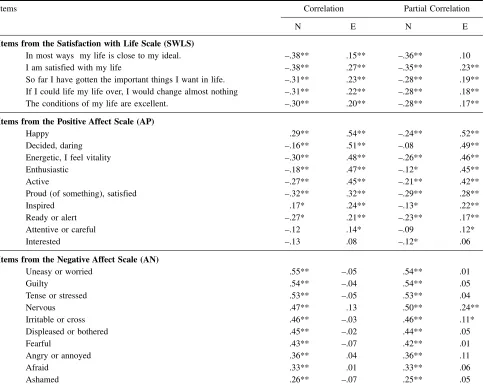
As the general variable subjective well-being is a measure that, in this case, is essentially based on satisfaction with life and positive and negative affect, it is possible to verify the specific associations with extraversion and neuroticism. In Table 3 are presented the bivariate correlations of each of the items that comprise the global variable of subjective well-being with extraversion and neuroticism.
Table 3
Bivariate and Partial Correlations between the Items of Subjective Well-Being and Neuroticism and Extraversion
Items Correlation Partial Correlation
N E N E
Items from the Satisfaction with Life Scale (SWLS)
In most ways my life is close to my ideal. –.38** .15** –.36** .10
I am satisfied with my life –.38** .27** –.35** .23**
So far I have gotten the important things I want in life. –.31** .23** –.28** .19** If I could life my life over, I would change almost nothing –.31** .22** –.28** .18**
The conditions of my life are excellent. –.30** .20** –.28** .17**
Items from the Positive Affect Scale (AP)
Happy .29** .54** –.24** .52**
Decided, daring –.16** .51** –.08 .49**
Energetic, I feel vitality –.30** .48** –.26** .46**
Enthusiastic –.18** .47** –.12* .45**
Active –.27** .45** –.21** .42**
Proud (of something), satisfied –.32** .32** –.29** .28**
Inspired .17* .24** –.13* .22**
Ready or alert –.27* .21** –.23** .17**
Attentive or careful –.12 .14* –.09 .12*
Interested –.13 .08 –.12* .06
Items from the Negative Affect Scale (AN)
Uneasy or worried .55** –.05 .54** .01
Guilty .54** –.04 .54** .05
Tense or stressed .53** –.05 .53** .04
Nervous .47** .13 .50** .24**
Irritable or cross .46** –.03 .46** .11*
Displeased or bothered .45** –.02 .44** .05
Fearful .43** –.07 .42** .01
Angry or annoyed .36** .04 .36** .11
Afraid .33** .01 .33** .06
Ashamed .26** –.07 .25** .05
In addition to the above-mentioned bivariate correlations, this table also presents the partial correlations, controlling first for extraversion and subsequently for neuroticism. There were no very high differences between the bivariate and the partial correlations, which indicates a low level of covariation between extraversion and neuroticism, as was displayed in Table 1.
As can be observed, the variable satisfaction with life is determined more by neuroticism than by extraversion. Negative affect is also chiefly determined by neuroticism, as the predictive power of extraversion is very low. With regard to positive affect, both personality variables predict positive affect, although extraversion does so to a greater extent. It is noteworthy that the items that are more directly related to subjective well-being, especially the items from the Negative Affect scale, basically correlate positively with neuroticism.
Discussion
Once again, these results reveal that personality is an important correlate of subjective well-being. In this study, as in other previous ones, neuroticism was the best predictor of balanced affect, subjective well-being and satisfaction with life. Although it may seem instinctively natural to associate the positive state of subjective well-being to extraversion, these results point in the direction of those already indicated by DeNeve and Cooper (1998) and by González, Moreno, Garrosa, and Peñacoba (2005). Neuroticism, in general, accounts for a high percentage of the variance of all the indicators of subjective well-being than extraversion. As far as the other dependent variables are concerned, the following is noteworthy: regarding the variable satisfaction with life, neuroticism accounts for high-level of its variance than extraversion. The influence of neuroticism on the dependent variable affective balance is noteworthy, whereas extraversion explains small. As can be observed, neuroticism seems to account for a higher percentage of the variance than does extraversion in all the dependent variables.
As indicated by DeNeve and Cooper (1998), neuroticism predisposes people to experience a low level of subjective well-being, and this is due to the fact that, statistically, subjective well-being is a bipolar measure where high scores are determined by high scores in satisfaction with life and in positive affect, and low scores are determined by low scores in satisfaction with life and high scores in negative affect. In contrast, extraversion was not the best predictor of subjective well-being. In fact, alone, it only predicted 7.3% of the variance of subjective well-being, 4% of the variance of satisfaction with life, and 6.7% of the variance of the variable affective balance. Therefore, extraversion seems to be fairly less significant than neuroticism as a predictor of the variables of subjective well-being, satisfaction with life, and balance.
To conclude, this work raises doubts about the dimension of extraversion being the main trait that influences subjective well-being, and supports the viewpoint that neuroticism-emotional stability is the dimension that is consistently associated with the three dependent variables (subjective well-being, satisfaction with life, and affective balance). The evidence provided by this work suggests that the concept of subjective well-being, considered globally, is more closely related to emotional stability than to the trait of extraversion.
Despite the results obtained, some limitations of this study should be noted, such as, for example, no systematic control of the sociodemographic variables of the sample was carried out. The most significant sociodemographic variable is age and in this work, age was not taken into account, mainly because there was very little dispersion of this variable in the sample. As noted in other recent studies (González et al., 2005; Hayes & Joseph, 2003), the factor age may somehow affect the results obtained because the range in this study is fairly low.
References
Aguilar, A., Tous, J.M., & Andrés, A. (1990). Adaptación y estudio psicométrico del EPQ-R. Anuario de Psicología, 46, 101-118.
Andrews, F.M., & Withey, S.B. (1976). Social indicators of well-being. New York: Plenum Press.
Argyle, M., & Lu, L. (1990). The happiness of extraverts.
Personality and Individual Differences, 11,1011-1017. Argyle, M., & Martin, M. (1991). The psychological causes of
happiness. In F. Strack, M. Argyle, & N. Schwarz (Eds.),
Subjective well-being. An interdisciplinary perspective(pp. 77-100). Oxford: Pergamon Press.
Atienza, F.L., Pons, D., Balaguer, I., & García Merita, M.L. (2000). Propiedades psicométricas de la Escala de Satisfacción con la Vida en adolescentes. Psicothema, 12,331-336.
Bradburn, N.M. (1969). The structure of psychological well-being.
Chicago: Aldine.
Brebner, J., Donaldson, J., Kirby, N., & Ward, L. (1995). Relationship between happiness and personality. Personality and Individual Differences, 19,251-258.
Campbell, A. Converse, P., & Rodgers, W. (Eds.). (1976). The quality of American life. New York: Sage.
Chan, R., & Joseph, S. (2000). Dimension of personality, domains of aspiration, and subjective well-being. Personality and Individual Differences, 28,347-354.
Chico, E. (2000). Relación entre la impulsividad funcional y disfuncional y los rasgos de personalidad de Eysenck. Anuario de Psicología, 31,79-87.
Costa, P., & McCrae, R. (1994). Set like plaster? Evidence for the stability of adult personality. In T. Heartherton & C. Weinberger (Eds.), Can personality change?(pp. 21-40). Washington DC: American Psychological Association.
David, J.P., Green, P.J., Martin, R., & Suls, J. (1997). Differential roles of neuroticism, extraversion, and event desirability for mood in daily life. An integrative model of top-down and bottom-up influences. Journal of Personality and Social Psychology, 73,149-159.
DeNeve, K.M., & Cooper, H. (1998). The happy personality: A meta-analysis of 137 personality traits and subjective well-being. Psychological Bulletin, 124. 197-229.
Diener, E. (1984). Subjective well-being. Psychological Bulletin, 95,542-575.
Diener, E., Emmons, R, Larsen, R., & Griffin, S. (1985). The Satisfaction with Life Scale. Journal of Personality Assessment, 49,1105-1117.
Diener, E., & Larsen, R.J. (1993). The experience of emotional well-being. In M. Lewis & J.M. Haviland. Handbook of emotions (pp. 405-415). New York: Guilford.
Eysenck, H.J., & Eysenck, M. (1985). Personality and individual differences: A natural science approach. New York: Plenum Press. Eysenck, S.B.G., Eysenck, H.J., & Barrett, P. (1985). A revised version of the Psychoticism Scale. Personality and Individual Differences, 6,21-29.
González, J.L., Moreno, B., Garrosa, E., & Peñacoba, C. (2005). Personality and subjective well-being: Big Five correlates and demographic variables. Personality and Individual Differences,
38,1561-1569.
Hayes, N., & Joseph, S. (2003). Big 5 correlates of three measures of subjective well-being. Personality and Individual Differences, 34,723-727.
Headey, B., & Wearing, A. (1989). Personality, life events and subjective well-being: Toward a dynamic equilibrium model.
Journal of Personality and Social Psychology, 57,731-739.
Hills, P., & Argyle, M. (2001a). Emotional stability as a major dimension of happiness. Personality and Individual Differences, 31,1357-1364.
Hills, P., & Argyle, M. (2001b). Happiness, introversion-extraversion, and happy introverts. Personality and Individual Differences, 30,595-608.
Hotard, S.R., McFatter, R., McWhirter, R., & Stegall, M. (1989). Interactive effects of extraversion, neuroticism, and social relationship on subjective well-being. Journal of Personality and Social Psychology, 57,321-331.
Kline, P. (1993). The handbook of psychological testing. London: Routledge.
Lu, L.A. (1995). The relationship between subjective well-being and psychosocial variables in Taiwan. Journal of Social Psychology, 135,351-357.
Lu, L.A., & Shih, J.B. (1997). Personality and happiness: Is mental health a mediator? Personality and Individual Differences, 22,
249-256.
Pavot, W., Fujita, F., & Diener, E. (1997). The relation between self-aspect congruence, personality and subjective well-being.
Personality and Individual Differences, 22,183-191. Ryan, R.M., & Frederick, C. (1997). On energy, personality, and
health: Subjective vitality as a dynamic reflection of well-being, Journal of Personality, 65,529-565.
Sandin, B., Chorot, P., Lostao, L., Joiner, T., Santed, M., & Valiente, R. (1999). Escalas PANAS de afecto positivo y negativo: Validación factorial y convergencia transcultural. Psicothema, 11,37-51. Watson, D., Clark, L., & Tellegen, A. (1988). Cross-cultural
convergence in the structure of mood: A Japanese replication and a comparison with U.S. finding. Journal of Personality and Social Psychology, 47,127-144.