1 Technical University of Košice, Faculty of Mechanical Engineering, Letná 9, Košice, Slovakia, e-mail: pavol.
[email protected], [email protected], [email protected]
2 Technical University of Košice, Faculty of Mining, Ecology, Process Control and Geotechnologies, Letná 9,
Košice, Slovakia, e-mail: [email protected]
ABSTRACT
The paper describes a specific design of the sound insulating enclosure of a vibrat
-ing sorter. Recycl-ing aspects have been taken into account when design-ing the en
-closure, because recycled foam has been applied as a sound-absorbing material. An acoustic camera was used to measure, analyze, evaluate and to localise and identify sound sources. The visualization method was used to locate the critical locations of the device and then quantify them. To evaluate the effectiveness of the proposed en
-closure, the measurements of the sound parameters were performed before and after the realization soundproofing measure. The measured results show the requested efficiency of the sound insulating enclosure in terms of noise reduction as well as dust near the sorter.
Keywords: sound insulating measures, vibrational sorter, noise visualization, analy
-sis and measurement.
INTRODUCTION
The possible effects of the formation of un
-desirable conditions that may cause increased vibration of devices used predominantly in stone quarries are described more specifically in the publications [1÷5].
When designing a noisy machine enclo
-sure, we use structural elements to interrupt the propagation paths by the applications of sound absorbing materials and vibro-elastic material and elements. The enclosure must be designed with regard to the machine running checks, its repairs, disassembly and proper cooling dur
-ing operation [6]. The design and calculation of acoustic enclosures, cabins and wrappings is given a great deal of attention in the book by Ver and Beranek in Chapter 12 [7].
Before designing the soundproofing mea
-sures of the technological devices, it is neces
-sary to know the frequency of the sound that is
calculated from the time recording of the sound. Such outputs can be obtained by conventional sound measurement techniques as well as mod
-ern technologies for measuring and visualizing sound [8÷11]. Correct vibro-acoustic analysis of individual components of mechanical and elec
-trical equipment is essential based on theoretical and practical knowledge published in books and publications as [12÷20].
The sound insulation materials used for the application of the enclosures in heavy industrial installations are subject to high demands, par
-ticularly in terms of high sound insulation, di
-mensional stability, ease of handling and ability to withstand temperature changes and changes in air humidity. Requirements and recommend
-ed proc-edures for designing workstations and noise measures for workplaces with mechani
-cal devices are given in STN EN ISO 11690-2: 1999 [27] as well as in works by Liptai. R.G. and Zajac [21÷23].
EXPERIMENTAL PART
Vibrational sorter (Fig. 1) is a device that serves to separate stone fractions of different sizes depending on the vibrating sieve used. The drive is provided by an electric motor, which is the driv
-ing element of the pulley and belt transmissions. The sieve gradient and the oscillation of the entire device cause the fraction to shift over the vibration sieve. The larger fraction is moved to the end into the buffer and the smaller fraction falls through the mesh sieve into the container and the next con
-veyor belt. The vibrating sorter is attached to the metal floor structure, which transmits oscillation from the floor to the surrounding structures.
MATERIALS AND METHODS
For the sound analysis of the device, we chose a method of measuring A - weighted equivalent sound pressure level and a method of
dynamic visualization of sound, which is very advantageous in terms of sound source local
-ization. For measurement we used the Class 1 sound analyzer, Norsonic 140, and a circular mi
-crophone acoustic camera were used. This mi
-crophone array is designed primarily to identify sound sources of machines and equipment inside industrial plants and buildings.
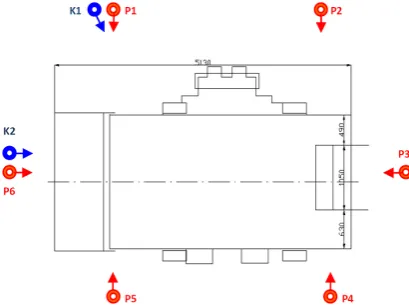
At the measurement points indicated in Fig. 2 as P1-P6. 1-minute measurements were real
-ized by the sound analyzer at a distance of 1.5 m from the structure of the sorter along its cir
-cumference. At the measuring points indicated in Fig. 2 as K1 and K2. 8-second acoustic cam
-era measurements were taken during which all sources of sound that occurred throughout the measuring period were captured. The location of the acoustic camera and the sound analyzer at the measurement point P6 and K2 is shown in Fig. 3. The measurements were performed in two operating modes and in the case of the vibration sorter being on with sorting of stone fraction and without the sorting (no load of stone fraction). The stone fraction was up to 32 mm. These same measurements were made even after the sound insulating enclosure was realized.
ANALYSIS AND SOUND SOURCES
LOCALIZATION
Acoustic camera measurements help us bet
-ter locate the devices noise sources. Acoustic images of quantitatively significant sources of noise are shown in Fig. 4 to Fig. 6 during the sorting of stone fraction.
Fig. 1. Vibrational sorter
Fig. 2. Measurement points
Classification of partial noise sources from the loudest to the least noisy is of great importance for the selection of noise measures. Based on the analysis carried out, the noise sources were classi
-fied according to significance in descending order: • Z1 - Noise caused by the supply of material
and the fall of the stone fraction on the metal parts and the vibrating screens;
• Z2 - Noise caused by moving the stone frac
-tion to the sorter site;
• Z3 - Noise caused by the oscillation of the whole sorter;
• Z4 - Belt gear elements noise; • Z5 - Electric motor noise.
The analysis of noise sources shows that the dominant source of noise is the fall of the stone fraction on the sorter construction and the shift
-ing of the material along the site of the sorter. The realization of structural changes for noise reduc
-tion is very difficult and inefficient for this kind of noise sources. In addition, there could be an un
-wanted impact on the operating parameters, func
-tionality and efficiency of the device. For these
reasons, the most effective solution is to cover the entire vibrational sorter.
DESIGN OF SOUND INSULATING
ENCLOSURE
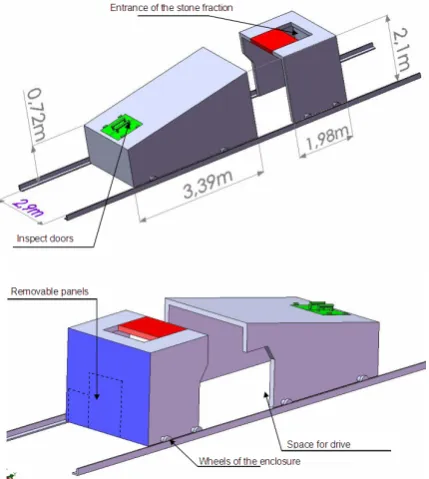
From the point of view of the function and parameters of the device, we designed a sound insulating enclosure with access to maintenance of the sorting device, see Fig. 7. The design was realized with a flexible housing of wheels that al
-lows movement of the enclosure. The avoidance of undesirable conditions was taken into account, (overheating, resonance, etc.). For realization are used oriented strand boards along the load-bear -Fig. 4. Acoustic image for the frequency range from
150 Hz to 1150 Hz
Fig. 5. Acoustic image for the frequency 890 Hz
Fig. 6. Acoustic image for the frequency 690 Hz
ing structure of the walls and the ceiling cover. The thickness of the inner filler of the sound in
-sulating material for this cover design is min. 50 mm. The cross-section of the sandwich arrange
-ment of the sound insulating cover materials is shown in Fig. 8.
When designing an acoustically suitable ma
-terial inside the sound insulating enclosure, we also took into account the recycling aspect. In terms of physical parameters, handling and effi
-ciency, we have designed recycled polyurethane foam and recycled car seat covers for this appli
-cation. The addition of a binder based on liquid cured polymers results in a material that exhibits favorable thermal insulating and sound insulating properties. The sound absorption coefficient was
determined by its own measurements by the im
-pedance tube and is graphically illustrated in Fig. 9. The methodology and procedure for measuring and determining the sound absorption of materi
-als are described in more detail [24÷26].
RESULTS AND DISCUSSION
Realized sound insulating enclosure with de
-tailed views of the maintenance door design and the drive cover with the belt gears is shown in Fig. 10. The casing of the drive with belt gear has been designed with openings for natural cooling.
The results of measurements of the A – weight
-ed equivalent sound pressure level of the vibrating sorter without sound insulating enclosure and with the installed sound insulating enclosure in both op
-erating modes are shown in Table 1.
Fig. 11 shows a comparative graph of the val
-ues of A – weighted equivalent sound pressure level at the individual measurement points before and after the measures during the operation mode without sorting of stone fraction.
Measurement analysis in idle mode shows a re
-duction in the A – weighted equivalent sound pres
-sure level between 8.5 ÷ 11 dB after the installation of sound insulating enclosure. In this case, the mea
-surements were influenced by background noise, respectively noise from other technological units.
Fig. 12 is a comparative graph of the values of A – weighted equivalent sound pressure level at the individual measurement points before and after the measures taken during the sorting of stone fraction. Analysis of mode with stone sort
-ing measurements indicates a reduction in the A – weighted equivalent sound pressure level in the range of 3 ÷ 5 dB after the installation of the sound insulating enclosure. When evaluating the effectiveness of sound insulating measures, it is Fig. 8. Cross-section of the sandwich arrangement
Fig. 9. Sound absorption coefficient of recycled polyurethane foam with recycled car seat cover -
thickness of 50 mm
necessary to take into account the noise of other technologies that had to be in operation due to the supply of the stone fraction to the vibration sorter.
Analysis of acoustic camera measurement re
-sults was performed using A - weighted frequency spectra. Comparison of the frequency spectra of the sound generated from the measurements in the
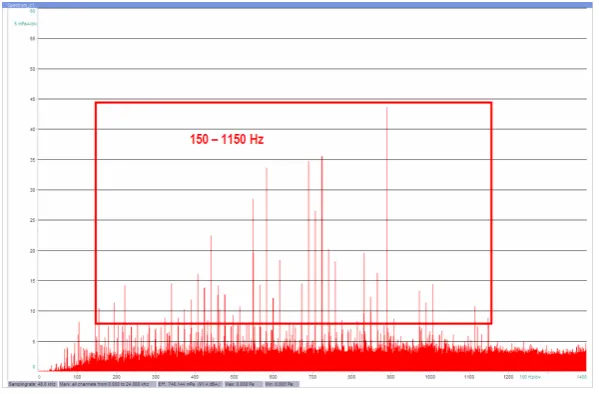
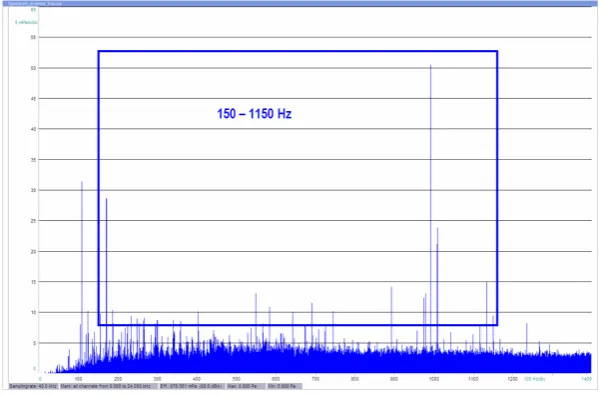
K1 and K2 measurement points in the operating mode during stone fraction sorting before (Fig. 13 and Fig. 15) and after (Fig. 14 and Fig. 16) the realization of the sound insulating measures.
From the comparison spectra in Fig. 13 and Fig. 14 they show that these sound insulation measures significantly reduced the noise level Fig. 11. Graphical comparison of the LAeq.T - mode without stone fraction sorting
Fig. 13. Frequency spectrum in the measurement point K1 – without enclosure
Fig. 14. Frequency spectrum in the measurement point K1 – with enclosure
at the frequencies emitted by the drive unit and belt gear components.
From the comparison in the frequency spec
-trum in Fig. 15 and Fig. 16, they show that, after covering the vibration sorter and the realization of additional sound insulating measures such as the isolation of the front maintenance doors, this reduced the noise levels of most frequencies. The increase of the sound pressure level occurred in the frequency range of 1000 Hz and at the fre
-quency of 170 Hz, which however may not be related to the sources of noise of the vibration sorter, since other technological sources of noise (conveyors and other sorting devices) which af
-fect the acoustic situation in the surroundings of the vibrating sorter.
CONCLUSIONS
The presented work is focused on the solution of industrial noise sources in the working environ
-ment. Resolving noise from industrial sources is a demanding process that requires complex the
-oretical and practical knowledge in the field of acoustics, which must be based on science and research results. The most appropriate way to ef
-fectively reduce machine, mechanical and tech
-nological noise levels is to address this factor at the design and production stage. In practice, there are a large number of instances where noise issues are needed to be reduced by technical sound re
-ducing measures on already operated equipment and machines. These noise reduction measures can be applied directly to noise sources, to the noise propagation transmission path, and to the
persons receiving the noise. Noise reduction solu
-tions by use of an acoustic visualization technique can serve as an aid to the faster and more efficient localization and analysis of partial noise sources. The concrete realization of the sound insulating enclosure of the vibrational sorter in the operation of a stone quarry was able to reduce the noise lev
-els in its surroundings. A secondary effect of this measure is the reduction in the concentration of solid aerosols in the vicinity of the sorter.
Acknowledgements
This work was supported by the Slovak Re
-search and Development Agency under the con
-tract no. APVV 0432-12.
REFERENCES
1. Molnár V., Fedorko G., Stehlíková B., Tomašková M., Hulínová Z. Analysis of asymmetrical effect of tension forces in conveyor belt on the idler roll contact forces in the idler housing. Meas J Int Meas Confed. 52(1), 2014, 22–32.
2. Molnár V., Fedorko G., Stehlíková B., Michalik P., Kopas M. Mathematical models for indirect measurement of contact forces in hexagonal idler housing of pipe conveyor. Meas J Int Meas Confed. 47(1), 2014, 794–803.
3. Molnár V., Fedorko G., Stehlíková B., Michalik P., Weiszer M. A regression model for prediction of pipe conveyor belt contact forces on idler rolls. Meas J Int Meas Confed. 46(10), 2013, 3910–3917. 4. Debski H., Teter A., Kubiak T., Samborski S. Lo
jected to quasi-static compression. Compos Struct. 136, 2016, 593–601.
5. Garbacz T., Jachowicz T., Gajdoš I., Kijewski G. Research on the influence of blowing agent on selected properties of extruded cellular products. Adv Sci Technol Res J. 2015, 9(28), 81–88. 6. Žiaran S. Znižovanie kmitania a hluku v priemysle.
STU Bratislava, 2006.
7. Ver I.L., Beranek L.L. Noise and vibration con
-trol engineering: principles and applications. John Wiley and Sons Ltd. John Wiley & Sons. Inc. Hoboken, New Jersey, 2006.
8. Döbler D., Heilmann G. Perspectives of the Acous
-tic Camera. In: Environmental Noise Control. The 2005 Congress and Exposition on Noise Control Engineering, 2015, 1–9.
9. Fischer S., Simmer K.U. Beamforming microphone arrays for speech acquisition in noisy environments. Speech Commun. 20(3–4), 1996, 215–227.
10. Johnson D.H., Dudgeon D.E. Array signal process
-ing: concepts and techniques. 1992, 533 p.
11. Gauthier P.A., Camier C., Pasco Y., Berry A., Chambatte E., Lapointe R. et al. Beamforming reg
-ularization matrix and inverse problems applied to sound field measurement and extrapolation using microphone array. Journal of Sound and Vibration. 330, 2011, 5852–5877.
12. Malov E.A., Bronfin V.N., Dolgopyatov V.N., Pav
-lenko B.A., Kostyukov V.N., Bojchenko S.N. et al. Experience of large-scale introduction of COM
-PACS stationary systems for vibrodiagnostics. Kh
-imiya i Tekhnologiya Topl i Masel. 1, 1997. 13. Urbanek J., Barszcz T., Zimroz R., Antoni J. Appli
-cation of averaged instantaneous power spectrum for diagnostics of machinery operating under non-stationary operational conditions. Meas J Int Meas Confed. 45(7), 2012, 1782–1791.
14. Opocenska H., Hammer M. Use of technical diag
-nostics in predictive maintenance. In: 17th Interna
-tional Conference on Mechatronics - Mechatronika (ME). 2016, 1–6.
15. Huňady R., Hagara M., Schrotter M. The applica
-tion of high-speed digital image correla-tion in vi
-bration analysis of a rotating object. In: EAN 2012: Proceedings of the 50th Annual Conference on Ex
-perimental Stress Analysis. 2012.
16. Kráľ J. jr., Kráľ J. Verification of a three axis mill
-ing machine accuracy in the process of complex shaped part production. Appl Mech Mater. 474, 2014, 261–266.
17. Krajňák J., Homišin J., Grega R., Urbanský M. The analysis of the impact of vibrations on noisi
-ness of the mechanical system. Diagnostyka. 17(3), 2016, 21–26.
18. Stejskal T., Kováč J., Valenčík Š. Mechanism of randomness in vibration signals of machinery. In: Applied Mechanics and Materials: ROBTEP 2012. 2012, 257–262.
19. Ingard U. Noise Reduction Analysis. Jones and Bartlett Publishers, Ontario, 2008.
20. Dolnik B. Contribution to analysis of daily diagram of supply voltage in low voltage network: Working days versus non-working days. In: Proceedings of the 2015 16th International Scientific Conference on Electric Power Engineering. EPE 2015, VŠB-TU, 2015, 373–376.
21. Liptai R.G., Harris D.O. Materials Research and Standards. MTRSA. 11(3), 1971, 8.
22. Zajac J., Szabó D. Akustické požiadavky na deli
-ace konštrukcie: priečky. STU Bratislava, 2009. 23. Zajac J et all. Znižovanie hluku a vibrácií v strojár
-skych prevádzkach. Alfa Bratislava, 1990. 24. Liptai P., Moravec M., Badida M. Research of
possibilities of using the recycled materials based on rubber and textiles combined with vermiculite material in the area of noise reduction. Adv Mater Res. 1001, 2014.
25. Kuczmarski M.A., Johnston J.C. Acoustic Absorp
-tion in Porous Materials. Nasa/Tm-2011-216995 2011, 1–20.
26. Dalmont J.P. Acoustic impedance measurement. Part I: A Review. J Sound Vib. 243(3), 2001, 427–439. 27. STN EN ISO 11690-2: 1999. Akustika. Odporúčané
postupy na navrhovanie nízkohlučných pracov