Biolinguistics 6.3–4: 338–353, 2012 ISSN 1450–341 http://www.biolinguistics.eu
From Gesture to Speech
Maurizio Gentilucci, Elisa De Stefani
& Alessandro Innocenti
One of the major problems concerning the evolution of human language is to understand how sounds became associated to meaningful gestures. It has been proposed that the circuit controlling gestures and speech evolved from a circuit involved in the control of arm and mouth movements related to ingestion. This circuit contributed to the evolution of spoken language, mov-ing from a system of communication based on arm gestures. The discovery of the mirror neurons has provided strong support for the gestural theory of speech origin because they offer a natural substrate for the embodiment of language and create a direct link between sender and receiver of a message. Behavioural studies indicate that manual gestures are linked to mouth movements used for syllable emission. Grasping with the hand selectively affected movement of inner or outer parts of the mouth according to syllable pronunciation and hand postures, in addition to hand actions, influenced the control of mouth grasp and vocalization. Gestures and words are also related to each other. It was found that when producing communicative ges-tures (emblems) the intention to interact directly with a conspecific was transferred from gestures to words, inducing modification in voice parameters. Transfer effects of the meaning of representational gestures were found on both vocalizations and meaningful words. It has been conclu-ded that the results of our studies suggest the existence of a system relating gesture to vocalization which was precursor of a more general system reciprocally relating gesture to word.
Keywords: Broca’s area; gesture; human kinematics; mirror neurons; voice spectra; word
1. Introduction
languages. Hand and arm movements are distinguished, namely gesticulation (i.e. idiosyncratic spontaneous movements of the hands and arms during speech); language-like gestures (i.e. like gesticulation, but grammatically integrated in the utterance); pantomimes (i.e. gestures without speech used in theater to com-municate a story); emblems (e.g. insults and praises); sign language (i.e. a set of gestures and postures for a full fledged linguistic communication system).
Later, McNeill (2000) enriched this continuum and he divided it into four continua by using characteristics as ‘relationship to speech’, ‘relationship to con-ventions’, ‘relationship to linguistic properties’, and ‘character of the semiosis’. McNeill (1992) has identified a number of different types of gestures that speakers routinely use when they talk: iconics (i.e. gestures depicting a concrete object or event and bearing a close formal relationship to the semantic content of speech); metaphorics (i.e. as iconics but depicting an abstract idea); deictics (i.e. gestures pointing to something or somebody either concrete or abstract); beats (i.e. gestures with only two phases (up/down, in/out) indexing the word or phrase it accompanies as being significant). Iconic gestures and abstract deictic gestures are called also representational (McNeill 1992; Kita 2000). McNeill (1992) is concerned with gestures similar to gesticulation as defined in Kendon’s conti-nuum (Kendon 1988; McNeill 1992). Gesticulation is the most frequent type of gesture in daily use and it covers many variants and usages. It is made chiefly with the arms and hands but is not restricted to these body parts; the head can take over as a kind of third hand if the anatomical hands are immobilized or otherwise engaged, and the legs and feet too can move in a gesture mode. McNeill (1992) claimed that there was no body ‘language’, but that instead ges-tures complement spoken language. Gesticulations would be distinct from ‘em-blems’ because they are obligatory associated with speech while emblems and pantomimes may be delivered in utter silence (see McNeill 1992, 2000; Goldin-Meadow 1999; Kendon 2004).
There are two alternative views about the relationship between gesture and speech. The first posits that gesture and speech are two different communication systems ( Levelt et al. 1985; Hadar et al. 1998; Krauss & Hadar 1999). According to this view, gesture works as an auxiliary support when the verbal expression is temporally disrupted or word retrieval is difficult. The other view (McNeill 1992; Kendon 2004) posits that gesture and speech form a single system of communi-cation, since they are linked to the same thought processes even if they differ in expression modalities. According to the view held by McNeill (1992) and Kendon (2004), we have hypothesized that manual gestures and speech share the same control circuit (Bernardis & Gentilucci 2006; Gentilucci et al. 2006; Gentilucci & Corballis 2006). This hypothesis can be supported by evidence that speech itself may be a gestural system rather than an acoustic system, an idea captured by the motor theory of speech perception (Liberman et al. 1967) and articulatory phon-ology (Browman & Goldstein 1995). According to this view speech is regarded, not as a system for producing sounds, but rather one for producing mouth articu-latory gestures.
will suggest that both these circuits contributed to the evolution of the spoken language moving from a system of communication based on arm gestures (Gentilucci & Corballis 2006). These circuits are also responsible for the relations between spoken language and gesture during conversation. That is, these are specific instantiations of more general relations between the control of arm and mouth actions (Willems & Hagoort 2007).
2. Anatomical and Physiological Consideration
The link between gesture and speech (and in general language) supporting the view that gesture and speech are controlled by a same system can be the result of the activity of systems evolved from two classes of neurons recorded in monkey premotor area F5.
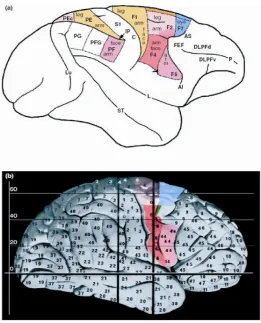
Based on cytoarchitectural and histochemical data, the agranular frontal cortex of macaque monkey has been parceled by Matelli and colleagues (Matelli et al. 1985, 1991) in the areas shown in Figure 1a. Area F1 corresponds basically to Brodmann’s area 4 (primary motor cortex), and the other areas correspond to sub-divisions of Brodmann’s area 6. Areas F2 and F7, which lie in the superior part of area 6, are referred to as ‘dorsal premotor cortex’, whereas areas F4 and F5, which lie in the inferior area 6, are referred to as ‘ventral premotor cortex’ (Matelli & Luppino 2000).
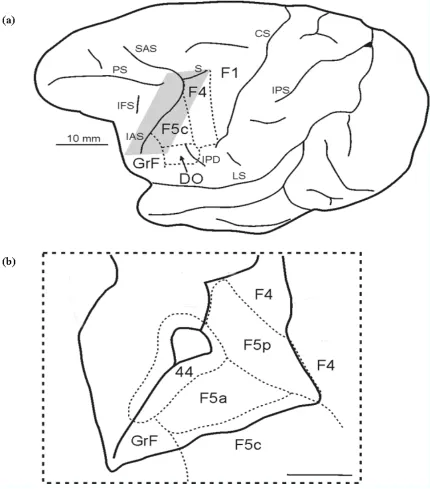
Neurophysiological studies showed that in area F5, which occupies the most rostral part of ventral premotor cortex, there is a motor representation of distal movements (Rizzolatti et al. 1988; Kurata & Tanji 1986; Hepp-Reymond et al. 1994). Functional and multi-architectonic data have demonstrated that this area is not a single entity but it consists of three main sectors: F5c, designated as ‘convexity’, is located on the postarcuate convexity cortex; F5p designated as ‘posterior’ is located on the posterior bank of the arcuate sulcus dorsally and F5a, designated as ‘anterior’, on the posterior bank of the same sulcus ventrally (Fig. 2a–b; see Belmalih et al. 2009; Gerbella et al. 2011).
In area F5 two classes of neurons were recorded, which might have been instrumental in the development of a system controlling speech and gestures. The first class of neurons frequently recorded in the posterior part of the inferior postarcuate bank (F5 sector of the arcuate bank in Rizzolatti & Luppino 2001; sector F5c in Gerbella et al. 2011) commands grasp actions with hand and mouth (Rizzolatti et al. 1988). A typical neuron of this class discharges when the animal grasps a piece of food with its mouth or when the animal grasps the same piece of food with the hand contralateral or ipsilateral to the recorded cortical side. Frequently, the discharge of this class of neurons is selective for a specific type of grasp (for example, a neuron discharges when a precision grasp is used, but not for a power one), and it can be even elicited by the visual presentation of a graspable object, provided that its size is congruent with the type of grasp coded by the neuron (‘canonical neurons’; see Murata et al. 1997; Rizzolatti et al. 1988). Rizzolatti et al. proposed that these neurons are involved in coding the aim of the grasp action, i.e. to take possession of an object. From a functional point of view, these neurons can be involved in planning a strategy in order to perform succes-sive grasp actions. For example, they can command the grasp of an object with the hand while preparing the mouth to grasp the same object. From an evolu-tionary point of view, this circuit of commands might have evolved a system of hand–mouth double command, becoming instrumental in the transfer of a man-ual gesture communication system, from movements of the hand to movements of the mouth. That is, this system might have been used in language evolution (Gentilucci & Corballis 2006) according to the proposal that language evolved from manual gestures rather than from vocalizations. Indeed, whereas vocali-zations of non-speaking primates are mainly related to emotional states, manual actions can provide more obvious iconic links with objects and, consequently, they might have been initially used to represent the physical world (Hewes 1973; Donald 1991; Corballis 1992, 2002; Givòn 1995; Armstrong et al. 1995; Rizzolatti & Arbib 1998; Armstrong 1999; Arbib 2005; Ruben 2005; Gentilucci & Corballis 2006). This coupling between hand and mouth, used to transfer a gesture com-munication system from movements of the hand to movements of the mouth, could also evolve in a system functionally relating gesture and speech.
The second class (the so called ‘mirror neurons’, MNs) becomes active when the animal executes a transitive action (i.e. acted upon an object) with the hand and when it observes the same action performed by another individual (Gallese et al. 1996). In addition, Ferrari et al. (2003) recorded discharges in the premotor area F5 of monkeys both from mirror neurons during lip-smacking (the most common communicative facial gesture in monkeys) and from other mirror neurons during mouth movements related to eating. This suggests that non-vocal facial gestures may be indeed transitional between visual gesture and speech.
Finally, mirror neurons in monkey have been also recorded in the rostral part of the inferior parietal lobule (Gallese et al. 2002), and neurons only activated by the observation of movements of different body effectors were recorded in the superior temporal sulcus region (Perrett et al. 1989).
individuals to understand observed actions. In this way, individuals are able to recognize the meaning and the aim of actions performed by another individual. Therefore, providing a link between an actor and an observer, similar to the one existing between a sender and a receiver of a message, mirror neurons may have played a role in the development of a gestural communication system. Thanks to this mechanism, actions done by other individuals become messages that are understood by an observer. In the present review, we will focus on the system of double motor commands to hand and mouth rather than the mirror system and how it evolved in humans in order to transfer a communication system based on arm actions to mouth postures and it acquired the capability to interact with speech. The role of the mirror system in the construction of a communication system in humans has been reviewed elsewhere (Gentilucci & Corballis 2006; Gentilucci & Dalla Volta 2008; Gentilucci et al. 2008).
3. Relations between Execution of Hand/Arm Actions and Speech
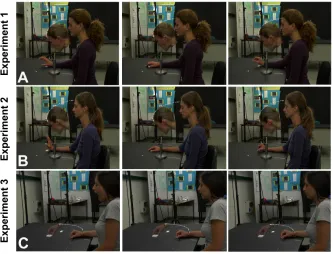
Figure 3: Experimental set-up, stimuli, procedure and examples of trajectories in Gentilucci & Campione (2011)
In the successive experiment 3 participants were required to open or to close their mouth, or to maintain it relaxed (Fig. 3C). Then, they performed a manual grasp, maintaining that mouth posture. Maximal finger aperture was larger when the mouth was opened as compared to when it was closed. An inter-mediate aperture was observed in the relaxed mouth condition. The results of these experiments extend the effects of motor interactions with objects to pos-tures of effectors; specifically, the posture of one effector (the mouth or the hand) can be a template for the configuration that will be assumed by the other grasp-ing effector (the hand or the mouth) durgrasp-ing shapgrasp-ing. Finally, a control experi-ment verified whether similar relation also exists between foot and hand. Indeed, previous experiments did not verify whether the reciprocal interactions between postures and actions were specific for hand and mouth or they could be extended to other distal effectors, as, for example, the foot.
activating different interactions with objects. Also, from an anatomical point of view (see Buccino et al. 2001) premotor area where foot is represented is separ-ated from premotor area where the hand is represented. On the contrary, hand and mouth areas are adjacent and partially overlap.
If this system, coupled with the mirror system, is also used to share a communication gestural repertoire of the hand with the speaking mouth, the execution of transitive actions should affect speech, and specifically the production of phonological units. Gentilucci & colleagues required participants to reach and grasp small and large objects while pronouncing syllables (Genti-lucci et al. 2001). They found that when grasping the large objects as compared to the small objects, the lip opening and parameters of the vowel vocal spectra in-creased. Conversely, the pronunciation of a vowel during the entire execution of the grasp affected maximal finger aperture (Gentilucci & Campione 2011). Speci-fically, the vowel /a/ induced an increase in maximal finger aperture if com-pared to /i/. The vocalization /ɔ/ induced an intermediate effect. The vowel /a/ is characterized by higher Formant 1 (F1; depending on internal mouth aperture) and lower Formant 2 (F2; depending on tongue protrusion; Leoni & Maturi 2002). In contrast, /i/ is characterized by lower F1 and higher F2. The vowel /ɔ/ has in-termediate values. In sum, configurations of the internal mouth related to vocali-zations seem to be responsible for effects on finger shaping during grasping. This coupling can be precursor of more complex interactions between gestures and words.
4. Interactions between Gestures and Words
Chieffi et al. (2009) studied the relations between production of deictic gestures (HERE, i.e. a pointing directed towards the agent’s body, and THERE, i.e. a pointing directed towards a remote point far from the agent’s body) and the simultaneous pronunciation of the words QUA ‘here’ and LÁ ‘there’. The authors found facilitation/interference when the meaning of word was congruent/ incongruent with the gesture direction; that is, the gesture was quicker in the case of congruence with word meaning. This can be explained by considering that di-rection was stressed by the word. The reverse occurred in the case of incongruent meaning; that is, the direction was ambiguous because the direction coded by the word was opposite. Consequently, gesture was slowed down. A non-alternative explanation is a priming effect of the word on arm velocity. This suggests an interaction at a higher level due to the presentation of linguistic stimuli.
Summing up, in all studies (Bernardis & Gentilucci 2006; Gentilucci et al. 2006; Barbieri et al. 2009; Chieffi et al. 2009) gesture and speech interacted with each other by reciprocally transferring aspects of the signal meaning. Obviously, these aspects differed according to the type of signal.
5. Are the Relations between Hand Postures and Vocalizations Precursors of Relations between Gestures and Speech?
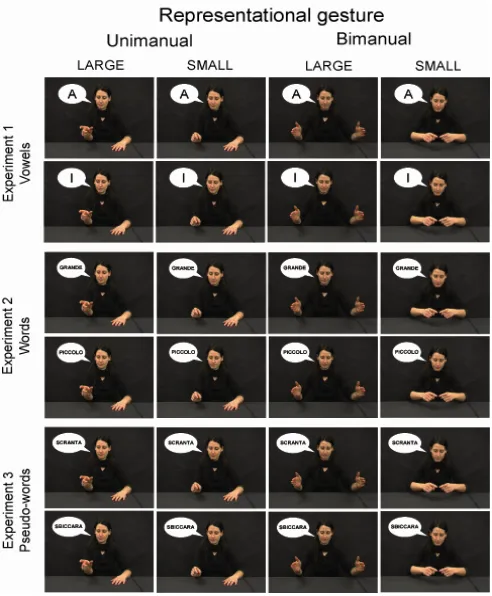
In a previous study, Gentilucci & Campione (2011) found that when subjects pro-nounced the open vowel /a/, which is characterized by a larger aperture of the internal mouth, the finger shaping of a simultaneous grasp was larger than when they pronounced the closed vowel /i/, which is characterized by a smaller inter-nal mouth aperture. In a subsequent study, Gentilucci et al. (2012) reasoned that if the relation between hand actions and vocalizations is precursor of the relation between gesture and speech, same or similar effects of meaningful gestures on both simple vocalizations and words should be found. In this study unimanual/ bimanual gestures LARGE and SMALL were contemporaneously presented with a vignette close to the actor in which, in experiment 1, either the vowel ‘A’ (/a/) or ‘I’ (/i/) was printed, in experiment 2 the word GRÀNDE ‘large’ or PÌCCOLO ‘small’, and in experiment 3 the pseudo-words SCRÀNTA or SBÌCCARA (Fig. 4).
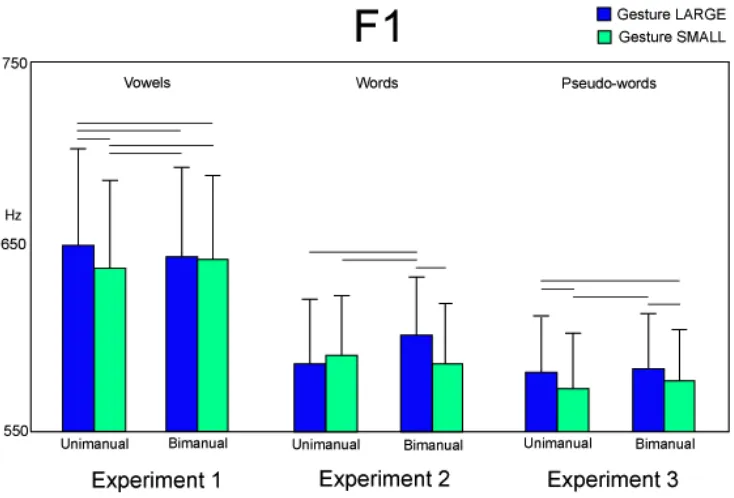
Unimanual gestures affected formant 1 (F1) of voice spectra of the two vowels pronounced alone. This parameter, which is directly related to internal mouth aperture (Leoni & Maturi 2002), increased after gesturing LARGE as com-pared to SMALL (Fig. 5). F1 of the vowels /a/ and /i/ included in the words GRÀNDE ‘large’ and PÌCCOLO ‘small’, respectively, were greater when gestur-ing LARGE in bimanual condition as compared to the other conditions (Fig. 5). In contrast, F1 of vowels included in the pseudo-words increased when gesturing LARGE in both unimanual and bimanual conditions (Figure 5).
Figure 5: Effects of gestures on Formant 1 (F1) of vowels (experiment 1) or vowels included in words (experiment 2) or vowels included in pseudo-words (experiment 3) pronounced after pro-duction of the gestures LARGE and SMALL in unimanual and bimanual conditions. Horizontal bars represent significance or trend to significance in the ANOVAs, whereas vertical bars repre-sent SE.
Summing up, we found similarity in the relations between gestures and vocalizations and between gestures and words. However, the differences between the two systems should be discussed. The system gesture/vocalization seems to be simpler since it couples right hand postures with mouth postures. In contrast the system gesture/word seems to be more complex and distributed. This system is involved in a process of abstraction since a size categorization is performed in which the absolute distance rather than that relative to the effector is taken into account.
The gesture LARGE induced an increase in F1 of /i/ of the word PICCOLO and the gesture SMALL induced a decrease in the F1 of /a/ of the word GRANDE; that is, the gesture did not selectively affect the vowels of words whose meaning could be or not associated to the gesture meaning. This result may be explained following the hypothesis that the system relating words and gestures derives from a system relating assumed postures of the hand and simple vowel pronunciation, i.e. due to internal mouth posture. This effect was not selec-tive for vowels (i.e. /a/ vs /i/) and probably this property was conserved in the evolution of the system. This produced predominance of gesture meaning on word meaning in order that the gesture could modulate the meaning of a word. For example the word PICCOLO ‘small’ could be differently interpreted and pro-nounced if accompanied by the gesture LARGE or SMALL, respectively. Specifi-cally, the word could be interpreted as less small if accompanied by the gesture LARGE and conversely smaller if accompanied by the gesture SMALL.
Kelly et al. (2004) carried out an Event Related Potential (ERP) experiment in which participants saw an actor producing a representational gesture expres-sing the property like width or height. If the gesture was preceded by a spoken word expressing a different property, a stronger deflexion was observed in ERPs (N400 effect). In many language studies, N400 effect was found when semantic process is harder to integrate into the previous context (for a review, see Kutas & van Petten 1994). Consequently, Kelly et al. (2004) interpreted their results as consequent to semantic processing of the gesture. Other studies (Wu & Coulson 2005; Holle & Gunter 2007; Kelly et al. 2007; Ozyurek et al. 2007) confirmed an N400 effect for incongruence between word and gesture. The data of the study by Gentilucci et al. (2012) are in agreement with the idea about a semantic processing of the gesture. Indeed, from a functional point of view the gestures were catego-rized according to the meaning of the words, and, in turn the meaning of the gestures modulated the meaning of the word.
6. Final Anatomical Considerations
control-ling the grasp with the hand and the mouth and it may be located in pars orbi-talis of IFG (area BA44, Fig. 1b). This area is involved in encoding phonological representations in terms of mouth articulation gestures (Demonet et al. 1992; Zatorre et al. 1992; Paulesu et al. 1993), in manipulation of complex objects (Bin-kofski et al. 1999), and is part of the human mirror circuit (Gazzola & Keysers 2009; Kilner et al. 2009; for a review, see Rizzolatti & Craighero 2004). The second circuit is more involved in the relations between gesture and speech concerning the semantics of the signals. This circuit is enlarged as compared to the first one and may also comprises pars triangularis and/or pars orbicularis of IFG (areas BA45, BA47; Fig. 1b), sectors which are more related to semantics than phonology (Bookheimer 2002). In previous neuro-imaging studies, Willems et al. (2007) and Xu et al. (2009) found a common circuit comprising pars opercularis, triangularis, and orbitalis of IFG which was activated by the processing of speech or gesture. It might allow a common access of words and gestures to semantics in order to in-tegrate the two signals. In the present study, categorization of unimanual and bi-manual gestures on the basis of word meaning might take place in this circuit. In addition, in this circuit transferring aspects of gesture meaning (i.e. the size) to the word might also occur and, consequently, its pronunciation might change. In sum, an enlarged circuit, whose primary (and precursor) nucleus allows a direct communication between vocalization and unimanual gestures (both actions and meaningful gestures), was involved in controlling gestures and words.
References
Arbib, Michael A. 2005. From monkey-like action recognition to human language: An evolutionary framework for neurolinguistics. Behavioral and Brain Scien-ces 28, 105–124.
Armstrong, David F., William C. Stokoe & Sherman E. Wilcox. 1995. Gesture and the Nature of Language. Cambridge: Cambridge University Press.
Armstrong, David F. 1999. Original Signs: Gesture, Sign, and the Source of Language. Washington, DC: Gallaudet University Press.
Baldissera, Fausto G., Paolo Cavallari & Roberto Esposti. 2006. Synchrony of hand-foot coupled movements: Is it attained by mutual feedback entrain-ment or by independent linkage of each limb to a common rhythm gener-ator? BMC Neuroscience 26, 7–70.
Barbieri, Filippo, Antimo Buonocore, Riccardo Dalla Volta & Maurizio Gentilucci. 2009. How symbolic gestures and words interact with each other. Brain and Language 110, 1–11.
Belmalih, Abdelouahed, Elena Borra, Massimo Contini, Marzio Gerbella, Stefano Rozzi & Giuseppe Luppino. 2009. Multimodal architectonic subdivision of the rostral part (area F5) of the macaque ventral premotor cortex. The Journal of Comparative Neurology 512, 183–217.
Binkofski, Ferdinand, Giovanni Buccino, Stefan Posse, Rudiger J. Seitz, Giacomo Rizzolatti & Hans-Joachim Freund. 1999. A fronto-parietal circuit for object manipulation in man: Evidence from an fMRI-study. The European Journal of Neuroscience 11, 3276–3286.
Bookheimer, Susan. 2002. Functional MRI of language: New approaches to un-derstanding the cortical organization of semantic processing. Annual Review of Neuroscience 25, 151–188.
Browman, Catherine P. & Louis Goldstein. 1995. Dynamics and articulatory pho-nology. In Robert F. Port & Timothy van Gelder (eds.), Mind as Motion, 175– 193. Cambridge, MA: MIT Press.
Buccino, Giovanni, Ferdinand Binkofski, Gereon R. Fink, Luciano Fadiga, Leonardo Fogassi, Vittorio Gallese, Rudiger J. Seitz, Karl Zilles, Giacomo Rizzolatti & Hans J. Freund. 2001. Action observation activates premotor and parietal areas in a somatotopic manner: An fMRI study. European Jour-nal of Neuroscience 13, 400–404.
Chieffi, Sergio, Claudio Secchi & Maurizio Gentilucci. 2009. Deictic word and gesture production: Their interaction. Behavioural Brain Research 203, 200– 206.
Corballis, Michael C. 1992. On the evolution of language and generativity. Cog-nition 44, 197–226.
Corballis, Michael C. 2002. From Hand to Mouth: The Origins of Language. Prince-ton, NJ: Princeton University Press.
Démonet, Jean-Francois, Francois Chollet, Stuart Ramsay, Dominique Cardebat, Jean-Luc Nespoulous, Richard Wise, André Rascol & Richard S. Frackowi-ak. 1992. The anatomy of phonological and semantic processing in normal subjects. Brain 115, 1753–1768.
Donald, Merlin. 1991. Origins of the Modern Mind. Cambridge, MA: Harvard Uni-versity Press.
Ferrari, Pier F., Vittorio Gallese, Giacomo Rizzolatti & Leonardo Fogassi. 2003. Mirror neurons responding to the observation of ingestive and communi-cative mouth actions in the monkey ventral premotor cortex. European Jour-nal of Neuroscience 17, 1703–1714.
Gallese, Vittorio, Luciano Fadiga, Leonardo Fogassi & Giacomo Rizzolatti. 1996. Action recognition in the premotor cortex.Brain 119, 593–609.
Gallese, Vittorio, Luciano Fadiga, Leonardo Fogassi & Giacomo Rizzolatti. 2002. Action representation and the inferior parietal lobule. InWolfgang Prinz & Bernhard Hommel (eds.), Attention and Performance XIX: Common Mechan-isms in Perception and Action, 334–355. Oxford: Oxford University Press. Gazzola, Valeria & Christian Keysers. 2009. The observation and execution of
actions share motor and somatosensory voxels in all tested subjects: Single-subject analyses of unsmoothed fMRI data. Cerebral Cortex 19, 1239–1255. Gentilucci, Maurizio, Francesca Benuzzi, Massimo Gangitano & Silvia Grimaldi.
2001. Grasp with hand and mouth: A kinematic study on healthy subjects. Journal of Neurophysiology 86, 1685–1699.
1059–1074.
Gentilucci, Maurizio & Michael C. Corballis. 2006. From manual gesture to speech: A gradual transition. Neuroscience and Biobehavioral Reviews 30, 949– 960.
Gentilucci, Maurizio & Riccardo Dalla Volta. 2008. Spoken language and arm ges-tures are controlled by the same motor control system. Quarterly Journal of Experimental Psychology 61, 944–957.
Gentilucci, Maurizio, Riccardo Dalla Volta & Claudia Gianelli. 2008. When the hands speak. Journal of Physiology Paris 102, 21–30.
Gentilucci, Maurizio & Giovanna C. Campione. 2011. Do postures of distal effec-tors affect the control of actions of other distal effeceffec-tors? Evidence for a system of interactions between hand and mouth. PLoS One 6, e19793.
Gentilucci, Maurizio, Giovanna C. Campione, Elisa De Stefani & Alessandro Innocenti. 2012. Is the coupled control of hand and mouth postures pre-cursor of reciprocal relations between gestures and words? Behavioural Brain Research 233, 130–140.
Gerbella, Marzio, Abdelouahed Belmalih, Elena Borra, Stefano Rozzi & Giuseppe Luppino. 2011. Cortical connections of the anterior (F5a) subdivision of the macaque ventral premotor area F5. Brain Structure and Function 216, 43–65. Givòn, Talmi. 1995. Functionalism and Grammar. Amsterdam: John Benjamins. Goldin-Meadow, Susan. 1999. The role of gesture in communication and
thinking. Trends in Cognitive Science 3, 419–429.
Hadar, Uri, Dafna Wenkert-Olenik, Robert M. Krauss & Nachum Soroker. 1998. Gesture and the processing of speech: Neuropsychological evidence. Brain and Language 62, 107–126.
Hepp-Reymondd, Marie-Claude, Erhard J. Hüsler, Marc A. Maier & Hui-Xin Qi. 1994. Force-related neuronal activity in two regions of the primate ventral premotor cortex. Canadian Journal of Physiology and Pharmacology 72, 571– 579.
Hewes, Gordon W. 1973. Primate communication and the gestural origins of language. Current Anthropology 14, 5–24.
Holle, Henning & Thomas C. Gunter. 2007. The role of iconic gestures in speech disambiguation: ERP evidence. The Journal of Neuroscience 19, 1175–1192. Kelly, Spencer D., Corinne Kravitz & Michael Hopkins. 2004. Neural correlates of
bimodal speech and gesture comprehension. Brain and Language 89, 253– 260.
Kelly, Spencer D., Sarah Ward, Peter Creigh & James Bartolotti. 2007. An intenti-onal stance modulates the integration of gesture and speech during com-prehension. Brain and Language 101, 222–233.
Kendon, Adam. 1982. The study of gesture: Some remarks on its history. Re-cherches Séiotiques/Semiotic Inquiry 2, 25–62.
Kendon, Adam. 1988. How gestures can become like words. In Fernando Poyatos (ed.), Crosscultural Perspectives in Nonverbal Communication, 131–141. Toron-to: C. J. Hogrefe Publishers.
Kendon, Adam. 2004. Gesture: Visible Action as Utterance. Cambridge: Cambridge University Press.
2009. Evidence of mirror neurons in human inferior frontal gyrus. The Jour-nal of Neuroscience 29, 10153–10159.
Kita, Sotaro. 2000. How representational gestures help speaking. In Donald McNeill (ed.), Language and Gesture, 162–185. Cambridge: Cambridge Uni-versity Press.
Krauss, Robert M. & Uri Hadar. 1999. The role of speech-related arm/hand ges-tures in word retrieval. In Lynn Messing & Ruth Campbell (eds.), Gesture, Speech, and Sign, 93–116. Oxford: Oxford University Press.
Kurata, Kiyoshi & Jun Tanji. 1986. Premotor cortex neurons in macaques: Activity before distal and proximal forelimb movements. The Journal of Neuroscience 6, 403–411.
Kutas, Marta & Cyma Van Petten. 1994. Psycholinguistics electrified: Event-related brain potential investigations. In Morton A. Gernsbacher (ed.), Handbook of Psycholinguistics, 83–143. San Diego, CA: Academic Press. Leoni, Federico A. & Pietro Maturi. 2002. Manuale di Fonetica, 3rd edn. Rome:
Car-occi.
Levelt, Willem J. 1985. Pointing and voicing in deictic expressions. Journal of Me-mory and Language 24, 133–164.
Liberman, Akiva M., Franklin S. Cooper, Donald P. Shankweiler & Michael Studdert-Kennedy. 1967. Perception of the speech code. Psychological Review 74, 431–461.
Matelli, Massimo, Giuseppe Luppino & Giacomo Rizzolatti. 1985. Patterns of cytochrome oxidase activity in the frontal agranular cortex of the macaque monkey. Behavioural Brain Research 18, 125–136.
Matelli, Massimo, Giuseppe Luppino & Giacomo Rizzolatti. 1991. Architecture of superior and mesial area 6 and the adjacent cingulate cortex in the macaque monkey. The Journal of Comparative Neurology 311, 445–462.
Matelli, Massimo & Giuseppe Luppino. 2000. Parietofrontal circuits: Parallel channels for sensory-motor integrations. Advances in Neurolology 84, 51–61. McNeill, Donald. 1992. Hand and Mind: What Gestures Reveal about Thought.
Chi-cago, IL: University of Chicago Press.
McNeill, Donald (ed.). 2000. Language and Gesture. Cambridge: Cambridge Uni-versity Press.
Murata, Akira, Luciano Fadiga, Leonardo Fogassi, Vittorio Gallese, Vassilis Raos & Giacomo Rizzolatti. 1997. Object representation in the ventral premotor cortex (area F5) of the monkey. Journal of Neurophysiology 78, 2226–2230. Ozyürek, Asli, Roel M. Willems, Sotaro Kita & Peter Hagoort. 2007. On-line
integration of semantic information from speech and gesture: Insights from event-related brain potentials. Journal of Cognitive Neuroscience 19, 605–616. Paulesu, Eraldo, Chris D. Frith & Richard S. Frackowiak. 1993. The neural
corre-lates of the verbal component of working memory. Nature 362, 342–345. Perrett, David I., Mark H. Harries, Ruth Bevan, S. Thomas, P. J. Benson, A. J.
Mistlin, A. J. Chitty, J. K. Hietanen & J. E. Ortega. 1989. Frameworks of analysis for the neural representation of animate objects and actions. The Journal of Experimental Biology 146, 87–113.
inferior area 6 in the macaque monkey. II. Area F5 and the control of distal movements. Experimental Brain Research 71, 491–507.
Rizzolatti, Giacomo, Luciano Fadiga, Vittorio Gallese & Leonardo Fogassi. 1996. Premotor cortex and the recognition of motor actions. Cognitive Brain Re-search 3, 131–141.
Rizzolatti, Giacomo & Michael A. Arbib. 1998. Language within our grasp. Trends in Neurosciences 21, 188–194.
Rizzolatti, Giacomo & Giuseppe Luppino. 2001. The cortical motor system. Neuron 31, 889–901.
Rizzolatti, Giacomo & Laila Craighero. 2004. The mirror-neuron system. Annual Review of Neuroscience 27, 169–192.
Ruben, Robert J. 2005. Sign language: Its history and contribution to the under-standing of the biological nature of language. Acta Oto-Laryngologica 125, 464–467.
Willems, Roel M. & Peter Hagoort. 2007. Neural evidence for the interplay bet-ween language, gesture, and action: A review. Brain and Language 101, 278– 289.
Willems, Roel M., Aslı Özyürek & Peter Hagoort. 2007. When language meets action: The neural integration of gesture and speech. Cerebral Cortex 17, 2322–2333.
Wu, Ying C. & Seana Coulson. 2005. Meaningful gestures: Electrophysiological indices of iconic gesture comprehension. Psychophysiology 42, 654–667. Xu, Jiang, Patrick J. Gannon, Karen Emmorey, Jason F. Smith & Allen R. Braun.
2009. Symbolic gestures and spoken language are processed by a common neural system. Proceedings of the National Academy of Sciences of the United States of America 106, 20664–20669.
Zatorre, Robert J., Alan C. Evans, Ernst Meyer & Albert Gjedde. 1992. Later-alization of phonetic and pitch discrimination in speech processing. Science 256, 846–849.
Maurizio Gentilucci, Elisa De Stefani, and Alessandro Innocenti Università di Parma
Dipartimento di Neuroscienze Rete Multidisciplinare Tecnologica & Istituto Italiano di Tecnologia Via Volturno 39
43100 Parma Italy