University of Trento University of Brescia University of Padova University of Trieste University of Udine Università IUAV di Venezia
Stefania Palaoro
ARCH BRIDGES
Design
Î
Construction
Î
Perception
Tutors: Enzo Siviero, Airong Chen Cotutors: Bruno Briseghella, Tobia Zordan
UNIVERSITY OF TRENTO
Doctoral School in Civil and Mechanical Structural Systems Engineering 23° Cycle
Head of the Doctoral School: Prof. Davide Bigoni
Final Examination 8 April 2011
Board of Examiners
SUMMARY
The arch bridges have an historical development, that is rooted in their ancient tradition, yet are also very successful to this day, a rediscovery of the earliest arched forms can be seen in the most recent innovations. After millennia of masonry arch bridges and almost two centuries of relentless development of iron, steel and concrete arch bridges, with different structural schemes and constructive shapes, there was a moment that this type of structure was bound to disappear. The scope of traditional arch bridges, which refers mainly to the ones of small and medium span, was to become the uncontested role of the girder bridges. The reuse and the assertion of the arch bridge has been accompanied by a strong architectural emphasis on their structural design and constructive details. This relation, increasingly important during the design phase between the concept of FORM and of STRUCTURE, has ensured that many new projects link the strong relationship between TRADITION and technological and constructive INNOVATION.
SOMMARIO
ACKNOWLEDGEMENTS
First and foremost, I wish to thank my tutor Prof. Enzo Siviero, who gave me the opportunity to carry out this study, giving me the right motivation for my choices and the useful and necessary help needed for my training and my scientific growth. I am grateful to him for his patience and his generosity but also for his enthusiasm, his cultural honesty and his teachings which have left a profound impression on me. I came upon to the theme of bridges for the first time when I met Prof. Siviero during my university career. K" ycu" hcuekpcvgf" d{" vjg" ngevwtgu" kp" ÐVjgqt{" cpf" Fgukip" qh" DtkfiguÑ"at the University of Venice, where the main theme is the relationship between form and structure, a combination that is rare in a school of architecture. The research work started while I was writing the degree thesis that was based on historical and technical studies of Italian motorway infrastructures, paying attention to how the architectural shape of bridges and viaducts evolved over the years depending on the technological and constructive innovations and use of new materials.
I learned a lot from him especially regarding the fact that the two apparently remote worlds, one being artistic and the other technical, may overlap with one common goal of creating a good design. Through him I also learned how to communicate by means of a different reality from mine own. He is a very true Master.
I also want to thank prof. Airong Chen because not only has he contributed to my work with valuable advice, but showing great generosity he allowed me to stay and do research at Tongji University in Shanghai, where I spent a total of eight months This period of study abroad has allowed me to get in touch with a reality that is completely different from mine own, not only in terms of university life, research and design planning, but even from the human point of view..
He was always ready to listen to me, to advise me, to show me things with new eyes. The conversations I had with the Prof. Chen will forever remain in my heart because not only were they rich in scientific content but also in architectural
eqpvgpv0"K"nkmg"vq"fghkpg"jko"cu"cp"ÐctejkvgevÑ"coqpi"gpikpggtu0
A special thanks also goes to Prof. Bruno Briseghella and Prof. Tobia Zordan, always present in their contribution through suggestions and for their constant encouragement and illuminating instruction during all the time of my research. Their scientific background, their diligence and their passion in research and teaching gave me the right incentive to complete this study.
K" ecpÓv" hqtigv" rtqh0" Vwnnkc" Kqtk."for the friendly cooperation that began during the degree thesis and continued throughout the years of my PhD. She passed on her passion of teaching methodology and scientific research on to me, she advised me in every choice and helped me to pursue the right direction in the research. For me, she is a outstanding example to follow.
CONTENTS
INTRODUCTION ... 03
CHAPTER 1: DESIGN - What beauty means? ... 11 1.1 Introduction
Relation between bridge shape and construction method through history 1.2 Chinese ancient arch bridges
1.3 Roman period (700 B.D. Î 400 A.D.) 1.4 Middle Ages period (500-1400) 1.5 Renaissance (1300-1500) 1.6 18th century
1.7 19th century
1.8 What beauty means? 1.9 Final considerations
CHAPTER 2: PERCEPTION Î Landscape perception ... 53 2.1 Architecture, place and perception
2.2 Gestalt theory and bridges
2.3 Gestalt and the design: arch bridge becomes architecture 2.4 Landscape and its perception
CHAPTER 3: STATE OF ART - Arch bridges in the world and in Italy ... 93 3.1 Introduction
3.2 State of art in the world 3.3 Italian arch bridges
3.4First Italian arch bridge realizations in 1900
3.5 Italian arch bridges realized after the Second World War 3.6 Contemporary designers: recent concrete realizations 3.7 Italian steel arch bridges
CHAPTER 4: CONSTRUCTION - Construction methods ... 153 4.1 Introduction
4.2 Scaffolding construction method, centering 4.3 Melan scaffolding
4.4 Cantilever construction method 4.5 CFST
4.6 Swing method
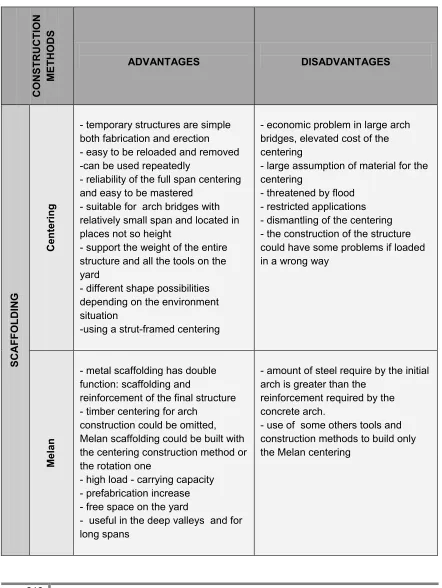
4.7 New construction methods for small and medium span 4.8 Advantages and disadvantage of the construction methods
CONCLUSION ... 227
INTRODUCTION
3
INTRODUCTION
Just like one hand clenching another a bridge embodies the sense of a connection, which unites two things that were once separated. Reaching and connecting with others in a common need of all people, bridge becomes an explicit expression of the human desire to connect and it is the union point between what is here and what lies beyond.
The design phase of any piece of architecture must take into account its entire lifespan from its inception, therefore, from primary need, to its implementation, from design to construction, and especially, as it will become part of the everyday life of the people that user it.
Architecture is an area of interrelations between people. A space becomes architecture with the continuous flow of people who live it, with materials and objects that it is made up of and with the surrounding environment that is in symbiosis with it: in a project all these factors must be considered, which interact among themselves. The individual person becomes an important component of the architectural reality when they feel integrated with the surroundings living their own daily lives through their own sensory experiences. Architecture becomes one unit with the environment, which is a complex system subjected to constant changes: from this point of view architecture, buildings, bridges and all artefacts constitute an factor of interrelation between people and landscape.
Bridges overcome artificial and natural obstacles, wide rivers and deep valleys, and open new communication paths. As work of architecture and engineering, the bridge has played a predominant role in the development of construction methods. The historical background of bridges shows us how construction methods have developed from their earliest application up to the present day and this evolution has been influenced by social, political and economic conditions of various time periods. Bridge structure particularly shows its typological progress much more than other man-made architecture and bridge designers play a main role in this development.
The choice, that lies at the basis of an architectural project, is mainly based on two geometries, apparently in contrast with each other: the clean and minimal line, that in its simplicity underlines the great design complexity, and the curved line, the arch, which defines the architectural form for excellence even more. History offers us many examples of arches, that are a symbol in the landscape design. The arch, more than any other architectural elements, is a geometric shape that in a natural way defines even its very structure. Therefore, the arch becomes the combination between form and structure and the arch bridge joins an architectural thought to an engineering one.
4
in recent years in bridge design due to innovations in both technique and architecture. After many years of arch bridge achievements, we had a long period of inactivity, during which traditional construction was replaced by the undisputed role of girder bridge, in steel, concrete, prestressed concrete, and it seemed that the arch shape was eventually going to disappear. It is only in recent years that arch bridge regained and reaffirms its importance thanks to a new structural design and construction details.
The arch structure, thanks to its shape, resists to external stresses through a mechanism, in which compression strain prevails, and in history it has been considered to be the most durable. Arch bridges meet their greatest difficulties during the construction phases: in fact, once completed the arch shape begins to function. The analysis of construction methods thus acquire the same value of the project phase. Despite the continuous and ever amazing architectural research of bridges built by means of modern and innovative methods of assembly, arch bridges never deny their basic structural principles.
AIM AND SCOPE
This PhD thesis aims to search the factors that influence the architecture design of a new project. Before people can live the arch bridge in their daily life, the bridge must answer first and foremost the basic requirements of necessity, to then be imagined, designed, and calculated. The life of the bridge is very complex, from its earliest design phase to its construction and use. In the doctoral research, titled Arch Bridges, design Î construction Î perception, I intend to retrace some steps of the arch bridge, from its project design through all the intermediate stages of site analysis, construction methods, up to when the bridge becomes a part of the human world, as persistent element in the area. Along this analysis, four issues will be discussed and studied separately, in order to answer several questions that will allow the designer to understand what the characteristics to consider are in the planning phase.
These four issues are:
-DESIGN
5
Apart from the basic requirements of the bridge project, that must meet the exigency of functionality, design must also respond to the architectural question: structures must first be functional, but also have a pleasant form. Structural beauty can be considered as a subjective quality, but bridge as to possess the characteristic of completeness, must comprise two general non-independent elements: structural efficiency and unified appearance. With regard to structural considerations, these relate mainly to the materials used in the bridge, and how it should be designed and studied to ensure convenience, efficiency and durability. The shape of the arch bridge itself has a characteristic of harmony. This principle is valid for both small and medium span bridges, but also of those with longer spans. In every period of the history the arch bridge has been an important landmark and has seen important developments and various architectural forms.
It is very important to consider the value of traditions during the project process, and more precisely with regards to the design of bridges: in fact it begins with a critical study of the existing works and an analysis of the factors that influence the design, so that they can propose alternative structures.
What are the formal characteristics of the arch bridge?
Architectural design must consider some important factors that define the arch shape: in this section were found to be: span, rise, rise/span ratio, arch typology (position of the deck). Vjg"ejcrvgt"enqugu"ykvj"eqpukfgtcvkqpu"tgictfkpi"vjg"Ðiqqf" fgukipÑ0"Vjg"rwtrqug"qh"vjku"uvgr"ku"vq"ngctp"htqo"yjcv"jcu"cntgcf{"dggp"fqpg."kp" order to access future developments, and to define what are the main features that should be considered in the design of an arch bridge.
- human PERCEPTION and LANDSCAPE PERCEPTION
The architectural harmony does not require elaborate and false ornaments, but on the contrary the pleasure to live a work must be closely linked with the efficiency that it ensures<"Ðdgcwv{Ñ"ku"kp"hcev"tgncvgf"vq"vjg"hwpevkqpcnkv{"qh"vjg"dtkfig."vjcv"ecp" be considered a good piece of architecture when it possesses these physical and psychological characteristics which reveal its character. These physical characteristics are proportion, symmetry, rhythm, repetition and contrast, and psychological characteristics one are those that give positive feelings to the observer. Structure should have a pure and clear shape and gives a feeling of stability.
6
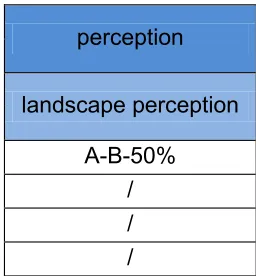
natural or urban landscape. Even purely architectural features, as superficial texture and color, have fundamental roles in the integration of a work to its surroundings.
How are the feelings of the people that live the arch bridge? What is the relation between the arch bridge and the landscape?
The aim of this chapter is to tell the designer that arch bridges, and any other types of architecture, are not only structural works, but are objects that comes into direct contact with the people who will cross it, who will see it from distance and recognize that place by its presence. The primary importance of design lies in its functionality cpf"kvu"iqcn"ku"vq"dgeqog"c"Ðyqtm"hqt"ocpÑ."cp"qdlgev"vq"dg"nkxgf0"Vjg"tgncvkqpujkr" between the arch bridge and environment is of equal importance.
-STATE OF ART
This study will allow us to understand the design choices made in the recent past for bridge building and what the common characteristics are among a number of projects, taking into account both architectural aspects of shape, but also place and the obstacles to be overcome.
The comparison of what has already been done is useful and necessary. The uvcvkuvkecn" cpcn{uku" qh" vjg" yqtnfÓu" nqpiguv" ctej" dtkfigu" kpenwfgu" c" ogvkewnqwu" collection of data subdivided into length, construction method, structural typology, materials used and country of belonging. Through research filtered with appropriate parameters, graphics can be obtained, which allow us to understand the trends of arch bridges over time, to help guess future possible developments. A similar study will be done for the arch bridges over the Italian territory, with a distinction between concrete and steel works. There are many examples of important Italian bridges, that do not find classification on a national level. The analysis of these bridges permit us to see bridge development, from the first use of reinforced concrete in the mid 20th century to the latest steel achievements of the 21st century: this has involved, albeit in more modest measure, comparable evolutionary phases and construction techniques.
What are the methods most used for the construction of arch bridges?
7
construction methods adopted mostly for the construction of these works, successively analyzed in chapter 4.
-CONSTRUCTION
After the design phase follows the construction phase: bridges have always been at the forefront of technology, and create a union between architecture and engineering. The knowledge, about what are the advantages and disadvantages of one method respect another in advance, is of fundamental importance to comprehend what the issues effectively dictated by the site are. Over time the construction of arch bridges has created ever more examples which have span ever longer respect to any previous constructions: in fact, the record spans represent the evolution in construction technologies, the development of the tools used on the yard and the quality of the materials. However, a technological evolution does not necessarily mean a higher quality in the architectural design or more attention to construction design, which on the contrary, are often overlooked. The choice of the construction method and the verification of the preliminary project, that starts from the designerÓu creativity which is based on the past experience, cultural background and knowledge of the designer.
What are the positive and negative characteristics of each method?
The purpose of this final chapter is to define the methods mostly used in construction highlighting the advantages and disadvantages to be considered in the first phase of the project.
HOW TO PURSUE THE AIM
Chapter 1: Design
What are the formal characteristics of the arch bridge?
The evolution of the arch shape and the definition of its main architectural features have been pursued through a brief historical overview of the major and most influential works that have been made around the world.
Chapter 2: Perception
What are the feelings of the people that live the arch bridge?
8
By means of the Gestalt psychology methodology laws, figures and objects will be analyzed taking into account the separation from the background.
What is the relation between an arch bridge and the landscape?
Landscape is considered as a set of past experiences, human, historical, architectural, relational. The goal of this analysis is to be able to identify the concept qh"Ðfgukip"swcnkv{Ñ"cpf"vq"cejkgxg"vjku"c"tgcfkpi"eqfg"qh"vjg"Kvcnkcp"ncy is used, the DPCM 12th December 2005, which stipulates that the public and private management of the territory is authorized through an obligatory landscape report whose contents and purposes are determined by the decree. The use of the criteria listed in the DPCM does not constitute a scientific method but a discussion method of some concepts: this evaluation method of the landscape perception does not represent a technical manual, does not indicate mathematical models to follow but merely provides some evaluation elements that could be used as a base for a critical judgment to a given context. These elements have the aim of sensitizing the designers to the themes of landscape, emphasizing the importance of the quality in the design and land management.
Chapter 3: State of art
What are the methods most used for the construction of arch bridges?
By means of a in-depth analysis of modern artifacts that show the development of infrastructure networks through political, economical and social changes in the world, and especially in Italy, and by means of the analysis of the construction methods and the various stages of assembly, the factors that influence the design work mostly are considered.
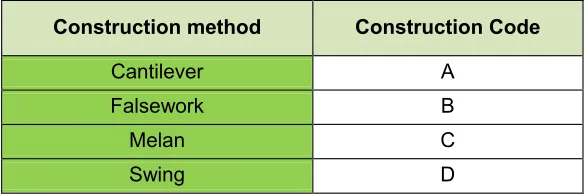
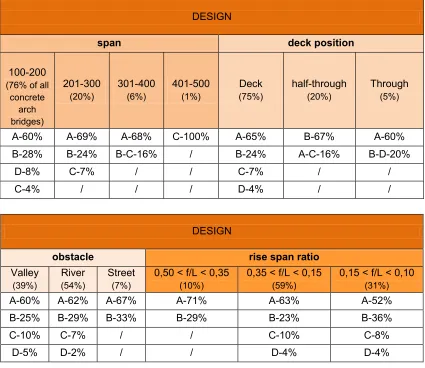
Some 600 examples of arch bridges in the world were taken into account, with the two common characteristics of having been built after the year 1900 and with a span of more than 100 m. The analysis of the data (span, material, static scheme, construction method, year of construction, etc.) can determine the record lengths, the materials most used in the construction of arch bridges, the amount of bridges depending on their length and country and how the architectural features (span/rise ratio, environment, location and obstacle to overcome) can be arranged in relation to construction methods.
9 Chapter 4: Construction
What are the positive and negative characteristics of each method?
Showing various types of construction methods, using examples of built arch bridges, enables us to define what are the advantages and disadvantages of each methodology.
CONCLUSIONS AND ACHIEVEMENTS
My personal contribution to the state of research analysis is to have collected a unique number of examples of arch bridges, catalogued in a database that gathers as much information as possible about each work (name, year of realization, main span, total span, construction method, country, location, designer). This collection defines a very wide overview of arch bridges.
The research of arch bridge projects lead to a very interesting investigation of Chinese achievements, because China is the country that has the highest number of arch bridge than any other country. My permanence there and the opportunity I had at the Tongji University of Shanghai under the guidance of the professor Airong Chen allowed me to broaden the study of Chinese bridges, both by direct observation and through the material that was given me.
Yet another study was carried out on Italian arch bridges. Although our country has a long tradition in the construction of arch bridges, as we will see later on, there has been some time blocks in their realization, nevertheless a sort of renaissance has been seen in recent years. This important collection of the works present in our territory still in only at the beginning: an archive of Italian artifacts does not exist and I consider this to be a really important issue to must be pursued in the future.
The long list of bridges gathered during my PhD years has allowed me to make considerations about many issues that are closely related to the design of bridges: the holistic view towards the bridge allows to highlight how it is going to unfold in history, what its relationship with the surrounding environment is like, which are the most important phases of construction and how people become an integral part of the finished structure by living it in their everyday lives. An attempt was done to show how architecture and engineering go parallel in the design of arch bridges, taking into account all factors, both formal and structural.
10
construction methods according to the architectural features allows us to understand what are the most widely used methods. Structural considerations are confronted with environmental issues, because the environment is a key element in the design phase: this suggests in advance the relationship between arch bridge typology and the method of assembly within a context. The proposed study is intended as a first step, a baseline, to be developed and deepen the topics of the arch bridge. Factors influencing the choice of the bridge are many and their number is so great that getting a straightforward solution for a finished work becomes a challenge. So the initial idea of the designer should therefore consider architecture, technology and the surrounding conditions.
The attention given today towards bridge projects and particular regard to the arch bridge, is revealed in the frequent meetings, lectures and conferences on the subject, in particular the Arch Bridges conference, that in 2010 has come at the 6th edition.
CHAPTER 1: DESIGN What beauty means?
Who does not see in a Roman bridge the strength of being? Or in a Renaissance bridge a place to live? Or in the nineteenth century metal bridges the strength of the scientist-artist? Or in the eight-twentieth-century rail achievements Qh"nqpi"cpf"uocnn"dtkfigu"vjg"crqvjgquku"qh"vjg"ctej"*vjcv"pgxgt"unggru"È"+A Or in many reinforced and prestressed concrete works Of the last century the depth of thought-action? In all this, the skill of the craftsman-builder is combined with a knowledge able to blending tradition and innovation, form and structure,
13 1.1 Introduction
Relation between bridge shape and construction method through history
Bridges rise over natural obstacles, across wide rivers and deep valleys, overcoming obstructions and opening new paths of communication. Bridge construction has been a main feature of progress in the connecting of different places and passing over difficulties, but at the same time it represents the evolution within the technological field, through the improvement of materials, and we can see the evolution of the architectural bridge shape through history. Bridge typology demonstrates progress more than any other man-made structure and bridge engineers act as agents in this evolution. During history, from the first examples to modern ones, this evolution can be clearly seen from the past to the present. History is a combination of many conditions: economic, political and social, which together generate the situations that are favourable or not for transformation of places.
As written by Charles Smith Whitney in Bridges of the World: Their Design and Construction1." ÐBridges are built to further human welfare and not to exploit and exalt scientific principlesÑ." dwv" kv" ku"also true that this evolution owes a debt to science, especially in the last century, where structural systems and construction methods evolved tremendously. The Roman intuition in the use of the arch has been handed down for use and is still used today. The arch is the same but the shape and the artistic expression has changed. The shapes of bridges, of any historical period mirror the society of that era and the technological evolution achieved up until then. Each arch bridge reflects and marks its political and historical settings.
The technique helps the progress, but dgcwv{"qh"c"uvtwevwtg"ku"c"Ðthing apart from the human progressÑ2 and could be a individual quality. In every case a Ðbridge must possess two general elements: these are structural efficiency and unity of appearance: structural considerations require that the material of the bridge shall be so proportioned and placed as to provide convenience and durability. The width and arrangement of roadways or waterways should suit the needs of traffic. The construction should be strong enough to stand safely for as long as it is needed0Ñ
On the other hand."Ðbeauty does not demand elaborate ornamentation, and is not in any way opposed to efficiency. Beauty is in fact so closely related to efficiency that it sometimes seems to result entirely from perfect fitness0Ñ
We have seen over the years a gradual evolution in bridge design, from simple shapes and structures to more complex ones. Some periods were distinguished by invention and the appearance of new shapes, systems, and types of bridges; others
1 Whitney, C. S., 2003, Bridges of the World: Their Design and Construction. Dover Publications, New York, USA, p.24
14
were characterized by mastering and perfecting existing systems along with the development in scientific research.
The fastest progress came about in the late 19th century with the use of new materials, which permitted the gradual abandonment of the use of stone, which had highlighted ancient times, like that of the glorious Roman Empire. The appearance of cast iron, due to the development of industry and transport, gave a great turning point in all respects. The first 40 or 50 years of the 19th century were spent creating the iron beam bridges, and the second part of the century was devoted to developing expedient systems and improving construction.
The first use of concrete, and later on reinforced concrete, brought knowledge regarding the possibilities this material possessed. However, with the general development of science and technology, the role of scientific research was increasingly racing alongside novelty, rationalization and invention. When you think of something new, it should not be regarded as something directly related to actual economic condition. In fact this concept can be easily found in the various uses of prestressed concrete in different periods: while at the beginning these new materials were expensive, now its use should be considered as an economic advantage thanks to its typical characteristic of being industrially produces and also because of mass production.
The industrial revolution introduced new materials, new building techniques, new working methods and new relationships between social classes and the problems brought about the urbanization.
Along with new materials the amount of designers were also distinguished: architects and engineers embody consequently a technical thought and a new formal value. A new method of design was to develop from the second half of the 19th century. As Edoatfq" Dgpxgpwvq" uc{u" Ðthe construction might as well as be characterized by different criteria aim at meeting venustas, utilitas and firmitas requirements. The new realizations searched the evocative strength of forms; beauty was reached in one act in which science, technique, imagination, poetry, memory interpenetrated0Ñ3
It is in this way that more technical designs met these principles related to architectural design in general: the characteristics of proportion, symmetry, rhythm, repetition, contrast become values to take into consideration during the drawing phase. The master schools in the past, such as Vitruvius and Palladio had rules and guidelines for these characteristics. Surely these guidelines are still valid today and they can be of valuable help in designing beautiful structures and avoiding formal
okuvcmgu" cpf" Vqttqlc" uckf" vjcv" Ðthe enjoyment and conscious understanding of
3 Benvenuto E., 1850-1880: Bridge-building and modern structural mechanics, in Sinopoli A., 1998, Arch Bridges: History, Analysis, Assessment, Maintenance and Repair, proceedings of
the Second International Arch Bridge Conference, Venice, Italy, 6-9 October 1998, Balkema
15
aesthetic pleasure will without doubt be much greater if, through a knowledge of the rule of harmony, we can enjoy all the refinements and perfections of the building in questionÑ04
The primary element that characterizes any design is the desired function of the project: bridge design has to fulfil this purpose in an optimum way. A structure should reveal itself as a pure, clear form and impart a feeling of stability. The form of the basic structure must also correspond with the materials used. The second one is its integration with the environment: the need to integrate a structure into its environment, landscape or cityscape, particularly where its dimensional relationships and scale are concerned. Dimensions of structures must also be related to the human scale.
The others elements that must be considered are related to the architectural shape of the object:
- Proportion: an important characteristic, necessary to achieve beauty in building, are good, harmonious proportions in the three-dimensional space. Good proportions must exist among the relative size of the various parts of a structure; among its height, width and breadth; among its masses and voids, closed surfaces and openings, and between the light and dark caused by sunlight and shadow. Proportions of the geometric dimensions are important not only for individual parts of the building, but also for the entire structure. In a bridge these relationships may exist between suspended superstructure and supported columns; between depth and span of the beam, or among height, length and width of the openings. Harmony is also achieved by the repetition of the same proportions in the entire structure or in its various parts.
- Order: repetition of elements provides rhythm, which create satisfaction. But too many repetitions, on the other hand, lead to monotony. In the case where too many repetitions occur, they should be interrupted by some other design elements.
- Surface texture and colour: in the integration of a building with its surroundings, a major role is played by choice of materials, texture and surfaces, and particularly by colour that plays a significant role in the overall formal effect. Many researchers have studied the psychological effects of colour.
-Character: a bridge should have character and a certain deliberate effect on people. The nature of this desire depends on purpose, situation, type of society, and on sociological relationships and intentions.
The choice of the arch shape become from the importance that an arch bridge acquires in the entire human culture, how it attends the progress and how it identifies an icon in the story of construction. Fritz Leonhatfv"uc{u"vjcv"Ðthe arch is the strongest embodiment of a bridge. Its shape directly expresses its ability to
4
Leonhardt F., Developing Guidelines for Aesthetic Design, in Bridge aesthetics around the
world, 1991, Committee on General Structures, Subcommittee on Bridge
16
carry loads across river, valley and gorge. Arch bridges are therefore considered beautiful by their obviously suitable shape, this is valid for small and large arch bridges alike, and it has represented in all the historical period an important landmark, and has seen significant developments and formal architecturalÑ05
1. 1 Sequence of arches, wide piers look better that narrow ones
1. 2 Flat arches with parapet without ledge
1. 3 Shapes of piers
1. 4 Variation of spans corresponding to curved vertical alignment
In regarding to masonry in arch bridges the beauty of natural stone is best expressed in small bridges when the arch and face walls form a unit. They are often
17
characterized by a multi-span shape and old bridges do show such variations. To obtain an impression of stability, it was necessary that the piers between arches were sufficiently thick and high in relation to width and depth of the span (fig. 1.1). This is especially valid for flat arches which should not be too thin at the crown, because this would cause an impression of insufficient stability and create a lack of balance in relation to the face wall (fig. 1.2). For the shape of the piers, there are also many possibilities. In new bridges, piers generally rise up only to the spring of the arches and are covered with stone plates in the form of a roof (fig. 1.3). Though very often old bridges, that do look so charming, have a different curvature of the road in elevation between the ramps (fig. 1.4).6
Another masonry arch bridge type is the barrel structure: the opening of the structure above the arch with transverse walls and small vaults decreases the weight of the bridge and the arch thrust. The good proportion between the wall thickness and the spacing should be at least 1:4 (Fig. 1.5). For viaducts on high piers, the Roman semi-circular shape is preferable shaping the arch by following the thrust line (Fig. 1.6).
1. 5 Masonry barrel arch.
1. 6 Series of arches on tall piers (viaduct).
From this first reference we will look at how the arch shape changed through history up until modern times. The historical periods were taken into consideration from the conventional periods: Ancient Roman, Middle Age, Renaissance, 18th century and 19th century. The aim of the following brief description of every period, with some important examples, is to characterize the arch bridge in different historical contexts along with the use of different materials and construction techniques. In this chapter
18
we will also see the arch design up until the 19th century. The modern period and the state of art of the latest realizations will be explained in Chapter 3 State of art. Before discussing what occurred in the world closest to us, I would like to give a brief introduction on the first construction of arch bridges which were made in China. The development of this subchapter is not only due to the presence of interesting arch bridges in China but also to the period I spent abroad at the Tongji University in Shanghai, more precisely under the guidance of professor Airong Chen in the Department of Bridges. The research work carried out at this foreign university allowed me to come into contact with a reality that is different and charming as well as having access at their material, that consists mostly of recent realizations and planning projects. This brief introduction, however, is meant to give a historical background on some known examples with great architectural value.
1.2 Chinese ancient arch bridges7
Throughout history, the Chinese nation has erected thousands of bridges, which form an important part of its culture. Ancient Chinese bridges are universally acknowledged and have enjoyed high prestige in the bridge history of both in East and in West.8
China is a big country where nearly every region has a different language, culture and necessities. In the case of stone bridges, diverse land transport and the varying morphologic position between north and south, permitted the different styles in the construction of the arch bridges. To the north the flat-deck bridge with solid spandrel prevails, thick piers and arch rings, whereas to the south, with the presence of many rivers, the hump-shaped bridge with thin piers and arch structure prevails.
The most ancient Chinese bridge is the Anji Bridge, and maybe the oldest arched stone bridge in the world, also known as the Zhaozhou Bridge(Fig. 1.7), at Zhouxian, Hebei Province, built in 605 A. D. during the Sui Dynasty by an architect named Li Chun. It is constituted by a single arch span made by stone and composed of 28 individual arches connected transversely. The stone arch was built by vertically juxtaposing 28 arch rings, each 34 cm wide and capable of standing erect by itself, which facilitates the construction work and independent repairs. With
7 A big part of the material available and directly consulted in China was written in the original language with the obvious problems of understanding. Therefore, the material provided has been obtained from books transcribed in English and from the website of the Tongji University that collect an interesting survey of the bridges built in their country (http://bridge.tongji.edu.cn/cb/ancient/ancient.htm).
8 Gies J., 1966, Bridges and Men, Universal Library Edition, USA., p.19
19
its solid foundation and a grand view, the structure features a completely reasonable design and ingenious construction techniques. The bridge is 37 m span with a rise of 7.23 m. Each of its spandrels is perforated by two small arches, 3.8 m and 2.8 m respectively in clear span, so that flood water can be drained and bridge weight is lightened as well. The bridge represents a unique structure for that period and we can only see similar such examples in Europe from the start of the Middle Ages.
1.7 1.8
1. 7 Zhaozhou Bridge, Hebei Province, China, 37 m span, 605 A.D., Li Chun 1. 8 Lugou Bridge, near Bejing, China, 1192 A. D., 212.2m long, 11 semicircular arches,
ranging from 11.4m to 13.45 m in span
1.9
1.10
20
"Over this river there is a very fine stone bridge, so fine indeed, that it has very few equals in the world." These are the words Marco Polo described the Lugou Bridge (Fig. 1.9) that crosses the Youngding River near Beijing city. The project was completed in 1192 A. D. during the Jin Dynasty. It is 212.2 m long and it presents 11 semicircular arches, ranging from 11.4 m to 13.45 m span. Every column is decorated with lions sculptures, each one different from the other. As well as being famed for its formal features, the Lugou Bridge is also considered to be an architectural masterpiece.
In Beijing there are two of the most important ancient Chinese arch bridges, both located in the Summer Palace Garden: the Seventeen arch Bridge (Fig. 1.9) is a decreasing arch with a total length of 150 m and the famous Jade Bridge (Fig. 1.10) that is a single marble arch with humped-shape. The need of the bridge to overcome water at a sufficient height as to allow the navigation below meant that the shape of the bridge was determined by two sloping roads. It is really fascinating to cross the bridge where the deck in the middle part follows the trend of the arch perfectly.
In the southern part of China, in the Jiangsu and Zhejiang provinces, connected by navigable rivers, boats were the main means of transportation. As bridges were to be built over tidal waters and their foundations laid in soft soil, even stone arch bridges had to be built with thin piers and shell arches in order for its weight to be lightened as much as possible. The Fengsheng Bridge (Fig. 1.11) in Zhu jia jiao, in the Shanghai province, built during the Qing Dynasty, is characterized by its shell arch and with piers so thin that the arch stones meet on it.
1. 11 Fengsheng Bridge, Zhu jia jiao, Shanghai Province
21
Tangqi, Zhejian Province, with seven arches and both bridges present decreasing spans.
1.12 1.13
1. 12 Gongchen Bridge, Hangzhou, China, 15.8 m 1. 13 Guangji Bridge, Tangqi, Zhejian Province, China
The longest surviving multi-span bridge with shell arches and thin piers is the Baodai Bridge (Fig. 1.14) in Suzhou, Jiangsu Province. Built in the Tang Dynasty but having undergone a series of renovations in successive dynasties, the bridge is now 316.8 m long and has 53 spans in all. The three central arches are higher than the rest to allow the boats to pass through and both ends of the bridge are ornamented with lions, or pavilions and towers, all of stone.
22
1.3 Roman Period (700 a. C. Î 400 d. C.)9
The arch was applied later on respect to the beam, and after an initial period where the false arch was introduced, it can be said that the important use of this structure began with Romans. During Roman times, most bridges were constructed as stone arches, also known as masonry or Voussoir arches. These wedge-shaped elements were made by means of precise rules: the roman arch is characterized by geometrical perfection and the Voussoir arch have the same dimension from the imposts to the keystone.10
Romans were magnificent builders and many of their masonry bridges are still standing today. Stone arch bridges are very beautiful and much admired and a wide number have become the fundamental core of their cities. Stone is capable of supporting very large compressive forces: the arch is stable as long as the thrust line is contained within the cross-sectional area.11 Masonry arch bridges are very durable: Voussoir arches were even more durable and robust than the stone beams.
Romans had the issue of crossing the rivers, so how could the placing of the piers on a mud river be solved? How could the construction problem be resolve? The typical Roman arch, and the only one that they knew, is represented by the semi-circular shape. In fact, Romans intuited that the thrust from the arch was going directly down onto the support piers. From this experience it was clear to note how the shape of piers acquired a key role in the design and construction of a bridge. Piers were usually made, especially earlier on, by a ratio scale of pier/arch span equal to unity: the pier had the same amplitude as the arch span. The choice of having a large sized pier was useful in the construction phase: if they were built wide enough at about one-third of the arch span, then any two piers could support an arch without shoring or propping from the sides. In this way it was possible to build a bridge from one shore to the other shore, one span at a time, without having to assembly the entire structure across the river before even starting the arches.12 The size of the piers was also influenced by the difficulty in the construction of the
9 As mentioned before, the arch and its use in bridge construction has a long history and there are countless bibliographies about it. Here there are cited: J.J. Arenas, 2002, Caminos en el aire, Colegio de Ingenieros de Caminos, Canales y Puertos, Marid, Spain; Withney C.S., 1983, Bridges, their art, science & evolution, Greenwich House Edition, USA.; Gies J., 1966, Bridges and Men, Universal Library Edition, USA.
10 Troyano L. F., 2006, Vgttc"uwnnÓceswc."Atlante storico universale dei Ponti, Dario Flaccovio Editore, Palermo, Italia, p.126
11 Gerard F. Fox, Arch Bridges, in Chen W.F. and Duan L., 2000, Bridge Engineering
Handbook, CRC Press LLC, USA
23
foundations. For all these reasons Roman bridges are generally composed of a series of stone arches that permits them to pass over the water.13
The stone arch was built by means of a wooden framework resumed with the exact profile of the final arch (Fig. 1.15). The semi-circular arch meant that all the stones were cut identically and that no mortar was needed to bind them together once the keystone was locked into position. The compression forces in the arch ensured complete stability of the span. What is still standing today, whether it be a bridge or an aqueduct, rank among the most inspiring and noble of bridge structures ever built, considering the limitations of their technology.14
1. 15 Construction procedure of Romans arch bridges
The strength of Romans was dependent on their transportation system. Along the roads, realized throughout the Empire, many bridges were built and we can find important examples of them in France and Spain. Romans understood that the establishment and the maintenance of their empire depended on efficient and permanent communication routes. Building roads and bridges was therefore of high priority. Their influence on bridge building technology and architecture has been profound. Roman bridges, which remain standing today, are admired as much for their artistry as for the monumental form built with limited technology.15 Arch bridges respected order in the design shape and this sensitivity in construction became culture and tradition.
An example of this is the UcpvÓCpignq Bridge (Fig. 1.16) over the Tiber River in Rome: it was built in 136 B. C. and in 1668 by suggestion of Bernini was embellished with the angel statues. The bridge is faced with travertine marble and spans the Tiber with five arches. The piers are thick and taper upstream to divide
13 To a greater knowledge about the scenario of Roman bridges, see: Galliazzo V., 1995, I ponti romani, vol. I: Esperienze preromane, storia, analisi architettonica e tipologica, qtpcogpvk."tcrrqtvk"eqp"nÓwtdcpkuvkec."ukipkhkecvq, and vol. II: Catalogo generale, Treviso, Italia; S. Delli, 1977, I ponti di Roma, Newton Compton Editori, Roma, Italia
14 Ibid.
24
the floodwaters. The face walls are terminated at the top by a slightly projecting ledge.16
1. 16 Sant'Angelo Bridge, five spans of 18 m, 135 m total length, completed in 134 B.D., Rome
The most famous Roman bridges are the great aqueducts used for the transportation of water to the cities. The aqueducts consisted of open channels, without pressure, with a considerable height in order to overcome the valleys. Romans resolved the problem of the height by superimposing one deck to another until reaching the altitude required.
1.17 1.18
1. 17 Pont Du Gard, Gardon RiverNimes, France, I sec B.D., 24 m span 1. 18 Segovia Viaduct, Spain
Probably the most famous aqueduct is the Pont Du Gard at Nimes in France. It stands as a monument (Fig. 1.17). This is the largest well-preserved Roman bridge of all, and it is simultaneously a road bridge and an aqueduct, built in 63-13 B. C. Above the lower six arches the long aqueduct rises into two storeys to a height of 46.4 m above the river. Built on three levels, the Pont Du Gard is 49 m high, the longest level is 275 m long, the lower level is 142 m long with 6 arches, the middle
25
level is 242 m, and it has 11 arches, the upper level has 35 arches with a total span of 275 m. On the first level there is a road and at the top of the third level, a water conduit. It was entirely constructed without the use of mortar. Another important famous aqueduct is the Segovia Viaduct (Fig. 1.18).
Bridges built by Romans had a significant development from the start up until the end of the Empire, because of their accumulated experience. From these descriptions it is easy to understand that the intention of those who created the bridge was to try to alleviate the pressure as much as possible on the piers. The continuous research to lighten the structure led to the use of small arches at the springing site.
As mentioned above, there are many bridges that have survived over the centuries, some famous examples are described here just to give an idea of the arch shape used at the time. When the Roman Empire collapsed, it seemed as though the progress around the world had stopped for a long period of time. It was left to the spread of Christianity and the strength of the church to start the next boom in road building and bridge building around 1000 A.D.
1.4 Middle Ages period (500-1400)
In the 12th century important bridges were built by Fratres Pontifices, a monastic order, who were the first to start building with flat segmental arches. The shape of the arch bridges in the Middle Ages improved respect the Romans by using narrower piers, thinner arches and lower span-rise ratio. The slenderness of the arch increased significantly decreasing the ratio between the thickness of the stones and the span of the arch. As said by Bennett17, the aim of this church order, Ðthe brothers of bridgesÑ." obviously apart from its spiritual duties, was to aid travellers and pilgrims by building bridges along pilgrimage routes, offering boats for their use and welcoming them to stay in hospices built for them on the riverbanks. In this period the mechanism of the resistance of arches became clearer: the shape of the arch structure is amended in favour of a lowered form, however there are examples of semi-arch bridges. The medieval bridges also have bigger cutwaters than Romans, sometimes with the presence of rear cutwater that demonstrates a greater knowledge of the effect of water on foundations.
A famous example of this during this period is the bridge over the Rhone River in Avignon (Fig. 1.19). It had an original length of some 900 m but it suffered frequent collapses during floods and had to be reconstructed several times. In the end the bridge was put out of use by a catastrophic flood in 1668, which swept away much
26
of the structure. The consequent abandonment meant that the bridge had subsequent collapses and only 4 of the initial 22 arches remain intact to this day. Medieval bridges have the characteristic of having fortified lookout towers built in the middle or at the ends of the bridge. In the Middle Ages, bridges constituted strategic routes and for this reason they had to be defended. Many bridges had a part that could be raised as to block the passage over it. For this reason, some examples of medieval bridges have an arch with a shorter span.
1. 19 Avignon Bridge, over the Rhone River, France, XVI century, 34 m span
The Scaliger Bridge (Fig. 1.20) over the Adige River in Verona is of the same period (1354-1356). Built in red brick at the top, like all the medieval monuments of Verona, and white marble on the bottom, the bridge consists of three arches of decreasing span. The major span was daring for the time, and every length is respectively 48.70 m, 29.15 and 24.11 m. The bridge is then longer than 120 m. The face walls of red brick are crowned by pinnacles, which are typical for the Scaliger period.
Bridges of the Middle Ages were equipped with fortification towers and gates like the Valentre Bridge (Fig. 1.21) over the River Lot in Cahors, France (1308-1355) that was built with six Gothic arches and three square towers. The face walls are joined to the massive parapet without any interruption by a ledge.
1.20 1.21
27
The Gothic elliptical arch presents a shape with the long axis in a vertical position, this is an effect achieved by constructing the arch from three separate circles, with the smallest at the top (Fig.1.22). This typology required a pier of only one fourth of the arch span rather than the Roman semi-circular arch that required from one third to one half of the arch span.18
1. 22 Gothic arch
A peculiarity of the Middle Ages is represented by the so-called hump-back bridges19, which consist of two ramps that meet at the summit, at the centre of the arch: the two road ramps reach the middle at the height of the key stone leading to the point of change of inclination. Hump-back bridge permits to have a major height of the deck from the water level, allowing a greater flow in case of flooding. In this way it can cover large spans with a single arch, without intermediate piers that become necessary in a bridge with a horizontal plane.
Vjku"rctvkewnct"hqto."pcogf"Ðoqqp"dtkfigÑ"kp"Cukcvke"eqwpvties, comes from the size of the rise: it was necessary to raise the height above the river banks in order to develop the arch. The hump-back bridge was a structural necessity, which could be more or less accentuated according to the formal intentions of those who had designed and built the bridge and also to the historical period. This architectural solution is used at different epochs of history because it assured the parts of the bridge would be less prone to the violence of the water. The slenderness of the arches increased significantly, decreasing the ratio between the thickness of the stones and the span of the arch.
Many medieval bridges in France, Spain and Italy, were designed by local people called "magister muri" who were the architects of their time, and were built because of the work of the monks which was also provided to the maintenance of roads. A good example of a hump-back bridge with inclined planes is the Maddalena Bridge (Fig 1.23), over the Serchio River, near Lucca in Italy, dating from the 12th
18 Gies J., 1966, Bridges and Men, Universal Library Edition, USA., p.30
28
century. The bridge is called, just like many others, the Devil's Bridge: this name derives from a legend that recounts that the construction of it seemed so impossible the builders were forced to ask the devil for help, who in exchange for the completing the bridge in one night, demanded the first soul that would ever cross the bridge. The story relates that the devil get cheated in his prize, seeing an animal cross the bridge for first. The shape of the river mainly affects the morphology of the artefact: the Maddalena Bridge, is asymmetrical as is the river bed. Another one of the problems, that has always been attempted to be reduced or avoided, and that led to the ruin of many stone bridges, is the reversal of tympanums which is caused by the thrust due to the filling of the walls.
In some examples of this period there is the presence of a votive construction on the key, necessary to concentrate load in this part and to have a correct structural regime, balancing the presence of massive loads at the abutments, and to prevent rupture of the arch (Fig. 1.24).
1.23 1.24
1. 23 Maddalena Bridge, Serchio River, Lucca, Italy, 1100 1. 24 Martorell Devil Bridge, Llobregat River, XIII century, 37 m span
1.5 Renaissance (1300-1500)
29 1. 25 Semi-arch and Segmental arch shapes
Also in this period there are many examples of hump-back bridges, even though the arch tends to have a more horizontal profile. The arch shape looks descending from the centre towards the ends (as seen for the ancient Chinese bridges). Renaissance is synonymous for the use of decorative orders and architectural proportions. Construction techniques was improving continuously paying attention to the stability of the bridge and the lesser use of material.
At the end of Middle Ages and at the beginning of Renaissance many bridges had constructions on them, many of which intended for housing. The Ponte Vecchio in Florence (Fig. 1.26), erected in 1345, is a famous example an inhabited-bridge with buildings along its full length. The architecture of this bridge is truly unique, not only for buildings, but for its most innovative feature the extremely shallow arches compared with any previously built arches: very low 30 m span and it is for this reason that was considered a turning point for Dark Ages.
One of the most famous bridges of the Renaissance is the Rialto Bridge on the Grand Canal in Venice (fig. 1.27). It consists of a single segmental stone arch with 27.5 m span and 7.3 m rise. It was constructed between 1588 and 1591under the supervision of Antonio Da Ponte (1515-1597 circa). The construction was made difficult by the conditions of instability and by the height of the sea bottom. The structure, very similar in style to the previous wooden bridge, is formed by two inclined ramps, with shops on each side, covered by a portico. John Ruskin once uckf"qh"kv<"ÐThe best building raised in the time of the Grotesque Renaissance, very noble in its simplicity, in its proportions and its masonryÑ020 This shape type is
30
commonly used in Venetian bridges because the banks are all at water level and the arch needs to be high enough to allow for navigation.
1.26 1.27
1. 26 Ponte Vecchio, Florence, Italy, three span of 30 m, 1345, (Vasari attributed to Taddeo Gaddi)
1. 27 Rialto Bridge, Venice, Italy, 27.5 m span, 1591, Antonio Da Ponte
Equally innovative bridge construction was developing across Europe. In the state of Bohemia over the Moldau River in Prague the famous Charles Bridge21 (Fig. 1.28) was built in 1503. It took a century and half to completely finish it. The bridge is 516 m long and nearly 10 m wide, and consists of 16 arches.
1. 28 Charles Bridge, Prague, Czech Republic, 16 spans (length: 16.62 - 23.38 m), total length 515.76 m, 1380, Peter Parler
The finest examples of late French Renaissance Bridge built during the XVII century are the Pont Royale (Fig. 1.29) and Pont Marie Bridge, both of which are still standing today. The Pont Royale was the first bridge in Paris to have arches with elliptical features and the first to use an open caisson to provide a dry working area in the river bed.
31 1. 29 Pont Royale, Paris, France, 20.58 m - 22.70 m - 23.52 m - 22.44 m - 20.64 m span,
1687, Jules Hardouin Mansart
It is in this period that the major European cities evolved. Thanks to their tactical locations, were often positioned in transit zones and with the presence of water that divides the city into separate parts, they therefore become important nodes along the lines of communication and economic routes. Venice, Florence, Paris, London, Nuremberg, Seville, and many more, are concrete examples of how a place, characterized by a considerable problem of division could become a centre of commerce. The economic fortune of some cities is mainly due to the position of the market, compared to other city destinations that constitute a focal point around which the lives of citizens revolve: the presence of public spaces, ranging intersections with the mesh of the residences, and the possibility of paths meant that the "passage" became a fundamental requirement and at the same time an opportunity. The bridge is not only a constrained route, but becomes "inhabited", a place where multiple interests can exist together, a point of connection between two residential areas growing on two opposite sides.
The examples cited above, Rialto, Ponte Vecchio and the bridges in France, then came to acquire an economic significance, beyond the purely strategic transition. Bridges on the River Seine are defined by the archbishop Andrea Minucci during his travels "so wide and with buildings above them so big [that those who walked on it in seemed to be] in a square rather than on a bridge." The symbol that these bridges possessed inside the city was certainly greater than any other value: they are a sign of entrepreneurship for the people who live in these cities that went beyond the national pride, because for a long time the construction of bridges, yjkej"ctg"coqpi"vjg"yqtnfÓu"oquv"rqrwnct. were funded by private donations from citizens who saw through their implementation the progress of the city as a whole.22
At the start of Renaissance the role of the architect integrated the theoretical structurer and the manufacturer into one person. Filippo Brunelleschi (1377-1446),
32
Leon Battista Alberti (1404-1472), Leonardo Da Vinci (1452-1519), Michelangelo Buonarroti (1475-1564), Andrea Palladio (1508-1580) and Antonio Da Ponte (about 1515-1597) all experimented new architectural forms of bridges.
1.30 1.31
1. 30 Bridges in Paris
1. 31 Pont Neuf, Paris, France, 1607, spans of 19,5 m and 17,7 m length, Baptiste Androuet Du Cerceau
1. 32 Mostar Bridge, Bosnia, XVI century, 30 m span, Hajrudin
33
The bridge consists of two independent sections, one with seven arches and second with five. The arches have a semi-arch shape with decreasing spans, as the classic typology of hump-backed bridge required, which was modified over the century due to subsequent necessity of reparation. The bridge represents one of the more typical masonry bridges in the city.
The arch shape changed from the semi-arch to a lower form, until the arrival of the engineer Jean Rodolphe Perronet (1708-1794) in the mid 18th century.
The examples of bridges with an significant history are very numerous all over France, but not only, like in Spain, England or in Turkey and in the Balkan countries where there were bridges built after Roman age. The Bridge over the Neretva River in Mostar (Fig. 1.32), in Bosnia, was built in 16th century. The bridge narrowed between the rock and fortress has a span of 30 m and a rise of 19 m above the river. It was destroyed in 1993 during the Bosnian War. Subsequently, it was rebuilt in 2004.
1.6 18th century
In the 16th century, Palladio described vjg" dtkfig" kp" vjg" hqnnqykpi" yc{<" ÐThe convenience of bridges was first thought upon because many rivers are not fordable by reason. Of their largeness, depth, and rapidity: upon which account it may be well said, that bridges are a principal part of the way; and are nothing else but a street or way continued over water. Bridges therefore ought to have the self-same qualifications that are judged requisite in all other fabrics: which are, that they shall be convenient, beautiful and durableÑ023
The 18th century was the era when civil engineering was finally born as a profession, when the first school of engineering was established in Paris at the Ecole de Paris. With the presence of a vast knowledge it was inevitable that building architecture and civil engineering should be separated into the two fields of expertise.24
In the second half of the century, the engineer Jean Rodolphe Perronet (1708-1794) introduced important innovations in the construction of stone bridges. The arch shape that he chose was the curve of a segment of a circle of larger radius, instead of the familiar three-centred arch. In his works he greatly reduced the size of the piers through offsetting of the arches thrust with the adjacent forces: when the arches have equal length the resultant of the two forces is vertical.
23 Whitney, C. S., 2003, Bridges of the World: Their Design and Construction. Dover Publications, New York, USA, p. 27
34
The main issue of new projects was the construction method: to avoid failure of thrust it was in fact necessary to erect the arches with the simultaneous use of a falsework under all the spans. Unlike Roman bridges if one of the arches were to fall there would be the subsequent and inevitable destruction of the entire bridge. Perronet tried to overcome these problems by designing two distinct types of piers: after a number of slender arch spans one larger pier was made that would have prevented the complete destruction of the entire bridge in case of a collapse of one arch, but that would have allowed for the destruction of a single part.25
1. 33 Pont De La Concorde, Paris, France, 1791, 25 m - 28 m - 31 m - 28 m - 25 m span, J. R. Perronet
Qh" RgttqpgvÓu" itgcvest enterprises only his last bridge remains, the Pont de la Concorde in Paris (Fig. 1.33): it is one of the most slender and daring stone arch bridges ever built. It was realized between 1787 and 1791 and has a total length of 153 m span (25 m - 28 m - 31 m - 28 m - 25 m). The spans and rises are different for the five arches: the roadway is not the same level along the entire length of the bridge but it rises towards the centre part to give additional clearance for boats.
1.7 19th century
Even if at the beginning of this century can be found many examples of stone arch bridges, the development of the techniques and materials permitted to have a significant structural improvement in the construction of bridges. Industrial Revolution allowed the realization of new transport routes, including railway development, to keep up with the increasing coal exploitation and the manufactory of textile and pottery. A rapid assembly of manufactures was necessary for the construction of new road routes.
Heavy steam engines and longer freight train subjected the bridge structures to new larger stresses than before. Bridge had to be stronger and more rigid and had to be
35
faster to assemble to keep pace with progress. When car arrived, it was necessary to create an infrastructure network that crossed the entire countryside from town to city, over mountains, valleys, streams, rivers, estuaries and seas. This is the period of iron and arch trusses.
A significant iron bridge is the famous Coalbrookdale Bridge, constructed in England to span the Severn River. It is the first realization with the use of this new material. The potential of iron was much greater than the materials known up until that time and with much higher resistance characteristics. The Coalbrookdale (Fig. 1.34), completed in 1779, is a semicircular arch spanning 30 m designed by Pritchard for the owner and builder Abraham Darby III. The size of the cast iron elements in the early arches is astonishing: the ring of some of them is made in two pieces with lengths of over 15 m. The lightening of the tympanums was made by overlapping the main arch of other segments of circles, ending at the deck with support function. These elements are interconnected by bars positioned according to a radial design, as well as the circles under the deck.
1. 34 Coalbrookdale Bridge, Severn River, England, 1779, T. Pritchard, A. Darby III and J. Wilkinson
The architecture principles of the preindustrial period appear to have been carried forward very successfully into this design. These along with subsequent developments heralded the birth of what can be considered the modern bridge, in which there was a profound marriage between the conceptual understanding of structures and the practice of bridge construction. Steel became competitive with iron, and this material had vastly superior qualities, both in compression and tension. The age of steel opened the door to tremendous advantages in long-span bridge building technology.
36
architecture and the great delicacy of the steel sections make it a structure of rare lightness, elevated in relation to the piers. Although it was rebuilt during the Second Empire, the original structure of the footbridge was far too light and the new footbridge(completed in 1985) is not made of cast iron but of steel and has only seven arches instead of nine.
1. 35 The Pont des Arts, P