PhD Dissertation
International Doctorate School in Information and
Communication Technologies
University of Trento
Department of Information Engineering and Computer Science
Modeling and Reasoning about
Contextual Requirements:
Goal-based Framework
RAIAN ALI
Advisor:
Prof. Paolo Giorgini
Università degli Studi di Trento
Abstract
Most of requirements engineering (RE) research ignores, or presumes a uni-form nature of, the context in which the system operates. This assumption is no longer valid in emerging computing paradigms, such as Ambient, Per-vasive and Ubiquitous Computing, where it is essential to monitor and adapt to an inherently varying context. There is a strong relationship between re-quirements and context. Context might be considered to determine the set of requirements relevant to a system, to derive the alternatives the system can adopt to reach these requirements, and to assess the quality of each alterna-tive. A RE framework that explicitly captures and analyzes this relationship is still missing.
Before influencing the behavior of software, context influences the behavior of users. It influences users’ goals and their choices to reach these goals. Capturing this latest influence is essential for a software developed to meet users’ requirements in different contexts. In this thesis, we propose a goal-oriented RE modeling and reasoning framework for systems operating in and reflecting varying contexts. To this end, we develop a conceptual modeling language, the contextual goal model, that captures the relationship between context and requirements at the goal level and provides constructs to analyze context. We develop a set of reasoning mechanisms to analyze contextual goal models addressing various problems: the consistency of context, the derivation of requirements in different contexts, the detection of conflicts between requirements happening as a consequence of changes in the context they lead to, and the derivation of a set of requirements that leads to a system developed with minimum costs and operable in all of the analyzed contexts. We develop a formal framework, CASE tool, and methodological process to assist analysts in using our modeling and reasoning RE framework.
We evaluate our proposed RE framework by applying it on two systems: smart home for patient with dementia and museum-guide mobile information system. Our contribution to RE research is a RE framework specialized for emerging computing paradigms that weave together software and context. It allows us to overcome the limitation of existing RE frameworks that ignore, or presume a uniform nature of, the context in which the system operates.
Keywords [Requirements Engineering, Context Analysis, Goal Modeling,
Acknowledgments
Contents
1 Introduction 1
1.1 Research Baseline . . . 3
1.2 Research Question . . . 6
1.3 Contribution of the Thesis . . . 8
1.4 Structure of the Thesis . . . 9
1.5 Published Work . . . 10
2 State of the Art 12 2.1 Context-Awareness . . . 12
2.1.1 Context definition . . . 12
2.1.2 Context dimensions . . . 14
2.1.3 Context Modeling . . . 18
2.2 Goal-oriented Requirements Engineering . . . 20
2.2.1 Main concepts . . . 20
2.2.2 Main motivations . . . 22
2.2.3 Ongoing research . . . 23
2.3 Requirements Driven Variability . . . 27
2.3.1 Goal-based variability . . . 27
2.3.2 Problem Frames variability . . . 29
2.3.3 Feature models variability . . . 30
2.4 Chapter Summary . . . 32
3 Contextual Goal Model 33 3.1 Weaving Requirements with Context . . . 33
3.2 Running Example. . . 35
3.3 Tropos Goal Model: Overview . . . 36
3.4 Context in Requirements. . . 38
3.5 Weaving Context with Goals . . . 40
3.6 Contextual Goal Model: Variation Points . . . 42
3.7 Context Influence on Goals: A Classification . . . 44
3.8 Contextual Goal Model: Context Analysis . . . 45
3.9 Discussion . . . 50
4 Reasoning about Contextual Goal Models 55
4.1 Reasoning about Consistency . . . 56
4.1.1 Running example . . . 56
4.1.2 Reasoning about context consistency . . . 57
4.1.3 Conflict analysis . . . 64
4.2 Reasoning about Variants Derivation . . . 70
4.2.1 Running example . . . 71
4.2.2 Deriving variants for varying contexts . . . 72
4.2.3 Deriving variants for minimum costs . . . 76
4.3 Chapter Summary . . . 81
5 Automated Support Tool and Methodological Process 83 5.1 RE-Context: Automated Support Tool . . . 83
5.1.1 Architecture . . . 83
5.1.2 Functionality . . . 84
5.1.3 Input Format . . . 88
5.2 Methodological Process . . . 93
5.3 Chapter Summary . . . 97
6 Evaluation 98 6.1 Smart Home System . . . 98
6.1.1 Contextual Goal Model of Smart Home . . . 101
6.2 Museum-guide System . . . 109
6.2.1 Contextual Goal Model of Museum Guide . . . 112
6.3 Evaluation Results . . . 120
6.3.1 Analysts feedback and observations . . . 122
6.3.2 Reasoning results . . . 127
6.3.3 Performance analysis . . . 130
6.4 Chapter Summary . . . 132
7 Conclusions and Future work 133 7.1 Summary of The Thesis . . . 133
7.2 Generality of The Approach . . . 135
7.2.1 Running example . . . 136
7.2.2 Contextual feature model . . . 137
7.3 Towards a Unified Framework for Contextual Requirements . . . . 139
7.3.1 Integrated model for contextual requirements . . . 140
7.3.2 Benefitting from the integration: an example . . . 141
7.4 Future Work . . . 143
Chapter 1
Introduction
The recent advances in computing and communication technologies such as sensor systems, positioning systems, mobile devices, and so on, have led to the emergence of computing paradigms such as ambient intelligence, per-vasive, ubiquitous and context-aware computing. A core element of these emerging paradigms is context. The notion of context has been used in different ways and in different computer science disciplines such as artificial intelligence, natural language processing, and recently mobile and ubiquitous computing. Since requirements are user needs that could vary according to the environment the users are in, we refer by context to the reification of such environment [1].
Context has a strong influence on system requirements: it can be a fac-tor in deciding requirements to meet, choosing among possible ways to meet the requirements, and assessing the quality of each of these ways. On the other hand, the system itself may cause changes in the context as a result of meeting its requirements. However, in spite of the mutual influence between context and requirements, context is either ignored or presumed uniform in RE literature and is considered mainly during the later stages of software development (Architecture [2], Runtime Adaptation [3], HCI [4], Services [5]). A RE framework for modeling and analyzing the requirements of sys-tems reflecting their context is still missing.
sys-tem, the network bandwidth and the computing device capabilities influence the system decision of downloading high/low quality image or video attach-ments. However, there is even an earlier adaptation to the environment that is user adaptation. For example, usually users do not need to see emails with attachments when they are driving, in a meeting rooms, or using mobile phones with small screens. The system has to reflect user intentions to read emails first before deciding whether to download high quality or compressed attachments.
Context has been used in different ways in computer science literature. It has been used in natural language processing, communication, and image processing to name few. Recently, the notion of context has become common in emerging computing paradigms such as Pervasive, Ubiquitous, Ambient Computing. Although this notion tends to have a common sense in this community, there are several definitions of it. The definition we are going to develop in this thesis is close to the one given in [1] where context is considered as the reification of the environment. The environment is defined as whatever in the world provides a surrounding in which the system is supposed to operate. This definition emphasizes the world that is broadly accepted as a core element in requirements engineering literature [6, 7, 8].
Software systems are means to reach user requirements and they are not requirements per se [6, 9, 10]. One important source of requirements is the stakeholders’ goals and their variant choices to reach them. Context has influence at this level, the goal level, deciding what goals to reach and how to reach them. For example, in a health care institute for people with dementia, a caregiver may have the goal to“involve the patient in social activities” (G1) whenever“the patient is feeling bored and it has been long time since his last
social activity” (C1). The caregiver can satisfy goal G1 both by “taking the
patient for a trip in the city” (G1.1) or“asking a relative or an old friend of
the patient to come” (G1.2). Goal G1.1 is adoptable only if “the city is not
crowded” (C1.1), since people with dementia usually get anxious in crowded
places. Goal G1.2 is adoptable only if “the patient has relatives or friends
that can come" (C1.2). The requirements model of a software that supports
people with dementia should reflect the caregiver goals G1, G1.1, and G1.2,
the rationale G1.1 ∨G1.2 → G1 and adaptation to contexts: (i) if C1 ∧C1.1
then G1.1, and (ii) if C1∧C1.2 then G1.2.
This thesis addresses the problem of modeling and analyzing requirements for systems operating in and reflecting varying contexts. It proposes a goal-based modeling language to express the requirements at an early level, the in-tentional level, that makes explicit thewhy of requirements [14]. Besides the why of requirements, capturing the relationship between context and goals makes explicit the where/when of requirements as well. The requirements are complete if they sufficiently establish the goals they are refining [18,19]. Considering systems reflecting their varying contexts, the requirements are complete if they sufficiently establish their goals in those varying contexts. In other words, we make explicit the influence of the world variability on goals and goal refinements.
1.1 Research Baseline
The work in this thesis is, mainly, based on the following baselines:
• Context is a partial state of the world. The world is whatever provides a
surrounding in which an actor, possibly the system, lives. The relevance of the parts of the world depends on the decisions and actions an actor takes.
Example 1. Lets us consider a smart home system (actor) that
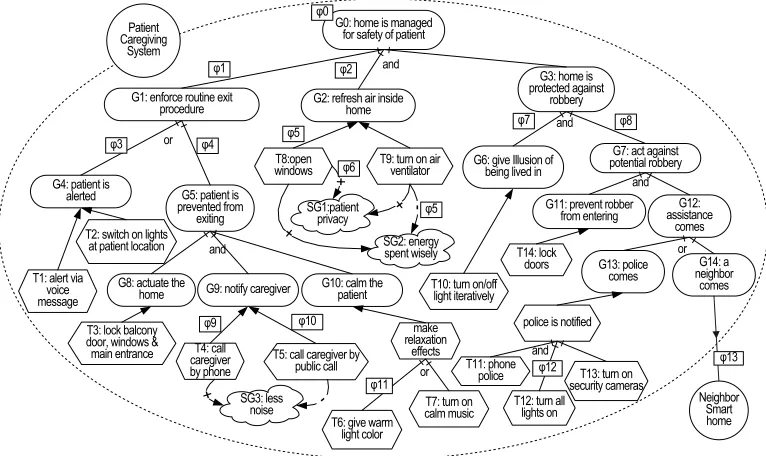
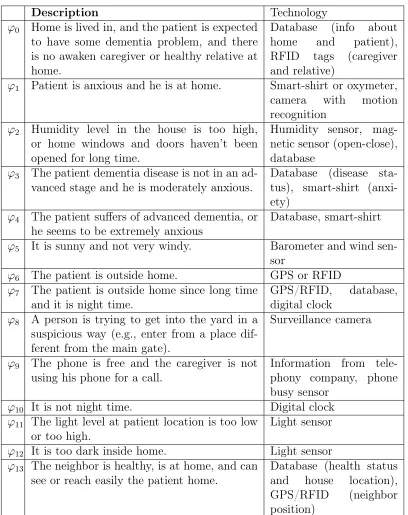
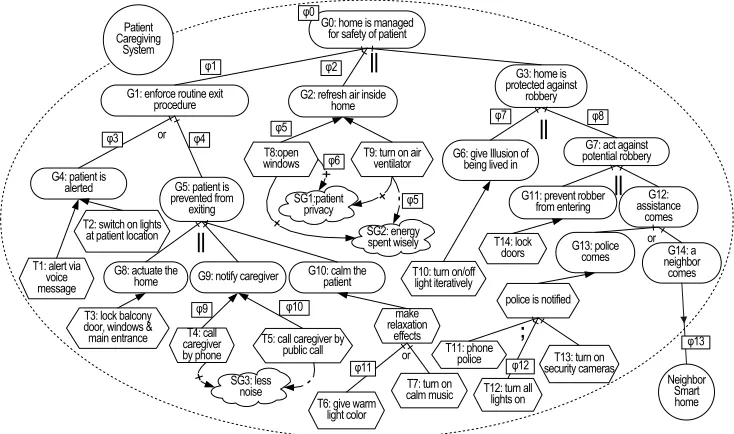
is responsible of managing home on behalf of habitants. One of the objectives of a smart home is the refreshment of air inside home. The decision about the activation of this objective depends on the context. In a context like “humidity inside home is high or windows have not been opened for long time”, the system may decide to refresh the air. Such context describes, partially, the world. The world elements rel-evant to this decision are the humidity level and the windows state. The system may open the windows in order to refresh air or may, alternatively, turn a ventilator on. The decision about the adoptable alternative depends on the context in turn. In a context like “it is sunny and not windy outside” the system may open the windows, otherwise it may turn the ventilator on. The action of opening the windows may change the context in turn. The windows become opened and the light level may become high.
• Requirements can be contextual. Context can influence the user
different contexts. This reflection is essential for a valid software that meets user expectations in different contexts.
Example 2. Let us consider a promotion staff in a shopping mall
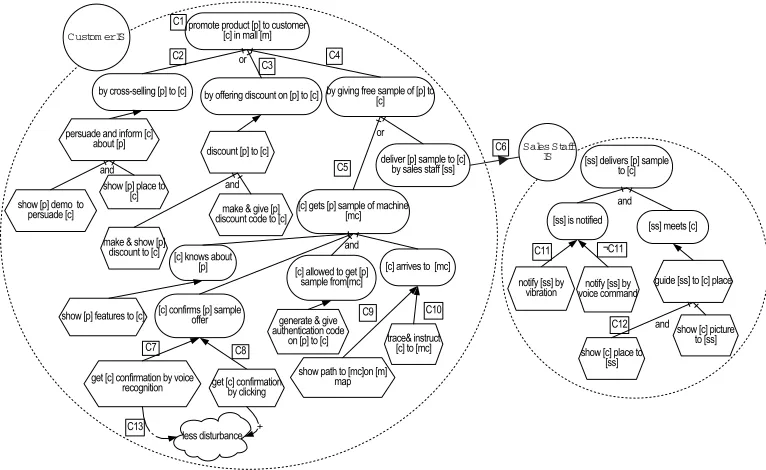
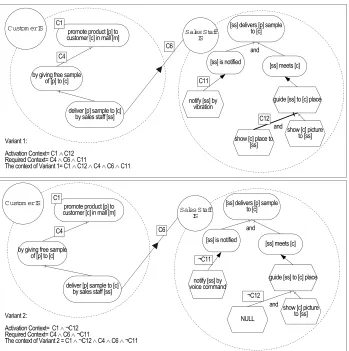
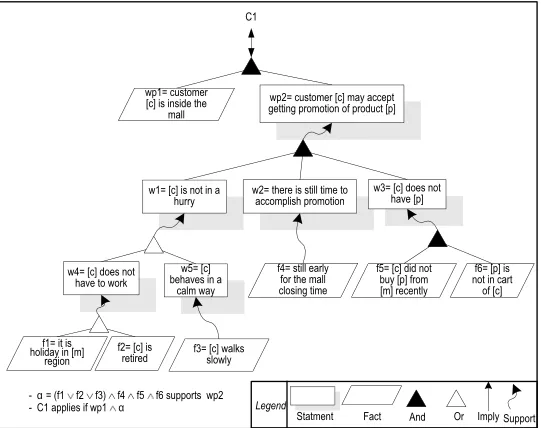
who is responsible of promoting a product by giving free samples of it to customers. The staff activates the promotion of the product to a customer in a context like “the customer looks interested in the prod-uct”. A staff may give a sample in two ways: giving a physical sample directly to the customer, or giving a code to the customer to use it for getting the sample through a dedicated machine in the mall. Con-text may help to decide which of these two alternatives is adoptable. The first alternative is adoptable in a context like “customer has no experience in using automated machines and staff still has samples of the product”. The second alternative is adoptable in a context like “user knows how to use automated machines or there is no free sample with staff anymore”. The quality of each of these two alternatives de-pends on the context. The second alternative, from the perspective of a quality measure like “customer comfort”, is good if a context like “one of the dedicated machines is free and close enough to the customer’s location” holds, otherwise it is a poor quality alternative. A system de-signed to autonomously manage the promotion process should reflect this rationale of a promotion staff. It may, for example, direct staff to give samples to customers or may send code to customers through SMS depending on the context.
• Variants are the cornerstone for adaptability. A system with one
vari-ant can not be adaptable. From the perspective of requirements, adapt-ability is a selection between variants to meet user requirements. Adapt-ability to context is the selection of variants that fit to context.
Example 3. Let us consider a museum guide system designed to
the main requirement is activated in a context like “there is a visitor who touched or he is so closed to a piece of art”. The light-based alarm can be adopted in a context like “there is an audio presentation in the room of the piece of art”, while the voice-based alarm can be used in the other contexts.
• Software is a means to reach humans’ goals. The seminal works by
[18, 14, 10], emphasized the importance of knowing the goals behind software systems and answering the question “why do we need a soft-ware”. In other words, software is not a goal by itself, rather it is a means for reaching some human’ goals. Humans’ goals and the way through which they reach these goals can be influenced by the context. Consequently, software is not necessarily uniform in reaching human goals but can be context-dependent. Software has to reflect the ratio-nal of human in deciding what goals to reach and which way to reach them in different contexts. This reflection is preliminary to derive a useful functionalities to execute.
Example 4. Let us consider a caregiver for people with dementia
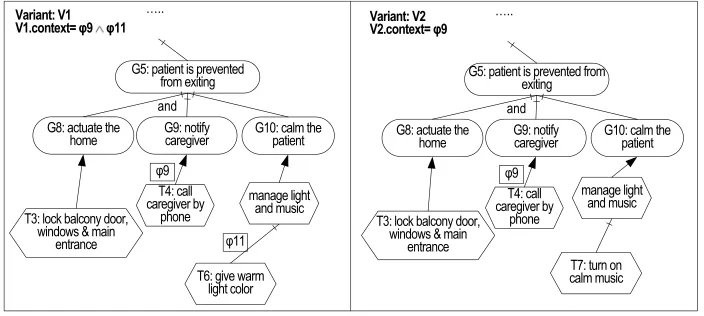
problems. One of the goals of a caregiver is to maintain the safety of the patient in case of anxiety attacks. This goal of a cargiver becomes active when the context “symptoms of anxiety are clear” holds. The caregiver may have two alternatives to deal with such anxiety and keep the patient safe. The first one is by calming the patient down that is adoptable when the context “anxiety seems to be moderate or the patient dementia stage is still basic” holds. The second one is by pre-venting the patient from getting out by closing entrances and calling other colleagues to help in giving medication. This second alternative is adoptable when the context “the patient is extremely anxious and his dementia disease is severe” holds. A smart home, as a software system, is a means to reach the caregiver goals. The smart home has to reflect the goals of caregiver and the way through which he reaches these goals in different contexts. Smart home may calm the patient down, in the correspondent context, by playing relaxation music. Alternatively, it may actuate motors to close and lock the entrances, and issue a public speaker message to call caregivers to give medication.
• Context needs a systematic way to be correctly specified. The
be an abstraction of visible facts in the world. Discovering these facts and the way through which they are composed to verify the truth of a state of the world may be complex. This complexity necessitates a systematic way to specify a context correctly.
Example 5. A context like C1=“the customer is interested in the
product” is relevant when deciding if a product has to be promoted to a customer. However, this context is not visible per se, rather it is derived from visible facts in the environment. Facts that indicate this context can be multiple and the logical composition of these facts to derive the truth value of such context can also be complex. One of the different ways to derive C1 can be through the context C1.1= “the
customer’s behavior indicates interest in the product”, or the context
C1.2=“his purchase history indicates interest in the product”. In turn C1.1 is not monitorable per se but can be derived from some facts such
as “he is watching the product for long time” and “he does not watch much other products that are of the same category”.
1.2 Research Question
In several emerging computing paradigms, such as Pervasive, Ubiquitous, and Ambient computing, requirements are not absolute but can be context-dependent. Context may influence requirements in different ways. It may activate a set of requirements, make adoptable a set of alternatives to meet the activated requirements, and influence the quality of each of such alter-natives. On the other hand, the system may cause changes in the context as a consequence of meeting its requirements. Therefore the influence between context and software is mutual.
A requirements engineering framework for systems operating in and flecting varying contexts is missing. In most requirements engineering re-search, context is either ignored or presumed uniform. The assumption of uniform context is obviously not valid when we weave software with a hu-man’s living context. Systems are now expected to reflect varying contexts they may operate in. This thesis aims to develop a requirements engineering framework that weaves requirements with context. It, mainly, addresses the following questions:
– How can we capture the relationship between requirements and con-text?. In other words, how can we model the mutual influence between requirements and context?.
• The specification of context is not always a trivial task. Some com-plex, or unclear, contexts may require a systematic way to reach their specification correctly. This raises another research question that this thesis deals with:
– How can we systematically identify the way an actor (possibly the
system) can judge if a context holds? In other words, how can we materialize context by discovering visible facts in the system environment that the context reifies?
• A contextual-requirements model may include complex specification of (several) context(s). Such specification may be a subject of modeling errors that make it inconsistent. This raises another main question of this thesis:
– How can we check the consistency of a context specification?
• The system, for meeting its requirements, may carry out a set func-tionalities that lead to changes in the context. The changes of the context may lead to conflicts among the different functionalities that the system may execute to reach its set of requirements. This raises the question:
– How can we check a designed contextual requirements model to
detect and assess the severity of conflicts, manifested via changes on the context, between different system functionalities?
• Systems, at runtime, need to monitor their context and adapt them-selves to its current state. This means that the system has to choose amongst variants to meet its requirements. In other words, the system needs to make a meta-computation to derive useful functionalities to execute in each different context. This rises the question:
– How can we specify a way to adapt the requirements model to
• Having numerous variants is desirable for reaching higher degree of flexibility that allows, amongst other things, the system to adapt to multiple contexts. From the other side, supporting a large number of variants can be problematic in terms of extra time and costs needed to establish them. In other words, there is often a tradeoff between flexibility and feasibility. This raises the question:
– how can we reason about a designed contextual requirements model,
that contains a large number of variants, to elicit those variants allowing the system to meet its requirements in all considered con-texts with minimum development costs?
1.3 Contribution of the Thesis
In literature, there is a gap between variability of context and requirements. In this thesis, we try to reduce this gap and allow for expressing of and reason-ing about requirements for varyreason-ing contexts. More precisely, the contribution of this thesis is:
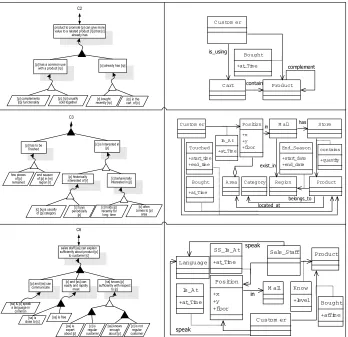
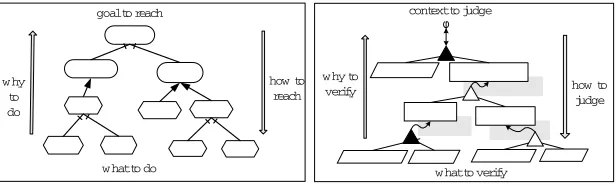
• Conceptual modeling language for representing contextual requirements: we propose the contextual goal model to capture context-based vari-ability in requirements at the goal level. We identify a set of variation points at Tropos goal model where context may intervene to decide the adoptable alternatives for satisfying a goal. We also propose a set of modeling constructs to analyze context. This analysis helps to discover the information that the system needs to capture from its environment and how this information is composed to judge if an analyzed context holds.
• Logical framework and CASE tool: we formalize our proposed con-textual model and use off-the-shelf reasoners as a part of implement-ing our reasonimplement-ing mechanisms. We develop a prototype tool, called RE-Context, that incorporates the formalism and the reasoning mech-anisms. We propose a methodological process to construct and reason about contextual goal models. We also apply our process on two con-textual goals models of two context-dependent systems and report the obtained results.
1.4 Structure of the Thesis
The thesis is structured as follows:
• Chapter 2presents an overview of the state of the art of the research
question of this thesis.
• Chapter 3proposes thecontextual goal model to express requirements
for varying contexts. The chapter starts with the main principles of weaving together requirements and context. It overviews Tropos goal modeling and its main constructs. We then motivate the integration between context and goals. A set of variation points of Tropos goal model is defined. The variation points are classified based on the se-mantic of the relation between context and goal model on each of them. A set of modeling constructs to analyze context is proposed. These constructs are motivated by the need to analyze contexts and discover ways to verify them based on visible facts in the environment. An anal-ogy between context analysis and goal analysis is discussed. A general discussion about our proposed model is presented.
• Chapter 4 proposes a set of reasoning techniques about our proposed
contexts with minimum development costs. The other reasoning tech-nique addresses the runtime derivation of the contextual goal model variants that fit to a monitored context and user prioritization.
• Chapter 5 proposes a logical framework and CASE tool to support
our reasoning mechanisms. We translate our contextual goal model into Datalog that enables us to derive all the alternatives for the satisfaction of a goal. We translate context specification into a Boolean formula as a step to use SAT solver for verifying context consistency. A prototype CASE tool, called RE-Context, is developed to support the four kinds of reasoning that are proposed in Chapter 4. A methodological process that is followed to construct and reason about contextual goal models is also proposed.
• Chapter 6describes the results we got by applying our framework on
two case studies. We explain the application of our proposed framework on two systems: a smart home for patients with dementia problems, and a museum-guide mobile information system. We report the results we got in terms of developed models, reasoning results, qualitative feedbacks reported by software engineers, performance analysis of our developed CASE tool.
• Chapter 7concludes the thesis and presents a set of problems as
direc-tions for a future work. We discuss the generality of our approach ap-plying its principles on another variability model that is Feature Model. We also present an initial work towards an integrated RE framework for contextual requirements. We outline a set of problems concerning the RE of system operating in and reflecting varying contexts such as: viewpoints in context specification, contextual security requirements, optimizing monitoring requirements, and lifelong adaption to context.
1.5 Published Work
• Raian Ali, Fabiano Dalpiaz, and Paolo Giorgini. Location-based Software Modeling
and Analysis: Tropos-based Approach. In the Proceedings of the 27th International
Conference on Conceptual Modeling (ER 08), Springer LNCS 5231, Pages 169-182. Barcelona, Spain. October 20-23, 2008.
• Raian Ali, Fabiano Dalpiaz, and Paolo Giorgini. Location-based Variability for
Mo-bile Information Systems. In the Proceedings Of the 20th International Conference
• Raian Ali, Fabiano Dalpiaz, and Paolo Giorgini. A Goal Modeling Framework for
Self-Contextualizable Software. In the Proceedings of the 14th International
Con-ference on Exploring Modeling Methods in Systems Analysis and Design (EMM-SAD09), Springer LNBIP 29. Pages 326-338. Amsterdam, The Netherlands, 8-9 June, 2009.
• Raian Ali, Fabiano Dalpiaz, and Paolo Giorgini. Modeling and Analyzing
Location-based Requirements: Goal-oriented Approach. International Journal of Computer
Science and Software Technology (IJCSST). Vol. 2, Nr. 2, July-December (2009).
• Raian Ali, Fabiano Dalpiaz and Paolo Giorgini.Modeling and Analyzing Variability
for Mobile Information Systems. In proceedings of the International Conference on
Computational Science and Its Applications (ICCSA 2008), Springer LNCS 5073, Pages 291-306. Perugia, Italy, June 30th - July 3rd, 2008.
• Raian Ali, Fabiano Dalpiaz, and Paolo Giorgini. Goal-based Self-Contextualization.
In the Forum of the 21st International Conference on Advanced Information Systems (CAiSE 09 - Forum). CEUR-WS Vol-453, Pages 37-42 .Amsterdam, the Nether-lands, 8-12 June, 2009.
• Raian Ali, Yijun Yu, Ruzanna Chitchyan, Armstrong Nhlabatsi, and Paolo Giorgini.
Towards a Unified Framework for Contextual Variability in Requirements. In the
proceedings of the 3rd International Workshop on Software Product Management (IWSPM09), In conjunction with 17th IEEE International Requirements Engineer-ing Conference (RE09). Atlanta, Georgia, USA. September 1, 2009.
• Raian Ali, Ruzanna Chitchyan, and Paolo Giorgini. Context for Goal-level
Prod-uct Line Derivation. In Proceedings of 3rd International Workshop on Dynamic
Software Product Lines (DSPL09) co-located with the 13th International Software Product Line Conference (SPLC09). San Francisco, California, USA.August 24 -28, 2009.
• Raian Ali, Amit K. Chopra, Fabiano Dalpiaz, Paolo Giorgini, John Mylopoulos,
and Vitor E. Silva Souza. The Evolution of Tropos: Contexts, Commitments and
Adaptivity. In the proceedings of the 4th International i* Workshop, co-located with
the 22nd International Conference on Advanced Information Systems Engineering (CAiSE 10). Hammamet, Tunisia, 07-08 June, 2010.
• Fabiano Dalpiaz, Raian Ali, Yudistira Asnar, Volha Bryl, Paolo Giorgini. Applying
Tropos to Socio-Technical System Design and Runtime Configuration. In the
Pro-ceedings of the 9th WOA workshop, From Objects to Agents (Dagli Oggetti Agli Agenti), ISBN 978-88-6122. Palermo, Italy, 17-18 Novembre 2008.
• Raian Ali, Sameh Abdel-Naby, Antonio Mana, Antonio Munoz and Paolo Giorgini.
Agent Oriented AmI Engineering. In the Proceedings of the Ambient Intelligence
Developments Conference (AmI.D07), Springer ISBN: 978-2-287-78543-6, Pages 166-179. Sophia Antipolis, French Riviera, France, September 17-19, 2007.
• Sameh Abdel-Naby, Paolo Giorgini, and Raian Ali. Towards Integrating Agents with
Objects Tracing Systems in AmI. In the 5th European Workshop on Multi-Agent
Chapter 2
State of the Art
2.1 Context-Awareness
The advances in information and communication technology has led to new computing paradigms such as Ambient Intelligence [20, 21], Pervasive Com-puting [22,23], Ubiquitous Computing [24,25], Context-Aware systems [26,
27], and so on. The target computing systems in these paradigms are able to reach users’ requirements transparently and avoid them the explicit interac-tion with computers. In other words, the main motivainterac-tion in these paradigms is decoupling user from computing devices [28]. Users should get their needs met without an explicit request to a computing system. These computing paradigms are the application area for which our modeling and reasoning framework is designed. A core element in these paradigms iscontext. In this section, we review the literature and discuss several definitions of context, show different classification of contextual information, and finally we outline different approaches concerning context modeling.
2.1.1 Context de
fi
nition
Context has been defined in different computer science disciplines such as artificial intelligence (for a survey see [29]). It has also been defined in the literature of context-aware computing in variant ways. Here we outline several definitions of context and then we make an observation about the common characteristics of context.
than a physical location that the user is in. It may also includes differ-ent changing factors such as lighting, noise level, network connectivity, communication costs, communication bandwidth. Context can also re-fer to the social environment of a user such as whether he is with his manager or with a co-worker, and so on. However, in this work, context is defined by examples. Although it gives intuition to what context is, this approach makes it difficult to judge precisely if an information is a part of context.
• Dey [32], observed that defining context by examples or by giving syn-onyms to it (such as situation or environment) does not help to decide what context is. The work also made another observation about several other definitions that defined context based of the kind of the targeted applications. Dey gives a definition of context that refers to the world relevant to the interaction between humans and computing: “Context is any information that can be used to characterize the situation of an
entity.” An entity is defined as “a person, place, or object that is
con-sidered relevant to the interaction between a user and an application,
including the user and applications themselves”. In [33], Dey et.al,
ex-tend this definition by giving examples about the dimensions of context:
“context is typically the location, identity, and state of people, groups,
and computational and physical objects”.
This definition emphasizes that context is what is relevant to an in-teraction between the users and an application. However, these is also another limitation for context. Context may influence the users’ needs before influencing their interaction with applications. The application has to reflect the influence of context on users in order to derive use-ful execution course. In [32], Dey also gives a definition of context-awareness as following: “A system is context-aware if it uses context to provide relevant information and/or services to the user, where
rel-evancy depends on the user’s task”.
• In [34], Chen observed that context has two main aspects that are the characteristics of the surrounding of an application that strongly influence the behavior of that application, and the surrounding that is relevant but not critical. Context is defined as“the set of environmental states and settings that either determines an applications behavior or
in which an application event occurs and is interesting to the user”.
– Active context awareness: where the application monitors context and adapts its behavior when a change in the context occurs.
– Passive context awareness: where the application monitors changes in the context and presents them to the user like presenting an in-formation about a close restaurant.
• Finkelstien et al. [1], give another definition of the context. The def-inition emphasizes the uncontrollable nature of the context. Context is defined as the reification of the environment. The environment is defined as whatever in the world provides a surrounding in which the machine is supposed to operate. Alternative definition of the environ-ment is whatever over which we have no control. The context in this work tends to be a technical context such as the network bandwidth, display characteristics, the spatia-relations between devices, and so on.
• Yau et al [35,36], define context as “any detectable attribute of a device, its interaction with external devices, and/or its surrounding environ-ment”. The context considered here is that describing a computing device such as the battery level, the geographical location, the history of interaction of this device with other and so on. The same work de-fine context-awareness as “the ability of a device to detect its current contexts and changes in any contextual data”. Again, the adaptability to context is limited to the one that concerns the technical environment of a computing device.
2.1.2 Context dimensions
Contextual information can be classified into different dimensions. Krogstie et el. [37, 38], observed that mobility is strongly related to changes in the context. The changes in the context could potentially affect the objectives and the tasks of mobile information systems. In the same works, Krogstie et al. classify context information as follows:
• The spatio-temporal context: it describes aspects related to time and space. It contains attributes like time, location, direction, speed and track.
• The personal context: it describes the user state. It consists of the physiological and the mental contexts. The physiological context may contain information like pulse, blood pressure and weight, as well as personal abilities and preferences, while the mental context may include elements such as mood, expertise, anger, and stress.
• The task context: it describes what the user is doing. The task context may be described with explicit goals or the tasks and task breakdown structures.
• The social context: it describes the social aspects of the user con-text. It may, for instance, contain information about friends, neighbors, coworkers and relatives. The role that the user plays is an important aspect of the social context. A role may describe the user’s status in this role and the tasks that the user may perform. The term social mo-bility refers to the ways in which individuals can move across different social contexts and social roles and still be supported by technology and services.
• The information context: it describes the information space that is available at a given time.
In [39], Henricksen et.al, context has been divided based on changeability into two main categories:
• Static context: it refers to a property that is fixed regarding one entity, like for example: device type.
• Dynamic context: that refers to the context that changes over time such as wheatear, temperature, user mood and so on. The dynamic context is further subdivided into three categories:
– Sensed context: it is the context that can be captured by sen-sors such as location, temperature degree, humidity level, blood pressure, and so on.
– Derived context: it is the context that can be derived using a derivation function. An example of the derived context is the “Is Located Near” relationship. An object is located near to another one is derived from two sensed location contexts which are the coordination parameters.
Schmidt et al. [40, 41], uses 3-D model to view context, the dimensions of this model:
1. Self: e.g. device state, physiological, cognitive
2. Environment: the physical and the social environment.
3. Activity: the behavior and task being done.
The work also provides another hierarchial categorization of context. The two root categories are:
• Human factors: these factors are related to a human as individuals, as social environment, and as activities they are doing.
• Physical environment factors: these factors concern the physical condi-tions, infrastructure, location of the system. Condicondi-tions, for example, are further classified into dimensions like: light, pressure, accelerations, audio, temperature, humidity and so on. The dimension light is in turn characterized by dimensions such as level, flickering, color, wave length, and so on.
In his PhD thesis [42], Shilit has classified context information into:
• Physical objects: the main entity that context information are centered around is a physical object. It can be a human or an artefact. Examples of this kind are: mobile phone, windows, furniture, user and so on.
• Conditions and states: some objects have dynamic state, such as users who might be busy, sleeping, driving and so on, and mobile phone which may be off, on, busy, and so on. Some other objects has a static state and does not make part of a variable context such as furniture. Obviously the decision between dynamic and static states is to a large extent a design decision.
• Spatial relations: each object occupies a space and exists in a location. The location may be presented as coordinates in a system or presence in a containing place. For example, two objects may have spatial relation such as “close to”, “on”, “inside” and so on.
• Ways and means: it concerns the ways to achieve tasks. For example, the ways through which a user can get instructions about the use of an information terminal in an airport, or the ways user can make the check-in through.
• Customizations: it is user, or a user group, given commands or pref-erences. For example, “do not allow calls during meeting”, “turn the mobile phone to silent during meeting” and so on.
Zimmermann et al. [43], classified contextual information into:
• Individuality context: it concerns properties and attributes describing an entity. An entity can be natural, human, group, and artificial.
• Activity context: it concerns the tasks an entity is involved in.
• Spatio-temporal context: it refers to the time and the location of an entity.
• Relations context: concerns any possible relations an entity may estab-lish with other entities.
We emphasize that the definition of context and its dimensions depend on the application area. Taking business process modeling and execution as another domain that addressed contextualization, the considered context is different from that of mobile, pervasive, context-aware computing. For example, Rosemann et al. [44,45], classify context with regards to its relation to a business process into four kinds:
• Immediate context: this context includes the elements of the organiza-tion that are beyond the pure control flow and facilitate the execuorganiza-tion of a process directly. For example, the kind of data required, the source of data, the organizations resources that are in charge with the next activity and so on.
• Internal context: refers to the elements of the organization that have indirect influence on the business process. For example, norms and values, concerns and interests, strategy, structure and culture and so on.
• Environment context: this context refers to those elements in the world that are outside the business network but still have influence on it. For example, the weather factor may influence the organization activities as the call volume may need to be increased during the storm season. Time of the day, week, month, and year may also influence the activities, for example, on Saturday many people make shopping, so more products has to be available in the store.
From the above definitions, we could outline the following characteristics of context:
• Context is a surrounding for an entity: in all the definition, we see
that context is seen as a surrounding of an actor. This actor could be a person or a machine i.e., the context-aware system. This means that a context is seen from some perspective and not given as an absolute concept.
• Context is not fully controllable: context refers to what is in the world
and that is not under the full control of an actor. The actor is supposed to reflect to the uncontrollable changes in context, as possible. The elements in the world that are fully controlled by an entity are not part of the context but part of the actor itself.
• Context influences certain decisions and actions: context has influence
the decisions and the actions an actor needs to take. The actor that observes context will reflect the changes in that context. Those parts of the world that do not influence the choices or the actions of an actor, are not part of the context and do not need to be observed.
• Context has a subjective nature: following the previous point, what
makes an element in the world of an actor part of the context is the decision that actor needs to take.
• Context has a volatile nature: the elements in the world that are
uni-form are not part of the context. An actor does not need to observe them when it takes a decision. One main idea of context-awareness is the variable nature of the world an actor lives in and that influence that actor’s decisions.
2.1.3 Context Modeling
representation of context information in pervasive computing. They extend Entity-Relationship diagrams with constructs to allow for more expressive-ness in capturing context information. The association entities-entities and entities-attributes are classified into static and dynamic. The dynamic as-sociation is classified into sensed, profiled, and derived. An example of a static association is that between a mobile device and its type. An example of sensed association is that between a person and its location (location is sensed). An example of profiled association is that between a person and his supervisor or his device. An example of derived association is that the spatio-relation between two entities that can be derived from their locations. The associations between entities-entities and entities-attributes are clas-sified according to their structure into four kinds. The simple association that happens when an entity, which owns an association, does not participate in it more than once. For example, the device has one device type. An associ-ation is composite if it is not simple and this kind includes the other three kinds of associations. The collection association means that an entity can be associated simultaneously with multiple attributes values and/or other enti-ties. For example, a person may be sitting with more than one friend at the same time. The alternative association refers to an association between an entity and a number of other entities/attirbutes, where at one moment there is only one active association. For example, the relation between a TV and channel. The temporal association is the same as alternative associations but attached to a time interval. For example, a person may be doing activity within a certain time. In [48], Henricksen et al. use the Object-Role Model (ORM [49]) instead of ER model for the purpose of efficient formalization and transformation to logical models.
to hold such as “patient is in the bathroom”, “bathroom doors are closed”, “water heater is on”, and so on.
Another example of ontology-based context modeling is CoBrA [53]. It provides a set of classes common in pervasive computing such as the place, agent, activity, location. These classes are refined into subclasses as well. For example the place is specialized into campus, building, restroom, room and so on and the class agent that can be a person, a software agent, a role and so on. The ontology proposes also a set of attributes related to each class. For example an agent could have a name, address, intends to perform and so on. An activity could have attributes such as starting time, end time, location, ..etc. Similar to CONON, CoBrA is formalized and reasoned about using OWL.
Several other approaches for modeling context exists. CMP is a UML Context Modeling Profile for Mobile Distributed Systems proposed by Si-mons in [54]. It provides a UML profile tailored for contextual information. To this end it proposes specialized classes that help for better capturing and visualizing of contextual information. It uses Object Constraint Language (OCL [55]) to assert the right usage of the proposed constructs and associa-tions. In [56], a context is considered as atomic situation and the ontology proposed is for hierarchial representation of a compound/complex situations. Description logic (DL) reasoner over OWL are used for different purposes such as consistency checking of an ontology and knowledge inferring.
2.2 Goal-oriented Requirements Engineering
In this section, we briefly discuss goal-oriented requirements engineering (GORE) research. We outline the main concepts and key ideas behind GORE. We list the main motivation of GORE and we finally review a variety of ongoing research in GORE.
2.2.1 Main concepts
Although different approaches in requirements engineering used goal model-ing in different ways, a set of concepts is almost core in all of them. Here we review a list of the main GORE concept:
The concept of goal: the main concept in GORE is goals. Goals have
needed and guide decisions at various levels within the enterprise”. Plihon et al. [59], consider goal as a synonym of intention and define it as “a future system state or behavior to avoid, maintain, attain, cease, etc.”. Rolland et al. [60], refines the last definition into “a goal is something that some stakeholder hopes to achieve in the future.”. Bresciani et al. [12], define goal as “representation of actors’ strategic interests” where actor is defined as “an entity that has strategic goals and intentionality within the system or the organizational settings”. Pohl et al. [61], define goals as “the objectives an actor wants to achieve when requesting a certain service”, while an actor or user type “represents a set of users that have some common characteristics with respects of why and how they use the system”.
The concept of softgoals: a category of goals is called softgoals and
defined by Mylopoulos et al. [15] as “goals that do not have a clear-cut criterion for their satisfaction. We will say that softgoals are satisficed when there is sufficient positive and little negative evidence for this claim, and that they are unsatisficeable when there is sufficient negative evidence and little positive support for their satisficeability”. Often, softgoals are treated as quality measures to differentiate between multiple strategies to reach goals. They also can be used to express user preferences over those strategies as done in [62].
The owners of goals: goals does not exist as separate entities. They
are owned by an (intentional) entity. Dardenne et al. [14], classify goals with regard to the ownership dimension into: private that an individual agent owns, and system that are the goals of a system as whole. Similarly, Pohl et al. [61], classify goals into business goals and personal goals. There is no explicit classification of goals based on ownership in Tropos GORE method-ology [12]. Tropos projects a system/organization as a set of interdependent actors and associate goals to them. There is no explicit notion of a whole system or individual actors goals.
The source of goals: identifying or eliciting goals can be done through
ways such as scenarios, use cases, interviews, corporate mission statements, policy statements, an so on [63, 64]. Eliciting goals via scenarios is one of the intensively studied techniques. Scenarios help for identifying goals and the different ways through which they may be implemented or reached [65]. Use cases may be considered as implementation of stakeholders goals [66]. However, as observed by Constantine et al. [67], although use cases can be goal driven, but the focus is on those goals concerning the direct interaction between a user and a system. In other words, there could be goals that are not directly related to that interaction.
The refinement of goals: goals are not executable, they tend to be
sets of executable processes [12,14]. The refinement is AND/OR refinement. When we refine a goal through AND-Decomposition into subgoals, this means that reaching all subgoals implies the achievement of the refined one. When we refine a goal into a set of goals through an OR-Decomposition, this means that reaching one of these subgoals is enough to reach the refined goals. The refinement through OR creates a space of alternatives to reach the root ana-lyzed goal, i.e. variability. An anatomy to the elements of a goal statement that can be refined through OR to give a space of alternative is explained in [68].
2.2.2 Main motivations
The main reason for goal-oriented requirements engineering is to explicitly capture the “Why” in requirements. Requirements are, first of all, user’s requisites over the world and are not a set of software functionalities. A software is a means to reach user goals. The starting point of software devel-opment has to be at the level of stakeholders’ strategic goals. The analysis of such goals may indicate a need and possibility for a software that helps to reach such goals. Consequently, goals allow for a rationale for software functionalities and answer the basic question “why do we need a software”. In what follows, we list a set of main motivations for goal-oriented requirements engineering [9, 10]:
1. Requirements acquisition: goals guide and give rationale to what a software has to execute. Analyzing goals by asking questions such as, “why”, “how”, “how else”, “how good is”, helps to reveal stakeholders’ requirements. Moreover, stakeholders become aware of the space of possible solutions to reach their goals instead of committing, in less comprehensive way, to a certain technology without discovering what the other possibilities are.
2. Positioning requirements in the organizational domain: goals allow us to bridge the gap between software and the organization it is intended to operate in. Goal-based requirements analysis helps to derive a soft-ware that addresses certain problems in an organization. It overcomes the limitation of other approaches, such as object oriented analysis, that start immediately by studying what the system has to do, but do not justify why it has to do that.
helps stakeholders to clarify their potentially ambiguous requirements. Moreover, this refinement explains the requirements to stakeholders by answering their questions such as “why do we need to do this”, and “how do we reach this” and so on.
4. Managing conflicts: stakeholders are different in their interests and priorities of these interests. This may lead to conflicts about what requirements to reach and how, and how well, to reach them. Even a single stakeholder may have conflicts between a set of requirements. Goals allow for a natural, high level, abstraction that may be exploited to manage those conflicts. For example, achieving a goal may deny the achievement of another. Moreover, a way to reach a goal can be assessed differently by different stakeholders.
5. Tracking the design: goals and the refinement of goals lead to several design options. In other words, the system may implement a subset of these options. Goals can be used to assess if the design or even the final system is correctly specified/developed. Goals provide a cri-teria to evaluate and track the system at later stages. For example, in autonomic computing, the final system may switch between different execution course to keep user goals satisfied.
6. Avoiding irrelevant requirements: goals provide a criteria for software pertinence. A software functionality is pertinent if it is a part of reach-ing a goal of stakeholder, otherwise its implementation is not justified.
7. Isolating stable from volatile aspects in requirements: goals tend to be persistent or stable while software, as a way to reach goals, are subject of evolvement or changes. The ways to reach goals may be influenced by the environment in which the system will operate while goals may be stable. In other words, we may have a goal that needs to be reached in different environments while the way to reach it may be different in each of them.
2.2.3 Ongoing research
• Security modeling and analysis [70,71,72]: this research focuses on the security requirements at a level higher than the software, the organi-zational level. It provides modeling concepts that stand for high level security requirements and trust requirements between actors (inten-tional entities) and their implementation. i*/Tropos has been shown a suitable abstraction for an organizational system, especially the early requirements phase where actors depend on each other for goal to be achieved, tasks to be executed, or resources to be furnished. Secure Tro-pos extends i*/TroTro-pos with concepts to catch security and trust require-ments between those actors. While security in traditional i*/Tropos and goal oriented analysis in general is left vague or at most treated as a softgoal; Secure Tropos treats security requirements as a first class entity at this early level of analysis. To this end, Secure Tropos pro-vides modeling concepts for the entitlement between actors and their capabilities. To model the transfer of entitlement and responsibilities between actor and the expectation of an actor about the other actors, Secure Tropos provides the delegation, trust, distrust relations. Secure Tropos engineering framework also provides an automated reasoning. One main purpose of the reasoning is to verify the consistency between security and trust entitlement. Secure Tropos uses Datalog to formalize and reason about its models.
• Risk analysis [73, 74, 75]: goal models have been shown very useful to capture and analyze the objectives of stakeholders and identify and jus-tify the requirements of a software system. However, capturing these objectives and analyzing them has to take into consideration any unex-pected or uncertain situation that might be an obstacle when reaching stakeholder objectives. Goal-Risk framework addresses the last ques-tion. It extends goal model with constructs to capture uncertain events and their impact on the goals achievement. The negative impacts in-troduce risks that face the goal achievement. Goal-Risk framework also deals with the treatment of a potential risk. It analyzes the possible treatments in terms of possible actions performed to uncertain events of negative impact. An automated reasoning about the Goal-Risk model is then developed. It allows the analyst of a software system to detect important properties about the designed system regarding what risks are there and how they are treated.
enough set of delegations between actors and assignment of goals to them. To this end, the research exploits artificial intelligence plan-ning techniques to generate all the possible design structures. Having the alternative design structures generated, they might be then evalu-ated against the local strategies of system actors. The evaluation part exploits ideas from game theory. The reason for such choice is that each actor has its own strategic interests and try, first of all, to maxi-mize their local utilities. The evaluation of alternative design structure might seek for the one that is good enough for the maximum number of those actors. A prototype tool (P-Tool) is designed to implement the approach and support the analyst in selecting a good enough design-structure alternative.
• Normative i* modeling [79,80,81]: when eliciting the requirements, the analyst needs to consider the laws and regulation of the organization where the designed system will operate. This research aims at gener-ating a set of requirements for a new system that are complaint with a given law. To this end, this research develops a conceptual framework that extends goal models with concepts from the legal domain and their relations to goal model concepts. It also provides a systematic process to generate a set of requirements that are compliant with a collection of legal prescriptions and addresses the problem to solve at the same time. Therefore, the proposed Normative i* framework allows for cap-turing laws at an early level of analysis, the intentional level, where an early impact of laws occurs.
• Commitments and goal models [85, 86]: i* emphasizes the social na-ture of requirements fulfillment that actors often depend on others to achieve their goals. However, the notion of dependencies in i* is an intentional one, not social. An actor may depend on another for some goal; however that in itself does not amount to any social expectation that the latter will fulfill the goal. More precisely, i* gives no account of which dependencies are legitimate from a social perspective.
For example, Alice is new to Trento and depends on Barbara, her only acquaintance in the city, to show her around the city; Barbara may also know that Alice depends on her. However, unless Barbara actu-ally commits (via an explicit act of communication) to showing Alice around the city, we (as the society, the observer) do not form the legit-imate expectation that Barbara will show Alice around Trento. Until Barbara actually commits to Alice for showing her around the city, the dependency exists only in the minds of the actors. When Barbara commits to Alice, there exists an objective and verifiable relation be-tween her and Alice. This objectivity is a key aspect of being social in systems involving autonomous and heterogeneous actors. Moreover, even if Alice somehow knew that Barbara has the goal of showing her around the city (because, maybe it was mentioned in Barbara’s TODO list that Alice happened to read), that does not amount to any legiti-mate expectation that Barbara will actually do so. Barbara may not act upon her goals, or she may simply change her mind. People and organizations want commitments from each other to guard precisely against such uncertainties: one does not have to care what another’s goals are as long as the latter has committed to the former for a state of the world corresponding to that goal. We often mention loose coupling as highly desirable among system components; with commitments, we get the loosest possible coupling among actors.
2.3 Requirements Driven Variability
2.3.1 Goal-based variability
Goal models allows for analyzing goals and identifying different ways to reach them. This motivates several research questions concerning the acquisition of the space of alternatives to goal satisfaction and the selection amongst them either at design time or at runtime. Starting with goals gives rational to the adjustment of the system in terms of switching between plans guided by stakeholder goals. In other words, the variability is in the actions to reach the goals that are, often, stable. In what follows, we review some research directions that are using goals in the requirements acquisition and design of high-variability software:
• Designing self-adaptive systems [88, 89, 90, 91]: self-adaptive systems is characterized by autonomy in reaching their objective at runtime. This implies a repository of plans the system supports and has the ability to choose between in different environments. A software engi-neering methodology for building self-adaptive systems is developed. The methodology allows to define and to model the autonomous diag-nosis and decision making going to be done at runtime. In order to design self-* systems, one of the major dimensions to consider is the dynamic environment in which the system lives.
Tropos4AS (Tropos for self-adaptive systems) is in extended version of Tropos proposed in this thread of research. Tropos4AS supports software engineers in developing self-adaptive systems, incorporating principles from goal-oriented requirements engineering, environment modeling and the BDI agent architecture. More precisely, Tropos4AS extends Tropos by constructs to model environment conditions and capture their influence on the behavior of a software agent. It also ex-tends Tropos goal model by constructs that capture the failure in one of its alternatives along with the recovery activities. It uses the alter-natives to goal satisfaction to generate alternative configurations that will be implemented in the system-to-be. The main result of Tropos4AS is the systematic transformation of design model into implementation. Therefore, the system at runtime will use the design time models as a reference that guide its behavior.
where a number of autonomous and intentional actors interact in or-der to achieve the respective objectives. STSs are characterized by dynamism, unpredictability and weak controllability. The operational environment is subject to sudden and unexpected changes, actors may join and leave the system at will, social dependencies between actors are at risk because of actors’ autonomy, and actors may fail in achieving their goals. The interests of the actors can be supported technologi-cally by introducing a software architecture that monitors the actors behavior, diagnoses failures against correct behavioral models, and re-acts to failures via compensation actions. This research proposes an architecture intended to make STSs self-reconfigurable. The architec-ture becomes an integral component of an STS; the goal model itself serves as a description of correct behavior. The architecture observes the actions performed by participating actors, compares the monitored data against goal models, and enacts reconfigurations in response to failures.
The algorithms the architecture exploits are based on the specializa-tion of the Belief-Desire-Intenspecializa-tion paradigm. An agent participating in an STS behaves correctly if, whenever a goal is activated, it will select and execute a plan that eventually leads to the achievement of that goal. Failures occur if the agent does not follow the plan correctly, if the agent does not execute anything, or if a dependee does not bring about the dependum for the depender. Reconfiguration actions take into account the autonomy and uncontrollability of the participants: the architecture can (i) perform some real action by controlling actu-ators; (ii) remind or suggest actions to actors; and (iii) assign some responsibilities to external agents.
• Acquiring variability in fulfilling requirements [94, 68]: for supporting high-variability the system is supposed to have relatively large num-ber of alternatives. The work discusses a systematic way to generate these alternatives at the goal level. More specifically, it discusses how to generate alternatives through OR-decomposing a goal. A semantic anatomy of what is OR-decomposed is given. A goal can be associ-ated with a set of concerns and the OR decomposition can consider each of these concerns (Agentive, Dative, Objective, Factitive, Process, Locational, Temporal, Conditional, Extent).
refers to the objects that will be affected by the activities done to reach the goal, the Locational concern refers to the spatial locations where the activity to reach the goal is established, and the Temporal concerns refers to the time in which such activities are perform.
• Goal-driven software customization [95, 62]: this work complements the previous one. While goal models allows for a space of alternatives to reach goals, a criteria to customize the goal model is needed. This research allows for customizing goal models based on two dimensions. The first one is the skills of user that may be required for each of the tasks (leaf goals) of goal model, and the user’s preferences that may rank goal satisfaction alternatives differently.
To illustrate the customization based on user skills, let us consider the example of conveying information to a user. For example, to show in-formation to a user interactively through his PDA, this requires a skill like knowing well about how to use touch screen and respond to inter-active presentation techniques. If user does not have these skills the information can be delivered as a video-like presentation. To illustrate the user preferences dimension in ranking the alternatives, let us take the information delivery process by an assistance staff in a shopping mall to a customer. This process can be done remotely or in person. Remote calling is positive from the perspective of staff comfort and negative from the perspective of the quality of information delivery as whole. Delivering information in person is as opposite to remote calling for the last two quality measures (staff comfort, and quality of information). If the mall adminstration appreciates staff comfort more than the quality of delivered information, then remote calling will be adopted and vice versa.
2.3.2 Problem Frames variability
phenomenon are changed. This allows for variability when the problem does not fit to the basic frame.
Salifu et al. [97, 98], investigate the use of problem descriptions to rep-resent and analyze variability in context-aware software. The work recog-nizes the link between requirements and context as a basic step in designing context-aware systems. The work applies Problem Frames approach to ana-lyze different specifications that can satisfy the core requirements under dif-ferent contexts. The problem description captures the relationship between contexts, requirements, and the specification (machine). For each different context there could be a different problem description. This leads to identifi-cation of variant problems that are variations of the original problem that are adapted for a particular context. A context-aware system is a composition of the specifications to the variant problem.
The specification of the system in this way allows it to be adaptive to the context. A context change that violates the requirement triggers a switching action to an alternative specification for restoring the satisfaction of require-ments. In other words, the requirements has to be always satisfied, and when the monitoring systems observes a failure in meeting the requirements be-cause of changes in the context the current configuration fits to, this will lead to looking for alternative problem variants that fits to the new context.
2.3.3 Feature models variability
Software product line variability modeling, mainly feature models [99, 100], concerns modeling a variety of possible configurations of the software func-tionalities to allow for a systematic way of tailoring a product upon stake-holder choices. Features are characteristics of the system, and feature model represents the variability of these characteristics for configuring a family of software products. However, there is still a gap between each variant and the context where it can, or has to, be adopted. Speaking in terms of feature modeling, context can determine if a feature is mandatory or optional or even redundant. For example, for an email editing system, encryption could be an optional feature if the system is to operate within one organization where staff members trust each other. On the other hand, such feature could be mandatory if the editor is for users who will write emails from a public network.
• Feature variability and context: in product lines engineering, con-text can be a main factor in deciding what product variants to de-rive. In other words, context influences the need for, the applicabil-ity and the appropriateness of, each variant. We use the term self-contextualizability to denote a system ability to adapt to context in order to keep its objectives satisfied. Self-contextualizable product line is a product line that incorporates the reasoning needed to derive prod-uct variants fitting to their contexts. Consequently, the relation be-tween products variants and context has to be explicitly captured and reasoned on to derive contextualized products. Context influences the set of features to be included in a software product variant. Consid-ering context at the design time can model a feature as mandatory or optional, whilst at the runtime context needs to be considered when switching to an alternative feature. Feature models can be enriched with context towards more systematic derivation of software variants. A recent work by Hartmann et al. [101] studies the relation between context and features to support the engineering of software supply chains. Context can determine if a feature is mandatory or optional or even redundant.
2.4 Chapter Summary
Chapter 3
Contextual Goal Model
In this chapter, we propose contextual goal models to capture the relation between variants for goal salification and context. As we have introduced in Chapter 1, context may have influence on human’s goals and their choices to reach such goals. The relationship between context and goals is essential for software developed to meet users needs in different contexts. Software has to reflect user adaptation to context, while reaching his goals, to derive a set of functionalities to execute. We explain the principles our modeling is based on, give an overview of Tropos goal modeling, and then propose an extension to it:
• we define a set of variation points on Tropos goal model where context might intervene to decide applicable alternatives for goal satisfaction.
• we define a set of constructs to analyze context. This analysis is for discovering the information that a system needs to capture of its envi-ronment to judge if an analyzed context holds.
3.1 Weaving Requirements with Context
1. a way to represent variability of the system, or in other words an explicit representation of variants the system can use to adapt its behavior to the changes of the context. For example, possible variants for circulat-ing the air inside the smart home can be: (i) opencirculat-ing the windows and (ii) turning the ventilator on;
2. an explicit association between variants and contexts, to allow for a
systematic derivation of variants adoptable in each context. For ex-ample, if the “humidity level inside home is high” (context), we need to circulate the air. Opening the windows to circulate air (variant) is adoptable if “it is good weather outside” (context) otherwise ventilator could be turned on;
3. an explicit representation of the influence of context on the quality of
each variant. A variant can be evaluated against a set of quality
mea-sures and this evaluation can be context dependent. For example, the variant of opening the windows to circulate air inside home may be evaluated negatively against a quality measure like “patient feels more privacy”, but only in certain contexts such as “patient is sleeping”;
4. a systematic analysis of context. An analysis to discover the