Syndromes in suites of correlated traits suggest
multiple mechanisms facilitating invasion
in a plant range-expander
Lisa Johanna Tewes1, Caroline Müller1
1 Department of Chemical Ecology, Bielefeld University, Universitätsstr. 25, 33615 Bielefeld, Germany
Corresponding author:Caroline Müller ([email protected])
Academic editor:J. Molofsky | Received 6 October 2017 | Accepted 15 February 2018 | Published 06 March 2018
Citation: Tewes LJ, Müller C (2018) Syndromes in suites of correlated traits suggest multiple mechanisms facilitating
invasion in a plant range-expander. NeoBiota 37: 1–22. https://doi.org/10.3897/neobiota.37.21470
Abstract
Various mechanisms can facilitate the success of plant invasions simultaneously, but may be difficult to disentangle. In the present study, plants of the range-expanding species Bunias orientalis from native, inva-sive and naturalised, not yet invainva-sive populations were compared in a field common garden over two years. Plants were grown under two nitrate-regimes and multiple traits regarding growth, defence, antagonist loads and reproduction were measured. A rank-based clustering approach was used to assign correlated traits to distinct suites. These suites were analysed for “syndromes” that are expressed as a function of pop-ulation origin and/or fertilisation treatment and might represent different invasion mechanisms. Indeed, distinct suites of traits were differentially affected by these factors. The results suggest that several pre-adaptation properties, such as certain growth characteristics and intraspecific chemical variation, as well as post-introduction adaptations to antagonists and resource availability in novel habitats, are candidate mechanisms that facilitate the success of invasive B. orientalis in parallel. It was concluded that rank-based clustering is a robust and expedient approach to integrate multiple traits for elucidating invasion syn-dromes within individual species. Studying a multitude of traits at different life-history and establishment stages of plants grown under distinct resource treatments reveals species-specific trade-offs and resource sinks and simplifies the interpretation of trait functions for the potential invasive success of plants.
Keywords
Glucosinolates, herbivory, invasion mechanisms, intraspecific variation, pathogens, nitrate allocation
Introduction
To understand why plant species become dominant in novel habitats is one of the cen-tral aims of invasion ecology. Various pre-adaptations and post-introduction evolution events are considered as mechanisms for facilitating invasions in common hypotheses on this topic (Jeschke and Heger 2018). Pre-adaptations are traits that provide suc-cessful invaders with advantages over non-invasive congeners, turning them into ideal weeds (Baker 1965) in disturbed habitats (van Kleunen et al. 2015). Successful invad-ers show, for example, optimal resource-use efficiency or high environmental tolerance (Ren and Zhang 2009). High intraspecific variation in defensive compounds within and across populations may prevent (novel) antagonists adapting to plant chemistry, as proposed by the chemical diversity hypothesis (CDH; Wolf et al. 2011). Hypotheses on post-introduction evolution consider changes in traits in individuals after establish-ment in a non-native range. Many of these changes are assumed to be driven by the re-lease from antagonists after migration (Keane and Crawley 2002, Mitchell and Power 2003). For example, the shifting defence hypothesis (SDH) postulates an increase in cheap toxic compounds but a decrease in expensive defences in plants growing in the novel range as a result of release from specialist enemies (Doorduin and Vrieling 2011). Facing distinct environmental conditions, (adapted) phenotypic plasticity in resource allocation to specific traits can also play a role in plant invasions, if the respective traits contribute to fitness (Richards et al. 2006, Davidson et al. 2011).
Several invasion hypotheses are substantively related but consider traits from dif-ferent physiological contexts, whereas the choice of target traits for comparisons can be challenging. Moreover, species characteristics may be revealed in suites of multiple traits (Junker et al. 2017). Groups of plant species with trait co-variations or trade-offs within functional suites are often assigned into “syndromes” (Reich et al. 2003), typically regarding pollination (Fenster et al. 2004) or defence (Agrawal and Fishbein 2006, Travers-Martin and Müller 2008). For groups of invasive species, syndromes were found in certain trait characteristics (Schmidt et al. 2012) and defined as “asso-ciations of species biology and invasion dynamics with particular contexts” (e.g. estab-lishment phase, habitat conditions) (Kueffer et al. 2013). However, also in individual invaders, multiple traits might be involved in adaptations to novel contexts (Zou et al. 2007). Thus, syndromes may also be expressed on the level of individual species and be defined as suites of correlated traits beneficial for, or altered by, invasion. Further-more, different invasion mechanisms, potentially involving different suites of traits, can simultaneously occur in one species (Wolf et al. 2011, Guo et al. 2014) or act in a different life-history-stage (Ren and Zhang 2009) or establishment phase during range-expansion (Dietz and Edwards 2006). Surprisingly, comprehensive information on co-occurring mechanisms, which could be revealed from large datasets, is lacking for most invaders, including model species (Kueffer et al. 2013).
2011, Müller and Müller 2015, Blight et al. 2017). Such methods have recently been used to evaluate consistency in plant individuals within a species over time regarding various traits (Kuppler et al. 2016), but to the authors’ knowledge, not yet to reveal suites of correlated traits and their “behaviour” in an invasion context.
In this study, associations were investigated between multiple traits in plants from dif-ferent populations of a range-expanding perennial, Bunias orientalis L. (Brassicaceae), to reveal candidate mechanisms facilitating invasion. This species grows natively in Southeast Europe and Western Asia, but was introduced to Central Europe in the 18th century as a
fodder plant and spread due to accidental human transport (Birnbaum 2006). In parts of Central Europe, the species is classified as invasive, rapidly establishing in disturbed, fer-tile dispersal corridors and spreading into adjacent habitats (Dietz et al. 1999, Birnbaum 2006). Thus, habitat fertilisation may facilitate the success of B. orientalis (Steinlein et al. 1996). In Western and Northern Europe, some populations can be considered as natural-ised but not yet invasive following the nomenclature of Richardson et al. (2000), i.e. they do not form dominant stands far from parental plants (Harvey et al. 2010, Fortuna et al. 2014). As defence metabolites, B. orientalis produces several glucosinolates (Tewes et al. 2018), which are characteristic for Brassicales and serve important roles in (novel) biotic interactions (Müller 2009). Thus, glucosinolates are valuable target compounds to evalu-ate relationships between defence and invasion in this species.
Plants were grown from populations of native, invasive and naturalised status over two years in a field common garden in an area where B. orientalis does not occur. Plants were exposed to two nitrate-fertiliser treatments to investigate the influence of resource avail-ability on various traits potentially facilitating successful establishment, regarding growth, defence, antagonist loads and reproduction. Suites of correlated traits were determined and it was hypothesised differential influences of population status and/or fertilisation on traits clustered in distinct consistent suites. When significantly affected by one of these factors, these suites were considered to express syndromes that might represent distinct invasion mechanisms. Furthermore, it was expected that plants from invasive populations reveal dif-ferential mechanisms that characterise those plants as more successful colonisers.
Methods
Plant material and common garden design
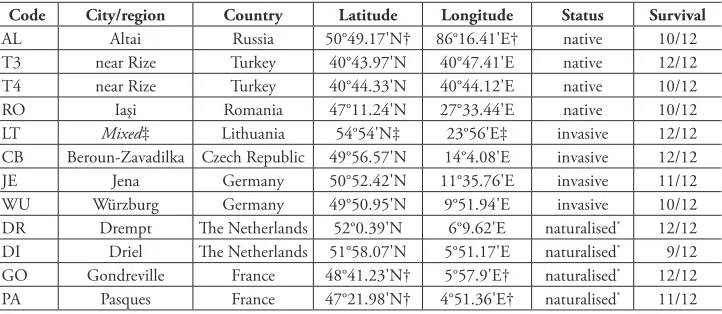
Table 1. Origin, invasion status and survival of Bunias orientalis populations. Populations were grouped by status according to their ecology, plant frequency or distribution in the origin region (Harvey et al. 2010; Tewes et al. 2018), following the nomenclature of Richardson et al. (2000). The number of plants that survived the winter between 2015 and 2016 are given in relation to the original number.
Code City/region Country Latitude Longitude Status Survival
AL Altai Russia 50°49.17'N† 86°16.41'E† native 10/12
T3 near Rize Turkey 40°43.97'N 40°47.41'E native 12/12
T4 near Rize Turkey 40°44.33'N 40°44.12'E native 10/12
RO Iaşi Romania 47°11.24'N 27°33.44'E native 10/12
LT Mixed‡ Lithuania 54°54'N‡ 23°56'E‡ invasive 12/12
CB Beroun-Zavadilka Czech Republic 49°56.57'N 14°4.08'E invasive 12/12
JE Jena Germany 50°52.42'N 11°35.76'E invasive 11/12
WU Würzburg Germany 49°50.95'N 9°51.94'E invasive 10/12
DR Drempt The Netherlands 52°0.39'N 6°9.62'E naturalised* 12/12
DI Driel The Netherlands 51°58.07'N 5°51.17'E naturalised* 9/12
GO Gondreville France 48°41.23'N† 5°57.9'E† naturalised* 12/12
PA Pasques France 47°21.98'N† 4°51.36'E† naturalised* 11/12
† coordinates estimated from origin information
‡ coordinates averaged from four origin populations from which seeds were pooled * named “exotic” in Harvey et al. (2010) and Tewes et al. (2018)
invasive: LT, CB; naturalised: GO, PA), seeds only became available in 2014 and were thus used directly for the experiments. Thus, maternal effects influencing the traits of certain populations cannot be excluded. However, plants were grown and monitored for two years and, because at least half of the populations per status were available as F1-generation, a low impact on the statistical data analyses was assumed. Accordingly, none of the results of the study suggested evidence for an interfering influence of the seed generations of populations on the traits observed.
In April 2015, 30 seeds per population were sown in individual 50-mL pots on seed-ling soil (Archut Fruhstorfer Erde Typ LAT-Terra Standard Pickiererde; Hawita, Vechta, Germany) and kept in a greenhouse (14:10 h day:night, 15–20 °C). After three weeks, 15 seedlings per population were transferred to 2-L pots (11.3 × 11.3 × 21.5 cm) with poorly fertilised soil (C 710 with Cocopor, Stender, Schermbeck, Germany). The plant pots were arranged in 15 plots, each containing one plant per population, and were watered three times per week. Three weeks after re-potting, seven plots were assigned to a low and seven to a high fertilisation treatment to test for plant responses to nitrate availability. One addi-tional plot received intermediate fertilisation. Each plant was fertilised by adding 50 mL of a mineral nutrient solution (modified after Hoagland and Arnon 1950) to the pot contain-ing 1 mM (low), 4 mM (high) or 2 mM (intermediate) Ca(NO3)2 (for other constituents see Suppl. material 1). The volume was increased to 100 mL per pot after three weeks and the fertilisation treatment repeated once per week over the entire experimental period, with a break from October to early April.
longitude: 8°29.718'E; 146 m a.s.l.). A total of 144 plants were arranged in 12 plots, each containing one plant per population with a random position within each plot (in total n = 6 plants per fertilisation treatment and population; for detailed experimental set-up see Suppl. material 2, fig. S1). The pots were buried about 19 cm deep in the ground. To eventually replace a few of the experimental plants that died during the experiment, a surplus of one plot per fertilisation treatment and one plot with plants of the intermediate fertilisation treatment (n = 12 plants per plot) were set up next to the experimental area.
The experimental area was located in North-Western Germany, where B. orientalis does not occur in the wild (Harvey et al. 2010, Tewes LJ pers. obs.). Therefore, the present antagonists can be considered as naïve in interaction with this species. The area had been ploughed two months before the experimental plants were set up. Over the two years, the experimental plants were increasingly surrounded by naturally occurring vegetation, comprising associative character species of the Molinio-Arrhenatheretea (i.e. cultivated grassland communities, after Oberdorfer 1990), but only a low number of other Brassicaceae. Slug pellets were regularly spread to exclude slugs as these non-selective herbivores were highly abundant.
Measurements of growth, antagonist load and reproduction traits
After five weeks of plant acclimatisation in the common garden, several traits regarding antagonist load were measured. Insect observations were repeated for every experimen-tal plant ten times within six weeks until late August. Therefore, plants were first care-fully approached to count and identify escaping insects and, afterwards, the leaves were searched for eggs, larvae and adults of herbivorous and predatory insects. Each observa-tion was made between 1300 h and 1600 h on two consecutive days for all plots. Identi-fications were made on the family-level and related species recorded as morphotypes. As insect occurrence on B. orientalis was overall very low, insect count data were summed for every plant over the ten observations. Thus, insect counts might be biased by repeated counts of individuals, especially of immobile insects. However, a constant presence on a plant represents acceptance of, or even reproduction on, that plant.
were scored daily for the first flower opening between early May and late June. In early July, rosette, offshoot and stem leaves as well as pathogen infestation spots per plant were counted. Due to the greatly differing plant growth form (i.e. number, type and size of leaves), comparable insect observations were not possible. Between late July and mid August, the reproductive output was measured as the number of silicles per plant. As reproduction-related growth traits, the stems and branches were counted and the lengths of the highest stem and the longest branch were measured. The experiment concluded at the end of August 2016.
Analyses of leaf mass per area and glucosinolates as defence traits
Leaf discs harvested in 2015 were lyophilised and weighed to calculate the leaf mass per area (LMA) as a mechanical defence trait. From the same leaf material, glucosinolates were analysed after conversion to desulphoglucosinolates using high performance liquid chromatography, as in Martin and Müller (2007). Desulphoglucosinolates were identi-fied based on their UV spectra, retention time and verification by LC-MS (Fortuna et al. 2014). For quantification, the peaks were integrated at 229 nm; thereby response factors were considered for different side chain classes (González-Megías and Müller 2010).
Data analysis
Statistical analyses were done with R (version 3.0.3; R Core Team 2014). To evaluate the diversity of leaf glucosinolates and of herbivorous insect morphs occurring on each plant, the Shannon index [HS = - Σ pi * ln pi] (Shannon and Weaver 1949) (package
vegan) was calculated, where p is the glucosinolate concentration or herbivore morph
abundance. Linear mixed-effects models (LMMs) (package lme4) were computed to test for effects of population status (native, invasive, naturalised), fertilisation treat-ment (low, high) and their interaction (fixed factors) on selected plant traits (Table 2). Within these models plant population and plot identity of individuals were included as random factors. LMMs were calculated on the raw data, log-transformed or square root-transformed data (for details on model selection see Suppl. material 1). The final-ly-used transformations of the traits are given in Table 2. All models were fitted with a maximum likelihood approach, where P values were computed based on likelihood ratio tests (Chi² tests). The residuals of all final models were inspected for normality (visually; Shapiro-Wilk test) and homoscedasticity (Levene test; package car) and did not show obvious deviations from these assumptions.
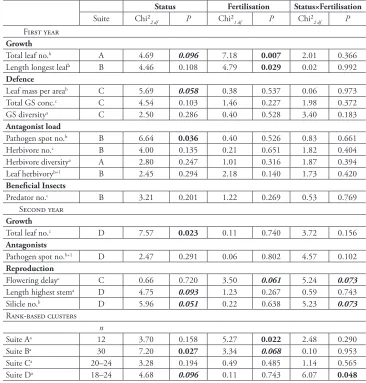
Table 2. Statistics for traits of Bunias orientalis plants. Populations of different status (native, invasive, naturalised, n = 4 populations each) were grown in a field common garden under two fertilisation treat-ments (low, high) (n = 5–6 per population and treatment). Traits were analysed using linear mixed-effect models (maximum likelihood approach, Chi² likelihood ratio tests) with status, fertilisation treatment and their interaction as fixed effects and population and common garden plot identity as random effects. Traits were grouped based on a cluster analysis of Spearman rank-correlations (Suite) and group ranks re-analysed with plant individual as an additional random factor. Transformations: a: no transformation; b: log-transformation; c: square root-transformation; +1: 1 added to whole dataset. P values < 0.1 and > 0.05 in bold and italic, P values < 0.05 in bold. no.: number; GS: glucosinolate; conc.: concentration.
Status Fertilisation Status×Fertilisation
Suite Chi²2 df P Chi²1 df P Chi²2 df P
First year
Growth
Total leaf no.b A 4.69 0.096 7.18 0.007 2.01 0.366
Length longest leafa B 4.46 0.108 4.79 0.029 0.02 0.992
Defence
Leaf mass per areab C 5.69 0.058 0.38 0.537 0.06 0.973
Total GS conc.c C 4.54 0.103 1.46 0.227 1.98 0.372
GS diversitya C 2.50 0.286 0.40 0.528 3.40 0.183
Antagonist load
Pathogen spot no.b B 6.64 0.036 0.40 0.526 0.83 0.661
Herbivore no.c B 4.00 0.135 0.21 0.651 1.82 0.404
Herbivore diversitya A 2.80 0.247 1.01 0.316 1.87 0.394
Leaf herbivoryb+1 B 2.45 0.294 2.18 0.140 1.73 0.420
Beneficial Insects
Predator no.c B 3.21 0.201 1.22 0.269 0.53 0.769
Second year
Growth
Total leaf no.c D 7.57 0.023 0.11 0.740 3.72 0.156
Antagonists
Pathogen spot no.b+1 D 2.47 0.291 0.06 0.802 4.57 0.102
Reproduction
Flowering delayc C 0.66 0.720 3.50 0.061 5.24 0.073
Length highest stema D 4.75 0.093 1.23 0.267 0.59 0.743
Silicle no.b D 5.96 0.051 0.22 0.638 5.23 0.073
Rank-based clusters
n
Suite Aa 12 3.70 0.158 5.27 0.022 2.48 0.290
Suite Ba 30 7.20 0.027 3.34 0.068 0.10 0.953
Suite Ca 20–24 3.28 0.194 0.49 0.485 1.14 0.565
Suite Da 18–24 4.68 0.096 0.11 0.743 6.07 0.048
Consistency was tested across traits within the cluster-groups (suites) and across the entire cluster using Kendall’s coefficient of concordance W (package irr). As the corresponding significance test cannot handle negative correlations within groups, the ranks of one trait (LMA) were manually reversed. For one group consisting of only two traits, a pairwise Spearman rank correlation was used. To test if the suites of correlated traits reveal different syndromes, the raw data ranks were combined for individuals of all traits in each group separately and these datasets analysed using LMMs as described above. Therefore, plant identity was used as an additional random factor to control for multiple measures with individual plants and each incomplete dataset was reduced to individuals, in which at least two traits were measured.
Data resources
The data underpinning the analyses reported in this paper are deposited in the Dryad Data Repository at https://doi.org/10.5061/dryad.v17p8m4.
Results
Growth
The total number of leaves differed depending on the population status, being lower in naturalised than in invasive and native populations (Fig. 1a, b; for individual leaf types see Suppl. material 3, fig. S2). The population status influenced the leaf num-bers by trend in the first year and affected them significantly in the second year (Table 2). The length of the longest leaf per plant (first year) did not differ significantly ac-cording to status (Table 2) but showed population-specific differences, whereby plants of the native populations T3 and T4 had shorter leaves than all other plants (Fig. 1c). The total number of leaves and the length of the longest leaf were significantly higher in highly fertilised plants in the first year (Table 2, Fig. 1a, c). In contrast, in the sec-ond year, the total leaf number was neither significantly affected by fertilisation nor by population status (Table 2; Fig. 1b).
Defence
AL T3 T4 RO LT CB JE WU DR DI GO PA 0 20 40 60 80 100 120
Total no. of leaves (2nd year
)
AL T3 T4 RO LT CB JE WU DR DI GO PA 3 4 5 6 7 8
Leaf mass per area [mg cm
]
−2
AL T3 T4 RO LT CB JE WU DR DI GO PA 0.5
1.0 1.5 2.0
Glucosinolate diversity [Shannon index
]
AL T3 T4 RO LT CB JE WU DR DI GO PA 10
20 30 40 50
Total no. of leaves (1st year)
AL T3 T4 RO LT CB JE WU DR DI GO PA 10 15 20 25 30 35 40
Length of the longest leaf [cm]
AL T3 T4 RO LT CB JE WU DR DI GO PA 0 20 40 60 80 100
Total glucosinolate conc. [µmol g DW
]
−1
(a) (b)
(c) (d)
(e) (f)
Figure 1. Growth and defence traits of Bunias orientalis plants. Twelve populations of native (green), invasive (red) or naturalised (yellow) status were grown in a field common garden under two nitrate-fertilisation treatments, low (light shade) and high (dark shade) (n = 6 per population and fertilisation treatment, n = 5–6 in (b); for population codes see Table 1). a Total number of leaves per plant in the first year (rosette and offshoot leaves) and b in the second year (rosette, offshoot and stem leaves) c length of the longest leaf, d leaf mass per area, e total leaf glucosinolate concentration and f Shannon diversity index for nine glucosinolates in the first year. Box plots: median, 5th, 25th, 75th, 95th percentiles; open dots:
outliers. Lines along four populations of identical status: status mean values for low (dashed) and high (solid) fertilisation treatments.
Antagonist loads
differ-Figure 2. Antagonist loads of Bunias orientalis plants. Twelve populations of native (green), invasive (red) or naturalised (yellow) status were grown in a field common garden under two nitrate-fertilisation treat-ments, low (light shade) and high (dark shade) (n = 6 per population and fertilisation treatment, n = 5–6 in (b); for population codes see Table 1). a Pathogen infestation spots in the first year and b in the second year, c cumulative total number of herbivorous and d predatory insect morphotypes, e leaf area per plant consumed by herbivores and f Shannon diversity index for the abundance of 24 insect morphotypes in the first year. Box plots: median, 5th, 25th, 75th, 95th percentiles; open dots: outliers. Lines along four
populations of similar status: status mean values for low (dashed) and high (solid) fertilisation treatments.
(a) (b)
(c) (d)
(e) (f)
AL T3 T4 RO LT CB JE WU DR DI GO PA 0
20 40 60 80
No. of pathogen infestations (1st year
)
AL T3 T4 RO LT CB JE WU DR DI GO PA 0 20 40 60 80 100
No. of herbivorous insects
AL T3 T4 RO LT CB JE WU DR DI GO PA 0 100 200 300 400 500 600
Consumed leaf area [mm
]
2
AL T3 T4 RO LT CB JE WU DR DI GO PA 0
50 100 150 200
No. of pathogen infestations (2nd year
)
AL T3 T4 RO LT CB JE WU DR DI GO PA 0
10 20 30 40
No. of predatory insect
s
AL T3 T4 RO LT CB JE WU DR DI GO PA 0.5
1.0 1.5 2.0 2.5
Herbivore diversity [Shannon index
]
predatory insects were neither significantly influenced by population status nor ferti-lisation treatment (Table 2; Fig. 2c, d). Herbivore diversity and damage also showed no significant differences between plants of different population status or fertilisation (Table 2), but differed between populations (Fig. 2e, f).
Reproduction
In the second year, highly fertilised plants tended to flower earlier, particularly those of invasive populations (Table 2, Fig. 3a). The height of the flowering stems was by trend influenced by the population status (Table 2); plants from native populations had shorter stems than those of non-native origin (Fig. 3b). The number of silicles per plant was nearly significantly influenced by population status and the interaction between status and fertilisation (Table 2), with most silicles in highly fertilised plants of invasive and fewest in those of native populations (Fig. 3c).
Suites of correlated traits and syndromes
(a)
(b)
(c)
AL T3 T4 RO LT CB JE WU DR DI GO PA 0
10 20 30 40
Flower delay [days]
AL T3 T4 RO LT CB JE WU DR DI GO PA 40
60 80 100 120 140
Length of the highest stem [cm]
AL T3 T4 RO LT CB JE WU DR DI GO PA
05
00
1000
1500
2000
No. of silicle
s
Figure 3. Reproduction traits of Bunias orientalis plants. Twelve populations of native (green), invasive (red) or naturalised (yellow) status were grown in a field common garden under two nitrate-fertilisation treatments, low (light shade) and high (dark shade) (n = 4–6 per population and fertilisation treatment; for population codes see Table 1). a Flowering start date, b height of the longest stem with inflorescences and c number of developed silicles. Box plots: median, 5th, 25th, 75th, 95th percentiles; open dots:
Figure 4. Rank-based correlations and clustering amongst individual traits of Bunias orientalis plants. Twelve populations were grown in a field common garden over two years. a Pairwise correlations of traits with heatmap shadings based on Spearman’s rho (n = 131–144 individuals in pairwise comparisons). Cor-relations are marked as positive (blue) or negative (red, hatched fields). Asterisks: significant corCor-relations,
P < 0.05; dots: tendencies, P < 0.1. b Agglomerative cluster analysis (coefficient 0.3) of traits based on 1 minus Spearman’s rho values as pairwise distances (UPGMA method). Dashed lines divide four suites of consistently correlated traits (Spearman’s rho; Kendall’s W, each P < 0.001), identified using silhouette plots (not shown). LeafMassArea: leaf mass per area; Hs: diversity of (Shannon index); 1, 2: year the trait was obtained. c Combined ranks of the four suites from (b), displayed over 12 populations of native (green), invasive (red) or naturalised (yellow) status grown under two fertilisation treatments, low (light shade) and high (dark shade); for population codes see Table 1. From top to bottom: suite A (n = 12 per population and fertilisation treatment), B (n = 30), C (n = 20–24) and D (n = 18–24). Box plots: median, 5th, 25th, 75th, 95th percentiles; open dots: outliers. Lines along four populations of identical status: status
mean values for low (dashed) and high (solid) fertilisation treatments.
invasive plants and, in contrast, lower in plants from native and naturalised popula-tions (Fig. 4c).
Discussion
This study revealed four suites of correlated traits in B. orientalis, which were differ-entially affected by the invasion status of populations and nitrate-fertiliser supply. The resulting syndromes may be considered as alternative strategies for successful establish-ment. The response of the individual traits is discussed within the syndromes to which they contributed.
Resource allocation and leaf production in the first year
As syndrome in suite A, vigorous leaf production of B. orientalis was enhanced by fertilisation and associated with high herbivore diversity. As high herbivore diversity overall corresponded to low infestation by chewing-biting herbivores (Suppl. mate-rial 6, fig. S5), high fertilisation may enhance plant resistance in this species. For example, a high leaf number also correlated with high glucosinolate diversity (Fig. 4a), which can have a negative influence on caterpillar performance (Tewes et al. 2018). An effective resource allocation to leaf growth, as also found by Steinlein et al. (1996), may represent a feature of B. orientalis that allows the species to exploit the resources of new (disturbed) habitats, when introduced. Moreover, B. orientalis possesses further traits that characterise a pre-adapted ideal weed as defined by Baker (1965). For example, it can re-grow vegetatively from small root-fragments and is cross-pollinated but it is also self-compatible, with high production of long-lived seeds (Birnbaum 2006).
Longer leaves and higher antagonist loads in non-native plants
Interestingly, glucosinolates appeared not to be involved in the proposed changes in resistance upon invasion, as they clustered in another suite. However, higher con-centrations of other low-cost toxic compounds might largely prevent non-native B.
orientalis plants from antagonist attack, while some costly defences seemed to be
de-creased, as proposed by the SDH (Doorduin and Vrieling 2011). Indeed, a predomi-nance of trichomes, which represent an effective mechanical barrier against antagonists (Handley et al. 2005), as well as digestibility-reducing defences (trypsin proteinase inhibitors) characterise B. orientalis compared to other Brassicaceae species (Travers-Martin and Müller 2008). These presumably costly defences may act as a resource sink and may potentially be reduced as a result of enemy release. Accordingly, a lower number of branched trichomes has been found in plants from non-native populations compared to native B. orientalis from Turkey (Fortuna et al. 2014), which were also characterised by low antagonist loads in the present study (Fig. 4a, c and e).
Finally, a strong correlation between herbivore and predator counts suggests that predators such as Chrysoperla carnea (Diptera: Syrphidae), Episyrphus balteatus (Neu-roptera: Chrysopidae) and ichneumonids effectively controlled the herbivores on B.
orientalis. These interactions may be partly mediated by plant volatiles that can attract
these organisms (Kessler and Baldwin 2001). The complexity of the food-web struc-ture rather than individual species ultimately determine the herbivore impact on a plant and the success of invasive species (Smith-Ramesh et al. 2017).
Defence and flowering start trade-offs and intra-population variation
Suite C combined defence by glucosinolates trading-off with defence by LMA and ear-ly flowering in the second year, which did not differ between plants of different status and fertilisation. A slightly higher LMA in plants of naturalised populations (Fig. 1d) presumably made these plants harder to consume. Indeed, a negative correlation of LMA with the number of chewing-biting herbivores suggests a contribution of this trait to defence in B. orientalis. Moreover, the elevated defence by LMA might partly compensate for lower performance in growth and reproduction in individual plants, as indicated by negative correlations with such traits (Fig. 4a).
The combination of high glucosinolate concentrations and late flowering, revealed in this study, has likewise been found in Brassica rapa in response to stress (Steinbren-ner et al. 2012) and might thus present a physiological trade-off. Assuming compa-rable glucosinolate concentrations in the overwintering plant parts, plants with high glucosinolate concentrations might delay resource allocation in reproduction without running the risk of being consumed before flowering starts. Intriguingly, early flow-ering of highly fertilised B. orientalis plants of invasive populations indicates effec-tive resource allocation to reproduction in those plants, as was also revealed by other reproduction-related traits clustering in suite D.
Effective resource allocation in invasive plants in the second year
Suite D suggests that the full potential of invasive B. orientalis as successful colo-nisers is revealed in the second reproductive year, in which well-fertilised soils are effectively exploited, maximising plant performance. Particularly, highly fertilised plants of invasive populations stood out by, on average, high silicle and leaf numbers (Figs 1b, 3c) and high values in reproduction-related growth traits (Suppl. material 5, fig. S4). This finding is a strong indication for adapted phenotypic plasticity in nitrate allocation to reproduction in invasive populations, which would need to be tested by using clones, full- or half sibs (Richards et al. 2006). Strikingly, at low fertilisation, the ranks in suite D were similar amongst all plants. Thus, fertiliser treatments allow resource sinks to be identified and to make predictions about the contribution of nutrient availability in invaded habitats to plant syndromes relevant for successful colonisation. In contrast to the invasives, plants of native populations invested their resources in the second year mainly in vegetative reproduction with offshoots, which is not necessarily a fitness disadvantage (Davidson et al. 2011). Moreover, putative increased defences produced in native plants in the first year might persist in the second year and might be more important than high propagule pressure in co-evolved habitats.
Conclusions
It could be demonstrated that regarding differential suites of traits within one invasive species, a variety of pre-adaptations and post-introduction evolution mechanisms, po-tentially beneficial for invasion, was revealed. Forming rank-based suites of functional traits over the life-history is a promising, integrative approach to identify syndromes displaying potential invasion strategies within species. More research on multiple mechanisms (and their interactions) facilitating individual migrating species in parallel should enhance the mechanistic understanding of novel ecological pattern. Thereby, a high number of traits should be monitored to discover species-specific trade-offs and to avoid misinterpretation of single trait functions. Finally, specifically in studies, in which bi- or perennial species are investigated, approaches that capture traits from dif-ferent life-history stages are highly recommended.
Acknowledgements
This work was funded by Deutsche Forschungsgemeinschaft (MU 1829/16-1). Seeds were kindly provided by T. Fortuna, A. Kania, A. Opera, Y. Pauthier, H. Skálová, G. Vogg and D. Žvingila. We thank M. Behrendt, V. Biela, M. Bultmann, N. Jäckel, A. Kerim and J. Stallmann for support in the field experiment; K. Djendouci and F. Zie-gler for glucosinolate analysis; K. Schrieber and R. Schweiger for statistical support; the gardeners of Bielefeld University, especially G. Sewing.
References
Agrawal AA, Fishbein M (2006) Plant defense syndromes. Ecology 87: 132–149. https://doi. org/10.1890/0012-9658(2006)87[132:PDS]2.0.CO;2
Agrawal AA, Kotanen PM, Mitchell CE, Power AG, Godsoe W, Klironomos J (2005) Enemy release? An experiment with congeneric plant pairs and diverse above- and belowground enemies. Ecology 86: 2979–2989. https://doi.org/10.1890/05-0219
Baker HG (1965) Characteristics and modes of origin of weeds. In: Baker HG, Stebbins GL (Eds) The genetics of colonizing species. Academic Press, New York, 147–172.
NOBANIS – Invasive Alien Species Fact Sheet – Bunias orientalis (2006) Online Database of the European Network on Invasive Alien Species – NOBANIS. http://www.nobanis.org/globalas-sets/speciesinfo/b/bunias-orientalis/bunias_orientalis.pdf [Accessed 7 November 2016] Blight O, Josens R, Bertelsmeier C, Abril S, Boulay R, Cerdá X (2017) Differences in behavioural
traits among native and introduced colonies of an invasive ant. Biological Invasions 19: 1389–1398. https://doi.org/10.1007/s10530-016-1353-5
Dietz H, Edwards PJ (2006) Recognition that causal processes change during plant invasion helps explain conflicts in evidence. Ecology 87: 1359–1367. https://doi.org/10.1890/0012-9658(2006)87[1359:rtcpcd]2.0.co;2
Dietz H, Steinlein T, Ullmann I (1999) Establishment of the invasive perennial herb Bu-nias orientalis L.: An experimental approach. Acta Oecologica 20: 621–632. https://doi. org/10.1016/s1146-609x(99)00104-6
Dlugosch KM, Anderson SR, Braasch J, Cang FA, Gillette HD (2015) The devil is in the details: genetic vatiation in introduced populations and its contributions to invasion. Molecular Ecology 24: 2095–2111. https://doi.org/10.1111/mec.13183
Doorduin LJ, Vrieling K (2011) A review of the phytochemical support for the shifting defence hypothesis. Phytochemical Reviews 10: 99–106. https://doi.org/10.1007/s11101-010-9195-8 Fenster CB, Armbruster WS, Wilson P, Dudash MR, Thomson JD (2004) Pollination
syndromes and floral specialization. Annual Review of Ecology, Evolution, and Systematics 35: 375–403. https://doi.org/10.1146/annurev.ecolsys.34.011802.132347
Fortuna TM, Eckert S, Harvey JA, Vet LEM, Müller C, Gols R (2014) Variation in plant defences among populations of a range-expanding plant: consequences for trophic interactions. New Phytologist 204: 989–999. https://doi.org/10.1111/nph.12983
González-Megías A, Müller C (2010) Root herbivores and detritivores shape above-ground multitrophic assemblage through plant-mediated effects. Journal of Animal Ecology 79: 923–931. https://doi.org/10.1111/j.1365-2656.2010.01681.x
Grayer RJ, Harborne JB (1994) A survey of antifungal compounds from higher plants, 1982– 1993. Phytochemistry 37: 19–42. https://doi.org/10.1016/0031-9422(94)85005-4 Guo WY, Lambertini C, Nguyen LX, Li XZ, Brix H (2014) Preadaptation and
post-introduc-tion evolupost-introduc-tion facilitate the invasion of Phragmites australis in North America. Ecology and Evolution 4: 4567–4577. https://doi.org/10.1002/ece3.1286
Gyuris E, Feró O, Tartally A, Barta Z (2011) Individual behaviour in firebugs (Pyrrhocoris apterus). Proceedings of the Royal Society Biological Sciences, Series B 278: 628–633. https://doi.org/10.1098/rspb.2010.1326
Han XM, Dendy SP, Garrett KA, Fang L, Smith MD (2008) Comparison of damage to native and exotic tallgrass prairie plants by natural enemies. Plant Ecology 198: 197–210. https:// doi.org/10.1007/s11258-008-9395-0
Handley R, Ekbom B, Ågren J (2005) Variation in trichome density and resistance against a specialist insect herbivore in natural populations of Arabidopsis thaliana. Ecological Ento-mology 30: 284–292. https://doi.org/10.1111/j.0307-6946.2005.00699.x
Harvey JA, Biere A, Fortuna T, Vet LEM, Engelkes T, Morriën E, Gols R, Verhoeven K, Vogel H, Macel M, Heidel-Fischer HM, Schramm K, van der Putten WH (2010) Ecological fits, mis-fits and lotteries involving insect herbivores on the invasive plant, Bunias orientalis. Biological Invasions 12: 3045–3059. https://doi.org/10.1007/s10530-010-9696-9 Hoagland DR, Arnon DI (1950) The water-culture method for growing plants without soil.
California Agricultural Experiment Station Circular 347: 1–32.
Jeschke JM, Heger T (2018) Invasion Biology: Hypotheses and Evidence. CABI (Wallingford). Junker RR, Kuppler J, Amo J, Blande JD, Borges RM, van Dam NM et al. (2017) Covariation
and phenotypic integration in chemical communication displays: biosynthetic constraints and eco-evolutionary implications. New Phytologist. https://doi.org/10.1111/nph.14505 Keane RM, Crawley MJ (2002) Exotic plant invasions and the enemy release hypothesis. Trends
in Ecology and Evolution 17: 164–170. https://doi.org/10.1016/s0169-5347(02)02499-0 Kessler A, Baldwin IT (2001) Defensive function of herbivore-induced plant volatile emissions
in nature. Science 291: 2141–2144. https://doi.org/10.1126/science.291.5511.2141 Kueffer C, Pyšek P, Richardson DM (2013) Integrative invasion science: model systems,
multi-site studies, focused meta-analysis and invasion syndromes. New Phytologist 200: 615–633. https://doi.org/10.1111/nph.12415
Kuppler J, Höfers MK, Wiesmann L, Junker RR (2016) Time-invariant differences between plant individuals in interactions with arthropods correlate with intraspecific variation in plant phenology, morphology and floral scent. New Phytologist 210: 1357–1368. https:// doi.org/10.1111/nph.13858
Martin N, Müller C (2007) Induction of plant responses by a sequestering insect: Relationship of glucosinolate concentration and myrosinase activity. Basic and Applied Ecology 8: 13–25. https://doi.org/10.1016/j.baae.2006.02.001
Mitchell CE, Power AG (2003) Release of invasive plants from fungal and viral pathogens. Nature 421: 625–627. https://doi.org/10.1038/nature01317.
Müller C (2009) Role of glucosinolates in plant invasiveness. Phytochemical Reviews 8: 227–242. https://doi.org/10.1007/s11101-008-9116-2
Müller C, Riederer M (2005) Review: Plant surface properties in chemical ecology. Journal of Chemical Ecology 31: 2621–2651. https://doi.org/10.1007/s10886-005-7617-7
Müller T, Müller C (2015) Behavioural phenotypes over the lifetime of a holometabolous insect. Frontiers in Zoology 12 (Suppl 1): S8. https://doi.org/10.1186/1742-9994-12-s1-s8 Nei M, Maruyama T, Chakraborty R (1975) Bottleneck effect and genetic variability in
populations. Evolution 29: 1–10. https://doi.org/10.2307/2407137 Oberdorfer E (1990) Pflanzensoziologische Exkursionsflora. Ulmer, Stuttgart.
R Core Team (2014) R: a language and environment for statistical computing. R foundation for Statistical computing. Vienna, Austria. http://www.R-project.org/
Reich PB, Wright IJ, Cavender-Bares J, Craine JM, Oleksyn J, Westoby M, Walters MB (2003) The evolution of plant functional variation: traits, spectra, and strategies. International Journal of Plant Sciences 164: 143–164. https://doi.org/10.1086/374368
Ren MX, Zhang QG (2009) The relative generality of plant invasion mechanisms and predicting future invasive plants. Weed Research 49: 449–460. https://doi.org/10.1111/ j.1365-3180.2009.00723.x
Richards CL, Bossdorf O, Muth NZ, Gurevitch J, Pigliucci M (2006) Jack of all trades, master of some? On the role of phenotypic plasticity in plant invasions. Ecology Letters 9: 981–993. https://doi.org/10.1111/j.1461-0248.2006.00950.x
Schmidt JP, Springborn M, Drake JM (2012) Bioeconomic forecasting of invasive species by ecological syndrome. Ecosphere 3. https://doi.org/10.1890/es12-00055.1
Shannon CE, Weaver W (1949) The mathematical theory of communication. University of Illinois Press, Urbana.
Smith-Ramesh LM, Moore AC, Schmitz OJ (2017) Global synthesis suggests that food web connectance correlates to invasion resistance. Global Change Biology 23: 465–473. https:// doi.org/10.1111/gcb.13460
Steinbrenner AD, Agerbirk N, Orians CM, Chew FS (2012) Transient abiotic stresses lead to latent defense and reproductive responses over the Brassica rapa life cycle. Chemoecology 22: 239–250. https://doi.org/10.1007/s00049-012-0113-y
Steinlein T, Dietz H, Ullmann I (1996) Growth patterns of the alien perennial Bunias orientalis
L. (Brassicaceae) underlying its rising dominance in some native plant assemblages. Vegeta-tio 125: 73–82. https://doi.org/10.1007/bf00045206
Tewes LJ, Michling F, Koch MA, Müller C (2018) Intracontinental plant invader shows matching genetic and chemical profiles and might benefit from high defence variation within populations. Journal of Ecology 106: 714–726. https://doi.org/10.1111/1365-2745.12869
Travers-Martin N, Müller C (2008) Matching plant defence syndromes with performance and preference of a specialist herbivore. Functional Ecology 22: 1033–1043. https://doi. org/10.1111/j.1365-2435.2008.01487.x
van der Putten WH (2002) Plant population biology - How to be invasive. Nature 417: 32–33. https://doi.org/10.1038/417032a
van Kleunen M, Dawson W, Maurel N (2015) Characteristics of successful alien plants. Molecular Ecology 24: 1954–1968. https://doi.org/10.1111/mec.13013
Wolf VC, Berger U, Gassmann A, Müller C (2011) High chemical diversity of a plant species is accompanied by increased chemical defence in invasive populations. Biological Invasions 13: 2091–2102. https://doi.org/10.1007/s10530-011-0028-5
Wolfe LM, Elzinga JA, Biere A (2004) Increased susceptibility to enemies following intro-duction in the invasive plant Silene latifolia. Ecology Letters 7: 813–820. https://doi. org/10.1111/j.1461-0248.2004.00649.x
Supplementary material 1
Methods S1: Details for plant treatment and data analysis
Authors: Lisa Johanna Tewes, Caroline Müller Data type: method
Copyright notice: This dataset is made available under the Open Database License
(http://opendatacommons.org/licenses/odbl/1.0/). The Open Database License
(ODbL) is a license agreement intended to allow users to freely share, modify, and use this Dataset while maintaining this same freedom for others, provided that the original source and author(s) are credited.
Link: https://doi.org/10.3897/neobiota.37.21470.suppl1
Supplementary material 2
Figure S1. Design of the common garden field experiment
Authors: Lisa Johanna Tewes, Caroline Müller Data type: image
Copyright notice: This dataset is made available under the Open Database License
(http://opendatacommons.org/licenses/odbl/1.0/). The Open Database License
(ODbL) is a license agreement intended to allow users to freely share, modify, and use this Dataset while maintaining this same freedom for others, provided that the original source and author(s) are credited.
Link: https://doi.org/10.3897/neobiota.37.21470.suppl2
Supplementary material 3
Figure S2. Growth traits of Bunias orientalis plants
Authors: Lisa Johanna Tewes, Caroline Müller Data type: image
Copyright notice: This dataset is made available under the Open Database License
(http://opendatacommons.org/licenses/odbl/1.0/). The Open Database License
(ODbL) is a license agreement intended to allow users to freely share, modify, and use this Dataset while maintaining this same freedom for others, provided that the original source and author(s) are credited.
Supplementary material 4
Figure S3. Herbivore loads of Bunias orientalis plants
Authors: Lisa Johanna Tewes, Caroline Müller Data type: image
Copyright notice: This dataset is made available under the Open Database License
(http://opendatacommons.org/licenses/odbl/1.0/). The Open Database License
(ODbL) is a license agreement intended to allow users to freely share, modify, and use this Dataset while maintaining this same freedom for others, provided that the original source and author(s) are credited.
Link: https://doi.org/10.3897/neobiota.37.21470.suppl4
Supplementary material 5
Figure S4. Reproduction traits of Bunias orientalis plants
Authors: Lisa Johanna Tewes, Caroline Müller Data type: image
Copyright notice: This dataset is made available under the Open Database License
(http://opendatacommons.org/licenses/odbl/1.0/). The Open Database License
(ODbL) is a license agreement intended to allow users to freely share, modify, and use this Dataset while maintaining this same freedom for others, provided that the original source and author(s) are credited.
Link: https://doi.org/10.3897/neobiota.37.21470.suppl5
Supplementary material 6
Figure S5. Pairwise correlations between individual traits of Bunias orientalis
plants
Authors: Lisa Johanna Tewes, Caroline Müller Data type: image
Copyright notice: This dataset is made available under the Open Database License
(http://opendatacommons.org/licenses/odbl/1.0/). The Open Database License
(ODbL) is a license agreement intended to allow users to freely share, modify, and use this Dataset while maintaining this same freedom for others, provided that the original source and author(s) are credited.