The rise of
Cynometra
(Leguminosae)
and the fall of
Maniltoa
: a generic re-circumscription
and the addition of 4 new species
Aleksandar Radosavljevic1,2,3
1 Chicago Botanic Garden, 1000 Lake Cook Road, Glencoe, Illinois 60022, USA 2 National Museum of Natural History, Smithsonian Institution, 10th St and Constitution Ave NW, Washington, D. C. 20560, USA
3 Northwestern University, 633 Clark St, Evanston, Illinois 60202, USA
Corresponding author: Aleksandar Radosavljevic ([email protected])
Academic editor: Clifford Morden | Received 28 September 2018 | Accepted 31 May 2019 | Published 19 July 2019
Citation: Radosavljevic A (2019) The rise of Cynometra (Leguminosae) and the fall of Maniltoa: a generic re-circumscription and the addition of 4 new species. PhytoKeys 127: 1–37. https://doi.org/10.3897/phytokeys.127.29817
Abstract
Cynometra L. is a genus of ca. 85 species of shrubs to large trees. It is amongst the largest genera in the legume subfamily Detarioideae and one of the few with a pantropical distribution. Perhaps due to this wide distribution and high diversity, systematists and taxonomists have struggled with the classification of
Cynometra and its close ally, the genus Maniltoa Scheff. Recent phylogenetic studies have shown that many of the African species are more closely related to other genera and that the genus Maniltoa is nested within a clade of Indo-Pacific Cynometra. Here, I present an emended circumscription of Cynometra that excludes the African species defined by jointed pedicels and dehiscent fruits and includes the species formerly recognised in Maniltoa. New combinations in Cynometra are also provided for those species that require them. Additionally, four new species of Neotropical Cynometra are described and illustrated: Cynometra cerebriformissp. nov. from the lower Rio Trombetas in Brazil; Cynometra dwyeriisp. nov. from the Darien gap region of Panama; C. tumbesianasp. nov. from the dry tropical forests of Ecuador and Peru; and C. steyermarkiisp. nov. from the foothills of the western Cordillera de la Costa in Venezuela.
Keywords
Cynometra L, Detaroideae, Leguminosae, Maniltoa Scheff, new species, taxonomy http://phytokeys.pensoft.net
Copyright Aleksandar Radosavljevic. This is an open access article distributed under the terms of the Creative Commons Attribution License (CC BY 4.0), which permits unrestricted use, distribution, and reproduction in any medium, provided the original author and source are credited.
Introduction
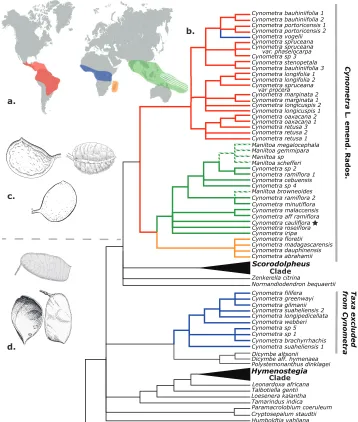
The genus Cynometra L. (Leguminosae) has a broad tropical distribution, is rela-tively species rich and many of its species are poorly represented in herbaria. The approximately 85 species of trees and (some) shrubs in the genus are spread some-what evenly amongst four regions (Figure 1): the Neotropics (from southern Mexico and the Caribbean to northern Argentina; Dwyer 1958, Sprada Tavares and da Silva 1992), mainland tropical Africa (equatorial forest belt; Léonard 1951), Madagascar and the Comoros Islands (Du Puy et al. 2002) and the Indo-Pacific (extending from the Western Ghats eastward to Fiji; Knaap-van Meeuwen 1970, Smith 1985). Perhaps unsurprisingly, the genus has long troubled taxonomists and systematists who have struggled with its diversity in several attempts to revise and classify regional groupings of the species (Léonard 1951, Dwyer 1958, Knaap-van Meeuwen 1970). Further, its relationship to the much smaller Pacific genus Maniltoa Scheff. has remained equivo-cal. Several important phylogenetic studies of the Caesalpinioideae sensu lato suggest-ed that Cynometra was not monophyletic (Bruneau et al. 2001, 2008). More recent studies, with greater taxonomic sampling, have provided additional evidence that the genus is polyphyletic and, furthermore, that one of the lineages is paraphyletic with respect to Maniltoa (Mackinder et al. 2013, Radosavljevic et al. 2017, de la Estrella et al. 2018). In order for the classification of Cynometra to reflect a monophyletic taxon, a new genus circumscription must be provided and Maniltoa should be subsumed into Cynometra. In addition, during the course of herbarium study and fieldwork, several undescribed species were revealed. Those species are here described. This paper is divided into three parts: I. A new circumscription of the genus Cynometra; II. The transfer of all species of Maniltoa into Cynometra; and III. Description of four new species of Cynometra.
Materials and methods
a. b. c. d. Cynometra spruceana var procera Cynometra floretii Maniltoa schefferi Cynometra longifolia 2
Cynometra sp 4
Cynometra cauliflora Maniltoa megalocephala Cynometra portoricensis 2
Cynometra oaxacana 1
Cynometra aff ramiflora Cynometra retusa 2 Cynometra stenopetala
Cynometra cebuensis Cynometra oaxacana 2 Cynometra longifolia 1 Cynometra vogelii
Cynometra sp 3
Cynometra sp 2
Cynometra minutiflora Cynometra marginata 2
Cynometra abrahamii Cynometra madagascarensis Maniltoa browneoides Cynometra bauhiniifolia 2
Cynometra malaccensis
Cynometra iripa Cynometra spruceana
Cynometra retusa 1 Cynometra longicuspis 2
Cynometra ramiflora 2 Cynometra marginata 1
Cynometra ramiflora 1 Cynometra bauhiniifolia 3 Cynometra bauhiniifolia 1
Cynometra portoricensis 1
Cynometra roseiflora Cynometra longicuspis 1 Cynometra spruceana var. phaselocarpa Cynometra dauphinensis Maniltoa gemmipara Maniltoa sp Cynometra retusa 3
Zenkerella citrina
Normandiodendron bequaertii
Cynometra sp 5 Cynometra webberi Tamarindus indica Loesenera kalantha Dicymbe altsonii Hymenostegia Paramacrolobium coeruleum Cynometra filifera Cynometra greenwayi Humboldtia vahliana Dicymbe aff. hymenaea
Talbotiella gentii
Cryptosepalum staudtii Cynometra sp 1 Cynometra longipedicellata Cynometra suaheliensis 2 Cynometra gilmanii
Leonardoxa africana Polystemonanthus dinklagei Cynometra suaheliensis 1 Cynometra brachyrrhachis Clade Clade Scorodolpheus Cynometra L . emend. Rados. Taxa excluded from Cynometra
Figure 1.A Map showing global distribution of Cynometra and Maniltoa (white hatching) B ML majority rules consensus tree from Radosavljevic et al. (2017) with branches coloured by species distributions. Star indicates type species of CynometraC indehiscent fruits typical of Cynometra as circumscribed here; D dehis-cent fruits typical of those species formerly included in Cynometra, but excluded by the new circumscription.
C. dwyerii) from herbarium specimens. Two of the new species are described based
Part I: A new circumscription of the genus
Linnaeus established the genus Cynometra and included two species from south-east Asia in the first edition of Species Plantarum, Cynometra cauliflora L. and C.
ramiflora L. (Linnaeus, 1753). This original concept of Cynometra was of a genus
distinguished by compound leaves, four reflexed sepals, five equal petals and by sin-gle-seeded, indehiscent pods with thick and tuberculate valves (Linnaeus’ descrip-tion does not explicitly mendescrip-tion ‘indehiscent pods’, but it is a character present in both of his original species). For nearly the next century, this circumscription was generally followed by taxonomists around the world. The limits of the genus were first expanded by the publication of two new species from the Indo-Pacific region:
Cynometra polyandra Roxb., described in 1820 from Indian material and Cynometra
grandiflora A.Gray, described in 1854 from Fijian specimens. These species differed
most notably from the traditional understanding of Cynometra by having more nu-merous stamens (35–40 in C. grandiflora and approximately 50 in C. polyandra;
Roxburgh 1820, Gray 1854). Bentham (1865a) later described the African species C.
floribunda Benth. and C. laxiflora Benth., species with large, petaloid bracteoles and
only two showy petals which he placed in a new subgenus, Hymenostegia (the fruit of the two species also differs from Cynometra, but these were unknown at the time). Scheffer (1876) established the segregate genus Maniltoa after viewing collections from New Guinea; believing the material to be conspecific, he included a single spe-cies, Maniltoa grandiflora (A.Gray) Scheff. (based on Cynometra grandiflora A.Gray). While the most apparent difference between the new genus Maniltoa and typical
Cynometra was the number of stamens, Scheffer (1876) argued that the genus was
distinct based on the size of the flowers, the number of seeds, caducous filiform stip-ules, the presence of a tendril terminating the leaf rachis and bracts subtending each pedicel in the inflorescence. He does not include or reference C. polyandra, another polyandrous species. Maniltoa was not universally accepted at first and Taubert’s (1894) treatment of the Leguminosae for Engler’s Die Natürlichen Pflanzenfamilien treated Maniltoa as a section of Cynometra (along with the sections Eucynometra,
Hymenostegia and Pseudocynometra). A few years later, however, Harms (1897) broke
apart this broad concept of Cynometra. He elevated Hymenostegia to the rank of ge-nus and restored Maniltoa by combining it with section Pseudocynometra (consisting of a single species, C. polyandra) on the basis of greater stamen number and the pres-ence of prominent buds enclosed in imbricate scarious bract scales (Harms 1897, 1902, 1919). This understanding of Cynometra and Maniltoa in the Indo-Pacific was further refined by Knaap-Van Meeuwen (1970) who sought to better define the limits between the two genera – she again placed greatest significance on the stamen number, placing those with 8–13 stamens in Cynometra and those with 15–80 in
Maniltoa. While many authors have followed this delimitation (Verdcourt 1979;
In Africa, misunderstanding of the delimitation of Cynometra persisted, even af-ter Harm’s (1897) treatment and the turn of the century marked the beginning of a period of rapid taxonomic expansion in both the number of species and, conse-quently, the characters describing the generic limits of Cynometra. As explained (in great detail) by Léonard (1951), the first few species described in Africa generally matched the Linnaean concept (e.g. Cynometra vogelii Hook.f. in 1849 from Nigeria;
C. mannii Oliv. in 1871 from Cameroon). However, with the description of
Cyn-ometra sessiliflora Harms, Harms (1899) expanded the understanding of Cynometra
to include species with five erect sepals (instead of four reflexed sepals) and, most importantly for the continued confusion regarding the genus, dehiscent pods with thin, flat valves. Not long after, the publication of Cynometra alexandri C.H.Wright,
C. gilletii De Wild., C. laurentii De Wild., C. lujae De Wild., C. oddonii De Wild.
and C. pedicellata De Wild. added more species with five sepals and dehiscent fruits
and further expanded the genus to include species with an intrastaminal disc and numerous ovules (Wright 1902; De Wildeman 1904, 1905, 1906, 1907). Harms (1907) also continued to expand the generic conception of Cynometra in Africa to include species with alternate leaflets, distichous flowers and a stipe fused with the receptacle wall when he described C. leptantha Harms, C. multijuga Harms and C.
pierreana Harms. Cynometra brachyura Harms, expanded the genus to again include
species with only two petals (Harms 1913). As a result, species with all manner of combinations of these characters were placed in Cynometra (see Baker 1930 and Pel-legrin 1949). While many taxonomists, working in Africa, noted the heterogeneity of the genus, it was not until Léonard undertook a thorough and careful revision of the African species that a coherent circumscription of Cynometra began to emerge (Baker 1930; Lebrun 1933; Aubréville 1936; Léonard 1951, 1957).
Léonard’s work (1951, 1957) was a major advancement in revising the boundaries
of Cynometra and its allies in Africa, which had become so broad as to make genera
nearly indistinguishable. Léonard (1951) removed from Cynometra any taxa with the stipe of the ovary adnate to the hypanthium or eccentrically inserted (species with a free, central stipe but alternate leaflets with translucent dots were moved to Gilletioden-dron Vermoesen). To accommodate his revised concept of the genus, Léonard (1951, 1957) described a new genus, Lebruniodendron J.Léonard, resurrected the genera
Gil-letiodendron Vermoesen and Zenkerella Taub. and transferred numerous species out of
Cynometra and into the genera Hymenostegia (Benth.) Harms, Plagiosiphon Harms,
Schotia Jacq. and Scorodophloeus Harms. He placed the remaining Cynometra into three
mode, seedling architecture and wood structure, amongst others. (Léonard 1957). A thorough examination of the genus Cynometra, unfortunately, was not included in that otherwise exhaustive study. Léonard and others recognised that, as contemporarily circumscribed, the genus was likely polyphyletic and would require further revisionary studies at a global scale (Aubréville 1968, 1970; Breteler 1996; Léonard 1996).
An early morphological cladistic analysis by Temu (1990) provided the first phylo-genetic evidence for the non-monophyly of African Cynometra. The results showed two distinct clades of Cynometra in tropical Africa, one of which included Maniltoa. Later morphological and molecular phylogenetic analyses, albeit with limited sampling of
Cynometra and Maniltoa, also found no evidence to support monophyly of Cynometra
and suggested that it may be paraphyletic with respect to Maniltoa (Bruneau et al. 2001, 2008). More recent studies which included a greater taxon sampling from
Cyn-ometra and Maniltoa have found support for two clades of Cynometra, one consisting
of exclusively East African species and the other containing species from the rest of the genus plus Maniltoa (Mackinder et al. 2013; Radosavljevic et al. 2017; de la Estrella et al. 2018). Radosavljevic et al. (2017), which featured 47 accessions from 36 species
of Cynometra and Maniltoa, recovered two strongly supported clades of Cynometra
sensu lato, which are each diagnosed by several morphological characters (Figure 1). One clade (Cynometra clade A of Radosavljevic et al. 2017) is comprised of exclusively east African species and is grouped as sister to a clade composed of Dicymbe Spruce ex Benth. and Polystemonanthus Harms with strong support. The other clade, which includes the type species Cynometra cauliflora L., contains Cynometra species from the Neotropics, the remaining Afrotropical species and the Indo-Pacific species ( Cynome-tra clade B of Radosavljevic et al. 2017). Maniltoa is nested within clade B and is also recovered as non-monophyletic. This clade of Cynometra and Maniltoa is placed in a clade with Zenkerella Taub., Normandiodendron J. Léonard and the Scorodophloeus
clade, again with strong support. The species of Cynometra clade A are characterised by the absence of foliar extra-floral nectaries, paniculate inflorescences (with two ex-ceptions), articulated pedicels, a well-developed intrastaminal disc, 2–4 ovules and dehiscent fruit. Cynometra clade B is characterised by the presence of foliar extra-floral nectaries (in most species), racemose inflorescences, simple pedicels, the absence of an intrastaminal disc, 1–2 ovules and indehiscent fruit. The species of Cynometra clade A correspond to Léonard’s (1951) groups 2 and 3 while Cynometra clade B, which con-tains the generitype Cynometra cauliflora L., corresponds to group 1. Léonard (1951, 1996) predicted as much; he referred to group 1 as ‘typical Cynometra’ and believed that Cynometra alexandri and C. hankei Harms were likely misplaced. De la Estrella et al. (2018), who sampled broadly across Detarioideae, placed Cynometra and Maniltoa
in a re-circumscribed Amherstieae.
To reconcile the discrepancy between the current classification of Cynometra and
Maniltoa and our understanding of their evolutionary relationships, I present here an
emended generic circumscription of Cynometra that excludes the species of Cynometra
Taxonomic treatment
Cynometra L. Sp. Pl. 1:382. 1753.
Syn. Iripa Adans., Fam. 2: 508. 1763. Cynomora R.Hedw. Gen. Pl. [R. Hedwig]. 1806. Type. Cynometra cauliflora L. (lectotype, designated by A.S. Hitchcock, in Hicth-cock and Green 1959, pg. 152)
Metrocynia Thouars, Gen. Nov. Madagasc. 22. 1806. Type. Metrocynia commersoniana DC.
Maniltoa Scheff., Ann. Jard. Bot. Buitenzorg 1: 20. 1876. Type. Cynometra grandiflora
A.Gray.
Schizosiphon K.Schum., Fl. Kais. Wilh. Land 101. 1889. Schizoscyphus K.Schum ex
Tau-bert, nom. superfl. Bot. Centralbl. 41: 265. 1890. Type. Schizosiphon rosea K. Schum.
Pseudocynometra Kuntze in Post & Kuntze, Lex. Gen. Phan. Phan. 464. 1903. Type.
Cynometra polyandra Roxb.
Trees or shrubs (infrequent), evergreen (rarely deciduous), buttressed or not, growth flush-wise, new growth flaccid and whitish or reddish at emergence, becoming green with maturity, vegetative buds covered in a series of imbricate scales. Stipules lateral, free, linear or filamentous, early caducous, scars typically not visible on mature growth.
Leaves pulvinate, petiolate, rachis (if present) terete or caniculate, often terminating in a filiform outgrowth, axes glabrous or pubescent, paripinnate with 1–16 pairs of op-posite leaflets (rarely unifoliolate); leaflets petiolulate but sometimes appearing sessile because of decurrent lamina, blade lanceolate, ovate, elliptic, oblong, obovate, oblan-ceolate or trapeziform, symmetrical to strongly asymmetrical, glabrous or sparsely pu-bescent abaxially, glabrous adaxially (rarely with sparse pubescence along midvein), margins entire, apex broadly obtuse to acuminate, retuse or emarginate, mucronate, base oblique, distal margin decurrent to petiolule; laminar nectaries usually present, abaxial, submarginal, embedded in laminar surface, shallow, without noticeably raised edges. Inflorescences axillary or ramiflorous (rarely cauliflorous), racemose, 1–2(–3), per axil, buds enclosed by imbricate bracts, appearing conical, ovoid or cigar-shaped in silhouette; pedicels simple (not articulated), filamentous in anthesis, accrescent and lignified in fruit; bracts enclosing inflorescence during development prior to emer-gence, imbricate, distichous, deciduous or persistent; bracteoles not enclosing buds, paired, inserted along proximal half of pedicel, opposite or subopposite, caducous.
indehiscent, splitting along suture after germination due to action of emerging shoot, orbicular to oblong, often laterally compressed, smooth to deeply fissured, often apicu-late (in some taxa only when immature), valves 0.5–4.0 mm thick, cork-like in several species, remaining attached to cotyledons during and after germination. Seeds 1–2, enclosed in fruit until germination. Seedling germination epigeal.
The emended description above reflects the merger of Maniltoa and Cynometra s.s. and the exclusion of the east African taxa with dehiscent pods, paniculate inflorescences and articulated pedicels (Tables 1, 2). While many taxa in the former Maniltoa are no doubt distinctive and, in many cases, striking when compared to the more
unassum-ing Cynometra, a close examination of their morphological characteristics reveals a strong
similarity. The number of stamens has been perhaps the most distinctive and most often cited character separating the two genera. Cynometra has long been known to have only 10 stamens, while Maniltoa has been traditionally treated as having anywhere from 15–80 stamens. Indeed, this proliferation in stamen number is rare in the Detarioideae. How-ever, a closer look at the Indo-Pacific Cynometra reveals several examples of species which regularly have as few as eight stamens (Cynometra glomerulata Gagnep.) or as many as 12
(Cynometra katikii Verdc.) and some with variation across the range within a species (8–10
stamens in Cynometra cauliflora L. and 10–15 stamens in Cynometra ramiflora L.; Knaap-van Meeuwen 1970, Verdcourt 1979). So, while the majority of species, placed within
Cynometra, do have 10 stamens, there is lability amongst this trait in the taxa of the region.
Several other characteristics of Maniltoa that supposedly distinguish it from Cynome-tra are also incorrect. The first is the presence of conspicuous ‘bract covered’ vegetative and reproductive buds (Scheffer 1876, Harms 1902, 1919). In some species of Maniltoa, these buds can be many centimetres long and several centimetres in diameter. The scales them-selves are often tan or brown, but can be whitish or pinkish and are often covered with parallel striations running longitudinally along the surface. These types of buds are also present in Cynometra, although they are much smaller, in some cases only 4 or 5 mm long. Likewise, the scales are similar in shape, vestiture and surface texture. Another general characteristic used to separate the two genera has been the sturdiness of the inflorescence rachis in Maniltoa (Knaap-van Meeuwen 1970). However, this is likely related to the overall general difference in size of the flowers and inflorescence between the two genera:
Maniltoa tend to have larger buds, bracts, inflorescences and individual flowers. The larger
inflorescences of the Maniltoa species may be an adaptation to mammal pollination as there are reports of marsupials and bats visiting the flowers of Maniltoa species in Australia and the Pacific Islands (Marshall 1985, Endress 1994). Scheffer (1876) cited the pres-ence of a tendril terminating the leaf rachis as a distinguishing character of Maniltoa, but Dwyer (1958) notes that this trait is present in several Cynometra. Finally, differences in wood anatomy given by Knaap-van Meeuwen (1970) have been found to be insufficiently distinct from one another and overlapping in range (Soerianegara 1993; Pan et al. 2010).
Table 1. Species excluded from Cynometra. Distributions correspond to regions given in text. Species may occupy only a part of the overall region. MTA = mainland tropical Africa.
Species Distribution
Cynometra alexandri C.H. Wright MTA
Cynometra ananta Hutch. & Dalziel MTA
Cynometra brachyrrhachis Harms MTA
Cynometra engleri Harms MTA
Cynometra filifera Harms MTA
Cynometra fischeri Baker f. MTA
Cynometra gilletii De Wild. MTA
Cynometra gillmanii J. Léonard MTA
Cynometra greenwayi Brenan MTA
Cynometra hankei Harms MTA
Cynometra leonensis Hutch. & Dalziel MTA
Cynometra longipedicellata Harms MTA
Cynometra lujae De Wild. MTA
Cynometra nyangensis Pellegr. MTA
Cynometra oddonii De Wild. MTA
Cynometra palustris J. Léonard MTA
Cynometra pedicellata De Wild. MTA
Cynometra sessiliflora Harms MTA
Cynometra suaheliensis (Taub.) Baker f. MTA
Cynometra ulugurensis Harms MTA
Cynometra webberi Baker f. MTA
nature of the pods’ dehiscence. Likewise, subsequent treatments were vague. Bentham (1865b), Taubert (1894) and Harms (1897) all described the pods as ‘two-valved’ with-out further elaboration. Léonard (1951) and Aubréville (1968, 1970) cite the pods of ‘typical Cynometra’ as dehiscent or indehiscent, likely owing to the fruit of Cynometra
mannii, the valves of which are not dehiscent but, upon pressing and drying, often
split and rupture in several places along axes roughly perpendicular to the sutures. A similar occurrence is observed in the Neotropical species Cynometra bauhiniifolia
Benth. When Harms (1899) described C. sessiliflora, he set a precedent regarding the pod characters that contributed to the imprecise delimitation of Cynometra and subse-quently led to the taxonomic confusion surrounding Cynometra in Africa.
With this new circumscription, the two genera are united and share radially sym-metric flowers, bract covered buds (with bracts persisting on the inflorescence), flow-ers with early caducous bracteoles not enveloping the flowflow-ers and indehiscent fruits (which may play a role in dispersal as many taxa are associated with alluvial habitats or appear as drift ‘fruit’ in coastal environments; Ridley 1930, Léonard 1951, Clarke et al. 2001, Tomlinson 2016). The new classification changes the overall distribu-tion of the taxa. Prior to this, Cynometra was a genus with its diversity distributed somewhat evenly across the American, African and Asian tropics. However, with the exclusion of many of the African species and the inclusion of the former Maniltoa,
Cynometra is now a genus whose primary centre of diversity is the Indo-Pacific
Table 2. Accepted species of Cynometra. Taxonomy follows: Knaap Van-Meeuwen 1970; Léonard 1951; Dwyer 1958. New combinations and new species presented in text are not included. Distributions cor-respond to regions given above. Species may occupy only a part of the overall region. COM = Comoros Islands; INP = Indo-Pacfic; MAD = Madagascar; MTA = mainland tropical Africa; NEO = Neotropics.
Species Distribution Species Distribution
Cynometra abrahamii Du Puy & R.Rabev. MAD Cynometra longifolia Huber NEO
Cynometra americana Vogel NEO Cynometra lukei Beentje MTA
Cynometra ankaranensis Dupuy & R.Rabev. MAD Cynometra lyallii Baker MAD
Cynometra aurita R.Vig. MAD Cynometra macrocarpa A.S.Tav. NEO
Cynometra bauhiniifolia Benth. NEO Cynometra madagascariensis Baill. MAD
Cynometra beddomei Prain INP Cynometra malaccensis Meeuwen INP
Cynometra bourdillonii Gamble INP Cynometra mannii Oliv. MTA
Cynometra brachymischa Harms INP Cynometra marginata Benth. NEO
Cynometra capuronii Du Puy & R.Rabev. MAD Cynometra marleneae A.S.Tav. NEO
Cynometra cauliflora L. INP Cynometra mayottensis Labat & O.Pascal COM
Cynometra cloiselii Drake MAD Cynometra megalophylla Harms MTA
Cynometra commersoniana Baill. MAD Cynometra microflora R.S.Cowan NEO
Cynometra congensis De Wild. MTA Cynometra minutiflora F.Muell. INP
Cynometra copelandii (Elmer) Elmer INP Cynometra mirabilis Meeuwen INP
Cynometra craibii Gagnep. INP Cynometra novoguineensis Merr. & L.M.Perry INP
Cynometra crassifolia Benth. NEO Cynometra oaxacana Brandegee NEO
Cynometra cubensis A.Rich. NEO Cynometra parvifolia Tul. NEO
Cynometra cuneata Tul. NEO Cynometra pervilleana Baill. MAD
Cynometra dauphinensis Dupuy & R.Rabev. MAD Cynometra polyandra Roxb. INP
Cynometra dongnaiensis Pierre INP Cynometra portoricensis Krug & Urb. NEO
Cynometra duckei Dwyer NEO Cynometra ramiflora L. INP
Cynometra elmeri Merr. INP Cynometra retusa Britton & Rose NEO
Cynometra falcata A.Gray INP Cynometra sakalava Du Puy & R.Rabev. MAD
Cynometra fissicuspis (Pittier) Pittier NEO Cynometra sanagaensis Aubrev. MTA
Cynometra floretii Labat & O.Pascal COM Cynometra schlechteri Harms MTA
Cynometra glomerulata Gagnep. INP Cynometra schottiana Hochr. NEO
Cynometra grandiflora A.Gray INP Cynometra simplicifolia Harms INP
Cynometra hemitomophylla (Donn.Sm.) Rose NEO Cynometra spruceana Benth. NEO
Cynometra hondurensis Dwyer NEO Cynometra stenopetala Dwyer NEO
Cynometra hostmanniana Tul. NEO Cynometra travancorica Bedd. INP
Cynometra humboldtiana Stergios NEO Cynometra trinitensis Oliv. NEO
Cynometra insularis A.C.Sm. INP Cynometra vogelii Hook.f. MTA
Cynometra iripa Kostel. INP Cynometra warburgii Harms INP
Cynometra katikii Verdc. INP Cynometra whitfordii Elmer INP
Cynometra letestui (Pellegr.) J.Léonard MTA Cynometra yokotai Kaneh. INP
Cynometra longicuspis Ducke NEO Cynometra zeylanica Kosterm. INP
Part II: Reduction of Maniltoa into Cynometra
The generic rearrangements require new combinations to reflect the merging of Manil-toa into Cynometra. For Maniltoa, in most cases, the taxonomy proposed by Knaap-van Meeuwen (1970) has been followed, but for some species limits, the interpretations of Verdcourt (1979) have been followed; such deviations are noted. Species, for which a combination already exists in Cynometra, are not listed (Knaap-van Meeuwen 1970). In total, 18 new combinations and one new name are proposed. A lectotype is designated for
1. Cynometra basifoliola (Verdc.) Rados., comb. nov.
urn:lsid:ipni.org:names:77199243-1
Basionym.Maniltoa basifoliola Verdc., Kew Bull. 37: 129. 1982. Type. PAPUA NEW GUINEA. Madang province: Madang subprovince [district], cleared area utilized as a gravel pit on north side of Madang Usino Highway on banks of Gogol River, 145 37 E, 05 15 S, 100 m alt., 25 April 1979, S.H. Somer & P. Katik LAE 75185 (holotype: K; isotypes: BM, L, M).
Notes. The arrangement of leaflets for which this species is named (i.e. the basal-most pair of leaflets inserted just above petiole and separated from terminal pair of leaflets by a relatively long rachis) is unusual amongst the species that were formerly included in Maniltoa; however some species of Cynometra have a similar arrangement (e.g. Cynometra sakalava Du Puy & R.Rabev from Madagascar).
2. Cynometra brassii (Merr. & L.M.Perry) Rados., comb. nov.
urn:lsid:ipni.org:names:77199244-1
Basionym.Maniltoa brassii Merr. & L.M.Perry, J. Arnold Arbor. 23: 398. 1942. Type. BRITISH NEW GUINEA [PAPUA NEW GUINEA]. Central Division: U-uma Riv-er, 14 May 1926, [fl., imm. fr.], L. J. Brass 1428, (holotype: A; isotype: K).
Notes. The protologue lists the collection year as 1928, however 1926 appears to be the correct date. While the label affixed to the holotype does list the collection date as “14 May 1928”, this appears to be a transcription error. The handwritten slip attached to the holotype, presumably filled out by the collector Brass, gives the date as “14/5/26”. Additionally, the printed label is titled “Arnold Arboretum Expedition, 1925–1926”. The label on the isotype also has the collection date as 14 May 1926.
3. Cynometra browneoides (Harms) Rados., comb. nov.
urn:lsid:ipni.org:names:77199245-1
Basionym. Maniltoa browneoides Harms, Notizbl. Königl. Bot. Gart. Berlin 3: 190. 1902. Synonym. Pseudocynometra browneoides (Harms) Kuntze, Deutsche Bot. Monatsschr. 21: 173. 1903. Type. [INDONESIA]. Java. [West Java: Bogor Botanic Gardens], 1880–1882, [fl], H. O. Forbes 1204a (holotype: B, destroyed; isotype: BM).
Synonym.Maniltoa gemmipara Scheff. ex Backer, Voorl. Schoolfl. Java 104: in cla-vi. 1908. Type. [INDONESIA]. Cultivated at Weltevreden (Djakarta), 1908, Backer s.n. (holotype: L, fide Knaap-van Meeuwen 1970).
Notes. According to Knaap-van Meeeuwen (1970, p. 42), the type material for
Gar-dens from seeds or seedlings collected by Forbes on New Guinea, however no citation is given as the source for this information. The holotype for M. gemmipara is listed as being at Leiden by Knaap-van Meeuwen, however there are no specimens there anno-tated as such. There are two specimens, however, from Java collected in 1908 that seem to match the details in the protologue. These are filed as M. gemmipara and have the registration numbers L.3886447 and L.3886448.
4. Cynometra cynometroides (Merr. & L.M.Perry) Rados., comb. nov.
urn:lsid:ipni.org:names:77199246-1
Basionym. Maniltoa cynometroides Merr. & L.M.Perry, J. Arnold Arbor. 23: 398. 1942. Type. BRITISH NEW GUINEA [PAPUA NEW GUINEA]. Palmer River, 2 mi. below junction Black River, 100m alt., Jun 1936, [fr], L. J. Brass 6903 (holotype: A; isotypes: BM, BO, BRI, L).
5. Cynometra fortuna-tironis (Verdc.) Rados., comb. nov.
urn:lsid:ipni.org:names:77199247-1
Basionym.Maniltoa fortuna-tironis Verdc., Kew Bull. 32 (1): 243. 1977. Type. PAP-UA NEW GUINEA. Central District [Central Province]: Rouna Falls area, forest by tributary of R. Laloki, 300 m alt., 2 Jan. 1976, B. Verdcourt, C.R. Huxley, & Dodd 4899
(holotype: K; isotypes: LAE, UPNG).
6. Cynometra lenticellata (C.T.White) Rados., comb. nov.
urn:lsid:ipni.org:names:77199248-1
Basionym. Maniltoa lenticellata C.T.White, J. Arnold Arbor. 8: 130. 1927. Type. PAPUA [PAPUA NEW GUINEA]. Northern Division: Sageri, July 1922, [fl], C. E.
Lane-Poole 203 (holotype: BRI; isotype: A).
7. Cynometra lenticellata var. villosa (Verdc.) Rados., comb. nov.
urn:lsid:ipni.org:names:77199249-1
8. Cynometra mariettae (van Meeuwen) Rados., comb. nov.
urn:lsid:ipni.org:names:77199250-1
Basionym.Maniltoa mariettae van Meeuwen, Blumea 18 (1): 37. 1970. Type. TER-RITORY OF NEW GUINEA [PAPUA NEW GUINEA]. Morobe District [Morobe Province]: Yalu, 6°36'S, 146°52'E, 50 ft alt., Jul 1944, [fl], C.T. White, H.E. Dadswell,
& L.S. Smith, NGF 1661 (holotype: BRI; isotype: CANB).
9. Cynometra megalocephala (Harms) Rados., comb. nov.
urn:lsid:ipni.org:names:77199251-1
Basionym.Maniltoa megalocephala Harms, Bot. Jahrb. Syst. 55 (1): 52. 1917. Type. NORDÖSTLICH NEU-GUINEA [PAPUA NEW GUINEA]. Sepik area, 1912–1913,
C. L. Ledermann 7857, 7895, 10616 (syntypes: B, destroyed). PAPUA NEW GUINEA.
Sepik area, Harms, Bot. Jahrb. Syst. 55 (1): 53, tab. 2. 1917. (lectotype, here designated)
Notes. All three syntypes cited in Harms’ original description were destroyed and no isotypes have been located. Therefore plate 2 (tab. 2) from Harms 1917 is desig-nated as the lectotype (Figure 2).
10. Cynometra minor (A.C.Sm.) Rados., comb. nov.
urn:lsid:ipni.org:names:77199252-1
Basionym.Maniltoa minor A.C.Sm., Sargentia 1: 37. 1942. Type. FIJI. Lau Province: Moala Island, near Maloku, 20–24 Mar 1934, [fl], A.C. Smith 1333 (holotype: GH; isotype: BISH, K, NY, S, WIS, US).
11. Cynometra plurijuga (Merr. & L.M.Perry) Rados., comb. nov.
urn:lsid:ipni.org:names:77199253-1
Basionym.Maniltoa plurijuga Merr. & L.M.Perry, J. Arnold Arbor. 23: 398. 1942. Type. NETHERLANDS NEW GUINEA [INDONESIA]. [Papua:] 2 km southwest of Bernhard Camp, Idenburg River, 650 m alt., 3 April 1939, L.J. Brass & C. Versteegh
13539 (holotype: A; isotype: BO, BRI, L).
12. Cynometra psilogyne (Harms) Rados., comb. nov.
urn:lsid:ipni.org:names:77199254-1
13. Cynometra rosea (K.Schum.) Rados., comb. nov.
urn:lsid:ipni.org:names:77199255-1
Basionym. Schizosiphon roseus K.Schum., Fl. Kais. Wilh. Land 101. 1889. Syn.
Schizoscyphus roseus (K.Schum.) Warb., nom superfl., Bot. Jahrb. Syst. 13: 331. 1891.
Maniltoa rosea (K.Schum.) Meeuwen, Blumea 18: 35. 1970. Type.
KAISER-WIL-HELMSLAND [PAPUA NEW GUINEA]. Astrolabebay, Im Hochwalde von Con-stantinhafen, July [1886–1887], Hollrung 492 (holotype: B, destroyed; isotypes not found). PAPUA NEW GUINEA. Madang Province: Madang District, Naikum, Jo-sephstaal, 04°45'30"S, 145°00'30"E, 1 Sept. 1958, K.J. White NGF 10226 (neotype, designated by Knaap-van Meeuwen 1970, p. 35: K; isoneotypes: BRI, CANB).
Maniltoa urophylla Harms, Bot. Jahrb. 55: 51. 1917. Type. NORDÖSTLICH
NEU-GUINEA [PAPUA NEW GUINEA]. Kameelsrücken, lager G, 6–900 m, Sept. 1912, C. L. Ledermann 8848 (holotype: B, destroyed; isotypes: WRSL, LE, not located).
Notes. I agree with Verdcourt (1979) that this synonymy is questionable. How-ever, with the original type material destroyed and to avoid creating an unnecessary new combination, I have elected to follow Knaap-van Meeuwen’s treatment here.
14. Cynometra schefferi (K.Sch.) Rados., comb. nov.
urn:lsid:ipni.org:names:77199256-1
Basionym.Maniltoa schefferi K.Sch., Fl. Kais. Wilh. Land 10. 1889. Syn.
Pseudocy-nometra schefferi Kuntze, Deutsche Bot. Monatsschr. 21: 173. 1903. Type. PAPUA
NEW GUINEA. Dore, Teysmann s.n. (lectotype, designated by Knaap-van Meeuwen 1970, p. 45: L).
Maniltoa hollrungii Harms, Notizbl. Königl. Bot. Gart. Berlin 3: 189. 1902. Syn.
Pseudocynometra hollrungii Kuntze, Deutsche Bot. Monatsschr. 21: 173. 1903. Type.
KAISER-WILHELMSLAND [PAPUA NEW GUINEA]. Augusta-Station, Aug. 1887, Hollrung 689 (holotype: B, destroyed; isotypes not found).
15. Cynometra schefferi var. peekelii (Harms) Rados., comb. nov.
urn:lsid:ipni.org:names:77199257-1
Basionym.Maniltoa peekelii Harms, Bot. Jahrb. Syst. 55 (1): 50. 1917. Syn. Maniltoa
schefferi var. peekelii (Harms) Verdc. Type. [PAPUA NEW GUINEA].
Neu-Mecklen-burg (New Ireland): Lemakot, Garamate, Strandebene, July 1912, G. Peekel 841 (holo-type: B, destroyed). PAPUA NEW GUINEA. New Ireland District [Province]: [Island of New Ireland], Kavieng Sub-District [District], ca. 26 miles from Kavieng, inland from Lavongai, 2°46'S, 151°2'E, 0 m alt., 24 Jan. 1967, M.J.E. Coode, T. Cropley, &
P. Katik NGF 29604 (neotype, here designated: K; isoneotypes: A, CANB, L, LAE).
tioned Coode et al NGF 29604 as a specimen he was certain belonged to this species. Given that it is well represented in herbaria and was collected near the original type locality, this specimen has been chosen as the neotype.
16. Cynometra steenisii (van Meeuwen) Rados., comb. nov.
urn:lsid:ipni.org:names:77199258-1
Basionym.Maniltoa steenisii van Meeuwen, Blumea 18 (1): 40. 1970. Type. TERRI-TORY OF PAPUA [PAPUA NEW GUINEA]. Northern District [Northern Prov-ince]: Tufi subdistrict, near Budi Barracks, 9°32'S, 148°58'E, 75 m alt., 26 August 1954, R.D. Hoogland 4581 (holotype: CANB).
Notes. Knaap-van Meeuwen incorrectly cites the holotype as being housed in BRI.
17. Cynometra steenisii var. rodneyensis (Verdc.) Rados., comb. nov.
urn:lsid:ipni.org:names:77199266-1
Basionym. Maniltoa steensisii var. rodneyensis Verdc., Kew Bull. 32 (1): 241. 1977. Type. TERRITORY OF PAPUA [PAPUA NEW GUINEA]. Central District [Central Province]: Abau Subdistrict [Abau District], Cape Rodney, Mori River, 200 ft alt., 20 June 1968, E. E. Henty NGF 38561 (holotype: LAE; isotypes: A, BISH, BO, BRI, CANB, K, L, NSW, SING).
18. Cynometra vestita (A.C.Sm.) Rados., comb. nov.
urn:lsid:ipni.org:names:77199267-1
Basionym.Maniltoa vestita A.C.Sm., J. Arnold Arbor. 31: 170. 1950. Type. FIJI. Va-nua Levu. Mathuata [Macuata] province: east of Lambasa [Labasa], on the southern slopes of Mt Numbuiloa, 3 Nov 1947, [fl], A.C. Smith 6442 (holotype: A; isotypes: BISH, BRI, K, L, LE, NY, P, S, US).
19. Cynometra vitiensis Rados., nom. nov.
urn:lsid:ipni.org:names:77199269-1
Basionym. Maniltoa floribunda A.C.Sm., J. Arnold Arbor. 31: 169. 1950, non
Cy-nometra floribunda Benth, Trans Linn. Soc. London 25: 318. 1865. Type. FIJI. Viti
Levu. Nandronga-Navosa Province: southern slopes of Nausori Highlands, in drainage of Namosi Creek above Tumbenasolo, 300–400 m alt., 29 May 1947, A.C. Smith 4588
(holotype: A; isotypes: BISH, BRI, K, L, LE, NY, P, S, US).
Part III: Four new species of Cynometra
A monograph of the Neotropical species of Cynometra was published by Dwyer (1958), but it was limited by the lack of fertile material. In the intervening decades, however, many new collections have been made, particularly in the Amazon basin, the centre of diversity of the genus in the New World. This has made revisionary work more feasible and uncovered previously undocumented diversity. In the context of the ongoing taxo-nomic and phylogenetic studies, several new species have been discovered in existing herbarium collections. Four new species are described below: Cynometra cerebriformis
sp. nov. from the lower Rio Trombetas in Para State, Brazil; Cynometra dwyerii sp. nov. from the Darien gap region of Panama; C. tumbesiana sp. nov. from the dry tropical forests of Ecuador and Peru; and C. steyermarkii sp. nov. from the foothills of the west-ern Cordillera de la Costa in Venezuela (Figure 3).
1. Cynometra cerebriformis Rados., sp. nov.
urn:lsid:ipni.org:names:77199270-1 Figures 4, 5
Type. BRAZIL. Pará: [Mun. Oriximiná] Rio Trombetas, near Cachoeira Porteira, 24 May 1974, [fl.], D. G. Campbell et al., P22338 (holotype US; isotype F, INPA, MO, NY).
Figure 3. Distribution of Cynometra cerebriformis, C. dwyerii, C. steyermarkii and C. tumbesiana.
surrounding basal portion of ovary, fleshy, abaxial surface pubescent, adaxial surface glabrous; sepals 4, imbricate, reflexed, abaxial and adaxial sepals larger than lateral, greenish-white, petaloid, oblong to elliptic, apices acute to rounded, 3.0–4.0 mm long, 1.0–2.0 mm wide, pubescence on abaxial surface near apex, with faint parallel venation; petals 5, equal, white, crumpled texture, curving inwards, oblanceolate, 4.0–5.0 mm long, 1.0–1.5 mm wide, adaxial surface with minute appressed hairs, pinnate venation; stamens 10, filaments free, subequal, 7.0–8.5 mm long, anthers dorsifixed, versatile, longitudinal dehiscence, ellipsoid, to 1.0 mm long, glabrous; ovary centrally inserted, free, stipitate, obliquely elliptical, 2.5–3.0 mm long, 1.5– 2.0 mm wide, tomentose, stipe 0.5 mm, style apical, 2.0–2.5 mm long, glabrous, eccentric, curving downwards, stigma capitate. Legume indehiscent, oblate, rugose, apiculate when immature, 14.2–17.5 mm long, 7.1–9.2 mm wide, 12.1–13.9 mm thick, valves pubescent, wall of pericarp up to 2.5 mm thick, brown. Seeds 1 per pod, filling locule, dark brown.
Distribution and ecology. Currently, this species appears restricted to the Trom-betas River Basin of Para State, Brazil. However, it is quite possible that the range is more extensive given that the species occurs in seasonally flooded forests and the genus is known for water dispersed fruits (Ridley 1930, Clarke et al. 2001, Tomlinson 2016). Little else is known about this taxon.
Figure 5. Photograph of the holotype of Cynometra cerebriformis (Campbell et al. P22338, US).
Etymology. Cynometra cerebriformis is named after the brain-like appearance of the mature fruit.
(INPA, NY, US); Margem direita do Rio Mapuera, entre as Cach[oeira] Paraiso Grande e Maracajá, Área do reservatório da 2a etapa, 00°58'S, 57°35'W, 12 Aug 1986
[im fr], C.A. Cid Ferreira et al. 7659 (INPA, NY); Rio Trombetas, river banks downri-ver from Cachoeira Porteira, N to NE bank (Between C.P. and IBDF Redownri-verval – Lago do Jacaré), 17 Jun 1980 [fr], C. Davidson & G. Martinelli 10324 (INPA, NY, US); Rio Trombetas, margem esq. entre o Lago Jacaré e Cachoeira Porteira, 70 m alt., 17 Jun 1980 [fr], G. Martinelli 7016 (INPA, NY, RB).
Notes. This taxon has been collected in the areas around Santarem and Oriximiná in Para, Brazil. Many of the specimens have been annotated by Adalea Sprada Tavares
as Cynometra duckei ssp. trombetensis, but I can find no record of publication and several
of the specimens thus annotated are assigned to different taxa in her unpublished thesis (Sprada Tavares 1987). The available material of C. duckei is limited and only a few fruit-ing specimens exist. While a case can be made that C. duckei shares certain vegetative traits with C. cerebriformis (prominent lenticels, the smoothness of the adaxial surface of the leaflets), it also shares characteristics with several other taxa, including C. spruceana
var. spruceana (long pedicels, leaflet shape) and C. marginata var. laevis (smooth leaflet surface, nearly sessile leaflets). In light of the characters separating C. cerebriformis from other taxa (see below), the author has opted to describe this taxon at the species level.
Cynometra cerebriformis differs from C. duckei primarily in the shape of the
leaf-lets. Cynometra cerebriformis differs from C. spruceana var. spruceana in several ways. The leaflets of C. cerebriformis are generally smaller than those of C. spruceana var.
spruceana and the surface is nearly smooth, while the secondary veins are quite obvious
in C. spruceana. Cynometra cerebriformis also lacks the basal laminar gland present in C.
spruceana and many other Cynometra taxa. Finally, the fruit of C. spruceana is
approxi-mately 1.5×–2.5× larger than the fruit of C. cerebriformis and the valves are smooth to slightly rugulose, lacking the strongly rugose surface of C. cerebriformis.
Cynometra cerebriformis differs from C. marginata var. laevis by having an acute
leaflet base, short acumen and oblate rugose fruit; C. marginata var. laevis has an obtuse leaflet base, long acumen and a globose fruit with a prominent raised suture ridge.
2. Cynometra dwyerii Rados., sp. nov.
urn:lsid:ipni.org:names:77199272-1 Figures 6, 7
Type. PANAMA. Darién [now Comarca Emberá-Wounaan]: vicinity of Campa-mento Buena Vista, Río Chucunaque above confluence with Río Tuquesa, [08°23'N, 77°47'W] 5 July 1959, [fr.], W. L. Stern 941 (holotype US; isotype MO).
Description. Tree to approximately 20 m tall; bark not seen; branchlets lentice-late, pubescent when young, becoming glabrous with age. Stipules not seen. Leaves
eccentric, proximal side 2.8–3.7 times wider than distal, 3.1–3.9 cm long, 1.4–1.9 cm wide, thin, abaxial surface sparsely pubescent, more so on midvein and major second-aries, adaxial surface with pubescence restricted primarily to midvein, occasional hairs scattered on lamina, primary venation pinnate, secondary venation brochidodromous-eucamptodromous, 2(–3) basal acrodromous veins, decurrent to primary, prominent abaxially, only slightly less so adaxially, tertiary venation visible on both surfaces at 10× magnification, margins entire, apex acute, weakly acuminate (to 2.0 mm), retuse, mucronate, base oblique, acute, distal side narrowly cuneate, proximal side slightly concave to cuneate, decurrent to petiolule, laminar glands present, 3–6 per leaflet, arranged in a row approximately halfway between margin and midvein, restricted to distal portion of lamina, typically adjacent to tertiary veins, crateriform, less than 1.0 mm in diameter. Inflorescences not seen, position inferred as axillary from remnant of peduncle. Flowers not seen. Legume indehiscent, roughly globose, to 4.7 cm in diameter, surface of valves rugulose, wall of pericarp up to 3.0 mm thick, deep brown colour at maturity. Seeds 1 per pod, filling entire cavity, dark brown.
Distribution and ecology. Known only from the type locality in the Darien Gap region of Panama; the area where the type was collected is primarily lowland moist tropical forest.
Phenology. The type was collected with mature fruit in July.
Etymology. The specific epithet honours the contributions of Dr. John Dwyer, who published the first monograph of the Neotropical species of Cynometra.
Note. This species is known only from the type collection, however the combina-tion of vegetative characters and fruit morphology make it clearly distinct from other
Cynometra species. Superficially, this species resembles C. bauhiniifolia, given its small
leaflets with prominent secondary venation. However, the pubescence and arrange-ment of laminar glands clearly distinguish it from other Neotropical species of
Cyn-ometra, which usually have just a single, basal laminar gland. In fact, the combination
of bifoliolate leaves with small leaflets and several submarginal laminar glands is unique across the entire genus. When these characters are combined with the large, globose fruit, it is clear that this is a distinct species.
Additional specimens examined. None.
3. Cynometra steyermarkii Rados., sp. nov.
urn:lsid:ipni.org:names:77199276-1 Figures 8–10
Type. VENEZUELA. Miranda: Distrito Brión, Selva siempre verde a lo largo de la quebrada afluente del río Aricagua, 3.9 km oeste del Pueblo Seco, 1.6 km oeste de Ar-icagua, 75 m alt., 24–25 March 1973, [fl, fr], J. A. Steyermark & V. Carreño Espinoza,
106937 (holotype: US; isotypes: F, VEN n.v.).
9.0 mm long, 2.0 mm wide, transversely corrugated; petiolules 2.0–3.0 mm long, 1.0 mm wide, transversely corrugated; leaflets, coriaceous, elliptic to slightly obovate, asymmetric, primary vein eccentric, proximal side 2.3–3.1 times wider than distal, 5.7–7.1 cm long, 2.7–3.6 cm wide, discolorous, abaxial and adaxial surface glabrous, primary venation pinnate, secondary venation brochidodromous-eucamptodromous, 2(–3) basal acrodromous veins, decurrent to primary vein, prominent abaxially, slight-ly raised adaxialslight-ly, tertiary venation visible on abaxial surface without magnification, margins entire, apex obtuse, usually rounded but occasionally acuminate (to 3.0 mm), retuse, mucronate, base oblique, acute, distal side strongly cuneate, proximal concave to convex, decurrent to petiolule, single laminar gland present on some leaflets, abax-ial, near basal margin of proximal lamina and insertion point of petiolule, typically adjacent to tertiary veins, crateriform, 0.5 mm in diameter. Inflorescence an axillary raceme, bracteate, axes densely ferrugino-puberulent; peduncle together with rachis to 6.0 mm long, flowers spirally arranged, 15 per raceme; pedicels 5.5–6.0 mm, pu-bescent, accrescent in fruit; bracts subtending individual flowers, scale-like, decidu-ous, lustrdecidu-ous, brown, broadly elliptical, strongly convex 1.0–2.0 mm long, 1.5–2.5 mm wide, striate, abaxial surface with appressed pubescence along medial surface and along margins, glabrous adaxially; bracteoles paired, inserted near base of pedicel, subopposite, linear to oblanceolate, 2.5–3.0 mm long, 0.75 mm wide, acute at apex, densely pubescent on abaxial surface, less so adaxially. Flowers bisexual, radially sym-metric, pentamerous, delicate; hypanthium much reduced, less than 0.5 mm deep, with a few scattered hairs on abaxial and adaxial surface; sepals 4, imbricate, reflexed, slightly unequal, white, petaloid, oblong to obovate, 2.5–3.5 mm long, 1.0–1.5 mm wide, faintly striate, appressed pubescence on abaxial surface near insertion point and along central axis; petals 5, equal, white, oblanceolate, 3.5–4.5 mm long, 1.0–1.5 mm wide, pinnate venation; stamens 10, filaments appearing free but possibly connate for approximately 0.25 mm at base, subequal, 4.0–5.5 mm long, anthers dorsifixed, versatile, longitudinal dehiscence, ellipsoid, to 0.75 mm long, glabrous; ovary cen-trally inserted, free, sessile, obliquely elliptical, 2.5–4.0 mm long, 1.5–3.0 mm wide, pubescent at base and along suture, becoming glabrous with age, style apical, 1.5–2.5 mm long, glabrous, eccentric, stigma capitate. Legume indehiscent, globose, shortly apiculate (to 0.75 mm), 1.5 cm in diameter, surface of granulose, with very short pu-bescence, wall of pericarp up to 2.0 mm thick, brown. Seeds 1 per pod (1 ovule per ovary based on dissections), dark brown.
Distribution and ecology. Known from a single collection made in Miranda State, Venezuela. The species was collected growing along a small stream in the foot-hills of the Cordillera de la Costa at approximately 75 m above sea level. While much of this region is covered in xeric shrublands and thorn forests, this site corresponds to a low gallery forest growing along a tributary of the Río Aricagua.
Phenology.The type material was collected at the end of March with late flowers and nearly mature fruit.
Figure 8. Illustration of Cynometra steyermarkii. A Habit, flowering branch B habit, fruiting branch
C leaf base, showing basal acrodromous veins arising from leaflet pulvinus D inflorescence rachis, showing bracts and bracteoles; pedicels removed to show structure E buds with imbricate bracts F flower G bract
Figure 9. Photograph of the holotype of Cynometra steyermarkii, sheet one of two (Steyermark et al. 106937, US).
career, he made over 130,000 collections and greatly advanced our knowledge of the Venezuelan flora.
Figure 10. Photograph of the holotype of Cynometra steyermarkii, sheet two of two (Steyermark et al. 106937, US).
(1926) published an account of a Cynometra growing in the hills outside of Caracas,
Cynometra sphaerocarpa Pittier, for his Manual de las plantas usuales de Venezuela. While
the description is valid, according to the rules of nomenclature in effect at the time, he failed to designate a type or list any collections that may correspond to this taxon. In his 1958 revision, Dwyer was unable to locate any material that could be assigned to this taxon and pointed out the limited utility of Pittier’s description – ‘Las hojas inequilaterales, lanceadas, largamente atenuadas y glabras… Los frutos son subglo-bosos, de 3.5–4 cm. de diametro y contienen una sola semilla [Leaflets asymmetric, lanceolate, largely attenuate and glabrous. The fruits are sub-globose, 3.5–4 cm in diameter, and contain a single seed].’– which could very well describe any number of
Cynometra species, including C. steyermarkii. A full set of Pittier’s duplicates from this
publication should be deposited in the United States National Herbarium (US), but after exhaustive searches in the US collections and a study of both Pittier’s archives and the museum registrar’s records, I was unable to find any material that could be attributable to C. sphaerocarpa. Curators at Herbario Nacional de Venezuela graciously searched through material housed there, but were also unsuccessful. While it is possible that C. steyermarkii and C. sphaerocarpa are the same taxon, without Pittier’s original material, it is impossible to know for sure. Rather than leave this unresolved, it is more useful to describe a new species with good type material.
This species bears a resemblance to Cynometra spruceana var. phaselocarpa Benth. owing to the obtuse nature of the leaf apices. However, C. steyermarkii often has slight-ly acuminate apices. Furthermore, both the rachis and pedicels of the inflorescence are much shorter in C. steyermarkii than in typical C. spruceana var. phaselocarpa.
4. Cynometra tumbesiana Rados., sp. nov.
urn:lsid:ipni.org:names:77199277-1 Figures 11, 12
Type. ECUADOR. El Oro: Bosque Petrificado Puyango, dirt track from information centre towards the camping area near Río Puyango, 03°52'30"S, 80°05'01"W, 450 m alt., 6 May 1997 [fl], B.B.Klitgaard et al. 507, (holotype K; isotype AAU n.v., LOJA n.v., NY, QCNE n.v., US).
Description. Tree 10–25 m tall; bark grey-brown, lenticelate, inner bark red; branchlets with short pubescence when young, becoming glabrous with age. Stipules
primary vein, prominent abaxially, flush to slightly raised adaxially, tertiary venation visible on abaxial surface at 10× magnification, margins entire, apex acute, acuminate (to 6.0 mm), retuse, mucronate, base oblique, distal side acute, convex to cuneate, proximal side obtuse, concave to rounded, decurrent to petiolule, single laminar gland present, abaxial, near basal margin of proximal lamina and insertion point of petiolule, typically adjacent to tertiary veins, crateriform, 1.0 mm in diameter. Inflorescence a cluster of (1–)2–3 axillary racemes, bracteate, axes ferrugino-puberulent at base, hairs becoming scattered at distal end; peduncle together with rachis 4.5–8.0 mm long, flow-ers spirally arranged, 12–20 per raceme; pedicels 5.0–9.0 mm, pubescent initially but soon glabrescent, accrescent in fruit; bracts subtending individual flowers, scale-like, deciduous, leaving behind a lunate scar on the rachis, lustrous, brown, broadly ellipti-cal, strongly convex 1.5–2.5 mm long, 1.5–2.5 mm wide, striate, abaxial surface with scattered appressed pubescence at apex and along margins, glabrous adaxially; paired bracteoles inserted 0.5–1.0 mm from base of pedicel, subopposite, oblong-lanceolate, 2.0–2.5 mm long, 1.0 mm wide, convex at apex, pubescent along margins and medial abaxial surface. Flowers bisexual, radially symmetric, pentamerous, delicate; hypanthi-um cupular, 1.0–1.5 mm deep, fleshy, with a few scattered hairs on abaxial and adaxial surface; sepals 4, imbricate, reflexed, unequal, adaxial sepal usually 2 times as wide as the others, white, petaloid, broadly ovate to elliptical, 3.0–4.5 mm long, 1.5–4.0 mm wide, striate, scattered pubescence at base; petals 5, erect, equal to subequal, white, spathulate to oblanceolate, 3.5–5.5 mm long, 1.0–2.0 mm wide, glabrous but with a tuft of hair at base of claw; stamens 10, filaments free, subequal, 5.5–7.5 mm long, white, anthers dorsifixed, versatile, longitudinal dehiscence, suborbicular, to 1.5 mm long, yellow-orange, glabrous; ovary centrally inserted in hypanthium, free, stipitate, obliquely elliptical, 4.0–5.0 mm long, 2.0–2.5 mm wide, densely pilose, stipe 0.5–1.0 mm long, style apical, 3.0–4.0 mm long, glabrous, eccentric, geniculate, stigma capi-tate. Legume indehiscent, oblong, weakly apiculate, slightly compressed, up to 5.2 cm long, 4.0 cm wide, 3.9 cm thick, surface of valves finely textured, granulose, wall of pericarp up to 4.0 mm thick, deep brown colour at maturity. Seeds 1 per pod, filling entire cavity, dark brown.
Distribution and ecology. Cynometra tumbesiana occurs in the seasonally dry tropical forests of western and southern Ecuador and north-western Peru (a single collection) at elevations between 100–800 m (Figure 3). These habitats are severely threatened regionally and globally due to extensive human modification of the land-scape and, as a result, this species now exists primarily as isolated fragments. While C.
tumbesiana is locally abundant at a few sites, it is currently known from less than 10
localities, several of which are within 5 km of each other.
Phenology. Flowering specimens have been collected in May and December to January; fruiting specimens have been collected in August and January to February.
Cynometra tumbesiana is one of the few woody taxa in the dry forests that retain their
leaves during the dry season.
Figure 11. Illustration of Cynometra tumbesiana.A Habit B leaflet base, showing laminar gland C flower
D inflorescence rachis, showing bracts and bracteoles; pedicels removed to show structure E fruit, dis-sected to show single seed filling entire cavity. A–DKlitgaard et al. 507, K; BNeill & Núñez 10453, US.
n.v., K, LOJA n.v., NY, QCNE n.v.); 26 Feb 1997 [fr], B.B. Klitgaard et al. 424 (AAU n.v., K, LOJA n.v., NY, QCNE n.v.). [Piñas]: Piedras, about 3 km. along new trail, 18 Jun 1943 [st], E.L. Little, Jr. 6622 (US). Guayas: [without specific locality] 2 Feb 1962 [fr], A.J. Gilmartin 551 (US). Guayaquil: Bosque Protector Cerro Blanco, 15 km west of Guayaquil, summit area of Cerro Blanco, 2°10'S, 79°58'W, 370 m alt., 27 Feb 1996 [fr], D. Neill & T. Núñez 10453 (MO, US); Bosque Protector Cerro Blanco, along road from visitor centre to “Cusumbo Top”, 80, 01 W, 2 10 S, 400 m alt., 7 Aug 1996 [im fr], D. Neill, T. Núñez & J. Machuca 10636 (MO); Bosque Protector Cerro Blan-co, carretera a Salinas, km 15, 2°10'S, 79°58'W, 400 m alt., 21–25 Jan 1992 [fr], D.
Rubio & Galo Tipaz 2365 (MO). Isidro Ayora: Reserva Ecológica Manglares Churute,
carretera Guayaquil–Puerto Inca, sector norte del Cerro Masvale, 2°20'S, 79°50'W, 200–300 m alt., May 1993 [fl], T. Núñez & A. Hernández 147 (MO). Manabi: [Puerto López]: Estero Perro Muerto, Machalilla National Park, below San Sebastian, 1°36'S, 80°42'W, 400–420 m alt., 23 Jan 1991 [fl], A. Gentry & C. Josse 72677 (MO); [San Vicente]: [hacienda] El Recreo, [fl], H.F.A. von Eggers 15752 (US). PERU. Tumbes:
Zarumilla: Dtto. Matapalo, Campo Verde a 68 km de. Tumbes, 700–800 m alt., 24 Dec 1967 [fr], J. Schunke V. 2411 (F, NY, US).
Notes. This species, restricted to the few remaining fragments of dry tropical forest in western Ecuador and the Tumbes region of Peru, has been mistakenly referred to as
Cynometra crassifolia Benth. for many years. However, closer examination shows it to
be quite distinct from this taxon. The type specimen of C. crassifolia was collected in Brazil by Portuguese naturalist Alexandre Rodriques Ferreira during his exploration of the Amazonian region of Brazil from 1783–1792. His collections, along with many others housed at Lisbon, were expropriated by Étienne Geoffroy Saint-Hilaire and transferred to Paris during Napoleon’s occupation of Portugal. There, it was seen by George Bentham, who described Cynometra crassifolia in 1840. The primary differences between C. tumbesiana and C. crassifolia are found in the inflorescences: the racemes of
C. crassifolia have larger flowers, longer pedicels and a more robust pedicel and rachis,
but fewer individual flowers than those of C. tumbesiana. The flowers of C. tumbesi-ana are indeed relatively small compared to the other neotropical Cynometra species, though they are densely clustered on the short rachis of the inflorescence. The leaflets
of C. tumbesiana are also less distinctly acuminate than those of C. crassifolia and have a
less obtuse base; the base of the leaflet in C. crassifolia can appear to be almost truncate. Some taxonomists have placed the Ecuadoran Cynometra within C. bauhiniifolia
Cynometra tumbesiana is morphologically and ecologically similar to C. oaxacana
Brandegee from western and southern Mexico. The two can be distinguished by the narrower and more acuminate leaflets and larger fruits in C. tumbesiana. The inflores-cences of C. oaxacana are also slightly more robust and have a more obvious pubes-cence. Both species are found in dry habitats (uncommon amongst the neotropical species of Cynometra), though C. tumbesiana is found in much drier sites.
Acknowledgements
I thank the directors, curators and support staff at the following herbaria for allow-ing me to view and borrow specimens: A, ATH, BM, BRI, CANB, F, IAN, INPA, K, MG, MO, NY, P, RB, SING and US. I am very grateful to my thesis advisors Vicki Funk (US) and Patrick Herendeen (CHC) for their suggestions to improve the manuscript. Kenneth Wurdack (US) and Warren Wagner (US) provided invaluable feedback during the preparation of this manuscript. I thank Alice Tangerini (US) and her students, Mattias Lanas and Katherine Rudebusch for providing detailed and illuminating illustrations of the new species. This project was conducted as part of my doctoral research at the Chicago Botanic Garden, Northwestern University and the National Museum of Natural History. The research was funded by grants and fellowships from the American Society of Plant Taxonomists, Garden Clubs of America, the Hunt Institute, the National Science Foundation (Doctoral Disserta-tion Improvement Grant DEB-1501199; co-PI Patrick Herendeen) and the Smith-sonian Institution.
References
Aubréville A (1936) La flore forestière de la Côte d’Ivoire (Vol. 1). Larose, 1–311. Aubréville A (1968) Légumineuses-Caesalpinioïdées. Flore du Gabon 15: 1–362. Aubréville A (1970) Légumineuses-Caesalpinioïdées. Flore du Caméroun 9: 1–339. Baker EG (1930) The Leguminosae of Tropical Africa (Vol. 3). Unitas Press, 608–953. Bentham G (1865a) Description of some new genera and species of tropical
Legumi-nosae. Transaction of the Linnean Society of London 25(2): 297–320. https://doi. org/10.1111/j.1096-3642.1865.tb00186.x
Bentham G (1865b) Leguminosae. In: Bentham G, Hooker JD (Eds) Genera Plantarum (Vol. 1, part 2). Lovell Reeve and Co., 434–600.
Breteler FJ (1996) Generic delimitations in African groups which also have wide distributions outside Africa. In: Van der Maesen LJG, van Medenbach de Rooy (Eds) The Biodiveristy of African Plants – Proceedings of XIVth AETFAT Congress. Kluwer Academic Publishers, Wageningen, 385–392. https://doi.org/10.1007/978-94-009-0285-5_50
Bruneau A, Mercure M, Lewis GP, Herendeen PS (2008) Phylogenetic patterns and diversi-fication in the caesalpinioid legumes. Botany 86(7): 697–718. https://doi.org/10.1139/ B08-058
Clarke PJ, Kerrigan RA, Westphal CJ (2001) Dispersal potential and early growth in 14 tropi-cal mangroves: Do early life history traits correlate with patterns of adult distribution? Journal of Ecology 89(4): 648–659. https://doi.org/10.1046/j.0022-0477.2001.00584.x de la Estrella M, Forest F, Klitgård B, Lewis GP, Mackinder BA, de Queiroz LP, Wieringa JJ,
Bruneau A (2018) A new phylogeny-based tribal classification of subfamily Detarioideae, an early branching clade of florally diverse tropical arborescent legumes. Scientific Reports 8(1): 6884. https://doi.org/10.1038/s41598-018-24687-3
De Wildeman EAJ (1904) Flore du Bas- et du Moyen-Congo. Annales du Musée du Congo, série V (Vol 1, part 2): 89–212.
De Wildeman EAJ (1905) Mission Émile Laurent (1903–1904) (Vol. 1). F. Vandenbuggen-houdt, 112 pp.
De Wildeman EAJ (1906) Flore du Bas- et du Moyen-Congo. Annales du Musée du Congo, série V (Vol 1, part 3): 213–346.
De Wildeman EAJ (1907) Flore du Bas- et du Moyen-Congo. Annales du Musée du Congo, série V (Vol 2, part 2): 85–220.
Du Puy DJ, Labat JN, Rabevohitra R, Villiers J (2002) The Leguminosae of Madagascar. Kew Publishing, 1–737.
Dwyer JD (1958) The New World species of Cynometra. Annals of the Missouri Botanical
Garden 45(4): 313–345. https://doi.org/10.2307/2394543
Endress PK (1994) Diversity and evolutionary biology of tropical flowers. Cambridge Univer-sity Press, 525 pp.
Gray A (1854) United States Exploring Expedition, Botany (Vol. 1). George P. Putnam and Co, 777 pp.
Harms H (1897) Leguminosae. In: Engler A, Prantl K (Eds) Die Naturlichen Pflanzenfamilien, Nachträge zum II. bis IV. Teil (Nachtr 1). Wilhelm Engelmann, Leipzig, 190–204. https:// doi.org/10.5962/bhl.title.4635
Harms H (1899) Leguminosae africanae II. In: Engler A (Ed.) Beiträge zur Flora von Afrika XVII. Botanische Jahrbücher fur Systematik, Pflanzengeschichte und Pflanzengeographie 26: 253–324.
Harms H (1902) Einie neue Arten der Gattungen Cynometra und Maniltoa. Notizblatt
des Königl. Botanischen Gartens und Museums zu Berlin 3: 186–191. https://doi. org/10.2307/3994044
Harms H (1907) Leguminosae africanae IV. In: Engler A (Ed.) Beiträge zur Flora von Afrika XXXI. Botanische Jahrbücher fur Systematik, Pflanzengeschichte und Pflanzengeographie 40: 15–44.
Harms H (1913) Leguminosae africanae VI. In: Engler A (Ed.) Beiträge zur Flora von Afrika XLI. Botanische Jahrbücher fur Systematik, Pflanzengeschichte und Pflanzengeographie 49: 419–454.