Open Access
Research
Correlation between Progetto Cuore risk score and early
cardiovascular damage in never treated subjects
Aldo Pende*, Caterina Grondona and Stefano Bertolini
Address: Department of Internal Medicine, University of Genoa School of Medicine, Viale Benedetto XV, 6, 16132 Genoa, Italy
Email: Aldo Pende* - [email protected]; Caterina Grondona - [email protected]; Stefano Bertolini - [email protected] * Corresponding author
Abstract
Background: Global cardiovascular risk is a new approach which allows the physicians to quantitate the prognosis of the patients. It is therefore possible that a score, based on the major cardiovascular risk factors, is correlated with some degree of cardiovascular anatomic damage. Since this hypothesis has been demonstrated with the Framingham risk score, we decided to verify it using another score (Progetto Cuore risk score), which is probably more precise in a european low-risk population, such as the italian one.
Methods: We studied 84 italian caucasian subjects (50 males and 34 females) with elevated blood pressure and/or dyslipidemia plus other possible cardiovascular risk factors.
The subjects have never been treated for these reasons. The following evaluations were performed: history, clinical and laboratory determinations, echocardiogram, carotid echodoppler.
Results: The recruited people were on the whole characterized by a low cardiovascular risk, as confirmed by the low scores of the Progetto Cuore. Simple linear regression analysis showed significant associations between some parameters of early cardiovascular damage (left ventricular mass, intima-media thickness, and an integrated measure of both the carotid wall thickness and the presence of a plaque, called Carotid score) and some predictors. The highest significance was found between the cardiovascular structural results and the Progetto Cuore score. In a multivariate regression analysis our model, which included factors potentially linked to the cardiovascular anatomic changes, demonstrated that the Carotid score was significantly associated with age, sex and pulse pressure; intima-media thickness with the same factors and, in addition, with the body mass index; left ventricular mass with sex, pulse pressure and body mass index.
Conclusion: Our paper confirms previous studies about the association between a comprehensive risk score and signs of early cardiovascular damage. A temporally limited exposure to cardiovascular risk factors, in particular to blood pressure, is already able to induce significant changes in both the heart structure and the vascular wall. Also in a european low-risk population the use of a cardiovascular risk score program, such as the Progetto Cuore in Italy, allows a quite precise estimation of the possible cardiovascular damage.
Published: 22 September 2008
Cardiovascular Ultrasound 2008, 6:47 doi:10.1186/1476-7120-6-47
Received: 24 August 2008 Accepted: 22 September 2008 This article is available from: http://www.cardiovascularultrasound.com/content/6/1/47
© 2008 Pende et al; licensee BioMed Central Ltd.
Background
The concept of global cardiovascular risk has been widely accepted in medicine: the patient is no more considered as a carrier of single cardiovascular risk factors, to be tackled one by one by the physician, but as a subject potentially affected by their interactions. This approach was proposed in 2003 by the guidelines of the European Society of Hypertension and the European Society of Cardiology [1], in partial disagreement with those written in the same year by the american hypertension specialists, which put the blood pressure values only as reference for the begin-ning of the anti-hypertensive therapy [2].
In support of this new approach in the last few years many projects were developed (in Italy named Progetto Cuore) in order to provide the practising physician a quantifica-tion of the cardiovascular risk of the single patient through a computerized procedure based on the acquisi-tion of clinical parameters, such as age, sex, blood pres-sure values, lipid status, and smoking habits.
In order to evaluate the impact of different risk factors on target organs and the possible correlations with the italian risk score Progetto Cuore, we decided to study subjects sent to our outpatient clinic by the general practitioners. Our outpatient clinic is devoted to patients with dyslipi-demia and hypertension: we could therefore choose to evaluate subjects with two important cardiovascular risk factors, such as high blood pressure and/or abnormal lipid values, but without previous or concomitant thera-pies.
Methods
Since February 2007 through September 2007 we studied 84 caucasian subjects (50 males and 34 females) affected by blood pressure above normal levels (high normal blood pressure or hypertension) and/or dyslipidemia, sent to our outpatient clinic by the general practitioners in a local survey of the prevalence of the metabolic syn-drome.
The inclusion criteria are shown in Table 1. In all subjects we obtained a history, a complete clinical examination, fasting blood and urine samples, and we performed a B-mode echocardiogram and a carotid echodoppler. The
clinical parameters obtained with this approach are shown in Table 2. Blood pressure and heart rate are expressed as means of three values measured consecu-tively by a mercury sphygmomanometer and at the radial artery, respectively.
Global cardiovascular risk at 10 years was evaluated using the Progetto Cuore program of the Istituto Superiore di Sanità http://www.cuore.iss.it: this score is calculated tak-ing into account some variables such as sex, age, smoktak-ing habits, systolic and diastolic blood pressure, total choles-terol levels, HDL-cholescholes-terol levels, and possible anti-hypertensive therapy.
The metabolic syndrome was defined using the criteria of the National Cholesterol Education Program – Adult Treatment Panel III (NCEP-ATP III) [3].
All the echocardiogram examinations were performed by the same experienced cardiologist using an ATL model HDI 5000 B-mode echocardiograph with a 3.5 MHz sec-torial probe. Registrations were performed along the long axis parasternal projection with the M-mode measure-ment of the left atrium, aortic root, and left ventricle (end diastolic and end systolic thickness of both the ventricular septum and the posterior wall, end diastolic and end systolic diameters of the left ventricle). The doppler regis-tration of the transmitralic profile was performed in the apical projection. Left ventricle mass (LVM) was deter-mined calculating the left ventricle mass (according to the formula of the American Society of Echocardiography) [4]. The relative wall thickness of the left ventricle was cal-culated as the ratio between the double of the end diasto-lic posterior wall and the chamber diameter.
All the carotid echodopplers were performed by the same physician using ESAOTE model AU5 with a 7.5 MHz lin-ear probe. The examination of the subjects, in supine posi-tion and with the extrarotated head contralaterally by 45°C, evaluated the common carotid artery, the carotid bifurcation and the extracranial tracts of both the internal and external carotids with a longitudinal and transverse approach. Intima-media thickness was determined in tel-ediastole at the level of the far wall of the common carotid artery at a distance of 20-10-5 mm from the bifurcation.
Table 1: Inclusion criteria
Age between 35 and 75 years
Presence of blood pressure values higher than 130/85 mmHg and/or dyslipidemia (defined according to the ESH/ESC guidelines) Absence of previous or concomitant drug treatments
Absence of secondary hypertension and monogenic dyslipidemia
Absence of serious pulmonary, renal, hepatic, gastrointestinal, endocrine, immunologic, neoplastic diseases Absence of previous cardiovascular diseases
For statistical analysis the mean of the three measure-ments in both common carotid arteries (defined as mean intima-media thickness, m-IMT) was used. According to the ESH/ESC guidelines an intima-media thickness lower than 0.9 mm was considered normal; a thickness higher than 0.9 mm but lower than 1.3 was considered increased; a thickness higher than 1.3 mm was defined as a plaque [1]. Based on these definitions, we calculated a Carotid score giving 1 point (presence of plaque), 0.5 point (pres-ence of increased intima-media thickness) and 0 points (absence of lesions): the final score was the sum of the possible lesions in 10 sites (3 at common carotid artery and at the bifurcation, 1 at internal carotid artery, and 1 at external carotid artery on both sides).
Statistical analysis was carried out using Statistica 8.0 package (StatSoft Inc., Tulsa, OK, USA). For statistical pur-poses the Progetto Cuore scores were log-transformed to reduce skewness.
Results
The clinical characteristics of the subjects studied are shown in Tables 2 and 3. As we already mentioned, we evaluated subjects without previous treatments for hyper-tension and dyslipidemia. Since the inclusion criteria allowed the recruitment of subjects with mild increases of blood pressure and lipid values, our population was on the whole characterized by not advanced age, high normal mean blood pressure values, and not very high mean serum levels of total cholesterol and triglycerides.
These characteristics were confirmed by the cardiovascular risk scores calculated for our subjects: mean value was 5.16 ± 5.3 SD, and only 2 of them (2%) were above 20% risk of cardiovascular events at 10 years (i.e. high cardio-vascular risk according to the Progetto Cuore score).
Simple linear regression analysis showed significant asso-ciations between some responses (Carotid score, m-IMT, LVM) and some predictors (Table 4 and Figure 1). Instead urinary albumin/creatinine ratio and relative wall thick-ness demonstrated no significant associations with any independent variable (data not shown). When we evalu-ated the possible associations between an integrevalu-ated measurement such as the Progetto Cuore score and the previous dependent variables we found a very high signif-icance with the Carotid score, the m-IMT, and the LVM.
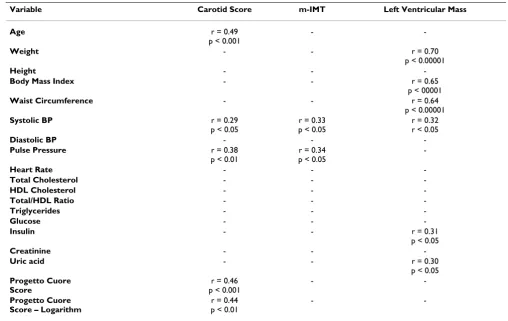
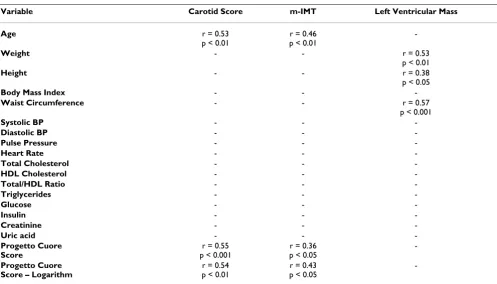
We also divided the subjects according to the sex: in both male (Table 5) and female (Table 6) subjects we con-firmed some significant associations but again the highest one was between the Carotid score and the Progetto Cuore score.
In a multivariate regression analysis (Table 7), we used a model which included factors potentially linked to the Carotid score, to the m-IMT, to the left ventricle mass, and to the urinary albumin/creatinine ratio. For the Carotid score age, sex and pulse pressure maintained a significant association; for the m-IMT there was a low significance also with body mass index. On the contrary sex, pulse pressure and body mass index showed a significant asso-ciation with the LVM.
Table 2: Clinical characteristics of the subjects
Number 84
Sex (Males/Females) 50/34 (59/41%)
Hypertension (Yes/No) 48/36 (57/43%)
Grades of Hypertension:
1 35 (73%)
2 12 (25%)
3 1 (2%)
Types of Dyslipidemia:
Total Cholesterol > 190 73 (87%)
HDL Cholesterol < 40 19 (23%)
Triglycerides > 150 62 (74%)
Smoke (Yes/No) 24/60 (29/71%)
Metabolic Syndrome (Yes/No) 36/48 (43/57%)
Table 3: Parameters of the subjects
Mean SD
Age (years) 52.5 10.05
Weight (kg) 77.53 16.64
Height (cm) 169.67 9.94
Body Mass Index (kg/m2) 26.78 4.41
Waist Circumference (cm) 96.47 13.51
Systolic Blood Pressure (mmHg) 137.34 14.79
Diastolic Blood Pressure (mmHg) 88.2 9.43
Pulse Pressure (mmHg) 49.14 10.26
Heart Rate (bpm) 74.32 8.84
Total Cholesterol (mg/dl) 246.76 49.7
HDL Cholesterol (mg/dl) 52.99 15.7
Total/HDL Cholesterol Ratio 4.94 1.37
Triglycerides (mg/dl) 202.38 85
Glucose (mg/dl) 86.83 13.39
Insulin (μU/ml) 9.86 9.12
Creatinine (mg/dl) 0.85 0.16
Uric Acid (mg/dl) 5.44 1.48
Components of the Metabolic Syndrome 2.29 0.99
Urinary Albumin/Creatinine Ratio (mg/g) 13.92 16.61
Left Ventricle Mass (g) 146.08 40.9
Relative Wall Thickness 0.34 0.08
m-IMT (mm) 0.81 0.22
Carotid Score (A.U.) 2.02 1.77
Univariate correlations between the logarithmic transformation of the Progetto Cuore score (LogCUORE) and the mean intima-media thickness (m-IMT), the Carotid score, and the left ventricular mass (LVM) in all subjects (n. = 84)
Figure 1
Univariate correlations between the logarithmic transformation of the Progetto Cuore score (LogCUORE) and the mean intima-media thickness (m-IMT), the Carotid score, and the left ventricular mass (LVM) in all subjects (n. = 84).
0,4 0,6 0,8 1,0 1,2 1,4 1,6 1,8 m-IMT (mm)
-0,6 0,0 0,6 1,2 1,8
L
o
g
CUORE
0 1 2 3 4 5 6 7 8 9
CAROTID SCORE
60 120 180 240 300
LVM (g) r = 0.3
p < 0.01
r = 0.48 p < 0.00001
r = 0.27 p < 0.02
Table 4: Simple regression analysis – All subjects. Only significant associations are shown.
Variable Carotid Score m-IMT Left Ventricular Mass
Age r = 0.41
p < 0.001
r = 0.23 p < 0.05
-Weight - r = 0.23
p < 0.05
r = 0.75 p < 0.00001
Height - - r = 0.53
p < 0.0001
Body Mass Index - - r = 0.58
p < 00001
Waist Circumference - r = 0.22
p < 0.05
r = 0.66 p < 0.00001
Systolic BP r = 0.26
p < 0.05
r = 0.27 p < 0.01
r = 0.29 r < 0.01
Diastolic BP - - r = 0.26
p < 0.02
Pulse Pressure r = 0.28
p < 0.05
r = 0.3 p < 0.01
-Heart Rate - -
-Total Cholesterol - - r = -0.28
p < 0.01
HDL Cholesterol - - r = -030
p < 0.01
Total/HDL Ratio - -
-Triglycerides - -
-Glucose - -
-Insulin - - r = 0.34
p < 0.01
Creatinine - - r = 0.24
p < 0.05
Uric acid - - r = 0.46
p < 0.0001 Progetto Cuore
Score
r = 0.46 p < 0.001
r = 0.27 p < 0.02
r = 0.28 p < 0.01 Progetto Cuore
Score – Logarithm
r = 0.48 p < 0.00001
r = 0.3 p < 0.01
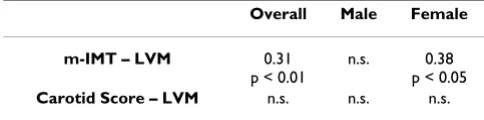
In addition m-IMT was significantly associated with LVM when we considered all the subjects; this association was confirmed in female subjects, instead it was not seen in male subjects (Table 8).
As a final point, the presence of the metabolic syndrome was not able to induce a higher level of damage at the car-diovascular sites (data not shown).
Discussion
Our results show that, in a population with some cardio-vascular risk factors but, as a whole, not at particularly high risk, it is possible to demonstrate a significant corre-lation between a simple risk score, used in clinical practice by italian physicians, and some parameters of target organ damage. This was something already demonstrated with the Framingham risk score and confirmed by recent papers [5-7]. However it is well known that this cardiovas-cular score does not fit perfectly to our population with a tendency to the overestimation of the risk [8,9]: this is the main reason we decided to evaluate the correlation between target organ damage and the Progetto Cuore risk score.
In addition, the absence of the effects of any anti-hyper-tensive and hypolipemic therapy allows us to exclude pos-sible drug effects in terms of reversal of the anatomic damage: this is something the other studies, although with more subjects, had to take into account.
Our population can be considered at not very long expo-sure of traditional risk factors: this can be inferred by the absence of drug therapy for hypertension or dyslipidemia. In fact all the subjects studied in this study were regularly evaluated by their family physicians and, at the appear-ance of an increase of blood pressure or blood lipids, rap-idly sent to our clinic. In addition the age and the absolute levels of those parameters put our subjects on average at low risk of cardiovascular events; again in other studies all the categories of risk were included.
Our clinical evaluations allow to find interesting associa-tions. The most significant is the association between Pro-getto Cuore score and the Carotid score: the associations with m-IMT and LVM were less significant. The reason we used the Carotid score in order to define the damage of the vascular wall was related to the possible different meanings of the intima-media thickness and the plaques
Table 5: Simple regression analysis – Male subjects (n = 50). Only significant associations are shown.
Variable Carotid Score m-IMT Left Ventricular Mass
Age r = 0.49
p < 0.001
-
-Weight - - r = 0.70
p < 0.00001
Height - -
-Body Mass Index - - r = 0.65
p < 00001
Waist Circumference - - r = 0.64
p < 0.00001
Systolic BP r = 0.29
p < 0.05
r = 0.33 p < 0.05
r = 0.32 r < 0.05
Diastolic BP - -
-Pulse Pressure r = 0.38
p < 0.01
r = 0.34 p < 0.05
-Heart Rate - -
-Total Cholesterol - -
-HDL Cholesterol - -
-Total/HDL Ratio - -
-Triglycerides - -
-Glucose - -
-Insulin - - r = 0.31
p < 0.05
Creatinine - -
-Uric acid - - r = 0.30
p < 0.05 Progetto Cuore
Score
r = 0.46 p < 0.001
-
-Progetto Cuore Score – Logarithm
r = 0.44 p < 0.01
-[10,11]: in fact the increase of the intima-media thickness could represent a hypertrophic response of intimal and medial cells to vascular risk factors (hypertension, dyslip-idemia); instead the atherosclerotic plaques could repre-sent a later stage of vascular damage related to endothelial dysfunction and inflammation. A possible confirmation of this hypothesis is the presence of a significant relation-ship between m-IMT and LVM (another parameter mainly affected by the blood pressure levels), but not between LVM and Carotid score: previous studies showed that IMT was more closely associated with LVM than with coronary artery disease [12,13]. The use of a score for the evaluation of the carotid walls was proposed by some groups [14,15];
others suggested the determination of the plaque area [16].
When we performed the simple regression analysis, as a first step we evaluated the all subjects finding the signifi-cant associations shown in Table 4. Subsequently we divided the subjects by sex and we could not confirm all the statistical significances: however Progetto Cuore score maintained a significant association with the Carotid score in both sexes.
The multiple regression analysis was carried out defining a model with possible variables potentially related to both vascular and cardiac damage: for Carotid score we found
Table 6: Simple regression analysis – Female subjects (n = 34). Only significant associations are shown.
Variable Carotid Score m-IMT Left Ventricular Mass
Age r = 0.53
p < 0.01
r = 0.46 p < 0.01
-Weight - - r = 0.53
p < 0.01
Height - - r = 0.38
p < 0.05
Body Mass Index - -
-Waist Circumference - - r = 0.57
p < 0.001
Systolic BP - -
-Diastolic BP - -
-Pulse Pressure - -
-Heart Rate - -
-Total Cholesterol - -
-HDL Cholesterol - -
-Total/HDL Ratio - -
-Triglycerides - -
-Glucose - -
-Insulin - -
-Creatinine - -
-Uric acid - -
-Progetto Cuore Score
r = 0.55 p < 0.001
r = 0.36 p < 0.05
-Progetto Cuore Score – Logarithm
r = 0.54 p < 0.01
r = 0.43 p < 0.05
-Table 7: Multiple regression analysis. Only significant associations are shown.
Variable Carotid Score m-IMT Left Ventricular Mass
Age β = 0.542
p < 0.00001
β = 0.336 p < 0.01
-Sex β = 0.301
p < 0.01
β = 0.236 p < 0.05
β = 0.406 p < 0.0001
Pulse Pressure β = 0.191
p < 0.05
β = 0.235 p < 0.05
β = 0.166 p < 0.05
Tot/HDL Ratio - -
-Glucose - -
-Body Mass Index - β = 0.274
p < 0.05
β = 0.571 p < 0.0001
-significant associations with age, sex and pulse pressure. As for m-IMT, body mass index was significant in addition to the above mentioned variables. Instead with regards to the LVM the significant associations in the multiple regression analysis were with sex, pulse pressure and body mass index. These statistical evaluations suggest that, among modifiable cardiovascular risk factors, blood pres-sure is more important than cholesterol in inducing initial damage of heart and vessels.
An apparent contradiction in our results is a better corre-lation with the Progetto Cuore score exhibited by the carotid damage with respect to the heart: it is well known that the left ventricular hypertrophy is a better prognostic indicator in terms of cardiovascular events. Again we believe that our particular population (subjects with not a long exposure to risk factors) can explain this discrepancy. Only one subject could be considered with left ventricular hypertrophy (according to the ESH-ESC criteria) and in this setting of subjects a thorough vascular evaluation can be more sensitive than the echocardiographic examina-tion.
A final issue of these results is the presence of rather low correlation coefficients, although with good statistical sig-nificance. This is something already shown in similar studies [7], likely related to the fact that the cardiovascular damage can be a marker of risk per se, indipendently of the usual risk factors [17,18].
Conclusion
Our paper confirms previous studies about the associa-tion between a comprehensive risk score and signs of early cardiovascular damage. A temporally limited exposure to cardiovascular risk factors is already able to induce signif-icant changes in both the heart structure and the vascular wall. Among the possible risk factors for these changes blood pressure seems to be the most powerful inducer.
Echographic examination of the cardiovascular system represents a useful tool for a complete prognostic evalua-tion of subjects with different risk factors.
Competing interests
The authors declare that they have no competing interests.
Authors' contributions
AP conceived the study, carried out the clinical evalua-tions, and drafted the manuscript. CG carried out the clin-ical evaluations and the ultrasound examinations. SB participated in the design of the study and helped to draft the manuscript. All the authors read and approved the final manuscript.
References
1. Guidelines Committee: 2003 European Society of Hypertension – European Society of Cardiology guidelines for the manage-ment of hypertension. J Hypertens 2003, 21:1011-1053. 2. National High Blood Pressure Education Program Coordinating
Com-mittee: The seventh report of the Joint National Committee on prevention, detection, evaluation, and treatment of high blood pressure. Hypertension 2003, 42:1206-1252.
3. Expert panel on detection, evaluation, and treatment of high blood cholesterol in adults: Executive summary of the third report of the National Cholesterol Education Program (NCEP) Expert Panel on detection, evaluation and treat-ment of high blood cholesterol in adults (Adult Treattreat-ment Panel III). JAMA 2001, 285:2486-2497.
4. Devereux RB, Alonso DR, Lutas EM, Gottlieb GJ, Campo E, Sachs I, Reichek N: Echocardiographic assessment of left ventricular hypertrophy: comparison to necropsy findings. Am J Cardiol
1986, 57:450-458.
5. Touboul PJ, Labreuche J, Vicaut E, Amarenco P: Carotid intima-media thickness, plaques, and Framingham risk score as independent determinants of stroke risk. Stroke 2005,
36:1741-1745.
6. Touboul PJ, Vicaut E, Labreuche J, Belliard JP, Cohen S, Kownator S, Portal JJ, Pithois-Merli I, Amarenco P: Correlation between the Framingham risk score and intima media thickness: The Paroi Artérielle et Risque Cardio-vasculaire (PARC) study.
Atherosclerosis 2007, 192:363-369.
7. Touboul PJ, Hernandez-Hernandez R, Küçükoğlu S, Woo KS, Vicaut E, Labreuche J, Migom C, Silva H, Vinueza R: Carotid intima media thickness, plaque and framingham cardiovascular score in Asia, Africa/Middle East and Latin America: the PARC-AALA Study. Int J Cardiovasc Imaging 2007, 23:557-567.
8. Bastuji-garin S, Deverly A, Moyse D, Castaigne A, Mancia G, de Leeuw PW, Ruilope LM, Rosenthal T, Chatellier G: The Framingham pre-diction rule is not valid in a European population of treated hypertensive patients. J Hypertens 2002, 20:1973-1980. 9. Brindle P, Emberson J, Lampe F, Walker M, Whincup P, Fahey T,
Ebra-him S: Predictive accuracy of the Framingham coronary risk score in British men: prospective cohort study. BMJ 2003,
327:1-6.
10. Spence JD: Technology insight: ultrasound measurement of carotid plaque – patient management, genetic research, and therapy evaluation. Nat Clin Pract Neurol 2006, 2:611-619. 11. Spence JD, Hegele RA: Noninvasive phenotypes of
atheroscle-rosis. Similar windows but different views. Stroke 2004,
35:649-653.
12. Linhart A, Gariepy J, Giral P, Levenson J, Simon A: Carotid artery and left ventricular structural relationship in asymptomatic men at risk for cardiovascular disease. Atherosclerosis 1996,
127:103-112.
13. Megnien JL, Simon A, Gariepy J, Denarie N, Cocaul M, Linhart A, Lev-enson J: Preclinical changes of extracoronary arterial struc-tures as indicators of coronary atherosclerosis in men. J Hypertens 1998, 16:157-163.
14. Hashimoto H, Kitagawa K, Kuwabara K, Hougaku H, Ohtsuki T, Mat-sumoto M, Hori M: Circulating adhesion molecules are corre-lated with ultrasonic assessment of carotid plaques. Clin Sci
2003, 104:521-527.
15. Irace C, Cortese C, Fiaschi E, Carallo C, Sesti G, Farinaro E, Gnasso A: Components of the metabolic syndrome and carotid atherosclerosis. Role of elevated blood pressure. Hypertension
2005, 45:597-601.
16. Spence JD, Eliasziw M, DiCicco M, Hackam DG, Galil R, Lohmann T:
Carotid plaque area: a tool for targeting and evaluating vas-Table 8: Relation between vascular (m-IMT and Carotid score)
and cardiac parameters (LVM).
Overall Male Female
m-IMT – LVM 0.31
p < 0.01
n.s. 0.38
p < 0.05
Publish with BioMed Central and every scientist can read your work free of charge "BioMed Central will be the most significant development for disseminating the results of biomedical researc h in our lifetime."
Sir Paul Nurse, Cancer Research UK
Your research papers will be:
available free of charge to the entire biomedical community
peer reviewed and published immediately upon acceptance
cited in PubMed and archived on PubMed Central
yours — you keep the copyright
Submit your manuscript here:
http://www.biomedcentral.com/info/publishing_adv.asp
BioMedcentral
17. Touboul PJ, Elbaz A, Koller C, Lucas C, Adraï V, Chédru F, Amarenco P, for the GÉNIC Investigators: Common carotid artery intima-media thickness and brain infarction: the Etude du profil Genetique de l' Infarctus Cerebral (GENIC) case-control study. Circulation 2000, 102:313-318.