Challenges in moving promising new drugs to the marketplace
Although advances in basic and preclinical science continue to fuel the drug discovery pipeline, only a small fraction of compounds in the pipeline meet criteria for approval by the US Food and Drug Administration (FDA) [1]. Current success rates for compounds that reach phase II and phase III clinical trials have dropped to 18% and 50%, respectively [2,3], with failures in the clinic and removal prior to FDA review being attributed to a lack of effi cacy, unidentifi ed toxicities in the preclinical phase, and an ever-changing business strategy for some of the drug developers [2,3]. Since the drug discovery pipeline is both labor and resource intensive, alternative approaches that would enable early indications and potentially more
reliable readouts of toxicity or effi cacy could provide
signifi cant improvements in the success rate and
associated cost benefi ts for this process. To address this challenge in drug development and regu la tory science, the National Center for Advancing Trans lational Sciences (NCATS), through the Cures Acceleration Network and in conjunction with the National Institutes of Health (NIH) Common Fund, has invested $70 million over a 5-year period to launch the Microphysiological Systems (MPS) Program or Organs-on-Chips Program.
The NIH Microphysiological Systems Program targets novel human cell-based systems for predictive drug toxicity
Th e NIH MPS Program is part of a coordinated eff ort between the NIH, the Defense Advanced Research Projects Agency (DARPA), and the FDA to accelerate the development of human MPS that will improve the reliability to identify human drug toxicities and predict the potential effi cacy of a drug in a human population prior to use of the drug in late-stage clinical studies. While the NIH and DARPA independently fund and manage their own MPS programs, coordination of these programs occurs through biannual meetings with NIH and DARPA investigators. Th ese meetings provide oppor-tunities not only to share advances in platform develop-ment, cell source characterization, but also to establish collaborations that will help accelerate the development, validation and integration of robust human MPS.
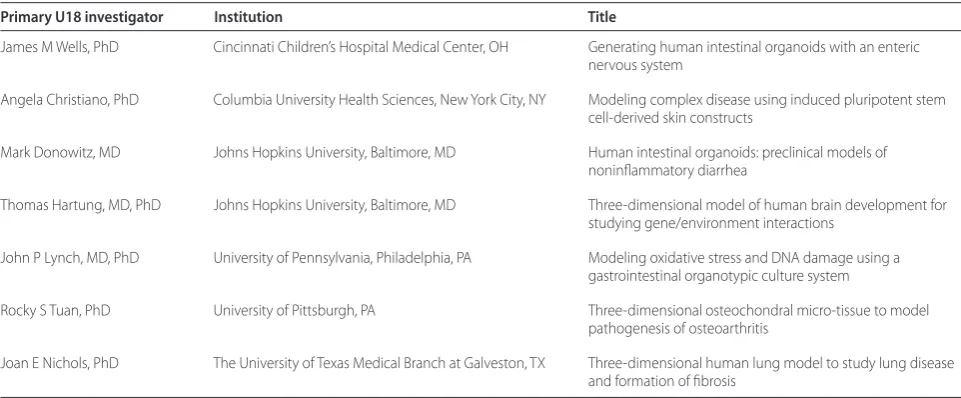
Th e goal of the NIH MPS Program is to create and integrate MPS that utilize human primary or stem cell sources, which are sustainable over a 4-week period and functionally represent the 10 major organ systems: circulatory, respiratory, integumentary, reproductive, endo crine, gastrointestinal, nervous, urinary, musculo-skeletal, and immune. Th e 19 investigators funded under the MPS Program are supported through 2-year (Table 1) and 5-year (Table 2) cooperative agree ments, where annual milestones determine the success ful progression Abstract
The National Institutes of Health has partnered with the US Food and Drug Administration and the Defense Advanced Research Projects Agency to accelerate the development of human microphysiological systems (MPS) that address challenges faced in predictive toxicity assessment and effi cacy analysis of new molecular entities during the preclinical phase of drug development. Use of human MPS could provide better models for predicting the effi cacy of new molecular entities in clinical trials. It is also anticipated that improvements in predicting drug toxicities early in the drug development process through the use of MPS or human organs-on-a-chip will decrease the need to withdraw new therapies from the market and minimize or eliminate deaths due to unidentifi ed drug toxicities.
© 2010 BioMed Central Ltd
The National Institutes of Health
Microphysiological Systems Program focuses on a
critical challenge in the drug discovery pipeline
Margaret L Sutherland*
1, Kristin M Fabre*
2and Danilo A Tagle
2I N T R O D U C T I O N Open
Access
*Correspondence: [email protected]; [email protected] 1National Institute of Neurological Disorders and Stroke, National Institutes of Health, 6001 Executive Blvd., Bethesda, MD 20892, USA
2National Center for Advancing Translational Sciences, National Institutes of Health, 6701 Democracy Blvd., Bethesda MD 20892, USA
© 2013 The article is a work of the United States Government; Title 17 U.S.C 105 provides that copyright protection is not available for any work of the United States government in the United States; licensee BioMed Central Ltd.
of each project. Th e MPS cooperative agreement mechanism also facilitates monthly reviews of progress on individual projects where scientifi c program staff , representing 15 NIH institutes, provide advice on system metrics and assist in the identifi cation of available resources that can help achieve the aggressive timelines of the program. To further serve the objectives of the cooperative agreement, the MPS Program has imple men-ted a communications interface sponsored by NCATS, which is design to facilitate information exchange and the development of MPS organ and cell source standards among the investigators.
Th e concept of developing standards around the microphysiological organ systems under development by NIH investigators is driven by the need to provide a MPS consensus view on the minimal functional requirements of a system to accurately mimic the function of the human organ. A similar approach is being applied to the induced pluripotent stem cell sources being utilized in MPS development, wherein any induced pluripotent stem cell source must: demonstrate a normal karyotype; be free of bacterial and mycoplasma contamination; demon-strate expression of stem cell markers; demon strate successful silencing of transgenes used in the reprogram-ming phase; and have the ability to diff er entiate along mesoderm, ectoderm and endoderm germ layer lineages.
Th rough the development of MPS and cell source
standards, collaborations and information ex change, it is anticipated that within the next 5 years the collective eff orts of the NIH grantees will culminate in MPS that will provide improved research tools for effi cacy and toxicology screening of new molecular entities.
To evaluate the potential improvement MPS provide over traditional in vivo animal toxicology, a set of training compounds has been selected based on known toxicities in the human population. Th is training set of compounds addresses organ-specifi c toxicities that will be tested across the various MPS platforms. A second set of drugs, where the identity is blinded to the investigators, will be used for validation to ensure an unbiased evaluation of the reliability and predictability of these systems. Th e global application of MPS in new drug toxicity and effi cacy testing, and recognition of these systems by regulatory agencies such as the FDA, will require co-ordination with standards agencies like the International Conference on Harmonization. Th e International Con-fer ence on Harmonization has developed a compre-hensive set of safety guidelines to uncover potential risks such as carcinogenicity, genotoxicity and reprotoxicity, and these safety guidelines have been adopted by international regulatory agencies.
Defense Advanced Research Projects Agency and US Food and Drug Administration
To provide advanced engineering and platform develop-ment that will support the integration of 10 human organ systems onto a single platform with a biofl uidics infrastructure that can link the various organ systems, a parallel and complementary eff ort to the NIH MPS
Program is funded by DARPA. Dr Linda Griffi th
(Massachusetts Institute of Technology, MA) and Dr Don Ingber (Wyss Institute, Harvard University, MA) are DARPA investigators tasked with the stepwise integration and validation of 10 human organ systems onto a shared Table 1. The U18: 2-year funded National Institutes of Health Microphysiological Systems Program investigators
Primary U18 investigator Institution Title
James M Wells, PhD Cincinnati Children’s Hospital Medical Center, OH Generating human intestinal organoids with an enteric nervous system
Angela Christiano, PhD Columbia University Health Sciences, New York City, NY Modeling complex disease using induced pluripotent stem cell-derived skin constructs
Mark Donowitz, MD Johns Hopkins University, Baltimore, MD Human intestinal organoids: preclinical models of noninfl ammatory diarrhea
Thomas Hartung, MD, PhD Johns Hopkins University, Baltimore, MD Three-dimensional model of human brain development for studying gene/environment interactions
John P Lynch, MD, PhD University of Pennsylvania, Philadelphia, PA Modeling oxidative stress and DNA damage using a gastrointestinal organotypic culture system
Rocky S Tuan, PhD University of Pittsburgh, PA Three-dimensional osteochondral micro-tissue to model pathogenesis of osteoarthritis
Joan E Nichols, PhD The University of Texas Medical Branch at Galveston, TX Three-dimensional human lung model to study lung disease and formation of fi brosis
platform that supports the viability of the integrated systems for a 4-week period. Like the NIH MPS Program, the DARPA Program represents a 5-year, $75 million commitment.
As defi ned in a memorandum of understanding between the NIH and the FDA, for the NIH MPS Program the FDA provides key guidance for development of robust compound libraries and physiological readouts that refl ect toxicities both within a single organ system and across multiple organ systems.
Why animal models can fail
Th e challenge of accurately predicting drug toxicities and effi cacies is in part due to inherent species diff erences in drug metabolizing enzyme activities [4,5] and cell type-specifi c sensitivities to toxicants [5]. For example, a dramatic diff erence between rat and human drug meta-bo lism is demonstrated by the metameta-bolism of coumarin. Species diff erences in coumarin toxicity appear to be
mediated through two major phase I metabolic pathways. Th e fi rst involves the conversion of coumarin by cyto-chrome P450 CYP2A enzymes to the nontoxic metabolite 7-hydroxycoumarin. Whereas in humans this reaction is very effi cient, in rats CYP2A enzymes preferentially catalyze 7α-hydroxylation of testosterone rather than coumarin 7-hydroxylation [6] and therefore the forma-tion of 7-hydroxycoumarin is extremely low in rats and the lack of 7-hydroxycoumarin is thought to render rats more susceptible to hepatotoxicity [7]. Th e second path-way involves detoxifi cation of the epoxide intermediate coumarin 3,4-epoxide. In humans, coumarin 3,4-epoxide spontaneously rearranges to o-hydroxyphenyl acetal-dehyde, which is further detoxifi ed by oxidation to o -hydroxyphenylacetic acid. In rats, this conversion to o -hydroxyphenylacetic acid is 50 times lower than in humans, and represents a second major species diff er-ence in coumarin-mediated heptotoxicity [8]. Certainly, a clear understanding of the role of drug metabolism in Table 2. The UH2/UH3: 5-year funded National Institutes of Health Microphysiological Systems Program investigators
Primary UH2 investigators Institution Title
Gordana Vunjak-Novakovic, PhD Columbia University in the City of New York, NY Integrated heart–liver–vascular systems for drug testing in human health and disease
Michael L Shuler, PhD and James J Hickman, PhD
Cornell University, Ithaca, NY and University of Central Florida, FL
Microphysiological systems and low-cost microfl uidic platform with analytics
George A Truskey, PhD Duke University, Durham, NC Circulatory system and integrated muscle tissue for drug and tissue toxicity
Kevin K Parker, PhD Harvard University, Cambridge, MA Human cardiopulmonary system on a chip
Linda G Griffi th, PhD Massachusetts Institute of Technology, Cambridge, MA All-human microphysical model of metastasis and therapy
James A Thomson, VMD, PhD Morgridge Institute for Research at the University of Wisconsin-Madison, WI
Human induced pluripotent stem cell and embryonic stem cell-based models for predictive neural toxicity and teratogenicity
Teresa K Woodruff , PhD Northwestern University, Chicago, IL Ex vivo female reproductive tract integration in a three-dimensional microphysiologic system
Kevin E Healy, PhD and Luke P Lee, PhD
University of California, Berkeley, CA Disease-specifi c integrated microphysiological human tissue models
Steven C George, MD, PhD University of California, Irvine, CA An integrated in vitro model of perfused tumor and cardiac tissue
D Lansing Taylor, PhD and Martin L Yarmush, MD, PhD
University of Pittsburgh, PA and Rutgers University, NJ Three-dimensional biomimetic liver sinusoid construct for predicting physiology and toxicity
Jonathan Himmelfarb, MD University of Washington, Seattle, WA A tissue-engineered human kidney microphysiological system
John P Wikswo, PhD, Damir Janigro, PhD, Donna Webb, PhD and Kevin Niswender, PhD
Vanderbilt University, Nashville, TN Neurovascular unit on a chip: chemical communication, drug and toxin responses
toxicity and potential species diff erences in response to toxic metabolites will aid in the development of safer drugs.
Inherent diff erences in cell type-specifi c sensitivities between species may also be an important diff erentiating factor for the prediction of drug toxicities. An example of diff erential cell toxicities across species is observed with bizelesin, a potent synthetic derivative of the anticancer agent CC-1065 that preferentially alkylates and binds the minor groove of DNA. Results with myelopoietic cells in vitro, in the absence of liver metabolism, reproduced in vivo species diff erences in myelosuppression, hence showing that murine cells are 1,000-fold more sensitive than human or canine cells [9]. In the case of the anti-diabetic drug troglitazone, metabolism by CYP3A4 and CYP3a1 in human and rat, respectively, results in a reactive quinone intermediate that can bind to proteins and nucleic acids and can potentially produce oxidative stress through the generation of reactive oxygen species via redox cycling or depletion of the oxidative stress protective tripeptide, glutathione. Using rat and human hepatocyte monolayer cultures, Lauer and colleagues demonstrated strong species diff erences and marked alterations in expressions of genes involved in xenobiotic metabolism as well as oxidative stress after treatment with troglitazone [6]. Th e higher sensitivity of human hepatocytes towards troglitazone treatment in contrast to the weaker eff ects observed in rat hepatocytes at least partially ex plains why the strong hepatotoxic eff ects of troglitazone in the human population could not be predicted from regulatory animal studies [6]. Th e results of these in vitro studies suggest that in addition to diff erences in drug metabolism, target cell sensitivity diff erences may also account for species diff erences in toxicity.
A review of FDA-approved drugs released from 1975 to 1999 estimated that 2.9% of these marketed drugs were withdrawn from the market due to severe adverse drug eff ects [10]. According to Temple and Himmel, hepato-toxicity was the most frequent single reason for removing drugs from the market during this timeframe, and probably will still be the most important single toxicity leading to withdrawal or signifi cant modifi cation of labeling for FDA-approved drugs going forward [11]. Examples of drugs removed from the market due to hepatoxicity during this time period include ticry nafen, benoxaprofen, bromfenac, and troglitazone. In addition to hepatoxicity, six drugs were withdrawn from the market because of hemolytic anemia (nomifensine maleate), hemolytic anemia, renal and hepatic injury (temafl oxacin), thromboembolism (azaribine), anaphy-laxis (zomepirac sodium), acute but reversible renal failure (suprofen), and increased mortality (fl osequinan). Based on estimates from Lasser and colleagues, the
probability of a new drug acquiring black box warnings or being withdrawn from the market over 25 years is approximately 20% [12]. Th rough development of human cell-based MPS, it is hoped that toxicities as mentioned above will be detected earlier, preferably during the preclinical phase of drug development.
Given the list of FDA drugs withdrawn due to un-predicted toxicities in the human population, a key goal of the NIH MPS Program is to accurately evaluate the predictive value of these systems in determining drug toxicity and effi cacy. Th is goal can be achieved through either development of a single microphysiological system, such as a liver organoid system that can reliably predict human hepatoxicity, or through a more complex platform where multiple MPS predict multiorgan toxicities to a given challenge drug. Th e multisystem platform approach will also assist in understanding the time dependence and magnitude of drug–drug interactions; for instance, how one drug may increase the blood concentration of another, as seen in the eff ect of mibefradil on midazolam blood concentrations [12]. Understanding the limitations of these model systems will also be important. For instance, in cases where recognition of toxicity in the human population has been delayed – such as seen in the marked hypo tension with clozapine, the pulmonary fi brosis and marrow tox icity with tocainide, the valvulopathy asso ciated with fenfl uramine hydrochloride and the sub-arachnoid hemorrhage associated with phenyl propanol-amine [13] – the application of relatively short-term exposures of drugs in the MPS may limit the predictive value of the system for delayed toxicities.
National Center for Advancing Translational Sciences and the Microphysiological Systems Program
Th e MPS Program is an excellent fl agship program for NCATS, established in 2011 with a mission to catalyze the generation of innovative methods and technologies that will enhance the development, testing, and implementation of diagnostics and therapeutics across a
wide range of diseases and conditions. Th e
Abbreviations
CYP, cytochrome P450; DARPA, Defense Advanced Research Projects Agency; FDA, US Food and Drug Administration; MPS, microphysiological systems; NCATS, National Center for Advancing Translational Sciences; NIH, National Institutes of Health.
Competing interests
The authors declare that they have no competing interests.
Acknowledgement
The publication costs for this article were funded by the NIH Common Fund.
Declarations
Publication of this supplement has not been supported by sponsorship. Articles have undergone the journal’s standard review process. The Editors declare that they have no competing interests.
This article has been published as part of Stem Cell Research & Therapy
Volume 4 Supplement 1, 2013: Stem cells on bioengineered microphysiological platforms for disease modeling and drug testing. The full contents of the supplement are available online at http://www.stemcellres.com/supplements/4/S1.
Published: 20 December 2013
References
1. Collins FS: Reengineering translational science: the time is right.Sci Transl Med 2011, 3:90-17.
2. Arrowsmith J: Trial watch: phase II failures: 2008–2010.Nat Rev Drug Discov
2011, 10:328-329.
3. Arrowsmith J: Trial watch: phase III and submission failures: 2007–2010.
Nat Rev Drug Discov 2011, 10:87.
4. Martignoni M, Groothuts GMM, de Kanter R: Species diff erences between mouse, rat, dog, monkey and human CYP-mediated drug metabolism, inhibition and induction. Expert Opin Drug Metab Toxicol 2006, 2:875-894.
5. Li AP: Evaluation of metabolism-based drug toxicity in drug development.
Chem Biol Interact 2009, 179:1-3.
6. Lauer B, Tuschl G, Kling M, Mueller SO: Species-specifi c toxicity of diclofenac
and troglitazone in primary human and rat hepatocytes.
Chemico-Biological Interactions 2009, 179:17-24.
7. Pearce R, Greenway D, Parkinson A: Species diff erences and inter-individual variation in liver microsomal cytochrome P450 2A enzymes: eff ects on coumarin, dicoumarol and testosterone oxidation. Arch Biochem 1992,
298:211-225.
8. Lake BG: Coumarin metabolism, toxicity and carcinogenicity: relevance for human risk assessment.Food Chem Toxicol 1999, 37:423-453.
9. Vassallo JD, Hicks SM, Daston GP, Lehman-McKeeman LD: Metabolic detoxifi cation determines species diff erences in coumarin-induced hepatotoxicity.Toxicol Sci 2004, 80:249-257.
10. Volpe DA, Tomaszewski JE, Parchment RE, Garg A, Flora KP, Murphy MJ, Grieshaber CK: Myelotoxic eff ects of the bifunctional alkylating agent bizelesin on human, canine and murine myeloid progenitor cells.Cancer Chemother Pharmacol 1996, 39:143-149.
11. Temple RJ, Himmel MH: Safety of new approved drugs: implication for prescribing.JAMA 2002, 287:2273-2275.
12. Lasser KE, Allen PD, Wollhandler SJ, Himmelstein DU, Wolfe SM, Bor DH:
Timing of new black box warnings and withdrawls for prescription medications.JAMA 2002, 287:2215-2220.
13. Sekiguchi N, Kato M, Takada M, Watanabe H, Takata S, Mitsui T, Aso Y, Ishigai M: Quantitative prediction of mechanism-based inhibition caused by mibefradil in rats. Drug Metab Dispos 2011, 39:1255-1262.
doi:10.1186/scrt361