The Journal of Threatened Taxa (JoTT) is dedicated to building evidence for conservation globally by publishing peer-reviewed articles online every month at a reasonably rapid rate at www.threatenedtaxa.org. All articles published in JoTT are registered under Creative Commons Attribution 4.0 International License unless otherwise mentioned. JoTT allows allows unrestricted use, reproduction, and distribution of articles in any medium by providing adequate credit to the author(s) and the source of publication.
www.threatenedtaxa.org
ISSN 0974-7907 (Online) | ISSN 0974-7893 (Print) Building evidence for conservation globally
Journal of Threatened Taxa
For Focus, Scope, Aims, Policies, and Guidelines visit https://threatenedtaxa.org/index.php/JoTT/about/editorialPolicies#custom-0
For Article Submission Guidelines, visit https://threatenedtaxa.org/index.php/JoTT/about/submissions#onlineSubmissions
For Policies against Scientific Misconduct, visit https://threatenedtaxa.org/index.php/JoTT/about/editorialPolicies#custom-2 For reprints, contact <[email protected]>
Note
Pollinators of Sikkim Mandarin Orange Citrus reticulata
(Sapindales: Rutaceae)
Urbashi Pradhan & M. Soubadra Devy
26 March 2019 | Vol. 11 | No. 5 | Pages: 13625–13628 DOI: 10.11609/jott.4528.11.5.13625-13628
Partner
Member
Threatened Taxa
Publisher & Host
PLATINUM OPEN ACCESS
13625 to 2013. These orange orchards
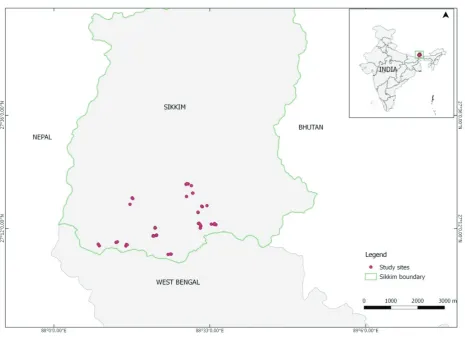
were selected within an altitudinal gradient of 700–1,452 m and were spread across 316km2 (Fig. 1).
Pollinator visitation: At each site, 150 flowers were tagged and observed from 08.00–17.00 h to record insect species that visit them. Intra-floral foraging behavior of each insect species was carefully
observed to note whether it is a pollinator or a forager. SMO bear self-fertile, bisexual flowers and pollen movement is facilitated by pollinators. Transparent plastic bags were used to trap insects visiting the flowers to avoid any fruit loss during their collection. Collected samples were preserved in 70% ethanol and subsequently identified in the laboratory. Insects which were not seen touching the flower reproductive parts were not collected for identification.
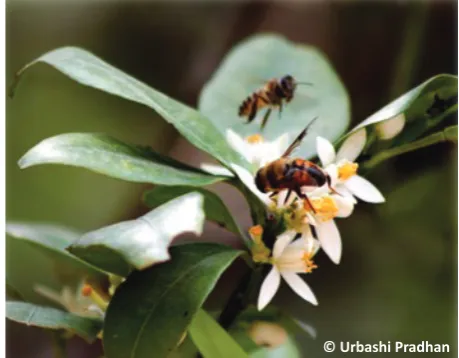
We recorded 24 species of insects during the study period (2011–2013). Common Honey Bee Apis cerana was the most dominant pollinator followed by hoverflies belonging to eight genera, namely, Episyrphus sp., Melanostoma sp., Ischiodon sp., Eristalis sp., Eristalinus sp., Scaeva sp., Episyrphus sp.,and Eupeodes sp. (Image 1,2) . This was followed by stingless bees (Hymenoptera), seed bug (Hemiptera), and beetles (Coleoptera) that were sparse visitors. Recorded insects were both pollen and nectar feeders. Bees (Hymenoptera) and hoverflies (Diptera) visited flowers in groups while most of the
No
te
DOI:https://doi.org/10.11609/jott.4528.11.5.13625-13628 | ZooBank: urn:lsid:zoobank.org:pub:8120DF28-84C5-48D0-B1DF-2F6C8F8312C3
Editor: Kannan C.S. Warrier, Institute of Forest Genetics and Tree Breeding, Coimbatore, India. Date of publication: 26 March 2019 (online & print)
Manuscript details: #4528 | Received 28 August 2018 | Final received 06 February 2019 | Finally accepted 16 March 2019
Citation:Pradhan, U. & M.S. Devy (2018). Pollinators of Sikkim Mandarin Orange Citrus reticulata (Sapindales: Rutaceae). Journal of Threatened Taxa 11(5):
13625–13628. https://doi.org/10.11609/jott.4528.11.5.13625-13628
Copyright: © Pradhan & Devy 2019. Creative Commons Attribution 4.0 International License. JoTT allows unrestricted use, reproduction, and distribution of this article in any medium by adequate credit to the author(s) and the source of publication.
Funding: Department of Science and Technology, Government of India;
National Mission for Himalayan Studies (NMHS) under the Ministry of Environment, Forest and Climate Change, Government of India (NMHS/2015-16/HF11/11).
Competing interests:The authors declare no competing interests.
Acknowledgements: We would like to thank Dr Belavadi, Dr Yashwanth and Dr Arathi at GKVK, Bangalore and Dr Kumar Ghorpade, at University of Agricultural Science, Dharwad for helping us identify our pollinator samples. We are immensely grateful to the people of the study villages for their hospitality and support. The officials of the Department of Horticulture and Cash Crop, especially Mr K.K. Singh, ex- Principal Secretary, Mr Khorlo Bhutia, the present Principal Secretary, Mr P.T. Bhutia and field staffs were all generously helpful. We would like to thank the Forest Department officials, PCCF Mr S.T.Lachungpa and PCCF Dr Thomas Chandy, Mrs Usha Lachungpa (Ex- Scientific officer) for giving the necessary permission to work in Sikkim. We take this opportunity to thank the donors—Department of Biotechnology, Government of India and National Mission on Himalayan Studies(NMHS), The Ministry of Environment, Forest & Climate Change (MoEF&CC) —who generously funded this research.
Pollinators of Sikkim Mandarin Orange
Citrus reticulata (Sapindales: Rutaceae)
Urbashi Pradhan 1 & M. Soubadra Devy 2
1,2 Ashoka Trust for Research in Ecology and the Environment (ATREE),
Royal Enclave, Srirampura, Jakkur, Bengaluru, Karnataka 560064, India.
1 Manipal Academy of Higher Education,Tiger Circle Road, Madhav Nagar, Manipal, Karnataka 576104, India
1 [email protected] (corresponding author), 2[email protected]
ISSN 0974-7907 (Online) ISSN 0974-7893 (Print)
PLATINUM OPEN ACCESS
Journal of Threatened Taxa | www.threatenedtaxa.org | 26 March 2019 | 11(5): 13625–13628
Sikkim Mandarin Orange (Citrus reticulata Blanco, 1837) is a member of the Rutaceae family and a commercially desirable variety of the mandarin group native to Sikkim. The Sikkim Mandarin Orange (SMO) growing area lies at an altitudinal range of 700–1,500 m and it is an annual flowering plant. Mandarin orange is dependent on bees for its pollination and pollinators help in higher yield and increased fruit set (ICIMOD 2003). Irrespective of large cardamom yield decline due to pollinator deficiency in Sikkim (Sinu & Shivanna 2007), till date there exists no systematic study on the range of pollinators for SMO. This study aims to bridge this gap especially when a large proportion of farmers are dependent on the SMO for cash income.
Journal of Threatened Taxa | www.threatenedtaxa.org | 26 March 2019 | 11(5): 13625–13628
Pollinators of Sikkim Mandarin Orange Pradhan & Devy
13626
beetles and seed bugs visited individually. All the insects landed on the petal and foraged for pollen placed on top of the flower and nectar at the flower base. In this process all the insects invariably touch both anther and stigma of SMO flower. An insect visitor was called a pollinator when the ventral side of insect’s body containing pollen load touched the reproductive part of flowers.
SMO is an evergreen plant showing flowering response to early monsoon shower starting in the mid of February. Flowering period lasts for a month, from late February to early April. Orchards in the lower altitude starts flowering earlier followed by orchards in the higher altitudes. Flowers are white in colour with strong scent attracting a range of insects for pollination. Highlighting the importance of pollinators of the mandarin orange, in a study conducted by the International Center for Integrated Mountain Development (2003), pollination was seen to increase the yield of mandarin orange by four times compared to pollinator excluded flowers. Honey bee (Apis sp.) has been reported as a major pollinator of different varieties of Citrus sp. from across the world, for example, Mandarin orange Citrus reticulata in Nepal
is pollinated by A. cerana, A. dorsata, A. florea, and A. mellifera (International Center for Integrated Mountain Development 2003). Kinnow Citrus reticulata, a hybrid between mandarin orange and sweet lime, was reported to be pollinated by A. dorsata and A. florea in Pakistan (Manzoorul-Haq et al. 1978). Results of our study show only A. cerana visited mandarin orange flowers, while A. dorsata or A. florea, which were recorded in other studies, were not observed even outside our experiment sites during the study period. Hoverflies, although not reported as pollinators of mandarin oranges earlier, are known to pollinate rapeseed oil (Jauker & Wolters 2008), apple (Solomon & Kendall 1970), and strawberries (Kendall et al. 1971). Both bees and flies visited flowers in groups and visited more than one flower at a time, possibly aiding in cross/sexual pollination (Raju et al. 2012). Visits by other taxa such as butterflies, stingless bees, and beetles to orange flowers were less in comparison to bees and flies. However, the importance of these wild pollinators in sustaining pollination of SMO needs further exploration.
Pollinators of Sikkim Mandarin Orange Pradhan & Devy
Journal of Threatened Taxa | www.threatenedtaxa.org | 26 March 2019 | 11(5): 13625–13628 13627
Table 1. Pollinators of Sikkim Mandarin Orange.
Order Family Sub family Genus Species Altitude range Forage collected
1 Coleoptera Coccinellidae Coccinellidae Oenopia kirbyi (Mulsant) 700–1400 nectar + pollen
2 Scarabaeidae Rutelinae Anomala sp. 700–1400 nectar + pollen
3 Scarabaeidae Citoniinae Clinteria sp. 700–1400 nectar + pollen
4 Chrysomelidae Eumolpinae Chrysonopa sp. 700–1400 nectar + pollen 5 Chrysomelidae Galerucinae Galerucinae sp. 700–1400 nectar + pollen 6 Diptera Calliphoridae Chrysomyinae Chrysomya sp. 1000–1400 nectar + pollen
7 Rhiniidae Rhiniinae Rhinia sp. 0800–1400 nectar + pollen
8 Sarcophagidae Paramacronychiinae Wohlfartia sp. 0800–1400 nectar + pollen
9 Syrphidae Syrphinae Episyrphus sp. 0800–1400 nectar + pollen 10 Syrphidae Syrphinae Melanostoma sp. 900–1400 nectar + pollen 11 Syrphidae Syrphinae Ischiodon scutellaris (Fabricius) 0800–1400 nectar + pollen 12 Syrphidae Eristalinae Eristalis tenax (Linnaeus) 0800–1400 nectar + pollen 13 Syrphidae Syrphinae Scaeva pyrastri (Linnaeus) 900–1400 nectar + pollen 14 Syrphidae Syrphinae Eupeodes confrater (Wiedemann) 900–1400 nectar + pollen 15 Syrphidae Eristalinae Eristalinus taeniops (Wiedemann) 900–1400 nectar + pollen 16 Syrphidae Syrphinae Episyrphus Viridaureus 900–1400 nectar + pollen 17 Syrphidae Eristalinae Eristalis basifemorata(Brunetti) 700–1400 nectar + pollen 18 Hemiptera Lygaeidae Lygaeinae Spilostethus pandurus (Scopoli) 700–1400 nectar + pollen
19 Lygaeidae Lygaeinae Graptostethus incertus (Walker) 700–1400 nectar + pollen
20 Largidae Physopeltinae Physopelta gutta gutta(Burmeister) 700–1400 nectar + pollen
21 Hymenoptera Halictidae Halictinae Seladonia sp sp. 700–1200 nectar + pollen 22 Halictidae Halictinae Lasioglossum sp. 700–1200 nectar + pollen
23 Apidae Apinae Apis cerana 700–1500 nectar + pollen
24 Apidae Apinae Tetragonula sp. 800–1200 nectar + pollen
Image 2. Apis cerana and Eristalis sp. visiting Sikkim Mandarin
Orange flowers.
Image 1. Apis cerana pollinating Sikkim Mandarin Orange flower.
Journal of Threatened Taxa | www.threatenedtaxa.org | 26 March 2019 | 11(5): 13625–13628
Pollinators of Sikkim Mandarin Orange Pradhan & Devy
13628
Threatened Taxa References
DHCCD (2015). AgriSkm. Available from: http://sikkimagri.gov.in/
General/Eng/CropsDetails.aspx?ID=23. Accessed on 22 September
2015.
ICIMOD (2003). A report: Cash Crop Farming in Nepal: The
importance of pollinator diversity and managed pollination in
Citrus. International Center for Integrated Mountain Development Jawalakhel, Kathmandu, Nepal, 49pp
Jauker, F. & V. Wolters (2008). Hover flies are efficient pollinators of
oilseed rape. Oecologia 156: 819–823. https://doi.org/10.1007/
s00442-008-1034-x
Kendall, D.A., D. Wilson, C.G. Guttridge & H.M. Anderson (1971).
Testing Eristalis as a pollinator of covered crops. Long Ashton Res
Stn Rep 1971: 120–121.
Manzoorul-Haq, M. Rafie-ul-Din & A. Ghaffar (1978). Effect of insect
pollination on fruit bearing in Kinnow mandarin (Citrus reticulata),
and physical and chemical properties of the fruit. Journal of
Apicultural Research 17: 47–49.
Raju, A.J.S., P.V.S. Rao, R. Kumar & S.R. Mohan (2012). Pollination
biology of the crypto-viviparous Avicennia species (Avicenniaceae).
Journal of Threatened Taxa 4: 3377–3389.https://doi.org/10.11609/
JoTT.o2919.3377-89
Sinu, P.A. & K.R. Shivanna (2007). Pollination biology of large
cardamom (Amomum subulatum). Current Science 93: 548–552.
Solomon, M.E. & D.A. Kendall (1970). Pollination by the syrphid fly,
Eristalis tenax. Available online at http://agris.fao.org/agris-search/ search.do?recordID=XE20122001901. Accessed on 17 September
ISSN 0974-7907 (Online) | ISSN 0974-7893 (Print)
March 2019 | Vol. 11 | No. 5 | Pages: 13511–13630 Date of Publication: 26 March 2019 (Online & Print)
DOI: 10.11609/jott.2019.11.5.13511-13630 www.threatenedtaxa.org
The Journal of Threatened Taxa (JoTT) is dedicated to building evidence for conservation globally by publishing peer-reviewed articles online every month at a reasonably rapid rate at www.threatenedtaxa.org. All articles published in JoTT are registered under Creative Commons Attribution 4.0 International License
unless otherwise mentioned. JoTT allows allows unrestricted use, reproduction, and distribution of articles in any medium by providing adequate credit to the author(s) and the source of publication.
Article
Factors affecting diversity and distribution of threatened birds in Chitwan National Park, Nepal
– Jagan Nath Adhikari, Bishnu Prasad Bhattarai & Tej Bahadur Thapa, Pp, 13511–13522
Communications
Encounter rates and group sizes of diurnal primate species of Mole National Park, Ghana
– Edward Debrah Wiafe, Pp. 13523–13530
Estimating Leopard Panthera pardus fusca (Mammalia: Carnivora: Felidae) abundance in Kuno Wildlife Sanctuary, Madhya Pradesh, India
– Devavrat Pawar, Howard P. Nelson, Divya R.L. Pawar & Sarika Khanwilkar, Pp. 13531–13544
Food composition of Indian Eagle Owl Bubo bengalensis Franklin (Aves: Strigiformes: Strigidae) from Tiruchirappalli District, Tamil Nadu, India
– Tamilselvan Siva, Periyasamy Neelanarayanan & Vaidyula Vasudeva Rao, Pp. 13545–13551
Short Communications
Sunda Pangolin Manis javanica (Mammalia: Pholidota: Manidae) of Gaya Island, Sabah
– Jephte Sompud, Cynthia Boon Sompud, Kurtis Jai-Chyi Pei, Nick Ching-Min Sun, Rimi Repin & Fred Tuh, Pp. 13552–13556
Distribution and morphometric measurements of Blanford’s Fox
Vulpes cana (Mammalia: Carnivora: Canidae) of the Kingdom of
Saudi Arabia
– Abdulhadi Aloufi & Ehab Eid, Pp. 13557–13562
Sebaceous gland adenoma in a free-ranging Baird’s Tapir
Tapirus bairdii (Tapiridae: Perissodactyla)
– Randall Arguedas, Maricruz Guevara-Soto & Jorge Rojas-Jiménez, Pp. 13563–13566
Recent records of the Banded Racer Argyrogena fasciolata (Shaw, 1802) (Reptilia: Squamata: Colubridae) from southern Coromandel Coast, peninsular India
– Janani Sagadevan, Sumaithangi Rajagopalan Ganesh, Nitesh Anandan & Raveen Rajasingh, Pp. 13567–13572
A new species of Simulium (Simulium) (Diptera: Simuliidae), with
keys to S.striatum species-group from India
– Sankarappan Anbalagan, Suryliyandi Vijayan, Chellapandian Balachandran & Sundaram Dinakaran, Pp. 13573–13578
New host records of polyphagous Lepidoptera on Ban Oak
Quercus leucotrichophora A. Camus (Fabaceae) in the
Garhwal Himalaya, India
– Arun Pratap Singh, Kalpana Bahuguna & Gaurav Chand Ramola, Pp. 13579–13591
A preliminary study of the hawkmoth diversity (Lepidoptera: Sphingidae) of Kanyakumari District, Tamil Nadu, India
– Geetha Iyer & Ian James Kitching, Pp. 13592–13604
Calamus pseudoerectus (Arecaceae), a new species from the
eastern Himalaya, India
– Sujit Mondal, Shyamal K. Basu & Monoranjan Chowdhury, Pp. 13605–13610
Weed diversity in rice crop fields of Fatehgarh Sahib District, Punjab, India
– Yadvinder Singh & Rai Singh, Pp. 13611–13616
Observations on the female flowers and fruiting of Tape Grass
Enhalus acoroides from South Andaman Islands, India
– Vardhan Patankar, Tanmay Wagh & ZoyaTyabji, Pp. 13617–13621
Notes
First records of Agnidra vinacea (Moore, 1879) (Lepidoptera: Drepanidae: Drepaninae) from the western Himalaya, extending its known range westwards
– Pritha Dey & Sanjay Sondhi, Pp. 13622–13624
Pollinators of Sikkim Mandarin Orange Citrus reticulata (Sapindales: Rutaceae)
– Urbashi Pradhan & M. Soubadra Devy, Pp. 13625–13628
Book Review
A holistic look on birds in urban areas
– S. Suresh Ramanan & Lalit Upadhyay, Pp. 13629–13630