Copyright © 2014 IJECCE, All right reserved
The Bionic Man: Future Super Human
M. S. Sachin
Abstract – When I hear the phrase “human implantable
electronics,” I must confess that I feel a bit queasy. It conjures up a more extreme image of pervasive computing than is usually justified. However, my perspective is that of a relatively healthy person in his 40s, without any physical handicaps. If my hearing was impaired or my heartbeat arrhythmic, I might be keen to find a remedy and, at this time, an electronic implant would probably be the way to go. Putting my emotional reaction aside, when I think about the possibilities of implantable technology, it actually begins to sound pretty cool.
Humans do some Work well, some machine do, Why can’t combine them both? The result is The Bionic parts this paper will focus on the developments in technology towards amputees or those that have limited use of their arms or legs. Computers have enabled prosthetics to extend beyond wooden legs and plastic motionless appendages. A brief history of prosthetics will be introduced as well as the development of today’s newest technology. As it requires ECE, CS (for artificial intelligence), Mech & other fields combine technology. Prosthesis is an artificial body part designed to act as a cosmetic or functional replacement for the real thing, which might have been amputated or damaged as the result of trauma, disease or congenital disorder. Prostheses aren’t new – there’s evidence that artificial limbs were in use at least as far back as the first century BC.’
A prosthetic leg may have a knee joint that locks when the wearer puts weight on it, but this can happen only when the leg is fully extended and not, for example, when it’s bent while climbing a flight of stairs. Bionic prostheses offer a solution to such problems. Self-contained power sources perform a similar function to muscle, while sensors will detect what the wearer is doing and cause the limb to react accordingly. In addition to building artificial limbs that behave like the real thing, bionics can make possible completely new kinds of prostheses. Functional artificial eyes and ears simply wouldn’t be possible by any other means. The discussion will continue to the future of prosthetics and what can be expected, or what needs to be feared, as technology continues to develop. In this feature, we’ll take a look at what this entails. In other words, the technology has given us the first Bionic Man.
Keywords – Bionic Man, Disease or Congenital Disorder,
Artificial Limbs, Prosthetics. REX.
I.
C
OMPUTERS ANDP
ROSTHETICSArtificial limbs, as time has progressed, have developed both in their material construction as well as purpose. However, computer technology has developed this field into more than just plastic prosthetics and stationary appendages. The idea of functionality and purpose has spurred the merger of two different fields: robotics and prosthetics. Robotics in amputees has provided for increased functionality. Most of the developments have been for the upper body amputees, primarily the arm, a valuable tool of the human body. Many studies involving the human arm prosthetic are underway, which involve both robotics and state of the art computer technology.
Computers and the use of technology have revolutionized the prosthetics in use today. Between 3-D modelling and motion capturing, computers are a vital component of enhancing artificial limbs. Upper extremity prosthetics are more complex, most of them involving the hand or wrists, and for some the entire arm. The lower extremity amputees, however, benefit from technology as well.
II.
T
HEB
IONICM
ANIn May of 2001, Jesse Sullivan was electrocuted and lost both of his arms. The Rehabilitation Institute of Chicago was working on robotic arms that functioned off of electrical signals sent through the nerves of the human body. (1)&(4)
Fig.1. Jesse Sullivan with his Bionic Hand holding a glass cup
Copyright © 2014 IJECCE, All right reserved The technology behind Sullivan‟s procedure was
developed by Todd Kuiken, and his team, at Rehabilitation Institute of Chicago‟s (RIC) Neural Engineering Centre for Artificial Limbs (NECAL). The team discovered that the brain still sends electrical signals to move the arm even though an arm isn‟t present. They took this idea and by connecting the nerves that controlled the arm to the chest, it was then possible to detect muscle contractions in the chest. By using a computerized device, they were able to read this stimulation and control the robotic arm (Introducing).
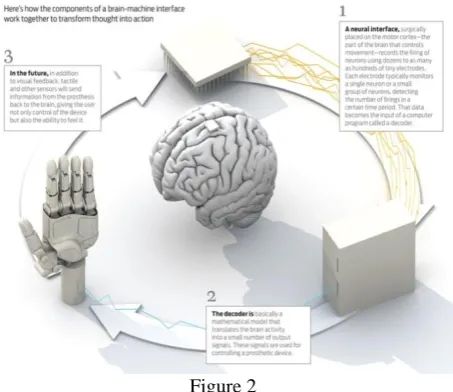
The Brain and Robotics In Jesse Sullivan‟s case, his brain was still sending electrical impulses through the nerves to his shoulder. This made it simple for the doctors to access these nerves and to manipulate them to control the robotic arm. However, what happens in a patient that, for instance, is paralyzed from the neck down? Suppose a patient‟s body is unable to receive electrical impulses through the limbs and other part of the body. The only source of these electrical impulses would be through the brain. This specific study is currently under way in several locations, as mentioned in the introduction. Government funded studies have enabled institutions to conduct experiments for research involving neuroscience. The brain has millions of neurons that trigger when the human body wants to do something; it is the control centre for which all human activity takes place. This idea led doctors to believe that if a robotic arm was to be controlled, it could be done form the source of the idea: the brain. Discovery Channel had a presentation on the “Robo Sapien”. In this presentation, the development of interfacing the brain with computers and technology is explored. The doctors interviewed discussed current technology for interfacing computers with the human brain.
Inside the brain, there are billions of neurons that communicate using bioelectrical signals among tens of thousands of connectors.
Figure 2
These signals of electrical impulses can be recorded using computers, and then interpreted to what they actually mean (RoboSapien). Dr. Walpow introduces the EEG, which is a cap fitted with 16 electrodes that record
electrical impulses through the scalp. These impulses are good for controlling virtual keyboards and limited actions. He commented that the limits are not close to being reached. The EEG cap will not provide for fluid, seamless mechanical control, but it will provide basic control (RoboSapien). The interpretation of the brain activity has recently taken off because of the signal processing capabilities of computers.
III.
N
OWH
EART
HISThe bionic ear, or cochlear implant, is a local biomedical success story. The device developed out of studies in the 1960s by Professor Graeme Clark and his team at the Melbourne University.
Fig.3. Apparatus for optimising the operation of a cochlear implant prosthesis (patent diagram) (publication no- EP
1741466 B1)
In theory, a cochlear implant works just like normal hearing; the ear drum transmits vibrations in the air to the fluid-filled cochlear behind it, which in turn causes the hair-like cilia inside to move and generate electrical impulses in the auditory nerve. A cochlear implant picks up sound using a microphone that transmits its signal wirelessly to a receiver placed under the scalp, which in turn sends electrical impulses to electrodes implanted surgically in the cochlear, bypassing the eardrum and cilia altogether. In practice, Things aren‟t so simple. The microphone doesn‟t transmit audio signals directly to the scalp receiver. The sound is first passed to an audio processor, worn behind the ear or in a pocket. The processor attempts to filter speech from ambient noise and concentrate its perceptually useful content. This simplification is required because, while the cochlear contains tens of thousands of cilia for turning vibrations into nervous impulses, a cochlear implant has only a few dozen electrodes at most. One electrode is enough to restore enough sound awareness to make a deaf person audibly aware of their surroundings; while a mere eight can restore the ability to understand speech.
IV.
S
EEING ISB
ELIEVINGCopyright © 2014 IJECCE, All right reserved implants use a small grid of electrodes that are implanted
into the retina at the back of the eyeball. When different parts of the grid (loosely equivalent to pixels) fire an electrical impulse in a particular pattern, that pattern is picked up by the optic nerve and sent to the brain, which interprets the signal as visual information. The Argus II Retinal Prosthesis System from Second Sight uses a small digital video camera built into a pair of sunglasses to transmit images wirelessly to electrodes implanted in the retina. Second Sight doesn‟t disclose the camera resolution, but it‟s the number of electrodes that ultimately determines what a person „sees‟.
Second Sight‟s Brian Mech explained, “We do not know exactly what the patient sees (that is hard, or perhaps impossible, to know). We can only measure what they can do. They are „seeing‟ in the sense that the signal travels to the visual cortex and they literally „see‟ the result of the stimulation. I think that, in the best patients, they perceive something like „pixelated‟ images, like a low-resolution scoreboard.” The limitation with this implementation of the technology is that it delivers only a 20° field of view, which is equivalent to looking through a hole as wide as a 30cm ruler held at arm‟s length. The opto-electrical sensor is implanted into the retina along with the electrodes, which also has the advantage of being more discreet. As for using retinal implants to deliver superhuman vision, the problems are the same as with cochlear implants. If there is a limitation to the amount of information captured, it isn‟t down to the technology itself but the brain‟s ability to process it. This makes ultra high- resolution vision impossible. Still, it doesn‟t rule out the possibility of using zoom lenses and sensors that can detect more than just the visible spectrum of light.
V.
G
ETTING AL
EGU
POtto Bock has been developing bionic knees since 1997 and its recently launched Genium model is one of the most sophisticated available. Thanks to a built-in gyroscope and accelerometer (like those on an iPhone), plus software models for what constitutes normal gait, the Genium can play an active role in walking by flexing and extending automatically at appropriate times, removing the delayed „drag‟ that functional prosthesis wearers complain about. The calf muscle and Achilles tendon expend a significant amount of energy to kick the toes off the ground when taking a step. Take those away and the remaining leg has to pick up the slack, and the rest of body must cope with the increased stress this involves. The Genium knee‟s passive, but reactive, hydraulic mechanism doesn‟t change this, but only because the knee doesn‟t pay a major part in transmitting energy to the foot while walking. However, the ankle does, which is why the walk PowerFoot BiOM uses an active powered mechanism to make below-knee amputees more mobile. Instead of using an Achilles heel and calf muscle to push the foot off the ground with each step, the PowerFoot BiOM uses a hydraulic piston for the same effect. As with the Genium knee, sensors detect what the wearer is doing and react in real-time, making the PowerFoot BiOM able to deal with uneven ground,
inclines and stairs – all things with which functional lower limb prostheses struggle. Still, despite the PowerFoot BiOM only becoming commercially available in early 2011, it‟s already had a profound impact on the people using it. Once the final software tuning is performed over Bluetooth using an Android application, the usual reaction is that it feels natural, which is something of a rarity for any prostheses. As for enhanced performance, the need to balance a bionic foot to work only as well as the remaining limb makes this difficult for unilateral (one limb) amputees.
Fig.4. Actuator assembly for prosthetic or orthotic joint (patent diagram) (publication no- US8048172 B2)(8)
VI.
T
HEREX
(F
IRSTC
OMPLETEB
IONICM
AN)
A bionic man complete with artificial organs, synthetic blood and robotic limbs has gone on display at the Science Museum in London. Dubbed THE MILLION-DOLLAR MAN (that‟s how much he cost to make), he consists of a prosthetic face, hips, knees, feet and hands, all of which are commercially available. Other off-the-shelf items include an artificial retina, cochlea and heart.(6)
Costing some 600,000 Euros he is expensive but not as pricey as the Six Million Dollar Man of the cult 1970s TV series.
He incorporates some of the latest advances in mechanical limbs, as well as a heart and lungs, an artificial pancreas, kidney, spleen and trachea, and a functional blood circulatory system.
Copyright © 2014 IJECCE, All right reserved Fig.5. The man – who is called Rex – can sense objects in
front of him with retinal implants and cochlear implants to allow him to hear.
Rex, which is short for Robotic Exoskeleton, was created for the British Channel 4 documentary “How to Build a Bionic Man”. The cost to built Rex was around $1 million. Rex will be exhibited from February 7th until March 11th in the Science Museum of London. Subsequently, Rex will take flight to The Smithsonian in Washington, DC, which, had it been done earlier, would have made Ben Stiller‟s 2009 movie Night at the Museum: Battle of the Smithsonian a whole lot simpler, as Rex is already alive. The artificial human, called Rex Stands 6.5-feet tall. All of its organs and body parts were built in labs at 18 universities and companies and assembled at Shadow Robot, a London company.
UK roboticists Richard Walker and Matthew Godden of Shadow Robot (London, UK) were responsible for assembling all the components into a humanoid robot. All the artificial limbs, organs and other parts were lent from eighteen companies and universities to create Rex. The skull of Rex‟s head is modelled on Bertolt Meyer, a Swiss psychologist, who has a bionic hand himself and also is the presenter of the British Channel 4 News documentary on this project.
Prepare to be amazed, as some of the components of Rex are: a self teaching arm with 26 degrees of movement; glasses that send images to a microchip in the retina that sends the info to the computer brain; synthetic blood; artificial lungs, an artificial pancreas with insulin stored in gel which softens and liquefies in the presence of excess glucose; a self-regulating artificial kidney, made up of a silicon nanoscale filtration system; a man- made spleen, bladder, ear, trachea and arteries; cochlear implants; a speech generator; bionic ankles using a motor and spring system to mimic human calf muscle and Achilles tendon; and of course a battery powered heart.
Our automobiles have already gone hybrid. So when will we go hybrid ourselves? Will we stop at replacing bodily functions or will the future bring us enhanced bodily functions? And how appropriate will it be to ask these questions to Rex himself… Rex will be disassembled after he returns from DC to London after his time in the Smithsonian, but our guess is that he‟ll be back.
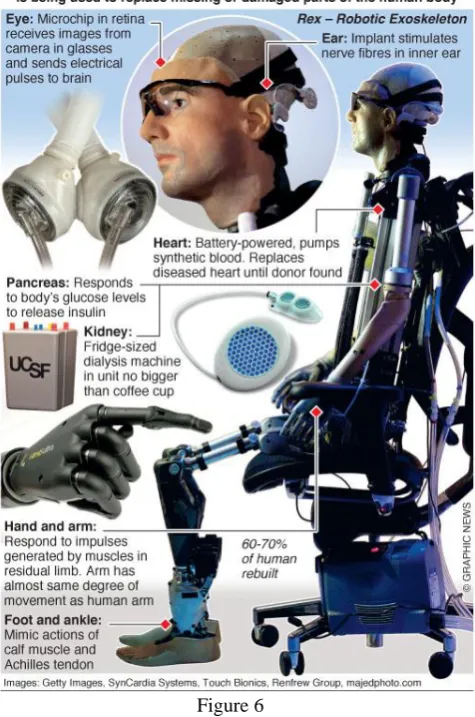
Scientists, among them the creators of “Rex” – the world‟s most complete bionic man, unveiled in London
this week – believe they can now replicate about two-thirds of the human body. “There are some vital organs missing, like the stomach, but 60 to 70 per cent of a human has effectively been rebuilt.”
Rex, billed as the pinnacle of robotics achievement to date, will meet his public from tomorrow at the Science Museum in London. Rex‟s other internal organs, among them a pancreas, a set of artificial lungs and bladder, are still in development. Some of the technology cannot work without human input; bionic hands, for example, need muscles and signals from the brain to function. Other parts, such as the heart and pancreas, are designed to work on their own. All of his components could theoretically be welded to a human body to replace missing or worn out parts.
Figure 6
Unveiled at a special exhibition at London‟s Science Museum this week, the artificial human was created for a Channel 4 documentary called How to Build a Bionic Man. The project cost £640k ($1m) and showcases the latest achievements and advancements in bionic technology and prosthetic science.(7)
Copyright © 2014 IJECCE, All right reserved together, but each one either is, or soon could be, part of a
living human being.”
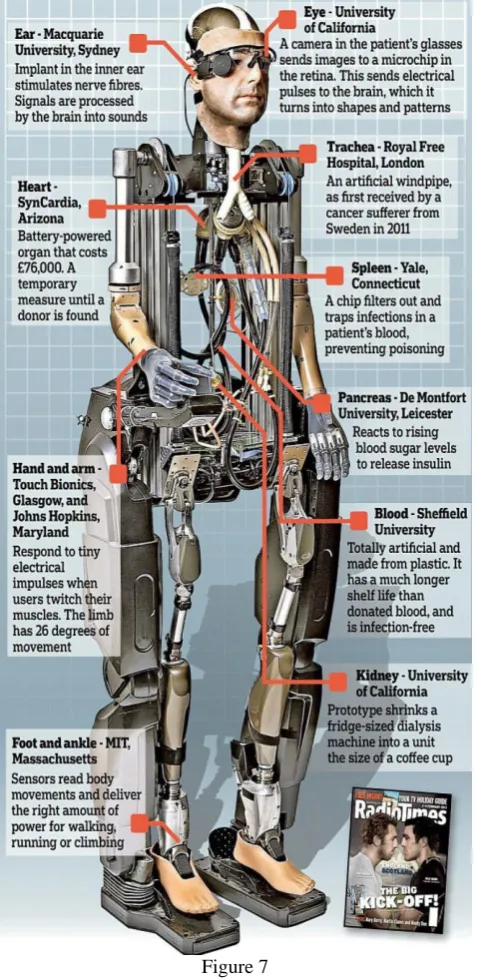
Rex‟s two-meter-tall „body‟, built with currently available bionic and prosthetic technology, includes a prosthetic face, hands, hips, knees and feet as well as cochlear implants which enable him to hear and retinal implants that allow him to sense objects in front of him. Speech synthesis technology means Rex can make sense of simple statements and even respond to some questions.
Artificial blood pumps through his artificial organs, which include a heart, kidney and pancreas. He also has a spleen and trachea. The stomach is missing, but one imagines it won‟t be too long before the science boffins fix him up with one of those, too. A real-life million-dollar bionic man with artificial organs, synthetic blood and robotic limbs has been created to showcase what‟s possible with modern science and hint at the future of prosthetics.
Figure 7
VII.
A
REW
ET
HEREY
ET?
Despite all the progress that has been made with bionic prostheses to date, there is much, much more to be done. For limbs, the goal is to develop devices that mimic the real thing more closely in both form and function. This requires advances in hardware to create ever more robust and articulate limbs with increased battery life, and advances in software engineering to develop more sophisticated systems that can automate the same kind of fine control offered by the nervous system. For sight and hearing, the limits of existing implant technology have yet to be reached, but there is still much to learn about how the brain processes information from these sense organs (particularly for colour perception, for example) and how it can be delivered more effectively by artificial means. It may be another 40 years before bionic prostheses technology reaches a similar level of sophistication to that which Steve Austin possessed. Still, all indications are that it will be achieved within many of our lifetimes.
Figure 8
Copyright © 2014 IJECCE, All right reserved The same idea is present in fear of the Internet expanding
because people won‟t visit the libraries to do research. However, today information is far more accessible and more recent than any books available in the library. The idea that humans can become better, can become more than human, should be embraced and the technology should flourish to benefit not only the lives of those that are unable to perform daily activities of brushing teeth and tying shoes, but for those that would eventually LIKE to have this option.
R
EFERENCES[1] Journal Neural Engineering Centre for Artificial Limbs
(NECAL) at the Rehabilitation Institute of Chicago (RIC)
[2] Innovating for Victoria‟s Health: Health and Medical Research
Book Expo (May 2012)
[3] Cortical Prosthethis. 2006. National Institute of Neurological
Disorders and Stroke. 20 November 2006
<http://www.ninds.nih.gov/funding/research>
[4] Introducing Jesse Sullivan, the World‟s First Bionic Man. 2006.
Rehabilitation Institute of Chicago. 3 November 2006 <http://www.ric.org/bionic/index.php>.
[5] Rehabilitation Research & Development Service. 28 September
2006. United States Department of Veterans Affairs. 3
November 2006
<http://www.rehab.research.va.gov/cent/centers.htm>.
[6] Bionics and Engineering; presented at Society of Women
Engineers Convention, Seattle, WA, 1983, Jill E. Steele
[7] NBCNEWS
(www.nbcnews.com/technology/futureoftech/real-million-dollar-bionic-man-built-goes-tour-1B8255395)
[8] Patent diagrams from Google patents,
[9] Photos of rex from Reuters, BBC, ieee spectrum, digital trends.
A
UTHOR’
SP
ROFILEM. S. Sachin
born at 5th Oct, 1993 in Ranibennur, Haveri Dist, Karnataka, India. Studying Third SEM B.E in Electronics and Communication Engineering at Shirdi Sai Engineering College, Bangalore -562106.