The Journal of Threatened Taxa (JoTT) is dedicated to building evidence for conservation globally by publishing peer-reviewed articles online every month at a reasonably rapid rate at www.threatenedtaxa.org. All articles published in JoTT are registered under Creative Commons Attribution 4.0 International License unless otherwise mentioned. JoTT allows allows unrestricted use, reproduction, and distribution of articles in any medium by providing adequate credit to the author(s) and the source of publication.
www.threatenedtaxa.org
ISSN 0974-7907 (Online) | ISSN 0974-7893 (Print) Building evidence for conservation globally
Journal of Threatened Taxa
For Focus, Scope, Aims, Policies, and Guidelines visit https://threatenedtaxa.org/index.php/JoTT/about/editorialPolicies#custom-0 For Article Submission Guidelines, visit https://threatenedtaxa.org/index.php/JoTT/about/submissions#onlineSubmissions For Policies against Scientific Misconduct, visit https://threatenedtaxa.org/index.php/JoTT/about/editorialPolicies#custom-2 For reprints, contact <[email protected]>
Short Communication
First camera trap record of Red Panda
Ailurus fulgens (Cuvier, 1825) (Mammalia: Carnivora:
Ailuridae) from Khangchendzonga, Sikkim, India
Tawqir Bashir, Tapajit Bhattacharya, Kamal Poudyal & Sambandam Sathyakumar
26 June 2019 | Vol. 11 | No. 8 | Pages: 14056–14061 DOI: 10.11609/jott.4626.11.8.14056-14061
Partner
Member
Threatened Taxa
Publisher & Host
PLATINUMOPEN ACCESS
Shor
t C
ommunica
tion
DOI:https://doi.org/10.11609/jott.4626.11.8.14056-14061 | ZooBank: urn:lsid:zoobank.org:pub:662D97A1-B492-43CF-BAA8-2B559D973D74
Editor:Karan Bahadur Shah, Hattigaunda, Nepal. Date of publication: 26 June 2019 (online & print) Manuscript details: #4626 | Received 11 October 2018 | Final received 30 March 2019 | Finally accepted 18 May 2019
Citation:Bashir, T., T. Bhattacharya, K. Poudyal & S. Sathyakumar (2019). First camera trap record of Red Panda Ailurus fulgens (Cuvier, 1825) (Mammalia: Carnivora: Ailuridae) from Khangchendzonga, Sikkim, India. Journal of Threatened Taxa 11(8): 14056–14061; https://doi.org/10.11609/jott.4626.11.8.14056-14061
Copyright: © Bashir et al. 2019. Creative Commons Attribution 4.0 International License. JoTT allows unrestricted use, reproduction, and distribution of this article in any medium by adequate credit to the author(s) and the source of publication.
Funding: Wildlife Institute of India (Grant-in-Aid).
Competing interests:The authors declare no competing interests.
Acknowledgements: We thank the Wildlife Institute of India, Dehradun, for providing funding support and infrastructure for conducting this study. We are grateful to the Department of Forests, Environment and Wildlife Management, Government of Sikkim, for providing research permits to work in Sikkim. We also thank our field assistants for their help during the field work.
First camera trap record of Red Panda
Ailurus fulgens (Cuvier, 1825) (Mammalia: Carnivora:
Ailuridae) from Khangchendzonga, Sikkim, India
Tawqir Bashir 1 , Tapajit Bhattacharya 2 , Kamal Poudyal 3 & Sambandam Sathyakumar 4
1–4 Wildlife Institute of India, Post Box #18, Chandrabani, Dehradun, Uttarakhand 248001, India. 1 Centre of Research for Development, University of Kashmir, Hazratbal, Jammu & Kashmir 190006, India. 2 Department of Conservation Biology, Durgapur Government College, Durgapur, West Bengal 713214, India.
3 Namchi Government College, Kamrang, Namchi, Sikkim 737126, India.
1 [email protected] (corresponding author), 2 [email protected], 3 [email protected], 4 [email protected]
Abstract: The Red Panda Ailurus fulgens (Cuvier, 1825) is recognized as one of the most elusive arboreal carnivores of the eastern Himalaya that is poorly documented. We report the first camera trap record of the Red Panda from the Prek catchment of Khangchendzonga Biosphere Reserve (KBR) in Sikkim, India. A total of three independent image captures were recorded during the sampling. All occurrence records were exclusively from the sub-alpine habitat and restricted to an elevation range of 3,000–3,850 m. This study not only accentuates the significance of sub-alpine habitats for the conservation of the Red Panda but also elucidates the importance of camera traps as an efficient sampling tool. Through this study, we propose the requirement of a long-term study on the species within and outside the protected areas of Sikkim.
Keywords: Conservation, opportunistic records, Prek catchment,
sub-alpine habitat.
ISSN 0974-7907 (Online) ISSN 0974-7893 (Print)
PLATINUM OPEN ACCESS
The Red Panda Ailurus fulgens (Cuvier, 1825), also known as the Lesser Panda, is an endangered monotypic member of the family Ailuridae and the only representative of the genus Ailurus (Roberts & Gittleman 1984; Glatston 2011). Primarily associated with the eastern Himalaya, its distribution range extends from western Nepal through Bhutan, India, and Myanmar to southern Tibet and the western Yunnan Province
of China (Choudhury 2001; Glatston et al. 2015). In India, its distribution is restricted to small pockets of the eastern Himalaya in the states of Arunachal Pradesh, West Bengal (Darjeeling District), and Sikkim (Choudhury 2001; Ghose & Dutta 2011), with anecdotal records from Meghalaya and Assam (Choudhury 2013). Its habitat is typically characterized by the presence of mixed deciduous and coniferous forests with bamboo-thicket understory (Choudhury 2001; Pradhan et al. 2001; Zhang et al. 2006; Chakraborty et al. 2015; Bista et al. 2017). Being an unusual member of Carnivora, it occupies a highly specialized niche as a bamboo feeder like that of the Giant Panda Alieuropoda melanoleuca
(Wei et al. 1999; Pradhan et al. 2001). In the eastern Himalaya, it occupies an elevation range of 1,500–4,800 m (Yonzon & Hunter 1991; Choudhury 2001).
Red Panda in Khangchendzonga, Sikkim Bashir et al.
Journal of Threatened Taxa | www.threatenedtaxa.org | 26 June 2019 | 11(8): 14056–14061 14057 elements for Red Pandas that provide substrates
suitable for defecation (Pradhan et al. 2001; Zhang et al. 2006). Being a habitat specialist, even a minor change in habitat conditions can cause a significant impact on its occurrence and survival (Dorji et al. 2011; Chakraborty et al. 2015). The species has been under tremendous threat across its distribution range due to habitat loss and fragmentation, habitat degradation, harvesting of timber, bamboo, and minor forest products, livestock grazing, inefficiently managed tourism, and other physical threats such as poaching for pelts (Sharma & Belant 2010; Dorji et al. 2012; Panthi et al. 2017) and killing by stray dogs (Chakraborty et al. 2015). Its global population is decreasing continuously and declined by nearly 50% over the last three decades as a result of which it was listed as Endangered by IUCN (Glatston et al. 2015). In spite of being a charismatic species of the eastern Himalaya, there is limited information on the ecology of the species from most parts of its distribution range, particularly from India, except for a few long-term studies (Pradhan et al. 2001; Chakraborty et al. 2015). Apart from these, information available on the species is merely based on incidental records, secondary information, and local knowledge (Sharma & Belant 2009; Srivastava & Dutta 2010; Dorjee et al. 2014; Khatiwara & Srivastava 2014). Moreover, the elusive, arboreal nature of the species and the difficult terrain it inhabits also pose limitations and challenges for conducting field surveys.
Sikkim holds the second largest extent of Red Panda habitat in India after the state of Arunachal Pradesh (Ghose & Dutta 2011). Despite being recognized as the state animal of Sikkim occurring in all seven protected areas (PAs) of the state (Ghose et al. 2011), very little information is available on the Red Panda from the area. Moreover, Khangchendzonga Biosphere Reserve (KBR) represents the largest PA in Sikkim (including the Khangchendzonga National Park and its buffer zone) having an array of habitat types that inhabit a rich diversity of flora and fauna including 1,580 species of vascular plants (Maity & Maiti 2007), 195 species of butterflies (Chettri 2000, 2010), 42 species of reptiles (Chettri et al. 2010), over 213 species of birds (Chettri et al. 2001, 2005) and more than 42 species of mammals (Sathyakumar et al. 2011). The Red Panda is also being considered critical for maintaining the quality of sub-alpine habitats (Pradhan et al. 2001) and, therefore, a detailed understanding of its ecology seems a prerequisite. Therefore, as a first step towards filling the knowledge gap, an attempt towards generating baseline information on the occurrence and distribution of this
elusive species was made using camera traps.
Material and Methods Study area
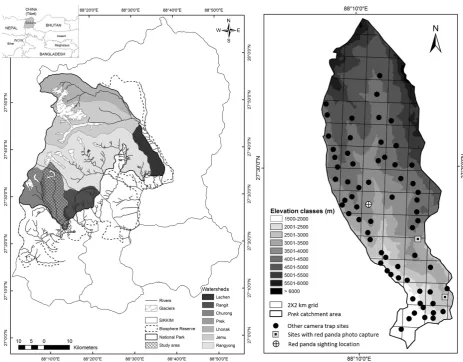
Khangchendzonga Biosphere Reserve covers an area of 2,620km² (National Park = 1,784km² and buffer zone = 836km²) and is categorized into seven watersheds, namely Lhonak, Jemu, Lachen, Rangyong, Rangit, Prek, and Churong. The area encompasses a sharp elevation gradient of 1,220–8,586 m accompanied by a wide range of habitat types (Tambe 2007; Fig. 1a). We selected Prek catchment (182km²) for our camera trapping surveys because it represents all the habitat types found in KBR (Sathyakumar et al. 2011). Covering an elevation range of 1,220–6,691 m, the major habitats types in Prek catchment include mixed sub-tropical, mixed temperate, sub-alpine, krummholz, alpine pastures, rock and snow cover, and water bodies (Tambe 2007). The relative humidity recorded for the Prek catchment is more than 60% all through the year in temperate, sub-alpine, and alpine habitats and reaches even above 90% in the months of June and July in the sub-alpine habitats (Chettri 2000; Tambe 2007). The annual temperature of the catchment varies from -16.11°C to 33.9°C and from -8.89°C to 15°C in the sub-alpine habitat.
Camera trapping
Results
A total sampling effort of 6,910 camera trap days included 629 trap days in sub-tropical, 1,426 in temperate, 2,671 in sub-alpine, 702 in krummholz, and 1,482 in alpine habitats. The Red Panda was image captured only at two camera trap locations (namely Kasturi ridge and Phedi; Table 1) with a total of three independent image captures (Image 1). Image captures were recorded during both night and daytime. These camera locations were in sub-alpine fir Abies densa and birch Betula utilis forests with Rhododendron spp. as the understory. A luxuriant growth of bamboo Arundinaria maling was also present in the lower elevation areas of Kasturi ridge. Moreover, besides a single sighting (in Kokchurong area), no indirect evidence (droppings/scats or feeding marks) of Red Panda was recorded during the study period. The habitat at Kokchurong was a typical eastern Himalayan fir forest with Abies densa as the most dominant species and Rhododendron hodgsonii
as the undergrowth. All presence records (sighting and images) were exclusively from the sub-alpine habitat and restricted to an elevation range of 3,000–3,850 m, particularly around the Kasturi area which is free from organized tourism.
Discussion
The present study reports the first camera trap record of the elusive Red Panda from the intricate habitats of KBR. It also plausibly documents the highest elevation record (3,850m) of the species from the state of Sikkim. Irrespective of the nocturnal and cryptic behaviour of the species, its detections during the night as well as the daytime only in winter can be attributed to its increased activity during the mating season, occurring mostly between early January and mid-March (Nowak 1999).
The occurrence records revealed a narrow elevation belt of just 850m (3,000–3,850 m) for the Red Panda in the area, which coincides with its preferred altitude
Figure 1. a - Khangchendzonga Biosphere Reserve in Sikkim showing the seven catchments including Prek catchment area; the shaded area in the inset indicates Sikkim in northeastern India | b - Deployment of camera traps in 2km × 2km grids in Prek catchment area indicating Red Panda occurrence records.
Red Panda in Khangchendzonga, Sikkim Bashir et al.
Journal of Threatened Taxa | www.threatenedtaxa.org | 26 June 2019 | 11(8): 14056–14061 14059
range of 2,800–3,600 m reported in similar habitats (Yonzon et al. 1991; Pradhan et al. 2001). Besides the present record, Red Pandas were also camera trapped in Barsey Rhododendron Sanctuary and Kyongnosla Alpine Sanctuary, Sikkim, up to an elevation of 3,630m with direct sightings and feces recorded up to 3,780 and 3,789m, respectively, in different forest types including
Rhododendron forest with scattered Abies and Abies -dominated coniferous forest contiguous with bamboo thickets (WWF-India 2011; Khatiwara & Srivastava 2014). Such habitat specificity is in coherence with the present occurrence records, thus validating the affinity of the species for the sub-alpine forests of the Sikkim Himalaya. Similarly, a preference for mixed coniferous and Rhododendron forests were also shown in studies conducted in Wolong Reserve in China (Reid et al. 1991), Dhorpartan Hunting Reserve in Nepal (Sharma & Belant 2009; Panthi et al. 2012), Jigme Dorji National Park in Bhutan (Dorji et al. 2011), and Chitwan-Annapurna Landscape in Nepal (Bista et al. 2017). Moreover, the Red Panda was also reported to be relatively abundant between 2,800m and 3,600m in other parts of Sikkim, Darjeeling, and Arunachal Pradesh (Pradhan et al. 2001; Srivastava & Dutta 2010; Bhutia 2011; Ghose et al. 2011; Chakraborty et al. 2015), although its occurrence was also reported at 2,350m in Neora Valley National Park in Darjeeling (Mallick 2010) and at 4,325m in Tawang District of Arunachal Pradesh (Dorjee et al. 2014). Given the arboreal habit of Red Panda, however, habitats above the tree-line may not be considered consistently occupied by them (Choudhury 2001).
Non-detection of Red Panda signs during the sampling period could be attributed to the arboreal, cryptic nature of the species and its habit of defecating at feeding sites generally on trees and fallen logs (Pradhan et al. 2001; Zhang et al. 2006). Previous studies reported the presence of the Red Panda in the northeastern states and parts of Nepal but very few calculated their abundance indices. While comparing the present records with that of 32 sightings in three years (Pradhan et al. 2001), 10 in one year (Mallick 2010, by the study team), 10 in five years (Chakraborty et al. 2015), and four in one year
Image 1. Camera trap image of the Red Panda Khangchendzonga Biosphere Reserve in Sikkim: a & b - at Kasturi ridge | c - at Phedi.
Table 1. Records of the Red Panda in the Prek catchment of Khangchendzonga Biosphere Reserve, Sikkim, India, during 2008–2011.
Place Evidence Date Time Elevation (m) Coordinates
Kasturi ridge Photo capture 26.xii.2009 02.12h 3,000 27.399N 88.244E
Kasturi ridge Photo capture 06.i.2010 04.14h 3,000 27.399N 88.244E
Phedi Photo capture 18.xii.2009 10.57h 3,850 27.439N 88.218E
Kokchurong Sighting 10.iii.2010 16.28h 3,720 27.464N 88.173E
a
b
with 13 image captures for an effort of 2,398 trap days (Khatiwara & Srivastava 2014), Red Pandas seem to be either more elusive or in very low densities in KBR. A species-specific camera trap design, however, would increase Red Panda detection and thereby its capture rate, aiding in a more comprehensive comparison.
Conclusion
This scientific documentation symbolizes a crucial step towards the conservation of the Red Panda and its habitat in KBR. In spite of a strong pro-conservation attitude shown by the government of Sikkim by declaring Red Panda as its state animal, very less work has been done on the ground to ensure efficient conservation and management of the species and its habitat across the Sikkim landscape. This study highlights the importance of sub-alpine forests for the occurrence and survival of the Red Panda in the area. Considering its low abundance status, increasing threats on habitat, and the lack of detailed ecological information from the area, any management intervention towards its conservation seems impractical. We, therefore, propose an urgent need for a long-term ecological study across the Sikkim Himalayan landscape covering the entire sub-alpine belt (within and outside the PAs), as an essential step towards Red Panda conservation in Sikkim. In view of this, the Forest, Environment and Wildlife Management Department (FEWMD), Govt. of Sikkim, recently initiated a camera trap based monitoring program which resulted in first occurrence records of species like Tiger Panthera tigris, Snow Leopard Panthera uncia, and Marbled Cat
Pardofelis marmorata from different PAs of the state. We recommend the continuation of such monitoring programs along with serious attention on the ecological study on the Red Panda to benefit its conservation and management in the area. We also recommend referring the management guidelines proposed by Pradhan et al. (2001) to append further towards achieving this goal.
References
Bhutia, J.L. (2011). Current Distribution, Population Status,
Habitat Characteristics and Conservation of Red Panda in Barsey Rhododendron Sanctuary, Sikkim, India. MSc Thesis. Department of Forestry, NERIST (Deemed University), Itanagar, Arunachal Pradesh, 42pp.
Bista, D., S. Shrestha, P. Sherpa, G.J. Thapa, M. Kokh, S.T. Lama, K. Khanal, A. Thapa & S.R. Jnawali (2017). Distribution and habitat
use of Red Panda in the Chitwan-Annapurna landscape of Nepal.
PLoS ONE 12(10): e0178797. https://doi.org/10.1371/journal.
pone.0178797
Chakraborty, R., L.T. Nahmo, P.K. Dutta, T. Srivastava, K. Mazumdar & D. Dorji (2015). Status, abundance, and habitat associations of
the Red Panda (Ailurus fulgens) in Pangchen Valley, Arunachal
Pradesh, India. Mammalia 79(1): 25–32. https://doi.org/10.1515/ mammalia-2013-0105
Chettri, N. (2000). Impact of Habitat Disturbances on Bird and Butterfly
Communities along the Yuksam-Dzongri Trail in Khangchendzonga Biosphere Reserve. PhD Thesis. Department of Zoology, North Bengal University, Darjeeling, India, 266.
Chettri, N. (2010). Cross-taxon congruence in a trekking corridor of
Sikkim Himalayas: surrogate analysis for conservation planning. Journal for Nature Conservation 18(2): 75–88.
Chettri, N., E. Sharma & D.C. Deb (2001). Bird community structure
along a trekking corridor of Sikkim Himalaya: a conservation perspective. Biological Conservation 102: 1–16.
Chettri, N., R. Jackson & E. Sharma (2005). Birds of Khecheopalri
and Yuksom-Dzongri trekking corridor, West Sikkim. Journal of Hill Research 18: 16–25.
Chettri, B., S. Bhupathy & B.K. Acharya (2010). Distribution pattern of
reptiles along an eastern Himalayan elevation gradient, India. Acta Oecologia 36: 16–22.
Choudhury, A. (2001). An overview of the status and conservation
of the Red Panda Ailurus fulgens in India, with reference to its global status. Oryx 35(3): 250–259. https://doi.org/10.1046/j.1365-3008.2001.00181.x
Choudhury, A. (2013). The Mammals of northeast India. Gibbon Books
and the Rhino Foundation for Nature in NE India, Guwahati, Assam, India, 432pp.
Dorjee, D., R. Chakraborty & P.K. Dutta (2014). A note on the
high elevation distribution record of Red Panda Ailurus fulgens (Mammalia: Carnivora: Ailuridae) in Tawang District, Arunachal Pradesh, India. Journal of Threatened Taxa 6(9): 6290–6292. https:// doi.org/10.11609/JoTT.o3492.6290-2
Dorji, S., K. Vernes & R. Rajaratnam (2011). Habitat correlates of the
Red Panda in the temperate forests of Bhutan. PLoS ONE 6(10): e26483. https://doi.org/10.1371/journal.pone.0026483
Dorji, S., R. Rajaratnam & K. Vernes (2012). The Vulnerable Red Panda
Ailurus fulgens in Bhutan: distribution, conservation status and management recommendations. Oryx 46(4): 536–543. https://doi. org/10.1017/S0030605311000780
Ghose, D. & P.K. Dutta (2011). Status and distribution of the Red Panda
Ailurus fulgens fulgens in India, pp357–374. In: Glatston, A.R. (ed.). Red Panda, Biology and Conservation of the First Panda. Academic Press, London, UK, 488pp.
Ghose, P.S., B. Sharma, R. Chakraborty & K. Legshey (2011). Status
of Red Panda in Sikkim: a case study in East Sikkim, pp363–378. In: Arrawatia, M.L. & S. Tambe (eds.). Biodiversity of Sikkim: Exploring and Conserving a Global Hotspot. Information and Public Relations Department, Government of Sikkim, Gangtok, Sikkim, 542pp.
Glatston, A., F. Wei, Z. Than & A. Sherpa (2015). Ailurus fulgens. In: The IUCN Red List of Threatened Species: e.T714A110023718. Accessed on 06 September 2018. https://doi.org/10.2305/IUCN.UK.2015-4. RLTS.T714A45195924.en
Glatston, A.R. (ed.) (2011). Red Panda: Biology and Conservation of
the First Panda. Academic Press, London, UK, 488pp.
Khatiwara, S. & T. Srivastava (2014). Red Panda Ailurus fulgens and
other small carnivores in Kyongnosla Alpine Sanctuary, East Sikkim, India. Small Carnivore Conservation 50: 35–38.
Maity, D. & G.G. Maiti (2007).The Wild Flowers of Kanchenjunga
Biosphere Reserve, Sikkim. Naya Udyog, Kolkata, India, 174pp.
Mallick, J.K. (2010). Status of Red Panda Ailurus fulgens in Neora
Valley National Park, Darjeeling District, West Bengal, India. Small Carnivore Conservation 43: 30–36.
Nowak, R. (1999).Walker’s Mammals of the World, Vol. 2. Johns
Hopkins University Press, Baltimore, 2,015pp.
Panthi, S., A. Aryal, D. Raubenheimer, J. Lord & B. Adhikari (2012).
Summer diet and distribution of the Red Panda (Ailurus fulgens
fulgens) in Dhorpatan Hunting Reserve, Nepal. Zoological Studies
51(5): 701–709.
Panthi, S., G. Khanal, K.P. Acharya, A. Aryal & A. Srivathsa (2017).
Red Panda in Khangchendzonga, Sikkim Bashir et al.
Journal of Threatened Taxa | www.threatenedtaxa.org | 26 June 2019 | 11(8): 14056–14061 14061 Nepal. PLoS ONE 12(7): e0180978. https://doi.org/10.1371/journal.
pone.0180978
Pradhan, S., G.K. Saha & J.A. Khan (2001). Ecology of the Red Panda
Ailurus fulgens in the Singhalila National Park, Darjeeling, India. Biological Conservation 98(1): 11–18. https://doi.org/10.1016/ S0006-3207(00)00079-3
Reid, D.G., H. Jinchu & H. Yan (1991). Ecology of the Red Panda Ailurus
fulgens in the Wolong Reserve, China. Journal of Zoology 225(3):
347–364. https://doi.org/10.1111/j.1469-7998.1991.tb03821.x
Roberts, M.S. & J.L. Gittleman (1984). Ailurus fulgens. Mammalian
Species 222: 1–8. https://doi.org/10.2307/3503840
Sathyakumar, S., T. Bashir, T. Bhattacharya & K. Poudyal (2011).
Assessing mammal distribution and abundance in intricate eastern Himalayan habitats of Khangchendzonga, Sikkim, India. Mammalia 75(3): 257–268. https://doi.org/10.1515/mamm.2011.023
Sharma, H.P. & J.L. Belant (2009). Distribution and observations of Red
Pandas Ailurus fulgens in Dhorpatan Hunting Reserve, Nepal. Small Carnivore Conservation 40: 33–35.
Sharma, H.P. & J.L. Belant (2010). Threats and conservation
of Red Pandas in Dhorpatan Hunting Reserve, Nepal.
Human Dimensions of Wildlife 15(4): 299–300. https://doi.
org/10.1080/10871200903582634
Srivastava, T. & P.K. Dutta (2010). Western Arunachal Pradesh offering
prime home to the endangered Red Panda. Current Science 99(2): 155–156.
Tambe, S. (2007). Ecology and Management of the Alpine Landscape
in the Khangchendzonga National Park, Sikkim Himalaya. PhD Dissertation. Department of Forestry, FRI University, Dehradun, 232pp.
Wei, F., Z. Feng, Z. Wang & M. Li (1999). Feeding strategy and resource
partitioning between Giant and Red Pandas. Mammalia 63(4): 417– 430. https://doi.org/10.1515/mamm.1999.63.4.417
WWF-India (2011). Red Panda camera trapped in Sikkim. Posted on 04
May 2011. Accessed on 12 June 2018, https://www.wwfindia.org/ news_facts/?5840/Red-Panda
Yonzon, P., R. Jones & F. Jefferson (1991). Geographic information
systems for assessing habitat and estimating population of Red Pandas in Langtang National Park, Nepal. Ambio 20(7): 285–288.
Yonzon, P.B. & M.L. Hunter (1991). Cheese, tourists, and Red Pandas in
the Nepal Himalayas. Conservation Biology 5(2): 196–202. https:// doi.org/10.1111/j.1523-1739.1991.tb00124.x
Zhang, Z.J., F.W. Wei, M. Li & J.C. Hu (2006). Winter microhabitat
separation between Giant and Red Pandas in Bashania faberi bamboo forest in Fengtongzhai Nature Reserve. Journal of Wildlife
Management 70(1): 231–235. https://doi.org/10.2193/0022-541X(
2006)70[231:WMSBGA]2.0.CO;2
Zhang, Z.J., J.C. Hu, J.D. Yang, M. Li & F.W. Wei (2009). Food habits and
space-use of Red Pandas Ailurus fulgens in the Fengtongzhai Nature Reserve, China: food effects and behavioural responses. Acta
Theriologica 54(3): 225–234.
https://doi.org/10.4098/j.at.0001-7051.017.2008
ISSN 0974-7907 (Online) | ISSN 0974-7893 (Print)
June 2019 | Vol. 11 | No. 8 | Pages: 13951–14086 Date of Publication: 26 June 2019 (Online & Print)
DOI: 10.11609/jott.2019.11.8.13951-14086 www.threatenedtaxa.org
publishing peer-reviewed articles online every month at a reasonably rapid rate at www.threatenedtaxa.org. All articles published in JoTT are registered under Creative Commons Attribution 4.0 International License
unless otherwise mentioned. JoTT allows allows unrestricted use, reproduction, and distribution of articles in any medium by providing adequate credit to the author(s) and the source of publication.
Communications
The status of wild canids (Canidae, Carnivora) in Vietnam
– Michael Hoffmann, Alexei Abramov, Hoang Minh Duc, Le Trong Trai, Barney Long, An Nguyen, Nguyen Truong Son, Ben Rawson,
Robert Timmins, Tran Van Bang & Daniel Willcox, Pp. 13951–13959
Diel activity pattern of meso-carnivores in the suburban tropical dry evergreen forest of the Coromandel Coast, India
– Kangaraj Muthamizh Selvan, Bawa Mothilal Krishnakumar, Pasiyappazham Ramasamy & Thangadurai Thinesh, Pp. 13960–13966
On the importance of alpha behavior integrity in male Capybara
Hydrochoerus hydrochaeris (Mammalia: Rodentia: Caviidae) following
immuno-contraceptive treatment
– Derek Andrew Rosenfield & Cristiane Schilbach Pizzutto, Pp. 13967– 13976
Dietary analysis of the Indian Flying Fox Pteropus giganteus
(Brunnich, 1782) (Chiroptera: Pteropodidae) in Myanmar through the analysis of faecal and chewed remnants
– Moe Moe Aung & Than Than Htay, Pp. 13977–13983
Report on three ectoparasites of the Greater Short-nosed Fruit Bat
Cynopterus sphinx Vahl, 1797 (Mammalia: Chiroptera: Pteropodidae)
in Cachar District of Assam, India
– Anisur Rahman & Parthankar Choudhury, Pp. 13984–13991
A checklist of mammals of Tamil Nadu, India
– Manokaran Kamalakannan & Paingamadathil Ommer Nameer, Pp. 13992–14009
A comparative study on dragonfly diversity on a plateau and an agro-ecosystem in Goa, India
– Andrea R.M. D’Souza & Irvathur Krishnananda Pai, Pp. 14010–14021
Review
Contributions to the knowledge of moths of Bombycoidea
Latreille, 1802 (Lepidoptera: Heterocera) of Bhutan with new records –Jatishwor Singh Irungbam & Meenakshi Jatishwor Irungbam, Pp. 14022–14050
Short Communications
First camera trap documentation of the Crab-eating Mongoose
Herpestes urva (Hodgson, 1836) (Carnivora: Feliformia:
Herpestidae) in Barandabhar Corridor Forest in Chitwan, Nepal – Trishna Rayamajhi, Saneer Lamichhane, Aashish Gurung, Pramod Raj Regmi, Chiranjibi Prasad Pokheral &
Babu Ram Lamichhane, Pp. 14051–14055
First camera trap record of Red Panda Ailurus fulgens (Cuvier, 1825) (Mammalia: Carnivora: Ailuridae) from Khangchendzonga, Sikkim, India
– Tawqir Bashir, Tapajit Bhattacharya, Kamal Poudyal & Sambandam Sathyakumar, Pp. 14056–14061
First record of black scavenger fly of the genus
Meroplius Rondani, 1874 (Diptera: Sepsidae) from Pakistan
– Noor Fatima, Ansa Tamkeen & Muhammad Asghar Hassan, Pp. 14062–14064
Scully’s Balsam Impatiens scullyi Hook.f. (Balsaminaceae): a new record for India from Himachal Pradesh
– Ashutosh Sharma, Nidhan Singh & Wojciech Adamowski, Pp. 14065–14070
Notes
Odisha’s first record of a free-tailed bat (Mammalia: Chiroptera: Molossidae): what could it be?
– Subrat Debata & Sharat Kumar Palita, Pp. 14071–14074
Additions to the flora of Arunachal Pradesh State, India – Umeshkumar Lalchand Tiwari, Pp. 14075–14079
A report on additions to the flora of Andaman & Nicobar Islands, India
– Johny Kumar Tagore, Ponnaiah Jansirani & Sebastian Soosairaj, Pp. 14080–14082
Range extension of Trigonella uncata Boiss. & Noë (Leguminosae) in peninsular India and a new record for Maharashtra State, India – Shrikant Ingalhalikar & Adittya Vishwanath Dharap, Pp. 14083–14086