Muir, L. 2015. Transparent Fictions: Big Data, Information and The Changing Mise-en-Scène of (Government and) Surveillance. Surveillance & Society 13(3/4): 354-369.
Lorna Muir
University of Aberdeen, UK. [email protected]
Abstract
Working within the framework of a hypothesised shift between Michel Foucault’s model of discipline and Gilles Deleuze’s paradigm of the control society, this article considers the cinematic expression of emerging modes of monitoring in a surveillance society in which there has been an exponential increase in, and access to, information. In order to contextualise this interplay between these two models, three related areas are considered in this article. Firstly, the growing awareness of the consequences of Big Data, not only within teaching and research institutions, but through the dissemination of (sometimes erroneous) information in popular media and various news platforms is discussed. The British government’s response to such developments with a ‘rhetoric of transparency’, which has been critically undermined with the recent ‘leaks’ from whistleblowers affecting both British and American security agencies, in particular, is considered. Secondly, a brief outline of the changing theoretical models which can be employed to aid understanding of this situation is offered and, thirdly, in examining popular cultural responses to the rise of a Big Data discourse, two films are analysed, Sam Mendes’s (2012) Skyfall and Tomas Alfredson’s (2011) Tinker Tailor Soldier Spy, both of which seek to engage with these changing frameworks. These films in turn contribute to the fictions of transparency in relation to government espionage agencies.
Introduction
In June 2008 Wired magazine released a series of articles which caused controversy in more than one academic community. One of the causes of this was Chris Anderson’s claim that we are nearing the end of theory, particularly in relation to science. The reason for this, he suggests, is that as children of the ‘Petabyte Age’ we must completely rethink what we know and how we know it as companies such as Google, Facebook and Amazon have access to vast stores of data which radically alter the ways in which research can be conceptualised and carried out (Anderson 2008). We have become “the most measured age in history” with a proliferation of data produced, primarily, from the technologies we create which move beyond megabytes, gigabytes, or even terabytes, to petabytes (Anderson 2008). It is important to note that in the shift outlined by Anderson there is an emphasis on internet companies. Here, then, there is an underlying assumption that is often critically unchallenged in the hype surrounding Big Data that such changes in our understanding of information are brought about as a result of the proliferation of market-driven digital technologies which have saturated every area of our day-to-day lives. For Anderson, this is an age in which information sheds its ‘body’ as there is a move away from physical storage devices to ‘the
Article
Transparent Fictions:
Big Data, Information and The Changing Mise-
cloud’.1 This discourse around materiality and immateriality forms a crucial thematic trait in
contemporary surveillance films. The articulation of this interest in the (in)visibility and (in)tangibility of information can most readily be observed in the deployment of mise-en-scène, as discussed in this article. That is, even in the way in which a shot or sequence is organised before the camera, film is negotiating the complexities of representing and engaging with fluctuating notions of data.
Working within the framework of a hypothesised shift between Michel Foucault’s model of discipline and Gilles Deleuze’s paradigm of the control society, this article considers the cinematic expression of emerging modes of monitoring in a surveillance society in which there has been an exponential increase in, and access to, information. In order to contextualise this interplay between these two models, three related areas are considered in this article. Firstly, the growing awareness of the consequences of Big Data, not only within teaching and research institutions, but through the dissemination of (sometimes erroneous) information in popular media and various news platforms is discussed. The British government’s response to such developments with a ‘rhetoric of transparency’, which has been critically undermined with the recent ‘leaks’ from whistleblowers affecting both British and American security agencies, in particular, is considered. Secondly, a brief outline of the changing theoretical models which can be employed to aid understanding of this situation is offered and, thirdly, in examining popular cultural responses to the rise of a Big Data discourse, two films are analysed, both of which seek to engage with these changing frameworks. These films in turn contribute to the fictions of transparency in relation to government espionage agencies.
The release of Sam Mendes’s Skyfall (2012) apparently echoes the control logic of digital networks, which focus on speed and ‘invisible’ modes of surveillance through the proliferation of digital technologies. Within the narrative the British government must oppose a former ‘insider’ turned cyber-terrorist fluent in the (en)coded contemporary world and working beyond previous institutional modes of monitoring. In contrast, Tomas Alfredson’s Tinker Tailor Soldier Spy (2011) emphasises the significance of materiality and slowness which is largely in keeping with a disciplinary framework. Here, the dominance of careful, patient human observation in the context of operational duration is brought to the fore. This potential flux in surveillance practices (from discipline to control, which is often related to digital technologies), opens up complex questions for the cinematic medium in which a renewed interest in mise-en-scène becomes crucial in negotiating questions of representation.
Set in different times, at first glance Alfredson’s and Mendes’ films offer contrasting views of surveillance societies in which two distinct forms of surveillance are the dominant modes of monitoring: analogue surveillance of the 1970s at the height of the Cold War, and digital surveillance which generates vast quantities of data in contemporary Britain. However, while distinct surveillance practices can be identified in the representation and construction of these films, such stark binary borders of analogue and digital reveal porous moments when the films may dialogue with one another. Such moments ask, for example, to what extent slowness and solidity within the visual image open up a possible space of resistance and contemplation within surveillance societies, which are increasingly asymmetrically-networked, information-saturated and invisible in nature; how is this visually represented; and what can the study of film contribute to such discussions?
Big Data and Government Transparency
There are many problems with Anderson’s view of the Petabyte Age and the concomitant notion of Big Data; not least among them is an apparently uncritical engagement with the ethics of such a worldview. Anderson conceptualises numbers and data as neutral entities which have little or no consequences, which
1 See N. Katherine Hayles’ How we became Posthuman: Virtual Bodies in Cybernetics, Literature, and Informatics
is revealed in statements such as, “[…] information is not a matter of simple three- and four-dimensional taxonomy and order but of dimensionally agnostic statistics”, or “[w]e can analyze the data without hypotheses about what it might show” (Anderson 2008). That is, we must let the ‘data speak’ for itself as it reveals a heretofore unimagined wealth of possibilities. Such statements stand in sharp contradistinction to a recent article by David Lyon and Kevin Haggerty on the surveillance legacies of 9/11 in which they offer the timely reminder that, “[…] data are not merely abstract but pertain to living persons” (Lyon and Haggerty 2012: 298). Similarly, in a paper outlining six provocations in relation to Big Data, danah boyd and Kate Crawford suggest the need for a more critical engagement with this concept. boyd and Crawford also highlight the fundamental challenges which Big Data poses for the ways in which research is conducted, particularly in a sociological context, in which a more nuanced, careful and critical approach to data is put forward; this bringing to the fore ethical concerns about, and the responsibilities of, this potentially powerful tool for research (boyd and Crawford 2011).
The tripartite link among academia, corporations and government is an uneasy agreement in which questions of trust are key. What is the integrity of research when close collaboration takes place with business-driven companies and what type of critique of certain practices can take place when reliance is placed on accessing their data sets? The increasing use of Big Data within research scenarios raises such questions. For some this is linked to the changing status of previously-secure research roles. Thus William Housley and his coauthors point to the ways in which sociological enquiry is shaped by the influence of Big Data (Housley et al. 2014). Similarly, Peter Struijs, Barteld Braaksama and Piet Daas highlight a shift in the position of National Statistics Institutes when commercial companies hold and process transactional data in new ways and on a massive scale (Struijs, Braaksma and Daas 2014). Big Data, then, is something with which we are confronted in research communities but also something which has come to infiltrate our everyday lives through the technologies we employ and the popular media we watch, such as the films considered in this paper. Citizens are also subtly affected by the impact of Big Data through government responses and policies on its use within governmental contexts.
In 2009, a year after Wired’s polemical issue on data and theory, the British public became aware of a scandal relating to the financial regulation, and irregularities, of Members of Parliament (MPs). After years of petitioning by Heather Brooke, among others, Freedom of Information (FOI) requests were finally fulfilled, releasing reams of information concerning MPs’ expenses claims. While the resulting data deluge was communicated in various print, electronic, visual and audio media which led to entertainment, incredulity and outrage, a serious shift in the balance of power transpired between those who govern and their citizens. The public demanded the release of information, exerting pressure on legal systems until this was achieved. Of course, information has often, if not always, been ‘leaked’ and/or hinted at in government, but widespread knowledge of FOI requests offered the possibility of altering power structures as they opened up a way for citizens potentially to hold to account those in positions of power.
In the wake of the scandal, MPs such as Douglas Carswell explicitly called for a renewal of the political landscape with a move to open source politics. In the following years, the British government more widely appeared to take a proactive attitude by contributing to Open Data initiatives with the Open Government Partnership (OGP) project, among others. Indeed, in the intervening years a rhetoric of transparency has increasingly crept into political parlance in which information/data is unproblematically equated with ‘truth’. The turn to openness and transparency has rippled throughout western governance structures with, for example, European Union directives on public sector information and President Barack Obama’s 2009 memorandum on transparency and open government, focussing on the need for data to be made publicly available (Struijs, Braaksama and Daas 2014: 1-4).2
2 See Nathanial Tkacz for a fuller discussion of these initiatives, as well as Australia’s Government 2.0 Taskforce
For some, such developments are seen as a positive step as government seeks to become more accountable to the British public; for others, it is a cynical strategy to regain the balance of power of more traditional top-down, often secretive, hierarchical structures under a new guise. The official website for ‘improving the transparency and accountability of government and its services’ offers the following statement:
The government produces a lot of data that describe the services that the government offers and how well those services are performing. There is also data on how people use these services and who those people are.
There are many reasons why government data is useful; data introduces transparency— in a democracy it is important that we know what the government is doing.
Data about public services’ performance, such as school grades, court sentences or hospital waiting times is a good way of measuring the data, the government allows people to see how the government is doing [sic].
Transparency isn’t just about access to data. People need to be able to use that data, to share it, and combine it with other data to use it in their own applications.
Used in this way, open data can create value by providing an opportunity for businesses to take the data released and produce goods and services from it.3
On the surface, this official statement would appear to support a view that the British government is attempting to abide by a new code of transparency by communicating openly with the public. The concept of ‘access’ is one which is crucial to any discussion of Big Data, and in this statement it is brought to the fore with promises of largesse in disclosing such information. However, the ‘people’ to whom the announcement refers do not appear to be citizens of the United Kingdom (UK) but businesses who will take and use this valuable source of information not only legitimately to provide for the needs of a population as claimed, but also to market to it. Using the rhetoric of transparency, then, government seeks to add to and address the exponentially increasing volume of data generated, but this also has the potential to render these data opaque, perhaps to entrench further pre-existing structures of governance and society.
In his essay on the links between open source (code) and open government, Nathaniale Tkacz (2012) repeatedly asks the question: if we already have an open society, why is so much emphasis placed on the notion of the open and transparent in our democracies? He advocates the need for careful analysis of projects which operate under the guise of openness (or rhetorics of transparency). This observation has turned out to be highly pertinent only a short time after its publication. In summer 2013, government claims to transparency were seriously undermined with the release of documents by Edward Snowdon, not to mention Julian Assange and Wikileaks or Chelsea Elizabeth (Bradley) Manning, revealing details of government ‘total’ surveillance programmes in Britain and America such as Tempora and PRISM.4
3 See Cabinet Office (2013) at
https://www.gov.uk/government/policies/improving-the-transparency-and-accountability-of-government-and-its-services (emphasis mine).
4 Within the British context, the Guardiannewspaper has been responsible for communicating the majority of leaks
through a series of newspaper articles which have become known as the ‘Snowdon files’, to much criticism from other mainstream media. See MacAskill et al. (2013) for an overview. In the Guardian’s sister newspaper, the Observer, Henry Porter has written widely on the reaction, or lack thereof, of the British public to the revelations concerning mass surveillance, wondering if a generation simply do not care about the loss of privacy and power imbalance represented in the documents. See, for example,
Snowden’s revelations have been used as a defining moment when the public became aware of the extensive monitoring of everyday life through technologies linked primarily to dataveillance. The rhetoric of transparency employed by governments was revealed only to be applicable to citizens and not to governments themselves. That is, citizens’ routine (trans)actions were rendered open to scrutiny simply by using the digital technologies which have become integral to our networked lives. The widespread collaboration among predominantly western democratic intelligence agencies and internet companies unearthed the extent of lives mined for every trace of data which may or may not prove significant. The mass nature of this monitoring has led some theorists to question if the concept of surveillance, with its focus on specific observation for a stated purpose, must be rethought, as well as the temporalities associated with such practices. That is, the Big Data-enabled monitoring carried out by the National Security Agency (NSA) and Government Communications Headquarters (GCHQ), among others, focuses on the potentialities of future uses to which collected data can be put (see, for example, Lyon 2014: 4-5).
While the release of intelligence documents by Snowden has rendered government rhetorics of transparency virtually meaningless, it also highlighted another aspect of Big Data. With the sheer volume of information gleaned, and with new ways of accessing information, there is scope to push against the dominant uses of Big Data. That is, although there is an undoubted balance of power in contemporary monitoring practices, citizens can intervene to check this power. Snowden as a single actor was able to reveal intelligence agencies’ practices through traditional and new media platforms. Snowden himself has commented that this has led to individuals exerting pressure on companies to resist capitulation to requests for information (Snowden 2014: TED). Similarly José van Dijck highlights the role of user-citizens in holding governments to account (van Dijck 2014: 206). While such actions are not without their consequences, they do outline the potential power of these same technologies of surveillance when they are put to other purposes. That is, when transparency, in the hands of those outwith governments, expands to include other ‘truths’ which in turn permits a more holistic view of the societies in which we live.
Surveillance Theories: Discipline to Control, Solid to Liquid
The foregoing demonstrates the fact that Big Data, transparency, information and surveillance have become part of our daily discourse, not only in an academic context, but in everyday (trans)actions with corporations, governments and one another. It can, of course, be argued that this has long been the case and this, to a certain extent, is true. However, what appears to have changed in recent months and years is a widespread cognisance of these factors coalescing to suggest a very different context in which the monitoring of our everyday lives is conducted. The sheer scale of the numbers involved in these mass surveillance events is enough to give pause for thought, if not action. In an article on big social data, Lev Manovich (2011) is keen to point out that the term ‘Big Data’ has a more specific meaning than that which is generally communicated in popular media. Within the computer industry, there is a more exact definition and “Big Data is a term applied to data sets whose size is beyond the ability of commonly used software tools to capture, manage, and process the data within a tolerable elapsed time”.5
Film attempts to address such theoretical complexities in its engagement with contemporary surveillance practices. Within the context of the films discussed in this paper, this more precise definition of Big Data is of particular importance, especially in relation to the character of Silva (Javier Bardem) in Skyfall. Silva is a significant figure in the film as he represents the ‘dark side’ of digital technologies and Big Data. Importantly, he has once been part of the ‘establishment’ but has used his skills to enact the fear at the heart of information-saturated societies: cyber-terrorism. Silva uses the reliance on data against itself to hack into infrastructures and institutions linked to government, while concomitantly working within Big Data frameworks. He elaborates on the various ways in which he can remotely use information
technologies to intervene in stock markets, bring down governments or carry out acts of violence for the highest bidder, and there is a suggestion of speed, agility and fluidity to this information-based activity.6
This emphasis on mobility, flexibility and highly-responsive (re)actions indicates a shift in the surveillance societies depicted in Tinker Tailor Soldier Spy and Skyfall and subtly reflects the changes taking place within emerging understandings of surveillance.
With the introduction and widespread use of digital monitoring technologies which contribute to the increase in and dissemination of data, contemporary understandings of surveillance are undergoing a radical re-thinking. From the previously dominant Foucauldian model of discipline with surveillance carried out in (apparently) clearly-identifiable institutional contexts suggesting stability, solidity and slowness, to the ambiguous multiplicities of current surveillance practices characteristic of Gilles Deleuze’s control society paradigm, a vocabulary emerges in which ‘networks’, ‘databases’, ‘information’, ‘real-time’, ‘(in)visibility’, ‘de/reterritorialisation’, ‘de/recoding’, ‘coercion’, ‘seduction’ and ‘flows’ saturate discussions of monitoring.7 It is as a result of this fluidity and plurality in current
surveillance strategies that governments can be said to have turned to a rhetoric of transparency to navigate the growing opaqueness of a society in which monitoring is increasingly carried out in asymmetrical networks that elude easy definition.
6
Although Silva’s actions appear to be invisible, it is important to note that they are described in a room in which huge computer servers dominate the space in which Bond is incarcerated. The mise-en-scène thus manifests the material presence of cyber-terrorism, grounding immaterial information in tangible objects that are usually hidden out of sight. The outcomes of these data-based actions are also tangibly experienced—buildings are blown up, trains are derailed and human life extinguished.
7 See, for example, Castells’ The Rise of the Network Society on the space of flows (1996/2000); Lyon’s ‘Liquid Surveillance: The Contribution of Zygmunt Baumann to Surveillance Studies’ (2010), and Bauman and Lyon’s
I offer the models of discipline (and primarily panoptic discipline) and control as placeholders for different modes of monitoring. I do not envision these paradigms as representing binary opposites of one another as they also combine in fluid forms of interaction and dialogue in the emerging surveillance society. Nevertheless, they do offer the possibility of thinking through the changing permutations of the examples discussed. In considering the move from disciplinary structures to a hybrid form of surveillance in which control modes of monitoring often come to the fore, there are two key characteristics of Deleuze’s model that are helpful to highlight at the outset. Firstly, there is a clear move away from institutional sites of confinement with their emphasis on the material and the immobile in the shift from discipline towards the control paradigm, in which mobility is a crucial component. Secondly, the control society as put forward by Deleuze is unthinkable without the increasing use of digital and computing technologies, as well as the related structure of the network, which can be said to permeate all aspects of life (Muir 2011). What results is a surveillance society in which, according to theorist Gary Marx, monitoring practices seek to extend the senses and increasingly have low visibility or are altogether
invisible, thus highlighting the problems potentially posed to the visual, cinematic medium and to government organisations (Marx 2002: 15).8
Echoes of the linguistic traits in Surveillance Studies discussed above are to be found within the control society model. This can be most readily observed in Deleuze’s notion of the contrast between moulds and modulations in which the previously solid boundaries, materiality, and sites of confinement that are associated with discipline are steadily eroded and replaced with an altogether more fluid form of interaction. Here, then, at least at the level of metaphor, the complex interplay between materiality and immateriality can be discerned at a theoretical level. Deleuze writes that,
Confinements are molds, different moldings, while controls are a modulation, like a self-transmuting molding continually changing from one moment to the next, or like a sieve whose mesh varies from one point to another.
(Deleuze 1990: 178-179)9
As the individual moves from one site of confinement to another in the discipline society (identified by Foucault as the school, the army, the family, the hospital, the prison, and the factory, among others, including the government), (s)he is known by the monitoring practices of the institution in question, usually by a plethora of supporting documentation all of which contributes to a physical archive of knowledge.10 We can see here, then, that, at least at the level of metaphor, the discipline society is one
which is predicated on materiality and physicality in the first instance. Human bodies, architecture, documents and other tangible markers are all crucial components of these structures. The control society does not discard these elements, but, rather, builds on their foundations with altogether less visible infrastructures which exist in multiple spaces and domains. An element of continuous uncertainty also underlies the move away from sites of confinement as the subject is shaped by a more ‘fluid’ form of power. This power is increasingly influenced by asymmetric, information-based forms of surveillance.
For theorists such as David Lyon, the turn to Deleuze’s model is a necessary step in traversing the emerging landscape in which once-solid structures and certainties melt and mingle into new flows of information (Lyon 2014: 6 onwards). Those who carry out informational forms of monitoring become
8 Marx goes on to say that the new surveillance can be characterised as being often involuntary, routine, automated,
inexpensive, remote, carried out by third parties, conducted in real time, comprehensive, multiple, intensive and extensive, carried out by systems and networks.
9 Deleuze also linked the idea of moulds and modulation to his work on cinema. Drawing on the work of Jean
Epstein, Deleuze adds to the concept of the movement-image by drawing attention to the differing temporalities of film and photography using the language of moulds and modulation (Deleuze 2011: 25).
increasingly opaque and it is hard to identify or define those who carry out surveillance or the creators of the algorithms which mine the traces of our online lives in new forms of dataveillance. In the context of Snowden’s revelations of Big Data surveillance, it is significant that intelligence agencies remain central figures. Although, at first glance, it can appear that commercial organisations have become increasingly dominant in the facilitation and management of our everyday lives, the role of government remains rooted at the centre. This point is stressed by Lyon when he notes that top-down government remains steady in the fluid forms of surveillance associated with the control paradigm (2014: 7). Nevertheless, for Lyon the turn to a vocabulary based on streams, flows and waves opens up the space for an ethical critique of contemporary monitoring practices (2014: 9-10). Thus, although the control model put forward by Deleuze can suggest an even more totalising view of surveillance than that of Foucault’s discipline, it can also offer new opportunities for resistance.
As sites of confinement are steadily eroded, concepts of the body, space and time become more fluid and less rigidly fixed to readily-definable institutional frameworks. In terms of the arrangement and construction of space there is a mutually informative exchange between physical and virtual space or cyberspace, partly due to the implementation and use of numerous digital surveillance technologies. It is with such structures that the medium of film seeks to engage.
Film Responses: Skyfall and Tinker Tailor Soldier Spy
Although I have suggested that film may encounter a number of difficulties in engaging with the emerging surveillance society, it is clear that it is nevertheless doing so. One need only think of the numerous films which have been released over the last few years that have surveillance as a key narrative device, such as
Enemy of the State, Minority Report, Gattaca, the Bourne and Mission Impossible series, The Lives of Others, Red Road and Her, to name but a few. These films all have at least as part of their mise-en-scène, if not narrative, a close relationship to available surveillance technologies—indeed, the films are often marketed on the strength of their ‘gadget appeal’—and as such reflect changing practices in order to establish a sense of relevance to their audience. Skyfall and Tinker Tailor Soldier Spy (Tinker Tailor) are considered in this article to offer an example, by no means exhaustive, of the ways in which films engage with the shifts taking place in contemporary modes of monitoring. In keeping with the discussion of Big Data, both films focus on British intelligence agencies and the place of information within these.
In considering the ways in which film seeks to articulate contemporary transformations in the surveillance society such as Big Data, information and transparency, I will show that mise-en-scène in particular takes on renewed importance in discussions of surveillance and the moving image. That is, the films are concerned with monitoring at both a structural and a thematic level. Susan Hayward identifies mise-en- scène as being,
Originally a theatre term meaning ‘staging’ [and] it crossed over to signify the film production practices involved in framing […] shots.
(Hayward 2000: 231)
Although at first glance Tinker Tailor and Skyfall appear to offer radically different views of the surveillance societies in which their narratives take place, they can be said to be in dialogue with one another in a number of ways. For example, both films, released within a year of one another, deal with the theme of British institutional espionage (through the James Bond franchise and John le Carré’s spy fiction) and the subsequent paranoia that results from surveillance practices associated with security agencies. Both have a strong sense of nostalgia for a time past/passed which was perceived to be simpler and easier to define, namely the Cold War.11 Indeed, at one point M (Judi Dench) explicitly states that she
misses the Cold War. In my research on these and other films, this forms part of a discernible pattern in which the loss and longing expressed in such sentiments appears to correlate to a desire for the apparently-clear structures of the disciplinary society, as opposed to the fluid, and often confusing, societies of control which can be said to be emerging. Both films also offer commentary on the place of information and governance in society, although this is represented in strikingly different ways.
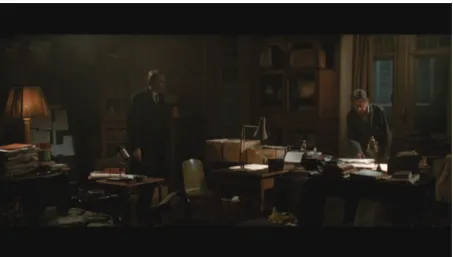
Figure 1: Control’s Flat—Spying on Spies
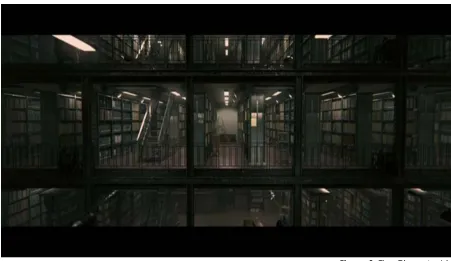
From the opening moments of Tinker Tailor it is clear to the audience that it has entered into a microcosm of society which is shrouded in suspicion and paranoia. This is most strikingly conveyed in the overwhelmingly dark palette of the film, which seems to suggest both a ‘heavy’ world and one in which any sense of joy has been washed out alongside colour. Previously, I suggested that the disciplinary model seems to evoke a society in which sites of confinement are brought to the fore, including the architectures and materiality associated with such structures, and Figures 1 and 2 echo this.
11 This, of course, has pertinent contemporary echoes in recent socio-political developments in the Ukraine and the
Figure 2: The Circus Archives
In Control’s (John Hurt) flat the viewer is presented with a covert spy operation as Control suspects one of his subordinates of being a mole who is passing sensitive information to Russia. This focus on the figure of the mole ties Tinker Tailor to disciplinary structures at the level of metaphor. In ‘Postscript on Control Societies’, Deleuze writes concerning the changing economic context of the shift from discipline to control paradigms with the introduction of the floating exchange rate. He notes that,
If money’s old moles are the animals you get in places of confinement, then control societies have their snakes. We’ve gone from one animal to the other, from moles to snakes, not just in the system we live under but in the way we live and in our relations with other people too.
(Deleuze 1990: 180)
For Deleuze, the stability of disciplinary structures, even at the level of financial markets is called into question by the fluidity of processes associated with control-dominant practices. In Tinker Tailor the figure of the mole ties the narrative to an identifiable enemy to be targeted. Although a similar situation takes place in Skyfall with former agent Silva, it takes longer to identify the antagonist, if not to name him outright.
In discussing manifestations of data, what is most striking about Figure 1 is the preponderance of objects such as files, folders and papers as surveillance is carried out in its analogue form. The frame is cluttered with physical traces of the detritus of everyday life, clumsily catalogued in a crude parallel of the ordered archive room in the Circus headquarters shown in Figure 2. In both stills, information is depicted through the mise-en-scène in its ‘bodily’ form, resulting in a material presence which threatens to exceed the boundaries of the cinematic image; the frame is seemingly unable to contain the data produced by everyday life. Anderson’s cloud storage is an unthinkable concept in a filmic world which is anchored in the material, leading to a claustrophobic and overwhelming situation. When this is considered alongside
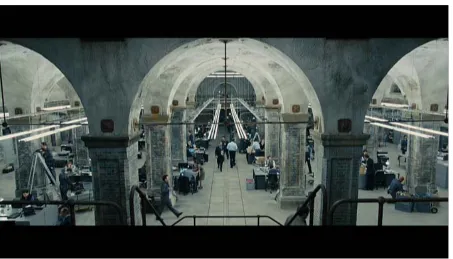
Figure 3: Pre-Silva Headquarters
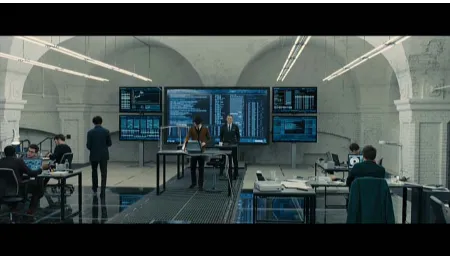
Figure 5: ‘Q Branch’
While Tinker Tailor offers a surveillance society which is visually communicated as being dark or ‘heavy’, Skyfall, at first glance, presents the opposite extreme. In Figures 3-5 the viewer is presented with a security agency which revolves around digital forms of information and, consequently, one which is in the process of having its material ‘body’ steadily flayed one hard-drive at a time. Here, the colours suggest surgical precision in their cool, crisp blues and whites which stand in sharp contradistinction to the messy world of Tinker Tailor. Superfluous objects are steadily removed from the mise-en-scène to be replaced with ever-smaller computing platforms. This focus on digital computing technologies is significant to note as they appear in almost every scene of the film (with the exception of the closing section which offers a nostalgic retreat to a ‘simpler’ world which is promptly destroyed by bullets and bombs), foregrounding one of the key components of the control society previously mentioned. Indeed, the move from analogue to digital forms of technology and surveillance practices is perhaps one of the most visually identifiable indicators of the shift between the Foucauldian and Deleuzian models, or at least of the emerging hybrid situation in which the two fuse together.12 Thus contemporary surveillance films often visually code the
invisible digital surveillance world as blue, as can be seen in Figure 5 as Q (Ben Wishaw) and Bond (Daniel Craig) are surrounded by computers covered with blue scripts depicting a human/screen interface into the invisible world of contemporary forms of information (Muir 2011, 2012).
The notion of a hybrid surveillance society is, however, important as it points to the complexities of these various modes of monitoring. The relationship between Bond and Q, for example, highlights the tensions and suspicions of a transition towards intelligence activities which moves from being ‘out in the field’ to taking place in digital spaces. I further suggest here that digital technologies are replete throughout the mise-en-scène, highlighting the dominance of information in this government agency and its antagonist, Silva. Nevertheless, it should be borne in mind that these scenes take place in an underground space filled with twisting and turning tunnels from the time of Second World War, at least. Figure 4 demonstrates how this is manifested in solid stone structures which suggest permanence, stability and solidity. Indeed, an
12 This continual foregrounding of the use of digital technology which characterises contemporary surveillance
undeniable material presence. It is in the centre of this permanent and ancient matter that the fluid forms of transparent, digital surveillance takes place. Immaterial cyberspace and cavernous stone fuse together in the mise-en-scène, visually representing the tensions between these different models of information and monitoring.
Nevertheless, the theme of information and transparency is also signalled throughout the film, both explicitly in the narrative and more subtly through the construction of the mise-en-scène. However, the popular link between truth and transparency is frequently undermined as MI6 and Bond are consistently lured into following false (digital) trails, allowing Silva to permeate further into their computer systems. The stability and solidity of stone is no guarantee of safety in information warfare. Within the mise-en-scène, glass is frequently deployed as a visual metaphor for the somewhat abstract concept of transparency. For Paul Virilio, this is a crucial feature in the struggle for materiality in an increasingly immaterial world. In an interview with Andreas Ruby he comments that,
In some ways, you can read the importance given today to glass and transparency as a metaphor of the disappearance of matter. It anticipates the media buildings in some Asian cities with facades entirely made of screens. In a certain sense, the screen becomes the last wall. No wall out of stone, but of screens showing images. The actual boundary is the screen.
(Ruby 1999: 181)
Virilio here seems to suggest that the material cannot be altogether forsaken, but that it does become something to be seen through.
Figures 3 and 5 show spaces in which glass forms an integral part of government architectures, allowing for the ease of mobility in bodies, increasing their speed in a constantly changing world. There is also a suggestion that the viewer is permitted a glimpse into the inner workings of (fictional) secretive security agencies, opening them up to scrutiny and a sense of accountability. Glass, then, seems to be a strategy which aids comprehension and suggests a clearer view of a fictional world which seems to be destabilised and shifting in an echo of current political reality in the context of the British government, discussed earlier.
Figure 6: Complex Clarity in Silva’s Prison
In Figure 6 the spectator is presented with a view of Silva, the agent turned cyber-terrorist who has threatened the balance of power in the British agency by virtue of his ‘insider’ knowledge. The representation of glass and transparency here is not straightforward, but is a complex, layered—perhaps even haptic—image which the viewer must seek to comprehend. It is not by chance that Silva is trapped behind a material which can screen him from visibility in its opaqueness, or render him visible by switching to clear glass at the touch of a button, mirroring the life he leads ‘at the touch of a button’, as he explains to Bond. Indeed, just as Silva has intricately planned each event leading to his incarceration, it is hard to discern in Figure 6 where the prison ends and freedom begins, for M too appears to be trapped alongside the agent she betrayed. Silva’s own asymmetric surveillance is here not only communicated through the narrative, but through the mise-en-scène which depicts an inverted reflection of the true situation—Silva’s desire to be captured in order to progress the next stage of his revenge. Moreover, glass here does not aid the movement of the body or the smooth communication of information, as it is usually employed in a visual shorthand, but is used to entrap and halt the body, to complicate the visual data. Transparency, then, is not always indicative of clarity, but of opacity, of situations which are not all they appear to be.
Material Traces
From the earliest days of cinema there has been an explicit interest in surveillance at a thematic level and it is also clear that there is an implicit relationship between the technologies of surveillance and those of cinema, mirrored more recently in the increasing dominance of the digital. That is, the connection between cinema and surveillance can be said to be symbiotic at the level of technological development, particularly in the way in which the camera is deployed (Muir 2011).
strategy used to differentiate certain images from others, but has become the movie’s primary narrative concern” (Levin 2002: 582). The contemporary surveillance society is an emerging phenomenon characterised by fluidity and mobility. The increasing use of digital technologies has led to a sense of a temporal framework marked by velocity and rapidity and, indeed, with Big Data, a preemptive turn to the not-yet future. As we negotiate these complexities, film offers a space of reflection concerning the societies in which we find ourselves. It is a valuable tool to help us make sense of our information-saturated lives. The fact that it too is caught up the digital drive adds to the urgency of examining the narratives we produce.
This article has discussed a number of the changes taking place in a surveillance society located in the interstitial moment of a hybrid situation between the models of discipline and control. In the wake of the Snowden revelations concerning the extent of collaboration between intelligence agencies and corporations in monitoring citizens, it has considered the ways in which changing forms and views of information influence our day-to-day lives. With the emergence of a Big Data discourse, we have considered governments’ investment in a rhetoric of transparency, as well as government responses to citizens who have an increasing ability to check, if not halt, previously entrenched power structures. It has been demonstrated that film engages with these emerging trends both at a narrative and a structural level. The question posed at the outset was how film, with its reliance on the visual image, might negotiate modes of monitoring which are characterised as being increasingly invisible and immaterial. Through considering six still images from Tinker Tailor and Skyfall, we have seen that information steadily loses its ‘body’ as digital modes of monitoring begin to take over from analogue forms of surveillance. This is communicated through the mise-en-scène of the films by the removal of material objects and clutter which threatened to exceed the limits of the cinematic frame, to the foregrounding of computing technologies which stand in for the invisible strings of information which comprise the majority of their surveillance activities. It was also suggested that visual metaphors such as glass and colour coding are employed visually to communicate monitoring which evade easy ocular comprehension. However, far from offering neat solutions, such strategies bring to the fore the opacity or fictions of transparency, reintroducing obstacles to movement and easy comprehension, and asking the viewer to pause and consider not only the films in question, but the wider societal situations which they reflect, however imperfectly.
References
Anderson, Chris. 2008. The End of Theory: Will the Data Deluge Makes [sic] the Scientific Model Obsolete? Wired.
http://www.edge.org/3rd_culture/anderson08/anderson08_index.html (Accessed 01.03.2014). Bauman, Zygmunt and David Lyon. 2013. Liquid Surveillance: A Conversation. Cambridge: Polity Press.
Bogard, William. 2006/2009. Surveillance Assemblages and Lines of Flight. In Theorizing Surveillance: The Panopticon and Beyond, ed. David Lyon, 97-122. Oregon: Willan Publishing.
Bogard, William. 2006. Welcome to the Society of Control: The Simulation of Surveillance Revisited. In The New Politics of Surveillance and Invisibility, eds Kevin D. Haggerty and Richard V. Ericson, 55-78. Toronto: The University of Toronto Press.
boyd, danah and Crawford, Kate. 2011. Six Provocations for Big Data. Paper to be presented at the Oxford Internet Institute: 1-17.
Cabinet Office Document. 2013. Improving the transparency and accountability of government and its services.
https://www.gov.uk/government/policies/improving-the-transparency-and-accountability-of-government-and-its-services (Accessed 28.02.2014).
Castells, Manuel. 1996/2000. The Rise of the Network Society. Oxford: Blackwell Publishers Inc.
Deleuze, Gilles. 2011 [1983]. Cinema 1: The Movement-Image [trans. Tomlinson, Hugh and Habberjam, Barbara]. London: Continuum International Publishing Group.
Deleuze, Gilles. 1990. Postscript on Control Societies. In Negotiations: 1972-1990, Gilles Deleuze [trans. Joughin, Martin], 177-182. New York: Columbia University Press.
Foucault, Michel. 1991. Discipline and Punish: The Birth of the Prison [trans. Sheridan, Alan]. London: Penguin Books. Hayles, N. Katherine. 1999. How we became Posthuman: Virtual Bodies in Cybernetics, Literature, and Informatics. Chicago:
The University of Chicago Press.
Hayward, Susan. 2000. Cinema Studies: The Key Concepts. London: Routledge.
Levin, Thomas Y. 2002. Rhetoric of the Temporal Index: Surveillant Narration and the Cinema of “Real Time”. In 2002. CTRL [SPACE]: Rhetorics of Surveillance from Bentham to Big Brother, eds Thomas Y. Levin, Ursula Frohne and Peter Weibel, 578-593. Karlsruhe: ZKM Centre for Art and Media.
Lyon, David. 2010. Liquid Surveillance: The Contribution of Zygmunt Baumann to Surveillance Studies. International Political Sociology 4: 325-338.
Lyon, David. 2014. Surveillance, Snowden, and Big Data: Capacities, consequences, critique. Big Data & Society July-December: 1-13.
Lyon, David and Kevin D. Haggerty. 2012. The Surveillance Legacies of 9/11: Recalling, Reflecting on, and Rethinking Surveillance in the Security Era. Canadian Journal of Law and Society/Revue Canadienne Droit et Société 27(3): 291-300.
MacAskill, Ewen et al. 2013. GCHQ taps fibre-optic cables for secret access to world’s communications. The Guardian
(21.06.2013). http://www.theguardian.com/uk/2013/jun/21/gchq-cables-secret-world-communications-nsa?guni=Article:in%20body%20link (Accessed 01.03.2014).
Manovich, Lev. 2011. Trending: The Promises and the Challenges of Big Social Data (28.04.2011). http://www.manovich.net/DOCS/Manovich_trending_paper.pdf (Accessed 01.03.2014).
Marx, Gary T. 2002. What’s New about the “New Surveillance”? Classifying for Change and Continuity. Surveillance & Society
1(1): 9-29.
Muir, Lorna. 2011. Between Discipline and Control: Cinematic Engagements with Contemporary Transformations in the Surveillance Society. Thesis. University of Aberdeen.
Muir, Lorna. 2012. Control Space?: Cinematic Representations of Surveillance Space Between Discipline and Control.
Surveillance & Society 9(3): 263-279.
Porter, Henry. 2013. Perhaps I’m out of step and Britons just don’t think privacy is important. The Observer (07.09.2013). http://www.theguardian.com/commentisfree/2013/sep/07/britons-privacy-not-important (Accessed 27.02.2014). Ruby, Andreas. 1999. Architecture in the Age of Its Virtual Disappearance: An Interview with Paul Virilio; Paris, 15th October
1993. In The Virtual Dimension: Architecture, Representation, and Crash Culture, ed. John Beckmann, 179-187. New York: Princeton Architectural Press.
Snowden, Edward. 2014. Here’s How We Take Back the Internet. TED (filmed March 2014).
http://www.ted.com/talks/edward_snowden_here_s_how_we_take_back_the_internet?language=en (Accessed 02.04.2015).
Struijs, Peter, Barteld Braaksma and Piet J.H. Daas. 2014. Official statistics and Big Data. Big Data & Society April-June: 1-6. Tkacz, Nathaniele. 2012. From open source to open government: A critique of open politics. ephemera 12(4): 386-405.
van Dijck, José. 2014. Datafication, dataism and dataveillance: Big Data between scientific paradigm and ideology. Surveillance & Society 12(2): 197-208.
Films
Skyfall. 2012. dir. by Sam Mendes, MGM.