Thomas, J.D.E., Driver, M., Coppola, J.F., & Thomas, B.A. (2008). Looking forward to look backward: Technology and King Arthur. AACE Journal, 16(4), 367-383.
Looking Forward to Look Backward:
Technology and King Arthur
JENNIFER D.E. THOMAS, MARTHA DRIVER, AND JEAN F. COPPOLA
Pace University, USA
[email protected] [email protected] [email protected]
BARBARA A. THOMAS
Westchester Community College, USA
Every era has sought the aid of some type of technology to enhance the transmission of learning, beginning with the caveman who utilized cave drawings to transmit and record ideas. We might call this the beginnings of the use of multimedia in learning. In recent times, we have resorted to such tools as blackboards, overhead projectors, videos, and more recently, computers (Coppola & Thomas, 2000). The efficacy of technology integra-tion of any sort into courses is still a hotly debated topic. Technology for its own sake is not considered an appropriate justification for its inclusion. It should in some manner contribute to learning objectives identified by educators and society as meaningful for students to acquire (McEuen, 2001).
Educators and industry agree that higher-order thinking skills (Herrington & Oliver, 2000; Shumacher, West, & Angell, 1997; Cook et al., 1996; Lewis & Smith, 1993) and team-building skills (Chin & Carroll, 2000; Jones, 1994) are important tools for students to acquire from their program of study. The South Carolina Higher Education Assessment Network Critical Thinking Task Force agreed on a definition of critical thinking, which they adapted from a number of authors: “Critical thinking is a reflective, system-atic, rational, and skeptical use of cognitive representations, processes, and strategies to make decisions about beliefs, problems, and/or courses of action” (Cook et al., 1996, p. 9). In the California Critical Thinking Skills Test©(CCTST), critical thinking skills are comprised of several important components identified as: Analysis, Inference, Explanation, Evaluation, Interpretation, Self-Regulation (Facione, 1990).
This study examines the effect of technology integration, as well as other course resources, on students’ perceptions of the contribution these make to their development of selected higher-order skills and team-building skills, in an undergraduate interdisciplinary medieval English literature and multime-dia course (Smith, 2004). Results indicate that their perceptions were favorably enhanced as a consequence of these inclusions. The research design, methodology, results, discussion, and conclusion are presented.
RESEARCH DESIGN
creative ideas, and on team-building skills, such as communication skills, team cooperation, and work coordination. The technologies integrated into a survey course in English literature that examines works from Beowulf to King Lear were an electronic classroom, which uses the Robotel™ system, an online class-management tool, Blackboard™, and training in HTML code for creating web-based documents with which to present their analyses in a multimedia context (Chism, 2004). Other course resources included read-ings for the course, content and images from the Internet and on a class site, and various classroom activities and assignments.
METHODOLOGY
The course was originally taught for many years as a straightforward survey of medieval and Renaissance literature. In fall 1996 a new version of the course was introduced combining the use of technology with substantial literary content. The course satisfies the university’s second-level literature course requirement and also fulfills one elective in computing, though this should be renegotiated as the students spend a lot of time creating their pages in response to the literature (Anstendig, Meyer, & Driver, 1998; Driver & Meyer, 1999).
interpretation of a scene from King Lear. The best student work (B+ and up) is published on an Internet site housed at Pace University. During the course, students are encouraged to revise and rewrite essays so that they will qualify to be published on the Web. In the last few years, students have also been asked to participate in discussions on Blackboard as well as to read and understand the lectures posted there.
Since 2001, our students have also been able to discuss Beowulf and King Arthur with students in a class titled “Heroes and Villains” at Western Michigan University through videoconferencing and Internet-2. Students were excited to meet their counterparts at another institution and share their ideas about Beowulf, films of Beowulf, and the King Arthur legends in two videoconference sessions during the semester. Students at both institutions, one urban, the other in the Midwest, discovered that many of their questions and observations on the medieval texts were the same. The exercise also brought out competitiveness between the students, the Pace University class becoming extremely articulate and expressive about the texts, even more so than in the usual classroom. Last semester, the Western Michigan students began to talk to the Pace students through Blackboard, and the plan is for this to continue in subsequent courses. The purpose of these exercises is to bring students into a larger learning community across institutions and to create cadres of student-scholars who will be taught to use Internet materials and their student networks as adroitly as adult scholars. The hope is to extend the connection with Western Michigan so that students can form study groups across campuses to create networks of learning. The interface created by Internet-2, as well as its future possibilities for use in the humani-ties, is very exciting.
The e-classroom© facility, Robotel™ is a software and hardware-based technology, which facilitates access to the Internet, access to multimedia capabilities for viewing and creating documents, a facility for student sharing of computer screens and for working in teams, and a facility for projecting computer screens to and from the instructor and among students, whether individually, as a group, or as a class. Blackboard™ facility is a software-based technology that provides, along with instructor course management facilities, student access to online course material, discussion board and electronic mail. Both facilities have other functionalities. However, only those functions that were used are indicated here. The Robotel™ facility by which computers can be put into team-mode and have students in the team take control of each other’s computers and keyboards, without moving chairs, to iteratively develop a single document was introduced in Section 2 (team-mode) of the course but not in Section 1 (nonteam-mode).
Grades were collected along with a survey of students’ perceptions of the support the technologies and course resources provided to their acquisition of higher-order learning skills, including critical thinking skills, problem-solving skills, research skills, and creative idea generation skills as well as team-building skills, such as communication skills, team coordination, and team cooperation skills. In the second section, perceptions concerning e-classroom© technology integration were also collected at the beginning of the course and at the end of the course. Both sections were taught by the same two instructors over two terms, using the same material, content, and instructional design.
RESULTS
Demographics
Table 1
Demographic Distributions
% Section 1 Nonteam-mode Section 2 Team-mode
N 15 13
Age:
<20 38 33
20-29 54 67
30-39 8 0
39+ 0 0
Gender:
Male 25 47
Female 75 53
Computer Experience:
Minimal 23 47
Moderate 62 47
Extensive 15 6
Note: Team-mode refers to the facility in Robotel technology to put computers in an electronic classroom into teams.
Grades
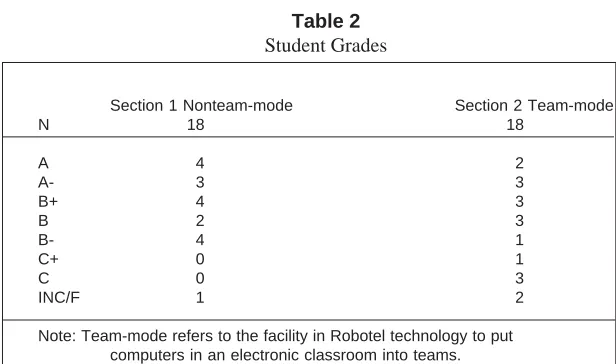
Grades were collected for 18 students in both of the sections which, surprisingly, were higher for the students in the nonteam-mode section (Table 2).
Table 2 Student Grades
Section 1 Nonteam-mode Section 2 Team-mode
N 18 18
A 4 2
A- 3 3
B+ 4 3
B 2 3
B- 4 1
C+ 0 1
C 0 3
INC/F 1 2
Perceptions
Depending on the section, one or two surveys were administered to gauge students’ perceptions. Students in both sections were asked to rate the support they perceived the technologies used, the course readings and the activities and assignments provided for acquiring critical thinking skills and other higher-order learning skills, as well as for acquiring team-building skills (Appendix A). Support was rated as either None, Some, or A Lot. In addition to this, students in Section 2 were asked to complete pre and postsurveys (Appendix B) concerning their perceived satisfaction with the electronic classroom to determine changes from beginning to the end of the course.
SKILLS SUPPORT SURVEY
Thinking Skills
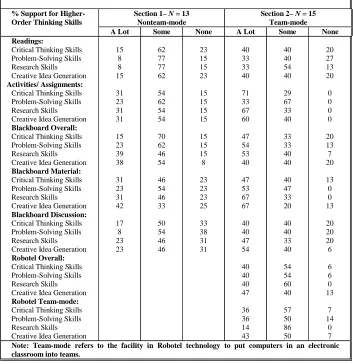
The distributions indicate that students in the team-mode section, Section 2, perceived much more support of all the higher-order thinking skills from the integration of the various technology elements, and from the other course resources employed, than did the students in Section 1, the nonteam-mode section (Table 3). The percentages of the team-mode section perceiving a lot of support ranged from 33-71%, except in the case of Robotel’s™ team-mode support for research skills, 14%, compared to the range for the nonteam-mode section, which was from 8-39%. In Section 1, the activities and assignments and material on Blackboard™ were perceived by one third (31-42%) of the students as providing a lot of support for developing critical thinking, research skills, and generating creative ideas. A third of students also thought Blackboard™ overall supported research skills and creative idea generation a lot.
Table 3
Skills Support Perceptions Distributions–Thinking Skills
Section 1– N = 13 Nonteam-mode
Section 2– N = 15 Team-mode % Support for
Higher-Order Thinking Skills
A Lot Some None A Lot Some None
Readings:
Critical Thinking Skills Problem-Solving Skills Research Skills Creative Idea Generation Activities/ Assignments:
Critical Thinking Skills Problem-Solving Skills Research Skills Creative Idea Generation Blackboard Overall: Critical Thinking Skills Problem-Solving Skills Research Skills Creative Idea Generation Blackboard Material: Critical Thinking Skills Problem-Solving Skills Research Skills Creative Idea Generation Blackboard Discussion: Critical Thinking Skills Problem-Solving Skills Research Skills Creative Idea Generation Robotel Overall: Critical Thinking Skills Problem-Solving Skills Research Skills Creative Idea Generation Robotel Team-mode: Critical Thinking Skills Problem-Solving Skills Research Skills Creative Idea Generation
Students in Section 1 appear to perceive lesser support of higher-order thinking skills from readings in the course (8-15%) and online discussions (8-23%) than was indicated for the course activities and assignments (23-31%), Blackboard™ overall (15-39%), and course material on Blackboard™ (23-42%). This difference is not evident in Section 2. Generally, it seems that perceptions are far more favorable when the team-mode functions of the Robotel electronic classroom are integrated.
Very few students indicated that they perceived no support at all from the technology integration which, on any of the dimensions, ranged from zero to, at most, 38%. It was only the Blackboard™ Discussion Board that was rated by 30-38% as not providing any support to acquiring these skills.
Team-Building Skills
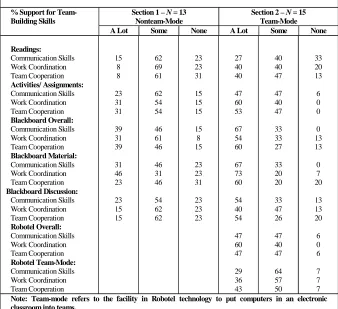
Again with respect to acquiring team-building skills, students in Section 1 perceived greater support from course activities and assignments (23-31%), Blackboard™ overall (31-39%), and course material on Blackboard™ (23-46%) than from the readings (8-15%) or the online Blackboard™ discus-sions (15-23) (Table 4). This difference is much less marked in Section 2, except for support of communication skills by the readings (27%) and by the Robotel team-mode (29%). Again, perceptions of those in Section 2, where the team-mode functions of the Robotel™ electronic classroom are integrat-ed into the course, are far more favorable for all categories with most percentages higher than 40% (except as noted) than those in Section 1, which range from 8-46%, where it was not.
Table 4
Skills Support Perceptions Distributions–Team Building
SATISFACTION SURVEY
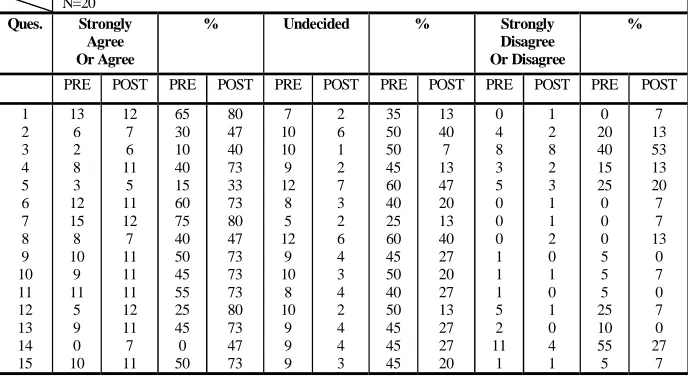
Table 5 shows the distributions of the satisfaction surveys, administered at the beginning and end of the course to Section 2, concerning the electronic classroom. The distributions indicate that the percentage of students agreeing or strongly agreeing with the statements on the survey increased markedly from the beginning to the end of the course, including those
Section 1 – N = 13 Nonteam-Mode
Section 2 – N = 15 Team-Mode % Support for
Team-Building Skills
A Lot Some None A Lot Some None
questions related to increased stress. Notwithstanding this perception of increased stress from using the technology, they felt technology also increased their opportunity to know classmates, to develop new communica-tion skills, be better motivacommunica-tion in the course, and have better retencommunica-tion of material. See Appendix B for a listing of all questions.
Table 5 Satisfaction Survey
Prior to using the electronic classroom, more than 60% agreed, or agreed strongly, that Q1- interactive technology would foster positive feelings about the content of the course, Q6 – electronic / interactive classroom would provide opportunities for small team assignments, Q7 – would learn a new set of communication skills, 65%, 60%, 75%, respectively. These figures changed to 80%, 73%, 80%, respectively, after use. Questions 4, 9, 10, 11, 13, and 15 showed increases from 40, 50, 45, 55, 45, 50%, respec-tively, to 73% for all. These questions related to: Q4 – if given the choice I’d choose the electronic classroom, Q9 – electronic classroom learning is more student-centered, Q10 – electronic classroom will improve attitude to course content, Q11 – anti-glare shields will provide privacy for quizzes and exams, Q13 – electronic classroom will help retention of course content,
N=20 Ques. Strongly
Agree Or Agree
% Undecided % Strongly Disagree Or Disagree
%
PRE POST PRE POST PRE POST PRE POST PRE POST PRE POST
of the course. Of particular note is Q 14 – use of the electronic classroom will/ did make me feel more stressed than a standard classroom, which went from 0% to 47 % perceiving this stress.
These perceptions are further borne out by the comments provided by students on the perception surveys administered to both sections, a sampling of which follows. Students responded to the question: “What did the integration of technology provide that you would not have had otherwise?”
Student 1: It made learning more easy and fun.
Student 2: Interest in the subject, without the multimedia portion of the course. It probably would not have stuck out more than any other literature course at Pace.
Student 3: This is a good course.
Student 4: Instructor X was a pleasure to have as an instructor.
Student 5: I learned how to make a web-page and areas in places to research documents. E.g., Pace Internet Library.
Student 6: It helped me understand computers a little better and helped me learn how to do HTML
Student 7: The computing environment was effective at providing easy re-search.
Student 8: I increased my experience in HTML.
Student 9: It provided an interest[ing] work experience. Where it was ind (sic) of entertaining learning about the subject matter. The technology should be used more in other subjects. It makes the learning process easier and more enjoyable.
Student 10: Awesome
Student 11: I already wrote an essay about this. I liked it.
DISCUSSION
readings for the course and online discussions were perceived to offer less support for the team-building and higher-order thinking skills by those not exposed to the Robotel™ team-mode facility. In the team-mode section, communication skills supported by the readings and the Robotel team-mode had a lower percentage of those rating them as providing a lot of support than in the other categories. On all the dimensions, very few students perceived no support from integrating technology. These perceptions did not translate into grades, however, as those in the nonteam-mode section received higher grades than those in the team-mode section.
CONCLUSION
Integrating technology into an interdisciplinary medieval English literature and multimedia course, at least those associated with Blackboard™, the Robotel™ system, and learning HTML, has proven to be a positive addition to the course. This has potential implications for all courses, as it would seem that even though there is some additional stress associated with making use of technology, students are nonetheless favorable to its use and perceive benefits to their development of important higher-order thinking and team-building skills, which has the potential for favorably influencing students’ perceptions of the course. The hope is also that these perceptions translate into improved performance in grades and in the actual acquisition of higher-order thinking skills such as critical thinking. In this small sample, the improvement in the grades was not seen, but there may be more to the story than just grades. In a future paper, the results from data collected through the California Critical Thinking Skills Test Inventory© (Facione, 1990) will be analyzed and presented.
References
Anstendig, L., Meyer, J., & Driver, M. (1998). Web research and hypermedia: Tools for engaged learning. Journal on Excellence in College Teaching, 9(2), 69-91.
Chin, G., Jr., & Carroll, J.M. (2000). Articulating collaboration in a learn-ing community. Behaviour and Information Technology, 19(4), 233-245.
Chism, N. (2004). Using a framework to engage faculty in instructional technologies. EDUCAUSE Quarterly, 27(2), 39-45.
Cook, P., Johnson, R., Moore, P., Myers, P., Pauly, S., Pendaryls, F., et al. (1996). Critical thinking assessment: Measuring a moving target. Re-port and Recommendations of the South Carolina Higher Education Assessment Network Critical Thinking Task Force. Rock Hill, SC. Coppola, J.F., & Thomas, B.A. (2000). Beyond ‘chalk and talk’: A model
for e-classroom design. T.H.E. Journal, 27(6), 30-32, 34, 36.
Driver, M., & Meyer, J. (1999, June). Beowulf to Lear: Text, image, and hypertext. Literary & Linguistic Computing, 14(2), 223-235.
Facione, P.A. (1990). California critical thinking skills test. Santa Clara University, Millbrae, CA: The California Academic Press.
Herrington, J., & Oliver, R. (2000). Using situated learning and multimedia to investigate higher-order thinking. Journal of Educational Multime-dia and HypermeMultime-dia, 8(3), 401-422.
Jones, E.A. (1994). A plan for validating criteria and measures to monitor progress toward national education Goal 5.5: Identifying college grad-uates’ essential skills in writing, speaking and listening, and critical thinking. Contract No. R117G10037. University Park, PA: National Center on Postsecondary Teaching, Learning and Assessment.
Lewis, A., & Smith, D. (1993). Defining higher order thinking. Theory into Practice, 32(3), 131-137.
McEuen, S.F. (2001). How fluent with information technology are our stu-dents? EDUCAUSE Quarterly, 24(4), 8-17.
Robotel. Retrieved August 4, 2007, from http://www.robotel.ca/english/ roducts_sc2000.html
Schumacher, B., West, D. V., & Angell, L.R. (1997, November). Assessing knowledge and cognitive skills. Paper presented at the Annual Meeting of the National Communication Association. Chicago, Illinois.
A ppen dix A . Electronic C lassroom S kills Sup port Perception Survey
P lease take a few m om ents to answer a som e questions regarding the areas of learning which you felt were supported by various technology used in the course, as well as som e dem ographic inform ation.
G ender: M ale Fem ale
A ge: <20 20-29 30-39 39+
C om puter E xperience: E xtensive M oderate Minim al R obotel E xperience: E xtensive M oderate Minim al
W ork Experience: Type Years
In answ erin g the questions below , please refer to the d efinitions provided here:
C onducting Research – investigating, finding, and synthesizing inform ation from m ultiple sources
C om m unicatio n S kills – conveying ideas effectively, both orally and written
P ro blem -solving – deriving alternatives and solutions for com plex problem s/ issues with incom plete inform ation
C reative Ideas – Ideas that are novel or unique
C oord inating w ork – bringing together work from m ultiple sources and team m em bers
C ooperation – interpersonal skills, resolution of differences
C ritical Thinking – analysis, inference, reasoning, evaluation, explanation, interpretation
1. H ow did the Textbook assist you in the following learning objectives?
C onducting research: A lot Som ewhat Not at all D eveloping com m unication skills A lot Som ewhat Not at all P roblem -solving A lot Som ewhat Not at all D eveloping creative ideas A lot Som ewhat Not at all Thinking critically A lot Som ewhat Not at all C oordinating work A lot Som ewhat Not at all C ooperation am ong team m em bers A lot Som ewhat Not at all
2. H ow did the C ases assist you in the following learning objectives?
C onducting research: A lot Som ewhat Not at all D eveloping com m unication skills A lot Som ewhat Not at all P roblem -solving A lot Som ewhat Not at all D eveloping creative ideas A lot Som ewhat Not at all Thinking critically A lot Som ewhat Not at all C oordinating work A lot Som ewhat Not at all C ooperation am ong team m em bers A lot Som ewhat Not at all
3. H ow did the Activities/ Assignm en ts assist you in the following learning objectives?
C onducting research: A lot Som ewhat Not at all D eveloping com m unication skills A lot Som ewhat Not at all P roblem -solving A lot Som ewhat Not at all D eveloping creative ideas A lot Som ewhat Not at all Thinking critically A lot Som ewhat Not at all C oordinating work A lot Som ewhat Not at all C ooperation am ong team m em bers A lot Som ewhat Not at all
4. H ow did Blackboard as a w h ole assist you in the following learning objectives?
C onducting research: A lot Som ewhat Not at all D eveloping com m unication skills A lot Som ewhat Not at all P roblem -solving A lot Som ewhat Not at all D eveloping creative ideas A lot Som ewhat Not at all Thinking critically A lot Som ewhat Not at all C oordinating work A lot Som ewhat Not at all C ooperation am ong team m em bers A lot Som ewhat Not at all
5. H ow did M aterial in Blackboard assist you in the following learning objectives?
Developing creative ideas A lot Somewhat Not at all Thinking critically A lot Somewhat Not at all Coordinating work A lot Somewhat Not at all Cooperation among team members A lot Somewhat Not at all
7. How did the Robotel classroom as a whole assist you in the following learning objectives?
Conducting research: A lot Somewhat Not at all Developing communication skills A lot Somewhat Not at all Problem-solving A lot Somewhat Not at all Developing creative ideas A lot Somewhat Not at all Thinking critically A lot Somewhat Not at all Coordinating work A lot Somewhat Not at all Cooperation among team members A lot Somewhat Not at all
8. How did the Robotel team-mode feature assist you in the following learning objectives?
Conducting research: A lot Somewhat Not at all Developing communication skills A lot Somewhat Not at all Problem-solving A lot Somewhat Not at all Developing creative ideas A lot Somewhat Not at all Thinking critically A lot Somewhat Not at all Coordinating work A lot Somewhat Not at all Cooperation among team members A lot Somewhat Not at all
9. What did integrating the Robotel technology into the course provide that you would not otherwise have had or been able to achieve? ______________________________________________________________________________________________
______________________________________________________________________________________________
______________________________________________________________________________________________
______________________________________________________________________________________________
______________________________________________________________________________________________
______________________________________________________________________________________________
A p p en d ix B P ac e U n iv er si ty -L ea rn in g E n vi ro n m en t P re /P os t-S tu d en t S at is fa cti on S u rv ey St ro n gl y Ag re e Ag re e U n de ci de d Di sa gr ee St ro n gl y Di sa gr ee N/ A ol o gy ha s c au se d m e t o f ee l posi ti ve a bout t he c on te nt w he n us in g i t. e t ec hnol og y f o r e ac h c la ss ha s g iv en m e t he op po rt un it y t o k n ow e ve ry one i n m y cl as s. in te ract iv e c la ss ro om , I h av e f el t m or e an xi et y t h an i n a s tan da rd cl as sr oo m . rt un it y t o c hoo se be tw ee n a n e le ct roni c/ in te ra ct iv e or r eg ul ar c la ssr oom , I w il l c hos e iv e. /in te ra ct iv e c la ss ro om it w as i m po rta nt f or m e to h av e d ir ec t e ye c on ta ct w ith th e t ea ch er es . in te ra ct iv e c la ss room ha s g iv en m e t he oppor tuni ty t
o do s
m al l gr oup a ss ignm en ts a nd in te ract iv e c la ss ro om I l ear ne d a n ew s et o f c om m u ni cat io n s ki ll s. om t he i nst ru ct or ha s c ha nge d i n a n e le ct ro ni c/ inte ra ct ive c la ssr o om . c la ss room , I ha ve f el t l ea rni n g i s m or e s tude nt -c en te re d. c/ int er ac ti ve c la ss room , I ha d a n i m p rov ed a tt it ud e t ow ar d t he c ont en t of t he c our se . nt i-gl ar e s hi el ds i n t he e le ct roni c/ in te ra ct iv e c la ssr oo m w il l g ave m e t he oppor tuni ty f or ng qui zz es or e le ct roni c ba se d e xa m s. s m et i n a n el ec tr on ic /i nt er act iv e c la ss ro om , I t en de d t o ar ri ve ea rl ie r an d/ or s ta y l at er . c/ in te ra ct iv e c la ss ro om I r et ai ne d m or e i nf or m at io n f rom t he c ont en t c ove re d. ro ni c/ in ter ac ti ve cl as sr o om m ad e m e f eel m or e s tr es se d t h an a s tan da rd cl as sr oo m . c/ in te ra ct iv e c la ssr oom , I f el t m ot iva te d a nd e xc it ed to c om e t o e ac h se ssi on. D CO M M EN T S AN D S U G G E S T IO N S ABO U T T H E R O O M O N T H
E BACK O