R E S E A R C H
Open Access
A new hybrid algorithm for a nonexpansive
mapping
Qiao-Li Dong
1,2*and Yan-Yan Lu
1*Correspondence:
1College of Science, Civil Aviation
University of China, Tianjin, 300300, China
2Tianjin Key Lab for Advanced
Signal Processing, Civil Aviation University of China, Tianjin, 300300, China
Abstract
In the paper, we introduce a new hybrid algorithm which is not based on the modification to weak convergence algorithms. The strong convergence theorem of the proposed algorithm is presented. Finally, the numerical experiments suggest that the new algorithm could be faster than Nakajo and Takahashi’s algorithm in J. Math. Anal. Appl. 279:372-379, 2003.
MSC: 90C47; 49J35
Keywords: nonexpansive mapping; Mann’s iteration; hybrid algorithm; strong convergence
1 Introduction
LetH be a real Hilbert space with the inner product·,·and the norm · andCbe a nonempty closed convex subset ofH. Recall that a mappingT :C→C is said to be nonexpansive ifTx–Ty ≤ x–yholds for allx,y∈C. We denote byFix(T) the set of fixed points ofT,i.e.,Fix(T) ={x∈C:Tx=x}.
Recently, a great deal of literatures on iteration algorithms for approximating fixed points of nonexpansive mappings have been published since they have a variety of ap-plications in inverse problem, image recovery, and signal processing; see [–]. Mann’s iteration process [] is often used to approximate a fixed point of the operators, but it has only weak convergence (see [] for an example). However, strong convergence is of-ten much more desirable than weak convergence in many problems that arise in infinite dimensional spaces (see [] and references therein). So, attempts have been made to mod-ify Mann’s iteration process so that strong convergence is guaranteed. LetT:C→Cbe a nonexpansive mapping such thatFix(T)=∅. Nakajo and Takahashi [] firstly introduced the following hybrid algorithm.
Algorithm
⎧ ⎪ ⎪ ⎪ ⎪ ⎪ ⎪ ⎨ ⎪ ⎪ ⎪ ⎪ ⎪ ⎪ ⎩
x∈Cchosen arbitrarily, yn=αnxn+ ( –αn)Txn,
Cn={z∈C:yn–z ≤ xn–z},
Qn={z∈C:xn–z,xn–x ≤}, xn+=PCn∩Qnx,
()
wherePKdenotes the metric projection onto the setK,{αn} ⊂[,σ] for someσ∈(, ].
Thereafter, many hybrid algorithms have been studied extensively since they have strong convergence, see [–]. As far as we know, most hybrid algorithms can be seen as the modification for weak convergence algorithms.
Inspired by the recent work of Malitsky and Semenov [], we propose the following algorithm.
Algorithm
⎧ ⎪ ⎪ ⎪ ⎪ ⎪ ⎪ ⎨ ⎪ ⎪ ⎪ ⎪ ⎪ ⎪ ⎩
x,z∈Cchosen arbitrarily, zn+=αnzn+ ( –αn)Txn,
Cn={z∈C:zn+–z≤αnzn–z+ ( –αn)xn–z},
Qn={z∈C:xn–z,xn–x ≤}, xn+=PCn∩Qnx,
()
where{αn} ⊂[,σ] for someσ∈[,). It is easy to see that Algorithm is not a
modifi-cation of any weak convergence algorithm.
The paper is organized as follows. In the next section, we present some lemmas which will be used in the main results. In Section , strong convergence theorem and its proof are given. In the final section, Section , some numerical results are provided, which show advantages of our algorithm.
2 Preliminaries
We will use the following notation:
() for weak convergence and→for strong convergence. () ωw(xn) ={x:∃xnjx}denotes the weakω-limit set of{xn}.
We need some facts and tools in a real Hilbert spaceHwhich are listed as lemmas below.
Lemma . The following identity in a real Hilbert space H holds:
u–v=u–v– u–v,v, u,v∈H.
Lemma . (Goebel and Kirk []) Let C be a closed convex subset of a real Hilbert space H,and let T:C→C be a nonexpansive mapping such thatFix(T)=∅.If a sequence {xn}in C is such that xnz and xn–Txn→,then z=Tz.
Lemma . Let K be a closed convex subset of a real Hilbert space H,and let PK be the
(metric or nearest point)projection from H onto K (i.e.,for x∈H,PKx is the only point in
K such thatx–PKx=inf{x–z:z∈K}).Given x∈H and z∈K.Then z=PKx if and
only if the following relation holds:
x–z,y–z ≤ for all y∈K.
Lemma .(Matinez-Yanes and Xu []) Let K be a closed convex subset of H.Let{xn}be
condition
xn–u ≤ u–q for all n,
then xn→q.
Lemma . Let{an}and{bn}be nonnegative real sequences,α∈[, ),β∈R+,and for all
n∈Nthe following inequality holds:
an+≤αan+βbn. ()
If∞n=bn< +∞,thenlimn→∞an= .
Proof Using inequality () forn= , , . . . ,N– , we obtain
a≤αa+βb,
a≤αa+βb,
.. .
aN≤αaN–+βbN–.
Adding all these inequalities yields
N
n= an≤
–α
a–αaN+β N–
n= bn ≤
–α
a+β
∞
n= bn .
SinceNis arbitrary, we see that the series∞n=anis convergent and hencean→.
3 Algorithm and its convergence
In this section, we present strong convergence theorem and its proof for Algorithm .
Theorem . Let C be a closed convex subset of a Hilbert space H,and let T:C→C be
a nonexpansive mapping such thatFix(T)=∅.Assume that{αn} ⊂[,σ]holds for some
σ∈[,).Then{xn}and{zn}generated by Algorithmconverge strongly to PFix(T)x. Proof It is easy to know thatCnis convex (see Lemma . in []). Next we show that
Fix(T)⊂Cnfor alln≥. To observe this, takingp∈Fix(T) arbitrarily, we have
zn+–p=αnzn+ ( –αn)Txn–p
≤αnzn–p+ ( –αn)xn–p,
which impliesFix(T)⊂Cnfor alln≥. Next we show
by induction. Forn= , we haveFix(T)⊂C=Q. AssumeFix(T)⊂Qn. Sincexn+is the projection ofxontoCn∩Qn, by Lemma . we have
xn+–z,xn+–x ≤ ∀z∈Cn∩Qn.
AsFix(T)⊂Cn∩Qn, by the induction assumption, the last inequality holds, in particular,
for allz∈Fix(T). This together with the definition ofQn+ implies thatFix(T)⊂Qn+. Hence () holds for alln≥.
SinceFix(T) is a nonempty closed convex subset ofC, there exists a unique elementq∈ Fix(T) such thatq=PFix(T)x. Fromxn=PQnx(by the definition ofQn) andFix(T)⊂Qn,
we havexn–x ≤ p–xfor allp∈Fix(T). Due toq∈Fix(T), we get
xn–x ≤ q–x, ()
which implies that{xn}is bounded.
The fact thatxn+∈Qnimplies thatxn+–xn,xn–x ≥. This together with Lemma . implies
xn+–xn≤ xn+–x–xn–x. ()
From () and () we obtain
N
n=
xn+–xn≤ N
n=
xn+–x–xn–x
=xN+–x–x–x ≤ q–x–x–x.
So it follows that∞n=xn+–xnis convergent and thusxn+–xn → asn→ ∞. The
fact thatxn+∈Cnimplies that
zn+–xn+≤αnzn–xn++ ( –αn)xn–xn+ =αn
zn–xn+ zn–xn,xn–xn++xn–xn+
+ ( –αn)xn–xn+ ≤αn
zn–xn+xn–xn+
+ ( –αn)xn–xn+ ≤σzn–xn+ xn–xn+,
where the second inequality follows from the AM-GM and the Cauchy-Schwarz inequal-ities, and the last inequality follows fromαn≤σ. From Lemma . andσ ∈(,), we
obtain
zn–xn →. ()
For this reason, we have
Noting that ( –αn)(Txn–xn) = (zn+–xn) +αn(xn–zn), we obtain
Txn–xn ≤
–αn
zn+–xn+
αn
–αn
xn–zn.
Sinceαn≤σand by () and (), we get
Txn–xn →. ()
By Lemma ., we obtain thatωw(xn)⊂Fix(T). This, together with () and Lemma .,
guarantees strong convergence of{xn}toPFix(T)x. From (), strong convergence of{zn}to
PFix(T)xis obtained.
Changing the definitions ofzn+andCnin Algorithm , we get the following algorithm:
⎧ ⎪ ⎪ ⎪ ⎪ ⎪ ⎪ ⎨ ⎪ ⎪ ⎪ ⎪ ⎪ ⎪ ⎩
x,z∈Cchosen arbitrarily, zn+=αnxn+ ( –αn)Tzn,
Cn={z∈C:zn+–z≤αnxn–z+ ( –αn)zn–z},
Qn={z∈C:xn–z,xn–x ≤}, xn+=PCn∩Qnx,
()
where{αn}∞n=⊂[a,b] for somea,b∈(, ). Using the process of proof of Theorem ., we can show the following theorem.
Theorem . Let C be a closed convex subset of a Hilbert space H,and let T:C→C be a nonexpansive mapping such thatFix(T)=∅.Assume{αn} ⊂[a,b]for some a,b∈(, ).
Then{xn}and{zn}generated by the iteration process()strongly converge to PFix(T)x.
4 Numerical experiments
In this section, we firstly present specific expression ofPCn∩Qnxin Algorithm and then compare Algorithms and through numerical examples.
Heet al.[] pointed out that it is difficult to realize the hybrid algorithm in actual computing programs because the specific expression ofPCn∩Qnxcannot be got, in general. For a special caseC=H, whereCnandQnare two half-spaces, they obtained the specific
expression ofPCn∩Qnxand realized Algorithm .
In the caseC=H, following the ideas of Heet al.[], we obtain the specific expression ofPCn∩Qnxof Algorithm as follows:
⎧ ⎪ ⎪ ⎪ ⎪ ⎪ ⎪ ⎪ ⎪ ⎪ ⎪ ⎪ ⎪ ⎪ ⎨ ⎪ ⎪ ⎪ ⎪ ⎪ ⎪ ⎪ ⎪ ⎪ ⎪ ⎪ ⎪ ⎪ ⎩
x,z∈Hchosen arbitrarily, zn+=αnzn+ ( –αn)Txn,
un=αnzn+ ( –αn)xn–zn+,
vn= (αnzn+ ( –αn)xn–zn+)/, Cn={z∈C:un,z ≤vn},
Qn={z∈C:xn–z,xn–x ≤}, xn+=pn, ifpn∈Qn,
xn+=qn, ifpn∈/Qn,
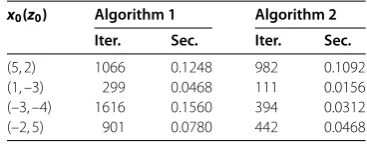
Table 1 Comparison of Algorithms 1 and 2 with different initial values
x0(z0) Algorithm 1 Algorithm 2
Iter. Sec. Iter. Sec.
(5, 2) 1066 0.1248 982 0.1092
(1, –3) 299 0.0468 111 0.0156
(–3, –4) 1616 0.1560 394 0.0312
(–2, 5) 901 0.0780 442 0.0468
where
pn=x–
un,x–vn
un
un,
qn=
– x–xn,xn–pn x–xn,wn–pn
pn+
x–xn,xn–pn
x–xn,wn–pn
wn,
wn=xn–
un,xn–vn
un
un.
LetRbe a two-dimensional Euclidean space with the usual inner productv(),v()= v() v() +v()v() (∀v()= (v()
,v ()
)T,v()= (v () ,v
()
)T∈R) and the normv=
v+v(v= (v,v)T∈R). Heet al.[] defined a mapping
T:v= (v,v)T→
sinv√+v ,cos
v+v √
T
, ()
and showed it is nonexpansive. It is easy to get thatT has a fixed point in the unit disk which is difficult to calculate.
Next, we compare Algorithms and with the nonexpansive mappingTdefined in (). In the numerical results listed in Table , ‘Iter.’ and ‘Sec.’ denote the number of iterations and the cpu time in seconds, respectively. We tookE(x) <εas the stopping criterion and
ε= –. We setx
=z in Algorithm and tookαn= . for Algorithms and . The
algorithms were coded in Matlab . and run on a personal computer.
Table illustrates that in our examples Algorithm has a competitive performance. We caution, however, that this study is a very preliminary one.
Competing interests
The authors declare that they have no competing interests.
Authors’ contributions
All authors contributed equally to the writing of this paper. All authors read and approved the final manuscript.
Acknowledgements
Supported by the National Natural Science Foundation of China (No. 11201476) and Fundamental Research Funds for the Central Universities (No. 3122013D017), in part by the Foundation of Tianjin Key Lab for Advanced Signal Processing.
Received: 6 November 2014 Accepted: 19 February 2015 References
1. Xu, HK: A variable Krasnosel’ski˘ı-Mann algorithm and the multiple-set split feasibility problem. Inverse Probl.22, 2021-2034 (2006)
2. Combettes, PL: On the numerical robustness of the parallel projection method in signal synthesis. IEEE Signal Process. Lett.8(2), 45-47 (2001)
3. Podilchuk, CI, Mammone, RJ: Image recovery by convex projections using a least-squares constraint. J. Opt. Soc. Am.
7(3), 517-521 (1990)
5. Halpern, B: Fixed points of nonexpanding maps. Bull. Am. Math. Soc.73, 957-961 (1967)
6. Moudafi, A: Viscosity approximation methods for fixed-points problems. J. Math. Anal. Appl.241, 46-55 (2000) 7. Xu, HK: Viscosity approximation methods for nonexpansive mappings. J. Math. Anal. Appl.298, 279-291 (2004) 8. Mann, WR: Mean value methods in iteration. Proc. Am. Math. Soc.4, 506-510 (1953)
9. Genel, A, Lindenstrass, J: An example concerning fixed points. Isr. J. Math.22, 81-86 (1975)
10. Bauschke, HH, Combettes, PL: A weak-to-strong convergence principle for Fejér-monotone methods in Hilbert spaces. Math. Oper. Res.26(2), 248-264 (2001)
11. Nakajo, K, Takahashi, W: Strong convergence theorems for nonexpansive mappings and nonexpansive semigroups. J. Math. Anal. Appl.279, 372-379 (2003)
12. Kim, TH, Xu, HK: Strong convergence of modified Mann iterations. Nonlinear Anal.61, 51-60 (2005)
13. Marino, G, Xu, HK: Weak and strong convergence theorems for strict pseudo-contractions in Hilbert spaces. J. Math. Anal. Appl.329, 336-346 (2007)
14. Yao, Y, Liou, YC, Marino, G: A hybrid algorithm for pseudo-contractive mappings. Nonlinear Anal.71, 4997-5002 (2009)
15. Zeng, LC, Ansari, QH, Al-Homidan, S: Hybrid proximal-type algorithms for generalized equilibrium problems, maximal monotone operators and relatively nonexpansive mappings. Fixed Point Theory Appl.2011, Article ID 973028 (2011) 16. Ceng, LC, Ansari, QH, Yao, JC: Hybrid proximal-type and hybrid shrinking projection algorithms for equilibrium
problems, maximal monotone operators and relatively nonexpansive mappings. Numer. Funct. Anal. Optim.31(7), 763-797 (2010)
17. Ceng, LC, Guu, SM, Yao, JC: Hybrid viscosity CQ method for finding a common solution of a variational inequality, a general system of variational inequalities, and a fixed point problem. Fixed Point Theory Appl.2013, Article ID 313 (2013)
18. Zhou, H, Su, Y: Strong convergence theorems for a family of quasi-asymptotic pseudo-contractions in Hilbert spaces. Nonlinear Anal.70, 4047-4052 (2009)
19. Nilsrakoo, W, Saejung, S: Weak and strong convergence theorems for countable Lipschitzian mappings and its applications. Nonlinear Anal.69, 2695-2708 (2008)
20. Malitsky, YV, Semenov, VV: A hybrid method without extrapolation step for solving variational inequality problems. J. Glob. Optim.61(1), 193-202 (2015)
21. Goebel, K, Kirk, WA: Topics in Metric Fixed Point Theory. Cambridge Studies in Advanced Mathematics, vol. 28. Cambridge University Press, Cambridge (1990)
22. Matinez-Yanes, C, Xu, HK: Strong convergence of the CQ method for fixed point processes. Nonlinear Anal.64, 2400-2411 (2006)