Quantitative learning conversations: Constructivism and
its application to learning in an engineering environment
Ms Lynne Fowler Lecturer
School of Engineering Rockingham Campus Murdoch University Dixon Rd Rockingham WA 6168
Tel: (08) 9360 7119 Fax: (08) 9360 7104 [email protected]
Mr Daniel McGill Lecturer
School of Engineering Murdoch University Murdoch WA 6168 [email protected]
Ms Jocelyn Armarego
Lecturer
School of Engineering Murdoch University Murdoch WA 6168 [email protected]
Associate Professor Maurice Allen
Dean of Engineering
School of Engineering Murdoch University Murdoch WA 6168 [email protected]
Abstract: The constructivist theory of knowledge and learning views knowledge not as pre-existing, but constructed. Individuals are different and these differences affect user performance. A recognition and awareness of learning styles will enable our students to develop learning strategies that will support them through their careers, assist our staff to present courses which address the needs of our students and industry, and promote quality conversations between staff and students addressing individual learning styles and approaches to learning.
All our students are required to complete a Foundation unit in first year, first semester. This unit is a critical course for the students as it sets the groundwork on which all further study is dependant. The principal material covered includes essay and report writing, use of technology, ethics, critical thinking and project planning. As a result of our research into constructivism and the recognition of the value of students understanding their own learning styles, it was decided that some
This continuing phase of our research examines the learning styles of our students and staff and addresses issues confronting them in a university environment and beyond.
This paper is presented as a series of questions and responses in a dialogic form.
Keywords: Learning styles, Foundation unit, Constructivist theory, Graduate attributes.
Paper for presentation to symposium
Biography:
Lynne Fowler
Cert Education (Cambridge Institute of Education)
MSc Computer Studies (Sheffield Hallam University, UK)
Position: Software Engineering Lecturer and Co-ordinator: Women in Engineering
Lynne has worked for 10 years in the software industry for national and international companies, both in UK and USA. This was at a time when there were very few females in Computing, involving great challenges and some very interesting experiences! For the last 15 years she has worked in education in various educational establishments and has lectured in Software Engineering both in Sheffield Hallam University, UK and Murdoch University, WA. Her experiences in industry have given her an empathy and understanding for the young women now entering engineering and computing professions. Currently she is completing a PhD in Software Engineering.
Daniel McGill
BA (Hons) Murdoch University
Daniel has worked at Murdoch for seven years mainly in the Teaching and Learning Centre, providing student learning skill support and co-ordinating Equity based bridging programs. For the past three years Daniel has co-ordinated the Foundation Unit, Interactions of Society and Technology, at Rockingham. He now works in the School of Engineering. Currently he is completing a PhD in Cultural Studies.
Maurice Allen
F. I. Chem E. F.I.E. Aust. F.I.M.E. C. Eng. C.P. Eng
Maurice Allen is currently Dean of Engineering in the School of Engineering, Murdoch University. He has academic and industrial experience in Australia, New Zealand and the United States, mainly in chemical engineering and process control.
Jocelyn Armarego
BA (French Studies) (UWA) Grad Dip Lib (WAIT)
Grad Dip Computing (WAIT)
MAppSc (Information Studies) (CSU)
Position: Lecturer: Software Engineering
Quantitative Learning Conversations: Constructivism and
its application to learning in an engineering environment
Ms Lynne Fowler
School of Engineering Rockingham Campus Murdoch University Rockingham WA 6168
Tel: (08) 9360 7119 Fax: (08) 9360 7104 [email protected]
Mr Daniel McGill
School of Engineering Murdoch University Rockingham WA 6168
Ms Jocelyn Armarego
School of Engineering Murdoch University Rockingham WA 6168
Associate Professor Maurice Allen School of Engineering Murdoch University
Rockingham WA 6168 [email protected]
Abstract: The constructivist theory of knowledge and learning views knowledge not as pre-existing, but constructed. Individuals are different and these differences affect user performance. A recognition and awareness of learning styles will enable our students to develop learning strategies that will support them through their careers, assist our staff to present courses which address the needs of our students and industry, and promote quality conversations between staff and students addressing individual learning styles and approaches to learning.
All our students are required to complete a Foundation unit in first year, first semester. This unit is a critical course for the students as it sets the groundwork on which all further study is dependant. The principal material covered includes essay and report writing, use of technology, ethics, critical thinking and project planning. As a result of our research into constructivism and the recognition of the value of students understanding their own learning styles, it was decided that some
This continuing phase of our research examines the learning styles of our students and staff and addresses issues confronting them in a university environment and beyond.
This paper is presented as a series of questions and responses in a dialogic form.
Keywords: Learning styles, Foundation unit, Constructivist theory, Graduate attributes.
Introduction and background
"How is knowledge individually constructed and is this process dependent upon learning style?"
" Does the learning style used by the teacher to present a software package impact on the student learning process?"
Education and learning are ongoing and dynamic. Our teaching and learning styles and methodologies must be continually reviewed to respond to developments in technology and to the changing demands of society.
When Murdoch University opened in 1975, Trunk courses were a part of each
undergraduate’s first year experience. Completing a Trunk course formed a compulsory part of first semester for new students; the units were designed to have a broad interdisciplinary focus and a clear aim to enable students to participate more effectively in the University experience. The academic study skills component of the Trunk course comprised 50% of the time committed, mainly via tutorials. Murdoch University has stayed with the concept of the Trunk courses that were the predecessors of the present Foundation units.
While the Foundation units have changed significantly throughout their history, their fundamental purposes have not:
· they still form a compulsory element of the University experience for the majority of students,
· they still maintain a focus on developing student learning skills, · they take a strong place in student acculturation into University study.
Learning: the construction of knowledge
"Does our teaching allow for different learners with different learning styles to construct the knowledge necessary to achieve success?"
Learning is a process of acquiring and synthesising ideas and concepts. The process not only involves obtaining information but also full participation by the learner. No longer are the traditional roles of teacher/student: teacher giving, student accepting, considered the only way to learn, or even the best way (Kolb, 1984).
The traditional behaviourist approach to learning views knowledge as a passive reflection of an external, objective reality. This model implies a process of instruction is required for the recipient to receive the information. One can think of a person's senses acting like a camera and obtaining images of the world. The early cognitivists viewed knowledge as abstract symbolic representations where active work of mental effort turns information into knowledge. These views do not allow for the complexities of the world.
Constructivism, the currently-accepted educational theory, rejects the behaviourist premise that rote learning, reliant on frequent reinforcement of responses, models the way people acquire knowledge (Fosnot, 1996). The acknowledgement of a reciprocal relationship between learning and memory (what we learn is affected by its meaningfulness, that meaning is determined by what is remembered and that memory is affected by what we learn (Winn & Snyder, 1996)) and between knowledge and environment has led to a philosophical shift within educational psychology, from objectivism to constructivism.
The concept of teaching and learning in 'conversation' was formalised through Pask's
Conversation Theory (Pask, 1976). He describes learning as occurring through conversations about a subject matter, which serves to make knowledge explicit. Our research into learning styles enables the School's teachers and students to enter into a dialogue about learning. This leads to a greater understanding of our own teaching and learning through a metacognitive process.
Although constructivism is now widely accepted, there are many facets and angles to this theory. A debate has arisen between cognitive and social constructivists, based on the relative importance placed on individual construction or socio-cultural effects on learning. An
individual’s cognitive structures are observed only in context, within a culture, but cultural knowing is also a dynamic interplay of individual interpretations, transformations and
constructions (Phillips, 1995). This leads to the understanding that knowledge construction is dependant upon that which is already known, previous experiences, organisation of these experiences and the beliefs that the individual uses to interpret the reality of objects and events encountered.
The consequences of these theories, and more specifically of the constructivist debate, are not clear for teaching and learning, with widely differing and often radically divergent views held by the individual educationalist (Dalgarno, 1996). We are proposing that effective learning cannot be achieved by behaviourist-based drill and rote learning but necessitates a
The importance of learning styles and their support on the construction of knowledge is therefore of paramount importance:
· The cognitivist approach used in this research has focussed on the styles of learning that apply to either different categories of learners, or the learning of different categories of material, providing insights into individual differences in learning and performance. The challenge is to identify the successful mental modelling strategies of the learner or to modify the learner’s approaches to learning (McLoughlin, 1996),
· Social constructivists recognise that people and teachers play an active role in the learning process (Vygotsky, 1978). Vygotsky states that the culture gives the child the cognitive tools needed for his or her development. Hence, the quality of those tools is paramount. The means by which we present information will therefore impact on the student learning process.
Individuals are different and these differences effect how a student performs with learning tasks. Hence individuals having an understanding of their learning style can then take positive control over their learning experiences.
Students whose learning styles are compatible with the teaching style of a course instructor tend to retain information better, obtain better grades and maintain a greater interest in the course (Felder, 1993). It follows (Fowler, Armarego, & Allen, 2001):
· that individuals can be aware of and address the divergences between student and staff learning styles,
· that academic staff can use this awareness to develop material and teach in a greater
variety of ways.
This awareness of issues surrounding learning will maximise learning outcomes.
Foundation unit
"Can students having an understanding of their learning styles construct knowledge more effectively in a learning environment contrary to their individual style?"
As identified in the 2001 University Handbook, the current brief for Foundation units at Murdoch identifies that "The primary purpose of University Foundation units is to enable students new to the university to develop a range of study skills which will provide a foundation for subsequent university studies" (Rowland, 2001, p19).
At present the Foundation units are the means by which the University begins to apply the criteria for developing the Graduate Attributes, which have become part of 21st century education in Australia. A part of the Foundation unit review acknowledged that while "addressing Murdoch’s Graduate Attributes has not been as a formal part of the role of Foundation units, the purpose of the Graduate Attribute audit of the Foundation units is to explore ways in which the Attributes are addressed in the current design and teaching of the Units" (Rowland, 2001, p3). Graduate Attributes identify abilities and skills that should be an anticipated consequence of each person’s study at university. Graduate attributes for
Beginning in first semester of 2000, the unit A115 Interactions of Society and Technology is the most recent of the six Murdoch University Foundation units. Based at the new
Rockingham Campus, A115 comes primarily from the School of Engineering although, as with all interdisciplinary courses, it has significant input from other Divisions, as well as having participation of the local industry sector. The students enrolled in this Unit primarily come from the Schools of Engineering, Commerce, Marketing, Information Technology and the Arts. In 2001 there was also a cohort of some 45 Year 12 students from 5 local high schools enrolled in the Unit as part of an innovative bridging program run at the Rockingham Campus.
The learning styles measurements discussed in this paper have been implemented as a part of the presentation of A115 over the past three years. The motivation for this inclusion was based on work by Felder (Felder, 1993) and Laurillard (Laurillard, 1993). Felder proposes that it is beneficial to talk to students about their learning styles and the strengths and
weaknesses associated with each style. Students now complete and evaluate a learning style survey as an integral part of the unit. This conversational framework identifies the activities necessary to complete the learning process. Teachback and self-explanation are components of a learning dialogue and are taken to be discursive, adaptive, interactive and reflective (Laurillard, 1993).
Learning styles
"Does the learning style used by the teacher impact on the student learning process?"
This continuing phase of our research rigorously examines learning issues confronting engineering and other first year students.
Whilst there are numerous instruments for assessing learning styles, those advocated by Kolb, Learning Style Inventory, (Kolb, 1984), and Soloman and Felder, Index of Learning Styles, (Soloman & Felder, 1999) are well known, and accepted within education theory
(Montgomery, 1995). Both instruments provide an efficient way of analysing our students' learning styles and complement each other on the information they supply.
Kolb Learning Style Inventory
Kolb views the learning process as a four-stage cycle: concrete experience followed by observation and reflection, which leads to the formation of abstract concepts and
generalisations, which leads to hypotheses. The hypothesis can then be tested, leading to new experiences and the cycle continuing. The Kolb Learning Style Inventory is a simple test based on experiential learning theory. It looks at four stages of the learning process: concrete experience (CE), reflective observation (RO), abstract conceptualisation (AC), and active experimentation (AE). A series of twelve questions are presented, with the user ranking four possible answers for each question. Special care is required when explaining to the clients the ranking process. The users' learning style, (Burns, 1989), can then be identified as either:
· Accommodator: What if? people. Often start with what they see and feel then plunge in and seek hidden possibilities. They learn by trial an error and self-discovery · Diverger : Why or why not? These people study life as it is and reflect on it to seek
find out how things work and learn by testing theories
· Assimilator: What? people. These people come up with ideas and then reflect on them. They like to know what the experts think.
Clients No. of Clients
Accommodator Diverger Assimilator Converger
1st year Engineering
Students
69 11.5% 14.5% 32% 42%
Engineering
Staff 12 0% 17% 41.5% 41.5%
General Arts and Commerce
Students 1st year
116 14% 14% 45% 27%
Year 12
all students 36 22% 11% 47% 20%
4th year Engineers
Students
18 0% 6% 33% 61%
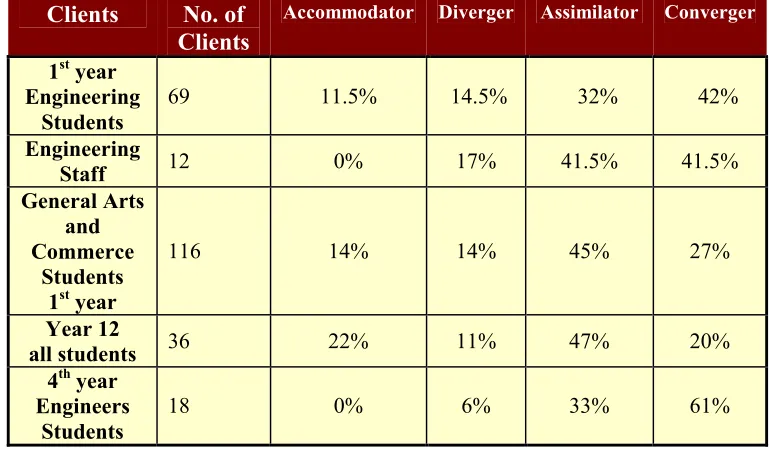
Table 1: Kolb Learning Style Inventory Results
Our results build upon our previous studies (Fowler, Allen, Armarego, & Mackenzie, 2000) and incorporate data from the 2001 student cohort. The learning styles of our engineering students are diverse, and span accommodator, diverger, and assimilator and converger types, (Table 1), indicating the variety of student types that our programs attract. This result is excellent given the multi-disciplinary nature of our curriculum content but we need to be able to cater for all students and their learning styles. Our staff show a greater tendency to be assimilator and converger types; this is in line with Kolb (Kolb, 1984) - that engineering is a good career area for convergers and that teaching suits assimilators. It is significant that we have no accommodator types in our teaching staff profile but we do have 12% of our students in this category.
The results of our year 12 mixed discipline student cohort show a heavy preference for assimilator type, but span all other types. The first year students who select engineering as a course have a heavier bias to converger types compared with the general year 12 students.
This led us to ask:
Is engineering attracting a greater percentage of students with a certain learning style that is seen to suit the discipline?
Do we want to attract a greater diversity of student types?
results, our students are shifting to converger types away from the accommodator and diverger types. This leads to the questions:
Are we only retaining students with similar learning styles to our staff?
Are we moulding our students to conform to our (staff) learning styles?
Soloman and Felder Index of Learning Styles
The Index of Learning Styles (Soloman & Felder, 1999) is an instrument to assess learning preferences on four dimensions; active/reflective, sensing/intuitive, visual/verbal, and
sequential/global. This instrument consists of forty-four simple questions each with a choice between two possible answers.
Clients No of Clients
Processing Perception Input Understanding
1st year Engineering
Students
69 Active 58% Reflective 42% Sensory 65% Intuitive 35% Visual 83% Verbal 17% Sequential 61% Global 39% Engineering Staff
11 Active 27% Reflective 73% Sensory 36% Intuitive 64% Visual 73% Verbal 27% Sequential 45% Global 55% General Arts and Commerce Students 1st years
116 Active 67% Reflective 33% Sensory 67% Intuitive 33% Visual 76% Verbal 24% Sequential 55% Global 45% Year 12 all students
36 Active 69% Reflective 31% Sensory 67% Intuitive 33% Visual 75% Verbal 25% Sequential 64% Global 36%
4th year Engineering
Students
18 Active 72% Reflective 28% Sensory 61% Intuitive 39% Visual 89% Verbal 11% Sequential 50% Global 50%
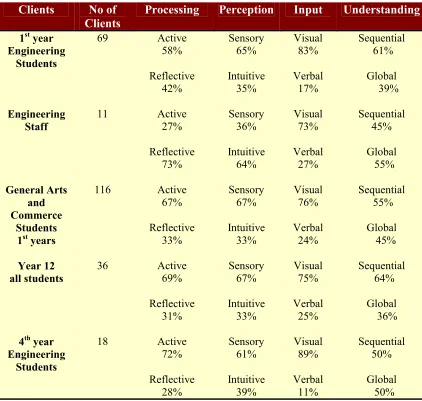
Table 2: Soloman and Felder Index of Learning Style Survey Results
The results from Table 2 show the following mismatches between staff and students:
· in all the student categories more students are active than reflective but our teachers are mainly reflective
· both staff and students show a heavy tendency to be visual, yet traditionally material is presented to them verbally or in written form
· students tend to be sequential learners but an increasing percentage are global learners, yet teaching is often narrowly focused.
Our results for students are similar to those of Mackenzie, (Mackenzie, 1998) who surveyed 75 Mechanical Engineering students.
Soloman (Soloman, 1999), has surveyed large volumes of students via her online site and her results show that:
· 80% of all students are active learners
· 55% are sensors (60% of engineering students are sensors) · 75% are visual learners
· 60% are sequential learners.
The profile of the general arts and commerce students is very similar to that of the
engineering students, (Table 2), but the Kolb survey, (Table 1), has differentiated more clearly between the learning styles of these two groups. The greater tendency towards assimilators for the general arts students is consistent with Kolb's description of assimilators, as being less practical and more creative.
Practical applications of our learning styles results are discussed in a previous paper (Fowler et al., 2001). The emphasis here is on the comparison of results. Is it relevant and important that our fourth year students have changed their learning styles and are more active and less reflective than when they entered university as first year students, shifting from72% to 58%.
Reasons identified include emphasising content more than reflection and teacher-student mismatch. Even though our staff are clearly inclined to be reflective and intuitive, these traits are not being transferred to our students.
Our research and analysis of learning styles is providing us with a mechanism for the
identification, development, and fulfilment of graduate student attributes, which have become increasingly important in contemporary higher education.
Graduate attributes
"How can essential Graduate Attributes be addressed and is there a role for a dialogue about learning?"
Murdoch University’s Foundation Unit Co-ordinators Committee recently conducted an audit of the Graduate Attributes (Rowland, 2001) in an effort to map the relationships between the agenda presented by the Graduate Attributes and the structure of units and programs within the University. In a report to the University’s Academic Council, it was noted that "the purpose of the Graduate Attribute audit of the Foundation units is to explore ways in which the Attributes are addressed in the current design and teaching of the Units" (Rowland, 2001, p3)
Murdoch’s graduate attributes are addressed within the units" (Rowland, 2001, p3). The Graduate Attributes cover 7 key areas of academic skill: Communication; Research, Analysis and Problem Solving (Critical Thinking); Social Interaction; Independent Learning; Social Justice; Interdisciplinarity; and In depth Professional Knowledge.
In the Audit, the Graduate Attributes were found to be addressed in all the Foundation units, although each had slightly differing emphases. The key Attributes most evident in the Foundation units were Communication, Critical Thinking, Interdisciplinarity, and
Independent Learning. Research and Social Interaction were also frequently associated with the Foundation units. In depth Professional Knowledge is accepted as not being within the remit of the Foundation units.
In A115, the attributes are addressed as they are within all the Foundation units. However, with regard to the Learning Styles agenda discussed in this paper, four of the Attributes are of particular interest. These Attributes relate to the areas of Critical Thinking, Interdisciplinarity, Social Interaction and Independent Learning. The introduction of learning styles analysis in our interdisciplinary Foundation Unit is a first stage for our students in attaining Graduate Attributes as well as giving them the necessary skills to achieve life long learning. Graduate Attributes identify expected outcomes from a students degree program. Learning styles analysis assist first year students in beginning to identify and adopt learning practices which are reflective of their own learning styles. This empowers the student to employ critical thinking and to take responsibility for their learning.
Critical Thinking is characterised in Foundation units as the actions of "students questioning their and analysing their own values and assumptions as well as what they read and hear"; and Interdisciplinarity is "seen as a distinctive attribute of Foundation Units" (Rowland, 2001, p5) and is "provided through the disciplinary mix of tutors and students" (Rowland, 2001, p5). Independent Learning is characterised as "students becoming able to clarify study purposes and goals, to organise their study, to carry out self directed research and to 'think for ourselves'" (Rowland, 2001, p9).
A key Graduate Attribute for A115 is that which relates to Social Interaction. This attribute is characterised in the Audit as relating to group work skills. The unit assessment requires students to work on one of range of hypothetical infrastructure projects. Their task is to provide an initial feasibility report on this prospective development, taking into consideration a specific range of perspectives which have been promoted through the structure of the Unit (e.g.; Legal, Ethical, Economic and other broad based criteria of analysis).
The students are required to consider and evaluate their own roles within study and work groups and use this as a basis for reviewing the groups’ interactions. As with the learning styles analyses, this activity provides the students and tutors with a means by which to discuss and evaluate their own group’s processes and the outcomes of their interactions. Other
Conclusion
Learning is a complex process and, as described by the constructivist paradigm, knowledge is internally constructed by the learner. This paradigm encompasses a collection of different perspectives but acknowledges that learning involves making meaning of experiences and therefore the process of the construction of knowledge by the learner is unique.
By using learning style inventories we have a mechanism to identify and discuss our pedagogical issues. This awareness raising enables 'quality learning conversations' to take place within the School of Engineering.
An understanding of learning styles will enable our students to cope with learning in a variety of work environments, particularly after leaving university, where a traditional student/teacher interaction may not be available. Through a greater awareness that others will not think or learn in the same way, both staff and students should be able to better participate and communicate in the learning experience.
This research is aiding us to identify and discuss the many educational questions which we must address in order to continue producing relevant courses and present them with
References
Burns, S. (1989). There's More Than One Way to Learn. Australia Wellbeing, 33, 42-44.
Dalgarno, B. (1996). Constructivist computer assisted learning: theory and techniques. Making new connections: proceedings of ASCILITE '96 University of Adelaide, 127-148.
Felder, R. (1993). Reaching the Second Tier: Learning and Teaching Styles in College Science Education.
Journal of College Science Teaching, 23(5), 286 - 290.
Felder, R., & Silverman, R. L. (1988). Learning and teaching styles in engineering education. Engineering Education, 78(8), 674-681.
Fosnot, C. (1996). Constructivism:theory, perspectives and practice. Teachers College Press, New York. Fowler, L., Allen, M., Armarego, J., & Mackenzie, J. (2000). Learning styles and CASE tools in Software
Engineering. Paper presented at the Flexible Futures in Tertiary Teaching. Proceedings of the 9th Annual Teaching Learning Forum,, Perth.
Fowler, L., Armarego, J., & Allen, M. (2001). CASE Tools: Constructivism and its application to learning and usability of software of engineering tools. Computer Science Education, 11(3), 261-272.
Kolb, D. A. (1984). Experiential Learning Experience as the Source of Learning and Development,: Prentice-Hall.
Laurillard, D. (1993). Rethinking University Teaching: a framework for the effective use of educational technology. London: Routledge.
Mackenzie, J. (1998). Computer applications in chemical engineering. Unpublished PhD, University of Canterbury, Canterbury, NZ.
McLoughlin, C. (1996). The implications of the research literature on learning styles for the design of instructional material. Australian Journal of Educational Technology, 15(3), 222-241.
Montgomery, S. M. (1995). Addressing Diverse Learning Styles Through the use of Multimedia. Paper presented at the Engineering Education for the 21st Century: Proceedings of the 25th Annual Frontiers in
Education Conference.
Pask, G. (1976). Conversation Theory: applications in education an epistemology. Amsterdam: Elsevier. Phillips, D. C. (1995). The Good, the Bad, and the Ugly: The Many Faces of Constructivism. Educational
Research, 24(7), 5-12.
Rowland, F. (2001). Foundation units and the graduate attributes: an audit. Perth: Murdoch University. Soloman, B. (1999). Private Communication.
Soloman, B., & Felder, R. (1999). Index of Learning Styles (ILS),. Available: http://www2.ncsu.edu/unity/lockers/users/f/felder/public/ILSpage.html.
Vygotsky, L. S. (1978). Mind and Society: the development of higher psychological processes. Cambridge (MA): Harvard University Press.
Winn, W., & Snyder, D. (1996). Cognitive perspectives in psychology.
PART C - ECU prize
The Edith Cowan University 2002 Centenary Prize for the Best Paper on an Authentic Learning
The purpose of this paper is to report on our progress relating educational constructivist theory and learning style analysis to learning in an engineering environment, particularly at the transitional first year Foundation unit stage. While this analysis takes part in semester one, it provides an authentic learning foundation that is purposefully intended to provide a basis for students' future academic and professional careers.
Our thesis is that teachers and learners can both benefit from developing an understanding and application of the range of learning styles in themselves and others. The involvement of students in this process of measurement, in self-awareness and in peer discussion is changing the culture of teaching and learning in the School of Engineering.