R E S E A R C H
Open Access
Identifying approaches for assessing
methodological and reporting quality of
systematic reviews: a descriptive study
Kusala Pussegoda
1, Lucy Turner
1, Chantelle Garritty
1,2, Alain Mayhew
1, Becky Skidmore
1, Adrienne Stevens
1,2,
Isabelle Boutron
3, Rafael Sarkis-Onofre
4, Lise M. Bjerre
5,6,7, Asbjørn Hróbjartsson
8, Douglas G. Altman
9and David Moher
10*Abstract
Background:
The methodological quality and completeness of reporting of the systematic reviews (SRs) is
fundamental to optimal implementation of evidence-based health care and the reduction of research waste.
Methods exist to appraise SRs yet little is known about how they are used in SRs or where there are potential gaps
in research best-practice guidance materials.
The aims of this study are to identify reports assessing the methodological quality (MQ) and/or reporting quality
(RQ) of a cohort of SRs and to assess their number, general characteristics, and approaches to
‘
quality
’
assessment
over time.
Methods:
The Cochrane Library, MEDLINE®, and EMBASE® were searched from January 1990 to October 16, 2014,
for reports assessing MQ and/or RQ of SRs. Title, abstract, and full-text screening of all reports were conducted
independently by two reviewers. Reports assessing the MQ and/or RQ of a cohort of ten or more SRs of
interventions were included. All results are reported as frequencies and percentages of reports.
Results:
Of 20,765 unique records retrieved, 1189 of them were reviewed for full-text review, of which 76 reports
were included. Eight previously published approaches to assessing MQ or reporting guidelines used as proxy to
assess RQ were used in 80% (61/76) of identified reports. These included two reporting guidelines (PRISMA and
QUOROM) and five quality assessment tools (AMSTAR, R-AMSTAR, OQAQ, Mulrow, Sacks) and GRADE criteria. The
remaining 24% (18/76) of reports developed their own criteria. PRISMA, OQAQ, and AMSTAR were the most
commonly used published tools to assess MQ or RQ. In conjunction with other approaches, published tools were
used in 29% (22/76) of reports, with 36% (8/22) assessing adherence to both PRISMA and AMSTAR criteria and 26%
(6/22) using QUOROM and OQAQ.
Conclusions:
The methods used to assess quality of SRs are diverse, and none has become universally accepted.
The most commonly used quality assessment tools are AMSTAR, OQAQ, and PRISMA. As new tools and guidelines
are developed to improve both the MQ and RQ of SRs, authors of methodological studies are encouraged to put
thoughtful consideration into the use of appropriate tools to assess quality and reporting.
Keywords:
Reporting quality, Methodological quality, Systematic reviews, Guideline adherence
* Correspondence:[email protected]
10Centre for Journalology, Canadian EQUATOR Centre, Clinical Epidemiology
Program, Centre for Practice-Changing Research, Ottawa Hospital Research Institute, Ottawa, Ontario, Canada
Full list of author information is available at the end of the article
Background
With the global annual expenditure of biomedical
re-search estimated to be in excess of 100 billion USD [1],
it is no surprise that the extent of published literature is
growing each year, with PubMed® housing over 24
mil-lion citations, for example [2]. Researchers and decision
makers have recognized that although there are
hun-dreds of thousands of studies of healthcare
interven-tions, the quality of research and reporting is variable.
Evidence indicates that unless research is adequately
de-signed and reported, the resources invested in research
are not used effectively [1]. One estimate suggests that
at least 50% of published research studies were poorly
conducted making them difficult to interpret and use to
inform best practice [1].
Systematic reviews (SRs) are considered the gold
standard for healthcare decision-making as they evaluate
the quality and confidence of all of the available evidence
addressing specific questions, such as the benefits and
harms of specific health care interventions. When SR
conduct is optimal, that is, when best practices are
employed to minimize biases in the process of collecting,
appraising, and synthesizing the evidence, researchers
can best understand whether or not they can be
confident in the findings [3, 4]. Further, when SR
report-ing is optimal, the essential information is presented for
practice guideline developers and other stakeholders,
such as policy makers and clinicians to facilitate
transla-tion into guidance and improved patient care.
Criteria for assessing the quality of primary research
emerged in the late 1980s with the rise of
evidence-based medicine. This set the stage for guidelines
asses-sing quality of SR conduct to be developed. Several sets
of criteria had been developed early on including
Mulrow [5] and Sacks criteria [6]. It was not until
Oxman and Guyatt developed the Overview Quality
As-sessment Questionnaire (OQAQ) [7] in 1991, that a
vali-dated tool for assessing methodological quality (MQ)
existed for SRs of intervention studies. More than a
dec-ade after OQAQ, A Measurement Tool to Assess
Sys-tematic Reviews (AMSTAR) [8] was developed and
validated in 2007 to address additional SR quality criteria
including potential sources of bias that were not
in-cluded in the OQAQ tool. In 2010, AMSTAR was
re-vised (R-AMSTAR) to provide a quantitative scoring
method to assess quality [9]. With criteria available for
assessing SR conduct, it was apparent that SR authors
address the standards for improving reporting quality
(RQ) as well. In 1999, the Quality of Reporting of
Meta-analyses (QUOROM) statement [10] was created to
evalu-ate the completeness of reporting of meta-analysis of
randomized trials. Subsequently, in 2009, QUOROM was
updated as the Preferred Reporting Items of Systematic
reviews and Meta-Analyses (PRISMA) statement [11] to
address several conceptual and methodological advances
in the conduct and reporting of SRs. The development
and adoption of SR MQ and RQ tools aim to assess, and
hopefully improve, the design, conduct, and reporting of
SRs. Which tools are accepted and used by SR authors to
assess MQ and completeness of reporting was unclear.
We set out to identify methodological evaluations
asses-sing the MQ and/or RQ of SRs published from 1990 to
2014 in order to determine the approaches that were used.
Methods
Definitions and important concepts
We defined SRs and meta-analyses in line with that
pro-vided by the Cochrane Collaboration and the PRISMA
statement [12, 13]. We adopted the term
‘
overview
’
, to
mean a summary of evidence from more than one SR,
in-cluding the combination of different populations, different
interventions, different outcomes (both favourable ones
and adverse events), or different conditions [14, 15]. It is
synonymous with
‘
systematic review of systematic reviews
’
,
‘
reviews of reviews
’
, or an
‘
umbrella review
’
. We have
in-cluded publications of
‘
methodological overviews
’
, meaning
research that has assessed the MQ and/or RQ of a cohort
of SRs and refer to these publications simply as
‘
reports
’
.
Methodological quality and completeness of reporting
It is necessary to make clear the distinction between MQ
and RQ. MQ addresses how well a SR was designed and
conducted (e.g. literature search, selection criteria, pooling
of data) [8]. RQ evaluates the description of the
method-ology and findings [11]. Moreover, to distinguish from MQ,
the concept of risk of bias to assess primary studies is used
to refer to systematic flaws or limitations in the design,
con-duct, or analysis of research that distort the findings [16].
Examples are the Cochrane Risk of Bias tool for
random-ized controlled trials [17], ROBINS-I for non-randomrandom-ized
studies [18], QUADAS-2 [19] for diagnostic studies, and
ROBIS for SRs [16]).
Objectives
The objectives of this study are to identify reports
asses-sing the MQ and/or RQ of SRs and to assess their general
characteristics and approaches used.
Eligibility criteria
Inclusion criteria
Exclusion criteria
We excluded reports of clinical interventions, whose
pri-mary intent was not to look at methodological quality or
reporting and rather to summarise SR evidence for use
in healthcare decision-making; reports assessing the
quality of SRs of diagnostic, screening, etiological, or
prognostic studies only; and evaluations of SRs that
in-clude study designs other than randomized controlled
trials such as, narrative reviews, rapid reviews, network
meta-analyses, and editorials. Reports in languages other
than English were excluded due to budget constraints
(Additional file 1) [20
–
31]. Reports assessing fewer than
10 SRs, those whose aim was to assess the reliability of
an assessment tool, those assessing SRs in relation to
one methodological characteristic (e.g. search strategy
only), or those only assessing SRs with pooled estimates
of effect, were also excluded.
Search methods
An experienced information specialist developed and
con-ducted an extensive search of the Cochrane Library,
EMBASE®, and Ovid MEDLINE®, including In-Process &
Other Non-Indexed Citations, from January 1990 to
May 23, 2012. All searches were updated on October
16, 2014. Potentially eligible titles and/or abstracts
were identified using a combination of subject headings
(e.g.
‘
Meta-Analysis as Topic
’
,
‘
Quality Control
’
,
‘
Checklist
’
)
and key words (e.g.
‘
umbrella review
’
, scoring, compliance)
(see Additional file 2). A second senior information
spe-cialist peer reviewed prior to execution [32]. Additional
reports eligible for inclusion were identified by members
of the research team prior to the start of the project and
used as
‘
seed
’
articles when developing the electronic
search strategy [33
–
35].
Screening
Titles and abstracts were screened for potentially inclusion
using a liberal accelerated approach (i.e. one reviewer to
include and two reviewers to exclude) [36]. Screening of
full-text reports was completed independently in duplicate
by a team of reviewers with experience in methodological
reviews; 5% of potentially relevant articles were pilot
tested. All screening disagreements were discussed, with
any outstanding disagreements resolved by an
independ-ent third reviewer (DM). Data Managemindepend-ent software,
DistillerSR® [37], was used to manage retrieved records,
screen reports, identify and track disagreements, and store
data extracted. Results of the screening process are
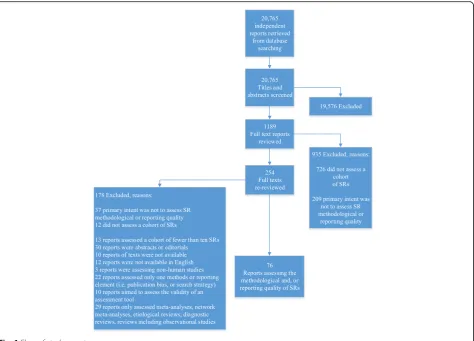
re-ported using a PRISMA flow diagram (Fig. 1).
Data extraction
We developed standardized forms for data extraction of
items of interest from the included reports. General
characteristics and full data extraction was conducted by
two reviewers in duplicate; a 10% random sample of
re-ports was assessed for accuracy. A pre-extraction
meet-ing was held for each extraction stage along with pilot
testing to ensure consistency across reviewers. The
fol-lowing general characteristics were extracted: year of
publication; number of included SRs; specified medical
area; databases searched; language restrictions; SR
defin-ition; reporting of availability of study protocol; and
source of funding. The method of assessing MQ or RQ
of SRs was extracted. Additional items pertaining to the
evaluated reviews were extracted including the following:
types of publishing journals; Cochrane or non-Cochrane
review; conflict of interest; number of SRs reported as
updated reviews; number of SRs discussing limitations;
critical appraisal of abstracts; number of SRs reporting
meta-analysis; methods of meta-analysis used in the SRs
(e.g. methods used for meta-analysis and type of
meas-ure, details of investigation of publication bias, whether
or not heterogeneity was reported as assessed); whether
interpretation were consistent with results; and whether
a quantitative summary of quality was provided.
The attributes of primary of interest were to identify the
method or tool used to assess (a) MQ of SRs (e.g. use of
AMSTAR) and (b) RQ of SRs (e.g. use of PRISMA,
identi-fication of key methodological items). We classified tools/
criteria into two groups: (1) items obtained from existing,
published tools and (2) those developed by the report
au-thors for their assessment.
Adherence data in relation to the MQ and RQ criteria
were also extracted from those reports that provided it
and are reported in a separate manuscript [38].
Analyses
Summary statistics are reported as frequency and
percent-age of reports. No formal inferential statistical analyses
were conducted. A post hoc decision was made to look at
publications by their intent to assess MQ only, RQ only,
or both MQ and RQ. This decision was made in order to
identify all methods or tools used by overview authors to
assess methodological conduct or reporting. In addition,
we can identify whether the appropriate methods or tools
were used to assess MQ or RQ of SRs. Differences in SR
characteristics such as funding, limitations, and language
restrictions whose intent was to assess MQ or both MQ
and RQ can also be determined. This decision was made
without prior review of the data by one of us (DM).
Results
criteria were met. A total of 76 reports were included
(Fig. 1; see Additional file 3).
Report characteristics
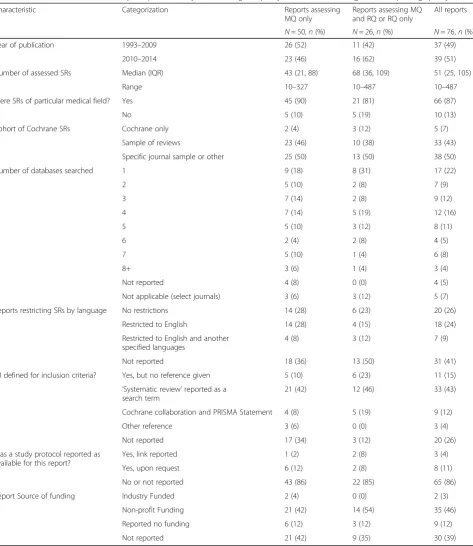
Characteristics of included reports are shown in Table 1.
Of the 76 included reports, 66% (50/76) of them had a
primary intent to assess MQ only, while the remaining
one-third had a primary intent to assess either both MQ
and RQ or RQ only; the latter two categories were
grouped together, post hoc, given six reports (8%)
assessed RQ only. Reports spanned a 21-year period; half
were published between 2010 and 2014, indicating a
marked increase in more recent years. A median of 51
SRs (interquartile range 25 to 105) were assessed in
re-ports. SRs assessed were published within a specific
medical field in 87% (66/76) of reports. Included SRs
were reported to be of interventions in medical fields
such as orthodontics, food and beverage, pediatrics,
nephrology, and dermatology; there were no
predomin-ant fields. SRs were mainly from a general sample of
re-views across medical journals; 7% (5/76) of reports
evaluated a cohort of Cochrane reviews only. The
major-ity of reports provided their source of SRs, whether via
database searches or specific journals. Forty-one percent
of reports did not report whether language restrictions
were used, whereas the remaining 59% were nearly
evenly divided as to whether they did or not. SR defined
for inclusion criteria were provided by nearly 30%, while
43% used
‘
systematic review
’
as a search term, and
26% did not report this information. Few reports
made reference to an available protocol. Thirty-nine
percent of reports did not report the source of
finan-cial support for their research.
Characteristics of SRs included in reports
how many of the included reviews had reported
con-ducting a meta-analysis. Seventeen percent (13/76)
re-ported which SRs were updates of an original review.
Half of the reports extracted whether or not reviews
considered issues of publication bias (formally or
informally). Limitations were described in half (14/26) of
the reports whose primary intent was to assess MQ and
RQ, whereas only 4% (2/50) reported this information in
reports whose intent was to assess MQ only. Critical
ap-praisal of SR abstracts was reported in 29% (22/76) of
Table 1
Table of characteristics of reports presented by methodological quality or both methodological and reporting quality
Characteristic Categorization Reports assessing
MQ only
Reports assessing MQ and RQ or RQ only
All reports
N= 50,n(%) N= 26,n(%) N= 76,n(%)
Year of publication 1993–2009 26 (52) 11 (42) 37 (49)
2010–2014 23 (46) 16 (62) 39 (51)
Number of assessed SRs Median (IQR) 43 (21, 88) 68 (36, 109) 51 (25, 105)
Range 10–327 10–487 10–487
Were SRs of particular medical field? Yes 45 (90) 21 (81) 66 (87)
No 5 (10) 5 (19) 10 (13)
Cohort of Cochrane SRs Cochrane only 2 (4) 3 (12) 5 (7)
Sample of reviews 23 (46) 10 (38) 33 (43)
Specific journal sample or other 25 (50) 13 (50) 38 (50)
Number of databases searched 1 9 (18) 8 (31) 17 (22)
2 5 (10) 2 (8) 7 (9)
3 7 (14) 2 (8) 9 (12)
4 7 (14) 5 (19) 12 (16)
5 5 (10) 3 (12) 8 (11)
6 2 (4) 2 (8) 4 (5)
7 5 (10) 1 (4) 6 (8)
8+ 3 (6) 1 (4) 3 (4)
Not reported 4 (8) 0 (0) 4 (5)
Not applicable (select journals) 3 (6) 3 (12) 5 (7)
Reports restricting SRs by language No restrictions 14 (28) 6 (23) 20 (26)
Restricted to English 14 (28) 4 (15) 18 (24)
Restricted to English and another specified languages
4 (8) 3 (12) 7 (9)
Not reported 18 (36) 13 (50) 31 (41)
SR defined for inclusion criteria? Yes, but no reference given 5 (10) 6 (23) 11 (15)
‘Systematic review’reported as a search term
21 (42) 12 (46) 33 (43)
Cochrane collaboration and PRISMA Statement 4 (8) 5 (19) 9 (12)
Other reference 3 (6) 0 (0) 3 (4)
Not reported 17 (34) 3 (12) 20 (26)
Was a study protocol reported as available for this report?
Yes, link reported 1 (2) 2 (8) 3 (4)
Yes, upon request 6 (12) 2 (8) 8 (11)
No or not reported 43 (86) 22 (85) 65 (86)
Report Source of funding Industry Funded 2 (4) 0 (0) 2 (3)
Non-profit Funding 21 (42) 14 (54) 35 (46)
Reported no funding 6 (12) 3 (12) 9 (12)
Not reported 21 (42) 9 (35) 30 (39)
reports, all of whose primary intent was to assess MQ
and RQ. Thirty-eight percent of reports (29/76) gave
consideration to how consistent review results were with
review conclusions. A quantitative summary of SR
qual-ity across items or criteria were provided in 59% (45/76)
of reports. The largest difference between reports with
the intent to assess MQ only and MQ and RQ is the
critical appraisal abstracts and limitations. This is likely
attributed directly to the structure of RQ guidelines (e.g.
PRISMA and QUOROM) specifically including
report-ing items for abstracts and limitations whereas MQ tools
(e.g. OQAQ and AMSTAR) do not (Table 2).
Use of published assessment tools to assess quality over
time
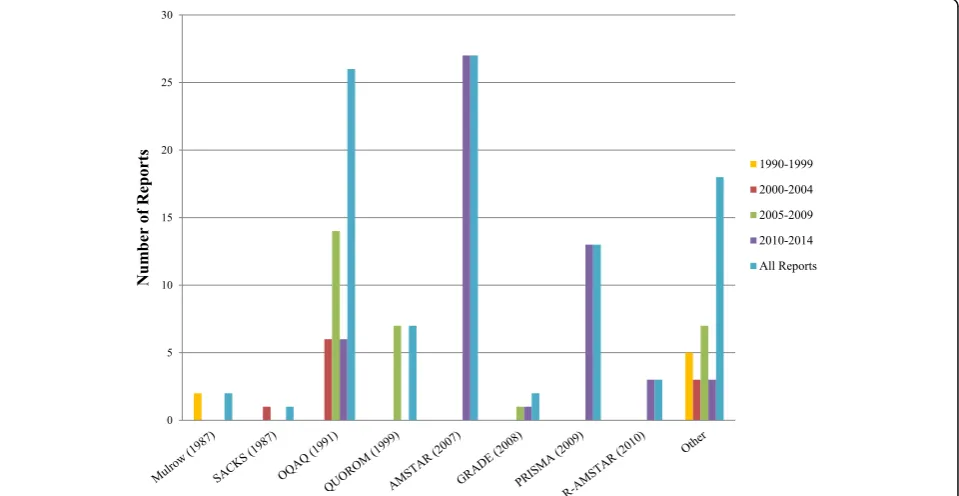
We assessed how frequently the published assessment
tools were used across reports, in 5-year increments
after 1999 (Fig. 2). For MQ, AMSTAR (27 reports) [8]
and OQAQ (26 reports) [7] were used the most often in
reports; others used R-AMSTAR (3 reports) [9], Mulrow
criteria (2 reports) [5], Grading of Recommendations
Assessment, Development, and Evaluation (GRADE)
cri-teria (2 reports) [39], and Sacks cricri-teria (1 report) [6].
We observed that although OQAQ (1991) use for MQ
decreased after 2009, it was still being used despite the
Table 2
Information reported by reports about included SRs
Assessment of characteristics at the report level Reports assessing MQ only
Reports assessing MQ and RQ or RQ only
All reports
N= 50,n(%) N= 26,n(%) N= 76,n(%)
Source of funding 25 (50) 19 (73) 44 (58)
Conflict of interest 22 (44) 12 (46) 34 (45)
Heterogeneity investigated 32 (64) 15 (58) 47 (62)
Meta-analysis results reported 22 (44) 10 (38) 32 (42)
Updated reviews 6 (12) 7 (27) 13 (17)
Publication bias 25 (50) 13 (50) 38 (50)
Limitations discussed 2 (4) 14 (54) 16 (21)
Critically appraised abstracts 0 (0) 22 (85) 22 (29)
Interpretation consistent with results 21 (42) 8 (31) 29 (38)
Provided quantitative summary of quality or reporting across reviews
29 (58) 16 (62) 45 (59)
MQmethodological quality,RQreporting quality
availability of AMSTAR as of 2007 (10 [after 2010] vs.
16 [before 2010]). For RQ, PRISMA (13 reports) [11]
was used more often than its predecessor QUOROM (7
reports) [10]. No reports used QUOROM (1999) to
assess RQ after PRISMA (2009) guidelines were
pub-lished. In addition, several reports used their own
cri-teria to assess quality after 2000, although OQAQ (1991)
and QUOROM (1999) guidelines were available.
The above eight published tools were used across 80%
(61/76) of reports. These reports used those tools alone,
in combination with other tools or in combination with
self-specified criteria. The remaining 15 reports used
only self-specified criteria to assess quality.
Published assessment tools used alone or in combination
with other criteria to assess quality
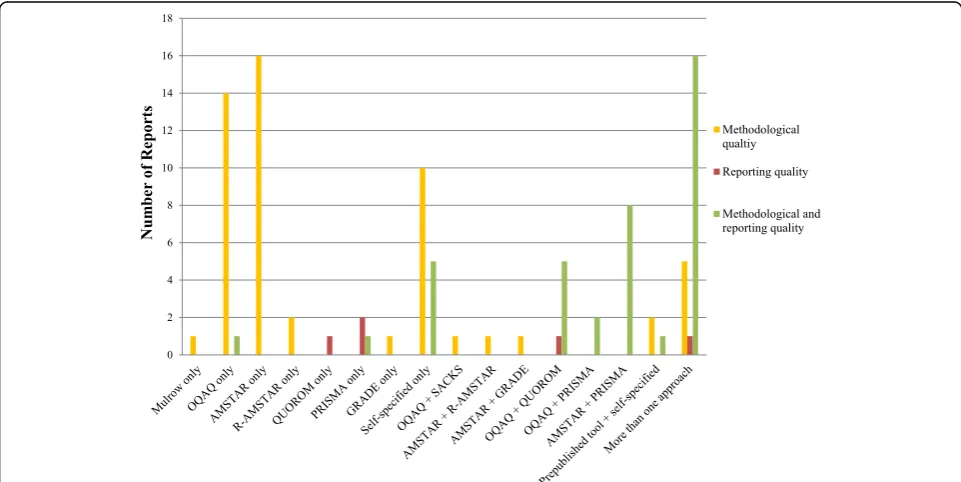
Thirty-nine (51%) reports used published tools alone to
assess quality (Fig. 3). Mulrow, GRADE, and QUOROM
were used in one study each (1%;
n
= 76). AMSTAR and
OQAQ were used the most frequently as stand-alone
means to assess quality in 21% (16/76) and 20% (15/76)
of reports, respectively. PRISMA and R-AMSTAR were
used alone in three (4%;
n
= 76) and two (3%;
n
= 76)
re-ports, respectively.
In 29% (22/76) of reports, published tools or criteria
were used in conjunction with other criteria or tools to
assess MQ or RQ (Fig. 3). Of those assessing MQ and
RQ, 36% (8/22) used AMSTAR and PRISMA, 27% (6/
22) of reports used OQAQ and QUOROM, and 9% (2/
22) of reports used OQAQ and PRISMA. The remaining
reports used a variety of combinations: AMSTAR and
R-AMSTAR (5%; 1/22); OQAQ in conjunction with Sacks
criteria (5%; 1/22); AMSTAR and GRADE (5%; 1/22); a
published tool (OQAQ or Mulrow) in combination with
self-specified criteria (9%; 2/22); and AMSTAR in
conjunction with OQAQ and self-specified criteria (5%;
1/22). No reports evaluated a combined approach for
assessing RQ. Due to the number of different
combina-tions of tools and criteria used to assess quality in
re-ports, it was not conducive to separate by time as well.
Self-specified criteria to assess quality
Although OQAQ was published in 1991, authors
devel-oped their own criteria to assess MQ or RQ in 24% (18/
76) of reports. Of these reports, 15 only used self-specified
criteria to assess quality, and three reports used
self-specified criteria in combination with another tool (as
de-scribed above).
Quality assessment criteria used in these reports varied
considerably. Furthermore, 13 reports used their own
criteria to assess quality after the publication of both
OQAQ (1991) and QUOROM (1999). Seven of the 18
reports (39%) did not provide any description of how
they derived their quality assessment items. Of the
remaining 11 reports, the majority were derived from
the Oxman and Guyatt criteria. Two reports based
cri-teria on Oxman and Guyatt, Jadad Scale (developed to
assess primary studies), and QUOROM [40, 41]; one
re-port on Oxman and Guyatt and the Jadad Scale [42];
two reports on Oxman and Guyatt and Mulrow [43, 44];
one report on Oxman and Guyatt, Light and Pillemer,
and Mulrow [45]; one report used Oxman Guyatt and
five additional criteria [46]; one report used Rapid
Appraisal Protocol (RAP), National Center for the
Dis-semination of Rehabilitation Research (NCDRR) [47];
one report was based on PRISMA [48]; one on PRISMA
and QUOROM [49]; and one report was based on
Oxman and Guyatt, Hoving scale, discussion between
three reviewers and expectations discussed from SRs by
Sackett and Seers [50].
Only four of the 18 reports (22%) provided an
explan-ation as to why they had created their own criteria. Two
reports stated criteria was developed to evaluate quality
of SRs in a specific medical field [40, 51]; one report
[44] published in 1996 stated there was no gold standard
for assessing quality; another report stated their quality
assessment scale was developed to specifically evaluate
patellofemoral pain syndrome [46].
Appropriate use of tools to assess quality of conduct vs.
reporting of conduct
We also assessed whether reports used the quality of
meth-odological conduct (MQ) and reporting (RQ) tools
appro-priately. The majority of reports used the tools correctly
(Fig. 3). However, we noted that several reports did not use
the tools or criteria appropriately based on their reported
or inferred intent. One report intended to assess both MQ
and RQ but only used OQAQ criteria, a tool for assessing
the quality of conduct. Another study intended to assess
both MQ and RQ but only used PRISMA, a reporting
guideline. Another report intended to assess RQ only and
used both OQAQ and QUOROM which are tools used to
assess quality of conduct and reporting of conduct. In
addition, one report used GRADE to assess MQ.
Discussion
We identified 76 reports in the health care literature
assessing the MQ and/or the RQ of SRs published in the
last 24 years in order to assess their quantity,
characteris-tics, and methodology over time. The number of such
re-ports increased over time with two-thirds intending to
assess MQ only and the remaining 34% assessing either
RQ only or both MQ and RQ. Although the number of
re-ports increased, the criteria used to assess MQ and critical
appraisal of SRs varied considerably across reports. Eight
published tools were used in 80% of reports while review
authors of the remaining reports only used their own
cri-teria to assess quality. We identified PRISMA, AMSTAR,
and OQAQ to be most commonly used tools.
This research parallels that of Dechartres et al. (2011),
who investigated how quality is assessed in RCTs [52].
Those authors found great variety in how the quality of
trials was assessed, from which the authors raised
im-portant issues about the tools and criteria that should be
used to assess RCT methodological quality and reporting
[53]. Although the diversity of assessment criteria and
the number of scales used to assess RCT quality was
greater, the authors found, as we did, that the number of
methodological reviews had increased over time.
Our findings appear consistent with that of other
re-search which suggests that tools used to assess MQ and
RQ of SRs are variable [33, 54, 55]. In 2012, two studies
were conducted to assess their methodological rigor
[56, 57]. The first concluded that PRISMA, OQAQ, and
AMSTAR were the most frequent methods of critical
ap-praisal and quality assessment for SRs and that
inconsist-ency in how SR quality is assessed should be reviewed
[56]. The second identified at least nine methods of
asses-sing SR quality and called for further empirical evidence
to support the conduct of overviews [57].
In addition, despite lack of available evidence, it would
be feasible to suggest that risk of bias assessment criteria
at the trial level over time may influence trial conduct.
By extension, critical appraisal criteria for SRs over time
may in turn influence SR conduct. A small body of
lit-erature has started to emerge with regard to biases
within SRs which would influence results of overviews
[58]. The SR community currently lacks clear guidance
re-garding best SR practices to minimize biases. Standardized
tools/criteria would provide the foundation upon which to
develop more consistent critical appraisal criteria for SRs,
which in turn could influence SR conduct.
ensure high quality of conduct and accurate
informa-tion is reported in SRs.
Methodologists focus on improving quality and
report-ing, and new tools and guidelines continue to be
devel-oped. For example, the US Institute of Medicine
developed their own standards for assessing MQ in SRs
and reporting [61]. Further, Cochrane recommends
using the Methodological Expectations of Cochrane
Intervention Review (MECIR) to guide conduct of
Cochrane SRs for interventions [62]. Other recently
published tools to improve quality in SRs include the
Risk of Bias in Systematic Reviews (ROBIS) [16],
devel-oped to complement AMSTAR. The concept of risk of
bias is distinct from MQ in that it assesses systemic
flaws or limitations in the design, conduct, or analysis of
research that distort the findings [16]. Although there is
some content overlap between risk of bias and MQ
cri-teria, the majority of criteria are distinct. For example,
AMSTAR assesses whether at least two electronic
sources were searched whereas ROBIS assesses whether
the search included an appropriate range of databases
for published and unpublished reports. Nonetheless,
with the plethora of tools and guidance available,
there remains confusion over the best criteria and
tools to assess quality or reporting for consistent
standards across reports. This may be simply due to
SR authors being unaware of appropriate newer tools
that exist; or tools or guidelines that have less criteria
to assess are appealing simply due to lack of time; or
they feel some criteria are lacking in the validated
tools. Newer MQ and RQ tools such as AMSTAR
and PRISMA were developed to reflect of the state of
current SR methodology research. SR authors should
put thoughtful consideration into use of appropriate
MQ and RQ criteria to conduct their SR.
There are potential limitations to this study. All
methodological research relating to the quality of
studies, whether at the trial or SR level, is contingent
upon the quality of reporting. In addition, due to
feasibility, we have limited reports to English language
only, reports assessing more than 10 SRs and reports
using more than one methodology or reporting
cri-teria to assess quality.
Conclusions
In conclusion, a body of literature exists in evaluating
the quality and reporting of SRs across a variety of
med-ical fields. How quality is assessed varies and is similar
to the conclusions in other reports. As new tools and
guidelines are developed to improve both the MQ and
RQ of SRs, SR authors are encouraged to give careful
thought to the use of the most current and appropriate
tools to assess quality and reporting as they reflect the
state of current SR methodology research.
Additional files
Additional file 1:List of non-English language studies [20–31]. (DOCX 15 kb)
Additional file 2:Search strategy. (DOCX 17 kb)
Additional file 3:List of included studies [33, 40, 42–51, 63–126]. (DOCX 22 kb)
Abbreviations
AMSTAR:A Measurement Tool to Assess Systematic Reviews; GRADE: Grading of Recommendations Assessment, Development, and Evaluation;
MECIR: Methodological Expectations of Cochrane Intervention Review; MQ: Methodological quality; OQAQ: Overview Quality Assessment Questionnaire; PRISMA: Preferred Reporting Items of Systematic reviews and Meta-Analyses; QUOROM: Quality of Reporting Of Meta-analyses; R-AMSTAR: Revised-A Measurement Tool to Assess Systematic Reviews; RQ: Reporting quality; SR: Systematic review
Acknowledgements
We would like to acknowledge Michelle Fiander for peer reviewing the search strategy. We would also like to thank Raymond Daniel for his support with running the search, identifying duplicates, and identifying studies for screening. We would like to thank Sophia Tsouros, Alexander Tsertsvadze, and Kavita Singh for their screening support.
Funding
This project was completed on behalf of the Cochrane Bias Methods Group, funded by Canadian Institutes of Health Research (CIHR reference no: CON-105529). The funder had no role in the design, conduct, and reporting of the project.
Availability of data and materials
Data are reported in the manuscript and additional files.
Authors’contributions
DM and DGA conceived the project. IB, LB, CG, LT, AS, DGA, and DM developed the protocol for the project. BS developed the search strategy. LT, KP, AM, and RO screened studies and extracted data. LT compiled the data and drafted the first version of the report. BS derived the literature search strategy for the review. All authors commented on the data and reviewed the manuscript. All authors read and approved the final manuscript.
Competing interests
DM is co-editor in chief of Systematic Reviews and also received funding from BioMed Central for a separate project. AM worked for the Cochrane Methods Bias Group from September 2013 to September 2015 when he worked on this paper; the group was supported by the Canadian Institutes of Health Research (CIHR Funding Reference Number—CON-105529). All other authors declare that they have no competing interests.
Consent for publication
Not applicable.
Ethics approval and consent to participate
Not applicable.
Publisher
’
s Note
Springer Nature remains neutral with regard to jurisdictional claims in published maps and institutional affiliations.
Author details
1Ottawa Methods Centre, Clinical Epidemiology Program, Centre for
and Preventive Medicine, University of Ottawa, Ottawa, Ontario, Canada. 8Center for Evidence-Based Medicine, University of Southern Denmark &
Odense University Hospital, Odense, Denmark.9Centre for Statistics in Medicine, Nuffield Department of Orthopaedics, Rheumatology & Musculoskeletal Sciences, University of Oxford, Oxford, UK.10Centre for Journalology, Canadian EQUATOR Centre, Clinical Epidemiology Program, Centre for Practice-Changing Research, Ottawa Hospital Research Institute, Ottawa, Ontario, Canada.
Received: 20 September 2016 Accepted: 31 May 2017
References
1. Chalmers I, Glasziou P. Avoidable waste in the production and reporting of research evidence. Lancet. 2009;374(9683):86–9. PMID: 19525005. 2. National Center for Biotechnology Information. PubMed Help [Internet]. Available
at: http://www.ncbi.nlm.nih.gov/books/NBK3827/. Accessed 14 Jan 2016. 3. Cook DJ, Mulrow CD, Haynes RB. Systematic reviews: synthesis of best evidence
for clinical decisions. Ann Intern Med. 1997;126(5):376–80. PMID: 9054282. 4. The Cochrane Collaboration. Cochrane Handbook for Systematic Reviews of
Interventions. Version 5.1.0. 2011 [updated March 2011].
5. Mulrow CD. The medical review article: state of the science. Ann Intern Med. 1987;106(3):485–8. PMID: 3813259.
6. Sacks HS, Berrier J, Reitman D, Ancona-Berk VA, Chalmers TC. Meta-analyses of randomized controlled trials. N Engl J Med. 1987;316(8):450–5. PMID: 3807986. 7. Oxman AD, Guyatt GH. Validation of an index of the quality of review
articles. J Clin Epidemiol. 1991;44(11):1271–8. PMID: 1834807. 8. Shea BJ, Grimshaw JM, Wells GA, Boers M, Andersson N, Hamel C, et al.
Development of AMSTAR: a measurement tool to assess the methodological quality of systematic reviews. BMC Med Res Methodol. 2007;7:10. PMID: 17302989.
9. Kung J, Chiappelli F, Cajulis OO, Avezova R, Kossan G, Chew L, et al. From systematic reviews to clinical recommendations for evidence-based health care: validation of revised assessment of multiple systematic reviews (R-AMSTAR) for grading of clinical relevance. Open Dent J. 2010;4:84–91. PMID: 21088686. 10. Moher D, Cook DJ, Eastwood S, Olkin I, Rennie D, Stroup DF. Improving the
quality of reports of meta-analyses of randomised controlled trials: the QUOROM statement. Quality of Reporting of Meta-analyses. Lancet. 1999; 354(9193):1896–900. PMID: 10584742.
11. Moher D, Liberati A, Tetzlaff J, Altman DG. Preferred reporting items for systematic reviews and meta-analyses: the PRISMA statement. J Clin Epidemiol. 2009;62(10):1006–12. PMID: 19631508.
12. Liberati A, Altman DG, Tetzlaff J, Mulrow C, Gotzsche PC, Ioannidis JP, et al. The PRISMA statement for reporting systematic reviews and meta-analyses of studies that evaluate health care interventions: explanation and elaboration. Ann Intern Med. 2009;151(4):W65–94. PMID: 19622512. 13. Green S, Higgins JPT, Alderson P, et al. What is a systematic review? 1.2.2.
[Internet]. Available at: http://handbook.cochrane.org/chapter_1/1_2_2_ what_is_a_systematic_review.htm. Accessed 27 Jan 2016.
14. Smith V, Devane D, Begley CM, Clarke M. Methodology in conducting a systematic review of systematic reviews of healthcare interventions. BMC Med Res Methodol. 2011;11(1):15. PMID: 21291558.
15. Becker, LA and Oxman, AD. Chapter 22: Overview of reviews. [Internet]. Available at: http://handbook.cochrane.org/chapter_22/22_overviews_of_ reviews.htm. Accessed 14 Jan 2016.
16. Whiting P, Savovic J, Higgins JP, Caldwell DM, Reeves BC, Shea B, et al. ROBIS: a new tool to assess risk of bias in systematic reviews was developed. J Clin Epidemiol. 2016;69:225–34. PMID: 26092286.
17. Higgins JP, Altman DG, Gotzsche PC, Juni P, Moher D, Oxman AD, et al. The Cochrane Collaboration’s tool for assessing risk of bias in randomised trials. BMJ. 2011;343:d5928. PMID: 22008217.
18. Sterne J, Higgins JPT, Reeves B, et al. A Cochrane Risk Of Bias Assessment Tool: for non-randomized studies of interventions (ACROBAT-NRSI). [Internet]. Available at: https://sites.google.com/site/riskofbiastool/welcome/ home/the-team. Accessed 14 Jan 2016.
19. Whiting PF, Rutjes AW, Westwood ME, Mallett S, Deeks JJ, Reitsma JB, et al. QUADAS-2: a revised tool for the quality assessment of diagnostic accuracy studies. Ann Intern Med. 2011;155(8):529–36. PMID: 22007046.
20. Letelier L, Juan J, Manriquez M, Gabriel Rada G. Systematic reviews and metaanalysis: are the best evidence? Rev Med Chile. 2005;133:246–9.
21. Grootens K, Assendelft W, Overbecke A. Increased number of systematic reviews in the Netherlands in the period 1991–2000. [Dutch]. Ned Tijdschr Geneskd. 2003;147(45):2226–30.
22. Yan Y-Y, Yi Z-M. Publication and quality of systematic reviews/meta-analyses conducted by Hospital Pharmacists in China. Chin J Evid Based Med. 2012; 12(1):92–7.
23. Gonzalez de Dios J. Checklist in systematic reviews and meta-analysis: the PRISMA statement, beyond the QUOROM. Aten Primaria. 2011;18(3):164–6. 24. Wang J, Lui Q, Weng C-G, Wang Y, Li L, Lie X, et al. Quality assessment for
Chinese systematic reviews/meta-analyses in public health. Chin J Evid Based Med. 2010;10(12):1367–74.
25. Coenen M, Schuetz GM, Dewey M. Evaluating the methodologic quality of systematic reviews and meta-analyses. AMSTAR (A Measurement Tool for the Assessment of Multiple Systematic Reviews]. [German]. ROFO Fortschr Geb Rontgenstr Nuklearmed. 2013;185(10):937–40. PMID: 24490255. 26. Xu J, An N, Zhou W, Shi X, Liu Y, Liang L, et al. Methodological quality
assessment of systematic reviews or meta-analyses of intervention published in the Chinese journal of evidence-based medicine. Chin J Evid -Based Med. 2013;13(5):605–11.
27. Wang Y-Q, Luo Q-Q, Li Y-P, Deng S-L, Li X-L, Wei S-Y. A systematic assessment of the quality of systematic reviews/meta-analyses in radiofrequency ablation versus hepatic resection for small hepatocellular carcinoma. Chin J Evid -Based Med. 2014;14(5):561–74.
28. Morichon A, Pallot A. Taping: trial by evidence? Review of systematic reviews. Kinesitherapie. 2014;14(147):34–66.
29. Liao X, Shen H, Xie Y-M. Literature review report on efficacy evaluation about Kudiezi injection. Zhongguo Zhongyao Zazhi. 2012;37(18):2810–3. 30. Chen M, He J, Xiao Y, Huang R, Zhou Z-F, Chen C-Y, et al. Status quo
analysis on TCM systematic reviews/meta-analyses published in Chinese journals. Chin J Evid -Based Med. 2012;12(12):1526–30.
31. Jin Y-H, Ma E-T, Hua W, Dou H-Y. Reporting and methodological quality of systematic reviews and meta-analyses in nursing field in China. Chin J Evid -Based Med. 2012;12(9):1148–55.
32. Altman DG, Simera I, Hoey J, Moher D, Schulz K. EQUATOR: reporting guidelines for health research. Open Med. 2008;2(2):e49–50. PMID: 21602941. 33. Moher D, Tetzlaff J, Tricco AC, Sampson M, Altman DG. Epidemiology and reporting characteristics of systematic reviews. PLoS Med. 2007;4(3):e78. PMID: 17388659.
34. Higgins J, Altman DG. Chapter 8: Assessing risk of bias in included studies. [Internet]. Available at: http://handbook.cochrane.org/chapter_8/8_ assessing_risk_of_bias_in_included_studies.htm. Accessed 18 Dec 2013. 35. Jadad AR, Moore RA, Carroll D, Jenkinson C, Reynolds DJ, Gavaghan DJ, et
al. Assessing the quality of reports of randomized clinical trials: is blinding necessary? Control Clin Trials. 1996;17(1):1–12. PMID: 8721797.
36. Khangura S, Konnyu K, Cushman R, Grimshaw J, Moher D. Evidence summaries: the evolution of a rapid review approach. Syst Rev. 2012;1:10. PMID: 22587960. 37. Evidence Partners. DistillerSR [Internet]. Available at: https://www.
evidencepartners.com/products/distillersr-systematic-review-software. Accessed 27 Jan 2016.
38. Pussegoda K, Turner L, Garritty C, Mayhew A, Skidmore B, Stevens A, Boutron I, Sarkis-Onofre R, Bjerre LM, Hrobjartsson A, Altman DG, Moher D. Systematic review adherence to methodological or reporting quality. Manuscript submitted for publication. Corresponding author Dr. David Moher.
39. Atkins D, Best D, Briss PA, Eccles M, Falck-Ytter Y, Flottorp S, et al. Grading quality of evidence and strength of recommendations. BMJ. 2004;328(7454): 1490. PMID: 15205295.
40. Sheikh L, Johnston S, Thangaratinam S, Kilby MD, Khan KS. A review of the methodological features of systematic reviews in maternal medicine. BMC Med. 2007;5:10. PMID: 17524137.
41. Sood A, Sood R, Bauer BA, Ebbert JO. Cochrane systematic reviews in acupuncture: methodological diversity in database searching. J Altern Complement Med. 2005;11(4):719–22. PMID: 16131298.
42. Stroup DF, Thacker SB, Olson CM, Glass RM, Hutwagner L. Characteristics of meta-analyses related to acceptance for publication in a medical journal. J Clin Epidemiol. 2001;54(7):655–60. PMID: 11438405.
43. Smith AF. An analysis of review articles published in four anaesthesia journals. Can J Anaesth. 1997;44(4):405–9. PMID: 9104524.
45. Assendelft WJ, Koes BW, Knipschild PG, Bouter LM. The relationship between methodological quality and conclusions in reviews of spinal manipulation. JAMA. 1995;274(24):1942–8. PMID: 8568990.
46. Barton CJ, Webster KE, Menz HB. Evaluation of the scope and quality of systematic reviews on nonpharmacological conservative treatment for patellofemoral pain syndrome. J Orthop Sports Phys Ther. 2008;38(9):529–41. PMID: 18758046.
47. Pieper D, Mathes T, Eikermann M. Impact of choice of quality appraisal tool for systematic reviews in overviews. J Evid Based Med. 2014;7(2):72–8. PMID: 25155764.
48. Turner L, Galipeau J, Garritty C, Manheimer E, Wieland LS, Yazdi F, et al. An evaluation of epidemiological and reporting characteristics of
complementary and alternative medicine (CAM) systematic reviews (SRs). PLoS One. 2013;8(1):e53536. PMID: 23341949.
49. Weir CR, Staggers N, Laukert T. Reviewing the impact of computerized provider order entry on clinical outcomes: the quality of systematic reviews. Int J Med Inform. 2012;81(4):219–31. PMID: 22342868.
50. McAlister FA, Clark HD, van Walraven C, Straus SE, Lawson FM, Moher D, et al. The medical review article revisited: has the science improved? Ann Intern Med. 1999;131(12):947–51. PMID: 10610646.
51. Knox EM, Thangaratinam S, Kilby MD, Khan KS. A review of the methodological features of systematic reviews in fetal medicine. Eur J Obstet Gynecol Reprod Biol. 2009;146(2):121–8. PMID: 19515478. 52. Dechartres A, Charles P, Hopewell S, Ravaud P, Altman DG. Reviews
assessing the quality or the reporting of randomized controlled trials are increasing over time but raised questions about how quality is assessed. J Clin Epidemiol. 2011;64(2):136–44. PMID: 20705426.
53. Schulz KF, Altman DG, Moher D. CONSORT 2010 statement: updated guidelines for reporting parallel group randomised trials. BMJ. 2010;340: c332. PMID: 20332509.
54. Ma IW, Khan NA, Kang A, Zalunardo N, Palepu A. Systematic review identified suboptimal reporting and use of race/ethnicity in general medical journals. J Clin Epidemiol. 2007;60(6):572–8. PMID: 17493512.
55. Brugha TS, Matthews R, Morgan Z, Hill T, Alonso J, Jones DR. Methodology and reporting of systematic reviews and meta-analyses of observational studies in psychiatric epidemiology: systematic review. Br J Psychiatry. 2012; 200(6):446–53. PMID: 22661677.
56. Pieper D, Buechter R, Jerinic P, Eikermann M. Overviews of reviews often have limited rigor: a systematic review. J Clin Epidemiol. 2012;65(12):1267–73. PMID: 22959594.
57. Hartling L, Chisholm A, Thomson D, Dryden DM. A descriptive analysis of overviews of reviews published between 2000 and 2011. PLoS One. 2012; 7(11):e49667. PMID: 23166744.
58. Page MJ, McKenzie JE, Kirkham J, Dwan K, Kramer S, Green S, et al. Bias due to selective inclusion and reporting of outcomes and analyses in systematic reviews of randomised trials of healthcare interventions. Cochrane Database Syst Rev. 2014;10:MR000035. PMID: 25271098.
59. PRISMA: Transparent reporting of systematic reviews and meta-analyses. [Internet]. Available at: http://www.prisma-statement.org/. Accessed 14 Jan 2016. 60. Guyatt GH, Oxman AD, Vist GE, Kunz R, Falck-Ytter Y, Alonso-Coello P, et al.
GRADE: an emerging consensus on rating quality of evidence and strength of recommendations. BMJ. 2008;336(7650):924–6. PMID: 18436948. 61. Institute of Medicine (US) Committee on Standards for Systematic Reviews of
Comparative Effectiveness Research. Finding what works in health care: standards for systematic reviews. [Internet]. Available at: http://www.ncbi.nlm. nih.gov/pubmed/?term=24983062 . [PMID:24983062] Accessed 12 Jan 2016. 62. Methodological Expectations of Cochrane Intervention Reviews
(MECIR). [Internet]. Available at: http://methods.cochrane.org/mecir. Accessed 14 Jan 2016.
63. Al Faleh K, Al-Omran M. Reporting and methodologic quality of Cochrane Neonatal review group systematic reviews. BMC Pediatr. 2009;9:38. PMID: 19534780.
64. Anttila H, Samuelsson K, Salminen A, Brandt A. Quality of evidence of assistive technology interventions for people with disability: an overview of systematic reviews. Technol Disability. 2012;24:9–48.
65. Aziz T, Compton S, Nassar U, Matthews D, Ansari K, Flores-Mir C. Methodological quality and descriptive characteristics of prosthodontic-related systematic reviews. J Oral Rehabil. 2013;40(4):263–78. PMID: 23330989.
66. Barbosa FT, Castro AA, de Miranda CT. Neuraxial anesthesia compared to general anesthesia for procedures on the lower half of the body: systematic review of systematic reviews. Rev Bras Anestesiol. 2012;62(2):235–43. PMID: 22440378.
67. Biondi-Zoccai GG, Lotrionte M, Abbate A, Testa L, Remigi E, Burzotta F, et al. Compliance with QUOROM and quality of reporting of overlapping meta-analyses on the role of acetylcysteine in the prevention of contrast associated nephropathy: case study. BMJ. 2006;332(7535):202–9. PMID: 16415336. 68. Boluyt N, van der Lee JH, Moyer VA, Brand PL, Offringa M. State of the
evidence on acute asthma management in children: a critical appraisal of systematic reviews. Pediatrics. 2007;120(6):1334–43. PMID: 18055684. 69. Braga LH, Pemberton J, Demaria J, Lorenzo AJ. Methodological concerns
and quality appraisal of contemporary systematic reviews and meta-analyses in pediatric urology. J Urol. 2011;186(1):266–71. PMID: 21600615. 70. Brito JP, Tsapas A, Griebeler ML, Wang Z, Prutsky GJ, Domecq JP, et al.
Systematic reviews supporting practice guideline recommendations lack protection against bias. J Clin Epidemiol. 2013;66(6):633–8. PMID: 23510557. 71. Canter PH, Ernst E. Sources of bias in reviews of spinal manipulation for
back pain. Wien Klin Wochenschr. 2005;117(9-10):333–41. PMID: 15989112. 72. Choi PT, Halpern SH, Malik N, Jadad AR, Tramer MR, Walder B. Examining
the evidence in anesthesia literature: a critical appraisal of systematic reviews. Anesth Analg. 2001;92(3):700–9. PMID: 11226105.
73. Collier A, Heilig L, Schilling L, Williams H, Dellavalle RP. Cochrane Skin Group systematic reviews are more methodologically rigorous than other systematic reviews in dermatology. Br J Dermatol. 2006;155(6):1230–5. PMID: 17107394. 74. Conway A, Inglis SC, Chang AM, Horton-Breshears M, Cleland JG, Clark RA.
Not all systematic reviews are systematic: a meta-review of the quality of systematic reviews for non-invasive remote monitoring in heart failure. J Telemed Telecare. 2013;19(6):326–37. PMID: 24163297.
75. de Bot CM, Moed H, Berger MY, Roder E, van Wijk RG, van der Wouden JC. Sublingual immunotherapy in children with allergic rhinitis: quality of systematic reviews. Pediatr Allergy Immunol. 2011;22(6):548–58. PMID: 21919934. 76. Delaney A, Bagshaw SM, Ferland A, Laupland K, Manns B, Doig C. The
quality of reports of critical care meta-analyses in the Cochrane Database of Systematic Reviews: an independent appraisal. Crit Care Med. 2007;35(2): 589–94. PMID: 17205029.
77. Derry CJ, Derry S, McQuay HJ, Moore RA. Systematic review of systematic reviews of acupuncture published 1996–2005. Clin Med (Lond). 2006;6(4): 381–6. PMID: 16956145.
78. Elangovan S, Avila-Ortiz G, Johnson GK, Karimbux N, Allareddy V. Quality assessment of systematic reviews on periodontal regeneration in humans. J Periodontol. 2013;84(2):176–85. PMID: 22509753.
79. Fleming PS, Koletsi D, Seehra J, Pandis N. Systematic reviews published in higher impact clinical journals were of higher quality. J Clin Epidemiol. 2014; 67(7):754–9. PMID: 24709031.
80. Fleming PS, Seehra J, Polychronopoulou A, Fedorowicz Z, Pandis N. A PRISMA assessment of the reporting quality of systematic reviews in orthodontics. Angle Orthod. 2013;83(1):158–63. PMID: 22720835. 81. Fleming PS, Seehra J, Polychronopoulou A, Fedorowicz Z, Pandis N. Cochrane
and non-Cochrane systematic reviews in leading orthodontic journals: a quality paradigm? Eur J Orthod. 2013;35(2):244–8. PMID: 22510325. 82. Gagnier JJ, Kellam PJ. Reporting and methodological quality of systematic
reviews in the orthopaedic literature. J Bone Joint Surg Am. 2013;95(11): e771–7. PMID: 23780547.
83. Gebel K, Bauman AE, Petticrew M. The physical environment and physical activity: a critical appraisal of review articles. Am J Prev Med. 2007;32(5):361–9. PMID: 17478260.
84. Glenny AM, Esposito M, Coulthard P, Worthington HV. The assessment of systematic reviews in dentistry. Eur J Oral Sci. 2003;111(2):85–92. PMID: 12648258. 85. Hu J, Zhang J, Zhao W, Zhang Y, Zhang L, Shang H. Cochrane systematic
reviews of Chinese herbal medicines: an overview. PLoS One. 2011;6(12): e28696. PMID: 22174870.
86. Jadad AR, Cook DJ, Jones A, Klassen TP, Tugwell P, Moher M, et al. Methodology and reports of systematic reviews and meta-analyses: a comparison of Cochrane reviews with articles published in paper-based journals. JAMA. 1998;280(3):278–80. PMID: 9676681.
87. Jadad AR, Moher M, Browman GP, Booker L, Sigouin C, Fuentes M, et al. Systematic reviews and meta-analyses on treatment of asthma: critical evaluation. BMJ. 2000;320(7234):537–40. PMID: 10688558.
88. Junhua Z, Hongcai S, Xiumei G, Boli Z, Yaozu X, Hongbo C, et al. Methodology and reporting quality of systematic review/meta-analysis of traditional Chinese medicine. J Altern Complement Med. 2007;13(8):797–805. PMID: 17983335. 89. Kelly KD, Travers A, Dorgan M, Slater L, Rowe BH. Evaluating the quality of
90. Kitsiou S, Pare G, Jaana M. Systematic reviews and meta-analyses of home telemonitoring interventions for patients with chronic diseases: a critical assessment of their methodological quality. J Med Internet Res. 2013;15(7): e150. PMID: 23880072.
91. Kuukasjarvi P, Malmivaara A, Halinen M, Hartikainen J, Keto PE, Talvensaari T, et al. Overview of systematic reviews on invasive treatment of stable coronary artery disease. Int J Technol Assess Health Care. 2006;22(2):219–34. PMID: 16571198. 92. Latthe PM, Foon R, Khan K. Nonsurgical treatment of stress urinary
incontinence (SUI): grading of evidence in systematic reviews. BJOG. 2008;115(4):435–44. PMID: 18271880.
93. Lawson ML, Pham B, Klassen TP, Moher D. Systematic reviews involving complementary and alternative medicine interventions had higher quality of reporting than conventional medicine reviews. J Clin Epidemiol. 2005; 58(8):777–84. PMID: 16018912.
94. Lee MS, Oh B, Ernst E. Qigong for healthcare: an overview of systematic reviews. JRSM Short Rep. 2011;2(2):7. PMID: 21369525.
95. Li JL, Ge L, Ma JC, Zeng QL, Yao L, An N, et al. Quality of reporting of systematic reviews published in“evidence-based”Chinese journals. Syst Rev. 2014;3:58. PMID: 24906805.
96. Linde K, ter Riet G, Hondras M, Melchart D, Willich SN. Characteristics and quality of systematic reviews of acupuncture, herbal medicines, and homeopathy. Forsch Komplementarmed Klass Naturheilkd. 2003;10(2):88–94. PMID: 12808368. 97. Lundh A, Knijnenburg SL, Jorgensen AW, van Dalen EC, Kremer LC. Quality
of systematic reviews in pediatric oncology—a systematic review. Cancer Treat Rev. 2009;35(8):645–52. PMID: 19836897.
98. Luo J, Xu H, Yang G, Qiu Y, Liu J, Chen K. Oral Chinese proprietary medicine for angina pectoris: an overview of systematic reviews/meta-analyses. Complement Ther Med. 2014;22(4):787–800. PMID: 25146083. 99. Ma B, Guo J, Qi G, Li H, Peng J, Zhang Y, et al. Epidemiology, quality and
reporting characteristics of systematic reviews of traditional Chinese medicine interventions published in Chinese journals. PLoS One. 2011;6(5): e20185. PMID: 21633698.
100. Ma B, Qi GQ, Lin XT, Wang T, Chen ZM, Yang KH. Epidemiology, quality, and reporting characteristics of systematic reviews of acupuncture interventions published in Chinese journals. J Altern Complement Med. 2012;18(9):813–7. PMID: 22924413.
101. MacDonald SL, Canfield SE, Fesperman SF, Dahm P. Assessment of the methodological quality of systematic reviews published in the urological literature from 1998 to 2008. J Urol. 2010;184(2):648–53. PMID: 20639030. 102. McGee RG, Craig JC, Rogerson TE, Webster AC. Systematic reviews of
surgical procedures in children: quantity, coverage and quality. J Paediatr Child Health. 2013;49(4):319–24. PMID: 23530924.
103. Melchiors AC, Correr CJ, Venson R, Pontarolo R. An analysis of quality of systematic reviews on pharmacist health interventions. Int J Clin Pharm. 2012;34(1):32–42. PMID: 22183578.
104. Moher D, Soeken K, Sampson M, Ben-Porat L, Berman B. Assessing the quality of reports of systematic reviews in pediatric complementary and alternative medicine. BMC Pediatr. 2002;2:3. PMID: 11914146.
105. Momeni A, Lee GK, Talley JR. The quality of systematic reviews in hand surgery: an analysis using AMSTAR. Plast Reconstr Surg. 2013;131(4):831–7. PMID: 23542254. 106. Moseley AM, Elkins MR, Herbert RD, Maher CG, Sherrington C. Cochrane
reviews used more rigorous methods than non-Cochrane reviews: survey of systematic reviews in physiotherapy. J Clin Epidemiol. 2009;62(10):1021–30. PMID: 19282144.
107. Mrkobrada M, Thiessen-Philbrook H, Haynes RB, Iansavichus AV, Rehman F, Garg AX. Need for quality improvement in renal systematic reviews. Clin J Am Soc Nephrol. 2008;3(4):1102–14. PMID: 18400967.
108. Nicolau I, Ling D, Tian L, Lienhardt C, Pai M. Methodological and reporting quality of systematic reviews on tuberculosis. Int J Tuberc Lung Dis. 2013; 17(9):1160–9. PMID: 23809432.
109. Olsen O, Middleton P, Ezzo J, Gotzsche PC, Hadhazy V, Herxheimer A, et al. Quality of Cochrane reviews: assessment of sample from 1998. BMJ. 2001; 323(7317):829–32. PMID: 11597965.
110. Padula RS, Pires RS, Alouche SR, Chiavegato LD, Lopes AD, Costa LO. Analysis of reporting of systematic reviews in physical therapy published in Portuguese. Rev Bras Fisioter. 2012;16(4):381–8. PMID: 22858736. 111. Panic N, Leoncini E, de Belvis G, Ricciardi W, Boccia S. Evaluation of the
endorsement of the preferred reporting items for systematic reviews and meta-analysis (PRISMA) statement on the quality of published systematic review and meta-analyses. PLoS One. 2013;8(12):e83138. PMID: 24386151.
112. Papageorgiou SN, Papadopoulos MA, Athanasiou AE. Evaluation of methodology and quality characteristics of systematic reviews in orthodontics. Orthod Craniofac Res. 2011;14(3):116–37. PMID: 21771267. 113. Pieper D, Mathes T, Neugebauer E, Eikermann M. State of evidence on the
relationship between high-volume hospitals and outcomes in surgery: a systematic review of systematic reviews. J Am Coll Surg. 2013;216(5):1015–25. PMID: 23528183.
114. Remschmidt C, Wichmann O, Harder T. Methodological quality of systematic reviews on influenza vaccination. Vaccine. 2014;32(15):1678–84. PMID: 24513008. 115. Santaguida P, Oremus M, Walker K, Wishart LR, Siegel KL, Raina P. Systematic
reviews identify important methodological flaws in stroke rehabilitation therapy primary studies: review of reviews. J Clin Epidemiol. 2012;65(4):358–67. PMID: 22360987.
116. Schmitter M, Sterzenbach G, Faggion Jr CM, Krastl G. A flood tide of systematic reviews on endodontic posts: methodological assessment using of R-AMSTAR. Clin Oral Investig. 2013;17(5):1287–94. PMID: 23436119. 117. Seo HJ, Kim KU. Quality assessment of systematic reviews or meta-analyses
of nursing interventions conducted by Korean reviewers. BMC Med Res Methodol. 2012;12:129. PMID: 22928687.
118. Shea B, Boers M, Grimshaw JM, Hamel C, Bouter LM. Does updating improve the methodological and reporting quality of systematic reviews? BMC Med Res Methodol. 2006;6:27. PMID: 16772030.
119. Shea B, Bouter LM, Grimshaw JM, Francis D, Ortiz Z, Wells GA, et al. Scope for improvement in the quality of reporting of systematic reviews. From the Cochrane Musculoskeletal Group. J Rheumatol. 2006;33(1):9–15. PMID: 16267878. 120. Shea B, Moher D, Graham I, Pham B, Tugwell P. A comparison of the quality
of Cochrane reviews and systematic reviews published in paper-based journals. Eval Health Prof. 2002;25(1):116–29. PMID: 11868441.
121. Silagy CA. An analysis of review articles published in primary care journals. Fam Pract. 1993;10(3):337–41. PMID: 8282163.
122. Tunis AS, McInnes MD, Hanna R, Esmail K. Association of study quality with completeness of reporting: have completeness of reporting and quality of systematic reviews and meta-analyses in major radiology journals changed since publication of the PRISMA statement? Radiology. 2013;269(2):413–26. PMID: 23824992.
123. Weed DL, Althuis MD, Mink PJ. Quality of reviews on sugar-sweetened beverages and health outcomes: a systematic review. Am J Clin Nutr. 2011; 94(5):1340–7. PMID: 21918218.
124. Wen J, Ren Y, Wang L, Li Y, Liu Y, Zhou M, et al. The reporting quality of meta-analyses improves: a random sampling study. J Clin Epidemiol. 2008; 61(8):770–5. PMID: 18411041.
125. Windsor B, Popovich I, Jordan V, Showell M, Shea B, Farquhar C. Methodological quality of systematic reviews in subfertility: a comparison of Cochrane and non-Cochrane systematic reviews in assisted reproductive technologies. Hum Reprod. 2012;27(12):3460–6. PMID: 23034152.
126. Xu F, Xiao Z, Zhang Y, Wang Y. Quality assessment for systematic review /meta-analysis on antidepressant therapy published in Chinese journals. International Journal of Pharmacology. 2012;8(7):614–20.
• We accept pre-submission inquiries
• Our selector tool helps you to find the most relevant journal
• We provide round the clock customer support
• Convenient online submission
• Thorough peer review
• Inclusion in PubMed and all major indexing services
• Maximum visibility for your research
Submit your manuscript at www.biomedcentral.com/submit