R E S E A R C H
Open Access
The relationship of internalizing problems
with emotional intelligence and social skills
in secondary education students: gender
differences
Carlos Salavera
1,2*, Pablo Usán
1,2and Pilar Teruel
1,2Abstract
Internalizing problems (depression, anxiety, social anxiety, somatic complaints, post-traumatic symptoms, and obsession-compulsion) are very important in adolescents’ development. These problems can be related with people who lack social skills and poorly handle their emotions. This study assessed 1358 secondary education students (12–17 years) to analyze the relationship linking internalizing problems, emotional intelligence, and social skills. The results showed not only how these constructs were related, but how students’ internalizing problems varied according to their emotional intelligence and social skills. They also indicated that two in every three males, and just over one in every two females, obtained high scores for internalizing problems. The model showed a good fit:χ2(85) = 201.161 p< 0.001;χ2/gl= 2.367; CFI = 0.919; NFI = 0.869; TLI = 0.900; RMSEA = 0.075, IC 95% (0.062–0.089). Finally, gender influenced the way that internalizing problems, emotional intelligence, and social skills were related, and an inverse relation appeared to link internalizing problems, emotional intelligence (r=−.77), and social skills (r=−.52) for females, while this relationship was poorer for males. By way of conclusion, we state that internalizing problems are related with emotional intelligence and social skills in secondary education students, but this relationship differs according to gender.
Keywords:Internalizing problems, Social skills, Emotional intelligence, Secondary education students
Background
Adolescence is a transition period, a growth cycle which announces that infancy is ending. In this stage, adoles-cents search for their real selves and their identity, shift from individual trends to group trends, seek uniformity in their conduct, and wish to control these many changes. In parallel, they have to adapt to many major physical, intel-lectual, social, and emotional changes and start to experi-ence the need for social acceptance, identification, and affect from peers. Adolescence is perhaps in emotional and development terms the most complicated stage in the whole life cycle (Livesey & Ronstain,2017).
The adolescent begins two important processes: searching for self-knowledge and achieving autonomy. A good realization of these processes helps people better
cope with stress in this stage, which leads to a greater perception of happiness (Salavera, Usán, Pérez, Chato, & Vera, 2017). Accordingly, self-perception, social skills, and emotional functioning are fundamental. Adoles-cence is characterized by the development of emotional intelligence (ability to manage or self-regulate emo-tions) and social competence (ability to interact effect-ively with others). The adolescent moves from concrete thinking to abstract thinking and begins to develop more advanced reasoning skills. This development facil-itates progressive autonomy, contributes to young peo-ple’s well-being and psychosocial development, and protects them from developing psychological problems in the face of stressful life experiences, where personal development, adequate social skills, and good emo-tional functioning are fundamental for adolescents (Gaete,2015; Salavera, Usán, & Jarie,2017).
* Correspondence:[email protected]
1Research Group OPIICS, University of Zaragoza, Zaragoza, Spain 2Faculty of Education, University of Zaragoza, c/ Pedro Cerbuna, 12, 50009
Zaragoza, Spain
Problems in adolescence
Adolescents’ problems are divided into the following two groups: (1) internalizing problems, which basically include the typical emotional alterations of anxiety disor-ders and depression (anxiety, depression, somatic com-plaints, post-traumatic disorders, obsession-compulsion, etc.) and (2) externalizing problems, related with disrup-tive behavior that causes conflicts in relationships with others (conduct disorders, defiant conduct, aggression, controlling rage, etc.).
The literature outlines differences between males and females in the prevalence of different psychological dis-orders in infancy and adolescence (Crick & Grotpeker, 1995; Ortuño-Sierra, Fonseca-Pedrero, Sastre, & Muñiz, 2017). For instance, males are two to four times more likely to present conduct problems (Campos, Besser, Morgado, & Blatt, 2014; Navarro-Pardo, Meléndez, Sales, & Sancerni, 2012), while females present more emotional problems (Chaplin & Aldao, 2013; Schäfer, Naumann, Holmes, Tuschen-Caffier & Samson,2017).
Both externalizing and internalizing problems are re-lated with children’s adaptation to their main socialization contexts (family, school, and classmates), and they strongly impact adolescents’lives.
One of the highest prevalence rates of internalizing problems is found in adolescents and affect 10% and 20% of the general population. Youths soon grasp the reality around them by occasionally configuring those who present internalizing problems, a threatening dimension that deals with personal, family, school, and social rela-tionships. When faced with such situations, adolescents display fearful and anxious reactions that are merely physiological defense reactions to potential dangers, and which place them in a state of alert to possible threats.
These problems are directly related with adolescents’ habitual setting (family, school, and classmates), and they affect adolescents as they see that their relation-ships with family or peers are altered (Jaccar, 2016). Some consequences are social isolation, worse academic performance, or obtaining academic marks below those expected for what they are capable of. When these prob-lems continue over time, the result may be academic failure, which can have implications for adolescents and their surroundings. In Spain, almost 40% of students reach the last compulsory secondary education course having accumulated some degree of delay (Fernández, Mena, & Riviere,2010).
Internalizing problems and social skills
Other variables may somehow come into play in these internalizing problems as protectors or risk factors. This may occur with social skills and emotional intelligence (EI), where the absence of the former or the poor hand-ling of the latter can alter someone’s reality. Social skills
are a series of conducts required to effectively and satis-factorily interact and relate with others that can show the capacity to behave in a way that is rewarded and to avoid behaving in a way that is punished or ignored by others (Kinnaman & Bellack,2012). In other words, they are a series of conducts displayed by individuals in an interpersonal context to express feelings, attitudes, de-sires, opinions, or rights adequately for a given situation by respecting these conducts in others, which generally solve the immediate problems in a given situation, and reduce the likelihood of future problems (Caballo,2002; Was & Warneken, 2017). These skills are acquired mainly by learning through observation, imitation, test-ing, and information and are learned conducts as some-one is not born with a given repertoire of social skills, but people include them while they develop, learn, and grow. There are two types of social skills: basic and com-plex. The former has to be learned to develop the latter. This process begins in infancy and develops basically in adolescence to confer someone communicative and rela-tional tools in adulthood, and they cover the need to es-tablish positive social relationships as a source of satisfaction and personal well-being (Lent et al.,2017).
Internalizing problems include controlled behavior di-rected mainly toward oneself and creating difficulties for the person presenting them, hence the importance in their relationship with social skills (Tandon, Cardeli, & Luby, 2009). Internalizing problems present three inter-related aspects: at the cognitive level (irrational negative thoughts), at the physical level with the presence of ten-sion symptoms (fears), and at the behavioral level (deficit of social skills). People with internalizing problems show considerable inhibition, difficulties in communication, and poor interaction with others, which prevent them from developing skills and socially competent mecha-nisms (Alarcón Parco, Jó, & Patricia,2015). Internalizing problems and lack of social skills can have long-term ad-verse consequences, such as school failure, difficulties in solving problems, or problems in relationships with other people (Lozano & Lozano,2017).
Nowadays, there is debate between two large concep-tual perspectives: on the one hand, one that centers on basic emotional skills, based on the adaptive use of emo-tions by someone to solve problems and to efficiently adapt to an environment (Mayer & Salovey, 1997); on the other hand, one based on stable conduct traits and personality variables (Bar-On, 1997; Fernández-Berrocal & Extremera,2005; Petrides,2016).
In both approaches, the presence of internalizing problems can affect the adolescent’s emotional perform-ance capacity, which can give rise to problems such as depression, anxiety, social anxiety, somatic complaints, and post-traumatic symptoms (Schneider, Arch, Landy, & Hankin,2016; Shapero, Abramson, & Alloy,2016).
Study aims
Cross-sectional associations among internalizing prob-lems, social skills, and EI have been reported. However, no joint prospective examinations have been made of the re-lationships of internalizing problems with social skills and EI. Nor are there studies that include a young adolescent sample. Based on the idea of the role that social skills and EI can play in the emergence, maintenance, and develop-ment of internalizing problems in adolescents, the object-ive of this research was to examine the relationship linking these three constructs (internalizing problems, EI, and social skills) in secondary education students and the role of gender in that relationship.
This study puts forward two initial hypotheses: (1) in-ternalizing problems are related with adolescents’social skills and EI; (2) the relationship linking these three con-structs differs according to gender.
Method
Participants
The sample was formed by 1358 students studying compulsory Spanish secondary education (ESO), 691males (50.88%) and 667 females (49.12%), from years 1 to 4 of ESO at the public secondary education institute of Zaragoza. The participants’ages went from 12 to 17 years, and their mean age was 14.89 years (s.d. = 1.586). This study observed the ethical considerations of the Declaration of Helsinki and met the ethical research cri-teria applied to human beings (voluntary participation, informed consent from mothers/fathers and students prior to the research, information rights, personal data protection and guarantees of confidentiality, no discrim-ination, cause-free status, and being able to drop out of the study in any of its phases). After calculating sample representativeness with a 95% confidence level and a 5% sampling error, the final surveyed sample proved repre-sentative of the province of Zaragoza. This study was de-signed as prospective ex post facto study (Montero & León,2007).
Instruments
SENA (System to Evaluate Children and Adolescents) (Fernández-Pinto, Santamaría, Sánchez-Sánchez, Carrasco, & del Barrio,2015)
It comprises nine questionnaires for three age groups: infants (3–6 years), primary (6–12 years), and secondary (12–18 years). It has specific questionnaires to collect in-formation from different informants by addressing the various settings in which children develop (self-report, family, and school). The questionnaire allows a wide series of contents to be evaluated using three problem scales (internalizing, externalizing, and contextual), a vulnerability scale, and a personal resources scale. The secondary education self-report was used in the present research, which consists of 188 items with a 5-point Likert scale. In each one, the informant evaluated the frequency with which each described conduct appeared. In the present study, work was done using the scales of internalizing problems (depression, anxiety, social anx-iety, somatic complaints, post-traumatic symptoms, and obsession-compulsion), with reliability values (α= .90 depression,α= .85 anxiety,α= .85 social anxiety,α= .81 somatic complaints, α= .82 post-traumatic symptoms, andα= .68 obsession-compulsion).
The ICQ-15 social skills questionnaire (Buhrmester, Furman, Wittenberg, & Reis,1988)
We used the Spanish version of the ICQ-15 (Salavera & Usan, 2018). This scale evaluates the multidimensional construct of social skills using five different, but interre-lated, scales and measures personal competence in the capacity for the following: (1) initiating relations, (2) nega-tive assertion, (3) disclosing personal information, (4) of-fering emotional support, and (5) interpersonal conflict management. It comprises 15 items and takes a 5-point Likert format. The Spanish version offers high reliability (alpha = .85). Reliability in the present research was 0.84.
The TEIQue-SF emotional intelligence questionnaire
We used the Spanish versions of the TEIQue-SF (Petrides,2012). This questionnaire is based on both the EI trait theory and model, within whose frame EI is deemed a personality trait, and is located at levels below the hier-archies of personality. It consists of 30 items and takes a 7-point Likert format. It has four factors: (1) well-being, (2) self-control skills, (3) emotional skills, and (4) social skills. The Spanish version offers high reliability (alpha = .83). Reli-ability in the present research was alpha = .81.
Procedure
participants were explained the research objectives, and the importance of answering all the items was stressed.
The participants had 30 min to complete the above-mentioned scales and informed consent. Participants were reminded that any collected information would re-main anonymous and confidential in all cases. The data collected in the present study were obtained in April and May 2016.
The SPSS 22.0 statistical software package was employed for the statistical analysis. Having proven the normality of the sample and the equality of variances, parametric techniques were chosen. A descriptive ana-lysis was done for each variable. Work was conducted in all cases with the lowest possible level of significance, and any differences with a p< 0.05 value were taken to be significant. Contrasts were considered bilaterally. A conglomerate of means was established to obtain a clus-ter to classify the participants into different groups ac-cording to their internalizing problems, social skills, and EI. Finally, the AMOS v.24 statistical software was used to consider a structural equations model to validate and quantify the relationships linking internalizing problems, social skills, and EI of secondary education students.
Results
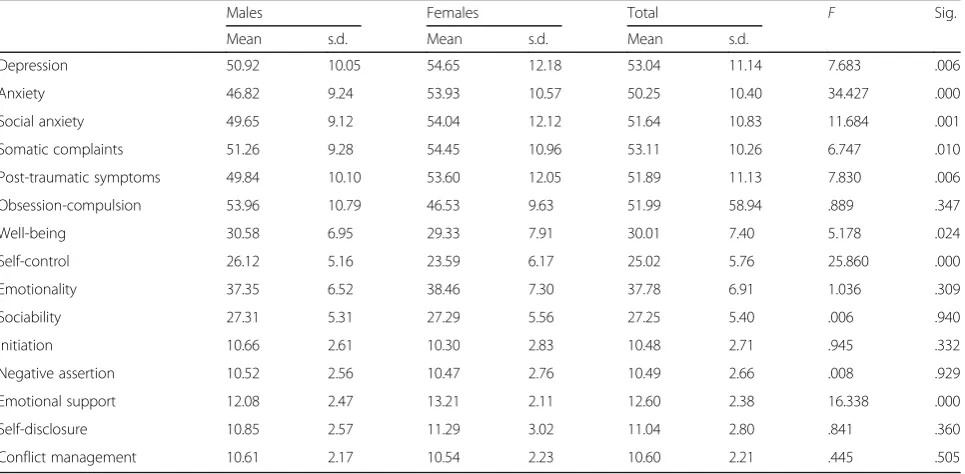
The relationship linking internalizing problems, social skills, and EI was analyzed, as was the influence of gen-der (Table 1). The results showed how gender was sig-nificant in internalizing problems (depression, anxiety, social anxiety, somatic complaints, and post-traumatic symptoms), except in obsession-compulsion. Signifi-cance was also found for the well-being and self-control
factors of the emotional intelligence construct and for the emotional support in social skills. This indicates dif-ferences in internalizing problems between males and fe-males. The present research results revealed how gender mainly influenced internalizing problems, but only in some EI and social skill factors.
In order to evaluate the relationship linking the three variables and in accordance with the first hypothesis, the existing correlations among the scales that measured in-ternalizing problems, social skills, and EI were studied (Table2). The results indicated how the internalizing prob-lems showed an inverse relationship with EI (r=−.59) and social skills (r=−.34), which would indicate how high scores for internalizing problems would be associated with low scores for social skills and EI scales. The results highlighted how obsession-compulsion did not correlate with the other two constructs.
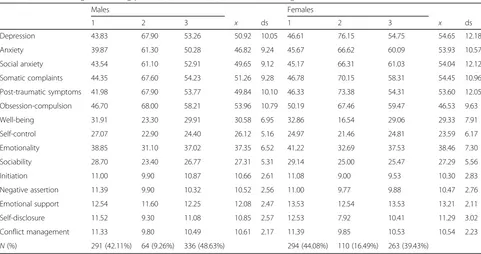
To continue and investigate these three constructs ac-cording to gender, a cluster analysis was run (Table3) as this is a set of the multivariate techniques used to clas-sify a group of individuals into homogeneous groups with a marked exploratory character. We intended to find a set of groups to be assigned by different individ-uals by some homogeneity criterion that would allow us to define a measure of similarity or divergence to classify the research participants according to these variables: in-ternalizing problems, social skills, and EI by gender. In turn, the gender variable was addressed to corroborate the second research hypothesis. This allowed three groups of males and three other groups of females to be formed. Males obtained higher mean scores in internal-izing problems (except obsession-compulsion) and
Table 1Scores obtained in internalizing problems, social skills, and EI. Influence of gender
Males Females Total F Sig. Mean s.d. Mean s.d. Mean s.d.
self-control. The emotional support of females scored higher than males. The mean scores obtained by males and females for the other variables were similar. The scores of both study groups were compared with the mean scores obtained in this research according to gen-der. With males, groups were distributed as follows: (1) formed by 291 subjects (42.11%), with lower than mean scores in internalizing problems, and higher than mean scores in social skills and EI; (2) with 64 participants (9.26%), with higher than mean levels in the three in-ternalizing problem factors (problems with the family, school, and classmates), somewhat lower than the mean in EI and similar scores to the mean for social skills; and (3) with 336 subjects (48.63%) with higher than mean scores in internalizing problems, lower than mean scores in EI and social skills (except self-control).
For the females, groups were made up as follows: (1) formed by 294 participants (44.08%), with lower than mean scores in internalizing problems and higher scores to the mean in EI and social skills; (2) with 110 subjects (16.49%) with higher than mean levels in internalizing problems, lower than mean scores in EI and social skills; and (3) with 263 partici-pants (39.43%) with higher than mean scores in in-ternalizing problems (except depression), higher scores to the mean in two EI factors (emotionality and sociability), and in three social skill factors (initi-ation, negative assertion, and self-revelation).
In short, 57.89% of the males obtained higher than mean scores for internalizing problems, and 9.26% of them ob-tained lower than mean scores for EI and social skills. Among the females, 55.92% obtained higher than mean Table 2Correlations among internalizing problems, emotional intelligence, and social skills
Depression Anxiety Social anxiety Somatic complaints Post-traumatic symptoms Obsession-compulsion Well-being −.533** −.281** −.373** −.331** −.438** −.160*
Self-control −.225** −.181** −.144* −.203** −.233** .021 Emotionality −.226** −.059 −.249** −.143* −.260** −.017 Sociability −.198** −.113 −.339** −.136* −.179** .077 Initiation −.181** −.136* −.331** −.101 −.126 .073 Negative assertion −.250** −.147* −.200** −.095 −.140* .073 Emotional support −.093 .148* .050 −.035 −.047 .050 Self-disclosure −.299** −.160* −.285** −.220** −.245** −.032 Conflict management −.144* −.039 −.074 −.110 −.138* .013
*p< 0,05**p< 0,01
Table 3Cluster among internalizing problems, social skills, and emotional intelligence
Males Females
1 2 3 x ds 1 2 3 x ds
Depression 43.83 67.90 53.26 50.92 10.05 46.61 76.15 54.75 54.65 12.18 Anxiety 39.87 61.30 50.28 46.82 9.24 45.67 66.62 60.09 53.93 10.57 Social anxiety 43.54 61.10 52.91 49.65 9.12 45.17 66.31 61.03 54.04 12.12 Somatic complaints 44.35 67.60 54.23 51.26 9.28 46.78 70.15 58.31 54.45 10.96 Post-traumatic symptoms 41.98 67.90 53.77 49.84 10.10 46.33 73.38 54.31 53.60 12.05 Obsession-compulsion 46.70 68.00 58.21 53.96 10.79 50.19 67.46 59.47 46.53 9.63 Well-being 31.91 23.30 29.91 30.58 6.95 32.86 16.54 29.06 29.33 7.91 Self-control 27.07 22.90 24.40 26.12 5.16 24.97 21.46 24.81 23.59 6.17 Emotionality 38.85 31.10 37.02 37.35 6.52 41.22 32.69 37.53 38.46 7.30 Sociability 28.70 23.40 26.77 27.31 5.31 29.14 25.00 25.47 27.29 5.56 Initiation 11.00 9.90 10.87 10.66 2.61 11.08 9.00 9.53 10.30 2.83 Negative assertion 11.39 9.90 10.32 10.52 2.56 11.00 9.77 9.88 10.47 2.76 Emotional support 12.54 11.60 12.25 12.08 2.47 13.53 12.54 13.53 13.21 2.11 Self-disclosure 11.52 9.30 11.08 10.85 2.57 12.53 7.92 10.41 11.29 3.02 Conflict management 11.33 9.80 10.49 10.61 2.17 11.39 9.85 10.53 10.54 2.23
scores in internalizing problems and lower than mean scores for their social skills and similar scores in EI.
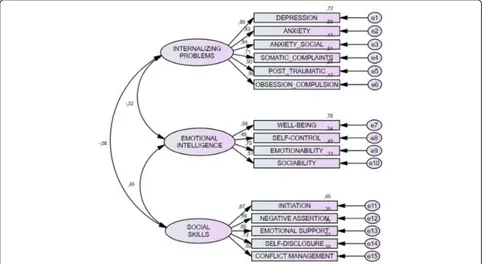
Finally, an attempt was made to confirm the second hypothesis: the relationship linking internalizing prob-lems, social skills, and EI differs according to gender. We worked with a model of structural equations. This technique combines factor analysis with linear regression to test the degree of adjustment of some observed data to a hypothesized model and expressed with a path dia-gram. As a result, they provide the values that belong to each relationship and, more importantly, a statistic that expresses the degree to which data conform to the pro-posed model to thus confirm its validity and, in this case, if the relationship linking the three research con-structs differs according to gender. Figure 1 offers the analysis results with structural equations by the max-imum likelihood method, which confirms the suitability of the model made up of the three constructs under study. In this case, differences were found with the ana-lyses that considered gender: for females, the relation-ship between EI and social skills was stronger (r= .86 in females, r= .64 in males). Inverse relationships were found between internalizing problems and EI (r=−.77 in females, r=−.30 in males) and social skills (r=−.52 in females, r=−.07 in males). This indicates that the ado-lescents who obtained higher scores in internalizing problems had a lower level of EI and poorer social skills.
When we analyzed all three constructs, correlations were also observed for some gender differences. Indeed,
high weight values were obtained for males for all the in-ternalizing problem factors, which were all above .60. In females, this relationship was also strong, except for the obsession-compulsion factor (r=−.06). In the internaliz-ing problems construct, differences were also found be-tween the scores obtained by males in the anxiety and obsession-compulsion factors with higher weight values, while the depression factor obtained higher weight values in females. The relationship of the social skill factors was homogeneous with this construct, and only factors emotional support (r= .86 males; r= .61 fe-males) and managing conflicts (r= .62 males; r= .46 fe-males) established a stronger relationship with the social skill construct for males. In EI, males established stronger relationships in the factors well-being (r= .89 males;r= .79 females), sociability (r= .58 males;r= .42 fe-males), and above all, self-control (r= .48 males;r= .18 fe-males). As the various indices reflected a suitable model fit, we can state that the proposed model about the factor-ial structure among the three factors is sustainable:χ2(85) = 201.161 p< 0.001; χ2/gl= 2.367; CFI = 0.919; NFI = 0.869; TLI = 0.900; RMSEA = 0.075,IC95% (0.062–0.089). When nested model comparisons were made (Table4) and when assuming the unconstrained model to be correct, we obtained a comparison made with the urement weights, which indicated that the equal meas-urement weights model displayed the same fit as the model with no restrictions. Thus, the regression weights in the indicated model were the same. Likewise, the
models of the measurement intercepts, structural covari-ances, and measurement residuals did not fit the data, and the comparison indicated that the model statistically differed and gave a worse fit. These results indicated both the gender differences and the adequacy of the model established among the three variables (internaliz-ing problems, social skills, and EI).
Discussion and conclusions
The present work had two objectives: (1) to analyze whether internalizing problems were related with adolescents’social skills and EI and (2) to evaluate if the relationship linking these three constructs differed according to gender.
The first hypothesis refers to a possible relationship linking internalizing problems and social skills and EI. The obtained research results corroborate this hypoth-esis by explaining how internalizing problems maintain an inverse relationship with social skills and EI, i.e., the higher the scores for internalizing problems, the lower the scores that adolescents obtain for performing social skills and EI, and vice versa. These results indicate how social skills and EI may act as protectors of these intern-alizing problems, which agrees with former research (Bubic & Ivanisevic,2016; Martínez-Martí & Ruch,2017; Trickey, Siddaway, Meider-Stedman, Serpell, & Field, 2012) that indicated the relationship between internaliz-ing problems and the social competence variables. Internalizing problems (depression, anxiety, social anx-iety, somatic complaints, post-traumatic symptoms, and obsession-compulsion) have been previously interrelated in recent works (Campos et al., 2014; Senzik, Shäfer, Samson, Naumann, & Tuschen-Caffier, 2017), but these works did not analyze the importance of their relation-ship with EI and social skills, which the present research indicates. As expected, and to a greater or lesser extent, the internalizing problem factors showed an inverse rela-tionship with EI and social skills. However, this point presents two exceptions: somatic complaints did not correlate with social skills, and obsession-compulsion did not correlate with social skills and EI.
An attempt was made to evaluate the participants’ levels in the analyzed constructs. This work showed how two in every three of the males, and just over one in every two of the females, who participated in our re-search obtained higher than mean scores for internaliz-ing problems. Generally speakinternaliz-ing, males obtained higher
scores than females for the two EI factors (well-being and self-control) and lower scores for the emotional support factor of social skills. These results differ from those ob-tained in former research (Ganguly, Kulkami, & Gupta, 2017; Stubbs & Maynard, 2016), which has indicated lower levels of well-being and self-control in males. How-ever, these studies were about matters like aggression and perfectionism rather than internalizing problems, as in the present study, which might explain these results.
In order to verify the second hypothesis, we investi-gated if the relationship linking internalizing problems, social skills, and EI differed according to secondary edu-cation students’gender. The model explains how social skills and EI are related inversely with internalizing problems in secondary education students and that when considering internalizing problems according to gender, a higher weight value is indicated for EI and so-cial skills in internalizing problems for females. The present research results also indicated how the weight of the obsession-compulsion factor for females was barely present in internalizing problems (r=−.06), and its weight for males was similar to the other factors. Accordingly, obsession-compulsion did not correlate with either EI or social skills, an aspect which indicates that it would not fit well in the three constructs model used herein. Moreover in EI, the well-being, self-control, and sociability factors presented higher weight values in males, as did the emotional support and managing emo-tions factors in social skills. The present results not only back this matter, which agrees with some former studies (Burger & Samuel, 2017; Eceiza, Arrieta, & Goñi, 2008; Ferrándiz, Hernández, Bermejo, Ferrando, & Sáinz, 2012), but also fall in line with other works that have studied these variables separately, and have indicated gender differences in internalizing problems (Gomes & Soares, 2013), social skills (Zach, Yazdi-Ugav, & Zeev, 2016), and even better handling emotions among fe-males (Balluerka, Gosostiaga, Alonso-Arbiol, & Aritzeta, 2017). However, it is worth highlighting that other works have indicated the difficulty of obtaining conclusive re-sults along these lines (Gartxia, Aritzeta, Bulluerka, & Barberá, 2012). This reveals the necessity of further studies and research that relate these variables together according to gender, and which study this research line in depth. Moreover, there are those concepts indicated by Vantieghem, Vermeersch, and Van Houtte (2014) Table 4Multiple-group analysis of internalizing problems, emotional intelligence, and social skills by gender
who point out how the theory of gender identity can be valuable for promoting gender educational research and how gender identity can be linked to certain behaviors in the classroom or study methods. Much remains to be dis-covered about the impact of identity on school achieve-ment, and research is needed to promote this dichotomy and to work on the association between gender identity and internalizing problems and social skills and EI.
Despite its large sample size, this study is not without its limitations. Longitudinal-type studies that allow the evalu-ation of the appearance and development of internalizing problems and attach the importance of working with so-cial skills and EI with adolescents as a preventive element of these problems are necessary. Besides, this study can and must be extended to other constructs, like affects and use of humor or personality, which should be related, and their relation with these variables should be studied.
The present results evidence a relationship among in-ternalizing problems, social skills, and EI and, hence, the relevance of working on these aspects at school. Along these lines, this relationship indicates the need to prevent internalizing problems, which requires identifying them early. This matter can help others who live alongside ado-lescents (fathers, mothers, and teachers) to observe their social skills and emotional performance as they could act as ideal informers to detect such problems in adolescents.
As future perspectives, the need to implement specific education programs that work with these three constructs at school is worth stressing, particularly internalizing problems given their importance for and implication in adolescents’development. Our research results encourage us to continue asking new questions to help us to define methodologies and to find some answers, which will allow us to make progress in building adolescents’ socio-affective development.
In conclusion, this study provides substantial empirical support for the postulated model through which intern-alizing problems, emotional intelligence, and social skills operate in accordance with adolescent development with the effects of EI and social skills on internalizing prob-lems. The study also explains the gender differences in the relationship of internalizing problems, EI, and social skills. Its findings suggest the importance of promoting social skills and EI among adolescents and engaging in appropriate academic, social, and school activities.
Acknowledgements
Our special thanks to the students, teachers, and educational centers for their participation in this study.
Funding
This study was performed by Research Group OPIICS (S46_17R), University of Zaragoza (Zaragoza, Spain) and was supported by research funds provided by the Department of Science and Technology of the Government of Aragón (Spain) and the European Social Fund.
Availability of data and materials
Please contact authors for data requests.
Authors’contributions
CS, PU, and PT contributed to the conception and design of the work. CS, PU, and PT organized the sample collection and data preparation and performed the data collection, analysis, and interpretation. CS, PU, and PT prepared drafts of the article. CS, PU, and PT critically reviewed its comprehensive content. All authors read and approved the final manuscript.
Ethics approval and consent to participate
All procedures performed in studies involving human participants were in concordance with the ethical standards of the institutional and/or national research committee and with the 1964 Helsinki declaration and its later amendments or comparable ethical standards.
Consent for publication
Assent was obtained from all participants and their caregivers provided written informed consent.
Competing interests
The authors declare that they have no competing interests.
Publisher’s Note
Springer Nature remains neutral with regard to jurisdictional claims in published maps and institutional affiliations.
Received: 13 January 2018 Accepted: 26 December 2018
References
Alarcón Parco, D., Jó, B., & Patricia, S. (2015). Conductas internalizantes y externalizantes en adolescentes.Liberabit,21(2), 253–259. Balluerka, N., Gosostiaga, A., Alonso-Arbiol, I., & Aritzeta, A. (2017). Peer
attachment and class emotional intelligence as predictors of adolescents’ psychological well-being: a multilevel approach.Journal of Adolescence,53, 1–9.https://doi.org/10.1016/j.adolescence.2016.08.009.
Bar-On, R. (1997).The emotional intelligence inventory (EQi): Technical manual. Toronto: Multi-Health Systems.
Bubic, A., & Ivanisevic, K. (2016). The role of emotional and competence in young adolescents’career judgments.Journal of Career Development,43(6), 498–511. https://doi.org/10.1177/0894845316633779.
Buhrmester, D., Furman, W., Wittenberg, M. T., & Reis, H. T. (1988). Five domains of interpersonal competence in peer relationships.Journal of Personality and Social Psychology,55, 991–1008.https://doi.org/10.1037/0022-3514.55.6.991. Caballo, V. (2002).Manual de evaluación y entrenamiento de las habilidades
sociales. Madrid: Siglo XXI.
Campos, R. C., Besser, A., Morgado, C., & Blatt, S. J. (2014). Self-criticism, dependency, and adolescents’externalizing and internalizing problems.
Clinical Psychologist,18(1), 21–32.https://doi.org/10.1111/cp.12024. Chaplin, T. M., & Aldao, A. (2013). Gender differences in emotion expression in
children: a meta-analytic review.Psychological Bulletin,139(4), 735–765. https://doi.org/10.1037/a0030737.
Crick, N. R., & Grotpeker, J. K. (1995). Relational aggression, gender, and social-psychological adjustment.Child Development,66(3), 710–722.https://doi.org/ 10.1111/j.1467-8624.1995.tb00900.x.
Eceiza, M., Arrieta, M., & Goñi, A. (2008). Habilidades sociales y contextos de la conducta social.Revista de Psicodidáctica,13(1), 11–26.
Fernández, M., Mena, L., & Riviere, J. (2010).Fracaso y abandono escolar en España. Barcelona: Fundación La Caixa.
Fernández-Berrocal, P., & Extremera, N. (2005). La inteligencia emocional y la educación de las emociones desde el Modelo de Mayer y Salovey.Revista Interuniversitaria de Formación del Profesorado,19, 63–93.
Fernández-Pinto, I., Santamaría, P., Sánchez-Sánchez, F., Carrasco, M. A., & del Barrio, V. (2015).Sistema de Evaluación de Niños y Adolescentes. Madrid: TEA Ediciones.
Ferrándiz, C., Hernández, D., Bermejo, R., Ferrando, M., & Sáinz, M. (2012). Social and emotional intelligence in chilhood and adolescence: Spanish validation of a measurement instrument.Revista de Psicodidáctica,17(2), 309–338. Gaete, V. (2015). Desarrollo psicosocial del adolescente.Revista chilena de
Ganguly, S., Kulkami, M., & Gupta, M. (2017). Predictors of academic performance among Indian students.Social Psychology of Education, 1–19.https://doi.org/ 10.1007/s11218-016-9345-y.
Gartxia, L., Aritzeta, A., Bulluerka, N., & Barberá, E. (2012). Inteligencia emocional y género: más allá de las diferencias sexuales.Anales de Psicología,28, 567–575. https://doi.org/10.6018/analesps.28.2.124111.
Goleman, D. (1995).Emotional intelligence. New York: Bantam Books. Gomes, G., & Soares, D. (2013). Diferencias de género con relación al desempeño
académico en estudiantes de nivel básico.Alternativas en Psicología,28, 106–118. Humphrey, N., Curran, A., Morris, E., Farrell, P., & Woods, K. (2007). Emotional
intelligence and education: a critical review.Educational Psychology,27, 235–254. https://doi.org/10.1080/01443410601066735.
Jaccar, J. (2016). The prevention of problem behaviors in adolescents and young adults: perspectives on theory and practice.Journal of the Society for Social Work and Research,7(4), 585–613.https://doi.org/10.1086/689354. Kinnaman, J. E. S., & Bellack, A. S. (2012). Social Skills. In W. O’Donohue, & J. E. Fisher
(Eds.),Cognitive behavior therapy: Core principles for practice. Nevada: Wiley. Lent, R. W., Taveira, D. M. C., Figuera, P., Dorio, I., Faria, S., & Gonçalves, A. M. (2017). Test of the social cognitive model of well-being in Spanish college students.Journal of Career Assesment,25(1), 135–143.https://doi.org/10.1177/ 1069072716657821.
Livesey, C. M. W., & Ronstain, A. L. (2017). Involving parents/family in treatment during the transition from late adolescence to young adulthood: Rationale, strategies, ethics, and legal Isuues.Child and Adolescent Psychiatric Clinics of North America,26(2), 199–216.https://doi.org/10.1016/j.chc.2016.12.006. Lozano, L., & Lozano, L. M. (2017). Los trastornos internalizantes: un reto para
padres y docentes.Padres y Maestros,372, 56–63.https://doi.org/10.1422/ pym.i372.y2017.009.
Martínez-Martí, M. L., & Ruch, W. (2017). Character strengths predict resilience over and above positive affect, efficacy, optimism, social support, self-esteem, and life satisfaction.The Journal of Positive Psychology,12(2), 110–119. https://doi.org/10.1080/17439760.2016.1163403.
Mayer, J.D., & Salovey, P. (1997). What is emotional intelligence? In P. Salovey y D. Sluyter (Eds.), Emotional development and emotional intelligence: Educational applications (pp. 3–31). New York: Basic Books.
Mikolajczak, M., Luminet, O., & Menil, C. (2006). Predicting resistance to stress: Incremental validity of trait emotional intelligence over alexithymia and optimism.Psicothema,18, 79–88.
Montero, I., & León, O. (2007). A guide for naming research studies in psychology.
International Journal of Clinical and Health Psychology,7(3), 847–862. Navarro-Pardo, E., Meléndez, J. C., Sales, A., & Sancerni, M. D. (2012). Desarrollo
infantil y adolescente: trastornos mentales más frecuentes en función de la edad y el género.Psicothema,24(3), 377–383.
Ortuño-Sierra, J., Fonseca-Pedrero, E., Sastre, S., & Muñiz, J. (2017). Patterns of behavioral through adolescence: the influence of prosocial skills.Anales de Psicología,33(1), 48–56.https://doi.org/10.6018/analesps.33.1.225031. Petrides, K. V. (2012).Technical manual for the trait emotional intelligence
questionnaire (TEIQue). London: London Psychometric Laboratory. Petrides, K. V. (2016). Four thoughts on trait emotional intelligence.Emotion
Review,8(4), 345.https://doi.org/10.1177/1754073916650504. Salavera, C., & Usan, P. (2018). Adaptación del Cuestionario de Competencia
Interpersonal ICQ-15 con Población Adolescente Hispanohablante.Revista Iberoamericana de Diagnóstico y Evaluación–e Avaliação Psicológica,3(48). https://doi.org/10.21865/RIDEP48.3.03.
Salavera, C., Usán, P., & Jarie, L. (2017). Emotional intelligence and social skills on self-efficacy in secondary education students. Are there gender differences?Journal of Adolescence,60, 39–46.https://doi.org/10.1016/j.adolescence.2017.07.009. Salavera, C., Usán, P., Pérez, S., Chato, A., & Vera, R. (2017). Differences in
happiness and coping with stress in secondary education students. Procedia-Social and Behavioral Sciences,237, 1310–1315.https://doi.org/10.1016/j. sbspro.2017.02.215.
Salovey, P., & Grewal, D. (2005). The science of emotional intelligence.Current Directions in Psychological Science,14, 281–285.
Schäfer, J. Ö., Naumann, E., Holmes, E. A., Tuschen-Caffier, B., & Samson, A. C. (2017). Emotion regulation strategies in depressive and anxiety symptoms in youth: A meta-analytic review.Journal of Youth and Adolescence,46(2), 261–276.https:// doi.org/10.1007/s10964-016-0585-0.
Senzik, L., Shäfer, J. O., Samson, A., Naumann, E., & Tuschen-Caffier, B. (2017). Emotional awareness in depressive and anxiety symptoms in youth: a meta-analytic review.Journal of Youth and Adolescence,46(4), 687–700.https://doi. org/10.1007/s10964-017-0629-0.
Shapero, B. G., Abramson, L. Y., & Alloy, L. B. (2016). Emotional reactivity and internalizing symptoms: Moderating role of emotion regulation.Cognitive Therapy and Research,40(3), 328–340.https://doi.org/10.1007/s10608-015-9722-4. Stubbs, N. S., & Maynard, D. M. B. (2016). Academic self-efficacy, school
engagement and family functioning, among postsecondary students in the Caribbean.Journal of Child and Family Studiesin press.https://doi.org/10. 1007/s10826-016-0595-2.
Tandon, M., Cardeli, E., & Luby, J. (2009). Internalizing disorders in early childhood: a review of depressive and anxiety disorders.Child and Adolescent Psychiatric Clinics of North America,18(3), 593–610.
Trickey, D., Siddaway, A. P., Meider-Stedman, R., Serpell, L., & Field, A. P. (2012). A meta-analysis of risk factors for post-traumatic stress disorder in children and adolescents.Clinical Psychological Review,32(2), 122–138.https://doi.org/ 10.1016/j.cpr.2011.12.001.
Vantieghem, W., Vermeersch, H., & Van Houtte, M. (2014). Transcending the gender dichotomy in educational gender gap research: The association between gender identity and academic self-efficacy.Contemporary Educational Psychology,39(4), 369–378.https://doi.org/10.1016/j.cedpsych. 2014.10.001.
Was, A. M., & Warneken, F. (2017). Proactive help-seeking: preschoolers know when they need help, but not always ask for it.Cognitive Development,43, 91–105.https://doi.org/10.1016/j.cogdev.2017.02.010.