R E S E A R C H
Open Access
On the convergence of an iteration method
for continuous mappings on an arbitrary
interval
Nazli Kadioglu
*and Isa Yildirim
*Correspondence:
[email protected] Department of Mathematics, Ataturk University, Erzurum, 25240, Turkey
Abstract
In this paper, we consider an iterative method for finding a fixed point of continuous mappings on an arbitrary interval. Then, we give the necessary and sufficient conditions for the convergence of the proposed iterative methods for continuous mappings on an arbitrary interval. We also compare the rate of convergence between iteration methods. Finally, we provide a numerical example which supports our theoretical results.
MSC: 26A18; 47H10; 54C05
Keywords: continuous mapping; fixed point; convergence theorem
1 Introduction
LetE be a closed interval on the real line and let f :E→Ebe a continuous mapping. A pointp∈Eis a fixed point off iff(p) =p. We denote byF(f) the set of fixed points off. It is known that ifEis also bounded, thenF(f) is nonempty.
There are many iterative methods for finding a fixed point off. For example, the Mann iteration (see []) is defined byu∈Eand
un+= ( –αn)un+αnf(un) (.)
for alln≥, where{αn}∞n=is a sequence in [, ]. The Ishikawa iteration (see []) is defined bys∈Eand
⎧ ⎨ ⎩
tn= ( –bn)sn+bnf(sn),
sn+= ( –αn)sn+αnf(tn)
(.)
for alln≥, where{αn}∞n=,{bn}∞n=are sequences in [, ]. The Noor iteration (see []) is defined byw∈Eand
⎧ ⎪ ⎪ ⎨ ⎪ ⎪ ⎩
rn= ( –an)wn+anf(wn),
qn= ( –bn)wn+bnf(rn),
wn+= ( –αn)wn+αnf(qn)
(.)
for alln≥, where{αn}∞n=,{bn}∞n=and{an}∞n=are sequences in [, ]. Clearly, Mann and Ishikawa iterations are special cases of the Noor iteration.
In , Roades proved the convergence of the Mann iteration for the class of contin-uous and nondecreasing functions on a closed unit interval, and then he [] extended convergence results to Ishikawa iterations. He also proved that the Ishikawa iteration con-verges faster than the Mann iteration for the class of continuous and nondecreasing map-pings. Later, in , Borwein and Borwein [] proved the convergence of the Mann it-eration of continuous mappings on a bounded closed interval. Recently, Qing and Qihou [] extended their results to an arbitrary interval and to the Ishikawa iteration and a gave necessary and sufficient condition for the convergence of Ishikawa iteration on an arbi-trary interval. Recently, Phuengrattana and Suantai [] proved that the Mann, Ishikawa and Noor iterations are equivalent for the class of continuous and nondecreasing map-pings.
In this paper, we are interested in employing the iteration method (.) for a continuous mapping on an arbitrary interval. The iteration method was first introduced by Thianwan and Suantai [] as follows. LetEbe a subset of a normed spaceXand letf :E→Ebe a mapping
⎧ ⎪ ⎪ ⎨ ⎪ ⎪ ⎩
zn= ( –an)xn+anf(xn),
yn= ( –bn–cn)xn+bnf(zn) +cnf(xn),
xn+= ( –αn–βn)xn+αnf(yn) +βnf(zn)
(.)
for alln≥, where{αn}∞n=,{βn}∞n=,{an}∞n=,{bn}n∞=and{cn}∞n=are sequences in [, ]. Note that (.) reduces to (.) whenan=bn=cn=βn= . Similarly, the process (.) reduces to (.) whenan=cn=βn= . Moreover, forcn=βn= , the process (.) reduces to (.).
The purpose of this article is to give a necessary and sufficient condition for the strong convergence of the iteration method (.) of continuous mappings on an arbitrary interval. Our results extend and improve the corresponding results of Rhoades [], Borwein and Borwein [], Qing and Qihou [], Phuengrattana and Suantai [], and many others.
2 Convergence theorems
We first give a convergence theorem for the iteration method (.) for continuous map-pings on an arbitrary interval.
Theorem Let E be a closed interval on the real line and let f :E→E be a continuous mapping.For x∈E,let the iteration{xn}∞n= be defined by(.),and let{an}∞n=,{bn}∞n=,
{cn}∞n=,{αn}n∞=and{βn}∞n=be sequences in[, ]satisfying the following conditions:
(i) limn→∞an= ,limn→∞bn= ,limn→∞cn= and
∞
n=βn<∞,
(ii) limn→∞αn= and
∞
n=αn=∞.
Then{xn}∞n=is bounded if and only if{xn}∞n=converges to a fixed point of f.
a<m<b, thenf(m) =m. Suppose thatf(m)=m. Without loss of generality, we suppose thatf(m) –m> . Becausef(x) is a continuous mapping, there existsδ∈(,b–a) such that
f(x) –x> for|x–m| ≤δ. (.)
By the boundedness of{xn}∞n=, we have{xn}∞n= belongs to a bounded closed interval. The continuity off implies that{f(xn)}∞n=belongs to another bounded closed interval, so
{f(xn)}∞n= is bounded, and sincezn= ( –an)xn+anf(xn), so{zn}∞n=is bounded, and thus
{f(zn)}∞n=is bounded. Similarly, sinceyn= ( –bn–cn)xn+bnf(zn) +cnf(xn), we have{yn}∞n= and{f(yn)}n∞=are bounded. It follows by (.) thatxn+–xn=αn(f(yn) –xn) +βn(f(zn) –xn), yn–xn=bn(f(zn) –xn) +cn(f(xn) –xn) andzn–xn=an(f(xn) –xn). By conditions (i) and (ii), we get|xn+–xn| →,|yn–xn| → and|zn–xn| →. Thus, there existsNsuch that
|xn+–xn|< δ
, |yn–xn|< δ
, |zn–xn|< δ
(.)
for alln>N. Sinceb=lim supn→∞xn>m, there existsk>Nsuch thatxnk>m. Letk=
nk, thenxk>m. Forxk, there exist only two cases:
Case :xk≥m+δ, then by (.), we havexk+–xk> –δ, thenxk+>xk– δ ≥m, so xk+>m.
Case:m<xk<m+δ, then by (.), we havem–δ<yk<m+δ andm–δ<zk<m+δ. So, we have|xk–m|<δ <δ,|yk–m|<δ <δand|zk–m|<δ <δ. Using (.), we get
f(xk) –xk> , f(yk) –yk> , f(zk) –zk> .
By (.), we have
xk+= ( –αk–βk)xk+αkf(yk) +βkf(zk)
=xk+αk
f(yk) –xk
+βk
f(zk) –xk
=xk+αk
f(yk) –yk
+αk(yk–xk) +βk
f(zk) –zk
+βk(zk–xk)
=xk+αk bk
f(zk) –xk
+ck
f(xk) –xk
+βkak
f(xk) –xk
+αk
f(yk) –yk
+βk
f(zk) –zk
=xk+akbk
f(zk) –zk
+akbk(zk–xk) +αkck
f(xk) –xk
+βkak
f(xk) –xk
+αk
f(yk) –yk
+βk
f(zk) –zk
=xk+akbk
f(xk) –xk
+akbk
f(zk) –zk
+αkck
f(xk) –xk
+βkak
f(xk) –xk
+αk
f(yk) –yk
+βk
f(zk) –zk
.
By Case and Case , we can conclude that xk+>m. By using the above argument, we obtainxk+>m,xk+>m,xk+>m, . . . . Thus we getxn>mfor alln>k=nk. So,a=
Thenf(xm) =xm. Thus
zm= ( –am)xm+amf(xm) =xm,
ym= ( –bm–cm)xm+bmf(zm) +cmf(xm)
= ( –bm–cm)xm+bmf(xm) +cmf(xm) =xm,
xm+= ( –αm–βm)xm+αmf(ym) +βmf(zm)
= ( –αm–βm)xm+αmf(xm) +βmf(xm) =xm.
By induction, we obtainxm=xm+=xm+=xm+=· · ·, so,xn→xm. This implies that xm=aandxn→a, which contradicts our assumption.
Case: For alln,xn≤aorxn≥b.
Becauseb–a> and|xn+–xn| →, so there existsNsuch that|xn+–xn|<b–a for alln>N. It implies that eitherxn≤afor alln>N orxn≥bfor alln>N. Ifxn≤a forn>N, thenb=lim supn→∞xn≤a, which is a contradiction witha<b. Ifxn≥bfor n>N, so we havea=lim infn→∞xn≥b, which is a contradiction witha<b.
Hence, we have{xn}∞n=is convergent.
Finally, we show that{xn}∞n=converges to a fixed point off. Letxn→pand suppose that f(p)=p. By the continuity off, we have{f(xn)}n∞=is bounded. Fromzn= ( –an)xn+anf(xn) andan→, we obtainzn→p. Similarly, byyn= ( –bn–cn)xn+bnf(zn) +cnf(xn) and bn→ andcn→, it follows thatyn→p. Letrk=f(yk) –xkandsk=f(zk) –xk. By the continuity off, we havelimk→∞rk=limk→∞(f(yk) –xk) =f(p) –p= andlimk→∞sk= limk→∞(f(zk) –xk) =f(p) –p= . Putw=f(p) –p. Thenw= . By (.), we getxn+= xn+αn(f(yn) –xn) +βn(f(zn) –xn). It follows that
xn=x+ n–
k=
(αkrk+βksk). (.)
Byrk→w= and
∞
n=αn=∞, we have that
∞
k=αkrkis divergent,
∞
k=βkskis con-vergent. It follows by (.) that{xn}∞n=is divergent, which is a contradiction withxn→p. Thusf(p) =p, that is,{xn}∞n=converges to a fixed point off.
The following corollaries are obtained directly by Theorem .
Corollary [] Let E be a closed interval on the real line and let f :E→E be a continuous mapping.For x∈E,let the Noor iteration{xn}∞n=be defined by(.),where{αn}∞n=,{βn}∞n=,
{γn}∞n=are sequences in[, ]satisfying the following conditions:
(i) ∞n=αn=∞andlimn→∞αn= ;
(ii) limn→∞βn= andlimn→∞γn= .
Then{xn}∞n=is bounded if and only if{xn}∞n=converges to a fixed point of f.
Proof By puttingcn=βn= for alln≥ in Theorem , we obtain the required result
directly from Theorem .
Corollary [] Let E be a closed interval on the real line and let f :E→E be a continuous mapping.For x∈E,let the Ishikawa iteration{xn}∞n= be defined by(.),where{αn}∞n=,
(i) ∞n=αn=∞andlimn→∞αn= ;
(ii) limn→∞βn= .
Then{xn}∞n=is bounded if and only if{xn}∞n=converges to a fixed point of f.
Proof By puttingan=cn= andβn= for alln≥ in Theorem , we obtain the desired
result.
Corollary [] Let E be a closed interval on the real line and let f:E→E be a continuous mapping.For x∈E,let the Mann iteration{xn}∞n=be defined by(.),where{αn}∞n=is a sequence in[, ]satisfying the following conditions:
(i) limn→∞αn= and
(ii) ∞n=αn=∞.
Then{xn}∞n=is bounded if and only if{xn}∞n=converges to a fixed point of f.
Proof It is the special casean=bn=cn=βn= in Theorem .
3 Rate of convergence
In this section, we compare the rate of convergence of the iteration (.) with the Mann, Ishikawa and Noor iterations. We show that the iteration (.) converges faster than the others.
In order to compare the rate of convergence of continuous self-mappings defined on a closed interval, we use the following definition introduced by Rhoades [].
Definition LetEbe a closed interval on the real line and letf :E→Ebe a continuous mapping. Suppose that{xn}∞n=and{un}∞n=are two iterations which converge to the fixed pointpoff. We say that{xn}n∞=is better than{un}∞n=if
|xn–p| ≤ |un–p| for alln≥.
Lemma [] Let E be a closed interval on the real line and let f :E→E be a continuous and nondecreasing mapping.Let{αn}∞n=,{βn}∞n=,{an}∞n=be sequences in[, ).Let{un}∞n=,
{sn}∞n=and{wn}∞n=be defined by(.)-(.),respectively.Then the following hold:
(i) Iff(u) <u,thenf(un) <unfor alln≥and{un}∞n=is nonincreasing.
(ii) Iff(u) >u,thenf(un) >unfor alln≥and{un}∞n=is nondecreasing.
(iii) Iff(s) <s,thenf(sn) <snfor alln≥and{sn}∞n=is nonincreasing.
(iv) Iff(s) >s,thenf(sn) >snfor alln≥and{sn}∞n=is nondecreasing.
(v) Iff(w) <w,thenf(wn) <wnfor alln≥and{wn}∞n=is nonincreasing.
(vi) Iff(w) >w,thenf(wn) >wnfor alln≥and{wn}∞n=is nondecreasing.
Lemma Let E be a closed interval on the real line and let f :E→E be a continuous and nondecreasing mapping.Let{an}∞n=,{bn}∞n=,{cn}∞n=,{αn}∞n= and{βn}∞n= be sequences in [, ).Let{xn}∞n=be defined by(.).Then the following hold:
(i) Iff(x) <x,thenf(xn) <xnfor alln≥and{xn}∞n=is nonincreasing.
(ii) Iff(x) >x,thenf(xn) >xnfor alln≥and{xn}∞n=is nondecreasing.
Case :f(z) <y≤z. Thenf(y)≤f(z) <z<x. It follows that iff(y) <x≤y, then f(x)≤f(y) <x, ify<x≤z, thenf(x)≤f(z) <y<xand ifz<x≤x, thenf(x)≤ f(x) <z<x. Thus, we havef(x) <x.
Case : z<y ≤x. Thenf(y)≤f(x) <z ≤x. This impliesf(y) <x≤x. Thus f(x)≤f(x) <z<y ≤x. It follows that if f(y) <x≤y, thenf(x)≤f(y) <x and ify<x≤x, thenf(x)≤f(x) <y<x. Hence, we havef(x) <x.
From Cases and , we havef(x) <x. By induction, we conclude thatf(xn) <xnfor all n≥. This implieszn≤xnfor alln≥. Sincefis nondecreasing, we havef(zn)≤f(xn) <xn for alln≥. Thusyn≤xnfor alln≥, thenf(yn)≤f(xn) <xnfor alln≥. Hence, we have xn+≤xnfor alln≥, that is,{xn}∞n=is nonincreasing.
(ii) Following the line of (i), we can show the desired result.
Lemma Let E be a closed interval on the real line and let f :E→E be a continuous and nondecreasing mapping.Let{an}∞n=,{bn}∞n=,{cn}∞n=,{αn}∞n= and{βn}∞n= be sequences in [, ).For w=x∈E,let{wn}n∞= and{xn}∞n= be the sequences defined by(.)and(.), respectively.Then the following are satisfied:
(i) Iff(w) <w,thenxn≤wnfor alln≥.
(ii) Iff(w) >w,thenxn≥wnfor alln≥.
Proof (i) Letf(w) <w. Sincew=x, we getf(x) <x. From (.), we havef(x) <z≤x. Sincef is nondecreasing, we obtainf(z)≤f(x) <z≤x. This implies f(z) <y≤z. Using (.) and (.), we have
z–r= ( –c)(x–w) +c f(x) –f(w)
= ,
that is,z=r, and we get
y–q= ( –b)(x–w) +b
f(z) –f(r)
+c
f(x) –x
≤.
Sincef is nondecreasing, we havef(y)≤f(q). This implies
x–w = ( –α–β)x+αf(y) +βf(z) – ( –α)w–αf(q)
= ( –α)(x–w) +α
f(y) –f(q)
+β
f(z) –x
≤,
that is,x≤w. Assume thatxk≤wk. Thusf(xk)≤f(wk).
By Lemma (v) and Lemma (i), we havef(wk) <f(wk) andf(xk) <f(wk). This implies f(xk) <zk≤xkandf(zk)≤f(xk) <zk. Thus
zk–rk= ( –γk)(xk–wk) +γk
f(xk) –f(wk)
≤.
That is,zk≤rk. Sincef(zk)≤f(rk), we have
yk–qk= ( –bk)(xk–wk) +bk
f(zk) –f(rk)
+ck
f(xk) –xk
soyk≤qk, which impliesf(yk) –f(qk). It follows that
xk+–wk+ = ( –αk)(xk–wk) +αk
f(yk) –f(qk)
+βk
f(zk) –xk
≤,
that is,xk+≤wk+. By mathematical induction, we obtainxn≤wnfor alln≥.
(ii) By using Lemma (vi) and Lemma (ii) and the same argument as in (i), we can show
thatxn≥wnfor alln≥.
Theorem Let E be a closed interval on the real line and let f :E→E be a continuous and nondecreasing mapping such that F(f)is nonempty and bounded.Let{an}∞n=,{bn}∞n=,
{cn}∞n=,{αn}∞n= and{βn}∞n=be sequences in[, ).For w=x∈E,let{wn}∞n= and{xn}∞n= be the sequences defined by(.)and(.),respectively.Let{an}∞n=,{bn}∞n=,{cn}∞n=,{αn}∞n= and{βn}∞n=be sequences in[, ).Then the following is satisfied:
The iteration(.){xn}∞n=converges to p∈F(f)if and only if the Noor iteration{wn}∞n= converges to p.Moreover,the iteration(.){xn}∞n=is better than the Noor iteration.
Proof PutL=inf{p∈E:p=f(p)}andU=sup{p∈E:p=f(p)}.
(⇒) If the iteration (.){xn}∞n= converges top∈F(f), then settingcn=βn= for all n≥ in (.), we can get the convergence of the Noor iteration.
(⇐) Suppose that the Noor iteration{wn}∞n=converges top∈F(f). We divide our proof into the following three cases:
Case :w=x>U, Case :w=x<L, Case :L≤w=x≤U.
Case :w=x>U. By Proposition . in [], we getf(w) <w andf(x) <x. Using Lemma (i), we get thatxn≤wnfor alln≥. Following the line of the proof of Theorem . in [], we haveU≤xnfor alln≥. Then we have ≤xn–p≤wn–p, so
|xn–p| ≤ |wn–p| for alln≥.
We can see that the iteration (.){xn}∞n=is better than the Noor iteration.
Case :w=x<L. By Proposition . in [], we getf(w) >w andf(x) >x. Using Lemma (ii), we getxn≥wnfor alln≥. Following the line of the proof of Theorem . in [], we getxn≤Lfor alln≥. So,
|xn–p| ≤ |wn–p| for alln≥.
We can see that the iteration (.){xn}∞n=is better than the Noor iteration.
Case :L≤w=x≤U. Suppose thatf(w)=w. Iff(w) <w, we have by Lemma (v) that{wn}∞n= is nondecreasing with limitp. By Lemma (i), we havep≤xn≤wnfor all n≥. It follows that|xn–p| ≤ |wn–p|for alln≥. Hence we have that the iteration (.)
{xn}∞n=is better than the Noor iteration{wn}∞n=. Iff(w) >w, we have by Lemma (vi) that
{wn}∞n=in nondecreasing with limitp. By Lemma (ii), we havep≥xn≥wnfor alln≥. It follows that|xn–p| ≤ |wn–p|for alln≥. Hence, we have that the iteration (.){xn}∞n= is better than the Noor iteration{wn}∞n=.
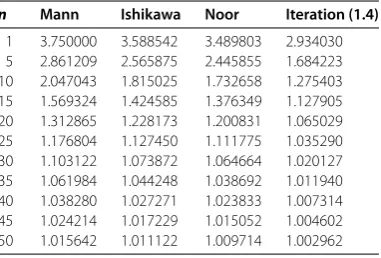
Table 1 Comparison of rate of convergence of the Mann, Ishikawa, Noor and iteration (1.4) for the given function in Example 1
n Mann Ishikawa Noor Iteration (1.4)
1 3.750000 3.588542 3.489803 2.934030 5 2.861209 2.565875 2.445855 1.684223 10 2.047043 1.815025 1.732658 1.275403 15 1.569324 1.424585 1.376349 1.127905 20 1.312865 1.228173 1.200831 1.065029 25 1.176804 1.127450 1.111775 1.035290 30 1.103122 1.073872 1.064664 1.020127 35 1.061984 1.044248 1.038692 1.011940 40 1.038280 1.027271 1.023833 1.007314 45 1.024214 1.017229 1.015052 1.004602 50 1.015642 1.011122 1.009714 1.002962
Example Letf : [, ]→[, ] be defined byf(x) = x+. Thenf is a continuous and nondecreasing mapping with a fixed pointp= . Use the initial pointx= and control conditionan=bn=cn=βn=n+ andαn=n.+.
Remark From the example above, we see that the iteration (.) is better than the Mann, Ishikawa and Noor iterations under the same control conditions (see Table ).
4 Convergence theorems for modified iteration methods
Now, we give a convergence theorem for continuous mappings on an arbitrary interval by using the following modified iteration method defined by Suantai [].
⎧ ⎪ ⎪ ⎨ ⎪ ⎪ ⎩
zn= ( –an)xn+anfn(xn),
yn= ( –bn–cn)xn+bnfn(zn) +cnfn(xn),
xn+= ( –αn–βn)xn+αnfn(yn) +βnfn(zn)
(.)
for alln≥, where{αn}∞n=,{βn}∞n=,{an}∞n=,{bn}n∞=and{cn}∞n=are sequences in [, ] and fn=f◦f◦· · ·◦f. Also, it is an open problem whether it is possible to prove the convergence theorem of a finite family of continuous mappings on an arbitrary interval by using the iteration methods in this paper.
Theorem Let E be a closed interval on the real line and let f :E→E be an injective and continuous mapping.If the sequence{xn}∞n=satisfying the conditions of Theoremis bounded,then it converges to a fixed point of f.
Proof Suppose that{xn}∞n=is not convergent. Leta=lim infn→∞xnandb=lim supn→∞xn. Thena<b. Next, we show that
ifm∈(a,b), thenf(m) =m.
To show this, suppose thatf(m)=mfor somem∈(a,b). Becausef is an injective map-ping,
Without loss of generality, we suppose thatfn(m) –m> . From the continuity off, we know thatfnis a continuous function. So, there existsδ, <δ<b–a, such that
fn(x) –x> for|x–m| ≤δ.
If we use a similar method as the proof of Theorem , the proof of this theorem follows. That is,{xn}∞n=converges to a fixed point off.
The following three corollaries follow from Theorem .
Corollary Let E be a closed interval on the real line and let f :E→E be an injective and continuous mapping.For x∈E,let{xn}∞n=be the sequence defined by
⎧ ⎪ ⎪ ⎨ ⎪ ⎪ ⎩
zn= ( –an)xn+anfn(xn),
yn= ( –bn)xn+bnfn(zn),
xn+= ( –αn)xn+αnfn(yn).
If the sequence{xn}∞n=satisfying the conditions of Corollaryis bounded,then it converges to a fixed point of f.
Proof If we takecn=βn= for alln≥ in Theorem , we obtain the desired result.
Corollary Let E be a closed interval on the real line and let f :E→E be an injective and continuous mapping.For x∈E,let{xn}∞n=be a sequence defined by
⎧ ⎨ ⎩
yn= ( –bn)xn+bnfn(xn),
xn+= ( –αn)xn+αnfn(yn).
If the sequence{xn}∞n=satisfying the conditions of Corollaryis bounded,then it con-verges to a fixed point of f.
Proof It follows directly from Theorem by settingan=cn=βn= for alln≥.
Corollary Let E be a closed interval on the real line and let f:E→E be an injective and continuous mapping.For x∈E,let{xn}∞n=be a sequence defined by
xn+= ( –αn)xn+αnfn(xn).
If the sequence{xn}∞n=satisfying the conditions of Corollaryis bounded,then it con-verges to a fixed point of f.
Proof By puttingan=bn=cn=βn= for alln≥ in Theorem , we obtain the desired
result.
Competing interests
Authors’ contributions
All authors read and approved the final manuscript.
Acknowledgements
Dedicated to Professor Hari M Srivastava.
Received: 13 November 2012 Accepted: 22 April 2013 Published: 13 May 2013
References
1. Mann, WR: Mean value methods in iteration. Proc. Am. Math. Soc.4, 506-510 (1953) 2. Ishikawa, S: Fixed points by a new iteration method. Proc. Am. Math. Soc.44, 147-150 (1974)
3. Noor, MA: New approximation schemes for general variational inequalities. J. Math. Anal. Appl.251, 217-229 (2000) 4. Rhoades, BE: Comments on two fixed point iteration methods. J. Math. Anal. Appl.56, 741-750 (1976)
5. Borwein, D, Borwein, J: Fixed point iterations for real functions. J. Math. Anal. Appl.157, 112-126 (1991) 6. Qing, Y, Qihou, L: The necessary and sufficient condition for the convergence of Ishikawa iteration on an arbitrary
interval. J. Math. Anal. Appl.323, 1383-1386 (2006)
7. Phuengrattana, W, Suantai, S: On the rate of convergence of Mann, Ishikawa, Noor and SP-iterations for continuous functions on an arbitrary interval. J. Comput. Appl. Math.235, 3006-3014 (2011)
8. Thianwan, S, Suantai, S: Convergence criteria of a new three-step iteration with errors for nonexpansive nonself-mappings. Comput. Math. Appl.52, 1107-1118 (2006)
9. Suantai, S: Weak and strong convergence criteria of Noor iterations for asymptotically nonexpansive mappings. J. Math. Anal. Appl.311, 506-517 (2005)
doi:10.1186/1687-1812-2013-124