Reprinted from the Soil Science Society of America Journal Volume 63, no. 5, Sept.-Oct. 1999
677 South Segoe Rd., Madison, WI 53711 USA
Reservations Regarding the Soil Quality Concept'
R. E. Sojka* and D. R. Upchurch
ABSTRACT
We consider the appropriateness of institutionalizing soil quality as a defined parameter in soil science. The soil management research of land grant universities and the Agricultural Research Service (ARS) and the mission and goals of state, federal, and private conservation agencies stand to be significantly affected. We feel that a non-advoca-live examination of this concept could provide a positive contribution. The definition of soil quality has proven elusive and value laden. There is concern by some that the concept has developed arbitrary policy overtones. Our reservations stem from concerns regarding pre-mature acceptance and institutionalization of an incompletely formu-lated and largely untested paradigm, potential unintended negative outcomes, promotion of a narrowly defined environmental policy in a context normally associated with value-neutral science, and taxonomic andlor regional bias in establishing the paradigm. To date, soil quality assessments have drawn from a relatively narrow crop production and ecological perspective to positively or negatively weight soil quality assessment factors. Although the soil quality paradigm acknowledges multi-defined soil functions, it has yet to operationally recognize and integrate the simultaneity of diverse and often conflicting functions and soil property requirements. Thus, we are attempting to articulate the concerns of many of our colleagues who are reluctant to endorse redefining the soil science paradigm away from the value-neutral tradition of edaphology and specific problem solving to a paradigm based on variable, and often subjective societal perceptions of environ-mental holism. Traditionally, it has been the soil science profession's role to perform the science to enable resource management policy and problem solving, not to establish relational-based value systems within the science. We suggest emphasizing quality soil management rather than soil quality management as a professional and scientific goal.
T
HE SOIL SCIENCE SOCIETY OF AMERICA (SSSA) has provided several written forums promoting the soil R.E. Sojka, USDA-ARS Northwest Irrigation and Soils Research Laboratory, Kimberly, ID 83341-5076; D.R. Upchurch, Cropping Sys-tems Research Laboratory, 3810 Fourth St., Lubbock, TX 79415. Received 26 Feb. 1999. *Corresponding author (sojka®kimberly.ars. pn.usbr.gov).
Published in Soil Sci. Soc. Am. J. 63:1039-1054 (1999).
quality concept (Allan et al., 1995; Doran et al., 1994; Doran and Jones, 1996; Karlen et al., 1997). These and several non-SSSA publications have described a soil quality paradigm to assess the condition and sustainabil-ity of soil and to guide soil research and conservation policy. No comprehensive critical examination of the scientific basis of the concept or the paradigm shift's ramifications has been published.
There can be no argument with the high goals of improving our ability to assess soil condition and pro-mote sustainability. However, many soil scientists fear that in the emerging soil quality paradigm, those high goals have led to advocating a value system as an end unto itself, supplanting otherwise value-neutral science and prematurely accepting interpretations and asser-tions of soil quality before the concept has been thor-oughly and analytically challenged. Indexing of soil properties for specific outcomes is not new. In the past, however, the scope of the indices were limited and spe-cific. Soil quality indexing, while perhaps originally fo-cused on indexing and optimization of limited collec-tions of specific attributes, has evolved to assessment of highly generalized, sometimes unspecific overall worth, value, or condition of soil. This approach risks certain pitfalls. As Lackey (1998a) noted, "quality" of managed natural systems is not an objective scientific attribute. Such quality definitions are contextual, subjective, value laden, outcome driven, and infinite in possibilities. While individuals (especially non-scientists) assessing soil quality may be familiar with the assessment parame-In 1994 the Soil Science Society of America established ad hoc Committee S-581 to define and describe the emerging soil quality concept. Committee members solicited the SSSAJ Editor for an op-portunity to present their views in a guest editorial for the express purpose of addressing what they acknowledged was a contentious and emotionally charged issue. Because of the solitary perspective presented by the conunittee in its editorial (SSSA) 61:4-10), the SSSA Editor-in-Chief and SSSAJ Editor recognized a need for and solicited an alternative comment. This paper is that invited response, and is written in the spirit of scientific discourse called for in the 1997 edi-torial.
1040 SOIL SCI. SOC. AM. J., VOL, 63, SEPTEMBER-OCTOBER 1999
ters being measured, they often do not know the value
judgements that were used or excluded in selecting or
interpreting the parameters. Index scores are the only outcome delivered to most users, who often do not have the expertise to evaluate the validity of the indexing process relative to their own needs or values. Singer and Ewing (2000) stated:
Useful evaluation of soil quality requires agreement about why soil quality is important, how it is defined, how it should be measured, and how to respond to measurements with management, restoration, or conservation practices. Be-cause determining soil quality requires one or more value judgments and because we have much to learn about soil, these issues are not easily addressed.
In other words, assessing soil quality must balance a combination of value judgments, much like the ecologi-cal concept of multiple-use management. This implies that no unique true or correct soil quality determination can be arrived at strictly from scientific principles. In-deed, agreement on a definition this complex, with the diversity of values among special interests and affected stakeholders, is unlikely.
These formidable barriers notwithstanding, a key fo-cus of soil quality essays and research has been develop-ment of soil quality assessdevelop-ment tools (Larson and Pierce, 1991, 1994; Pierce and Larson, 1993; Anonymous, 1996a; Arshad and Coen, 1992; Romig et al., 1995; Granatstein and Bezdicek, 1992; Gregorich et al., 1994; Warkentin, 1995; Liebig et al., 1996; Hortensius and Welling, 1996; Doran and Parkin, 1994; Halvorson et al., 1996; Turco et al., 1994; Harris et al., 1996; Sinclair et al., 1996). Most of these assessment tools stem from and are based on attempts to define parameters and functions linking crop performance with soil properties. Some include non-production empirical factors related to micro- and meso-faunal and -floral ecology and function. Some are based to varying degrees on non-empirical perceptions. As with many modeling efforts, the most comprehensive and science-based indices may be too complex to be practical at reasonable cost or timeliness, while some are too simplistic to be scientifically defensible. A major concern, however, is that none objectively and simulta-neously consider both the potential positive and nega-tive outcomes of all the indicators employed for all three major considerations of soil management—production, sustainability, and environmental impact (Sojka and Upchurch, 1999). Typically, only positive outcomes are recognized for certain touchstone parameters such as soil organic matter (SUM) contents and earthworm counts, and only negative outcomes for such parameters as salinity or compaction. These judgements are made largely on their relationship to crop productivity and microbial vigor. Each assessment index is not rigorously weighted separately and objectively for the simultane-ous and concomitant effects on production, sustainabil-ity, and environmental impact in the context of each specific farming (or other land management) system's constraints. What has emerged is a soil quality paradigm that conforms to a narrow vision of an ideal, and some would even argue politically correct soil.
In the last decade, there has been a gradual evolution of the soil quality concept. Karlen et al. (1990) at-tempted to identify the specific soil properties within identical soil mapping units that were responsible for yield variation in an otherwise uniformly treated corn
(Zea mays) crop. In broadening the goals to the
defini-tion of soil quality, the limited linkage to explaining crop performance ostensibly became less central to the concept. Larson and Pierce (1991) stated "In the past, Q [soil quality] has been defined in terms of productivity. However, 0 is not limited to productivity and such a limited view of soil quality does not serve us well in addressing current problems." Thus, they suggested de-linking the•concept of soil quality from productivity with the rationale that "...productivity is determined by the efficiency in the use and management of resource in-puts", whereas, they postulated that soil quality is re-lated to a set of intrinsic soil properties. Further, they suggested establishing a set of standards for evaluating soil. Pierce and Larson (1993) suggested that the intu-itive concept of soil quality be formalized and they iden-tified efforts then under way (Larson and Pierce, 1992; USDA, 1992). They described (but did not specifically attempt) the use of mathematical functions involving .minimum data sets and pedotransfer functions, applying statistical concepts from quality control theory to evalu-ation of soil quality.
Science strives to eliminate any doubt as to the facts determined. Interpretation of facts, setting goals, and establishing environmental indices are matters of policy or belief systems, with inherent capacity for ambiguity, confusion, disagreement, and even hostility (Lackey, 1998a,b; Zeide, 1998a,b; Callicott, 1998). Referring to communication dilemmas associated with the soil qual-ity lexicon, Karlen et al. (1997) stated: "...what would seem to be a relatively simple choice of words, can result in very different messages when delivered to our clients." Some key words in the soil quality vocabulary bear heavy burdens of multiple meaning. Quality can
mean degree of excellence, as in the conformance to a
SOJKA & UPCHURCH: RESERVATIONS REGARDING THE SOIL QUALITY CONCEPT 1041 Traditional soil assessments for crop production have
always striven for clarity of interpretation and applica-bility. Karlen et al. (1997) proposed tying soil quality evaluation to the relational non-absolute environmental philosophy of Aldo Leopold. The logic, ethical consis-tency, and scientific credibility of Leopold's "Land Ethic" were critically examined by Zeide (1998a), who raised significant questions as to the term's technical validity and appropriateness as a cornerstone for soil science—a discipline in which Leopold, a forester and game manager, had little actual expertise. Perhaps more importantly, contrary to the premise of Karlen et
al.
(1997), we do not believe that most soil scientists fail to assign adequate intrinsic value to soil, nor do we believe that they feel any less of a "special relationship with the earth" than "naturalists". Rather, it is because of the soil science community's general high regard for the soil resource that assigning "low quality" ratings to broad categories of soil is disturbing to many soil scientists. Moreover, this aspect, as noted by Karlen et al. (1997), underscores the evolution of the term soil quality away from objective and empirical quantifica-tion of "soil attributes" as suggested by Larson and Pierce (1991) and Pierce and Larson (1993), toward a subjective (cultural, etc.) designation of value per se. This evolution is troubling because it injects an emo-tional aspect to the soil quality debate by pitting the vast possible range of conflicting personal, cultural, in-stitutional, and economic value systems against one an-other. While this evolution is surely not the intent of scientists researching soil quality, the concept, unfortu-nately, attracts many adherents who cling specifically to such subjective interpretations. Therefore, we have reservations about institutionalizing soil quality. We are apprehensive of burdening soil science with ambiguous deviations from established, clear, objective, scientific principles of edaphology aimed at problem solving. We address these concerns: definitions, conceptual contra-dictions and dysfunctions, regional or taxonomic bias, advocacy and plausible ramifications, unintended out-comes, and premature institutionalization.Definitions
The terms air quality and water quality are ingrained in the scientific community, general public, and environ-mental regulatory bureaucracy. Soil quality might seem a logical ecosystem concept extension. Indeed, the Eu-ropean soil quality literature has emphasized establish-ing limits on measurable pollution (Howard, 1993; Bouma, 1997; Hortensius and Welling, 1996). However, with minor exceptions, quality in the context of air or water, implies analysis of specific pollutants below set concentration thresholds. With limited exceptions, the standard is the pure state. Air and water quality assess-ments do not attempt to specify a complex integration of static and functionally dynamic chemical, physical, biological and ecological factors defining an ideal state for an infinite number of environmental or management scenarios. We do not attempt to define air quality in terms of species diversity of airborne pollens, molds,
bacteria, viruses, seeds, flying insects, birds etc. or their metabolic processes representative of a healthy or natu-ral air mass. Nor do we attempt to stipulate air quality for every conceivable use of air, such as microwave transmission, jet traffic, combustion, tire inflation etc. Rather, air and water quality are defined almost entirely in terms of restricting negative impacts of a finite num-ber of biological, physical, and chemical pollutants in a limited number of specific environmental scenarios.
Sims et al. (1997) proposed a nonpolluted soil crite-rion for soil quality that they referred to as the "clean" state of soil. However, for other than a discrete list of xenobiotic substances, pure soil cannot be defined. Soil accumulates both naturally occurring and anthropo-genic toxic substances. Indeed, naturally occurring tox-ins and heavy metals are common at detectable levels in soils and parent materials.
One of many uses and roles of soil is its function as a filter. Soils can sequester large amounts of pollutants before threatening biological organisms or the healthi-ness of food (Cook and Hendershot, 1996; Oliver, 1997). High soil quality as a filter media requires sink capacity for toxins, i.e., the ability to be unclean. Alternately, making a soil unclean by adding toxic herbicides and pesticides improves soil quality for crop production by suppressing target organisms while raising pollutant concentrations.
The conundrum of clean vs. unclean soil underscores the incompatibility of soil quality with the water and air quality paradigm. There is, after all, no all-encom-passing pedologic cycle comparable to the hydrologic cycle or the 02–CO2 cycle, that regularly distills and replenishes soil in its entirety to a unique, pristine state. Thus, ultimately, there is little if any parallel between air or water quality and soil quality.
An early definition of soil quality, was offered by Larson and Pierce (1991), "Soil quality (Q) can thus be defined as the state of existence of soil relative to a standard, or in terms of a degree of excellence." SSSA ad hoc committee S-581 said of soil quality:
By encompassing productivity, environmental quality, and health as major functions of soil, this definition requires that values be placed on specific soil functions as they relate to the overall sustainability of alternate land-use decisions. Although unstated, the definition presumes that soil quality can be expressed by a unique set of characteristics for every kind of soil. It recognizes the diversity among soils, and that a soil that has excellent quality for one function or product can have very poor quality for another (Allan et al., 1995).
With institutionalization through the establishment of the Natural Resources Conservation Service Soil Quality Institute, a new and difficult dimension was added to the definition of soil quality. Mausbach and Tugel (1995) defined soil quality and soil condition sepa-rately, as follows.
1042 SOIL SCI. SOC. AM. J., VOL. 63, SEPTEMBER-OCTOBER 1999 maintain or enhance water and air quality, and
sup-port human health and habitation.
Soil Condition (Health)—is the ability of the soil to
perform according to its potential. Soil condition changes over time due to human use and management or to unusual natural events.
The imprecise meaning of the phrase "natural or man-aged ecosystem boundaries" coupled with the last sen-tence defining "condition" seems to contradict earlier stated rationales of using soil quality assessment per se to determine soil status at a point in time along its relative scale of potential function. Separation of the concepts sets up the potential use of soil quality indices to rate intrinsic value of regions or taxonomies.
Thus, soil quality must be defined in terms of distinct management and environmental considerations specific to one soil, under explicit circumstances for a given use. The considerations include social, economic, biological, and other value judgments. Aside from obvious poten-tial for disagreement on these management determi-nants, as many as 20 000 soil series occur in the USA. Multiplying by the number of crop or non-crop uses, crop species and cultivars, cropping systems, manage-ment, climate, and resource availability factors raises the needed total of specific soil quality indexes to an astronomic number. Furthermore, soil performs several functions simultaneously, not several functions sepa-rately. Only a difficult mixture of scientific and non-scientific judgements could decide the balance of func-tions needed to score soil quality or properly weight conflicting simultaneous functions. Multiplicity of defi-nition and simultaneity of function is exacerbated by spatial variability, another incompletely understood fac-tor, whose quantification and interpretation are not completely developed or agreed upon and which are made more enigmatic in the dynamic complexity of soil quality (Parkin, 1993; Stenberg, 1998).
The soil quality literature repeatedly emphasizes the need for indexing to encompass the diversity of soil function (Larson and Pierce, 1991; Pierce and Larson, 1993; Allen et al., 1995; Soil Survey Staff, 1996). Yet, the indices formulated to date are narrow in scope, mainly emphasizing soil factors related to plant growth and crop productivity (Sinclair et al., 1996). Soil micro-and meso-biological vigor are also heavily emphasized. Realistically, this is probably appropriate, despite con-tradicting the stated vision, since, after all, the over-whelming direct emphasis of global land management is for a narrow purpose: plant growth, be that range, forest, crops or habitat—with increasing consideration of sustainability and environmental impacts. It would greatly help focus the debate if soil quality paradigm proponents would concede that little soil property man-agement (globally) has, or will ever have, as a primary goal any other focus. Engineering uses of soil rarely consider soil biological properties outside of filtration uses of soil, and the rank and file engineering commu-nity is largely unconcerned with and all but oblivious to the soil quality polemic (an exception is an activity
of the International Standards Organization—addressed below).
Even in the productivity context, we feel quality (sin-gular) is undefinable for complex systems as diverse as soils. Anything that is infinitely defined is, ultimately,
undefined and undefinable. This principle of logic
ap-plies to soil quality, which is only definable in an infi-nitely branching tree of scenarios. Consider the follow-ing.
1. The definition must change for the same land and same use depending on weather—e.g., flood, drought, wind, heat, cold, etc.
2. The definition must change depending on the skill of each farmer. Some farmers consistently over or under apply inputs, improperly match tillage tools or tractors with production needs, ill time field operations etc. A manager's decision may be an error on one soil but less damaging or even benefi-cial on another.
3. The definition must change for every crop and cropping system, for every pest, etc., since the sys-tematics for each scenario alter the definition. Gersmehl and Brown's work (1990) underscored the problem of relational definitions. They tried to relate large integrated yield data bases of specific crops to each other. They segregated the data by soil mapping units to allow interchangeable predictions of crop per-formance for a given soil classification. In Union County, IA, soybean [Glycine max (L.) Merr.] yield easily predicted corn yield across taxonomies (R2 > 0.9). However, in Dillon County, SC, soybean yields were unrelated to cotton (Gossypium hirsutum L.) yields. One can assume that average soil quality varied ran-domly among data pairs for either county. The pre-dictive capability of crop response was affected more by the unique needs of specific crops than by the range of soil properties encountered within each soil taxa. It is hard to conceive of score cards, conceptual assessment frameworks, test kits, aroma, and quality pamphlets bet-ter assessing soil quality if another well-suited rotation crop cannot provide adequate prediction.
"There-SOJKA & UPCHURCH: RESERVATIONS REGARDING THE SOIL. QUALITY CONCEPT 1043 fore, ISOITC 190 established various subcommittees to
cover all aspects of soil quality [emphasis added]." The attempts to define soil quality to date are at odds with the evolution of the modern U.S. comprehensive Soil Taxonomy (Soil Survey Staff, 1975). Its fundamen-tal advancement was the movement away from interpre-tation of how classifiers thought a soil ought to be to simply describing what was found. To emphasize the non-judgmentalism of the new Soil Taxonomy, it's au-thors stated:
This was a revolutionary concept. The soil scientist did not need to depend wholly on inferences from the underlying rocks, the climate, or other environmental factors, consid-ered singly or collectively; rather, he could go directly to the soil itself and see the integrated expression of all these in its morphology.
Soil quality evaluation employs a variety of empirical and subjective measurements and perceptions from test kits, score cards, aroma etc. to make a subjective estimate of how well soil attributes and dynamics match those presumed to be the potential for that soil. This must not be dismissed as analogous to a variety of other land use classification schemes (Singer and Ewing, 2000). The evaluation is not based on a highly specific determina-tion of suitability for a single intended use--e.g., as in the case of a nutrient analysis for soybean vs rice (Oryza sativa L.). Unlike traditional soil tests, the assessments rely greatly on highly dynamic properties that may not still exist at the previously measured rate when the soil must actually perform that function (e.g., soil respiration rate). Furthermore, few if any soil quality assessment indicators have reliably quantified calibrations capable of predicting actual outcomes for the full range of possi-ble soil functions, particularly crop performance. These problems were recognized by Wagenet and Hutson (1997). They were optimistic of producing management decision aids for soil quality improvement through dy-namic process modeling. This may point toward promis-ing research of an academic interest for some soil scien-tists. However, the difficulty, time, and cost of providing sufficient assessment inputs, needed for meaningful site-specific soil quality management recommendations, does not appear achievable for practical, affordable, and timely use by farmers. Furthermore, optimizing crop (and forest, range, or habitat) production remains a concomitant need to the goal of soil quality improve-ment. While correlations and calibrations exist for input prescriptions for crop production based on soil test re-sults, virtually no such precise predictive management recommendations exist for prescribed improvements in soil quality. By contrast with traditional edaphic man-agement for crop production, a farmer usually has a clear decision path to follow, guided by quantifiable cost and income parameters, lacking with soil quality considerations in the absence of regulatory incentives or disincentives. The inability to prescribe specific man-agement measures to achieve desired soil quality index outcomes was recently underscored by a 20-yr manage-ment comparison conducted by Waldon et al. (1998) who concluded "Efforts to change whole soil ecosystems
to achieve an arbitrary standard may not be practical or economically possible."
Conceptual Contradictions and Dysfunctions
Despite suggestions for rigorous approaches to soil attribute quantification (Larson and Pierce, 1991; Pierce and Larson, 1993), soil quality assessment has gravi-tated, instead, to use of subjective perceptions, and un-quantifiable, even unresearched "measurements"—e.g., aroma (Romig et al., 1995; Anonymous, 1996b). Several important soil quality index components project out-comes based on a limited conceptual base, principally associated with Mollisols or close taxons such as Alfisols. This bias has led to maxims that, while environmentally popular, do not adequately recognize negative conse-quences of some aspects of the paradigm. Examples follow.
Certainly, SOM provides many benefits; however, it can also have negative environmental and crop produc-tion impacts. These negative impacts are rarely consid-ered or significantly weighted in soil quality assessments. Consideration of negatives related to SOM content has not appeared in any soil quality promotional materials (Anonymous, 1996a,b,c,d, 1997b, 1998a,b,c).
Increasing SOM content increases the application re-quirements of many soil-incorporated pesticides (Ste-venson, 1972; Ross and Lembi, 1985; Anonymous, 1997a; Gaston et al., 1997). As SOM increases from about the 1 to 3% range to the 3 to 5% range, soil incorporated pesticide application rates needed for effi-cacy commonly rise 20 to 100%. Soil sample clay frac-tions with 11% SOM, had 68% of the atrazine sorption affinity in the organic fraction (Laird et al., 1992; 1994; Barriuso et al., 1994). Clancy (1986) and Hallberg (1987) noted that increased use of synthetic insecticides, fungi-cides and herbifungi-cides increases the probability of people being exposed to toxic hazards. Economics of crop pro-duction, environmental quality, and human exposure to pesticides are all negatively affected by the increased pesticide loading and human exposure necessitated by higher SOM.
1044 SOIL SCI. SOC. AM. d., VOL. 63. SEPTEMBER—OCTOBER 1999 High SOM and manure were linked to greater P
solu-bility (Robinson and Sharpley, 1995; Meek et al., 1974, 1979, 1982; Sharpley and Smith, 1995). This facilitates loss to groundwater, as well as surface waters fed by runoff or springs (Beauchemin et al., 1998; Heckrath et al., 1995; Stamm et al., 1998).
Organic matter darkens soils. Summer soil tempera-ture is higher in darker soils. This benefits crop emer-gence and early growth in temperate regions. Higher midseason soil temperature, however, is detrimental to production and quality of many field and vegetable crops, especially in hot climates.
Few, if any, studies have explored the potential nega-tive role of SOM in environmental or on-farm soil man-agement. For example, does higher SOM content in-crease weed seed viability or seed bank size? Both are plausible hypotheses, given the effects of SOM level on efficacy of soil incorporated herbicides. Colonization and performance of vesicular arbuscular mycorrhiza have been increased by addition of manure or green manure on low organic matter soils, but suppressed by additions to,soils with moderate to high SOM contents (Ellis et al., 1992; Baltruschat and Dehne, 1988; Harini-kumar and Bagyaraj, 1989; Brechelt, 1987, 1989; Lam-bert and Weidensaul, 1991). What negative weighting should be assigned to SOM for its role in THM (trihalo-methane) contamination of chlorinated drinking water sources (Milnear and Amy, 1996)? Higher SOM has numerous benefits for plant growth, but responsible sci-ence requires that these be assessed against known envi-ronmental and production negatives.
The soil quality paradigm also affords great positive weight to earthworms. They too can greatly benefit crop production. However, they also produce negative ef-fects, acknowledged by a few researchers, but ignored by most. Earthworm burrows increase bypass flow and rapid movement of surface-applied contaminants to groundwater (Cohen, 1997; Edwards et al., 1989, 1992, 1993; Ehlers, 1975; Hall et al., 1989, 1991; Isensee et al., 1990; Tyler and Thomas, 1977; Shipitalo et al., 1994; Steenhuis et al., 1990; Trojan and Linden, 1992; Zach-mann et al., 1987; ZachZach-mann and Linden, 1989). In rainfed agriculture, earthworms help reduce runoff and erosion. In furrow irrigation, however, they cause a seri-ous water management problem that irrigators call backing up—a sudden infiltration increase as earth-worms surface to escape flooding. The result is severe nonuniformity of water application, affecting leaching, fertility, and crop water stress (Kemper et al., 1987; Trout et al., 1987; Trout and Johnson, 1989).
When earthworms digest organic-matter-rich soil the solubility of plant nutrients increases. While this can benefit crops, it can also contribute to runoff water quality degradation (Sharpley and Syers, 1976, 1977; Broussard et al., 1996). Earthworms also stimulate and accelerate soil nitrogen mineralization (Parkin and Berry, 1994). Earthworm activity increased extractable nitrate N in field and soil core studies (Blair et al., 1996; Willems et al., 1996). Their role in stimulating and accelerating mineralization of various N forms to nitrate, coupled with their role in macropore creation,
is an obvious dichotomy in the ecological and soil quality value of earthworms related to groundwater nitrate management. Earthworm activity contributes to the need to use nitrification inhibitors for N conservation and groundwater protection (more use and human ex-posure to agrichemicals—and increased costs). Ironi-cally, earthworm populations are higher on more fertile, higher SOM content soils. Thus, the negative environ-mental impacts related to nutrient solubilization are greatest where existing indices credit them most for their contribution to soil quality.
Earthworms are vectors of soil-borne plant diseases (Edwards and Lofty, 1977; Hampson and Coombes, 1989; Hoffman and Purdy, 1964; Khambata and Bhat, 1957; Thcirnton, 1970; Toyota and Kimura, 1994; Maria-ligati, 1979; Hutchinson and Kamel, 1956). This vec-toring is direct at short range, via ingestion in and through the gut followed by supra- and/or sub-terranean transport, and indirect over long range, via birds feeding upon and dropping earthworms and earthworm frag-ments in flight.
Earthworm effects on soil properties are not always positive, varying with species and geographic adapta-tion. Bulk density increase and reduced porosity have resulted from earthworms (Alegre et al., 1996; Gilot, 1994; Rose and Wood, 1980). Shrader and Zhang (1997) measured lower stability of earthworm casts compared with non-digested aggregates. Earthworms reduced wa-ter retention and sorptivity, which impaired soil-plant water relations, increased crop water stress and reduced rice yield by 43% (Pashanasi et al., 1996). Earthworms provide numerous benefits for plant growth, but respon-sible science requires that these be assessed against known environmental and production negatives.
Compaction, is generally regarded as a negative attri-bute. However, again, it must be evaluated in terms of specific processes and contexts. Traffic lane soil compac-tion reduces wheel slippage and increases traccompac-tion, low-ering horsepower and weight requirements for tillage and other field operations, conserving fuel and reducing atmospheric CO2 emission. Seed germination and emer-gence generally improve with soil firming until compac-tion is excessive. Compaccompac-tion can also reduce bypass flow by restricting macropores (Starett et al., 1996).
SOJKA & UPCHURCH: RESERVATIONS REGARDING THE SOIL QUALITY CONCEPT 1045 Because the specific functions of most soil
microor-ganisms are unknown or poorly understood, it seems unreasonable to interpret increased microbial biomass and activity entirely as a positive indicator. Clearly, if specific microorganisms are pathogenic or otherwise deleterious to the crop, their contribution to community biomass and function must be weighed negatively. Mi-croorganisms can even exacerbate otherwise largely physically mediated phenomena. Lindqvist and Enfield (1992) found an 8-fold increase in DDT movement through sand when bacteria were present. In wet or flooded soils, partidularly upon incorporation of fresh organic matter, or coupled with high temperature, sur-face sealing, or compaction, microorganisms compete fiercely with roots of higher plants for remaining avail-able oxygen and accelerate the onset of soil hypoxia or anoxia. As redox potentials shift, facultative and obli-gate anaerobes can produce toxic metabolic byproducts that further impair crop performance or survivability.
Important microbially mediated soil quality indica-tors are highly spatially variable (Parkin, 1993). Soil respiration varies greatly in short time periods. Influenc-ing factors include soil disturbance, season, substrate introduction, forage mowing, temperature and soil wa-ter (and aeration) fluctuation, radiation shifts (solar/ UV), fumigation, agrichemical application, certain xe-nobiotics, and heavy metals (Bremer et al., 1998; Gra-hammer et al., 1991; Lloyd and Taylor, 1994; Fitter et al., 1994; Garcia and Rice, 1994). It is unclear which of these highly complex and transient states should be the benchmark condition for soil quality respiration assess-ment. Respiration status changes diametrically on rota-tion between soybean and rice, or before and after till-age, and with weather or a preceding crop's residue type and amount (Alvarez et al., 1995a,b; Reicosky et al., 1993). Such perturbations have always defied simple extrapolation of respiration to a general assessment of soil status and will not likely soon be better calibrated.
A major rationale for soil quality assessment and management is to ensure soil sustainability and ecologi-cal balance. Since SOM concentration is used as a prime indicator of soil quality and sustainability, high soil res-piration bears an element of self-contradiction as an index component. Global environmental research has sought for decades to sequester atmospheric CO 2. Also, overly valuing SUM encourages greater exploitation of soils having high potential for SOM oxidation and CO 2 release to the atmosphere.
Arid zone agriculturalists and irrigators recognize the double Catch 22 of an SUM-dominated perspective. Many low SOM irrigated soils that are moderately saline are routinely managed for high productivity (Sojka, 1996, 1998; Bucks et al., 1990). Certain low salinity, high SOM soils such as Natrustolls and other soils with natric horizons (formerly called Solonetzic soils) are nearly incapable of supporting higher plant life. The first insti-tutional use of a soil quality index devalued most U.S. arid-zone soils (Sinclair et al., 1996). Yet, on average, arid zone irrigated agriculture produces over twice the yield and three times the crop value per acre of rainfed agriculture (Kendall and Pimentel, 1994; Bucks et al.,
1990). The key is water management. Aggregate stabil-ity, porosstabil-ity, hydraulic conductivstabil-ity, and aeration of low SOM irrigated soils are negatively affected by distilled water but are improved if irrigation balances divalent cation delivery (adding calcium salts with irrigation wa-ter) and leaching (Rhoades, 1972, 1998). In fact, high yields can be achieved with only mineral salts and water and no soil (hydroponically). Salinity alone is an unrelia-ble productivity index without knowing the crop to be grown, the nature of the salinity (exchangeable sodium percentage—ESP, boron content, etc.) and the nature (sodium adsorption ratio—SAR and electrical conduc-tivity—EC), amount, timing and evaporation path of irrigation water (positional salt deposition on irrigated beds), and the leaching fraction. These management factors can govern the ability of salt-threatened soil to function more than intrinsic soil properties themselves (Rhoades, 1972, 1998).
Regional and Taxonomic Bias
The soil quality paradigm firmly links quality to in-creases in SOM content, aggregation, porosity, earth-worm populations and microbial biomass and activity (Anonymous, 1996a; Arshad and Coen, 1992; Romig et al., 1995; Granatstein and Bezdicek, 1992; Gregorich et al., 1994; Warkentin, 1995; Liebig et al., 1996; Hortensius and Welling, 1996; Karlen et al., 1997; Kennedy and Papendick, 1995; Doran and Parkin, 1994; Halvorson et al., 1996; Turco et al., 1994; Harris et at, 1996; Sinclair et a1.,1996). As these references and their cited research suggest, the tenets of the soil quality concept evolved from a predominately Mollisol-centric and temperate climate and cropping system outlook. While certainly unintended, negative political, economic, and conserva-tion consequences could result for physiographic areas not dominated by Mollisols or close taxons, such as Alfisols. Although many soil quality researchers stress specificity of soil quality evaluation, there is concern that this subtlety will be lost on untrained practitioners and policy makers using an index. No single soil para-digm or index is intended, or regarded by most soil quality researchers as appropriate, or feasible nation-ally. Yet, the soil quality literature has not been forth-coming in identifying the needed host of specific indices or specific regional criteria. Criteria published to date, as well as promotional literature, are strikingly similar, clearly adhering to a Mollisol-centric ideal. Even if suit-able individual indices emerge for the multitude of needs, we wonder with great concern, how non-scientists will know which indices are appropriate to which needs or what institutional framework could assure their ap-propriate designation and use. The fact is, soil quality definition has been institutionalized and applied nation-ally (Mausbach and Tugel, 1995; Sinclair et al., 1996).
SOIL SO. SOC. AM. J., VOL. 63, SEPTEMBER—OCTOBER 1999
•"111TP•5'!P
cispuwalgowl MO
weer p vines
•D •
—.00,1104 *NG: 1 IMP:2 1046
DOMINANT SOIL ORDERS
tom QuandtQuandt and Waltman (1997). Fig. 1. The dominant soil orders of the USA, adapted
• It
Wilitrnan, S.W. Waltman, Terpstra. and • Debra Reed-Marsetan. 1596. Solt itaangs kr Plane Geord.h. USDA-MRCS Nations; Soli Survey Cramer Uncoil. NE and • lovee State University Stiltigled Laboratory. Aviles. 1A
Merl Equal Arta Prowden
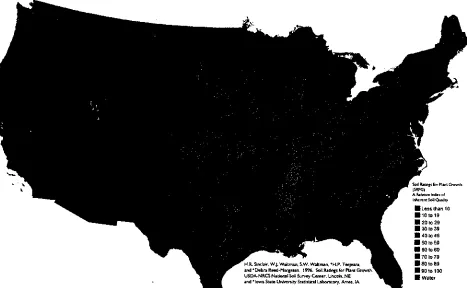
Fig. 2. A relative index of inherent soil quality for the USA, adapted from Sinclair et al. (1996).
far h
LSRPGI
A REF...eh/dem of
Irelenertr 501<itialirp
▪ Less than 10
▪ 10 to 19 U 20 to 29
nas to 39
II 40 to 45 ▪ to 59 e l 8059 58
▪ 70 to 79
• so to ag MIMI° 100
SOJKA & UPCHURCH: RESERVATIONS REGARD/NO THE SOIL QUALITY CONCEPT 1047 present the dominant soil orders of the USA (Fig. 1)
and the result of the Natural Resource Conservation Service's use of soil property data, crop performance and evaluator perceptions to model and map (Fig. 2) "a relative index of inherent soil quality" for the USA (Sinclair et al., 1996). The correspondence between locales with high soil quality rating and Mollisol- or Alfisol-dominated taxonomies is inescapably obvious. Conversely, the lowest soil quality ratings strongly cor-respond to the remaining soil orders. There are only isolated areas where Mollisols and Alfisols receive low soil quality ratings, largely confined to areas of low pre-cipitation.
If the paradigm's basis is not taxonomic, then perhaps, because the soil quality concept arose largely from Mid-western research, one might contemplate that the para-digm is based on an analysis of regional agricultural productivity. Midwestern farmers and scientists take great pride in their region's corn production. However, since 1980, county-wide average corn yields of Iowa, Nebraska, and Illinois have been erratic and 20 to 50% less than Washington state's steadily increasing yields (Fig. 3).
Readers might note that the Midwest has had several poor growing seasons since 1980 and that Washington corn is entirely irrigated. Management strategies and inputs reflect different production constraints, such as Midwestern fertilizer use reduction to reduce ground-water contamination. Disease and insects are less a fac-tor for corn production in the Columbia Basin than in the Midwest. Government programs, fertilizer taxes and production incentives apply differently to the areas. Ba-sically, yields are affected by many factors unrelated to soil quality. And that, of course, is our point. It is hard to reconcile a Mollisol-centric paradigm for soil quality when the productivity of Mollisols, for the crop perhaps best suited to its edaphic nature, is affected more by nonsoil factors than soil factors. The irony is deepened, given the disproportionate contribution of Iowa and Illinois to Gulf Hypoxia (Burkart and James, 1998).
Mollisols develop, in great part, as a response to tem-perature and soil water. The cold wet winter months of
14000
12000
.c 1
2
10000-a
ti >- 8000
0
6000
4000
1975 1980 1985 1990 1995
Year
Fig. 3. Statewide annual average corn yield. Data are from the USDA-National Agricultural Statistics Service public web site.
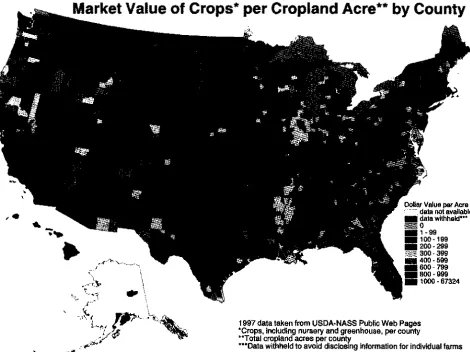
temperate climates promote accumulation of SOM. The cold winter (Mesic, Frigid, Boric) and wet (Udic) soil conditions also restrict temperate Mollisols to a growing season of only about 6 mo. Contrast a cold Mollisol to the hot Aridisols, Entisols, and Inceptisols of places like the California Imperial and Coachella Valleys or the Nile Valley of Egypt. A Mollisol-centric soil quality paradigm offers a poor conceptual framework for ex-plaining yield production of two or even three high-value crops per year on hyperthermic and often salt-affected arid-zone soils. Meek et al. (1982) showed that HoItville se (Typic Torrifluvents) in Brawley, CA, re-tained only a mean of 0.6% increase in SOM over the unamended 1.0% OM control, five years after a 3-yr accumulated application of 360 to 540 Mg/ha manure. The unreliability of soil quality for predicting one of the most important corollaries of soil and crop perfor-mance is evident in Fig. 2 and 4. There is a very poor correspondence between high soil quality rating (Fig. 2) and market value of crops per cropland acre (Fig. 4). Conversely, most of the highest market values per cropland acre correspond to some of the lowest rated soil quality regions. We should emphasize that the soil quality map uses a linear color scale; the market value of crops per cropland acre uses a scale of ascending incremental values for the higher value categories. Thus, the failure of the soil quality index to predict high mar-ket value is worse than immediately obvious from color distribution per se.
Advocacy vs. Science
Scientists, their professional societies, journals, and public infrastructure have a vested interest and responsi-bility in keeping science balanced, objective, challeng-ing, and even skeptical. Certainly, the motivation of scientists doing soil quality research is the advancement of soil science. Nonetheless, the validity of any scientific concept must ultimately survive the assessment of sci-ence at large. While we do not embrace the soil quality concept, we welcome its consideration in the literature as we would any concept. However, we have serious concerns that the soil quality paradigm has been institu-tionalized before core concepts have been thoroughly and objectively evaluated by the soil science community. We note that the often-cited SSSA ad hoc committee (Allan et al., 1995) and National Research Council (1993) statements on soil quality presented no dissenting arguments or alternative viewpoints. This unfortunate lack of balance seriously undermines the credibility of those statements, particularly given the acknowledged dissension surrounding this nascent paradigm in the soil science community (Karlen et al., 1997). Institutional policy is sometimes forced to ignore credible disagree-ment, but science should not.
Market Value of Crops* per Cropland Acre** by County
Qatar Value per Acre - data not available
N M data withheld"" 0
X1 - 99 ▪ 100 - 199 El 200 - 299
300 - 399
N g 400 - 599
▪ 600- 799
▪ 800 - 999
MI 7000 - 67324
1997 data taken from USDA-MASS Public Web Pages "Crops, including nursery and greenhouse, per county **Total cropland acres per county
"Data withheld to avoid disclosing Information for individual farms
1048 SOIL SCI. SOC. AM. 1., VOL. 63, SEPTEMBER-OCTOBER 1999
Fig. 4. Total crop dollar value per county divided by the acres planted in each U.S. county in 1997. Data are from the USDA-National Agricultural
Statistics Service public web site. 12.47 acre = 1.0 ha].
lived." Presumably the document did not intend to in-clude bones. shells, coral, or water, which all once lived, but none of which are included in analysis of SUM or soil organic carbon.
The same document states, "Well-decomposed or-ganic matter...has a pleasant, earthy smell." Romig et al. (1995) and Kennedy and Papendick (1995) implied that there is merit in the folk wisdom suggesting one can detect poor soil quality by the "off" or "sour chemical smell." There has been limited research into the aro-matic compounds that emanate from soil (Stahl and Parkin, 1996). However, the existing body of research falls tar short of validating serious consideration of aroma as a quantifiable evaluator of soil status or deter-miner of soil management. Research identifying com-pounds or concentration levels generating soil aroma are sparse, with insufficient correlation with soil proper-ties and human olfactory pleasure or discomfort to war-rant promoting aroma as a soil status indicator or man-agement decision aid. Lastly, we offer some quotes from Soil Quality-Agronomy Technical Note No. 4 (Anony-mous, 1997b), without comment, for our soil scientist colleagues to ponder: "In a healthy soil, nutrients be-come available when the plants need them." "Compac-tion... restricts the diffusion and flow of nutrients in the
soil." "... weed residue may not decompose and recycle plant nutrients for the subsequent crops."
Advocacy of high environmental goals is understand-able and even laudunderstand-able; however, taking an advocacy approach to soil quality has created confrontation rather than scientific consensus. There are several reasons for this. One is simply because, for many, the concept is not regarded as proven, yet it is already being institu-tionalized. At a technical level, in the soil quality para-digm, the structure of the index is determined by the value assumptions that make up the index. That is, qual-ity implies value assumptions—ones that are not univer-sal and that are being arbitrarily assigned by only one school of thought within a scientific discipline having diverse and eclectic perspectives. Soil quality assess-ment, in other words, is a distinct philosophical advocacy which represents itself as objective scientific analysis. Advocacy may have its place in public resource policy formulation, but not in the science drawn upon as a basis for decisions.
SOJKA & UPCHURCH: RESERVATIONS REGARDING THE SOIL QUALITY CONCEPT
1049
the presence and impact of pollution in soil? Is it that soil
science cannot otherwise identify or address resource
conservation or sustainability? Is soil quality meant to
become a classification or taxonomy adjunct? We fail
to see what new knowledge a soil quality index gives
or what problems soil quality indices identify that have
not already been identified via existing edaphology and
management concepts. Many scientists question how
the high investment in what they view as a redundant
technology and infrastructure benefits research and
so-lution of specific soils-related problems better than
tra-ditionally focused and targeted management research.
Lastly, what specific problems of farmers, the
environ-ment, or agribusiness are/were only solvable by a soil
quality paradigm?
Plausible Ramifications and Unintended Outcomes
SSSA president Lee Sommers (1998) itemized factors
that have led a large portion of SSSA membership to
consider seeking a new identity, separate from
agron-omy and crop science. A prominently cited factor was
desire for a stronger hard science identity—on a par
with physics, chemistry, or astronomy. Others have
com-mented in detail about this issue (Simonson, 1991;
Gard-ner, 1991; Greenland, 1991; White, 1993; Basher, 1997).
We are concerned that a soil assessment paradigm that
promotes kits, scorecards, perception surveys, and soil
smelling to guide global soil management and ecosystem
research and policy, risks diminishing the stature of soil
science in the scheme of science at large.
Soil science has expended great effort to develop
credible measures of soil properties and crop response
to evaluate fertilizers and soil amendments. The lack
of specificity of soil quality definition could encourage
promotion of
wonder products andquestionable
prac-tices touting claims of improved soil quality. Exploiters
need only point to the definition discrepancies in the
literature, making debunking of product or practice
claims more dfficult.
Once a paradigm is established that associates
supe-rior quality with a narrow soil taxonomic concept, it will
almost certainly have negative policy effects on
loca-tions dominated by "lesser" soil orders. A hint of
taxo-nomically based policy bias emerged in a 1995 editorial
entitled "Soil Quality: Goals for National Policy;" it
stated:
A
soil quality policy should focus attention on our highest quality lands; that is, on those /ands where we have the most to lose from soil degradation or where we have the most to gain from better soil (Cox, 1995).We cannot help wondering how non-scientist
politi-cians would interpret such a statement. Will a
congres-sionally or bureaucratically mandated national
Mollisol-centric soil quality paradigm recognize the two or three
crop-per-year advantage of irrigated Southwestern
hy-perthermic Aridisols, Entisols, and Inceptisols? Or what
of their two-fold yield advantage, or three-fold crop
value advantage? What impact will their interpretation
have on regional research and conservation funding?
There could be big winners and losers based on
taxo-nomically biased soil quality assessments. Figure 2 could
be the first step toward implementation of
taxonomi-cally biased policy.
Clearly, a significant thrust of the soil quality
move-ment is directed at bringing soil managemove-ment into the
environmental regulatory framework, both in the USA
and internationally. Beck et al. (1995) reviewed Dutch
and Canadian regulatory approaches and allowable
lim-its for various organic contaminants. Singer and Ewing
(2000) emphasized the strong environmental motivation
of the soil quality movement, stating: "Perhaps more
importantly, biological or ecological significance should
hold greater weight than statistical differences among
management systems." Haberern (1992) stated "...losses
of species at the far end of the chain, large,
warm-blooded animals, for example, are likely to be less
im-portant to the world's ecosystem than losses of those at
the start of the living chain, those found in the living
soil." He goes on to state that his proposed soil quality
index should be used to "...target more focused
agricul-tural research... [and] aid agriculagricul-tural scientists in
de-termining research goals." In listing what soil quality
policy should achieve, Cox, (1995) suggested the first
goal should be to "Establish soil-air-water quality
par-ity." Some may take this as a sign that soil science has
finally
arrived.But what are the implications? Will the
environmental objectives of the soil quality movement
have priority over production and profit? Will there be
mandatory soil testing for designated pollutants?
Willearthworms, soil microbes, or even soil-borne pests
come under scrutiny of the endangered species act
(Hagvar, 1998)?
It was further suggested that soil conservation should
shift focus from soil loss, as the primary benchmark of
mission accomplishment, to emphasis on the quality of
retained soil:
Soil management, that is, manipulation of the soil to achieve certain properties, infiltration, porosity, nutrient holding capacity, for example, should become an explicit objective of farm and ranch conservation plans rather than an indirect effect of erosion control Cox, (1995).
An interesting priority shift that is, perhaps,
appro-priate for deep resilient Midwestern soils. But what of
the fragile, yet more highly productive soils of other
regions, that measure epipedons in centimeters not
me-ters? Erosion aside, who will do and pay for the
monitor-ing? Who will judge compliance? How and at what
spa-tial scale will compliance be assessed? What will be the
consequences of degrading soil quality, and who will
determine or assign blame? More important
conceptu-ally, how will highly kaolinitic soils ever-attain adequate
"nutrient holding capacity" if soils dominated by 2:1
clays are the conceptual basis of regulation?
Readers who feel they could stand to gain from
good1050 SOIL SCI. SOC. AM. J., VOL. 63, SEPTEMBER-01,10BER 1499 in soil quality than a high quality soil that failed to
maintain an arbitrary standard.
These editorial quotes were likely meant as an en-dorsement of sustainability. However, if so, we ask again—what is the basis for a Mollisol-centric soil qual-ity paradigm? The Ultisols of the southeastern USA have been continuously farmed for 350 to 400 yr. Few U.S. Mollisols have been farmed longer than 150 yr-most barely 100 yr. Internationally, the ancient bread-baskets of civilization—Egypt, the Middle East, and China—have been farmed thousands of years; these are areas dominated by non-Mollisol soils.
The National Research Council (1993) discussed reg-ulatory enforcement of soil quality policy. "The Secre-tary of the U.S. Department of Agriculture (USDA), the Administrator of the Environmental Protection Agency (EPA), and the U.S. Congress should undertake a coordinated effort to identify regions or watersheds that should be highest priority for federal, state, and local programs to improve soil and water quality." And "The development and implementation of approved in-tegrated farming system plans should be the basis for delivery of education and technical assistance, should be the condition under which producers become eligible for financial assistance, and should be the basis for de-termining whether producers are complying with soil and water quality programs."
However, the NRC explicitly noted that freedom from oversight of these policies and programs might not be as simple as farmer non-participation, stating, "...policies are needed that target problem areas and problem farms, regardless of participation in federal commodity support programs." And, "Nonvoluntary approaches may be needed in problem areas where soil and water quality degradation is severe and where there are problem farms unacceptably slow in implementing improved farming systems." And, "The legal responsi-bilities of landowners and land users to manage land in ways that do not degrade soil and water quality should be clarified in state and federal laws." Such policies could make soil quality definition part of rural Ameri-ca's bitter property rights debate.
Conclusions
Soil science has struggled for over 200 yr to dispel the image of a second-class technology derived from folk wisdom and superstition. We are concerned that the ascendence of soil science to encompass crystallography, advanced physical and organic chemistry, biochemistry, numerical modeling, hydrology, artificial intelligence-based decision aids, remote sensing, global positioning, and geographical information systems, and more, is se-verely diminished by photos in our journals of farmers smelling a handful of soil, implying that this is the techni-cal legacy of 200 yr.
We caution against the premature institutionalizing of a concept for which there remains significant ques-tions and criticisms. Soil science cannot afford to deviate from the scientific method by assuming understanding that leads to policy implementation before completing objective research.
We are concerned that a single, affordable, workable, soil quality index is unattainable and that having individ-ual indices for all soils and circumstances is unachievably complex technically, and would be unthinkably confus-ing upon lay implementation. This is not to say that a task should be avoided because it is difficult, but rather that the more complex a concept, the greater the danger of popularizing or prematurely institutionalizing it.
There is undoubtedly merit in seeking to manage soil well, in terms of production potential, sustainability, and environmental impact. However, none of these goals require a reinvention of soil science, or replacement of the value-neutral reductionist scientific basis of eda-phology with an undefinable value-laden holism. We should be wary of a paradigm that is more committed to producing a passing score from a simplified battery of kit assays, than identifying (let alone solving) specific critical problems.
It is our experience that adept soil scientists or field practitioners of soil science have no difficulty identifying when a soil is in trouble. What they usually find pre-ciously scarce are focused insightful management solu-tions to what, all too often, are lamentably easily recog-nizable problems that have degraded soil productivity. It is a fundamental concept of agriculture that manage-ment per se can have more impact on a soil's ability to function than intrinsic soil properties per se. We feel that far more environmental and agricultural benefit will come from developing quality soil management ca-pability than institutionalizing soil quality management. Assessing and improving the quality of soil managers would likely have a far more immediate and profound affect on productivity, sustainability, and environmental impacts of soil management than decades of research on soil quality per se.
Our responsibility as scientists is not to attempt to establish the value system parameters that are accept-able for soil science. Our debate on this issue strongly parallels the acrimonious debates raging in all facets of ecosystem management. Soil, after all, is yet another identifiable multiple-use ecosystem. In agriculture, this also means a human-made ecosystem, since to manage in order to achieve any kind of natural soil ecosystem
health would require reforestation and resodding of
ev-ery hectare of America's farmland. In fact, this rationale cannot even be defended from a non-anthropogenic perspective, since, as Robert Lackey (1998) asked, "What is the natural state of Mount St. Helens?" Putting an emphasis on soil quality as opposed to our traditional science-based role of determining value-neutral param-eters undermines our credibility as scientists with activity better left to metaphysicians and politicians. Even if we could agree on a universal value system to rate and assess soil quality, it is a mistake to elevate soil quality to an over-arching good unto itself.
em-SOJKA & UPCHURCH: RESERVATIONS REGARDING THE SOIL QUALITY CONCEPT 1051 phasis of soil science and the primary rationalization
of a soil quality concept must be conceded to be the improvement of plant growth using environmentally re-sponsible technologies. Attempting to rationalize the weaknesses of a soil quality paradigm by saying quality will be tailored to all conceivable soil uses, belies both the entirety of the published body of soil quality re-search and the dominant focus of the soil science profes-sion. We reiterate that soil performs a multitude of functions
simultaneously.
If there is to be institutionalized soil quality assess-ment, it must employ soil- and utilization-specific indices and models that simultaneously account for all func-tions, properly weighting all inputs for all positive and all negative impacts of all productivity, sustainability, environmental, economic, social, strategic, and cultural components of the assessment. Physical, chemical, and biological index components should have zero reliance on subjective perceptions. Because of the potential im-pacts of this paradigm shift, program, policy, and regula-tory status of institutionalized soil quality assessment seems premature before it has been comprehensively developed and exhaustively tested under impartial and balanced scientific peer review.
Better, we feel, that understanding, rather than rating the soil resource, be the primary goal of soil science. And understanding it cannot be justified to society except in targeting our effort to understand toward solution of recognized problems and better management of soil for all uses, in spite of the system constraints faced by individual land managers. We are troubled that rating soil and debating rating indices can be perceived as legitimate research in a time of severely limited funding, when working
to
solve well-known problems affecting the soil resource and maximizing its productivity are inadequately supported.Within the life spans of our younger soil scientists, global agricultural production must rise more than 2% per year to meet rising population needs (Waggoner, 1994). This assumes we preserve most of our natural lands and provide our needs mainly from existing farm-land. By one estimate, more food must be grown by man in the first generation of the new millennium than was grown in the preceding 10 000 yr of fanning (Paarl-berg, 1994). The threat of all forms of soil degradation (impaired soil quality?) to meeting world production needs is non-existent on 77% of managed world soils (Crosson, 1997). Weighting Crosson's area estimates by impairment level, suggests that 95% of global soil pro-ductivity remains intact. He concluded that the chal-lenge in most urgent need of focused attention is contin-ued development of new technology to raise soil productivity and yields while minimizing negative envi-ronmental impacts.
We, as soil scientists, can already identify the major problems facing soil management. We know where ero-sion is. We know where compaction is. We understand the logic of minimizing dependence on chemicals while maximizing the environmental benefit of their use through efficiency gains. More often, we don't know the answers to the problems, or when we do, how to
enable their adoption. Preoccupation with diagnostics, definitions and trying to quantify something as illusive as soil quality does nothing to solve problems that are already clearly evident. Our children and grandchildren of 2030 will not care whether we crafted our definitions or diagnostics well. They will care if they are well fed, whether there are still woods to walk in and streams to splash in—in short, whether or not we helped solve their problems, especially given a 30-yr warning.
ACKNOWLEDGMENTS
The authors thank numerous contributors and several anon-ymous reviewers for critical reviews and/or for helpful ideas that sparked additional thinking. Many have been catalysts and critics of, and contributors to our thought processes in this endeavor.
REFERENCES
Alegre, J.C., B. Pashanasi, and P. Lavelle. 1996. Dynamics of soil physical properties in Amazonian agroecosystems inoculated with earthworms. Soil Sci. Soc. Am. J. 60:1522-1529.
Allan, D.L., D.C. Adriano, D.F. Bezdicek, R.G. Cline, D.C. Coleman, J.W. Doran, J. Haberern, R.G. Harris, A.S.R. Juo, M.J. Mausbach, G.A. Peterson, G.E. Schuman, M.J. Singer, and D.L. Karlen. 1995. SSSA statement on soil quality. p. 7. June, 1995. In Agronomy News, ASA, Madison, WI. '
Alvarez, R., O.J. Santanatoglia, P.E. Daniel, and R. Garcia. 1995a. Respiration and specific activity of soil microbial biomass under conventional and reduced tillage. Pesq. Agropec. Bras. 30:701-709. Alvarez, R., 0.J. Santanatoglia, and R. Garcia. 1995b. Effect of tem-perature on soil microbial biomass and its metabolic quotient in situ under different tillage systems. Biol. Fertil. Soils. 19:227-230. Anonymous. 1996a. Soil quality information sheet: Soil quality-intro-duction. National Soil Survey Center in cooperation with the Soil Quality Institute, NRCS, USDA, and the National Soil Tilth Lab, Agricultural Research Service, USDA.
Anonymous. 1996b. Soil Quality Information Sheet: Soil Quality Indi-cators: Organic matter. National Soil Survey Center in cooperation with the Soil Quality Institute, NRCS, USDA, and the National Soil Tilth Lab, Agricultural Research Service, USDA.
Anonymous. 1996c. Soil Quality Information Sheet: Soil Quality Indi-cators: Indicators for Soil Quality Evaluation. National Soil Survey Center in cooperation with the Soil Quality Institute, NRCS, USDA, and the National Soil Tilth Lab, Agricultural Research Service, USDA.
Anonymous. 1996d. Soil Quality Information Sheet: Soil Quality Indi-cators: Aggregate Stability. National Soil Survey Center in coopera-tion with the Soil Quality Institute, NRCS, USDA, and the Nacoopera-tional Soil Tilth Lab, Agricultural Research Service, USDA.
Anonymous. 1996e. Soil Quality Information Sheet: Soil Quality Indi-cators: Soil Crusts. National Soil Survey Center in cooperation with the Soil Quality Institute, NRCS, USDA, and the National Soil Tilth Lab, Agricultural Research Service, USDA.
Anonymous. 1996f. Soil Quality Resource Concerns: Soil Erosion. National Soil Survey Center in cooperation with the Soil Quality Institute, NRCS, USDA, and the National Soil Tilth Lab, Agricul-tural Research Service, USDA.
Anonymous. 1996g. Soil Quality Resource Concerns: Compaction. National Soil Survey Center in cooperation with the Soil Quality Institute, NRCS, USDA, and the National Soil Tilth Lab, Agricul-tural Research Service, USDA.
Anonymous. 1996h. Soil Quality Resource Concerns: Sediment Depo-sition on Cropland. National Soil Survey Center in cooperation with the Soil Quality Institute, NRCS, USDA, and the National Soil Tilth Lab, Agricultural Research Service, USDA.
Anonymous. 1997a. Crop protection reference, 13th edition. C & P Press, Inc., New York.