The Thirty-Third AAAI Conference on Artificial Intelligence (AAAI-19)
Walrasian Dynamics in Multi-Unit Markets
Simina Brˆanzei
Purdue UniversityAris Filos-Ratsikas
´Ecole Polytechnique F´ed´erale de Lausanne
Abstract
In a multi-unit market, a seller brings multiple units of a good and tries to sell them to a set of buyers that have mon-etary endowments. While a Walrasian equilibrium does not always exist in this model, natural relaxations of the concept that retain its desirable fairness properties do exist. We study the dynamics of (Walrasian) envy-free pricing mechanisms in this environment, showing that foranysuch pricing mech-anism, the best response dynamic starting from truth-telling converges to a pure Nash equilibrium with small loss in rev-enue and welfare. Moreover, we generalize these bounds to capture all the (reasonable) Nash equilibria for a large class of (monotone) pricing mechanisms. We also identify a natural mechanism, which selects the minimum Walrasian envy-free price, in which for n=2 buyers the best response dynamic con-verges from any starting profile. We conjecture convergence of the mechanism for any number of buyers and provide sim-ulation results to support our conjecture.
Introduction
The question of allocating valuable resources is one of the central problems faced by human society, starting from the division of land to modern variants such as allocating com-putational resources to the users of an organization or selling goods in online markets. A crucial development in answer to the question of how to exchange goods (optimally) occurred with the invention of money, i.e., of pricing mechanisms that aggregate information about the supply and demand of the goods in order to facilitate trade. The price mechanism was formalized and studied systematically starting with the 19th century, in the works of Fisher (2000), Walras (1874) and Arrow and Debreu (1954), but its complexity was under-stood only much more recently (Nisan et al. editors 2007). The basic setting in a free market consists of a set of agents that come to the market with their initial endowments (e.g. money or products for sale) and aim to purchase goods1in
a way that maximizes their utility subject to the initial bud-get constraints. Walrasian (market) equilibria are outcomes where demand and supply are perfectly balanced, satisfy de-sirable fairness and efficiency properties, and are guaranteed to exist under certain conditions (Arrow and Debreu 1954).
Copyright c2019, Association for the Advancement of Artificial Intelligence (www.aaai.org). All rights reserved.
1
Possibly after selling their initial bundles.
While the market equilibrium concept is a powerful ab-straction applicable to any economic environment, other driving forces of the modern digital economy are less well understood using traditional economic theory. In particular, online markets have been growing at an extremely high rate in the recent past, but they pose many conceptual challeng-ing questions such as what guidchalleng-ing principles should be used for designing them, how to model and use information about the behavior of the consumers, and even how to understand the product being sold in the first place (as is arguably the case with the products sold in ad auctions).
In this paper we will be concerned with the high level question of deriving a theory for how consumers behave. A scenario motivating our analysis is an online marketplace where a seller posts a number of goods for sale, while inter-ested buyers compete for obtaining them by submitting bids that signal their interest in the goods. The buyers have time to repeatedly update their bids after seeing the bids submit-ted by others (i.e., there is a clock that counts the time left for changing the bids), in order to get better allocations for themselves or potentially lower the price. This process con-tinues until a stable state is reached (or the time runs out), and then the seller allocates the goods based on the final bids. We are interested in understanding the outcomes at the end states of this dynamic in multi-unit markets, where the units on sale are identical, and in quantifying the social wel-fare of the participants and revenue extracted by the seller.
bundle of goods that maximizes its utility given this price. This type of pricing refers to the fact that no buyer should “envy” any bundle that it could afford in the market (Gu-ruswami et al. 2005). Fairness has often not been a con-sideration in auction design, and in fact for the purpose of maximizing revenue of the seller it is useful to impose higher payments to the buyers that are more interested in the goods. However, there are studies showing that customers are unhappy with such discriminatory prices (see, e.g., (An-derson and Simester 2008)), which has lead to a body of literature focused on achieving fair pricing (Guruswami et al. 2005; Feldman et al. 2012; Cohen-Addad et al. 2016; Feldman, Gravin, and Lucier 2015; Anshelevich and Sekar 2017). This situation is not unlike that in learning, where fairness has emerged as an important property in classifica-tion tasks (Zafar et al. 2017; Kleinberg, Mullainathan, and Raghavan 2017), with multiple notions of fairness emerging in this context.
Our Contributions
We study the (Walrasian) envy-free pricing problem in one of the most basic scenarios possible, namely linear multi-unit markets with budgets. There is one seller who comes equipped with m units of some good (e.g. chairs), while the buyers bring their budgets. The seller has no value for the items, while the buyers value both their money and the goods. The buyers are strategic and a mechanism for envy-free pricing will have to elicit the valuations from the buyers. The budgets are known. In the economics literature, budgets are viewed as hard information (quantitative), as opposed to preferences, which represent soft information and are more difficult to verify (see, e.g., (Petersen 2004)). Bulow, Levin, and Milgrom (2009) provide an example of such an infer-ence in a real-life actions. Known budgets are also studied in the auctions literature (Dobzinski, Lavi, and Nisan 2012; Fiat et al. 2011; Laffont and Robert 1996).
Our goal is to understand the best response dynamics as well as the entire Nash equilibrium set of such a mechanism, together with the social welfare and revenue attained at the stable states. For the best response dynamic, we assume that at each step of the process a buyer observes the bids of oth-ers, then updates its own bid optimally given the current state of the market. Our results are for (Walrasian) envy-free pric-ing mechanisms and can be summarized as follows.
First, we show that for any such mechanism, the best-response dynamic starting from the truth-telling profile con-verges to a pure Nash equilibrium, with the property that all buyers end up with higher utility and all but possibly one buyer end up with more items than what they received at the starting point of the dynamic (Theorem 1). We also show that given some standard market power metrics, the welfare and revenue loss because of the dynamic is small (and actually goes to0as the market becomes fully compet-itive) (Theorems 3 and 4). Furthermore, we show that while convergence can generally be slow (Theorem 2), there are classes of natural mechanism that convergence to an equilib-rium in at mostnsteps (wherenis the number of buyers).
Then, we consider any possible profile as the starting point and we show that there are mechanisms for which the
dynamic sometimes fails to converge (Theorem 5). On the positive side, we show that if it does converge to a reason-able equilibrium, then for many mechanisms of interest, the good welfare and revenue guarantees are retained (Theorems 6 and 7). We also prove that a known mechanism for the problem, ALL-OR-NOTHING(Brˆanzei et al. 2017), actually converges from any starting point, in the case of two buyers (Theorem 8) and provide experimental evidence supporting our conjecture that it converges for any number of buyers. The omitted proofs are in the full version of the paper2.
Related Work
The notion of the Walrasian equilibrium was formulated and studied systematically as early as the beginning of the 19th century, with the foundational works of Fisher (Brainard and Scarf 2000), Walras (1874), and Arrow and Debreu (1954). Its simple pricing scheme and its superior fairness proper-ties, have lead to the employement of the Walrasian equilib-rium as an auction mechanism for selling goods (Guruswami et al. 2005; Babaioff et al. 2014). The 2000 SMRA auction for 3G licences to UK providers (coined as “The Biggest Auction Ever” in (Binmore and Klemperer 2002)) as well as the Product-Mix auction (Klemperer 2010) run by the Bank of England are prime real-life examples of the employment of Walrasian pricing mechanisms.
The literature on best-response dynamics on games is rich (Roughgarden 2009; Chien and Sinclair 2007; Awer-buch et al. 2008), with questions raised about convergence and convergence time and the properties of the equilib-rium which is reached as the results of the dynamic. A line of work has also considered best-response dynamics in auctions (D¨utting and Kesselheim 2017; Nisan et al. 2011); this is relevant to this work as pricing mechanisms in our setting can be seen as simple and fair auction mech-anisms for selling indivisible goods. Our work is also re-lated to the literature on understanding dynamics of auc-tions under behavioral assumpauc-tions such as no-regret learn-ing and equilibria of auctions (e.g. for Nash, correlated, and coarse-correlated equilibria) with corresponding price of anarchy bounds, e.g. see (Freund and Schapire 1999; Roughgarden, Syrgkanis, and Tardos 2017; Daskalakis and Syrgkanis 2016).
Contrary to some of the related work on dynamics (e.g. see (Kesselheim 2016)), we do not need to make any as-sumptions about the order in which the buyers best-respond; our results are independent of this order. A summary on dy-namics for deciding the allocation of public goods can be found in (Laffont 1987). Best response dynamics starting from the true profile have been studied before in voting (see, e.g. (Brˆanzei et al. 2013; Meir et al. 2010)). We empha-size here that while a truthful mechanism with good wel-fare and revenue guarantees exists for our setting (Brˆanzei et al. 2017), providing guarantees for very general classes of mechanisms as we do here is quite important, as the mech-anisms that might actually be employed in reality might not be truthful. A prominent example of this phenomenon is the Generalized Second Price Auction, which is actually used
2
in practice in favour of its famous truthful counter-part, the VCG mechanism (see (Nisan et al. editors 2007)) and in fact, understanding such non-truthful mechanisms theoret-ically has been a focus of the related literature (Caragiannis et al. 2015; de Keijzer et al. 2013).
Finally, the question of understanding what can be achieved with item pricing is particularly important given the recent emphasis on the theme of complexity versus sim-plicity in mechanism design (Hartline and Roughgarden 2009), which is inspired by the computational perspective. Item pricing is a qualitative notion of simple pricing (as op-posed to more complex pricing schemes, such as pricing dif-ferent bundles arbitrarily), and is frequently used for selling goods in supermarkets.
Model and Preliminaries
A linear multi-unit market is composed of a set N =
{1, . . . , n}of buyers and one seller that bringsm (indivisi-ble) units of a good. Each buyerihas a budget3Bi>0, and
a valuationvi per unit, such that the value of buyerifor k
units isvi·k. The seller has no value for the units and its goal
is to extract money from the buyers, while the buyers value both the money and the good and their goal is to maximize their utility by purchasing units of the good as long as the transaction is profitable.
The seller will set a price pper unit and any buyer can purchase k units at a price of k·p. The outcome of the market will be a pair(x, p), wherepis the unit price and
x = (x1, . . . , xn) ∈ Zn+ is anallocation, with the prop-erty thatxi is the number of units received by buyeriand
Pn
i=1xi≤m.
Theutilityof buyerifor receivingkunits at pricepis:
ui(p, k) =
v
i·k−p·k, ifp·k≤Bi
−∞, otherwise
Thedemand of a buyeriat pricepis defined as the set of optimal bundles for the buyer given the price and its bud-get. Since the units are indistinguishable, the demand set will simply contain all the bundle sizes that the buyer would maximally prefer:
Di(p) =
n
minnbBi
p c, m
oo
, ifvi> p
n
0,1, . . . ,minnbBi
p c, m
oo
, ifvi=p
{0}, ifvi< p.
Thus, if the valuation is higher than the price per unit, the buyer demands as many units as it can afford (up to exhaust-ing all the units), while if the valuation is lower, the buyer wants zero units.
Terminology:A buyeriis said to behungryat a pricepif
vi > p,semi-hungryif vi = p,interested if vi ≥ p, and
uninterestedifvi< p.
3
Monetary endowment of intrinsic value to all the buyers and the seller.
Walrasian (Envy-Free) Pricing: An allocation and price
(x, p)represent anenvy-free pricing4 if the price per unit
ispandxi ∈ Di(p)for alli ∈ N, i.e. each buyer gets a
number of units in its demand set atp. A pricepis an envy-free priceif there exists an allocationxsuch that(x, p)is an envy-free pricing. An allocationxcan be supportedat price
pif there is an envy-free pricing(x, p).
While an envy-free pricing can always be obtained (e.g. setp= 1 +B1+. . .+Bn), it is not always possible to sell
allthe units in an envy-free way as can be seen next.
Example 1 (Non-existence of envy-free clearing prices)
Consider a market withm= 3units and two buyers,Alice andBob, with valuationsvAlice =vBob= 1.1and budgets
BAlice =BBob = 1. At any pricep > 0.5, no more than
2 units can be sold in total due to budget constraints. At p≤0.5, both Alice and Bob are interested and want at least 2units each, but there are only3units in total.
Mechanisms and Objectives: We study envy-free pricing mechanisms and will be interested in the social welfare of the buyers and the revenue of the seller. Amechanism A for envy-free pricingreceives as input a marketM= (v,B, m)
and outputs an envy-free pricing(x, p). The valuations are
privateand will be elicited byAfrom the agents. The bud-gets and number of units are known.
Thesocial welfareat an envy-free pricing(x, p)is the to-tal value of the buyers for the goods allocated to them, while therevenueis the amount of money received by the seller, respectively:SW(x, p) =Pn
i=1vi·xi, andREV(x, p) = Pn
i=1xi·p.
Incentives:Buyers are rational agents who strategize when reporting their valuations, in order to gain better allocations at a lower price. The truthful valuation profile will be de-noted byv= (v1, . . . , vn). However, each buyerican report
any numberv0i∈ <+as a value, and this will be itsstrategy. Given a mechanismAand marketM= (v,B, m), a strat-egy profiles= (s1, . . . , sn)is apure Nash equilibrium(or
simply an equilibrium) if no buyerican find an alternative strategys0i that would improve its utility under mechanism
A, given that the strategies of the other buyers are fixed.
Discrete Domain: The valuations and the budgets come from a discrete domain (an infinite grid):V={k·|k∈N}
for some > 0. An mechanism will be allowed to choose the price from an output gridW={k·δ|k∈N}, for some
δ >0. We note here that if the input and output domains are continuous, the best-response may not be well-defined.
Dynamics Starting from the Truth
In this section, we consider best-response dynamics and will focus on the truth-telling profile as a natural starting point of the dynamic. Given a marketM = (v,B, m), we will de-note byHp(v),Sp(v), andIp(v)the hungry, semi-hungry,and interested buyers atp, respectively. For a strategy profile
4
s,s−iwill denote the strategy profile of all other buyers
ex-cept thei’th one. Our main theorem is that the best response dynamic always converges to a pure Nash equilibrium when starting from the truth telling profile.
Theorem 1 (Convergence) Let A be any mechanism. Then the best response dynamic starting from the truth-telling profile converges to a pure Nash equilibrium of A. Compared to the truth-telling outcome, the Nash equilibrium reached has the property that
- the utility of each buyer is (weakly) higher, and
- the number of units received by each buyer is (weakly) larger, possibly with the exception of the last deviator.
Proof: For any stepkin the best response process, letsk= (sk
1, . . . , skn)be the vector of valuations reported by all the
buyers atk, andpk the price output by A in this round. For
k = 0we haves0 =v as the initial (true) valuations. We show by induction the following properties:
1. The price strictly decreases throughout the best response process, i.e.pk−1> pkfor every stepk≥0.
2. The buyers that appear hungry atpk, i.e.H
pk(sk), are also hungry at this price with respect to their true valuations, i.e.vi > pk for alli ∈ Hpk(sk). The buyers that appear semi-hungry atpk, i.e. S
pk(sk), have not changed their inputs, possibly with the exception of the last deviator, whose true valuation is greater or equal topk. The buyers
that appear uninterested atpkare honest, i.e.N\ Ipk(sk) is such thatski =vifor alli∈ Ipk(sk).
At k = 0 property 1) holds trivially since there is no previous price (we can definep−1=∞), while2)holds for the truth-telling valuations. Suppose properties(1−2)hold for all steps up tok−1. We show they also hold at stepk. Letibe the buyer that deviates in stepkto some valuation
sik. Let vkj = vjk−1 for all buyers j 6= i andpk the new price selected by A on inputvk. We consider a few cases
depending on the deviating buyer.
Case 1: Buyeriappears hungry in round k−1:ski−1 > pk−1. By the induction hypothesis,i ∈ H
pk−1(sk−1), and sovi > pk−1. Then buyerireceives a maximal allocation
in roundk−1 given the price. Ifi increases the price in roundk, i.e.pk > pk−1, this can only result in buyeri get-ting (weakly) fewer units at a higher price, which worsens
i’s utility compared to roundk−1. This cannot be a best re-sponse. Similarly, ifi’s deviation resulted in the same price for roundk,pk = pk−1, buyeriwould receive at most as many units at the same price, which is also not an improve-ment. Thus it must be the case thatpk< pk−1.
Moreover, buyeri’s new valuation cannot be smaller than
pk since that would result inigetting no units in roundk,
which cannot be better than roundk−1where buyeriwas hungry with respect to its true value. Sincevi> pk−1> pk,
we getski ≥pkandvi > pk. The setHpk(sk)of buyers that appear hungry in roundkcontains, in addition to possibly buyeri, also the following buyers:
• the buyers in Hpk−1(sk−1)\ {i}, which remain hungry with respect to their true valuations in roundksince the price decreased compared to roundk−1while their re-ports have not changed,
• the buyers with valuationsski−1 ∈(pk, pk−1), which are honest in roundk−1and remain honest in roundk, with true values strictly abovepk, since none of them deviated
in between.
The setSpk(sk)of buyers that appear semi-hungry in round k contains only buyers that were honest in round k−1, possibly with the exception of i. Thus all the buyers in Spk(sk)\ {i}have their true (and reported) valuations equal topk. If buyerideviates tosk
i =pk, then by previous
argu-ments,vi> pk. Finally, the buyersN\ Ipk(sk)that appear uninterested in roundkwere honest in roundk−1and re-main so in roundk, since the deviatoriis not one of them. Thus properties(1-2)hold in roundk.
Case 2: Buyeriappears semi-hungry in roundk−1:ski−1= pk−1. By the description of Spk−1(sk−1), if buyeri is not honest in roundk−1, it must be the case thatiwas the devi-ator in roundk−1. If buyerimanages to strictly increase its utility fromk−1tok, theni’s input in roundk−1was not a best response to roundk−2, which is a contradiction. By the induction hypothesis, it follows that buyeriis honest in roundk−1. Thenicannot wish to keep the price the same or increase it, since that would go above its true valuation, which isvi =ski−1. Thusican only decrease the price, so
pk < pk−1andvi > pk. Similarly, forski to be an
improve-ment, buyerishould appear interested on the new instance, sosk
i ≥pk.
The set of buyersHpk(sk), which appear hungry in round k, is a superset ofHpk−1(sk−1)and contains all the buy-ers with valuationsski−1 in(pk, pk−1), as well asiin case sk
i > pk. The set of semi-hungry buyers in roundk,Spk(sk), contains only buyers that were honest in roundk−1, pos-sibly with the exception of buyeriin casesk
i =pk. Finally,
the uninterested buyers in roundk,N\ Ipk(sk), form a sub-set ofN\Ipk−1(sk−1), were honest in roundk−1, and have not changed their inputs in between. Thus the sets in roundk
satisfy the required properties and the price decreased com-pared to roundk−1.
Case 3: Buyeriappears uninterested in roundk−1:ski−1< pk−1. Then i ∈ N \ I
pk−1(sk−1), which by the induction hypothesis only contains honest buyers. Then buyeri’s util-ity can only improve by decreasing the price and appearing hungry or semi-hungry in the next round, sopk < pk−1, sk
i ≥ pk, and vi > pk. Similarly to the previous cases,
Hpk(sk)contains all ofHpk+1(sk+1)(which continue to be hungry in roundkwith respect to both their true and reported valuations), the buyers with valuationsski−1 ∈ (pk, pk−1)
(which were honest in round k−1 and have not changed in between), and buyeriin caseski > pk (recallvi > pk).
is a subset ofN\ Ipk−1(sk−1), all of which were honest at k−1and kept the same valuations atk.
In all three cases, we obtain that properties(1−2) are maintained in round k, which completes the proof by in-duction. Then the price strictly decreases in every iteration. Since the price output is chosen from a discrete grid of non-negative entries, the best response process either stops or reaches the smallest grid point available above zero. At this point the buyers cannot decrease the price further, which im-plies there are no more best responses.
The improvement properties follow from the description of the setsHpk(sk),Spk(sk), N \ Ipk(sk) in the round k where the best response process stops, which completes the
argument.
In the full version, we also prove that the loss in the alloca-tion of the last deviator is sometimes inevitable.
In terms of the convergence rate, in the worst case, con-vergence can be slow: the buyers can force a mechanism to traverse the entire input grid by slowly decreasing their reported valuations with each iteration.
Theorem 2 (Lower bound on convergence time) There is a mechanism such that for arbitrary (fixed) market param-eters M = (v,B, m), the best response dynamic takes Ω(1/)steps to converge, where the distance between con-secutive entries in both input and output domain is at most >05.
However, many natural mechanisms, such as ones that max-imize or approximate welfare and revenue (Brˆanzei et al. 2017; Feldman et al. 2012)) converge faster, which we cap-ture under the umbrella of aconsistencyproperty, for which we obtain that each buyer best responds at most once, and so the dynamic converges to a pure Nash equilibrium in at mostnsteps. Informally, consistency means that the price is dictated by the sets of hungry and semi-hungry buyers and not their relative reports.
Social Welfare and Revenue
Next, we will evaluate the effect of the dynamic on the social welfare and revenue obtained by envy-free pricing mecha-nisms. We will show that the loss in the objectives is small if the market is sufficiently competitive. To measure the level of competition, we define thebudget shareof a mar-ketM= (v,B, m)asα(M) = maxi∈N REV(M)Bi ,where
REV(M)is the maximum possible revenue for valuation profile v. Intuitively, the budget share measures the frac-tion of the total revenue that a single buyer can be respon-sible for; this number is small when the market is compet-itive. Similar notions of market competitiveness have been studied before (see, e.g., (Dobzinski, Lavi, and Nisan 2012; Cole and Tao 2016)).
Theorem 3 (Welfare of the dynamic from truth-telling)
Let A be any mechanism. Then the best response dynamic starting from the truth-telling profile converges to a pure
5
E.g., the entries are at most-apart when the input and output domain are discretized to have the form{k·|k∈N}.
Nash equilibrium of A, whose loss in welfare compared to the truth-telling profile is at most the maximum budget.
We also measure the revenue loss due to the dynamic. A mechanism A is aβapproximation for the revenue objective if for every marketM= (v,B, m), the revenue achieved by A onMis at leastβ times the maximum revenue achieved byany envy-free pricingpair(x, p)onM.
Theorem 4 (Revenue of the dynamic from truthtelling)
Let A be a mechanism that approximates the optimal revenue within a factor of β ∈ [0,1] for every market. Consider any market M = (v,B, m). Then in every Nash equilibrium of A reached through a best-response dynamic from truth-telling, the revenue is a (β−α)/2 approximation of the optimal revenue forM, whereαis the budget share of the market.
Proof: Given the marketM= (v,B, m), for any strategy profile˜vwe define the following notation. LetpA(˜v)denote
the price and xA
i(v˜)the allocation to buyericomputed by
mechanism Aon input M˜ = (v˜,B, m). Additionally, let REVA(˜v,B)denote the revenue extracted byAonM˜. For
any envy-free pricepof M˜, let REV(˜v,B, p)denote the maximum possible revenue at the pricep. This is achieved by serving fully all the hungry buyers atpand allocating as many units as possible to the semi-hungry buyers. Finally, letREV0(v˜,B, p)denote the least possible revenue at price p, which is attained by allocating zero units to each semi-hungry buyer, andREV(v˜,B)denote the maximum possi-ble revenue from the market M˜. For ease of notation, we will write HpA(v)to denote the set HpA(v)(v)of hungry buyers at the pricepA(v)computed byAon inputv: (and
similarly for the setsSpA(v)(v)andIpA(v)(v)).
Let A be any mechanism that approximates the optimal revenue within a factor ofβ. We have two cases:
Case 1. pA(s) = pA(v). A deviating buyer can find a
strictly improving deviation if and only if it can strictly lower the price. Since the price reached is equal to the price output on the true valuations, it follows that no deviation has taken place. Thenvis the Nash equilibrium to which the dynamic converges and there is no loss in revenue.
Case 2.pA(s) < pA(v). The proof of Theorem 1 implies
that in the Nash equilibrium reached from the truth-telling profile, each buyer receives at least as many units as they did on the true inputv, except possibly the last deviator. Let
`be the last deviator in the best response path fromvtos. Consider the reduced market M0 = (v
−`,B−`, m),
which is obtained from the market Mby removing buyer
`. Let p−min` be the minimum envy-free price in M0. Our goal is to lower bound the revenue attained by A in the Nash equilibrium6, for which it will be sufficient to provide a lower bound onREV0(s,B)sinceREVA(s,B, pA(s))≥
REV0(s,B, pA(s)).
6
First, we claim thatpA(s) ≥ p−min` , or equivalently, that
pA(s)is an envy-free price for the marketM0. This follows
from the following fact established by Theorem 1:
During the best response process, the price always de-creases and at any point in time, the only buyer that appears semi-hungry from the setIpA(v)(i.e. the set of
interested buyers atv), is the last deviator.
In our case, the last deviator is buyer`. Then for each buyer
i∈ IpA(v)\ {`}, we have thatsi > pA(s), while for buyer `we haves`≥pA(s). This implies that
REV0(s,B, pA(s)) =REV0(v−`,B−`, pA(s)).
Thus, it suffices to bound the minimum revenue attain-able at the price pA(s), that is, REV0(v−`,B−`, pA(s)).
Next, note that since pA(s) ∈ [pmin−` , pA(v)), we get
REV0(v−`,B−`, pA(s)) ≥ (1/2)REV(v−`,B−`, pA(v)).
For ease of exposition, let αi = Bi/pA(s) and α∗i =
Bi/pA(v),∀i∈N. Denote byLthe set of buyers with
val-uations at leastpA(v)in the marketM0 = (v−`,B−`, m)
(i.e. buyersjwithvj ≥pA(v)) that can afford at least one
unit atpA(v); note that the set of buyers that get allocated
any items at pA(s) is a superset of L. Additionally, since pA(v)> pA(s), the setLdoes not contain any buyers that
are semi-hungry atpA(s)onM0. Moreover, the revenue at pA(v)is bounded by the revenue attained at the (possibly
infeasible) allocation where all the buyers inLget the max-imum number of units in their demand. These observations give the next inequalities:
REV0(v−`,B−`, pA(s))≥
X
i∈L
bαic ·pA(s)
REV(v−`,B−`, pA(v))≤
X
i∈L
bα∗ic ·pA(v).
Then the revenue loss, denoted by
r= REV0(v−`,B−`, pA(s))
REV(v−`,B−`, pA(v)) ,
can be bounded as follows:
r ≥ P
i∈Lbαic ·pA(s)
P i∈Lbα
∗
ic ·pA(v)
≥ P
i∈Lbαic ·pA(s)
P i∈Lα
∗
i ·pA(v)
=
P
i∈Lbαic ·pA(s)
P i∈LBi
=
P i∈Lbαic P
i∈Lαi ≥
P i∈Lbαic P
i∈L2bαic
.
Therefore, the revenue loss is at most1/2, where we used the fact that the for any buyer i ∈ L, bαic ≥ 1, and so
αi ≤ bαic+ 1 ≤ 2bαic, since by construction, all
buy-ers in L can afford at least one unit at pA(v) and
there-fore at pA(s). Note that in case the set L is empty, then
Mechanism A extracts zero revenue at the truth-telling pro-file and the theorem follows trivially. Finally, observe that REV(v−`,B−`, pA(v)) ≥ REV(v,B, pA(v))−B`.This
inequality holds becausepA(v)is an envy-free price on
in-putM0 = (v
−`,B−`, m)and outputting this price results in
a loss of revenue of at most the budget of the removed buyer. Since Mechanism A outputs pricepA(v)on(v,B)and since
it is aβ-approximation mechanism for the revenue objective,
it also holds that REV(v,B, pA(v)) ≥ REVA(v,B) ≥ β· REV(v,B).
Tying everything together we have:
REVA(s,B) ≥ REV0(s,B, pA(s)) = REV0(v−`,B−`, pA(s))
≥ 1
2 · REV(v−`,B−`, pA(v))
≥ β
2 · REV(v,B)− B`
2
≥ 1
2(β−α)REV(v,B),
where the last inequality follows from the budget share
def-inition. This completes the proof.
Note that asβapproaches1(that is, A approaches a revenue-optimal mechanism) andαapproaches0(that is the market becomes fully competitive), the revenue attained in the equi-librium is at least half of the optimum. We can also show the budget share is necessary. If there is one buyer with a bud-get share of100%, then the revenue obtained as a result of this dynamic can be arbitrarily worse compared to the truth-telling profile (even for a revenue maximizing mechanism).
Dynamics Starting from Arbitrary Profiles
The natural next question is whether we can get similar con-vergence and welfare and revenue guarantees when the best-response dynamic initiates from arbitrary profiles. If we are interested in the class of all possible mechanisms, then we prove that this is not always the case.Theorem 5 (Best-response cycles) There exist mecha-nisms for which the best response dynamic can cycle when starting from non-truthful profiles.
Despite the negative nature of the result above, we will provide several theoretical and experimental guarantees for natural mechanisms. Before discussing the convergence properties, we provide the following general result, which states that, for a large class of mechanisms, if the dynamic does converge to a reasonable equilibrium, then the the-oretical guarantees of Theorem 3 and Theorem 4 extend to this case as well. We state the two extension theorems below and first provide the following definition ofmonotone
mechanisms.
Monotone Mechanism: A mechanism is monotone if the following two properties hold:
• (Price Monotonicity). For any two valuation profiles v
andv0 such thatvi0 ≤ vi for all buyersi ∈ N (with the
other market parameters fixed), it holds that the price on
vis not lower than the price onv0.
• (Supply Monotonicity). Keeping the valuation of a buyer and the price unchanged, while increasing the supply, re-sults in that buyer receiving (weakly) more units.
Theorem 6 (Welfare in non-overbidding equilibria)
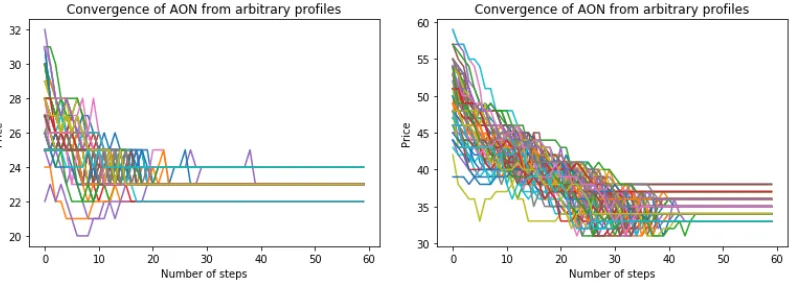
Figure 1: The convergence properties of the ALL-OR-NOTHINGmechanism when the dynamic starts from 100 different ar-bitrary profiles, forn= 25, m= 20. The budgets are drawn uniformly at random from[1,50](left) and[1,125](right). The differently coloured lines indicate different starting profiless(0).
equilibrium of A where buyers do not overbid, the loss in welfare (compared to the truth-telling outcome of A) is at most γA·B∗, where γA is the maximum number of
semi-hungry buyers that receive partial allocations by A andB∗the maximum budget.
Theorem 7 (Revenue in non-overbidding equilibria) Let A be a monotone mechanism that approximates the optimal revenue within a factor of β (with0 ≤ β ≤ 1). Then in every non-overbidding Nash equilibrium of A, the revenue is a(β−γA·α)/2approximation of the optimal revenue for
that instance, whereαis the budget share of the market and γA is the maximum number of buyers that receive partial
allocations byA.
The notion of “partial” allocations refers to buyers that are indifferent between multiple bundles. Here, the buyers that are indifferent among multiple bundles are precisely those whose valuation exactly matches the price, and their demand set contains all the bundle sizes that they can afford at that price (semi-hunry buyers). Note that there are many natural mechanisms with allocation rules that guaranteeγA = 1,
and for those, the guarantees of Theorem 4 extend verbatim. “Overbidding” refers to the behavior in which a buyer
i, with true value vi, declares a bid (value) higher than
its true value per unit. Any overbidding strategy is weakly dominated by truth-telling and can be ruled out using ar-guments about uncertainty, risk-aversion or trembling-hand considerations (Lucier and Borodin 2010; Caragiannis et al. 2015). For this reason, overbidding has been ruled out as “unnatural” in the literature (e.g. see (Feldman et al. 2013)) and the study of no-overbidding equilibria is common (see e.g. the incentive properties of the second-price auction) (Christodoulou, Kov´acs, and Schapira 2008; Caragiannis et al. 2015; Bhawalkar and Roughgarden 2011).7
Our final positive theoretical result of the section re-gards a known-mechanism from the literature, the ALL-OR -NOTHING MECHANISM (Brˆanzei et al. 2017). Informally,
7
For a more detailed discussion on the no-overbidding assump-tion and why it is natural, the reader is referred to (Lucier and Borodin 2010).
the mechanism first computes the minimum envy-free price and then allocates fully to the hungry buyers (as required by envy-freeness) and then considers the semi-hungry buy-ers in some fixed ordering and it allocates to them either as many units as they can afford or no units at all. We prove that the mechanism converges from any starting profile when we have two buyers.
Theorem 8 Forn = 2buyers, the best response dynamic of theALL-OR-NOTHINGmechanism converges to a Nash equilibrium from any initial strategy profile.
We remark here that ALL-OR-NOTHINGis monotone and actually guaranteesγA= 1, therefore by Theorems 6 and 7,
it is a mechanism that achieves the guarantees of Theorems 3 and 4 in all reasonable equilibria and which converges from any starting profile, at least whenn= 2. Whether it always convergences for any number of buyers is an open problem. To this end, in Figure 1, we show experimentally that for randomly generated profiles, the mechanism actually con-verges for more buyers as well. We present the convergence results for valuesn = 25andm = 20and for two differ-ent choices of budgets, either drawn from [1,50] or from
[1,120], but the mechanism actually always converges to a pure Nash equilibrium from any initial profile, for any choice ofn andmthat we have considered. We conclude with the following conjecture.
Conjecture 1 The best response dynamic of ALL-OR -NOTHING converges to a Nash equilibrium for any initial strategy profile, for any number of buyers.
Acknowledgments
References
Anderson, E., and Simester, D. 2008. Price stickiness and customer antagonism. Available at SSRN 1273647.
Anshelevich, E., and Sekar, S. 2017. Price doubling and item halving: Robust revenue guarantees for item pricing. InEC, 325–342. ACM.
Arrow, K. J., and Debreu, G. 1954. Existence of an equilib-rium for a competitive economy. Econometrica22(3):265– 290.
Awerbuch, B.; Azar, Y.; Epstein, A.; Mirrokni, V. S.; and Skopalik, A. 2008. Fast convergence to nearly optimal so-lutions in potential games. InEC, 264–273. ACM.
Babaioff, M.; Lucier, B.; Nisan, N.; and Paes Leme, R. 2014. On the efficiency of the walrasian mechanism. InEC, 783– 800.
Bhawalkar, K., and Roughgarden, T. 2011. Welfare guaran-tees for combinatorial auctions with item bidding. InSODA. Binmore, K., and Klemperer, P. 2002. The biggest auction ever: the sale of the british 3g telecom licences. Econ. J
112(478).
Brainard, W., and Scarf, H. 2000. How to compute equilib-rium prices in 1891. Cowles Foundation Discussion Paper. Brˆanzei, S.; Caragiannis, I.; Morgenstern, J.; and Procaccia, A. D. 2013. How bad is selfish voting? InAAAI, 138–144. Brˆanzei, S.; Filos-Ratsikas, A.; Miltersen, P. B.; and Zeng, Y. 2017. Walrasian pricing in multi-unit auctions. InMFCS, 80:1–80:14.
Bulow, J.; Levin, J.; and Milgrom, P. 2009. Winning play in spectrum auctions. Tech report.
Caragiannis, I.; Kaklamanis, C.; Kanellopoulos, P.; Ky-ropoulou, M.; Lucier, B.; Leme, R. P.; and Tardos, E. 2015. Bounding the inefficiency of outcomes in generalized sec-ond price auctions. JET156:343–388.
Chien, S., and Sinclair, A. 2007. Convergence to approxi-mate nash equilibria in congestion games. InSODA, 169– 178.
Christodoulou, G.; Kov´acs, A.; and Schapira, M. 2008. Bayesian combinatorial auctions. InICALP, 820–832. Cohen-Addad, V.; Eden, A.; Feldman, M.; and Fiat, A. 2016. The invisible hand of dynamic market pricing. InEC, 383– 400.
Cole, R., and Tao, Y. 2016. When does the price of anarchy tend to 1 in large walrasian auctions and fisher markets? In
EC.
Daskalakis, C., and Syrgkanis, V. 2016. Learning in auc-tions: Regret is hard, envy is easy. InFOCS, 219–228. de Keijzer, B.; Markakis, E.; Sch¨afer, G.; and Telelis, O. 2013. Inefficiency of standard multi-unit auctions. In Eu-ropean Symposium on Algorithms, 385–396. Springer. Dobzinski, S.; Lavi, R.; and Nisan, N. 2012. Multi-unit auctions with budget limits.GEB74(2):486–503.
D¨utting, P., and Kesselheim, T. 2017. Best-response dynam-ics in combinatorial auctions with item bidding. InSODA, 521–533.
Feldman, M.; Fiat, A.; Leonardi, S.; and Sankowski, P. 2012. Revenue maximizing envy-free multi-unit auctions with budgets. InEC, 532–549.
Feldman, M.; Fu, H.; Gravin, N.; and Lucier, B. 2013. Si-multaneous auctions are (almost) efficient. InSTOC, 201– 210.
Feldman, M.; Gravin, N.; and Lucier, B. 2015. Combinato-rial auctions via posted prices. InSODA, 123–135.
Fiat, A.; Leonardi, S.; Saia, J.; and Sankowski, P. 2011. Sin-gle valued combinatorial auctions with budgets. InEC, 223– 232.
Freund, Y., and Schapire, R. E. 1999. Adaptive game play-ing usplay-ing multiplicative weights. GEB29(1-2):79–103. Guruswami, V.; Hartline, J.; Karlin, A.; Kempe, D.; Kenyon, C.; and McSherry, F. 2005. On profit-maximizing envy-free pricing. InSODA, 1164–1173.
Hartline, J. D., and Roughgarden, T. 2009. Simple versus optimal mechanisms. InEC, 225–234.
Kesselheim, T. 2016. Combinatorial auctions with item bid-ding: Equilibria and dynamics. InWINE.
Kleinberg, J. M.; Mullainathan, S.; and Raghavan, M. 2017. Inherent trade-offs in the fair determination of risk scores. InITCS, 43:1–43:23.
Klemperer, P. 2010. The product-mix auction: A new auc-tion design for differentiated goods. J. Eur. Econ. Assoc8. Laffont, J., and Robert, J. 1996. Optimal auction with finan-cially constrained buyers.Econ. Letters52(2):181–186. Laffont, J. 1987. Incentives and the allocation of public goods. Handbook of Public Economics2:537–569.
Lucier, B., and Borodin, A. 2010. Price of anarchy for greedy auctions. InSODA, 537–553.
Meir, R.; Polukarov, M.; Rosenschein, J.; and Jennings, N. 2010. Convergence to equilibria in plurality voting. InAAAI. Nisan, N.; Schapira, M.; Valiant, G.; and Zohar, A. 2011. Best-response auctions. InEC, 351–360. ACM.
Nisan, N.; Roughgarden, T.; Tardos, E.; and Vazirani, V. (ed-itors) 2007. Algorithmic Game Theory. Cambridge Univ. Press.
Nisan, N. 2014. Algorithmic mechanism design through the lens of multi-unit auctions. Handbook of Game Theory 4. Petersen, M. 2004. Information: Hard and soft. Working paper.
Roughgarden, T.; Syrgkanis, V.; and Tardos, E. 2017. The price of anarchy in auctions.J. Artif. Intell. Res.59:59–101. Roughgarden, T. 2009. Intrinsic robustness of the price of anarchy. InSTOC, 513–522. ACM.
Walras, L. 1874. Elements d’economie politique pure, ou theorie de la richesse sociale.