A Model of Teacher Professional Development to
Support Technology Integration
LEE EHMAN AND CURT BONK Indiana University Bloomington, IN USA
LISA YAMAGATA-LYNCH Northern Illinois University
DeKalb, IL USA [email protected] [email protected]
relevant to other technology professional development programs.
This article describes the Teacher Institute for Curriculum Knowledge about Integration of Technology (TICKIT) and identifies key characteristics of its professional development model. The goal of this report is to share the TICKIT model and findings so that future researchers and practitioners can use them to replicate or adapt to their programs. While we compare our program model to general ideas from the professional development and staff development literature, the creation of this model relied primarily on own experience taking a design experiment approach (Collins, 1999). We focused our research and development efforts to examine what professional development models work within the context of TICKIT and its participants.
We began our model development process by identifying characteristics of Apple Classrooms of Tomorrow (ACOT) (Fisher, Dwyer, & Yocam 1996; Sandholtz, Ringstaff, & Dwyer 1997). The initial TICKIT model incorporat-ed principles from ACOT describincorporat-ed in Yocam (1996), which include: (a) professional development activities ought to be situated in the classroom; (b) teacher participants should attend in teams of two to four members from the same school; (d) professional development activities ought to incorpo-rate a constructivist learning approach; (e) participant teachers ought to engage in conversations and reflections regarding their teaching practices, their students, learning theories, technology, and how their teaching practic-es can be changed; (f) teacher participants ought to develop technology integrated lessons or units that can be implemented in their own classrooms; and (g) teacher participants need to be provided with support after they finish the program. Additionally, as a means for building practical teaching knowledge TICKIT participants were required to engage in action research and systemically reflect on their practice.
DESCRIPTION OF TICKIT
Program Overview
proficiency in integrating technology in their classrooms. During the first two years the program was open to teachers at all grade levels. However, the terms of the grant supporting the third and subsequent years restricted us from including teachers from all grade levels and we had to include at least 60% high school teachers with no more than 40% middle school teachers.
Approximately 25 teachers were recruited each year in groups of five from five school districts. Criteria for selection evolved throughout the years, and included: (a) commitment of individual teachers, (b) commitment by leadership of the individual school buildings and school districts, and (c) sufficient technology infrastructure and budget, including professional development funds.
The end goal of TICKIT was to provide year-long support to teachers who were attempting to successfully integrate technology into the curriculum. Additionally, TICKIT was designed to create school leadership cohorts to support other non-TICKIT teachers with technology integration. TICKIT staff provided support to participants by sustained assistance in classroom application of technology integration knowledge. We provided our assis-tance through school and university based workshops and informal interac-tion with participants throughout the year.
Program Structure
TICKIT participants enrolled in a three-credit graduate course in both fall and spring semesters of an academic year, thereby earning six graduate credits. Support from grants as well as the teacher’s respective school districts typically covered most or all tuition, books, and other technology fees associated with these graduate courses. The courses in the program did not require attendance on a weekly basis, but incorporated a number of interrelated activities throughout the semester. We used a mixed or blended instructional approach taking advantage of both face-to-face and online instructional activities.
report. In these reports, teachers documented the development of their project with descriptions, support materials created, examples of best student work, summaries of student evaluation data, lessons learned, and revision plans for subsequent iterations of the project.
These action research reports were shared among participants in the following formats: (a) formal written reports, (b) presentation to other TICKIT participants, (c) presentation to group of local colleagues in their schools, and (d) presentation at the Indiana Computer Educators (ICE) conference. The participation in the ICE conference provided TICKIT teachers the opportunity to address colleagues across the state. The full range of all projects since 1998 can be found at http://www.indiana.edu/ ~tickit/projectgallery/gallery.htm.
As part of the TICKIT program and courses, teachers attended a two-day orientation workshop at the start of the fall semester, and a one-day project-reporting workshop at the end of each semester. These three workshops were held on campus at Indiana University in Bloomington. To support teacher project work, at least one in-school workshop was held each semester for each school cohort team; sometimes two were held in a semester, depending upon the wishes and skill needs of teachers and availability of teacher release time during the school day. While TICKIT staff offered information about potential workshops, TICKIT participants determined the content of the in-school workshops. Some workshops involved all five teachers in a school team, while others were more individu-alized, where TICKIT staff worked with individuals or groups of two or three teachers in parallel workshops.
suggestions. We also experimented with synchronous expert chat sessions in years two through five.
During the first year, the cohort of teachers from each school district was required to carry out some local leadership project. These projects did not meet their purpose of involving non-TICKIT teachers into technology infusion activities because TICKIT staff did not communicate the expecta-tions clearly, and because of lack of time provided to teachers. During subsequent years of program operation, we provided clearer expectations regarding the leadership project and it became more focused and meaning-ful, often involving TICKIT teachers as workshop instructors in their schools, creators of instructional web sites for their departments, or organiz-ers and designorganiz-ers of their entire school or school district web sites.
Outcomes and Benefits
A WORKING MODEL FOR TICKIT
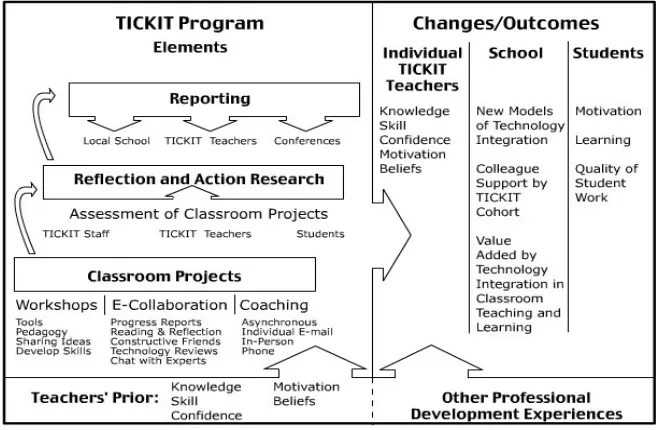
Figure 1 is a graphical representation of our professional development model. The right side of the model contains changes or outcomes that TICKIT teachers, schools, and students experienced. The left side of the model describes the TICKIT program elements, which interact with teacher prior knowledge, skills, confidence, motivations, and beliefs. The ultimate goal of TICKIT was increasing the quality of student learning through addition of various forms of technology integration in teaching and learning activities. However, before that can be achieved, we found the following teacher related changes or outcomes need to be established as prerequisites: (a) teachers’ knowledge, skill, confidence, motivation, and beliefs regarding technology integration must be heightened; (b) school-level technology infrastructure and support needs to be enhanced to compliment teacher efforts on technology integration; and (c) both TICKIT and non-TICKIT teachers need to participate in the continual efforts for adding value to instruction through the thoughtful integration of technology in the class-room (Yamagata-Lynch, 2003). These teacher related changes or outcomes do not occur simply by a cohort of teachers participating in TICKIT. The schools need to provide other professional development opportunities as well.
Teacher practical knowledge is gained through the reflection of past experiences, and it enables teachers to quickly take action in an educational context (Richardson, 1990). The development of such knowledge, in the context of the TICKIT program, was nurtured through teacher work on their classroom projects. Additionally, teacher beliefs are a particularly important in professional development programs because teacher change is more successful when both teacher beliefs and new teaching practices are aligned (Richardson, 1994). TICKIT addressed both teacher beliefs and practices through workshop demonstration and instruction, modeling, and peer interactions. The TICKIT model was built upon the assumption that teachers have valid knowledge, skills, and beliefs, and that the program should start with those as its basis, rather than some arbitrary theory of instruction (Richardson & Anders, 1994a).
Structure for Teachers to Set Goals and Carry Out Classroom Projects
At the core of TICKIT was the process of teachers creating their classroom technology integration projects and engaging in action research surrounding these projects. Similar to problem-based learning (Savery & Duffy, 1996), these projects provided an authentic experience to participants because they were situated in the context of the everyday classroom. Technology integra-tion situated in the teachers’ classrooms emphasized contextualized learning that provided a method for meeting critical teacher professional develop-ment needs (Stein, Smith, & Silver, 1999) and avoided a decontextualized computer skills approach that is irrelevant to classroom practices.
We found that many teacher projects reflected a constructivist approach to teaching and learning (Brooks, 1990; Cobb, 1994; Duffy & Cunningham, 1996; Ernest, 1995; Savery & Duffy, 1996; von Glasersfeld, 1995). We recognized that there are many versions of constructivism, but the TICKIT staff leaned toward a socially based or situated approach emphasized by Salomon (1998) and Bonk and Cunningham (1998). During workshops, online discussions, and other teaching activities, we modeled such a collaborative, team-based approach and often presented exemplars of previous projects based on socio-cultural perspectives.
As detailed in Figure 1, we valued teachers’ professional experiences, insights, and beliefs, and built upon them while adding our own knowledge and skills in the particular arena of technology infusion. We advised teachers to create TICKIT projects that built on past classroom teaching that they did not integrate technology. For example, a high school biology teacher previously had his students use traditional library and textbook resources to research on bacteria. His students created hand-made brochures on bacteria. As a TICKIT project, this teacher created a WebQuest unit to guide student research for their electronic brochures.
Table 1
TICKIT Individual Project Action Plan
Name(s): ____________________________
1 Vision: What is the curricular theme and focus of the project?
2 Goal: What do I want my students to accomplish?
3. Plan: What major steps do I have to take to do it?
4 Timeline: What is my timeline for planning, implementing, evaluating, and reporting?
5 Resources & Problems: What resources do I need to get to carry out this project, and what anticipated problems might keep me from accomplishing this project?
6 Strategies: How will I get these resources and overcome these problems?
7 Student Assessment: How will I assess student accomplishment of my learning goals?
8 Evaluation of Project: What evidence do I need to evaluate the success of the project? (examples: student evaluation feedback sheets; student products; student reflections journals; colleague observation and comments
Present an Array of Possible Curriculum Integration Ideas and Technology Tools
From our research and development experiences, K-12 teachers need exposure to a wide range of specific examples created by other teachers that resonate with their own classroom experience. As Brown (2001) pointed out, instructors in technology training workshops usually have little patience for theory and find those that focus solely on unique aspects of particular application packages too shallow. He found that most successful programs focus on common factors underlying teaching strategies and methods related to technology integration proven effective by other instructors (Brown, 2000). In TICKIT, we lead each cohort of teachers through a sampling of preexisting WebQuests by having the teachers evaluate them with a rubric and then share what they learned from those projects. Such an approach was selected because teachers tend to focus on individual projects rather than attempting to synthesize across a set of project-based learning cases (Krajcik et al., 1996).
To assist reflective activities, TICKIT teachers from prior years showcased their technology integrations to new participants. For specific computer application skills, we encouraged each cohort to inform us of the specific software or tools they need to learn to meet their technology integration project goals. Once the skills were determined, we scheduled half- or full-day workshops in each cohort’s school. Rather than trying to teach all 25 teachers a particular application, and then hope it was useful, we took a form of “just in time” training that was most valued by busy teachers. It also provided a degree of teacher choice within their professional development activities, which has been found to be an important part of successful professional development programs (McKenzie , 2001; Richardson & Hamilton, 1994).
Teach a Systematic Approach to Evaluation, Self-reflection, and Revision of Practice
personal reactions to the curriculum integration project. These data were analyzed and summarized as part of the formal report to TICKIT staff at the end of each semester. Through this reflective process, teachers evaluated their classroom practices. Additionally, the action research projects allowed TICKIT staff to identify what teachers learned from professional develop-ment activities, which are often times difficult to capture (Wilson & Berne, 1999).
Provide Audiences and Venues for Teacher Reports and Reflections
TICKIT required teachers to conduct a formal report of their reflections in professional settings. First, each teacher reported his/her project reflections to local colleagues in order to provide models of thoughtful and successful technology integration into the regular classroom. These reports provided a venue for celebrating individual accomplishments, and provided an opportu-nity for TICKIT participants to be acknowledged by professional peers. Additionally, the reports served as a catalyst to break down the sense of isolation in schools, which according to Little (1990) many teachers face at their work place.
As a second form of reporting, TICKIT teachers presented their projects and reflections formally to one another in workshops on campus at the end of each semester. Such presentations afforded all teachers the opportunity to observe a wide range of methods technology can be integrated into their classrooms. The workshops also served as a form of celebration and acknowledgement of teacher efforts, which were particularly important with an audience of TICKIT peers who fully understood the enormous amount of time and effort involved. These reports invariably lead to brainstorming and discussion of common problems, components of success, and effective ways to overcome or replicate them. TICKIT staff encouraged such brainstorming because it was extremely valuable to our participants’ future technology integration efforts and collegial collaborations.
worried that they would not have anything interesting or important to share in the sessions. However, at the end of the program, this experience was often remarked upon as a highlight, of TICKIT because it fostered teacher professional growth and self-confidence. Such success in moving teachers to the edge of their professional comfort zones was also rewarding to TICKIT staff members and sponsoring school administrators.
Electronic and Face-to-Face Collaboration with Colleagues and Coaching by TICKIT Staff
Jamie McKenzie (2001) argued that professional development of teachers related to the effective use of technologies too often amounts to a wasteful spending of money. According to McKenzie, there is a growing need for cohorts of teachers in schools to generate and share professional develop-ment plans in study groups while working in curriculum developdevelop-ment or invention teams that build innovative curricula based on district accepted standards and guidelines. He mentioned that teacher support for their technology integration ideas may come from technology coaches, mentors, and school leadership cadres, as well as informal support groups, help lines, conferences, visits or excursions to other teachers’ classrooms, and online courses and resources.
Structure for Developing Leadership Cohorts
One of the primary reasons for having administrators recruit cohorts of five teachers from a school system was the hope that our participants would provide leadership for their colleagues upon completing TICKIT. This approach succeeded in several, but not all, of the 18 schools in which we partnered. One of the factors leading to success was multi-year involvement of a school where two or three cohorts participated in TICKIT over succes-sive years, rather than involvement of just one team for one year. Four of our 18 schools have participated in multiple years, three of them for three years. Yamagata-Lynch (2003) studied what happened in two of these schools after their first year of participation. In both schools, she found examples of mutual support between cohorts in the same school from different years, as well as activities in which TICKIT teachers helped other colleagues with technology integration.
We have also found considerable evidence, in the year-end program evaluations that TICKIT teachers provided considerable support to their local colleagues. Finally, we found independent evidence from school administrators that, after completing classroom projects, TICKIT teachers continued to teach in-school technology workshops and participated in other activities to promote technology integration into the curriculum.
Summary
profes-LESSONS LEARNED DURING FIVE YEARS OF TICKIT
Avoid Including Shanghaied Teachers
The recruitment process for TICKIT involved local administrators to identify and select a group of teachers to participate. We assumed that they could best match the opportunities of TICKIT to their local talent and needs. Therefore, we selected or rejected school applications with a set of teacher applications from each school, including a statement of school-level intentions, not based on individual teacher applications alone. Although we screened the individual teacher applications, we never turned one down because on paper they invariably met our minimum requirements.
However, in the five years of the program we encountered several instances in which it became obvious that the local administrators who put together their TICKIT cohort must have either misrepresented the program to teachers, or coerced them into participating. The results were predicable. Teachers who were least devoted to developing, teaching, and reporting their classroom technology integration projects were the ones who did not volunteer, but rather were coerced, to participate. In a few cases, such reluctant teachers dropped out of the program mid-year.
We responded to this problem by directly communicating about this with the administrators in school systems when they recruit their cohorts, before they submit applications. We believe this helped ward off the problem, but was not a foolproof solution. We learned that we cannot assume complete willingness to participate on the part of teacher applicants, in spite of information given in their applications indicating keen interest in TICKIT.
Teachers Need a Reasonable Technology Environment in Which to Work
Computer access at home was an extremely important factor that determined participants’ program success. The proportion of teachers having home computers increased steadily since TICKIT began in 1998. In fact, in the 2001-02 academic year, only one of the 25 teachers did not have a computer at home, although two teachers did not have Internet connections. Given the many obligations and time pressures teachers have, home computer simpli-fied TICKIT-related work, whether it was project development or web interaction assignments.
We Must Teach Technology Use in the Teacher’s Computing Environment
A critical part of TICKIT operations was to provide instruction and support for teacher projects at the K-12 school setting and not at the university. This practice resulted in several benefits. First, teachers appreciated university staff visiting their schools and paying attention to them. There were teacher participants that reported that the visibility of the university made their non-TICKIT participating colleagues realize that technology integration was a valid form of curriculum development rather than a hobby-like activity (Yamagata-Lynch, 2003).
Second, university personnel learned about the realities of teachers work conditions, students learning environment, curriculum needs, and computing support available in each school. Therefore, we learned firsthand some of the technology opportunities and constraints experienced by teachers. Third, and perhaps most important, onsite contact provided an outside, but respect-ed source of information and recommendations, resulting in nerespect-edrespect-ed support for TICKIT teachers from the computer coordinators and administrators. If TICKIT staff did not journey to the schools, we would not know what support our participants needed, let alone be able to lobby to obtain it. Finally, the fact that we worked in the schools provided practical classroom examples for TICKIT staff to discuss with their preservice teachers and graduate students back at the university.
Local Leadership
group of five teachers, but we learned not to take this for granted. The best possible situation was when there were two leaders: (a) a within-cohort leader who facilitated communication among the group and between them and other important school figures, including the computer coordinator, media specialist, and principal; and (b) an administrator who gave both curriculum and resource support to the cohort during the TICKIT year.
The TICKIT staff permitted whatever within-group leadership arrange-ments, but we actively identified and worked with an external leader so that the teacher cohort “was not isolated and forgotten. To make sure they felt welcomed and needed, we invited these nonTICKIT administrators to Indiana University and school workshops, as well as the state computer educator’s conference. When a school had this external leader, the TICKIT cohorts invariably performed better.
Requiring Projects in a Graduate Course Framework
TICKIT was structured within two graduate courses, one each semester. Therefore, there were a set of required “assignments” and corresponding grades for the participants. For many of the teachers, this added consider-able stress. Not only did we coerce teachers to create and teach instruction-ally significant classroom technology integration units, but we also required one written and three formal oral reports, as well as several asynchronous conferencing assignments, all of which were graded. Among the most common complaints during the year was that the course requirements were extremely demanding, there was not enough time to complete projects, and that stress levels were unmanageable.
There was another common reaction on the final evaluations at the end of the year as the following quotes indicates:
I thought that I’d never be able to do all this, and I felt pressured and forced to do things I ordinarily wouldn’t have done, but now I’m really glad I did them, because I learned a great deal, improved my teaching, and am a better professional as a result. (Comment from end of year TICKIT participant evaluation)
Asynchronous Conferencing Requires Structure and Meaning for Teachers
Based on our five years of involving teachers in asynchronous web confer-encing activities, we learned that careful and clear structuring of expecta-tions was important to its success. To make the online interacexpecta-tions work well, it was necessary to be very clear about expectations and sometimes present models or examples of what was expected. In addition, program coordinators needed to plan reasonable time frames for each activity and stick to them. In our five years of TICKIT, we brought in more structure to teacher online activities as we built more experience in the usage of online discussion tools.
CONCLUSION
TICKIT combined a number of features that heightened its effectiveness. One of which was the fact that it was a yearlong program. Research indi-cates that the duration of professional development programs often distin-guishes effective from ineffective programs (Garet et al., 1999). TICKIT also incorporated a collaborative approach in which teacher participants helped determine aspects of the program. At the heart of the program were teachers working in their own classrooms to invent, teach, and reflect upon their technology integration and daily teaching practices to build practical knowledge. As pointed out throughout this article, many of these same elements have been found to be vital in previous professional development research. What we have learned in our experience is how to operationalize many of the effective professional development practices found in past research. It is our hope that our report will make further contributions for insights for future efforts made by researchers and practitioners facilitating professional development programs.
References
Bonk, C.J., Ehman, L., Hixon, E., & Yamagata-Lynch, L. (2002). The ped-agogical TICKIT: teacher institute for curriculum knowledge about the integration of technology. Journal of Technology and Teacher Educa-tion, 10(2), 205-233.
Brooks, J.G. (1990). Teachers and students: Constructivists forging new connections. Educational Leadership, 47(5), 68-71.
Brown, D.G., (Ed.). (2000). Teaching with technology: Seventy-five profes-sors from eight universities tell their stories. Boston: Anker Publishing. Brown, D.G. (2001). Teaching strategies and faculty workshops. Syllabus,
15(2), 20.
Collins, A. (1999). The changing infrastructure of education research. In E.C. Lagemann & L.S. Shulman (Eds.), Issues in education research: Problems and possibilities. San Francisco: Jossey-Bass.
Cobb, P. (1994). Where is mind? Constructivist and sociocultural perspec-tives on mathematical development. Educational Researcher, 23(7), 13-20.
Cuban, L. (2001). Oversold and underused: Computers in the classroom. Cambridge, MA: Harvard University Press.
Duffy, T.M., & Cunningham, D.J. (1996). Constructivism: Implications for the design and delivery of instruction. In D.H. Jonassen (Ed.), Hand-book of research on educational communications and technology (pp. 170-198). New York: Scholastic.
Ehman, L. (1999, April). University-based web conferencing to connect precollege teachers in a technology curriculum integration project. Pa-per delivered to the annual meeting of the North Central Association, Chicago, IL.
Ernest, P. (1995). The one and the many. In L.P. Steffe & J. Gale (Ed.), Constructivism in education (pp. 459-486). Hillsdale, NJ: Lawrence Erlbaum.
Fisher, C., Dwyer, D., & Yocam, K. (Eds.) (1996). Education and technology: Re-flections on Computing in classrooms. San Francisco: Jossey-Bass.
Garet, M., Birman, B., Porter, A., Desimone, L., & Herman, R. with Suk Yoon, K. (1999). Designing effective professional development: Les-sons from the Eisenhower program. Washington, DC: U.S. Department of Education.
Krajcik, J.S., Soloway, E., Blumenfeld, P.C., Marx, R.W., Ladewski, B.L., Bos, N.D., et al., (1996). The casebook of project practices—An example of an interactive multimedia system for professional development. Journal of Computers in Mathematics and Science Teaching, 15(1/2), 119-135.
Little, J.W. (1990). The persistence of privacy: Autonomy and initiative in teachers’ professional relations. Teachers College Record, 91(4), 509-536. McKenzie, J. (2001, March). How teacher learn technology best. From
North Central Regional Educational Laboratory (NCREL) (1997). Learning with technology: Participant’s manual. Oak Brook, IL: NCREL. Reeve, J. (1996). Motivating others: Nurturing inner motivational
resourc-es. Boston, MA: Allyn and Bacon.
Richardson, V. (1990). Significant and worthwhile change in teaching practice. Educational Researcher, 19(7), 10-18.
Richardson, V. (1992). The agenda-setting dilemma in a constructivist staff development process. Teaching and Teacher Education, 8(3), 287-300. Richardson, V. (1994). The consideration of teachers’ beliefs. In
Richard-son, V. (Ed). Teacher change and the staff development process: A case in reading instruction. New York: Teachers College Press, (pp. 90-108).
Richardson, V., & Anders, P. (1994a). The study of teacher change. In Richard-son, V. (Ed). Teacher change and the staff development process: A case in reading instruction. New York: Teachers College Press, (pp. 159-180). Richardson, V., & Anders, P. (1994b). A theory of change. In Richardson,
V. (Ed). Teacher change and the staff development process: A case in reading instruction. New York: Teachers College Press, (pp. 199-216). Richardson, V., & Hamilton, M. (1994). The practical-argument staff de-velopment process. In Richardson, V. (Ed), Teacher change and the staff development process: A case in reading instruction (pp. 109-134). New York: Teachers College Press.
Salomon, G. (1998). Novel constructivist learning environments and novel technologies: Some issues to be concerned with. Research Dialogue in Learning and Instruction, 1(1), 3-12.
Sandholtz, J.H., Ringstaff, C., & Dwyer, D.C. (1997). Teaching with tech-nology: Creating student-centered classrooms. NY: Teachers College Press.
Savery, J.R., & Duffy, T.M. (1996). Problem-based learning: An instruc-tional model and its constructivist framework. In B. G. Wilson (Ed.), Constructivist learning environments: Case studies in instructional de-sign (pp. 135-148). Englewood Cliffs, NJ: Educational Technology Publications.
Schön, D.A. (1987). Educating the reflective practitioner. San Francisco: Jossey-Bass
Stein, M., Smith, M., & Silver, E. (1999). The development of professional developers: Learning to assist teachers in new settings. Harvard Edu-cational Review, 69(3), 238-269.
Wilson, S., & Berne, J. (1999). Teacher learning and the acquisition of fessional knowledge: an examination of research on contemporary pro-fessional development. Review of Research in Education, 24, 173-209. Yamagata-Lynch, L.C. (2003). How a technology professional
von Glasersfeld, E. (1995). A constructivist approach to teaching. In L.P. Steffe & J. Gale (Eds.), Constructivism in education (pp. 3-15). Hills-dale, NJ: Lawrence Erlbaum.
Author Note
This project was originally funded by a grant from the Ackerman Family Foundation, and, more recently, by the Arthur Vining Davis Foundations.
Acknowledgements